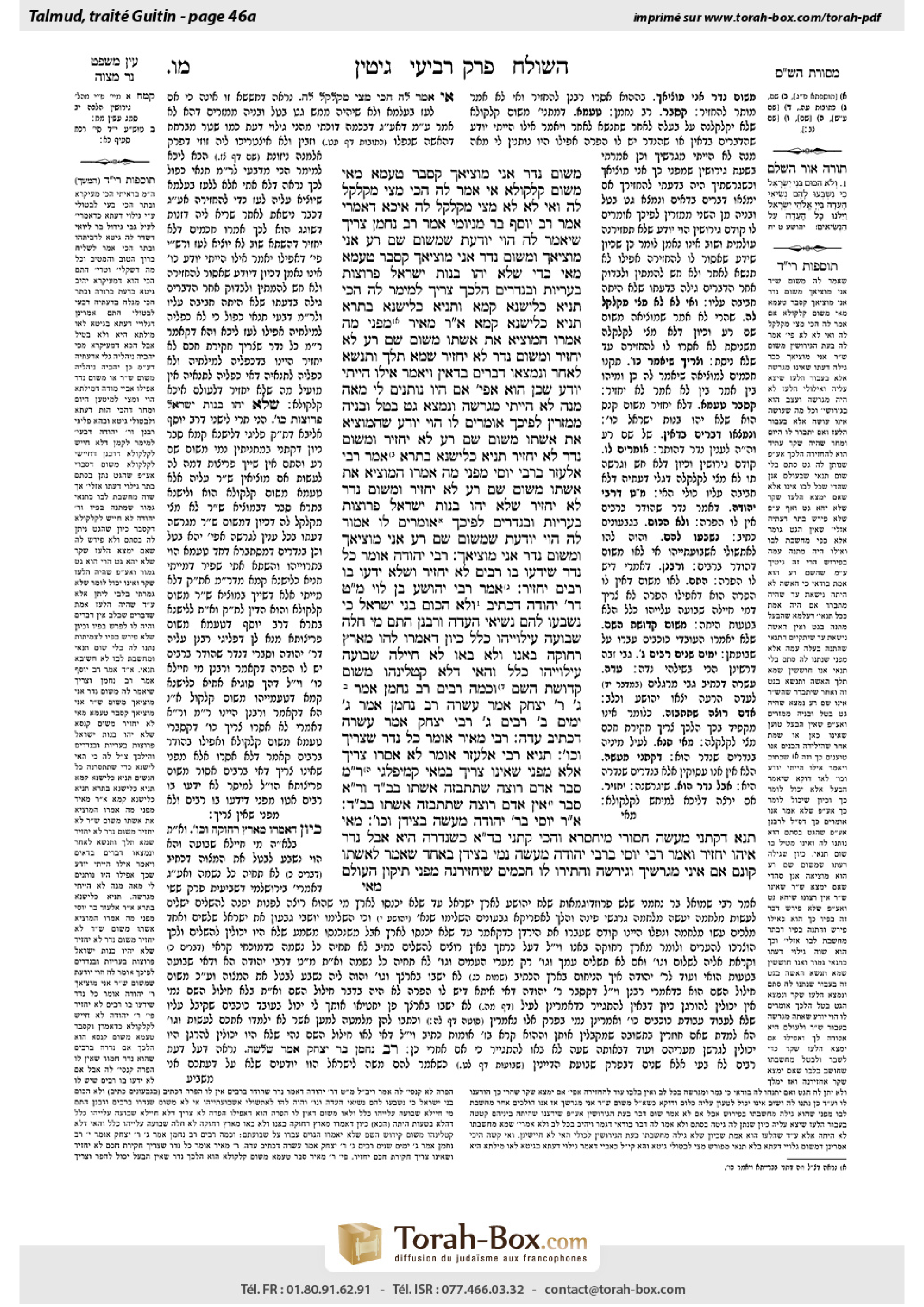
Gittin 46a: Talmud study for Daf Yomi
Study the Talmud for Daf Yomi with scanned pages, Hebrew text, English translations from Sefaria and AI-generated French translations.
Passage selection and English or AI-generated French translation are available where the scan has annotations. Daf Study is independent of Torah-Box and Sefaria.
Browse Gittin · גיטין · All tractatesGittin 46a text and translations
This page of Gittin includes the Aramaic text, an English translation and an AI-generated French translation, alongside the scan above.
גיטין מ״ו א · Aramaic and Hebrew text
״מִשּׁוּם נֶדֶר אֲנִי מוֹצִיאֵךְ״ – קָסָבַר: טַעְמָא מַאי – מִשּׁוּם קִלְקוּלָא; אִי אָמַר לַהּ הָכִי – מָצֵי מְקַלְקֵל לַהּ, וְאִי לָא – לָא מָצֵי מְקַלְקֵל לַהּ.
אִיכָּא דְּאָמְרִי, אָמַר רַב יוֹסֵף בַּר מִנְיוֹמֵי אָמַר רַב נַחְמָן: צָרִיךְ שֶׁיֹּאמַר לָהּ: ״הֱוִי יוֹדַעַת שֶׁמִּשּׁוּם שֵׁם רַע אֲנִי מוֹצִיאֵךְ וּמִשּׁוּם נֶדֶר אֲנִי מוֹצִיאֵךְ״ – קָסָבַר: טַעְמָא מַאי – כְּדֵי שֶׁלֹּא יְהוּ בְּנוֹת יִשְׂרָאֵל פְּרוּצוֹת בַּעֲרָיוֹת וּבִנְדָרִים; הִלְכָּךְ צָרִיךְ לְמֵימַר לַהּ הָכִי.
תַּנְיָא כְּלִישָּׁנָא קַמָּא, וְתַנְיָא כְּלִישָּׁנָא בָּתְרָא.
תַּנְיָא כְּלִישָּׁנָא קַמָּא – אָמַר רַבִּי מֵאִיר: מִפְּנֵי מָה אָמְרוּ הַמּוֹצִיא אֶת אִשְׁתּוֹ מִשּׁוּם שֵׁם רַע לֹא יַחְזִיר, וּמִשּׁוּם נֶדֶר לֹא יַחְזִיר? שֶׁמָּא תֵּלֵךְ וְתִנָּשֵׂא לְאַחֵר, וְנִמְצְאוּ דְּבָרִים בַּדָּאִין, וְיֹאמַר: ״אִילּוּ הָיִיתִי יוֹדֵעַ שֶׁכֵּן הוּא, אֲפִילּוּ אִם הָיוּ נוֹתְנִים לִי מֵאָה מָנֶה – לֹא הָיִיתִי מְגָרְשָׁהּ״; וְנִמְצָא גֵּט בָּטֵל וּבָנֶיהָ מַמְזֵרִין; לְפִיכָךְ אוֹמְרִים לוֹ: הֱוֵי יוֹדֵעַ, שֶׁהַמּוֹצִיא אֶת אִשְׁתּוֹ מִשּׁוּם שֵׁם רַע – לֹא יַחְזִיר, וּמִשּׁוּם נֶדֶר – לֹא יַחְזִיר.
תַּנְיָא כְּלִישָּׁנָא בָּתְרָא – אָמַר רַבִּי אֶלְעָזָר בְּרַבִּי יוֹסֵי: מִפְּנֵי מָה אָמְרוּ הַמּוֹצִיא אֶת אִשְׁתּוֹ מִשּׁוּם שֵׁם רַע לֹא יַחְזִיר, וּמִשּׁוּם נֶדֶר לֹא יַחְזִיר? שֶׁלֹּא יְהוּ בְּנוֹת יִשְׂרָאֵל פְּרוּצוֹת בַּעֲרָיוֹת וּבִנְדָרִים. לְפִיכָךְ אוֹמְרִים לוֹ, אֱמוֹר לָהּ: ״הָוֵי יוֹדַעַת שֶׁמִּשּׁוּם שֵׁם רַע אֲנִי מוֹצִיאֵךְ וּמִשּׁוּם נֶדֶר אֲנִי מוֹצִיאֵךְ״.
רַבִּי יְהוּדָה אוֹמֵר: כׇּל נֶדֶר שֶׁיֵּדְעוּ בּוֹ רַבִּים – לֹא יַחְזִיר, וְשֶׁלֹּא יָדְעוּ בּוֹ רַבִּים – יַחְזִיר: אָמַר רַבִּי יְהוֹשֻׁעַ בֶּן לֵוִי: מַאי טַעְמָא דְּרַבִּי יְהוּדָה? דִּכְתִיב: ״וְלֹא הִכּוּם בְּנֵי יִשְׂרָאֵל כִּי נִשְׁבְּעוּ לָהֶם נְשִׂיאֵי הָעֵדָה״.
וְרַבָּנַן: הָתָם, מִי חָלָה שְׁבוּעָה עִילָּוַיְיהוּ כְּלָל?! כֵּיוָן דַּאֲמַרוּ לְהוּ: ״מֵאֶרֶץ רְחוֹקָה בָּאנוּ״ – וְלֹא בָּאוּ, לָא חָיְילָה שְׁבוּעָה עִילָּוַיְיהוּ כְּלָל; וְהַאי דְּלָא קַטְלִינְהוּ – מִשּׁוּם קְדוּשַּׁת הַשֵּׁם.
וְכַמָּה רַבִּים? רַב נַחְמָן אָמַר שְׁלֹשָׁה, רַבִּי יִצְחָק אָמַר עֲשָׂרָה.
רַב נַחְמָן אָמַר שְׁלֹשָׁה, ״יָמִים״ – שְׁנַיִם, ״רַבִּים״ – שְׁלֹשָׁה. רַבִּי יִצְחָק אָמַר עֲשָׂרָה, דִּכְתִיב: ״עֵדָה״.
רַבִּי מֵאִיר אוֹמֵר: כׇּל נֶדֶר שֶׁצָּרִיךְ וְכוּ׳: תַּנְיָא, רַבִּי אֶלְעָזָר אוֹמֵר: לֹא אָסְרוּ ״צָרִיךְ״ אֶלָּא מִפְּנֵי ״שֶׁאֵינוֹ צָרִיךְ״.
בְּמַאי קָמִיפַּלְגִי? רַבִּי מֵאִיר סָבַר: אָדָם רוֹצֶה, שֶׁתִּתְבַּזֶּה אִשְׁתּוֹ בְּבֵית דִּין;
וְרַבִּי אֶלְעָזָר סָבַר: אֵין אָדָם רוֹצֶה שֶׁתִּתְבַּזֶּה אִשְׁתּוֹ בְּבֵית דִּין.
אָמַר רַבִּי יוֹסֵי בְּרַבִּי יְהוּדָה: מַעֲשֶׂה בְּצַיְדָּן וְכוּ׳: מַאי תַּנָּא דְּקָתָנֵי מַעֲשֶׂה?
חַסּוֹרֵי מִיחַסְּרָא וְהָכִי קָתָנֵי: בַּמֶּה דְּבָרִים אֲמוּרִים – כְּשֶׁנָּדְרָה הִיא, אֲבָל נָדַר אִיהוּ – יַחְזִיר; וְאָמַר רַבִּי יוֹסֵי בְּרַבִּי יְהוּדָה: מַעֲשֶׂה נָמֵי בְּצַיְדָּן, בְּאֶחָד שֶׁאָמַר לְאִשְׁתּוֹ: ״קוּנָּם אִם אֵינִי מְגָרְשִׁיךְ״, וְגֵירְשָׁהּ, וְהִתִּירוּ לוֹ חֲכָמִים שֶׁיַּחְזִירֶנָּה – מִפְּנֵי תִּיקּוּן הָעוֹלָם.
Gittin 46a · English translation
or: I am removing you from the house due to a vow. The Gemara explains that Rav Naḥman holds: What is the reason that he is prohibited from remarrying her? This is due to potential harm caused to her. If he would wish to remarry her after she had married someone else, he may cast aspersions on the validity of the bill of divorce by claiming that he gave it under a false impression. This may lead to her child from her second marriage to be considered a mamzer. Therefore, if he said to her at the time of the divorce that this is the reason he is divorcing her, then he will be able to cause this harm to her, but if he did not state this explicitly at the time of the divorce, he will not be able to cause this harm to her, as his claim will be disregarded.
There are those who say a different version of Rav Yosef bar Minyumi’s statement. Rav Yosef bar Minyumi said that Rav Naḥman said: He must say to her: Be aware that I am removing you from the house due to your bad reputation, or: Be aware that I am removing you from the house due to a vow. The Gemara explains that Rav Naḥman holds: What is the reason that he is prohibited from remarrying her? So that Jewish women will not be promiscuous with regard to forbidden sexual relations or lax with regard to vows. The Sages penalized these women who acted improperly by instituting that if they were divorced due to their actions, they cannot return to their husbands. Therefore he must say this to her: Be aware. It will therefore serve as a warning for other women.
The Gemara comments: It is taught in a baraita in accordance with the first version of Rav Yosef bar Minyumi’s statement citing Rav Naḥman, and it is taught in another baraita in accordance with the latter version.
It is taught in a baraita (Tosefta 3:4) in accordance with the first version: Rabbi Meir said: For what reason did they say that a man who divorces his wife due to her bad reputation may not remarry her, and one who divorces his wife due to a vow may not remarry her? Perhaps she will go and marry another man, and later the matter will be found to have been fabricated, i.e., he will find that the rumor was false or that it was possible to dissolve the vow, and he will say: If I would have known that it is like this, then even if they would have given me one hundred times one hundred dinars to divorce her I would not have divorced her; and the bill of divorce will be found to be void, and her children from her second husband will be considered mamzerim. Therefore, one says to him from the outset: Be aware that a man who divorces his wife due to her bad reputation may not remarry her, and one who divorces his wife due to a vow may not remarry her.
It is taught in a baraita (Tosefta 3:4) in accordance with the latter version: Rabbi Elazar, son of Rabbi Yosei, said: For what reason did they say that a man who divorces his wife due to her bad reputation may not remarry her, and one who divorces his wife due to a vow may not remarry her? So that Jewish women will not be licentious with regard to forbidden sexual relations or lax with regard to vows. Therefore, in order to publicize this matter, one says to him upon divorcing his wife: Say to her: Be aware that I am removing you from the house due to your bad reputation, or: I am removing you from the house due to a vow.
§ The mishna taught that Rabbi Yehuda says: If he divorced her due to any vow that the public was aware of, he may not remarry her, but if he divorced her due to a vow that the public was not aware of, he may remarry her. Rabbi Yehoshua ben Levi said: What is the reason of Rabbi Yehuda? Based on what does he make the distinction of whether the public is aware of the vow or not? As it is written in the Torah portion describing the interaction of the Jews with the people of Gibeon: “And the children of Israel did not strike them, for the leaders of the congregation swore to them” (Joshua 9:18). This teaches that a vow taken in the presence of the public cannot be dissolved. In this case as well, if she took an oath that is known by the public, it cannot be dissolved.
And the Rabbis, who hold that such a vow can also be dissolved, respond to this claim in the following manner: There, did the oath take effect with regard to them at all? Since the people of Gibeon said to them: “We came from a far country” (Joshua 9:6), and they did not come from a far country, the oath did not take effect with regard to the Jewish people at all, as it was taken under false pretenses. And this, that the Jewish people did not kill the Gibeonites, like they did to the other nations who resided in the land of Canaan, despite the fact that the vow did not take effect, was due to the sanctity of God’s name. If they would have killed them, they would have desecrated God’s name by not fulfilling their word, although this vow did not take effect.
The Gemara asks: And how many people constitute the public with regard to this halakha? Rav Naḥman says: Three people. Rabbi Yitzḥak says: Ten people. The Gemara explains their opinions.
Rav Naḥman says: Three, and he derives this from a verse written with regard to a zava. The verse states: “And if a woman has an issue of her blood for many days [yamim rabbim]” (Leviticus 15:25). Rav Naḥman holds that “days” are a minimum of two, so the addition of the word “many” indicates that it means three days. Here too, where the mishna uses the term many [rabbim], it is a minimum of three people. Rabbi Yitzḥak says: The halakha that a vow taken in the presence of the public cannot be dissolved is referring to a vow taken in the presence of at least ten people, as it is written in the Torah portion discussing the people of Gibeon, which is the source for this halakha: “For the leaders of the congregation swore to them,” and a congregation consists of at least ten people, as is derived from the episode concerning the spies.
§ The mishna taught that Rabbi Meir says: If he divorced her due to any vow that requires investigation and dissolution by a halakhic authority, he may not remarry her; however, if he divorced her due to a vow that does not require investigation and dissolution by a halakhic authority, he may remarry her. It is taught in a baraita that Rabbi Elazar says: They prohibited him from remarrying her in the case where she stated a vow that requires dissolution by a halakhic authority only due to a case where she stated a vow that does not require dissolution by a halakhic authority.
The Gemara asks: With regard to what principle do they disagree? The Gemara explains that Rabbi Meir holds: A man desires, i.e., does not mind, that his wife should be disgraced in court. Even though her vow would necessitate dissolution by a halakhic authority, the husband may still claim that had he known that it could be dissolved, he would not have divorced her. However, with regard to a vow that did not require dissolution by a halakhic authority but could have been nullified by the husband, he would not be deemed credible to state that he was not aware that he had the ability to nullify it. In such a case, if he were to claim that the divorce was in error, his claim would be disregarded.
And Rabbi Elazar holds: A man does not desire that his wife should be disgraced in court. Therefore, if he were to claim that had he known that her vow could have been dissolved by a halakhic authority he would not have divorced her, his claim would have been disregarded. He is, however, deemed credible if he were to state that he did not know that he had the ability to nullify her vow. Therefore, in the case of a vow that does not require dissolution by a halakhic authority, the Sages instituted that he would not be permitted to remarry her, lest he bring the validity of the divorce into question, as explained earlier. Rabbi Elazar also holds that once the Sages instituted this ordinance with regard to vows that do not require dissolution by a halakhic authority, they applied this ordinance with regard to vows that do require dissolution by a halakhic authority as well.
Rabbi Yosei, son of Rabbi Yehuda, said: There was an incident in Tzaidan involving one man who said to his wife: It is konam if I do not divorce you, and he divorced her; and the Sages permitted him to remarry her, for the betterment of the world. What did the mishna teach that causes Rabbi Yosei, son of Rabbi Yehuda to teach this incident? The mishna had just discussed a case where the woman took a vow, and it relates an incident where the man took a vow.
The Gemara answers: The mishna is incomplete and this is what it is teaching: In what case is this statement said? When she took a vow, since he may not remarry her in that case. However, if he took a vow, he may remarry her. And Rabbi Yosei, son of Rabbi Yehuda, said: There was also an incident in Tzaidan involving one man that said to his wife: It is konam if I do not divorce you, and he divorced her; and the Sages permitted him to remarry her, for the betterment of the world.
Gittin 46a · Traduction française (IA)
ou : Je t'expulse de la maison en raison d'une promesse. La Guemara explique que Rav Naḥman affirme : Pourquoi est-il interdit de remettre en mariage cette femme ? Cela est dû au danger potentiel qu'elle pourrait subir. Si l'on souhaitait la remettre en mariage après qu'elle ait épousé quelqu'un d'autre, on pourrait attaquer la validité du divorce en affirmant qu'il a été donné sous une fausse impression. Cela pourrait entraîner que l'enfant de sa deuxième épouse soit considéré comme un mamzer. Ainsi, si l'on avait dit à l'époque du divorce que c'était la raison de l'expulsion, on pourrait causer ce danger à elle, mais si l'on n'avait pas précisé cela à l'époque du divorce, on ne pourrait pas causer ce danger à elle, car son allégation serait rejetée.
Certains disent une version différente de la déclaration de Rav Yosef bar Minyumi. Rav Yosef bar Minyumi a dit que Rav Naḥman a dit : Il doit lui dire : Sois conscient que je t'expulse de la maison en raison de ta mauvaise réputation, ou : Sois conscient que je t'expulse de la maison en raison d'une promesse. La Guemara explique que Rav Naḥman affirme : Pourquoi est-il interdit de remettre en mariage cette femme ? Afin que les femmes juives ne soient pas promiscues en ce qui concerne les relations sexuelles interdites ou négligentes en ce qui concerne les promesses. Les Sages ont sanctionné ces femmes qui agissaient de manière inappropriée en instituant que si elles étaient divorcées en raison de leurs actions, elles ne pourraient pas revenir vers leurs époux. Ainsi, il doit lui dire : Sois conscient. Cela servira donc d'avertissement pour d'autres femmes.
La Guemara commente : Il est enseigné dans une baraïta conformément à la première version de la déclaration de Rav Yosef bar Minyumi citant Rav Naḥman, et il est enseigné dans une autre baraïta conformément à la version ultérieure.
Il est enseigné dans une baraïta (Tosefta 3:4) conformément à la première version : Rabbi Meir a dit : Pourquoi disent-ils qu'un homme qui divorce sa femme en raison de sa mauvaise réputation ne peut pas la remettre en mariage, et un homme qui divorce sa femme en raison d'une promesse ne peut pas la remettre en mariage ? Peut-être qu'elle ira épouser un autre homme, et plus tard on trouvera que la situation a été falsifiée, c'est-à-dire qu'il trouvera que le bruit était faux ou qu'il était possible de résilier la promesse, et il dira : Si j'avais su que c'était comme cela, même s'ils m'avaient donné cent fois cent dinars pour divorcer d'elle, je n'aurais pas divorcé d'elle ; et le divorce serait trouvé nul, et ses enfants de son deuxième époux seraient considérés comme des mamzerim. Ainsi, on dit à l'avance : Sois conscient que l'homme qui divorce sa femme en raison de sa mauvaise réputation ne peut pas la remettre en mariage, et l'homme qui divorce sa femme en raison d'une promesse ne peut pas la remettre en mariage.
Il est enseigné dans une baraïta (Tosefta 3:4) conformément à la version ultérieure : Rabbi Elazar, fils de Rabbi Yosei, a dit : Pourquoi disent-ils qu'un homme qui divorce sa femme en raison de sa mauvaise réputation ne peut pas la remettre en mariage, et un homme qui divorce sa femme en raison d'une promesse ne peut pas la remettre en mariage ? Afin que les femmes juives ne soient pas licencieuses en ce qui concerne les relations sexuelles interdites ou négligentes en ce qui concerne les promesses. Ainsi, afin de faire connaître cette affaire, on dit à lui lors du divorce : Dis-lui : Sois conscient que je t'expulse de la maison en raison de ta mauvaise réputation, ou : Je t'expulse de la maison en raison d'une promesse.
§ La Michna enseigne que Rabbi Yehuda dit : Si l'on divorce sa femme en raison d'une promesse dont la population était consciente, il ne peut pas la remettre en mariage, mais si l'on divorce sa femme en raison d'une promesse dont la population n'était pas consciente, il peut la remettre en mariage. Rabbi Yehoshua ben Levi a dit : Pourquoi Rabbi Yehuda fait-il cette distinction ? Sur quel texte s'appuie-t-il pour distinguer si la population est consciente de la promesse ou non ? Comme il est écrit dans la portion de la Torah décrivant l'interaction des Israélites avec les gens de Gibeon : « Et les enfants d'Israël n'ont pas frappé eux, car les chefs de la communauté ont juré à eux » (Josué 9:18). Cela enseigne que une promesse prise en présence de la population ne peut pas être annulée. Dans ce cas également, si elle a pris une promesse connue de la population, elle ne peut pas être annulée.
Et les Rabbins, qui pensent que telle promesse peut également être annulée, répondent à cette allégation de la manière suivante : Là, la promesse a-t-elle eu effet envers eux ? Comme les gens de Gibeon ont dit à eux : « Nous venons d'un pays éloigné » (Josué 9:6), et qu'ils n'étaient pas d'un pays éloigné, la promesse n'a pas eu d'effet envers le peuple d'Israël du tout, car elle a été prise sous des prétextes faux. Et cela, que le peuple d'Israël n'ait pas tué les Gibeonites, comme ils l'ont fait avec les autres nations qui résidaient dans la terre de Canaan, malgré le fait que la promesse n'ait pas eu d'effet, a été dû à la sainteté du nom de Dieu. S'ils avaient tué, ils auraient profané le nom de Dieu en ne respectant pas leur parole, même si cette promesse n'avait pas d'effet.
La Guemara pose la question : Et combien de personnes constituent la population en ce qui concerne cette halakha ? Rav Naḥman dit : Trois personnes. Rabbi Yitzḥak dit : Dix personnes. La Guemara explique leurs opinions.
Rav Naḥman dit : Trois, et il en dérive cela d'un verset relatif à une zava. Le verset dit : « Et si une femme a un problème de sang pendant de nombreux jours [yamim rabbim] » (Lévitique 15:25). Rav Naḥman affirme que « jours » sont un minimum de deux, donc l'ajout du mot « nombreux » indique qu'il signifie trois jours. Ici aussi, où la mitsva utilise le terme « nombreux » [rabbim], cela signifie un minimum de trois personnes. Rabbi Yitzḥak dit : La halakha selon laquelle une promesse prise en présence de la communauté ne peut pas être annulée fait référence à une promesse prise en présence de dix personnes au moins, comme il est écrit dans la portion de la Torah concernant les gens de Gibeon, qui est la source de cette halakha : « Pour les chefs de la communauté ont juré à eux », et une communauté comprend au moins dix personnes, comme il est dérivé de l'incident concernant les espions.
§ La Michna enseigne que Rabbi Meïr dit : Si l'homme l'a divorcée en raison d'un vœu qui nécessite une enquête et une dissolution par un autorité halakhique, il ne peut pas la remariée ; cependant, si l'homme l'a divorcée en raison d'un vœu qui ne nécessite pas une enquête et une dissolution par un autorité halakhique, il peut la remariée. Il est enseigné dans une baraïta que Rabbi Eléazar dit : Ils l'ont interdit de la remariée dans le cas où elle a formulé un vœu nécessitant une dissolution par un autorité halakhique uniquement en raison d'un cas où elle a formulé un vœu ne nécessitant pas une dissolution par un autorité halakhique.
Le Guemara demande : Sur quel principe ces deux opinions s'opposent-elles ? Le Guemara explique que Rabbi Meïr considère que l'homme désire, c'est-à-dire n'a pas d'objection, que sa femme soit humiliée en cour. Même si son vœu nécessiterait une dissolution par un autorité halakhique, l'époux pourrait encore affirmer qu'ayant su qu'il pouvait être dissous, il n'aurait pas divorcé. Cependant, concernant un vœu ne nécessitant pas une dissolution par un autorité halakhique mais pouvant être annulé par l'époux, il ne serait pas considéré comme crédible pour affirmer qu'il ne savait pas qu'il avait la capacité d'annuler ce vœu. Dans ce cas, s'il affirmait que le divorce était erroné, sa déclaration serait rejetée.
Et Rabbi Eléazar affirme que l'homme ne désire pas que sa femme soit humiliée en cour. Par conséquent, s'il affirmait qu'ayant su que son vœu pouvait être dissous par une autorité halakhique, il n'aurait pas divorcé, sa déclaration serait rejetée. Il est cependant considéré comme crédible s'il affirme qu'il ne savait pas qu'il avait la capacité d'annuler son vœu. Par conséquent, dans le cas d'un vœu ne nécessitant pas une dissolution par une autorité halakhique, les Sages ont institué qu'il ne serait pas autorisé à la remariée, de peur qu'il ne mette en doute la validité du divorce, comme expliqué plus tôt. Rabbi Eléazar affirme également que dès que les Sages ont institué cette ordonnance concernant les vœux ne nécessitant pas une dissolution par une autorité halakhique, ils l'ont appliquée également aux vœux nécessitant une dissolution par une autorité halakhique.
Rabbi Yosei, fils de Rabbi Yéhouda, dit : Il y avait un incident à Tzaidan concernant un homme qui a dit à sa femme : C'est konam si je ne te divorce pas, et il l'a divorcée ; et les Sages lui ont permis de la remariée, pour le bien du monde. Qu'est-ce que la Michna a enseigné qui a causé à Rabbi Yosei, fils de Rabbi Yéhouda de raconter cet incident ? La Michna avait juste discuté d'un cas où la femme avait pris un vœu, et elle relate un incident où l'homme avait pris un vœu.
Le Guemara répond : La Michna est incomplète et c'est ce qu'elle enseigne : Dans quel cas cette déclaration est-elle faite ? Lorsqu'elle a pris un vœu, puisqu'il ne peut pas la remariée dans ce cas. Cependant, si l'homme a pris un vœu, il peut la remariée. Et Rabbi Yosei, fils de Rabbi Yéhouda, dit : Il y avait aussi un incident à Tzaidan concernant un homme qui a dit à sa femme : C'est konam si je ne te divorce pas, et il l'a divorcée ; et les Sages lui ont permis de la remariée, pour le bien du monde.
Traduction française générée par IA à partir de l’édition anglaise de Sefaria. Vérifie toujours un passage avec le texte source.
Text from Sefaria: William Davidson Edition - Vocalized Aramaic (CC BY NC); William Davidson Edition - English (CC BY NC).