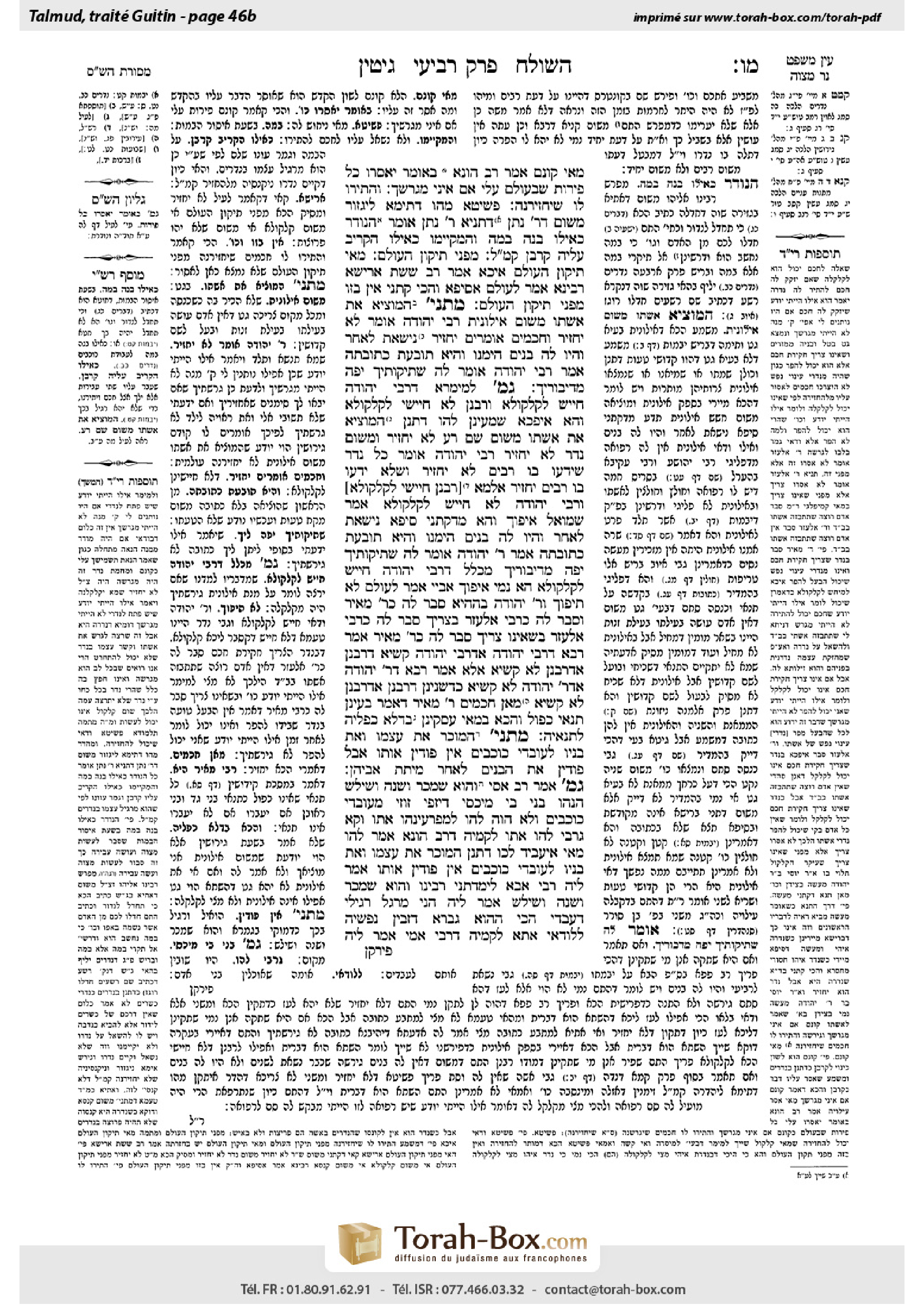
Gittin 46b: Talmud study for Daf Yomi
Study the Talmud for Daf Yomi with scanned pages, Hebrew text, English translations from Sefaria and AI-generated French translations.
Passage selection and English or AI-generated French translation are available where the scan has annotations. Daf Study is independent of Torah-Box and Sefaria.
Browse Gittin · גיטין · All tractatesGittin 46b text and translations
This page of Gittin includes the Aramaic text, an English translation and an AI-generated French translation, alongside the scan above.
גיטין מ״ו ב · Aramaic and Hebrew text
מַאי ״קֻוֽנָּם״? אָמַר רַב הוּנָא, בְּאוֹמֵר: ״יֵאָסְרוּ כׇּל פֵּירוֹת שֶׁבָּעוֹלָם עָלַי אִם אֵינִי מְגָרְשָׁהּ״.
וְהִתִּירוּ לוֹ שֶׁיַּחְזִירֶנָּה: פְּשִׁיטָא! מַהוּ דְּתֵימָא לִיגְזוֹר מִשּׁוּם דְּרַבִּי נָתָן – דְּתַנְיָא, רַבִּי נָתָן אוֹמֵר: הַנּוֹדֵר – כְּאִילּוּ בָּנָה בָּמָה, וְהַמְקַיְּימוֹ – כְּאִילּוּ הִקְרִיב עָלֶיהָ קׇרְבָּן; קָא מַשְׁמַע לַן.
מִפְּנֵי תִּיקּוּן הָעוֹלָם: מַאי תִּיקּוּן הָעוֹלָם אִיכָּא? אָמַר רַב שֵׁשֶׁת: אַרֵישָׁא.
רָבִינָא אָמַר: לְעוֹלָם אַסֵּיפָא, וְהָכִי קָתָנֵי: אֵין בָּזוֹ מִפְּנֵי תִּיקּוּן הָעוֹלָם.
מַתְנִי׳ הַמּוֹצִיא אֶת אִשְׁתּוֹ מִשּׁוּם אַיְלוֹנִית, רַבִּי יְהוּדָה אוֹמֵר: לֹא יַחְזִיר. וַחֲכָמִים אוֹמְרִים: יַחְזִיר.
נִישֵּׂאת לְאַחֵר וְהָיוּ לָהּ בָּנִים הֵימֶנּוּ, וְהִיא תּוֹבַעַת כְּתוּבָּתָהּ; אָמַר רַבִּי יְהוּדָה, אוֹמֵר לַהּ: שְׁתִיקוּתִיךְ יָפָה מִדִּיבּוּרִיךְ.
גְּמָ׳ לְמֵימְרָא דְּרַבִּי יְהוּדָה חָיֵישׁ לְקִלְקוּלָא, וְרַבָּנַן לָא חָיְישִׁי לְקִלְקוּלָא?! וְהָא אִיפְּכָא שָׁמְעִינַן לְהוּ!
דִּתְנַן: הַמּוֹצִיא אֶת אִשְׁתּוֹ מִשּׁוּם שֵׁם רַע – לֹא יַחְזִיר, וּמִשּׁוּם נֶדֶר – לֹא יַחְזִיר. רַבִּי יְהוּדָה אוֹמֵר: כׇּל נֶדֶר שֶׁיָּדְעוּ בּוֹ רַבִּים – לֹא יַחְזִיר, וְשֶׁלֹּא יָדְעוּ בּוֹ רַבִּים – יַחְזִיר. אַלְמָא [רַבָּנַן חָיְישִׁי לְקִלְקוּלָא], וְרַבִּי יְהוּדָה לָא חָיֵישׁ לְקִלְקוּלָא!
אָמַר שְׁמוּאֵל: אֵיפוֹךְ.
וְהָא מִדְּקָתָנֵי סֵיפָא: נִישֵּׂאת לְאַחֵר וְהָיוּ לָהּ בָּנִים הֵימֶנּוּ, וְהִיא תּוֹבַעַת כְּתוּבָּתָהּ; אָמַר רַבִּי יְהוּדָה, אוֹמֵר לָהּ: ״שְׁתִיקוּתִיךְ יָפָה מִדִּיבּוּרִיךְ״ – מִכְּלָל דְּרַבִּי יְהוּדָה חָיֵישׁ לְקִלְקוּלָא! הָא נָמֵי אֵיפוֹךְ.
אַבָּיֵי אָמַר: לְעוֹלָם לָא תֵּיפוֹךְ, וְרַבִּי יְהוּדָה בְּהָהִיא סָבַר לַהּ כְּרַבִּי מֵאִיר וְסָבַר לַהּ כְּרַבִּי אֶלְעָזָר – בְּצָרִיךְ סָבַר לַהּ כְּרַבִּי אֶלְעָזָר, בְּשֶׁאֵינוֹ צָרִיךְ סָבַר לַהּ כְּרַבִּי מֵאִיר.
אָמַר רָבָא: דְּרַבִּי יְהוּדָה אַדְּרַבִּי יְהוּדָה קַשְׁיָא, דְּרַבָּנַן אַדְּרַבָּנַן לָא קַשְׁיָא?!
אֶלָּא אָמַר רָבָא: דְּרַבִּי יְהוּדָה אַדְּרַבִּי יְהוּדָה לָא קַשְׁיָא – כִּדְשַׁנִּינַן. דְּרַבָּנַן אַדְּרַבָּנַן לָא קַשְׁיָא, מַאן חֲכָמִים – רַבִּי מֵאִיר, דְּאָמַר: בָּעֵינַן תְּנַאי כָּפוּל, וְהָכָא בְּמַאי עָסְקִינַן – בִּדְלָא כַּפְלֵיהּ לִתְנָאֵיהּ.
מַתְנִי׳ הַמּוֹכֵר אֶת עַצְמוֹ וְאֶת בָּנָיו לַגּוֹיִם – אֵין פּוֹדִין אוֹתוֹ, אֲבָל פּוֹדִין אֶת הַבָּנִים לְאַחַר מִיתַת אֲבִיהֶן.
גְּמָ׳ אָמַר רַב אַסִּי: וְהוּא שֶׁמָּכַר וְשָׁנָה וְשִׁילֵּשׁ.
הָנְהוּ בְּנֵי בֵּי מִיכְסֵי, דְּיָזְפִי זוּזֵי מִגּוֹיִם וְלָא הֲוָה לְהוּ לְמִפְרְעִינְהוּ. אָתוּ וְקָא גָרְבִי לְהוּ, אֲתוֹ לְקַמֵּיהּ דְּרַב הוּנָא. אֲמַר לְהוּ: מַאי אֶיעְבֵּיד לְכוּ, דִּתְנַן: הַמּוֹכֵר אֶת עַצְמוֹ וְאֶת בָּנָיו לַגּוֹיִם – אֵין פּוֹדִין אוֹתוֹ.
אֲמַר לֵיהּ רַבִּי אַבָּא: לִימַּדְתַּנִי רַבֵּינוּ, וְהוּא שֶׁמָּכַר וְשָׁנָה וְשִׁילֵּשׁ! אֲמַר לֵיהּ: הָנֵי מִרְגָּל רְגִילִי דְּעָבְדִי הָכִי.
הָהוּא גַּבְרָא דְּזַבֵּין נַפְשֵׁיהּ לְלוּדָאֵי. אֲתָא לְקַמֵּיהּ דְּרַבִּי אַמֵּי, אֲמַר לֵיהּ:
Gittin 46b · English translation
The Gemara discusses the formulation of the vow taken by the husband: What is meant by the expression: Konam, as stated by the husband? Generally this term is used when stating a vow of consecration; how does such a vow render her forbidden to him? Rav Huna said that the case is when he says: All the produce that is in the world will become forbidden to me if I do not divorce you.
The mishna taught: And they permitted him to remarry her. The Gemara asks: It is obvious that this is the case, as why shouldn’t he be able to remarry her? The Gemara answers that lest you say: Let us institute a decree due to the statement of Rabbi Natan. As it is taught in a baraita that Rabbi Natan said: One who vows, it is as if he built a personal altar during the time the Temple stood, when it became prohibited to build a personal altar to God outside the Temple. And one who fulfills a vow, it is as if he sacrificed an offering on this personal altar, thereby doubling his sin. Therefore, it would be possible to suggest that the husband is penalized and prohibited from remarrying her because he sinned by taking a vow and fulfilling it. Therefore, it teaches us that this is not the case.
The end of the mishna stated that the reason for this halakha was for the betterment of the world. The Gemara asks: What betterment of the world is there in allowing him to remarry her? Rav Sheshet said: This statement refers back to the first clause of the mishna. The expression: For the betterment of the world, is not an explanation of Rabbi Yosei bar Yehuda’s statement, but rather, it is meant to explain why there is a penalty that one may not remarry a woman whom he divorced due to her bad reputation or due to a vow she had taken.
Ravina said: Actually, this expression applies to the latter clause of the mishna, and this is what it taught: This is not for the betterment of the world. In other words, when they instituted that he may not remarry her for the betterment of the world, it is only with regard to a case where the woman has taken a vow. However, when the husband takes a vow, there is no element of the betterment of the world and he is permitted to remarry her in that case.
MISHNA: With regard to one who divorces his wife because she is a sexually underdeveloped woman who is incapable of bearing children [ailonit], meaning that after their marriage it became clear that she was sexually underdeveloped, Rabbi Yehuda says: He may not remarry her, and the Rabbis say: He may remarry her.
If, after he divorced her, this ailonit married another man and had children from him, meaning that she was not actually an ailonit, and she is demanding payment of her marriage contract from her first husband, claiming that he unlawfully divorced her without paying her marriage contract as he claimed that she was an ailonit and their marriage was a mistaken transaction, Rabbi Yehuda said that he may say to her: Your silence is preferable to your speech, meaning that it is preferable for her to withdraw her claim. If she persists, he may say that he divorced her only because he believed her to be an ailonit, casting aspersions on the validity of the divorce and the status of her children. Therefore, it would be wise of her to withdraw her claim.
GEMARA: The Gemara clarifies the dispute in the mishna: Is this to say that Rabbi Yehuda is concerned about potential harm, i.e., the harm that she may later incur if he casts aspersions on the validity of the divorce, and therefore rules that he may not remarry her, ensuring that he will divorce her only if he is absolutely certain that he wishes to do so, and the Rabbis are not concerned about potential harm? But didn’t we learn that they each said the opposite?
As we learned in the previous mishna (45b): A man who divorces his wife due to her bad reputation may not remarry her. And if one divorces his wife due to a vow that she stated, and he could not live with her under the conditions of the vow, he may not remarry her. Rabbi Yehuda says: If he divorced her due to any vow that the public was aware of, he may not remarry her, but if he divorced her due to a vow that the public was not aware of, he may remarry her. Apparently, the Rabbis are concerned about potential harm, and consequently, they do not make a distinction between one vow and another; and Rabbi Yehuda is not concerned about potential harm, and he makes a distinction between a vow that may lead to permissiveness and one that does not.
Shmuel said: Reverse the opinions in this mishna. Rather, say that it is Rabbi Yehuda who says that he may remarry her, and he is not concerned about potential harm, while the Rabbis say he may not remarry her, and they are concerned about potential harm.
The Gemara challenges: But from the fact that it teaches in the last clause of the mishna: If, after he divorced her, this ailonit married another man and had children from him, and she is demanding payment of her marriage contract from her first husband, Rabbi Yehuda said that he may say to her: Your silence is preferable to your speech, and one can learn by inference that Rabbi Yehuda is concerned about potential harm. The Gemara answers: Here too, reverse the opinions, and it is the Rabbis who stated the last case of the mishna.
Abaye said: Actually, do not reverse the opinions, and say that Rabbi Yehuda is concerned about potential harm. The distinction is that in that mishna, which discussed a woman who took a vow, he holds in one matter in accordance with the opinion of Rabbi Meir, and he holds in another matter in accordance with the opinion of Rabbi Elazar. In the case of a vow that requires dissolution by a halakhic authority he holds in accordance with the opinion of Rabbi Elazar that there is no concern about potential harm in such a case, as a husband would not desire that his wife be disgraced before the court. In the case of a vow that does not require dissolution by a halakhic authority he holds in accordance with the opinion of Rabbi Meir, who maintains that the husband would not be deemed credible if he were to state that he was unaware that he could nullify her vow.
Rava said: Is it difficult to reconcile the statement of Rabbi Yehuda in this mishna with the statement of Rabbi Yehuda in the previous mishna, but it is not difficult to reconcile the statement of the Rabbis in this mishna with the statement of the Rabbis in the previous mishna? Abaye only addressed how to explain the contradiction between the statements of Rabbi Yehuda.
Rather, Rava said: It is not difficult to reconcile the statement of Rabbi Yehuda in this mishna with the statement of Rabbi Yehuda in the previous mishna, as we answered. Additionally, it is not difficult to reconcile the statement of the Rabbis in this mishna with the statement of the Rabbis in the previous mishna, as who are the Rabbis in this mishna? It is Rabbi Meir, who said: We require a compound condition stipulating both positive and negative outcomes. And with what are we dealing here? We are dealing with a situation where he did not compound his condition, as he stated only that he is divorcing her because she is an ailonit, but did not state that he would not divorce her if she were not an ailonit. Therefore, his condition is disregarded, and he may remarry her.
MISHNA: With regard to one who sells himself and his children as slaves to gentiles, he is not redeemed, but the children are redeemed after their father’s death, as there is no reason to penalize them.
GEMARA: Rav Asi says: And this halakha, that he is not redeemed, applies only when he sold himself for a first time and was redeemed, and repeated his action by selling himself a second time and was redeemed, and repeated his action by selling himself a third time. Since he sold himself repeatedly, the Sages penalized him by instituting that he may not be redeemed.
The Gemara relates: There were those residents of Bei Mikhsi who borrowed money from gentiles, and they did not have sufficient funds to repay them. As a result, the gentiles came and seized them as slaves. They came before Rav Huna and requested that he instruct the Jews to redeem them. Rav Huna said to them: What can I do for you, as we learned in a mishna: With regard to one who sells himself and his children as slaves to gentiles, he is not redeemed.
Rabbi Abba said to Rav Huna: Our master taught me: And this halakha applies only when he sold himself, and repeated a second time, and repeated a third time, which was not the case in this incident. Rav Huna said to him: These people do this habitually, and it is as though they sold themselves for a second and third time.
The Gemara relates: A certain man sold himself to gladiators [luda’ei]. He came before Rabbi Ami and said to him:
Gittin 46b · Traduction française (IA)
La Guemara discute la formulation de la promesse faite par l'époux : Qu'entend-on par l'expression : Konam, comme dit par l'époux ? Généralement, ce terme est utilisé lorsqu'on formule une promesse de consécration ; comment une telle promesse rend-elle elle interdite à lui ? Rav Huna dit que le cas est celui où il dit : Tous les produits qui sont dans le monde deviendront interdits à moi si je ne t'abandonne pas.
La michna enseigna : Et ils lui permirent de se remarier avec elle. La Guemara demande : Cela est évident, car pourquoi ne devrait-il pas pouvoir se remarier avec elle ? La Guemara répond que afin de ne pas dire : Établisons un décret en raison de la déclaration de Rabbi Natan. Comme il est enseigné dans une baraïta que Rabbi Natan dit : Celui qui promet, c'est comme s'il avait construit un autel personnel pendant la période où le Temple était debout, lorsque cela était interdit de construire un autel personnel à Dieu en dehors du Temple. Et celui qui accompli une promesse, c'est comme s'il avait offert un sacrifice sur cet autel personnel, doubleant ainsi son péché. Par conséquent, on pourrait suggérer que l'époux est puni et interdit de se remarier avec elle en raison de son péché de prendre une promesse et de l'accomplir. Par conséquent, elle nous enseigne que cela n'est pas le cas.
La fin de la michna indiqua que la raison de cette halakha était le bien-être du monde. La Guemara demande : Quel bien-être du monde y a-t-il à permettre à lui de se remarier avec elle ? Rav Sheshet dit : Cette déclaration fait référence à la première partie de la michna. L'expression : Pour le bien-être du monde, n'est pas une explication de la déclaration de Rabbi Yosei bar Yehuda, mais plutôt, elle est destinée à expliquer pourquoi il y a une punition qui empêche de se remarier avec une femme qu'on a divorcée en raison de sa mauvaise réputation ou en raison d'une promesse qu'elle avait faite.
Ravina dit : En réalité, cette expression s'applique à la seconde partie de la michna, et c'est cela qu'elle enseigna : Cela n'est pas pour le bien-être du monde. En d'autres termes, lorsqu'ils ont institué qu'il ne puisse pas se remarier avec elle pour le bien-être du monde, cela ne concerne que le cas où la femme a pris une promesse. Cependant, lorsqu'il prend une promesse, il n'y a pas d'élément de bien-être du monde et il est autorisé à se remarier avec elle dans ce cas.
MICHNA : Concernant celui qui divorce sa femme parce qu'elle est une femme sexuellement sous-développée incapable d'avoir des enfants [ailonit], c'est-à-dire qu'après leur mariage il est devenu clair qu'elle était sexuellement sous-développée, Rabbi Yehuda dit : Il ne peut pas se remarier avec elle, et les Rabbins disent : Il peut se remarier avec elle.
Si, après qu'il l'ait divorcée, cette ailonit s'est mariée avec un autre homme et a eu des enfants avec lui, c'est-à-dire qu'elle n'était pas effectivement une ailonit, et elle exige le paiement de son contrat de mariage auprès de son premier époux, affirmant qu'il l'a divorcée illégalement sans lui payer son contrat de mariage, en affirmant qu'elle était une ailonit et que leur mariage était une transaction erronée, Rabbi Yehuda dit qu'il peut lui dire : Ton silence est préférable à ton discours, c'est-à-dire que c'est préférable qu'elle retire sa réclamation. Si elle persiste, il peut dire qu'il l'a divorcée uniquement parce qu'il croyait qu'elle était une ailonit, attaquant la validité du divorce et le statut de ses enfants. Par conséquent, il serait sage qu'elle retire sa réclamation.
GUEMARA : La Guemara clarifie le débat dans la michna : Est-ce que cela signifie que Rabbi Yehuda est préoccupé par un dommage potentiel, c'est-à-dire le dommage qu'elle pourrait subir plus tard si l'on attaque la validité du divorce, et donc il déclare qu'il ne peut pas se remarier avec elle, garantissant qu'il divorce uniquement s'il est absolument certain de le faire, et les Rabbins ne sont pas préoccupés par un dommage potentiel ? Mais n'avons-nous pas appris que chacun a dit l'opposé ?
Comme nous l'avons appris dans la précédente michna (45b) : Un homme qui divorce sa femme en raison de sa mauvaise réputation ne peut pas se remarier avec elle. Et si l'on divorce sa femme en raison d'une promesse qu'elle a faite, et qu'on ne peut pas vivre avec elle sous les conditions de la promesse, il ne peut pas se remarier avec elle. Rabbi Yehuda dit : Si l'on divorce sa femme en raison d'une promesse dont le public était conscient, il ne peut pas se remarier avec elle, mais si l'on divorce sa femme en raison d'une promesse dont le public n'était pas conscient, il peut se remarier avec elle. Apparemment, les Rabbins sont préoccupés par un dommage potentiel, et par conséquent, ils n'ont pas de distinction entre une promesse et une autre ; et Rabbi Yehuda n'est pas préoccupé par un dommage potentiel, et il fait la distinction entre une promesse qui peut mener à la permissivité et une qui ne le fait pas.
Shmuel dit : Inversez les opinions dans cette michna. Plutôt, dites que c'est Rabbi Yehuda qui dit qu'il peut se remarier avec elle, et il n'est pas préoccupé par un dommage potentiel, tandis que les Rabbins disent qu'il ne peut pas se remarier avec elle, et ils sont préoccupés par un dommage potentiel.
La Guemara remet en question : Mais à partir du fait que la michna enseigne dans sa dernière clause : Si, après qu'il l'ait divorcée, cette ailonit s'est mariée avec un autre homme et a eu des enfants avec lui, et elle exige le paiement de son contrat de mariage auprès de son premier époux, Rabbi Yehuda dit qu'il peut lui dire : Ton silence est préférable à ton discours, et on peut en déduire que Rabbi Yehuda s'inquiète d'un dommage potentiel. La Guemara répond : Ici aussi, inversez les opinions, et c'est les Rabbins qui ont énoncé cette dernière clause de la michna.
Abaye dit : En réalité, ne faites pas l'inverse des opinions, et dites que Rabbi Yehuda s'inquiète d'un dommage potentiel. La distinction est que dans cette michna, qui discute d'une femme qui a pris une promesse, il adopte l'opinion de Rabbi Meir dans un cas et celle de Rabbi Elazar dans un autre. Dans le cas d'une promesse nécessitant la dissolution par une autorité halakhique, il suit l'opinion de Rabbi Elazar, selon laquelle il n'y a pas de préoccupation concernant un dommage potentiel, car un époux ne voudrait pas que sa femme soit disgraciée devant la cour. Dans le case d'une promesse ne nécessitant pas la dissolution par une autorité halakhique, il suit l'opinion de Rabbi Meir, qui affirme que l'époux ne serait pas considéré comme crédible s'il affirmait qu'il ne savait pas qu'il pouvait annuler sa promesse.
Rava a dit : Est-ce difficile de concilier la déclaration du Rabbi Yéhuda dans cette mitsna avec la déclaration du Rabbi Yéhuda dans la mitsna précédente, mais ce n'est pas difficile de concilier la déclaration des Sages dans cette mitsna avec la déclaration des Sages dans la mitsna précédente ? Abaye n'a abordé que la manière d'expliquer la contradiction entre les déclarations du Rabbi Yéhuda.
En réalité, Rava a dit : Ce n'est pas difficile de concilier la déclaration du Rabbi Yéhuda dans cette mitsna avec la déclaration du Rabbi Yéhuda dans la mitsna précédente, comme nous l'avons répondu. De plus, ce n'est pas difficile de concilier la déclaration des Sages dans cette mitsna avec la déclaration des Sages dans la mitsna précédente, comme qui sont les Sages dans cette mitsna ? C'est le Rabbi Méir, qui a dit : Nous exigeons une condition composée stipulant à la fois des conséquences positives et négatives. Et avec quoi nous nous occupons ici ? Nous nous occupons d'une situation où il n'a pas composé sa condition, car il a déclaré seulement qu'il divorce d'elle parce qu'elle est une ailonit, mais n'a pas déclaré qu'il ne la divorcerait pas s'il ne l'était pas. Par conséquent, sa condition est rejetée, et il peut la remettre en mariage.
MITSNA : Concernant celui qui vend lui-même et ses enfants en esclavage aux non-juifs, il n'est pas racheté, mais les enfants sont rachetés après la mort de leur père, car il n'y a pas de raison de pénaliser eux.
GUEMARA : Rav Asi dit : Et cette halakha, qu'il n'est pas racheté, s'applique seulement lorsqu'il a vendu lui-même la première fois et a été racheté, et a répété son action en vendant lui-même la deuxième fois et a été racheté, et a répété son action en vendant lui-même la troisième fois. Puisque il a vendu lui-même répétément, les Sages l'ont pénalisé en instituant qu'il ne puisse pas être racheté.
La Guemara rapporte : Il y avait des habitants de Bei Mikhsi qui avaient emprunté de l'argent aux non-juifs, et ils n'avaient pas suffisamment d'argent pour les rembourser. En conséquence, les non-juifs sont venus et ont enlevé eux en esclavage. Ils se sont présentés devant Rav Huna et ont demandé qu'il instruise les Juifs à les racheter. Rav Huna a dit à eux : Que puis-je faire pour vous, car nous avons appris dans une mitsva : Concernant celui qui vend lui-même et ses enfants en esclavage aux non-juifs, il n'est pas racheté.
Rabbi Abba a dit à Rav Huna : Mon maître m'a enseigné : Et cette halakha s'applique seulement lorsqu'il a vendu lui-même, et a répété la deuxième fois, et a répété la troisième fois, ce qui n'était pas le cas dans cet incident. Rav Huna a dit à lui : Ces gens font cela habituellement, et c'est comme s'ils avaient vendu eux-mêmes la deuxième et la troisième fois.
La Guemara relate : Un certain homme a vendu sa liberté aux gladiateurs [luda’ei]. Il s'est présenté devant Rabbi Ami et a dit à lui :
Traduction française générée par IA à partir de l’édition anglaise de Sefaria. Vérifie toujours un passage avec le texte source.
Text from Sefaria: William Davidson Edition - Vocalized Aramaic (CC BY NC); William Davidson Edition - English (CC BY NC).