Gittin 47a: Talmud study for Daf Yomi
Study the Talmud for Daf Yomi with scanned pages, Hebrew text, English translations from Sefaria and AI-generated French translations.
Passage selection and English or AI-generated French translation are available where the scan has annotations. Daf Study is independent of Torah-Box and Sefaria.
Browse Gittin · גיטין · All tractatesGittin 47a text and translations
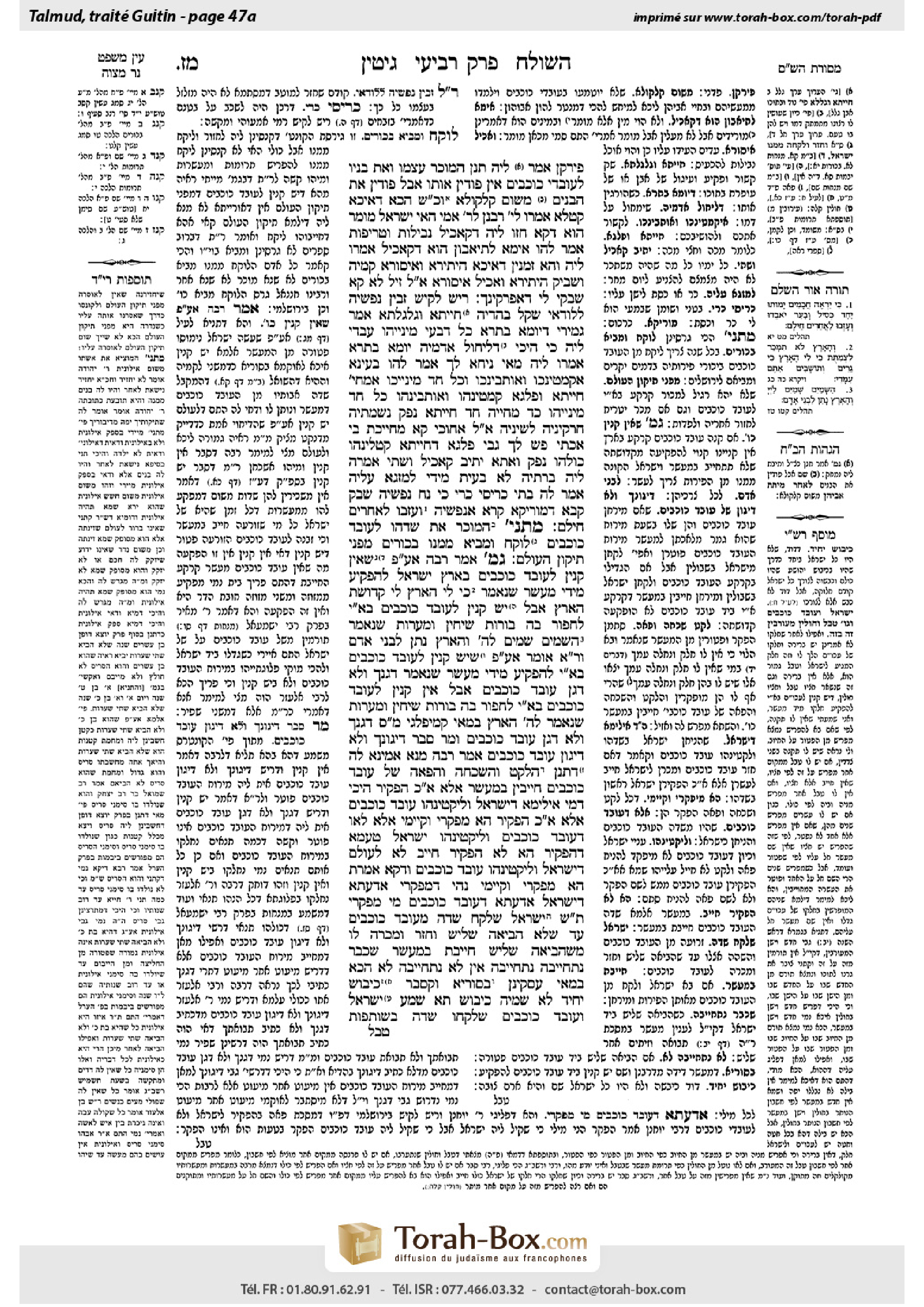
This page of Gittin includes the Aramaic text, an English translation and an AI-generated French translation, alongside the scan above.
גיטין מ״ז א · Aramaic and Hebrew text
פִּירְקַן! אֲמַר לֵיהּ: תְּנַן: הַמּוֹכֵר עַצְמוֹ וְאֶת בָּנָיו לַגּוֹיִם – אֵין פּוֹדִין אוֹתוֹ, אֲבָל פּוֹדִין אֶת הַבָּנִים – מִשּׁוּם קִלְקוּלָא, וְכׇל שֶׁכֵּן הָכָא דְּאִיכָּא קְטָלָא.
אֲמַרוּ לֵיהּ רַבָּנַן לְרַבִּי אַמֵּי: הַאי יִשְׂרָאֵל מוּמָר הוּא, דְּקָא חָזוּ לֵיהּ דְּקָאָכֵיל נְבֵילוֹת וּטְרֵיפוֹת! אֲמַר לְהוּ: אֵימָא לְתֵיאָבוֹן הוּא דְּקָאָכֵיל.
אֲמַרוּ לֵיהּ: וְהָא זִמְנִין דְּאִיכָּא הֶיתֵּירָא וְאִיסּוּרָא קַמֵּיהּ, וְשָׁבֵיק הֶיתֵּירָא וְאָכֵיל אִיסּוּרָא! אֲמַר לֵיהּ: זִיל, לָא קָא שָׁבְקִי לִי דְּאֶפְרְקִינָּךְ.
רֵישׁ לָקִישׁ זַבֵּין נַפְשֵׁיהּ לְלוּדָאֵי, שְׁקַל בַּהֲדֵיהּ חַיְיתָא וְגֻלְגֻּלְתָּא, אֲמַר: גְּמִירִי דְּיוֹמָא בָּתְרָא כֹּל דְּבָעֵי מִינַּיְיהוּ עָבְדִי לֵיהּ, כִּי הֵיכִי דְּלֵיחוּל אַדְּמֵיהּ.
יוֹמָא בָּתְרָא אֲמַרוּ לֵיהּ: מַאי נִיחָא לָךְ? אֲמַר לְהוּ: בָּעֵינָא אֶקְמְטִינְכוּ וְאוֹתְבִינְכוּ, וְכֹל חַד מִינַּיְיכוּ אֶמְחְיֵהּ חַיְיתָא וּפַלְגָא. קַמְטִינְהוּ וְאוֹתְבִינְהוּ, כֹּל חַד מִינַּיְיהוּ כַּד מַחְיֵיהּ חַד חַיְיתָא נְפַק נִשְׁמְתֵיהּ. חַרְקִינֵּיהּ לְשִׁינֵּיהּ, אֲמַר לֵיהּ: אַחוֹכֵי קָא מְחַיְּיכַתְּ בִּי? אַכַּתִּי פָּשׁ לָךְ גַּבַּי פַּלְגָא דְּחַיְיתָא. קַטְלִינְהוּ כּוּלְּהוּ.
נְפַק וַאֲתָא, יָתֵיב קָאָכֵיל וְשָׁתֵי. אֲמַרָה לֵיהּ בְּרַתֵּיה: לָא בָּעֵית מִידֵּי לְמִזְגֵּא עֲלֵיהּ? אֲמַר לַהּ: בִּתִּי, כְּרֵיסִי כָּרִי. כִּי נָח נַפְשֵׁיהּ שְׁבַק קַבָּא דְמוֹרִיקָא, קְרָא אַנַּפְשֵׁיהּ: ״וְעָזְבוּ לַאֲחֵרִים חֵילָם״.
מַתְנִי׳ הַמּוֹכֵר אֶת שָׂדֵהוּ לְגוֹי – לוֹקֵחַ וּמֵבִיא מִמֶּנּוּ בִּכּוּרִים, מִפְּנֵי תִּיקּוּן הָעוֹלָם.
גְּמָ׳ אָמַר רַבָּה: אַף עַל פִּי שֶׁאֵין קִנְיָן לְגוֹי בְּאֶרֶץ יִשְׂרָאֵל לְהַפְקִיעַ מִידֵּי מַעֲשֵׂר, שֶׁנֶּאֱמַר: ״כִּי לִי הָאָרֶץ״ – לִי קְדוּשַּׁת הָאָרֶץ; אֲבָל יֵשׁ קִנְיָן לְגוֹי בְּאֶרֶץ יִשְׂרָאֵל לַחְפּוֹר בָּהּ בּוֹרוֹת שִׁיחִין וּמְעָרוֹת, שֶׁנֶּאֱמַר: ״הַשָּׁמַיִם שָׁמַיִם לַה׳ וְהָאָרֶץ נָתַן לִבְנֵי אָדָם״.
וְרַבִּי אֶלְעָזָר אוֹמֵר: אַף עַל פִּי שֶׁיֵּשׁ קִנְיָן לְגוֹי בְּאֶרֶץ יִשְׂרָאֵל לְהַפְקִיעַ מִידֵי מַעֲשֵׂר, שֶׁנֶּאֱמַר: ״דְּגָנְךָ״ – וְלֹא דְּגַן גּוֹי; אֲבָל אֵין קִנְיָן לְגוֹי בְּאֶרֶץ יִשְׂרָאֵל לַחְפּוֹר בָּהּ בּוֹרוֹת שִׁיחִין וּמְעָרוֹת, שֶׁנֶּאֱמַר: ״לַה׳ הָאָרֶץ״.
בְּמַאי קָמִיפַּלְגִי? מָר סָבַר: ״דְּגָנְךָ״ – וְלֹא דְּגַן גּוֹי, וּמָר סָבַר: דִּיגּוּנְךָ, וְלֹא דִּיגּוּן גּוֹי.
אָמַר רַבָּה: מְנָא אָמֵינָא לַהּ? דִּתְנַן: הַלֶּקֶט וְהַשִּׁכְחָה וְהַפֵּאָה שֶׁל גּוֹי – חַיָּיבִין בְּמַעֲשֵׂר, אֶלָּא אִם כֵּן הִפְקִיר.
הֵיכִי דָמֵי? אִילֵּימָא דְּיִשְׂרָאֵל וְלַיקְּטִינְהוּ גּוֹי – ״אֶלָּא אִם כֵּן הִפְקִיר״?! הָא מַפְקְרִי וְקָיְימִי! אֶלָּא לָאו דְּגוֹי – וְלַקְּטִינְהוּ יִשְׂרָאֵל;
טַעְמָא דְּהִפְקִיר, הָא לֹא הִפְקִיר – חַיָּיב!
לָא, לְעוֹלָם דְּיִשְׂרָאֵל וְלַקְּטִינְהוּ גּוֹי, וּדְקָא אָמְרַתְּ: הָא מַפְקְרִי וְקָיְימִי, נְהִי דְּמַפְקְרִי אַדַּעְתָּא דְיִשְׂרָאֵל, אַדַּעְתָּא דְגוֹי מִי מַפְקְרִי?!
תָּא שְׁמַע: יִשְׂרָאֵל שֶׁלָּקַח שָׂדֶה מִגּוֹי עַד שֶׁלֹּא הֵבִיאָה שְׁלִישׁ, וְחָזַר וּמְכָרָהּ לוֹ מִשֶּׁהֵבִיאָה שְׁלִישׁ – חַיֶּיבֶת בְּמַעֲשֵׂר, שֶׁכְּבָר נִתְחַיְּיבָה. נִתְחַיְּיבָה – אִין, לֹא נִתְחַיְּיבָה – לָא!
הָכָא בְּמַאי עָסְקִינַן – בְּסוּרְיָא, וְקָסָבַר: כִּיבּוּשׁ יָחִיד לָא שְׁמֵיהּ כִּיבּוּשׁ.
תָּא שְׁמַע: יִשְׂרָאֵל וְגוֹי שֶׁלָּקְחוּ שָׂדֶה בְּשׁוּתָּפוּת –
Gittin 47a · English translation
Redeem me. Rabbi Ami said to him: We learned in a mishna: With regard to one who sells himself and his children as slaves to gentiles, he is not redeemed. However, his children are redeemed due to the harm of becoming assimilated among the gentiles, and all the more so here, where there is a concern that leaving him in bondage may lead to his death, he should be redeemed.
The Sages said to Rabbi Ami: This man is a Jewish apostate, as they saw him when he was eating unslaughtered animal carcasses and animals with a wound that will cause them to die within twelve months [tereifot]. He said to them: Say that he was eating them due to his appetite, not because he is an apostate, but because he was overcome by temptation.
They said to him: But there are times when there are permitted and forbidden foods before him, and he sets aside the permitted food and eats the forbidden food, indicating that it is not temptation alone that causes him to transgress. Once he heard this, Rabbi Ami said to that man: Go, because they do not allow me to redeem you.
The Gemara recounts a related incident: Reish Lakish sold himself to gladiators. He took a bag and a round stone inside of it with him. He said: There is a tradition that on the final day of a captive’s life, before his captors kill him, they do for him anything that he requests of them, so that he would forgive them for the spilling of his blood.
On the final day before they were set to kill him they said to him: What is amenable to you? He said to them: I want to tie you up and have you sit, and I will strike each one of you one and a half times. He tied them up and had each one of them sit. When he struck each of them with one strike with the stone in the bag, the one whom he struck died, because Reish Lakish was of great strength. Reish Lakish gritted his teeth in anger, and said to the one whom he killed, in order to prevent the others from realizing what was happening: Are you laughing at me? You still have half of a strike remaining with me, as I struck you only once. He killed them all, and Reish Lakish escaped his captors.
He left and came back home, and after some time had passed he was sitting, eating, and drinking, without concern for his livelihood. His daughter said to him: You don’t want something to lie upon? He said to her: My daughter, my belly is my pillow, and this is enough for me. When he died he left only a kav of saffron as an inheritance, and even so he recited this verse about himself: “And they leave their wealth for others” (Psalms 49:11), meaning that he was pained that he did not use all of his property. He exhibited his confidence that God would provide his needs by not saving money for the future.
MISHNA: One who sells his field to a gentile must purchase and bring the first fruits from the field that he sold, for the betterment of the world.
GEMARA: Rabba says: Even though a gentile has no capability of acquisition of land in Eretz Yisrael to cause the abrogation of the sanctity of the land, thereby removing it from the obligation to tithe its produce, as it is stated: “For the land is Mine” (Leviticus 25:23), which teaches: The sanctity of the land is Mine, and it is not abrogated when the land is sold to a gentile; a gentile does have, however, the capability of acquisition of land in Eretz Yisrael to allow him to dig pits, ditches, and caves in the land he has purchased, as it is stated: “The heavens are the heavens of the Lord; but the earth has He given to the children of men” (Psalms 115:16).
And Rabbi Elazar says: Even though a gentile has the capability of acquisition of land in Eretz Yisrael to cause the abrogation of the sanctity of the land, removing it from the obligation to tithe its produce, as it is stated with regard to tithes: “The tithe of your grain” (Deuteronomy 12:17), which teaches that it is only the grain of a Jew that is obligated in tithes and not the grain of a gentile; a gentile does not have, however, the capability of acquisition of land in Eretz Yisrael to allow him to dig pits, ditches, and caves, in the land he has purchased, as it is stated: “The earth is the Lord’s” (Psalms 24:1).
The Gemara asks: With regard to what principle do Rabba and Rabbi Elazar disagree? The Gemara answers: One Sage, Rabbi Elazar, holds that “your grain” teaches that only grain grown in the field of a Jew is obligated in tithes, but not the grain grown in the field of a gentile. And one Sage, Rabba, holds that “your grain” is not referring to the produce itself, but rather to your accumulation of the produce into a pile, which obligates the produce in tithes, and not the accumulation of the produce into a pile by a gentile, as Rabba holds that if a gentile harvests and gathers grain, the grain is not obligated in tithes.
Rabba said: From where do I say that a gentile’s acquisition of land in Eretz Yisrael does not cause the abrogation of the sanctity of the land with regard to tithes? As we learned in a mishna (Pe’a 4:9): With regard to the gleanings left for the poor, and the forgotten sheaves left for the poor, and the produce in the corner of the field, which is given to the poor [pe’a], of a gentile, one is obligated to tithe them unless the owner rendered them ownerless.
The Gemara discusses: What are the circumstances? If we say that this is referring to the gleanings, forgotten sheaves, and pe’a of a Jew, and a gentile collected them and sold them to a Jew, then how could the mishna write: Unless he rendered them ownerless? But they are already ownerless, since gleanings, forgotten sheaves, and pe’a are already ownerless, as anyone can take them. Rather, is it not the case that the mishna is referring to produce of a gentile, who then separated gleanings, forgotten sheaves, and pe’a, and declared them to be ownerless, and a Jew gathered them.
Rabba explains his inference: The reason that this produce is exempt from tithes is specifically because the gentile rendered it ownerless, but if he did not render it ownerless, then it would be obligated in tithes. One can infer from this mishna that the acquisition of land by a gentile does not cause the abrogation of the sanctity of the land with regard to tithes.
The Gemara rejects this: No, actually it may be that these were gleanings, forgotten sheaves, and pe’a of a Jew, and a gentile collected them. And that which you said: But they are already ownerless, is incorrect. Let it be that he rendered them ownerless with the intent that a Jew would collect them, but did he render them ownerless with the intent that a gentile would collect them? He did not in fact render them ownerless, as he expected only a Jew to collect them. Therefore, if a gentile collects them and sells them to a Jew, the Jew is obligated to tithe them.
The Gemara suggests: Come and hear another proof from a baraita: If there was a Jew who acquired a field from a gentile before its produce reached a third of its growth, at which point one is obligated to tithe the produce, and he then sold it to the gentile after its produce reached a third of its growth, then the owner is obligated to tithe the produce because the produce already became obligated in tithes when it reached a third of its growth while under Jewish ownership. The Gemara deduces from here: It is only when the produce became obligated in tithes while under Jewish ownership, that yes, the owner is obligated to tithe, but if the produce did not become obligated in tithes while under Jewish ownership, then no, the owner is not obligated to tithe. This teaches that produce that grows while the field is owned by a gentile is exempt from tithes, and a gentile’s acquisition in Eretz Yisrael abrogates the sanctity of the land with regard to tithes.
The Gemara rejects this: With what are we dealing here? We are not dealing with Eretz Yisrael proper, but with land in Syria, and this tanna holds that the conquest of an individual is not called a conquest. Since Syria was conquered in battle by King David, and not by the Jewish people as a whole, it is not bound by all the same halakhot that apply in Eretz Yisrael.
The Gemara suggests: Come and hear a proof from a baraita (Tosefta, Terumot 2:10): If there were a Jew and a gentile who purchased a field in partnership,
Gittin 47a · Traduction française (IA)
Rédemé-moi. Le Rabbi Ami dit à lui : Nous avons appris dans une mitsna : Concernant celui qui vend lui-même et ses enfants en esclavage aux non-Juifs, il n'est pas racheté. Cependant, ses enfants sont rachetés en raison du danger de s'assimiler parmi les non-Juifs, et encore davantage ici, où il y a un risque que le laisser en esclavage puisse entraîner sa mort, il devrait être racheté.
Les Sages dirent au Rabbi Ami : Cet homme est un apostat juif, car ils l'ont vu lorsqu'il mangeait des cadavres d'animaux non sacrifiés et des animaux blessés qui mourront dans les douze mois [tereifot]. Il répondit à ceux-ci : Dites qu'il les mangeait par faim, pas parce qu'il est un apostat, mais parce qu'il a succombé à la tentation.
Ils dirent à lui : Mais il y a des moments où des aliments permis et interdits sont devant lui, et il met de côté les aliments permis pour manger les interdits, ce qui montre que ce n'est pas seulement la tentation qui le pousse à transgresser. Une fois qu'il eut entendu cela, le Rabbi Ami dit à cet homme : Va, car ils ne me permettent pas de te racheter.
La Guemara rapporte un incident similaire : Reish Lakish a vendu sa liberté aux gladiateurs. Il a pris un sac et une pierre ronde à l'intérieur. Il a dit : Il y a une tradition selon laquelle, le dernier jour de la vie d'un prisonnier, avant que ses geôliers ne le tuent, ils font pour lui tout ce qu'il demande, afin qu'il pardonne leur sang versé.
Le dernier jour avant qu'ils ne l'abattent, ils dirent à lui : Quel est ton souhait ? Il dit à eux : Je veux que vous soyez ligotés et assis, et je frapperai chacun de vous un et demi fois. Il les ligota et les fit s'asseoir. Lorsqu'il frappa chacun d'eux avec un coup de pierre dans le sac, celui qu'il frappa mourut, car Reish Lakish était très fort. Reish Lakish serra les dents en colère et dit à celui qu'il avait tué, afin de faire croire aux autres que rien ne se passait : Tu ris de moi ? Tu as encore la moitié d'un coup à venir avec moi, car je t'ai frappé seulement une fois. Il tua tous les autres, et Reish Lakish s'échappa de ses geôliers.
Il partit et revint chez lui, et après un certain temps, il était assis, mangeant et buvant, sans souci de son subsistance. Sa fille lui dit : Tu ne veux pas quelque chose à porter ? Il lui dit : Ma fille, mon ventre est mon coussin, et cela suffit pour moi. Lorsqu'il mourut, il laissa seulement un kav de safran en héritage, et même ainsi, il récita cette verset à son sujet : « Et ils laissent leur richesse pour d'autres » (Psaumes 49:11), signifiant qu'il était triste qu'il n'ait pas utilisé toute sa propriété. Il montrait sa confiance en Dieu pour fournir ses besoins en ne conservant pas d'argent pour l'avenir.
MICHNA : Celui qui vend son champ à un non-Juif doit acheter et apporter les premiers fruits du champ qu'il a vendu, pour le bien de l'humanité.
GUEMARA : Rabba dit : Même si un non-Juif n'a pas la capacité d'acquérir une terre en Eretz Yisrael pour abroger la sanctité de la terre, ce qui enlèverait l'obligation de dîmer ses produits, comme il est dit : « Car la terre est mienne » (Lévitique 25:23), ce qui enseigne : La sanctité de la terre est mienne, et elle n'est pas abrogée lorsque la terre est vendue à un non-Juif ; un non-Juif a cependant la capacité d'acquérir une terre en Eretz Yisrael pour permettre à lui de creuser des puits, des canaux et des grottes dans la terre qu'il a achetée, comme il est dit : « Les cieux sont les cieux du Seigneur ; mais la terre a été donnée aux enfants des hommes » (Psaumes 115:16).
Et Rabbi Elazar dit : Même si un non-Juif a la capacité d'acquérir une terre en Eretz Yisrael pour abroger la sanctité de la terre, ce qui enlèverait l'obligation de dîmer ses produits, comme il est dit concernant les dîmes : « La dîme de votre blé » (Deutéronome 12:17), ce qui enseigne que seul le blé d'un Juif est obligé de dîmes et non celui d'un non-Juif ; un non-Juif n'a cependant pas la capacité d'acquérir une terre en Eretz Yisrael pour permettre à lui de creuser des puits, des canaux et des grottes dans la terre qu'il a achetée, comme il est dit : « La terre est du Seigneur » (Psaumes 24:1).
La Guemara pose la question : Sur quel principe les Sages Rabba et Rabbi Elazar s'opposent-ils ? La Guemara répond : Un Sage, Rabbi Elazar, considère que « votre blé » enseigne que seul le blé cultivé dans le champ d'un Juif est obligé de dîmes, mais pas celui cultivé dans le champ d'un non-Juif. Et un autre Sage, Rabba, considère que « votre blé » ne se réfère pas au produit lui-même, mais plutôt à votre accumulation du produit en tas, ce qui oblige le produit à dîmes, et non l'accumulation du produit en tas par un non-Juif, comme Rabba considère que si un non-Juif récolte et rassemble du blé, le blé n'est pas obligé de dîmes.
Rabba dit : D'où dis-je que l'acquisition d'une terre par un non-Juif en Eretz Yisrael ne cause pas l'abrogation de la sanctité de la terre concernant les dîmes ? Comme nous avons appris dans une mitsva (Pe’a 4:9) : Concernant les restes laissés pour les pauvres, les épis oubliés laissés pour les pauvres, et les produits dans le coin du champ qui sont donnés aux pauvres [pe’a], d'un non-Juif, on est tenu de dîmer ces produits à moins que l'propriétaire ne les rende sans propriétaire.
La Guemara discute : Quelles sont les circonstances ? Si nous disons que cela se réfère aux restes, aux épis oubliés et à la pe’a d'un Juif, et un non-Juif les a collectés et les a vendus à un Juif, alors comment la mitsva peut-elle écrire : À moins qu'il ne les rende sans propriétaire ? Mais ils sont déjà sans propriétaire, car les restes, les épis oubliés et la pe’a sont déjà sans propriétaire, car tout le monde peut les prendre. Plutôt, n'est-ce pas le cas que la mitsva se réfère aux produits d'un non-Juif, qui a ensuite séparé des restes, des épis oubliés et de la pe’a, et les a déclarés sans propriétaire, et un Juif les a récoltés.
Rabba explique son raisonnement : La raison pour laquelle ce produit est exempt de dîmes est spécifiquement parce que le non-Jeu l'a rendu sans propriétaire, mais s'il ne l'avait pas rendu sans propriétaire, il aurait été obligatoire en dîmes. On peut en déduire de cette mitsna que l'acquisition de terre par un non-Jeu ne cause pas l'abrogation de la sanctité de la terre en ce qui concerne les dîmes.
Le Guemara rejette cela : Non, en réalité, il se peut que ces récoltes soient des épis oubliés, des gerbes oubliées et des pe’a d’un Juif, et un non-Jeu les a récoltés. Et ce que vous avez dit : Mais ils sont déjà sans propriétaire, est incorrect. Qu’il soit que le non-Jeu les ait rendus sans propriétaire avec l’intention qu’un Juif les récolte, mais est-ce qu’il les a rendus sans propriétaire avec l’intention qu’un non-Jeu les récolte ? Il n’a pas effectivement rendu sans propriétaire, car il attendait seulement un Juif pour les récolter. Ainsi, si un non-Jeu les récolte et les vend à un Juif, le Juif est tenu de les dîmer.
Le Guemara suggère : Viens entendre une autre preuve d’une baraïta : Si un Juif a acquis un champ auprès d’un non-Jeu avant que la récolte ne soit arrivée à un tiers de sa maturité, au point où l’on est tenu de dîmer la récolte, et qu’il a ensuite vendu ce champ au non-Jeu après que la récolte ait atteint un tiers de sa maturité, alors l’acquéreur est tenu de dîmer la récolte, car la récolte était déjà tenu en dîmes lorsqu’elle était sous la propriété juive. Le Guemara déduit de cela : C’est seulement lorsque la récolte est devenue obligatoire en dîmes sous la propriété juive que l’acquéreur est tenu de dîmer, mais si la récolte n’est pas devenue obligatoire en dîmes sous la propriété juive, alors non, l’acquéreur n’est pas tenu de dîmer. Cela enseigne que la récolte qui pousse alors que le champ est propriété d’un non-Jeu est exempt de dîmes, et l’acquisition d’un non-Jeu en Eretz Yisrael abroge la sanctité de la terre en ce qui concerne les dîmes.
Le Guemara rejette cela : Avec quoi sommes-nous en train de nous occuper ici ? Nous ne sommes pas en train de nous occuper d'Eretz Yisrael proprement dite, mais de terres en Syrie, et ce tanna considère que la conquête d'un individu n'est pas appelée une conquête. Puisque Syrie a été conquise en guerre par le roi David, et non par le peuple juif en tant que tel, elle n'est pas soumise à toutes les mêmes halakhot qui s'appliquent en Eretz Yisrael.
Le Guemara suggère : Viens entendre une preuve tirée d'une baraïta (Tosefta, Terumot 2:10) : Si un Juif et un non-Jeu avaient acheté un champ en partage,
Traduction française générée par IA à partir de l’édition anglaise de Sefaria. Vérifie toujours un passage avec le texte source.
Text from Sefaria: William Davidson Edition - Vocalized Aramaic (CC BY NC); William Davidson Edition - English (CC BY NC).