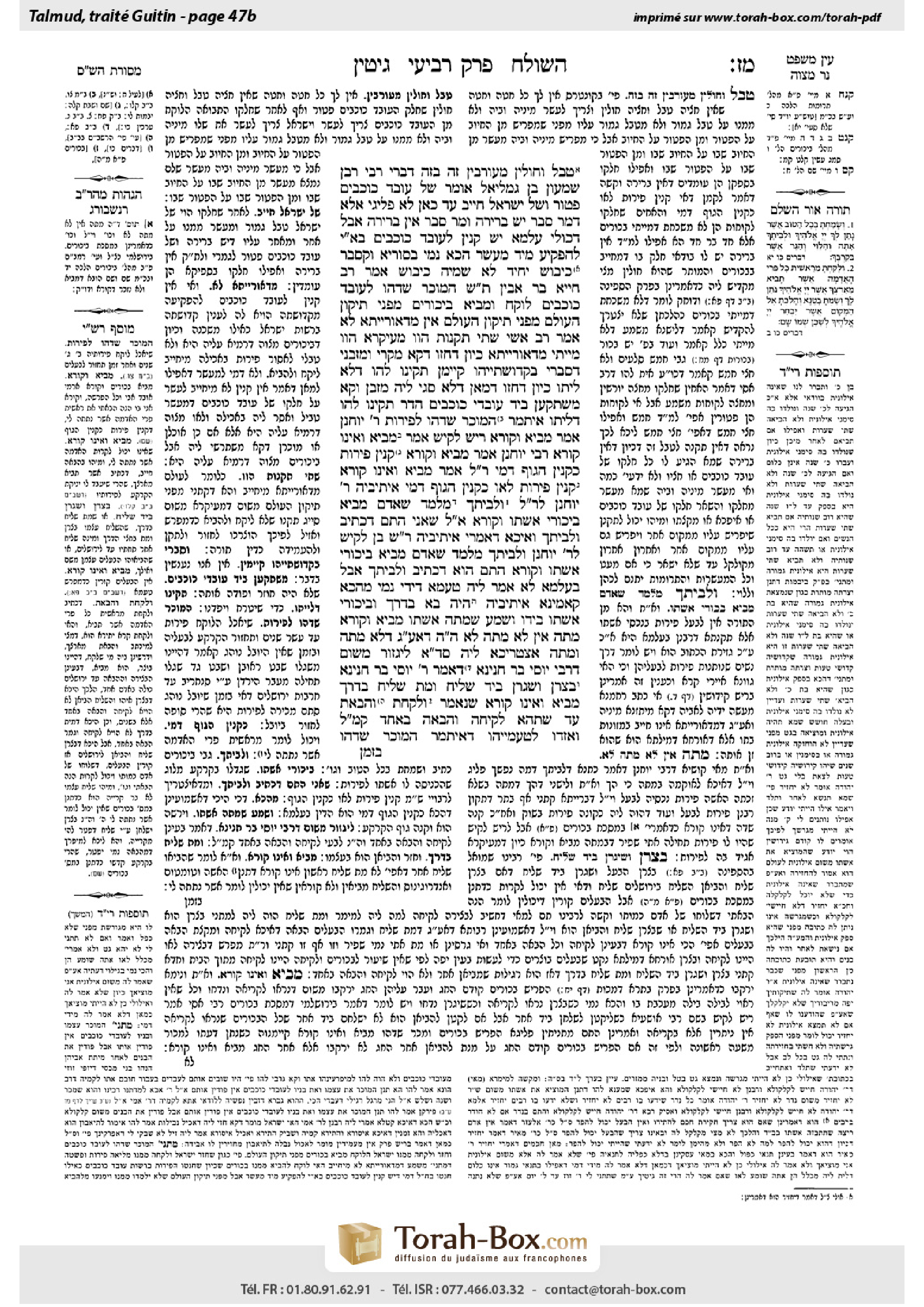
Gittin 47b: Talmud study for Daf Yomi
Study the Talmud for Daf Yomi with scanned pages, Hebrew text, English translations from Sefaria and AI-generated French translations.
Passage selection and English or AI-generated French translation are available where the scan has annotations. Daf Study is independent of Torah-Box and Sefaria.
Browse Gittin · גיטין · All tractatesGittin 47b text and translations
This page of Gittin includes the Aramaic text, an English translation and an AI-generated French translation, alongside the scan above.
גיטין מ״ז ב · Aramaic and Hebrew text
טֶבֶל וְחוּלִּין מְעוֹרָבִין זֶה בָּזֶה, דִּבְרֵי רַבִּי. רַבָּן שִׁמְעוֹן בֶּן גַּמְלִיאֵל אוֹמֵר: שֶׁל גּוֹי – פָּטוּר, וְשֶׁל יִשְׂרָאֵל – חַיָּיב.
עַד כָּאן לָא פְּלִיגִי אֶלָּא דְּמָר סָבַר ״יֵשׁ בְּרֵירָה״. וּמַר סָבַר ״אֵין בְּרֵירָה״; אֲבָל דְּכוּלֵּי עָלְמָא – יֵשׁ קִנְיָן לְגוֹי בְּאֶרֶץ יִשְׂרָאֵל לְהַפְקִיעַ מִיַּד מַעֲשֵׂר!
הָכָא נָמֵי בְּסוּרְיָא; וְקָסָבַר כִּיבּוּשׁ יָחִיד לָא שְׁמֵיהּ כִּיבּוּשׁ.
אָמַר רַב חִיָּיא בַּר אָבִין, תָּא שְׁמַע: הַמּוֹכֵר שָׂדֵהוּ לְגוֹי – לוֹקֵחַ וּמֵבִיא בִּיכּוּרִים מִפְּנֵי תִּיקּוּן הָעוֹלָם. מִפְּנֵי תִּיקּוּן הָעוֹלָם – אִין, מִדְּאוֹרָיְיתָא – לָא!
אָמַר רַב אָשֵׁי: שְׁתֵּי תַּקָּנוֹת הֲווֹ – מֵעִיקָּרָא הֲווֹ מַיְיתִי מִדְּאוֹרָיְיתָא; כֵּיוָן דַּחֲזוֹ דְּקָא מִקְּרִי וּמְזַבְּנִי, דְּסָבְרִי בִּקְדוּשְׁתַּיְיהוּ קָיְימָן, תַּקִּינוּ לְהוּ דְּלָא לַיְתוֹ;
כֵּיוָן דַּחֲזוֹ דְּמַאן דְּלָא סַגִּי לֵיהּ – מְזַבֵּן, וְקָא מִשְׁתַּקְּעָן בְּיַד גּוֹיִם, הֲדַר תַּקִּינוּ לְהוּ דְּלַיְתוֹ.
אִיתְּמַר: הַמּוֹכֵר שָׂדֵהוּ לְפֵירוֹת, רַבִּי יוֹחָנָן אָמַר: מֵבִיא וְקוֹרֵא. רֵישׁ לָקִישׁ אָמַר: מֵבִיא וְאֵינוֹ קוֹרֵא.
רַבִּי יוֹחָנָן אָמַר מֵבִיא וְקוֹרֵא – קִנְיַן פֵּירוֹת כְּקִנְיַן הַגּוּף דָּמֵי. רֵישׁ לָקִישׁ אָמַר מֵבִיא וְאֵינוֹ קוֹרֵא – קִנְיַן פֵּירוֹת לָאו כְּקִנְיַן הַגּוּף דָּמֵי.
אֵיתִיבֵיהּ רַבִּי יוֹחָנָן לְרֵישׁ לָקִישׁ: ״וּלְבֵיתְךָ״ – מְלַמֵּד, שֶׁאָדָם מֵבִיא בִּיכּוּרֵי אִשְׁתּוֹ, וְקוֹרֵא.
אֲמַר לֵיהּ: שָׁאנֵי הָתָם, דִּכְתִיב ״וּלְבֵיתֶךָ״.
וְאִיכָּא דְּאָמְרִי: אֵיתִיבֵיהּ רַבִּי שִׁמְעוֹן בֶּן לָקִישׁ לְרַבִּי יוֹחָנָן: ״וּלְבֵיתֶךָ״ – מְלַמֵּד, שֶׁאָדָם מֵבִיא בִּיכּוּרֵי אִשְׁתּוֹ וְקוֹרֵא – הָתָם הוּא דִכְתִיב ״וּלְבֵיתֶךָ״, אֲבָל בְּעָלְמָא – לָא! אֲמַר לֵיהּ: טַעְמָא דִּידִי נָמֵי מֵהָכָא קָאָמֵינָא.
אֵיתִיבֵיהּ: הָיָה בָּא בַּדֶּרֶךְ וּבִיכּוּרֵי אִשְׁתּוֹ בְּיָדוֹ, וְשָׁמַע שֶׁמֵּתָה אִשְׁתּוֹ – מֵבִיא וְקוֹרֵא. מֵתָה – אִין, לֹא מֵתָה – לָא!
הוּא הַדִּין דְּאַף עַל גַּב דְּלֹא מֵתָה; וּמֵתָה אִצְטְרִיכָא לֵיהּ – סָלְקָא דַּעְתָּךְ אָמֵינָא לִיגְזוֹר מִשּׁוּם דְּרַבִּי יוֹסֵי בַּר חֲנִינָא –
דְּאָמַר רַבִּי יוֹסֵי בַּר חֲנִינָא: בְּצָרָן, וְשִׁגְּרָן בְּיַד שָׁלִיחַ, וּמֵת שָׁלִיחַ בַּדֶּרֶךְ – מֵבִיא וְאֵינוֹ קוֹרֵא, שֶׁנֶּאֱמַר: ״וְלָקַחְתָּ״–״וְהֵבֵאתָ״ – עַד שֶׁתְּהֵא לְקִיחָה וַהֲבָאָה בְּאֶחָד; קָא מַשְׁמַע לַן.
וְאָזְדוּ לְטַעְמַיְיהוּ, דְּאִיתְּמַר: הַמּוֹכֵר שָׂדֵהוּ
Gittin 47b · English translation
the produce grown in that field is considered to be untithed produce and non-sacred produce mixed together; this is the statement of Rabbi Yehuda HaNasi. Rabban Shimon ben Gamliel says: The portion of the gentile is exempt from terumot and tithes, and the portion of the Jew is obligated.
The Gemara explains the inference: They disagree only with regard to the following issue: That one Sage, Rabban Shimon ben Gamliel, holds that there is retroactive clarification, i.e., when they divide the produce, it will be clarified who owned what produce from the outset. And one Sage, Rabbi Yehuda HaNasi, holds that there is no retroactive clarification, and therefore, since it grew in a mixed state, it retains that status even after they divide the produce. However, everyone agrees that a gentile has the capability of acquisition of land in Eretz Yisrael to cause the abrogation of the sanctity of the land, removing it from the obligation to tithe its produce, as the gentile’s portion is considered to be non-sacred produce.
The Gemara answers: Here, also, it is referring to a case in Syria, and he holds that the conquest of an individual is not called a conquest, and a gentile has the capability of acquisition of land in Syria to cause the abrogation of the sanctity of the land.
Rav Ḥiyya bar Avin said: Come and hear a proof from the mishna: One who sells his field to a gentile must purchase and bring the first fruits from the field that he sold, for the betterment of the world. Rav Ḥiyya bar Avin infers: For the betterment of the world, yes, he must bring the first fruits; however, by Torah law, no, he is not required. This teaches that the acquisition of a gentile causes the abrogation of the sanctity of the land.
Rav Ashi said: There were two ordinances concerning this issue. Initially, those who sold their fields to gentiles would bring first fruits by Torah law, as they held that the acquisition of a gentile does not abrogate the sanctity of the land. Once the Sages saw that the Jews would sell their land to gentiles when they had the opportunity, because these Jews thought that the fact that the Jew would still have to bring the first fruits indicates that the land retains its sanctity, and therefore there is no reason not to sell the land to gentiles, they instituted for those who sell land to gentiles that they should not bring the first fruits, to emphasize that the land should not be sold to gentiles. This was the first ordinance.
Once the Sages saw that those who were not able to subsist would sell their land despite this ordinance, and the fields would remain in the possession of the gentiles and would not be redeemed, they went back and instituted that they should bring the first fruits in order to penalize the seller, to encourage him to repurchase the field. This was the second ordinance. Therefore, one cannot prove from the mishna whether or not the acquisition of a gentile abrogates the sanctity of the land.
§ It was stated: With regard to one who sells his field for just its produce, meaning that he retains ownership over the field itself and he sells the rights to all of its produce to someone else, Rabbi Yoḥanan says: The purchaser brings first fruits from this field to the Temple and recites the verses in the Torah associated with the bringing of the first fruits, in which he thanks God for: “The land which You, Lord, have given me” (Deuteronomy 26:10). Reish Lakish says: Although the buyer brings the first fruits, he does not recite the verses, since it is not his field.
The Gemara explains the reason behind the dispute: Rabbi Yoḥanan says he brings the first fruits and recites the verses because he maintains that the acquisition of an item for its produce is considered to be like the acquisition of the item itself. Even though the field itself does not belong to him, it is as if he acquired the field because all of the produce belongs to him in practice. Reish Lakish says that he brings the first fruits and does not recite the verses because he holds that the acquisition of an item for its produce is not considered to be like the acquisition of the item itself.
Rabbi Yoḥanan raised an objection to Reish Lakish from a baraita concerning the bringing of first fruits, as the verse states: “And you shall rejoice in all of the good that the Lord your God has given to you and to your house” (Deuteronomy 26:11). The phrase “your house” often refers to a wife. Therefore, the Sages said: This teaches that a man brings his wife’s first fruits, and he recites the relevant verses. This is true despite the fact that a husband acquires the field of his wife only for the produce. It seems from this baraita that the acquisition of a field’s produce is considered to be like the acquisition of the field itself.
Reish Lakish said to him: It is different there, as it is written explicitly: “And to your house,” which teaches that with regard to first fruits, there is a scriptural decree that a field belonging to one’s wife is also included in the mitzva. This does not prove that in general the acquisition of a field’s produce is considered to be like the acquisition of the field itself.
And there are those who say that they had a different exchange: Rabbi Shimon ben Lakish raised an objection to Rabbi Yoḥanan from that baraita: It is written: “And to your house,” which teaches that a man brings his wife’s first fruits, and he recites the relevant verses. Reish Lakish infers from this: There, it is that he brings the first fruits and recites the verses despite having acquired only the rights to the produce from his wife’s field, as it is written explicitly: “And to your house”; but generally, no, one who acquired only a field’s produce would not recite the verses. Rabbi Yoḥanan said to him: I also state my reason from here, as I see the halakha of a man bringing the produce from his wife’s field not as an exception, but as the source for the general principle that the acquisition of a field’s produce is considered to be like the acquisition of the field itself.
Reish Lakish raised an objection to Rabbi Yoḥanan based on a baraita: If he was traveling on the road to Jerusalem and the first fruits of his wife’s field were in his possession, and he heard that his wife died, then he brings the first fruits and recites the verses. One can infer: If she died, yes, he brings the fruits and recites the verses, as he has now inherited the field itself; but if she did not die, then no, he does not recite the verses, because acquisition of a field’s produce is not considered to be like the acquisition of the field itself.
The Gemara answers: The same is true in that case, that even though she did not die he also brings the fruits and recites the verses, but it was necessary for the baraita to mention the possibility that she died, because it might enter your mind to say that there should be a rabbinic decree in this case due to the statement of Rabbi Yosei bar Ḥanina concerning a similar halakha.
As Rabbi Yosei bar Ḥanina says: If one harvested his first fruits and sent them in the possession of an agent, and the agent died on the way, then someone else brings the fruits but does not recite the verses, as it is stated: “And you shall take…and you shall bring” (see Deuteronomy 26:2–3), and this juxtaposition teaches that the verses are not recited until the taking and bringing will be accomplished by one person. One might have said that since the husband took the fruits as the owner of the fruits alone and not the field, as the field was owned by his wife, and then he became the owner of the field as well and is bringing the fruits as the full owner, he should not recite the verses. Therefore, the baraita teaches us that he is considered to be the full owner before his wife’s death, because the acquisition of a field’s produce is considered to be like the acquisition of the field itself.
The Gemara comments: And Rabbi Yoḥanan and Reish Lakish follow their standard line of reasoning with regard to the issue of the acquisition of a field’s produce. As it was stated that they had a dispute in the following case as well: One who sells his field
Gittin 47b · Traduction française (IA)
les produits cultivés dans ce champ sont considérés comme des produits non titulaires et non sacrés mélangés ensemble ; c'est la déclaration de Rabbi Yéhuda HaNasi. Rabban Shimon ben Gamliel dit : La part du non-Juif est exemptée des teroumat et des dîmes, et la part du Juif est obligatoire.
La Guemara explique l'inférence : Ils ne s'entendent que sur le point suivant : un Sage, Rabban Shimon ben Gamliel, affirme qu'il y a une clarification rétroactive, c'est-à-dire que lorsqu'ils divisent les produits, il sera clarifié qui possédait quels produits dès le départ. Un autre Sage, Rabbi Yéhuda HaNasi, affirme qu'il n'y a pas de clarification rétroactive, et par conséquent, puisque les produits ont grandi dans un état mélangé, ils conservent ce statut même après la division. Tout le monde convient cependant que le non-Juif a la capacité d'acquérir un terrain en Eretz Yisrael pour faire disparaître la sanctité du terrain, enlevant ainsi l'obligation de dîmer ses produits, car la part du non-Juif est considérée comme des produits non sacrés.
La Guemara répond : Ici aussi, il s'agit d'un cas en Syrie, et il affirme que la conquête d'un individu n'est pas appelée une conquête, et un non-Juif a la capacité d'acquérir un terrain en Syrie pour faire disparaître la sanctité du terrain.
Rav Ḥiyya bar Avin dit : Viens écouter une preuve à partir de la Michna : celui qui vend son champ à un non-Juif doit acheter et apporter les premiers fruits de ce champ, pour le bien de l'humanité. Rav Ḥiyya bar Avin en déduit : pour le bien de l'humanité, oui, il doit apporter les premiers fruits ; cependant, selon la Loi juive, non, il n'est pas tenu. Cela enseigne que l'acquisition d'un non-Juif cause l'abrogation de la sanctité du terrain.
Rav Ashi dit : Il y avait deux ordonnances concernant ce sujet. Initialement, ceux qui vendaient leurs champs aux non-Juifs apportaient les premiers fruits selon la Loi juive, car ils considéraient que l'acquisition d'un non-Juif ne faisait pas disparaître la sanctité du terrain. Une fois que les Sages virent que les Juifs vendaient leurs terres aux non-Juifs lorsqu'ils en avaient l'occasion, car ces Juifs pensaient que le fait que le Juif devait encore apporter les premiers fruits indiquait que la terre conservait sa sanctité, et par conséquent, il n'y avait pas de raison de ne pas vendre la terre aux non-Juifs, ils instituèrent que ceux qui vendaient des terres aux non-Juifs ne devaient pas apporter les premiers fruits, afin d'inciter à ne pas vendre la terre aux non-Juifs. C'était la première ordonnance.
Une fois que les Sages virent que ceux qui ne pouvaient subsister vendaient leurs terres malgré cette ordonnance, et que les champs restaient en possession des non-Juifs et ne pouvaient être rachetés, ils revinrent et instituèrent qu'ils devaient apporter les premiers fruits afin de punir le vendeur, pour encourager celui-ci à racheter le champ. C'était la deuxième ordonnance. Par conséquent, on ne peut pas prouver à partir de la Michna si l'acquisition d'un non-Juif abroge la sanctité du terrain ou non.
§ On a dit : concernant celui qui vend son champ pour seulement ses produits, c'est-à-dire qu'il conserve la propriété du champ lui-même et qu'il vend les droits à tous ses produits à quelqu'un d'autre, Rabbi Yoḥanan dit : l'acheteur apporte les premiers fruits de ce champ au Temple et récite les versets de la Torah associés à l'apport des premiers fruits, dans lesquels il remercie Dieu pour : « La terre que Tu, Seigneur, as donnée à moi » (Deutéronome 26:10). Reish Lakish dit : bien que l'acheteur apporte les premiers fruits, il ne récite pas les versets, car ce n'est pas son champ.
La Guemara explique la raison du débat : Rabbi Yoḥanan dit qu'il apporte les premiers fruits et récite les versets car il maintient que l'acquisition d'un objet pour ses produits est considérée comme l'acquisition de l'objet lui-même. Même si le champ lui-même ne lui appartient pas, il est comme s'il avait acquis le champ, car tous les produits lui appartiennent en pratique. Reish Lakish dit qu'il apporte les premiers fruits et ne récite pas les versets car il considère que l'acquisition d'un objet pour ses produits n'est pas considérée comme l'acquisition de l'objet lui-même.
Rabbi Yoḥanan a soulevé une objection contre Reish Lakish à partir d'une baraïta concernant l'apport des premiers fruits, car la versette dit : « Et vous vous réjouirez de toutes les bonnes choses que le Seigneur votre Dieu vous a données et à votre maison » (Deutéronome 26:11). La phrase « votre maison » fait souvent référence à une épouse. Par conséquent, les Sages dirent : cela enseigne qu'un homme apporte les premiers fruits de sa femme et récite les versets associés. Cela est vrai malgré le fait qu'un mari acquiert le champ de sa femme seulement pour les produits. Il semble à partir de cette baraïta que l'acquisition des produits d'un champ est considérée comme l'acquisition du champ lui-même.
Reish Lakish dit à lui : C'est différent là, car il est écrit explicitement : « Et à votre maison », ce qui enseigne que concernant les premiers fruits, il y a un décret scripturaire selon lequel un champ appartenant à l'épouse est également inclus dans la mitsva. Cela ne prouve pas que, dans l'ensemble, l'acquisition des produits d'un champ est considérée comme l'acquisition du champ lui-même.
Et il y a ceux qui disent qu'ils avaient un échange différent : Rabbi Shimon ben Lakish a soulevé une objection contre Rabbi Yoḥanan à partir de cette baraïta : il est écrit : « Et à votre maison », ce qui enseigne qu'un homme apporte les premiers fruits de sa femme et récite les versets associés. Reish Lakish en déduit : là, c'est qu'il apporte les premients fruits et récite les versets malgré l'acquisition seulement des droits aux produits du champ de sa femme, car il est écrit explicitement : « Et à votre maison » ; mais généralement, non, celui qui a acquis seulement les produits d'un champ ne réciterait pas les versets. Rabbi Yoḥanan dit à lui : Je dis aussi ma raison à partir de là, car je vois la halakha d'un homme apportant les produits du champ de sa femme non pas comme une exception, mais comme la source du principe général que l'acquisition des produits d'un champ est considérée comme l'acquisition du champ lui-même.
Reish Lakish a soulevé une objection contre Rabbi Yoḥanan en se basant sur une baraïta : Si l'on voyageait sur la route de Jérusalem et que les premiers fruits du champ de sa femme étaient en son possession, et qu'il apprenait que sa femme était décédée, alors il apportait les premiers fruits et récitait les versets. On peut en déduire : Si elle est décédée, oui, il apporte les fruits et récite les versets, car il a désormais hérité du champ lui-même ; mais si elle n'est pas décédée, alors non, il ne récite pas les versets, car l'acquisition des produits d'un champ n'est pas considérée comme équivalente à l'acquisition du champ lui-même.
Le Guemara répond : La même chose est vraie dans ce cas, à savoir que même si elle n'est pas décédée, il apporte les fruits et récite les versets, mais il était nécessaire que la baraïta mentionne la possibilité qu'elle soit décédée, car cela pourrait entrer en votre esprit pour dire qu'il y a un décret rabbinique dans ce cas en raison de la déclaration de Rabbi Yosei bar Ḥanina concernant une halakha similaire.
Comme Rabbi Yosei bar Ḥanina dit : Si l'on a récolté ses premiers fruits et les a envoyés en possession d'un agent, et que cet agent est décédé en chemin, alors quelqu'un d'autre apporte les fruits mais ne récite pas les versets, car il est dit : « Et tu prendras… et tu apporteras » (voir Lévitique 26 : 2–3), et cette juxtaposition enseigne que les versets ne sont pas récités jusqu'à ce que la prise et l'apportation soient accomplies par une seule personne. On aurait pu dire que puisque le mari prenait les fruits en tant que propriétaire des fruits seul et non du champ, car le champ était propriété de sa femme, et qu'il est ensuite devenu propriétaire du champ lui-même et apportait les fruits en tant que propriétaire complet, il ne devrait pas réciter les versets. Ainsi, la baraïta nous apprend que l'on considère qu'il est propriétaire complet avant la mort de sa femme, car l'acquisition des produits d'un champ est considérée comme équivalente à l'acquisition du champ lui-même.
Le Guemara commente : Et Rabbi Yoḥanan et Reish Lakish suivent leur raisonnement habituel concernant la question de l'acquisition des produits d'un champ. Comme il a été dit qu'ils avaient un désaccord dans le cas suivant également : Celui qui vend son champ
Traduction française générée par IA à partir de l’édition anglaise de Sefaria. Vérifie toujours un passage avec le texte source.
Text from Sefaria: William Davidson Edition - Vocalized Aramaic (CC BY NC); William Davidson Edition - English (CC BY NC).