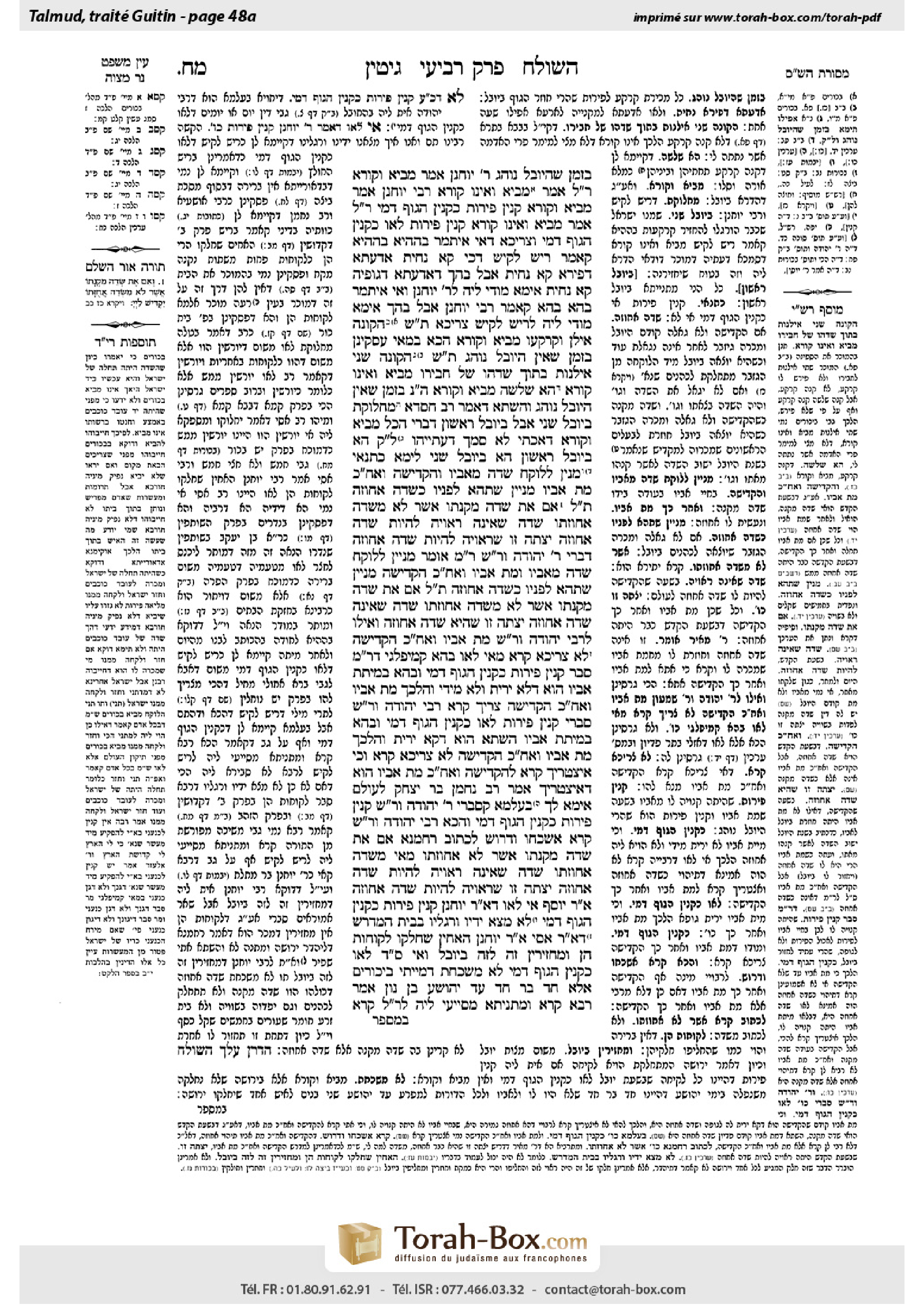
Gittin 48a: Talmud study for Daf Yomi
Study the Talmud for Daf Yomi with scanned pages, Hebrew text, English translations from Sefaria and AI-generated French translations.
Passage selection and English or AI-generated French translation are available where the scan has annotations. Daf Study is independent of Torah-Box and Sefaria.
Browse Gittin · גיטין · All tractatesGittin 48a text and translations
This page of Gittin includes the Aramaic text, an English translation and an AI-generated French translation, alongside the scan above.
גיטין מ״ח א · Aramaic and Hebrew text
בִּזְמַן שֶׁהַיּוֹבֵל נוֹהֵג, רַבִּי יוֹחָנָן אָמַר: מֵבִיא וְקוֹרֵא. רֵישׁ לָקִישׁ אָמַר: מֵבִיא וְאֵינוֹ קוֹרֵא.
רַבִּי יוֹחָנָן אָמַר מֵבִיא וְקוֹרֵא – קִנְיַן פֵּירוֹת כְּקִנְיַן הַגּוּף דָּמֵי. רֵישׁ לָקִישׁ אָמַר מֵבִיא וְאֵינוֹ קוֹרֵא – קִנְיַן פֵּירוֹת לָאו כְּקִנְיַן הַגּוּף דָּמֵי.
וּצְרִיכָא. דְּאִי אִיתְּמַר בְּהָהִיא, בְּהָהִיא קָאָמַר רֵישׁ לָקִישׁ, דְּכִי קָא נָחֵית – אַדַּעְתָּא דְפֵירָא קָא נָחֵית; אֲבָל בְּהָךְ – דְּאַדַּעְתָּא דְגוּפֵיהּ קָא נָחֵית, אֵימָא מוֹדֵי לֵיהּ לְרַבִּי יוֹחָנָן.
וְאִי אִיתְּמַר בְּהָא, בְּהָא קָאָמַר רַבִּי יוֹחָנָן, אֲבָל בְּהָךְ אֵימָא מוֹדֵי לֵיהּ לְרֵישׁ לָקִישׁ; צְרִיכָא.
תָּא שְׁמַע: הַקּוֹנֶה אִילָן וְקַרְקָעוֹ – מֵבִיא וְקוֹרֵא! הָכָא בְּמַאי עָסְקִינַן – בִּזְמַן שֶׁאֵין הַיּוֹבֵל נוֹהֵג.
תָּא שְׁמַע: הַקּוֹנֶה שְׁנֵי אִילָנוֹת בְּתוֹךְ שָׂדֵהוּ שֶׁל חֲבֵירוֹ – מֵבִיא וְאֵינוֹ קוֹרֵא. הָא שְׁלֹשָׁה – מֵבִיא וְקוֹרֵא! הָכָא נָמֵי בִּזְמַן שֶׁאֵין הַיּוֹבֵל נוֹהֵג.
וְהַשְׁתָּא דְּאָמַר רַב חִסְדָּא: מַחְלוֹקֶת בְּיּוֹבֵל שֵׁנִי, אֲבָל בְּיּוֹבֵל רִאשׁוֹן – דִּבְרֵי הַכֹּל מֵבִיא וְקוֹרֵא, דְּאַכַּתִּי לָא סְמַךְ דַּעְתַּיְיהוּ; לָא קַשְׁיָא: הָא בְּיוֹבֵל רִאשׁוֹן, הָא בְּיוֹבֵל שֵׁנִי.
לֵימָא כְּתַנָּאֵי: מִנַּיִן לַלּוֹקֵחַ שָׂדֶה מֵאָבִיו, וְהִקְדִּישָׁהּ, וְאַחַר כָּךְ מֵת אָבִיו – מִנַּיִין שֶׁתְּהֵא לְפָנָיו כִּשְׂדֵה אֲחוּזָּה?
תַּלְמוּד לוֹמַר: ״אִם אֶת שְׂדֵה מִקְנָתוֹ אֲשֶׁר לֹא מִשְּׂדֵה אֲחוּזָּתוֹ״ – שָׂדֶה שֶׁאֵינָהּ רְאוּיָה לִהְיוֹת שְׂדֵה אֲחוּזָּה, יָצְתָה זוֹ שֶׁרְאוּיָה לִהְיוֹת שְׂדֵה אֲחוּזָּה, דִּבְרֵי רַבִּי יְהוּדָה וְרַבִּי שִׁמְעוֹן.
רַבִּי מֵאִיר אוֹמֵר: מִנַּיִין לַלּוֹקֵחַ שָׂדֶה מֵאָבִיו וּמֵת אָבִיו וְאַחַר כָּךְ הִקְדִּישָׁהּ, מִנַּיִין שֶׁתְּהֵא לְפָנָיו כִּשְׂדֵה אֲחוּזָּה? תַּלְמוּד לוֹמַר: ״אִם אֶת שְׂדֵה מִקְנָתוֹ אֲשֶׁר לֹא מִשְּׂדֵה אֲחוּזָּתוֹ״ – שָׂדֶה שֶׁאֵינָהּ שְׂדֵה אֲחוּזָּה, יָצְתָה זוֹ שֶׁהִיא שְׂדֵה אֲחוּזָּה. וְאִילּוּ לְרַבִּי יְהוּדָה וְרַבִּי שִׁמְעוֹן, מֵת אָבִיו וְאַחַר כָּךְ הִקְדִּישָׁהּ – לָא צְרִיכָא קְרָא.
מַאי, לָאו בְּהָא קָמִיפַּלְגִי? דְּרַבִּי מֵאִיר סָבַר: קִנְיַן פֵּירוֹת כְּקִנְיַן הַגּוּף דָּמֵי, וּבְהָא – בְּמִיתַת אָבִיו הוּא דְּלָא יָרֵית וְלָא מִידֵּי, וְהִלְכָּךְ מֵת אָבִיו וְאַחַר כָּךְ הִקְדִּישָׁהּ – צְרִיךְ קְרָא;
רַבִּי יְהוּדָה וְרַבִּי שִׁמְעוֹן סָבְרִי: קִנְיַן פֵּירוֹת לָאו כְּקִנְיַן הַגּוּף דָּמֵי, וּבְהָא – בְּמִיתַת אָבִיו הַשְׁתָּא הוּא דְּקָא יָרֵית, וְהִלְכָּךְ מֵת אָבִיו וְאַחַר כָּךְ הִקְדִּישָׁהּ – לָא צְרִיכָא קְרָא; וְכִי אִיצְטְרִיךְ קְרָא – לְהִקְדִּישָׁהּ וְאַחַר כָּךְ מֵת אָבִיו הוּא דְּאִיצְטְרִיךְ.
אָמַר רַב נַחְמָן בַּר יִצְחָק: לְעוֹלָם אֵימָא לָךְ, בְּעָלְמָא קָסָבְרִי רַבִּי יְהוּדָה וְרַבִּי שִׁמְעוֹן קִנְיַן פֵּירוֹת כְּקִנְיַן הַגּוּף דָּמֵי. וְהָכָא, רַבִּי יְהוּדָה וְרַבִּי שִׁמְעוֹן קְרָא אַשְׁכַּחוּ וּדְרוּשׁ – לִכְתּוֹב רַחֲמָנָא ״אִם אֶת שְׂדֵה מִקְנָתוֹ אֲשֶׁר לֹא אֲחוּזָּתוֹ״; מַאי ״מִשְּׂדֵה אֲחוּזָּתוֹ״? שָׂדֶה שֶׁאֵינָהּ רְאוּיָה לִהְיוֹת שְׂדֵה אֲחוּזָּה – יָצְתָה זוֹ, שֶׁרְאוּיָה לִהְיוֹת שְׂדֵה אֲחוּזָּה.
אָמַר רַב יוֹסֵף: אִי לָאו דְּאָמַר רַבִּי יוֹחָנָן קִנְיַן פֵּירוֹת כְּקִנְיַן הַגּוּף דָּמֵי, לֹא מָצָא יָדָיו וְרַגְלָיו בְּבֵית הַמִּדְרָשׁ. דְּאָמַר רַבִּי אַסִּי אָמַר רַבִּי יוֹחָנָן: הָאַחִין שֶׁחָלְקוּ – לָקוֹחוֹת הֵן, וּמַחְזִירִין זֶה לָזֶה בְּיוֹבֵל;
וְאִי סָלְקָא דַעְתָּךְ לָאו כְּקִנְיַן הַגּוּף דָּמֵי, לָא מַשְׁכַּחַתְּ דְּמַיְיתֵי בִּיכּוּרִים אֶלָּא חַד בַּר חַד עַד יְהוֹשֻׁעַ בִּן נוּן!
אָמַר רָבָא: קְרָא וּמַתְנִיתָא מְסַיְּיעִי לֵיהּ לְרֵישׁ לָקִישׁ. קְרָא –
Gittin 48a · English translation
in the time when the Jubilee Year is practiced, and every sale of land is only for its produce, because the land returns to its original owners in the Jubilee Year, Rabbi Yoḥanan says: The purchaser brings the first fruits and recites the verses. Reish Lakish says: The purchaser brings the first fruits but he does not recite the verses.
The Gemara explains: Rabbi Yoḥanan says that the purchaser brings the first fruits and recites the verses, because he holds that the acquisition of an item for its produce is considered to be like the acquisition of the item itself. Consequently, the one bringing the fruits can truthfully recite: “The land which You, Lord, have given me” (Deuteronomy 26:10). Reish Lakish says that the purchaser brings the first fruits but he does not recite the verses, because he holds that the acquisition of an item for its produce is not considered to be like the acquisition of the item itself.
The Gemara comments: And it is necessary to state the dispute between Rabbi Yoḥanan and Reish Lakish in both cases. Because if it was stated only in that case, with regard to one who acquires a field for its produce, one might say that it is only in that case that Reish Lakish says that he does not recite the verses, since already when he descended to the field, i.e., took possession of the land, he descended with the intention of acquiring only the produce, as stipulated at the time of the sale; but in this case, with regard to one who purchases the field when the Jubilee Year is practiced, when he descended to the field with the intention of acquiring the land itself, say that he concedes to Rabbi Yoḥanan that he recites the verses. Therefore, it is necessary to state explicitly that Reish Lakish holds that he does not recite the verses in this case as well.
And if it was stated only in this case, with regard to one who purchases the field when the Jubilee Year is practiced, one might say that it is only in this case that Rabbi Yoḥanan says that it is like the acquisition of the item itself and recites the verses, as he purchased the field to fully own it; but in that case, where the sale was only with regard to the produce, say that he concedes to Reish Lakish that he does not recite the verses. Therefore, it is necessary to state the dispute in both cases.
The Gemara offers a proof in support of Rabbi Yoḥanan’s opinion: Come and hear a proof from the mishna (Bikkurim 1:11): One who acquires a tree and its surrounding land brings the first fruits of those trees and recites the verses, even though he is required to return the land in the Jubilee Year. The Gemara responds: With what are we dealing here according to the opinion of Reish Lakish? The mishna is referring to one who acquires a tree and its surrounding land in the time when the Jubilee Year is not practiced, so the acquisition is permanent.
The Gemara suggests another proof in support of Rabbi Yoḥanan’s opinion: Come and hear a proof from the mishna (Bikkurim 1:6): One who acquires two trees in another’s field brings the first fruits of those trees but does not recite the verses, as he acquires only the trees but not the land. But if one acquires three trees, he brings the first fruits of those trees and recites the verses, because he also acquires the land surrounding the trees, despite the fact that the land is returned in the Jubilee Year. The Gemara rejects this: Here too, Reish Lakish would explain that the mishna is referring to one who acquires three trees in the time when the Jubilee Year is not practiced.
The Gemara comments: And now that Rav Ḥisda said: The dispute between Rabbi Yoḥanan and Reish Lakish is with regard to land sold during the second Jubilee, after the Jewish people already practiced the Jubilee Year once and people could trust that the land would be returned in the Jubilee Year, but with regard to land sold during the first Jubilee, which was practiced by the Jews immediately following their entry into Eretz Yisrael, everyone agrees that he brings the first fruits and recites the verses, as they did not yet rely on the fact that the fields would be returned, there is no need to claim that according to Reish Lakish these mishnayot are referring to when the Jubilee Year was not practiced. Instead, one could answer that it is not difficult: This, the mishnayot that state that he brings the first fruits and recites the verses, are referring to land sold during the first Jubilee. That, where Reish Lakish rules that he brings the first fruits but does not recite the verses, is referring to land sold during the second Jubilee.
The Gemara suggests: Let us say that the dispute between Rabbi Yoḥanan and Reish Lakish is parallel to a dispute between tanna’im. The halakha is that if one consecrated but did not redeem his ancestral field, and the Temple treasury sold it to another Jew, it becomes the property of the priesthood in the Jubilee Year. However, if one purchases a field from another Jew and consecrates it, it reverts back to the original owner in the Jubilee Year. The baraita taught: From where is it derived that one who purchases a field from his father in the time when the Jubilee Year was practiced and consecrated it, and afterward his father died, from where is it derived that it should be considered before him like an ancestral field, and it does not revert to the son’s ownership in the Jubilee Year?
The baraita continues: The verse states: “And if he sanctify to the Lord a field which he has bought, which is not of the field of his ancestral field” (Leviticus 27:22). The addition of the phrase: “Which is not of the field of his ancestral field,” teaches that the halakha that the field reverts to the original owner applies specifically to a field that is not fit to be an ancestral field, meaning that he would not inherit it in the future. This field, which the son was entitled to inherit after he had consecrated it, is excluded, as it is fit to be an ancestral field, although the son had purchased it. This is the statement of Rabbi Yehuda and Rabbi Shimon.
The baraita continues: Rabbi Meir says: From where is it derived that one who purchases a field from his father at the time when the Jubilee Year was practiced and his father died, and afterward he consecrated it, from where is it derived that it should be considered before him like an ancestral field, and does not revert to the son in the Jubilee Year? The verse states: “And if he sanctify to the Lord a field which he has bought, which is not of the field of his ancestral field.” The addition of the phrase: “Which is not of the field of his ancestral field,” teaches that the halakha that the field reverts to the original owner applies specifically to a field that is not an ancestral field, meaning that he did not inherit it. This field, which the son inherited before he consecrated it, is excluded, as it is an ancestral field, while according to the opinion of Rabbi Yehuda and Rabbi Shimon, a verse is not required to teach that in a case where his father died, and he consecrated it afterward, it is considered an ancestral field, as this is obvious. The Gemara explains why the other tanna’im do not require a verse to teach the halakha in the case discussed by Rabbi Meir:
The Gemara clarifies: What, is it not that they disagree about this, as Rabbi Meir holds: The acquisition of an item for its produce is considered to be like the acquisition of the item itself, and in this case, when he purchased the field, i.e., the rights to the produce, from his father before his death, it is the case that he inherits nothing when his father dies, as he had already taken ownership of the field when he purchased it from his father, and nothing changed with his father’s death; and therefore, if his father died and he consecrated it afterward, then a verse is necessary to teach that it is treated like an ancestral field, as one might have thought that the field is his entirely as a result of the purchase, and not because of an ancestral inheritance.
While Rabbi Yehuda and Rabbi Shimon hold that the acquisition of an item for its produce is not considered to be like the acquisition of the item itself, and in this case, when he had purchased the field from his father before his father died, with the death of his father he now inherits the field as well, since until now he owned only the rights to the produce; and therefore if his father died and he consecrated the field afterward, a verse is not necessary to teach that it is an ancestral field, as it is obvious that he now owns it due to his inheritance. And when a verse was necessary, it is for a case where he consecrated the field and his father died afterward that it was necessary.
The Gemara rejects this explanation of the dispute. Rav Naḥman bar Yitzḥak said: Actually, I could say to you that in general Rabbi Yehuda and Rabbi Shimon hold that the acquisition of an item for its produce is considered to be like the acquisition of the item itself, and they agree that the verse is necessary to teach the halakha concerning a case where he consecrated the field after his father’s death. And here, Rabbi Yehuda and Rabbi Shimon found another element of the verse and they expounded it. They maintain that if the verse is teaching the halakha only in the case where he consecrated the field after his father’s death, then let the Merciful One write in the Torah: And if he sanctify to the Lord a field which he has bought, which is not his ancestral field. What is the meaning of the expression: “Of his ancestral field” (Leviticus 27:22)? This emphasizes: A field that is not fit to be an ancestral field, meaning that he would not inherit it in the future. This field, which the son was entitled to inherit after he had consecrated it, is excluded, as it is fit to be an ancestral field, although the son had purchased it.
Rav Yosef said: If not for the fact that Rabbi Yoḥanan said that the acquisition of an item for its produce is considered to be like the acquisition of the item itself, he would not find his hands or his feet in the study hall, i.e., there would be a contradiction between Rabbi Yoḥanan’s statements. As Rav Asi says that Rabbi Yoḥanan says: Brothers who divided property received as an inheritance are considered to be purchasers from one another, and as purchasers of land they must return the portions to each other in the Jubilee Year, at which point they may redistribute the property.
And if it enters your mind to say that the legal status of the acquisition of an item for its produce is not like that of the acquisition of the item itself, then according to Rabbi Yoḥanan’s opinion you will find that one brings first fruits by Torah law only when he is an only child the son of an only child, and so forth, dating back to the time of Joshua, son of Nun. Only in such a case does the child fully inherit the land. In any other case, the children inherit only the rights to the produce, as they must return the actual land to each other in the Jubilee Year, and would not be able to recite the verses connected with the first fruits, since they could not refer to the land that the Lord has given them. Since Rabbi Yoḥanan holds that the acquisition of an item for its produce is considered to be like the acquisition of the item itself, anyone who inherits land may recite the verses.
Rava said: A verse and a baraita support the opinion of Reish Lakish. A verse, as it is written:
Gittin 48a · Traduction française (IA)
Lorsque l'année sabbatique est en vigueur, et que chaque vente de terre est uniquement pour ses produits, car la terre retourne à ses propriétaires originels lors de l'année sabbatique, Rabbi Yoḥanan dit : L'acheteur apporte les premiers fruits et récite les versets. Reish Lakish dit : L'acheteur apporte les premiers fruits mais il ne récite pas les versets.
La Guemara explique : Rabbi Yoḥanan dit que l'acheteur apporte les premiers fruits et récite les versets, car il considère que l'acquisition d'un objet pour ses produits est comme l'acquisition de l'objet lui-même. Par conséquent, celui qui apporte les fruits peut sincèrement réciter : « La terre que tu as donnée, Seigneur, à moi » (Deutéronome 26:10). Reish Lakish dit que l'acheteur apporte les premiers fruits mais ne récite pas les versets, car il considère que l'acquisition d'un objet pour ses produits n'est pas comme l'acquisition de l'objet lui-même.
La Guemara commente : Il est nécessaire d'énoncer le débat entre Rabbi Yoḥanan et Reish Lakish dans les deux cas. Car si cela avait été dit uniquement dans ce cas, concernant celui qui acquiert un champ pour ses produits, on pourrait dire que c'est uniquement dans ce cas que Reish Lakish dit qu'il ne récite pas les versets, car déjà lorsqu'il est descendu dans le champ, c'est-à-dire qu'il a pris possession de la terre, il était descendu avec l'intention d'acquérir uniquement les produits, comme stipulé lors de la vente ; mais dans ce cas, concernant celui qui achète le champ lors de l'année sabbatique, lorsqu'il est descendu dans le champ avec l'intention d'acquérir la terre elle-même, on dirait qu'il reconnaît la position de Rabbi Yoḥanan et qu'il récite les versets. Par conséquent, il est nécessaire d'énoncer explicitement que Reish Lakish considère qu'il ne récite pas les versets dans ce cas également.
Et si cela avait été dit uniquement dans ce cas, concernant celui qui achète le champ lors de l'année sabbatique, on pourrait dire que c'est uniquement dans ce cas que Rabbi Yoḥanan dit que c'est comme l'acquisition de l'objet lui-même et qu'il récite les versets, car il a acheté le champ pour en être pleinement propriétaire ; mais dans ce cas, où la vente était uniquement concernant les produits, on dirait qu'il reconnaît la position de Reish Lakish et qu'il ne récite pas les versets. Par conséquent, il est nécessaire d'énoncer le débat dans les deux cas.
La Guemara propose une preuve en faveur de l'opinion de Rabbi Yoḥanan : Viens écouter une preuve à partir de la mitsna (Bikkurim 1:11) : Celui qui acquiert un arbre et la terre environnante apporte les premiers fruits de ces arbres et récite les versets, même s'il est tenu de rendre la terre lors de l'année sabbatique. La Guemara répond : Avec quoi sommes-nous en train de traiter selon l'opinion de Reish Lakish ? La mitsna fait référence à celui qui acquiert un arbre et la terre environnante lorsqu'il n'y a pas d'année sabbatique, donc l'acquisition est permanente.
La Guemara suggère une autre preuve en faveur de l'opinion de Rabbi Yoḥanan : Viens écouter une preuve à partir de la mitsna (Bikkurim 1:6) : Celui qui acquiert deux arbres dans le champ d'autrui apporte les premiers fruits de ces arbres mais ne récite pas les versets, car il acquiert uniquement les arbres mais pas la terre. Mais si l'on acquiert trois arbres, il apporte les premiers fruits de ces arbres et récite les versets, car il acquiert également la terre environnante des arbres, malgré le fait que la terre est rendue lors de l'année sabbatique. La Guemara rejette cela : Ici aussi, Reish Lakish expliquerait que la mitsna fait référence à celui qui acquiert trois arbres lorsqu'il n'y a pas d'année sabbatique.
La Guemara commente : Et maintenant que Rav Ḥisda a dit : Le débat entre Rabbi Yoḥanan et Reish Lakish concerne les terres vendues lors du deuxième année sabbatique, après que le peuple juif ait déjà pratiqué l'année sabbatique une fois et que les gens pouvaient compter sur le fait que la terre serait rendue lors de l'année sabbatique, mais concernant les terres vendues lors du premier année sabbatique, qui a été pratiqué par les Juifs immédiatement après leur entrée en Eretz Yisrael, tout le monde s'accorde à dire qu'il apporte les premiers fruits et récite les versets, car ils n'avaient pas encore confiance dans le fait que les champs seraient rendus, il n'est donc pas nécessaire de dire que selon Reish Lakish ces mitsvot font référence à un temps où l'année sabbatique n'était pas pratiquée. Au contraire, on pourrait répondre que cela n'est pas difficile : Ceux, les mitsvot qui disent qu'il apporte les premiers fruits et récite les versets, font référence aux terres vendues lors du premier année sabbatique. Celui, où Reish Lakish dit qu'il apporte les premiers fruits mais ne récite pas les versets, fait référence aux terres vendues lors du deuxième année sabbatique.
La Guemara suggère : Faisons-le savoir que le débat entre Rabbi Yoḥanan et Reish Lakish est parallèle à un débat entre des tannaïm. La halakha est que si l'on a consacré mais n'a pas racheté son champ ancestral, et que le trésor du Temple l'a vendu à un autre Juif, il devient la propriété des prêtres lors de l'année sabbatique. Cependant, si l'on achète un champ à un autre Juif et le consacre, il revient à l'original propriétaire lors de l'année sabbatique. La baraïta enseigne : D'où est tiré le fait que celui qui achète un champ à son père lorsqu'il y a une année sabbatique et le consacre, et ensuite son père meurt, d'où est tiré le fait qu'il est considéré comme un champ ancestral avant lui, et qu'il ne revient pas à la propriété du fils lors de l'année sabbatique ?
La baraïta continue : Le verset dit : « Et s'il sanctifie à l'Éternel un champ qu'il a acheté, qui n'est pas du champ de son champ ancestral » (Lévitique 27:22). L'ajout de la phrase : « Qui n'est pas du champ de son champ ancestral », enseigne que la halakha selon laquelle le champ revient à l'original propriétaire s'applique spécifiquement à un champ qui n'est pas adapté à être un champ ancestral, c'est-à-dire qu'il ne sera pas hérité à l'avenir. Ce champ, auquel le fils avait le droit d'hériter après qu'il l'ait consacré, est exclu, car il est adapté à être un champ ancestral, même si le fils l'avait acheté. C'est l'opinion de Rabbi Yehuda et Rabbi Shimon.
La baraïta continue : Rabbi Meïr dit : D'où tire-t-on que celui qui achète un champ auprès de son père pendant l'année sainte et que son père meurt, et ensuite il le consacre, d'où tire-t-on qu'il doit être considéré comme un champ ancestral avant lui et ne revienne pas au fils pendant l'année sainte ? La Sainte Écriture dit : « Et s'il sanctifie à l'Éternel un champ qu'il a acheté, qui n'est pas un champ de son ancêtre. » L'ajout de la phrase : « Qui n'est pas un champ de son ancêtre », enseigne que la halakha selon laquelle le champ revient à l'acquéreur initial s'applique spécifiquement à un champ qui n'est pas un champ ancestral, c'est-à-dire qu'il n'a pas été hérité. Ce champ, que le fils a hérité avant de le consacrer, est exclu, car il est un champ ancestral, tandis que selon l'opinion de Rabbi Yéhouda et de Rabbi Shimon, une verset n'est pas nécessaire pour enseigner cela dans le cas où son père est mort et qu'il le consacre ensuite, car cela est évident. La Guemara explique pourquoi les autres tannaïm n'ont pas besoin d'une verset pour enseigner cette halakha dans le cas discuté par Rabbi Meïr :
La Guemara clarifie : Qu'est-ce que cela signifie, n'est-ce pas qu'ils discutent de cela, car Rabbi Meïr affirme que l'acquisition d'un objet pour ses produits est considérée comme l'acquisition de l'objet lui-même, et dans ce cas, lorsqu'il a acheté le champ, c'est-à-dire les droits aux produits, auprès de son père avant sa mort, il ne hérite rien lorsque son père meurt, car il avait déjà acquis le champ lorsqu'il l'avait acheté auprès de son père, et rien n'a changé avec la mort de son père ; et donc, si son père est mort et qu'il le consacre ensuite, un verset est nécessaire pour enseigner qu'il est traité comme un champ ancestral, car on pourrait penser que le champ est entièrement à lui en raison de l'achat, et non en raison d'une héritage ancestral.
Tandis que Rabbi Yéhouda et Rabbi Shimon affirment que l'acquisition d'un objet pour ses produits n'est pas considérée comme l'acquisition de l'objet lui-même, et dans ce cas, lorsqu'il a acheté le champ auprès de son père avant la mort de ce dernier, avec la mort de son père, il hérite maintenant du champ, car jusqu'à présent il possédait seulement les droits aux produits ; et donc, si son père est mort et qu'il consacre le champ ensuite, un verset n'est pas nécessaire pour enseigner qu'il est un champ ancestral, car cela est évident qu'il possède maintenant le champ en raison de l'héritage. Et lorsque un verset était nécessaire, c'était pour un cas où il avait consacré le champ et que son père est mort après.
La Guemara rejette cette explication de la dispute. Rav Naḥman bar Yitzḥak dit : En réalité, je pourrais vous dire que, dans l'ensemble, Rabbi Yéhouda et Rabbi Shimon affirment que l'acquisition d'un objet pour ses produits est considérée comme l'acquisition de l'objet lui-même, et qu'ils s'accordent sur le fait que le verset est nécessaire pour enseigner la halakha concernant le cas où il a consacré le champ après la mort de son père. Et ici, Rabbi Yéhouda et Rabbi Shimon ont trouvé un autre élément du verset et l'ont interprété. Ils maintiennent que si le verset enseigne la halakha uniquement dans le cas où il a consacré le champ après la mort de son père, alors que l'Éternel écrive dans la Torah : « Et s'il sanctifie à l'Éternel un champ qu'il a acheté, qui n'est pas son champ ancestral. » Que signifie l'expression : « De son champ ancestral » (Lévitique 27:22) ? Cela souligne : un champ qui n'est pas adapté à être un champ ancestral, c'est-à-dire qu'il ne serait pas hérité à l'avenir. Ce champ, auquel le fils avait droit d'héritage après qu'il l'ait consacré, est exclu, car il est adapté à être un champ ancestral, bien que le fils l'ait acheté.
Rav Yosef dit : Si ce n'était pas pour le fait que Rabbi Yoḥanan disait que l'acquisition d'un objet pour ses produits est considérée comme l'acquisition de l'objet lui-même, il ne trouverait pas ses mains ou ses pieds dans la salle de study, c'est-à-dire il y aurait une contradiction entre les déclarations de Rabbi Yoḥanan. Car Rav Asi dit que Rabbi Yoḥanan dit : Les frères qui ont divisé les biens reçus en héritage sont considérés comme des acheteurs les uns des autres, et comme acheteurs de terre, ils doivent rendre les portions à l'autre lors de l'année sainte, à ce moment-là ils peuvent redistribuer les biens.
Et si vous pensez que le statut juridique de l'acquisition d'un objet pour ses produits n'est pas comme celui de l'acquisition de l'objet lui-même, alors selon l'opinion de Rabbi Yoḥanan, vous trouveriez que l'on apporte les premiers fruits selon la Loi divine uniquement lorsqu'il est un seul enfant, fils d'un seul enfant, et ainsi de suite, remontant à l'époque de Josué, fils de Nun. Seulement dans ce cas, l'enfant hérite pleinement de la terre. Dans tout autre cas, les enfants héritent seulement des droits aux produits, car ils doivent rendre la terre réelle à l'autre lors de l'année sainte, et ne pourraient pas réciter les versets liés aux premiers fruits, car ils ne pourraient pas se référer à la terre que l'Éternel a donnée. Puisque Rabbi Yoḥanan considère que l'acquisition d'un objet pour ses produits est considérée comme l'acquisition de l'objet lui-même, toute personne qui hérite de terre peut réciter les versets.
Rava dit : Un verset et une baraïta soutiennent l'opinion de Reïsh Lakish. Un verset, car il est écrit :
Traduction française générée par IA à partir de l’édition anglaise de Sefaria. Vérifie toujours un passage avec le texte source.
Text from Sefaria: William Davidson Edition - Vocalized Aramaic (CC BY NC); William Davidson Edition - English (CC BY NC).