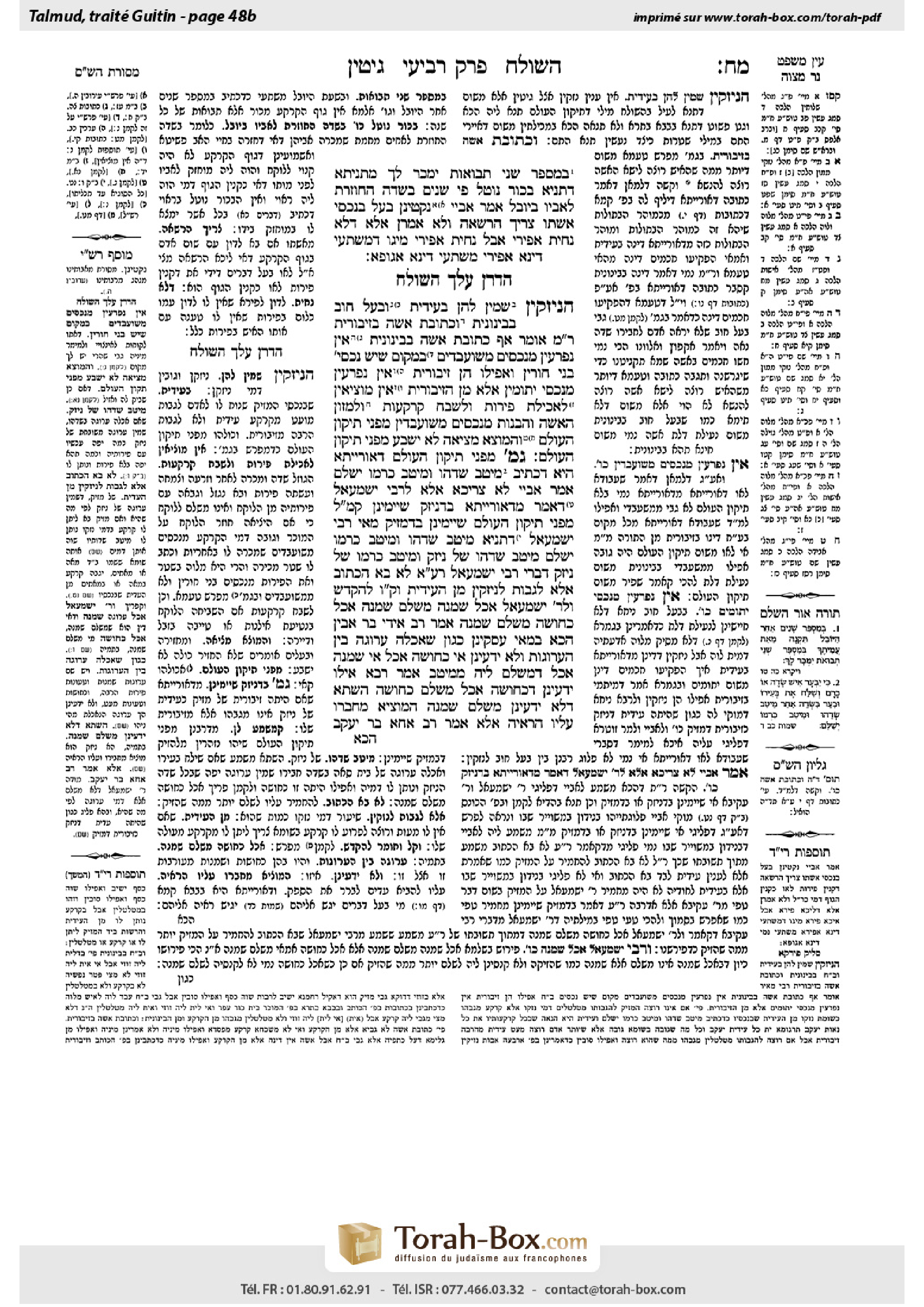
Gittin 48b: Talmud study for Daf Yomi
Study the Talmud for Daf Yomi with scanned pages, Hebrew text, English translations from Sefaria and AI-generated French translations.
Passage selection and English or AI-generated French translation are available where the scan has annotations. Daf Study is independent of Torah-Box and Sefaria.
Browse Gittin · גיטין · All tractatesGittin 48b text and translations
This page of Gittin includes the Aramaic text, an English translation and an AI-generated French translation, alongside the scan above.
גיטין מ״ח ב · Aramaic and Hebrew text
״בְּמִסְפַּר שְׁנֵי תְבוּאוֹת יִמְכׇּר לָךְ״.
מַתְנִיתָא – דְּתַנְיָא: בְּכוֹר נוֹטֵל פִּי שְׁנַיִם בְּשָׂדֶה הַחוֹזֶרֶת לְאָבִיו בְּיוֹבֵל.
אָמַר אַבָּיֵי, נָקְטִינַן: בַּעַל בְּנִכְסֵי אִשְׁתּוֹ צָרִיךְ הַרְשָׁאָה.
וְלָא אֲמַרַן אֶלָּא דְּלָא נָחֵית אַפֵּירֵי, אֲבָל נָחֵית אַפֵּירֵי, מִיגּוֹ דְּמִשְׁתַּעֵי דִּינָא אַפֵּירֵי – מִשְׁתַּעֵי דִּינָא אַגּוּפָא.
הֲדַרַן עֲלָךְ הַשּׁוֹלֵחַ
הַנִּיזָּקִין שָׁמִין לָהֶן בְּעִידִּית, וּבַעַל חוֹב בְּבֵינוֹנִית, וּכְתוּבַּת אִשָּׁה בְּזִיבּוּרִית. רַבִּי מֵאִיר אוֹמֵר: אַף כְּתוּבַּת אִשָּׁה בְּבֵינוֹנִית.
אֵין נִפְרָעִין מִנְּכָסִים מְשׁוּעְבָּדִים בִּמְקוֹם שֶׁיֵּשׁ נְכָסִים בְּנֵי חוֹרִין, וַאֲפִילּוּ הֵן זִיבּוּרִית.
אֵין נִפְרָעִין מִנִּכְסֵי יְתוֹמִין אֶלָּא מִן הַזִּיבּוּרִית.
אֵין מוֹצִיאִין לַאֲכִילַת פֵּירוֹת, וְלִשְׁבַח קַרְקָעוֹת,
וְלִמְזוֹן הָאִשָּׁה וְהַבָּנוֹת – מִנְּכָסִים מְשׁוּעְבָּדִין, מִפְּנֵי תִּיקּוּן הָעוֹלָם.
וְהַמּוֹצֵא מְצִיאָה – לֹא יִשָּׁבַע, מִפְּנֵי תִּיקּוּן הָעוֹלָם.
גְּמָ׳ מִפְּנֵי תִּיקּוּן הָעוֹלָם?! דְּאוֹרָיְיתָא הִיא, דִּכְתִיב: ״מֵיטַב שָׂדֵהוּ וּמֵיטַב כַּרְמוֹ יְשַׁלֵּם״!
אָמַר אַבָּיֵי: לָא צְרִיכָא אֶלָּא לְרַבִּי יִשְׁמָעֵאל, דְּאָמַר מִדְּאוֹרָיְיתָא בִּדְנִיזָּק שָׁיְימִינַן; קָא מַשְׁמַע לַן מִפְּנֵי תִּיקּוּן הָעוֹלָם שָׁיְימִינַן בִּדְמַזִּיק.
מַאי רַבִּי יִשְׁמָעֵאל? דְּתַנְיָא: ״מֵיטַב שָׂדֵהוּ וּמֵיטַב כַּרְמוֹ יְשַׁלֵּם״ – מֵיטַב שָׂדֵהוּ שֶׁל נִיזָּק, וּמֵיטַב כַּרְמוֹ שֶׁל נִיזָּק, דִּבְרֵי רַבִּי יִשְׁמָעֵאל. רַבִּי עֲקִיבָא אוֹמֵר: לֹא בָּא הַכָּתוּב אֶלָּא לַגְבּוֹת לַנִּיזָּקִין מִן הָעִידִּית, וְקַל וָחוֹמֶר לַהֶקְדֵּשׁ.
וּלְרַבִּי יִשְׁמָעֵאל, אָכַל שְׁמֵנָה – מְשַׁלֵּם שְׁמֵנָה; אָכַל כְּחוּשָׁה – מְשַׁלֵּם שְׁמֵנָה?! אָמַר רַב אִידִי בַּר אָבִין: הָכָא בְּמַאי עָסְקִינַן – כְּגוֹן שֶׁאָכְלָה עֲרוּגָה בֵּין הָעֲרוּגוֹת, וְלָא יָדְעִינַן אִי כְּחוּשָׁה אָכַל אִי שְׁמֵנָה אָכַל, דִּמְשַׁלֵּם לֵיהּ מִמֵּיטַב.
אָמַר רָבָא: אִילּוּ יָדְעִינַן דִּכְחוּשָׁה אָכַל – מְשַׁלֵּם כְּחוּשָׁה; הַשְׁתָּא דְּלָא יָדְעִינַן – מְשַׁלֵּם שְׁמֵנָה?! הַמּוֹצִיא מֵחֲבֵרוֹ עָלָיו הָרְאָיָה! אֶלָּא אָמַר רַב אַחָא בַּר יַעֲקֹב:
Gittin 48b · English translation
“According to the number of years of the crops he shall sell to you” (Leviticus 25:15), meaning that it is not the field itself that is sold, but rather, what is sold is the right to consume the produce for a specific number of years.
A baraita supports the opinion of Reish Lakish, as it is taught: A firstborn son takes a double portion in a field that returns to his father in the Jubilee Year, i.e., a field that his father sold, and he subsequently died, and the field therefore returns to his sons in the Jubilee Year. The halakha is that a firstborn son receives a double portion only of property that the father possessed at the time of his death, but not of property that was due to the father. If the acquisition of the produce is considered to be like the acquisition of the item itself, then the field the father sold would not be considered to have been in his possession at the time of his death.
Abaye said: We have a tradition that a husband requires authorization with regard to his wife’s property, meaning that if there is a legal dispute between the husband and another person with regard to the usufruct property the husband received from his wife, he requires authorization from his wife that he may act on her behalf in order to present himself in court as a litigant. If he does not receive such authorization, the other litigant has the right to claim that he is not legally answerable to the husband, and may insist that the wife come before the court herself. This indicates that the acquisition of the produce is not considered to be like the acquisition of the item itself, and therefore the husband is not the owner of the property.
The Gemara explains: And we said this halakha only when the other litigant did not go down to court with a claim concerning the produce, and the case addresses only the ownership of the land itself. But if he went down to court with a claim concerning the produce, with regard to which the husband is definitely the interested party, then since the husband speaks in front of the court about the law concerning the produce, he also speaks in front of the court about the law concerning the land itself, and therefore he does not require authorization from his wife.
MISHNA: The court appraises land of superior quality [iddit] for payment to injured parties. And a creditor collects his debt from the debtor’s intermediate-quality land. And payment of a woman’s marriage contract is collected from her husband’s inferior-quality land. Rabbi Meir says: Payment of a woman’s marriage contract is also collected from intermediate-quality land.
Payment of a debt or other obligation is not collected from liened property that has been sold to a third party when the debtor still has unsold property, even when this unsold property is inferior-quality land. The creditor cannot collect his debt from liened property that the debtor has sold to another person as long as the debtor is still in possession of other property, even if the remaining assets are inferior to those to which the creditor would otherwise have been entitled.
If one who owed money died and his children inherited his property, the father’s debt can be collected from the property of the orphans only from inferior-quality land.
The court does not appropriate liened property that has been sold to a third party for the consumption of produce or for the enhanced value of land. If one appropriated a field and sold it, and the buyer worked the land, enhanced it, and grew produce on it, and then the initial owner from whom the field had been stolen took back the land and the produce from the buyer, compensating him only for his expenses, then the buyer may go back to the seller, i.e., the robber, and collect his losses. He can collect the purchase price of the field even from property that the robber sold to another person. By contrast, the value of the produce and the enhancement in the value of the field, which resulted from his actions, may be collected only from the robber’s unsold property.
And similarly, payment for the sustenance of a man’s wife and daughters cannot be collected from his liened property. One of the stipulations included in a marriage contract is that after the husband dies, his widow and daughters are entitled to sustenance from his estate. This sustenance cannot be collected from the husband’s liened property that has been sold to another person, but only from his unsold property inherited by his heirs. All of these enactments were made for the betterment of the world.
And it was further instituted that one who finds a lost item and returns it to its rightful owner is not required to take an oath that he did not keep any part of the lost item for himself. This ordinance was also instituted for the betterment of the world.
GEMARA: When the mishna says: For the betterment of the world, it seems to be referring to all of the cases in the mishna. The Gemara therefore asks: The first clause of the mishna states that compensation for damage is collected from superior-quality land. Is this ordinance also only for the betterment of the world? This is by Torah law, as it is written with regard to one who damages another person’s property: “Of the best of his own field, and of the best of his own vineyard, shall he pay” (Exodus 22:4).
Abaye said: This statement is necessary only according to Rabbi Yishmael, who said that by Torah law we appraise the property of the injured party, i.e., the injured party can collect payment only from property equal in quality to the best of his own, even if the one who caused the damage owns property of higher quality. Therefore, the tanna of the mishna teaches us that for the betterment of the world we appraise the property of the one who caused the damage.
The Gemara asks: What is this statement of Rabbi Yishmael alluded to by Abaye? It is as it is taught in a baraita: The verse: “Of the best of his own field, and of the best of his own vineyard, shall he pay,” teaches that the appraisal is of the best quality of the field of the injured party and of the best quality of the vineyard of the injured party. This is the statement of Rabbi Yishmael. Rabbi Akiva says: The verse comes only to allow injured parties to collect compensation from superior-quality land belonging to the one who caused the damage, in the event that he has no money or movable property. And by means of an a fortiori inference one can derive that the Temple treasury collects from superior-quality land.
The Gemara asks: And according to the opinion of Rabbi Yishmael, if one’s animal ate from a rich garden bed, it is understandable that he must pay the injured party the value of a rich garden bed. But if it ate from a poor garden bed, is it reasonable that he pays the value of a rich garden bed? Rav Idi bar Avin said: With what are we dealing here? We are dealing with a case where the animal that caused the damage ate from one garden bed among other garden beds, and we do not know whether it ate from a poor one or it ate from a rich one. In such a case, the animal’s owner pays the injured party the value of the latter’s best quality property.
Rava raised a question and said: If we would know that the animal ate from a poor garden bed, its owner would have to pay only the value of a poor garden bed. Now that we do not know from which garden bed it ate, is it reasonable that he should have to pay the value of a rich garden bed? There is a principle governing monetary disputes that the burden of proof falls on the claimant. Therefore, so long as the injured party cannot prove that the animal ate from the rich garden bed, he should not be entitled to collect the value of such a garden bed. Rather, Rav Aḥa bar Ya’akov said:
Gittin 48b · Traduction française (IA)
"Selon le nombre d'années des récoltes qu'il te vendra" (Lévitique 25:15), cela signifie que ce n'est pas le champ lui-même qui est vendu, mais plutôt le droit de consommer les récoltes pendant un nombre spécifique d'années.
Une baraïta soutient l'opinion de Rachi Lakish, comme il est enseigné : Le premier-né reçoit une part double dans un champ qui revient à son père en l'an de sabbat, c'est-à-dire un champ que son père a vendu, et qu'il est ensuite mort, et que le champ revient donc à ses fils en l'an de sabbat. La halakha est que le premier-né reçoit une part double uniquement du bien que le père possédait au moment de sa mort, mais pas des biens dus au père. Si l'acquisition des récoltes est considérée comme l'acquisition de l'objet lui-même, alors le champ que le père a vendu ne serait pas considérée comme étant en son possession au moment de sa mort.
Abaye a dit : Nous avons une tradition selon laquelle le mari a besoin d'autorisation concernant les biens de sa femme, c'est-à-dire que si un litige existe entre le mari et une autre personne concernant le droit de jouissance que le mari a reçu de sa femme, il a besoin d'autorisation de sa femme pour agir en son nom afin de se présenter devant le tribunal comme partie. Si il ne reçoit pas cette autorisation, l'autre partie peut réclamer qu'il n'est pas légalement responsable envers le mari, et peut exiger que la femme vienne elle-même devant le tribunal. Cela montre que l'acquisition des récoltes n'est pas considérée comme l'acquisition de l'objet lui-même, et donc le mari n'est pas le propriétaire des biens.
La Guemara explique : Et nous avons dit cette halakha seulement lorsque l'autre partie n'est pas descendue devant le tribunal avec une réclamation concernant les récoltes, et que le cas concerne uniquement la propriété du champ lui-même. Mais si elle est descendue devant le tribunal avec une réclamation concernant les récoltes, concernant laquelle le mari est clairement partie intéressée, alors puisque le mari parle devant le tribunal concernant la loi concernant les récoltes, il parle aussi devant le tribunal concernant la loi concernant le champ lui-même, et donc il n'a pas besoin d'autorisation de sa femme.
MICHNA : Le tribunal évalue les terres de qualité supérieure [iddit] pour le paiement aux parties blessées. Et un créancier récupère sa dette sur la terre de qualité intermédiaire du débiteur. Et le paiement du contrat de mariage d'une femme est récupéré sur la terre de qualité inférieure de son mari. Rabbi Meir dit : Le paiement du contrat de mariage d'une femme est également récupéré sur la terre de qualité intermédiaire.
Le paiement d'une dette ou d'une obligation n'est pas récupéré sur une propriété liée qui a été vendue à un tiers lorsque le débiteur possède encore d'autres biens, même si ces biens sont des terres de qualité inférieure. Le créancier ne peut récupérer sa dette sur une propriété liée que le débiteur a vendue à une autre personne tant que le débiteur possède d'autres biens, même si les biens restants sont inférieurs à ceux auxquels le créancier aurait autrement eu droit.
Si celui qui devait de l'argent est mort et que ses enfants ont hérité de ses biens, la dette du père peut être récupérée sur les biens des orphelins uniquement sur des terres de qualité inférieure.
Le tribunal ne s'empare pas d'une propriété liée qui a été vendue à un tiers pour la consommation des récoltes ou pour la valeur augmentée de la terre. Si l'on a s'approprié un champ et l'a vendu, et que l'acheteur a travaillé la terre, l'a améliorée et a cultivé des récoltes, et que l'propriétaire initial, duquel le champ avait été volé, a récupéré la terre et les récoltes de l'acheteur, en compensant ce dernier uniquement pour ses dépenses, alors l'acheteur peut retourner auprès du vendeur, c'est-à-dire le voleur, pour récupérer ses pertes. Il peut récupérer le prix d'achat du champ même sur les biens que le voleur a vendus à un autre personne. En revanche, la valeur des récoltes et l'amélioration de la valeur du champ, résultant de ses actions, peuvent être récupérées uniquement sur les biens non vendus du voleur.
Et de même, le paiement pour la subsistance d'une femme et de ses filles ne peut pas être récupéré sur la propriété liée du mari. L'une des stipulations incluses dans un contrat de mariage est que, après la mort du mari, sa veuve et ses filles sont autorisées à recevoir une subsistance de son patrimoine. Cette subsistance ne peut pas être récupérée sur la propriété liée du mari qui a été vendue à un autre personne, mais uniquement sur ses biens non vendus hérités par ses héritiers. Toutes ces ordonnances ont été instituées pour le bien-être du monde.
Et il a été institué de plus que celui qui trouve un objet perdu et le rend à son propriétaire n'est pas tenu de jurer qu'il n'a pas gardé une partie de l'objet perdu pour lui-même. Cette ordonnance a également été instituée pour le bien-être du monde.
GUEMARA : Lorsque la mishna dit : Pour le bien-être du monde, cela semble faire référence à tous les cas de la mishna. La Guemara demande donc : La première clause de la mishna stipule que la compensation pour les dommages est récupérée sur une terre de qualité supérieure. Cette ordonnance est-elle aussi uniquement pour le bien-être du monde ? Cela est selon la loi de la Torah, car il est écrit concernant celui qui endommage la propriété d'une autre personne : "De la meilleure de son propre champ et de la meilleure de son propre vignoble, il paiera" (Exode 22:4).
Abaye a dit : Cette déclaration est nécessaire uniquement selon Rabbi Yishmael, qui a dit que selon la loi de la Torah nous évaluons la propriété de la personne blessée, c'est-à-dire que la personne blessée peut récupérer le paiement uniquement sur une propriété égale en qualité à la meilleure de la sienne, même si celui qui a causé le dommage possède une propriété de meilleure qualité. Ainsi, le tanna de la mishna nous enseigne que pour le bien-être du monde nous évaluons la propriété de celui qui a causé le dommage.
La Guemara pose la question : De quelle déclaration du maître Yishmael s'agit-il, selon l'interprétation d'Abaye ? C'est ce qui est enseigné dans une baraïta : La parole « De la meilleure de son propre champ et de la meilleure de son propre vignoble, il devra payer », enseigne que l'appréciation est faite sur la meilleure qualité du champ de la partie blessée et sur la meilleure qualité du vignoble de la partie blessée. C'est la déclaration du maître Yishmael. Le maître Akiva dit : La parole vient uniquement permettre aux parties blessées de réclamer une compensation provenant d'un terrain de qualité supérieure appartenant à celui qui a causé le préjudice, en cas où il n'a ni argent ni biens mobiliers. Et par une déduction a fortiori, on peut déduire que le trésor du Temple réclame à partir d'un terrain de qualité supérieure.
La Guemara pose la question : Et selon l'opinion du maître Yishmael, si un animal a mangé dans un lit de jardin riche, il est compréhensible qu'il doive payer à la partie blessée la valeur d'un lit de jardin riche. Mais si l'animal a mangé dans un lit de jardin pauvre, est-il raisonnable qu'il paie la valeur d'un lit de jardin riche ? Rav Idi bar Avin dit : De quoi s'agit-il ici ? S'agit-il d'un cas où l'animal qui a causé le préjudice a mangé dans un lit de jardin parmi d'autres lits de jardin, et nous ne savons pas s'il a mangé dans un lit pauvre ou dans un lit riche. Dans ce cas, le propriétaire de l'animal paie à la partie blessée la valeur de la meilleure qualité de ses biens.
Rava a posé une question et a dit : Si nous savions que l'animal a mangé dans un lit de jardin pauvre, son propriétaire devrait payer seulement la valeur d'un lit de jardin pauvre. Maintenant que nous ne savons pas de quel lit de jardin il a mangé, est-il raisonnable qu'il doive payer la valeur d'un lit de jardin riche ? Il existe un principe concernant les litiges monétaires : la charge de la preuve incombe à l'ayant droit. Ainsi, tant que la partie blessée ne peut pas prouver que l'animal a mangé dans le lit de jardin riche, il ne devrait pas être autorisé à réclamer la valeur de ce lit de jardin. Plutôt, Rav Aḥa bar Ya’akov a dit :
Traduction française générée par IA à partir de l’édition anglaise de Sefaria. Vérifie toujours un passage avec le texte source.
Text from Sefaria: William Davidson Edition - Vocalized Aramaic (CC BY NC); William Davidson Edition - English (CC BY NC).