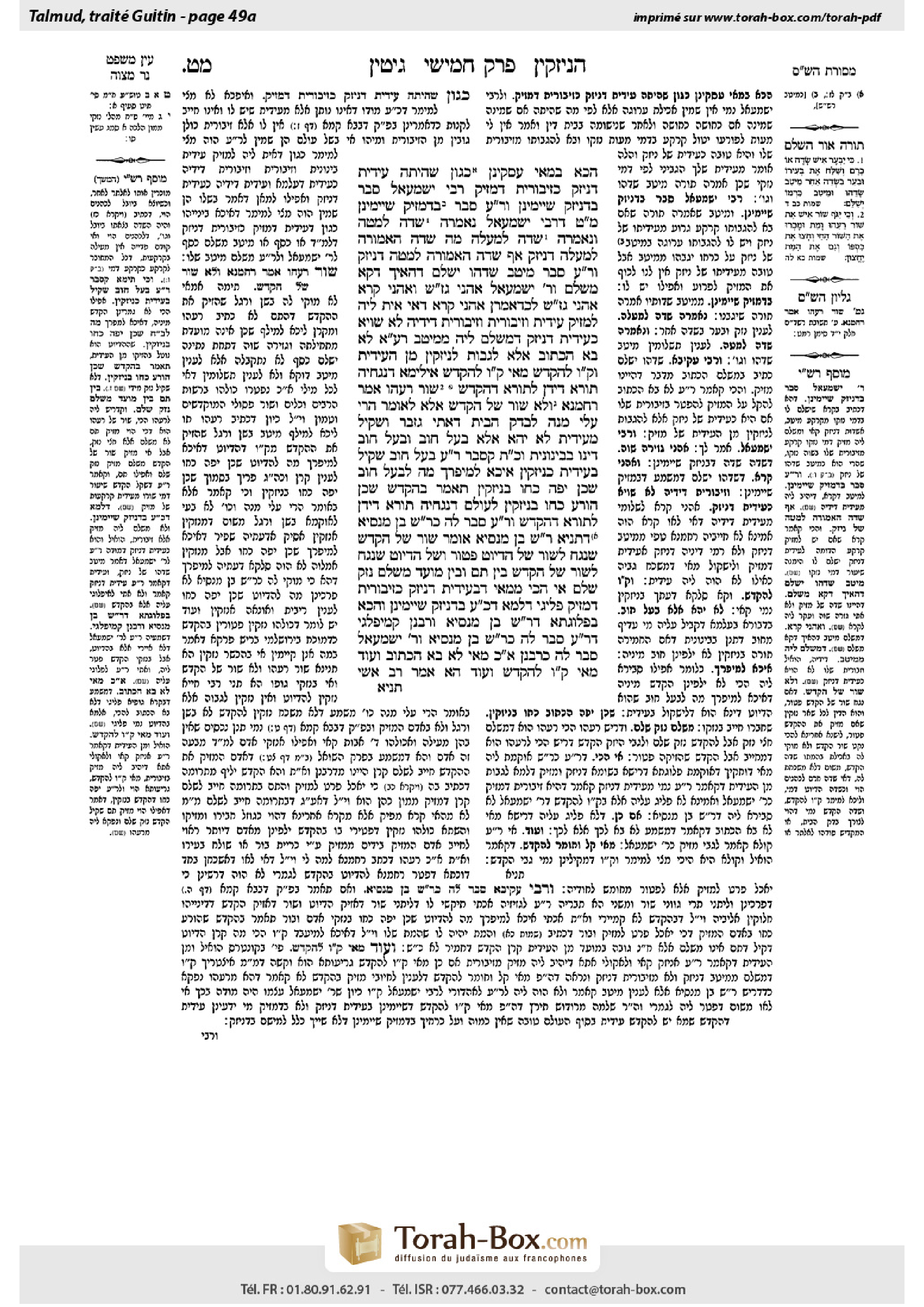
Gittin 49a: Talmud study for Daf Yomi
Study the Talmud for Daf Yomi with scanned pages, Hebrew text, English translations from Sefaria and AI-generated French translations.
Passage selection and English or AI-generated French translation are available where the scan has annotations. Daf Study is independent of Torah-Box and Sefaria.
Browse Gittin · גיטין · All tractatesGittin 49a text and translations
This page of Gittin includes the Aramaic text, an English translation and an AI-generated French translation, alongside the scan above.
גיטין מ״ט א · Aramaic and Hebrew text
הָכָא בְּמַאי עָסְקִינַן – כְּגוֹן שֶׁהָיְתָה עִידִּית דְּנִיזָּק כְּזִיבּוּרִית דְּמַזִּיק; רַבִּי יִשְׁמָעֵאל סָבַר: בִּדְנִיזָּק שָׁיְימִינַן, וְרַבִּי עֲקִיבָא סָבַר: בִּדְמַזִּיק שָׁיְימִינַן.
מַאי טַעְמָא דְּרַבִּי יִשְׁמָעֵאל? נֶאֶמְרָה ״שָׂדֶה״ לְמַטָּה, וְנֶאֶמְרָה ״שָׂדֶה״ לְמַעְלָה; מָה שָׂדֶה הָאֲמוּרָה לְמַעְלָה – דְּנִיזָּק, אַף שָׂדֶה הָאֲמוּרָה לְמַטָּה – דְּנִיזָּק.
וְרַבִּי עֲקִיבָא סָבַר: ״מֵיטַב שָׂדֵהוּ יְשַׁלֵּם״ – דְּהַאיְךְ דְּקָא מְשַׁלֵּם.
וְרַבִּי יִשְׁמָעֵאל: אַהֲנַי גְּזֵרָה שָׁוָה וְאַהֲנִי קְרָא; אַהֲנַי גְּזֵרָה שָׁוָה – לִכְדַאֲמַרַן. אַהֲנִי קְרָא – דְּאִי אִית לֵיהּ לְמַזִּיק עִידִּית וְזִיבּוּרִית, וְזִיבּוּרִית דִּידֵיהּ לָא שָׁוְיָא כְּעִידִּית דְּנִיזָּק – דִּמְשַׁלֵּם לֵיהּ מִמֵּיטַב.
רַבִּי עֲקִיבָא אוֹמֵר: לֹא בָּא הַכָּתוּב אֶלָּא לַגְבּוֹת לַנִּיזָּקִין מִן הָעִידִּית, וְקַל וָחוֹמֶר לַהֶקְדֵּשׁ.
מַאי קַל וָחוֹמֶר לַהֶקְדֵּשׁ? אִילֵימָא דְּנַגְחֵיהּ תּוֹרָא דִידַן לְתוֹרָא דְהֶקְדֵּשׁ, ״שׁוֹר רֵעֵהוּ״ אָמַר רַחֲמָנָא – וְלֹא שׁוֹר שֶׁל הֶקְדֵּשׁ!
אֶלָּא לָאוֹמֵר ״הֲרֵי עָלַי מָנֶה לְבֶדֶק הַבַּיִת״, דְּאָתֵי גִּזְבָּר וְשָׁקֵיל מֵעִידִּית.
לֹא יְהֵא אֶלָּא בַּעַל חוֹב, וּבַעַל חוֹב דִּינוֹ בְּבֵינוֹנִית! וְכִי תֵּימָא: קָסָבַר רַבִּי עֲקִיבָא בַּעַל חוֹב שָׁקֵיל בְּעִידִּית כְּנִיזָּקִין, אִיכָּא לְמִיפְרַךְ: מָה לְבַעַל חוֹב שֶׁכֵּן יִפָּה כֹּחוֹ בְּנִיזָּקִין, תֹּאמַר בְּהֶקְדֵּשׁ שֶׁכֵּן הוֹרַע כֹּחוֹ בְּנִיזָּקִין!
לְעוֹלָם דְּנַגְחֵיהּ תּוֹרָא דִידַן לְתוֹרָא דְהֶקְדֵּשׁ, וְרַבִּי עֲקִיבָא סָבַר לַהּ כְּרַבִּי שִׁמְעוֹן בֶּן מְנַסְיָא – דְּתַנְיָא, רַבִּי שִׁמְעוֹן בֶּן מְנַסְיָא אוֹמֵר: שׁוֹר שֶׁל הֶקְדֵּשׁ שֶׁנָּגַח לְשׁוֹר שֶׁל הֶדְיוֹט – פָּטוּר, וְשֶׁל הֶדְיוֹט שֶׁנָּגַח לְשׁוֹר שֶׁל הֶקְדֵּשׁ – בֵּין תָּם וּבֵין מוּעָד, מְשַׁלֵּם נֶזֶק שָׁלֵם.
אִי הָכִי, מִמַּאי דִּבְעִידִּית דְּנִיזָּק כְּזִיבּוּרִית דְּמַזִּיק פְּלִיגִי? דִּלְמָא דְּכוּלֵּי עָלְמָא בִּדְנִיזָּק שָׁיְימִינַן, וְהָכָא בִּפְלוּגְתָּא דְּרַבִּי שִׁמְעוֹן בֶּן מְנַסְיָא וְרַבָּנַן קָמִיפַּלְגִי –
דְּרַבִּי עֲקִיבָא סָבַר לַהּ כְּרַבִּי שִׁמְעוֹן בֶּן מְנַסְיָא, וְרַבִּי יִשְׁמָעֵאל סָבַר לַהּ כְּרַבָּנַן!
אִם כֵּן, מַאי ״לֹא בָּא הַכָּתוּב״? וְעוֹד, מַאי ״קַל וָחוֹמֶר לַהֶקְדֵּשׁ״? וְעוֹד, הָא אָמַר רַב אָשֵׁי,
Gittin 49a · English translation
With what are we dealing here? We are dealing with a case where, after appraising the damage, the court comes to collect from the one who caused the damage, but he does not have money available to pay for the damage he caused. And the tanna’im disagree in a case where the superior-quality land of the injured party was equal in quality to the inferior-quality land of the one who caused the damage, and the one who caused the damage also has land of superior quality. With regard to such a case, Rabbi Yishmael holds: We appraise the value of the land of the injured party, and therefore the one who caused the damage can pay with his inferior-quality fields, which are equal in quality to the best fields owned by the injured party. And Rabbi Akiva holds: We appraise the value of the land of the one who caused the damage and have him pay with his fields of superior quality.
What is the reason of Rabbi Yishmael? The word “field” is stated below, toward the end of the verse: “Of the best of his own field, and of the best of his own vineyard, shall he pay” (Exodus 22:4). And the word “field” is also stated above, at the beginning of that same verse: “If a man shall cause a field or vineyard to be eaten, and shall put in his beast, and shall feed in another man’s field.” Just as the field which is stated above belongs to the injured party, so too, the field stated below belongs to the injured party.
And Rabbi Akiva holds: When the verse says: “Of the best of his own field and of the best of his own vineyard shall he pay,” it means from the best of the one who is paying, i.e., from the best fields belonging to the one who caused the damage.
And how would Rabbi Yishmael respond to this? The verbal analogy between the two instances of the word “field” is effective, and the straightforward meaning of the verse itself is effective. The verbal analogy is effective, as we said. It serves to teach that when it says that he pays from the best of his field, it means from land equal in quality to the best field owned by the injured party. And the straightforward meaning of the verse itself is effective, as it serves to teach a different halakha, namely, that if the one who caused the damage has superior-quality land and inferior-quality land, and his inferior-quality land is not as good as the superior-quality land belonging to the injured party, the one who caused the damage pays the injured party from his best land, i.e., from the superior-quality land that he owns.
§ The baraita teaches that Rabbi Akiva says: The verse comes only to allow injured parties to collect compensation from superior-quality land belonging to the one who caused the damage, in the event that he has no money or movable property. And by means of an a fortiori inference one can derive that the Temple treasury collects from superior-quality land.
The Gemara asks: What is the a fortiori inference from ordinary damage to damage involving the consecrated property? To which case does this refer? If we say that our ox, i.e., an ox belonging to a Jew, gored an ox that is consecrated property, there is a difficulty, as the Merciful One states: “And if one man’s ox hurts another’s ox” (Exodus 21:35). This teaches that the halakha applies only if the ox hurt an ox belonging to another Jew, but not if it hurt an ox that is consecrated property. In the latter case no damages are collected.
Rather, we say that the a fortiori inference is not referring to a case of damage, but rather to one who says: It is incumbent upon me to donate one hundred dinars for Temple maintenance, and the inference teaches that if the one who took the vow has no money, then the Temple treasurer comes and collects the hundred dinars from his superior-quality land.
The Gemara challenges this understanding: The Temple treasurer should not be treated any better than an ordinary creditor, and, as stated in the mishna, the halakha of a creditor is that he collects only from intermediate-quality land. And if you would say that Rabbi Akiva holds that even a creditor can collect the money owed him from superior-quality land like payment for damages, there is still a difficulty; the a fortiori inference can still be refuted in the following manner: If an ordinary creditor can collect the money owed him from superior-quality land, this is because the Torah enhanced his power with regard to payment for damages, as a common person can collect payment for damages caused him by another’s ox. But can you say the same about the Temple treasury, with regard to which the Torah weakened its power with regard to payment for damages, not allowing it to collect such compensation?
The Gemara rejects this: Actually, we can explain that we are dealing here with a case where our ox gored an ox that is consecrated property, and Rabbi Akiva holds in accordance with the opinion of Rabbi Shimon ben Menasya with regard to this issue, as it is taught in a baraita that Rabbi Shimon ben Menasya says: If an ox that is consecrated property gored an ox belonging to a common person, the Temple treasury is exempt from liability. By contrast, if an ox belonging to a common person gored an ox that is consecrated property, whether the ox that gored the other ox was an innocuous ox [shor tam], i.e., an ox with no consistent history of causing damage with the intent to injure, or it was a forewarned ox [shor muad], i.e., an ox whose owner was forewarned because his ox had already gored another ox three times, the ox’s owner pays the full cost of the damage.
The Gemara asks: If so, from where do you know to say that Rabbi Akiva and Rabbi Yishmael disagree about a case where the superior-quality land belonging to the injured party is equal in quality to the inferior-quality land belonging to the one who caused the damage, and the one who caused the damage also has land of superior quality, as the dispute was previously interpreted by Rav Aḥa bar Ya’akov? Perhaps everyone, including Rabbi Akiva, agrees that we appraise the value of the land of the injured party, and here they disagree with regard to the dispute between Rabbi Shimon ben Menasya and the Rabbis.
The Gemara explains this suggestion: As Rabbi Akiva holds in accordance with the opinion of Rabbi Shimon ben Menasya, that in the case of damage caused by the ox of a common person to the property of the Temple treasury, compensation is collected from superior-quality land belonging to the one who caused the damage. And Rabbi Yishmael holds in accordance with the opinion of the Rabbis, that the owner of the ox bears no liability.
The Gemara rejects this suggestion: If it is so that this is the disagreement, then what is the meaning of Rabbi Akiva’s statement: The verse comes only to allow injured parties to collect compensation from superior-quality land? This indicates that Rabbi Akiva disagrees about how to understand this verse. And furthermore, if the subject is the Temple treasury, what is the meaning of: And by means of an a fortiori inference one can derive that the Temple treasury of consecrated property collects from superior-quality land. And furthermore, didn’t Rav Ashi say:
Gittin 49a · Traduction française (IA)
De quoi sommes-nous en train de parler ? Nous parlons d’un cas où, après avoir évalué le préjudice, la cour vient réclamer une compensation à celui qui a causé le préjudice, mais celui-ci n’a pas d’argent disponible pour payer le préjudice qu’il a causé. Et les tanna’im s’opposent sur un cas où le terrain de qualité supérieure de la partie blessée était égal en qualité au terrain de qualité inférieure de celui qui a causé le préjudice, et celui qui a causé le préjudice possède également un terrain de qualité supérieure. En ce cas, Rabbi Yishmael dit : Nous évaluons la valeur du terrain de la partie blessée, et donc celui qui a causé le préjudice peut payer avec ses terrains de qualité inférieure, qui sont égaux en qualité aux meilleurs terrains possédés par la partie blessée. Et Rabbi Akiva dit : Nous évaluons la valeur du terrain de celui qui a causé le préjudice et lui demandons de payer avec ses terrains de qualité supérieure.
Quel est le fondement de Rabbi Yishmael ? Le mot « terrain » est mentionné plus loin, vers la fin de la versette : « De la meilleure de son propre terrain et de la meilleure de son propre vignoble, il devra payer » (Exode 22:4). Et le mot « terrain » est également mentionné plus haut, au début de la même versette : « Si un homme fait manger un terrain ou un vignoble à un bœuf, et qu’il mette son bœuf dans un terrain d’un autre homme. » Tout comme le terrain mentionné plus haut appartient à la partie blessée, de même le terrain mentionné plus bas appartient à la partie blessée.
Et Rabbi Akiva dit : Lorsque la versette dit : « De la meilleure de son propre terrain et de la meilleure de son propre vignoble il devra payer », cela signifie de la meilleure de celui qui paie, c’est-à-dire de la meilleure des terrains appartenant à celui qui a causé le préjudice.
Et comment Rabbi Yishmael répondrait-il à cela ? L’analogie verbale entre les deux occurrences du mot « terrain » est efficace, et le sens littéral de la verset est également efficace. L’analogie verbale est efficace, comme nous l’avons dit. Elle sert à enseigner que lorsque la verset dit qu’il paie de la meilleure de son terrain, cela signifie de terres égales en qualité aux meilleurs terrains possédés par la partie blessée. Et le sens littéral de la verset est efficace, car il sert à enseigner une autre halakha, à savoir que si celui qui a causé le préjudice possède des terrains de qualité supérieure et des terrains de qualité inférieure, et que ses terrains de qualité inférieure ne sont pas aussi bons que les terrains de qualité supérieure appartenant à la partie blessée, celui qui a causé le préjudice paie la partie blessée avec ses meilleurs terrains, c’est-à-dire avec les terrains de qualité supérieure qu’il possède.
§ La baraïta enseigne que Rabbi Akiva dit : La verset vient uniquement permettre aux parties blessées de récupérer une compensation à partir des terrains de qualité supérieure appartenant à celui qui a causé le préjudice, en cas où celui-ci n’a pas d’argent ou de biens mobiliers. Et par une déduction a fortiori, on peut déduire que le trésor du Temple récupère à partir des terrains de qualité supérieure.
La Guemara pose la question : Quelle est la déduction a fortiori de l’endommagement ordinaire à l’endommagement concernant la propriété consacrée ? À quel cas cela fait référence ? Si nous disons que notre bœuf, c’est-à-dire un bœuf appartenant à un Juif, a blessé un bœuf qui est une propriété consacrée, il y a une difficulté, car le Tout-Puissant dit : « Et si un bœuf d’un homme blesse un bœuf d’un autre » (Exode 21:35). Cela enseigne que la halakha s’applique uniquement si le bœuf a blessé un bœuf appartenant à un autre Juif, mais pas si le bœuf a blessé un bœuf qui est une propriété consacrée. Dans ce dernier cas, aucun préjudice n’est récupéré.
Plutôt, nous disons que la déduction a fortiori ne fait pas référence à un cas de dommage, mais plutôt à celui qui dit : Il m’est imposé de donner cent drachmes pour l’entretien du Temple, et la déduction a fortiori enseigne que si celui qui a pris le vœu n’a pas d’argent, alors le trésor du Temple vient et récupère les cent drachmes de ses terrains de qualité supérieure.
La Guemara conteste cette interprétation : Le trésor du Temple ne devrait pas être traité mieux qu’un créancier ordinaire, et, comme il est dit dans la mishna, la halakha du créancier est qu’il récupère uniquement des terrains de qualité intermédiaire. Et si vous dites que Rabbi Akiva considère que même un créancier ordinaire peut récupérer l’argent dû à partir de terrains de qualité supérieure comme pour les dommages, il y a encore une difficulté ; la déduction a fortiori peut toujours être réfutée de la manière suivante : Si un créancier ordinaire peut récupérer l’argent dû à partir de terrains de qualité supérieure, c’est parce que la Torah a renforcé son pouvoir concernant les dommages, comme un homme ordinaire peut récupérer des dommages causés par un bœuf d’un autre. Mais pouvez-vous dire la même chose concernant le trésor du Temple, concernant lequel la Torah a affaibli son pouvoir concernant les dommages, ne permettant pas de récupérer une telle compensation ?
La Guemara refuse cette interprétation : En réalité, nous pouvons expliquer que nous sommes en train de parler d’un cas où notre bœuf a blessé un bœuf qui est une propriété consacrée, et Rabbi Akiva suit l’opinion de Rabbi Shimon ben Menasya concernant cette question, comme il est enseigné dans une baraïta que Rabbi Shimon ben Menasya dit : Si un bœuf qui est une propriété consacrée a blessé un bœuf appartenant à un homme ordinaire, le trésor du Temple est exempt de responsabilité. À l’inverse, si un bœuf appartenant à un homme ordinaire a blessé un bœuf qui est une propriété consacrée, que le bœuf qui a blessé l’autre bœuf était un bœuf inoffensif [shor tam], c’est-à-dire un bœuf sans histoire de causer des dommages avec l’intention de nuire, ou un bœuf averti [shor muad], c’est-à-dire un bœuf dont l’propriétaire a été averti car son bœuf avait déjà blessé un autre bœuf trois fois, l’propriétaire du bœuf paie le coût complet des dommages.
La Guemara pose la question : Si c’est ainsi, d’où savez-vous dire que Rabbi Akiva et Rabbi Yishmael s’opposent sur un cas où le terrain de qualité supérieure appartenant à la partie blessée est égal en qualité au terrain de qualité inférieure appartenant à celui qui a causé le préjudice, et celui qui a causé le préjudice possède également un terrain de qualité supérieure, comme la dispute avait été interprétée précédemment par Rav Aḥa bar Ya’akov ? Peut-être que tout le monde, y compris Rabbi Akiva, est d’accord pour dire que nous évaluons la valeur du terrain de la partie blessée, et ici ils s’opposent concernant la dispute entre Rabbi Shimon ben Menasya et les Rabbins.
La Guemara explique cette suggestion : Selon Rabbi Akiva, qui suit l'opinion de Rabbi Shim'on ben Menasya, dans le cas d'un dommage causé par un bœuf d'un homme ordinaire aux biens du trésor du Temple, la compensation est recueillie sur un terrain de qualité supérieure appartenant à celui qui a causé le dommage. Et Rabbi Yishmael suit l'opinion des Sages, affirmant que le propriétaire du bœuf n'encourt aucune responsabilité.
La Guemara rejette cette suggestion : Si c'est ainsi que le désaccord est, alors quelle est la signification de la déclaration de Rabbi Akiva : La parole vise uniquement à permettre aux parties blessées de recueillir une compensation à partir de terrain de qualité supérieure ? Cela indique que Rabbi Akiva diverge sur la manière d'interpréter cette parole. De plus, si le sujet est le trésor du Temple, quelle est la signification de : Et par une déduction a fortiori, on peut déduire que le trésor du Temple des biens consacrés recueille des terrains de qualité supérieure. De plus, n'a-t-il pas dit Rav Ashi :
Traduction française générée par IA à partir de l’édition anglaise de Sefaria. Vérifie toujours un passage avec le texte source.
Text from Sefaria: William Davidson Edition - Vocalized Aramaic (CC BY NC); William Davidson Edition - English (CC BY NC).