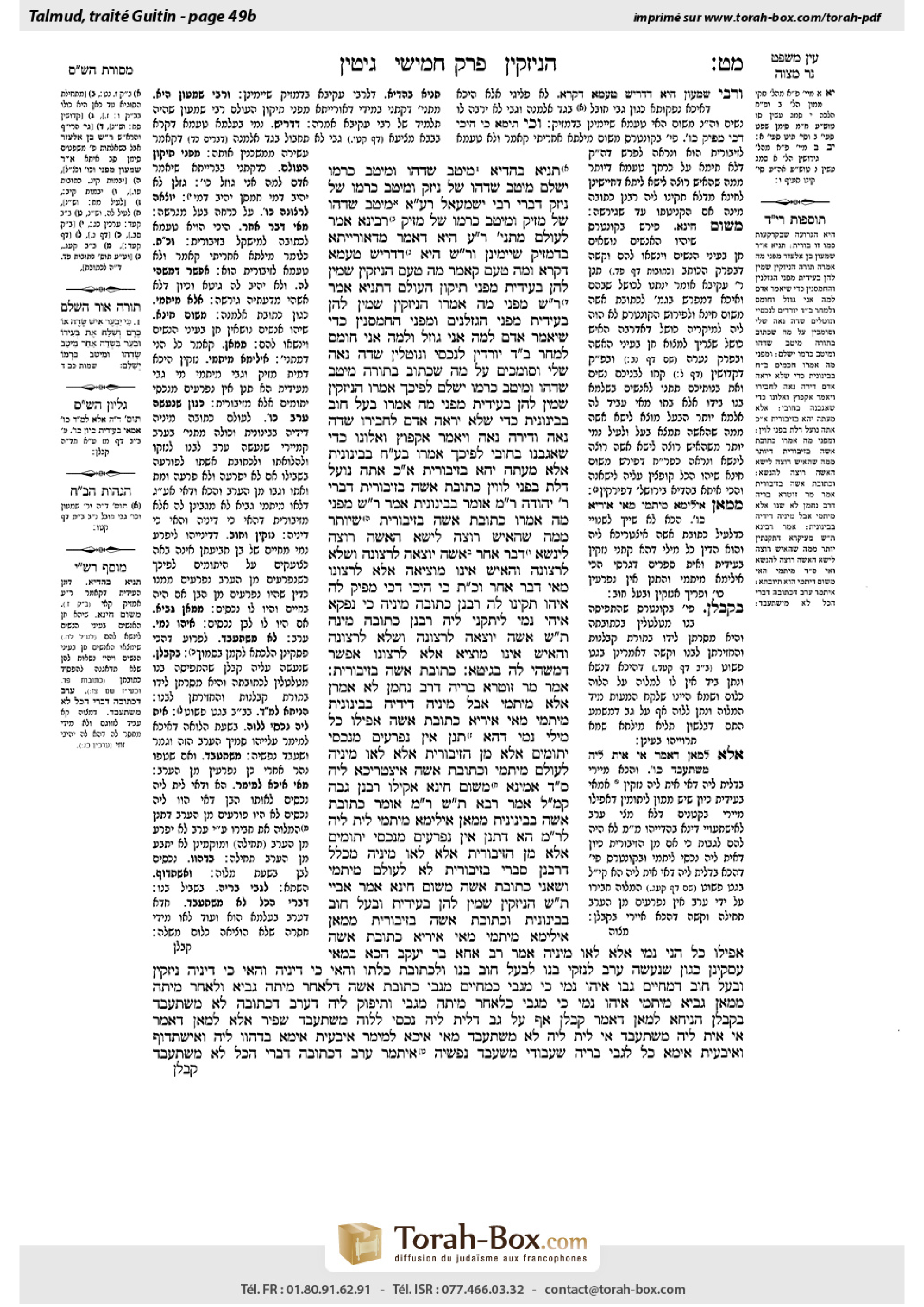
Gittin 49b: Talmud study for Daf Yomi
Study the Talmud for Daf Yomi with scanned pages, Hebrew text, English translations from Sefaria and AI-generated French translations.
Passage selection and English or AI-generated French translation are available where the scan has annotations. Daf Study is independent of Torah-Box and Sefaria.
Browse Gittin · גיטין · All tractatesGittin 49b text and translations
This page of Gittin includes the Aramaic text, an English translation and an AI-generated French translation, alongside the scan above.
גיטין מ״ט ב · Aramaic and Hebrew text
תַּנְיָא בְּהֶדְיָא: ״מֵיטַב שָׂדֵהוּ וּמֵיטַב כַּרְמוֹ יְשַׁלֵּם״ – מֵיטַב שָׂדֵהוּ שֶׁל נִיזָּק, וּמֵיטַב כַּרְמוֹ שֶׁל נִיזָּק, דִּבְרֵי רַבִּי יִשְׁמָעֵאל. רַבִּי עֲקִיבָא אוֹמֵר: מֵיטַב שָׂדֵהוּ שֶׁל מַזִּיק, וּמֵיטַב כַּרְמוֹ שֶׁל מַזִּיק.
רָבִינָא אָמַר: לְעוֹלָם מַתְנִיתִין רַבִּי עֲקִיבָא הִיא, דְּאָמַר מִדְּאוֹרָיְיתָא בִּדְמַזִּיק שָׁיְימִינַן; וְרַבִּי שִׁמְעוֹן הִיא – דְּדָרֵישׁ טַעְמָא דִּקְרָא, וּמָה טַעַם קָאָמַר – מָה טַעַם הַנִּיזָּקִין שָׁמִין לָהֶן בְּעִידִּית? מִפְּנֵי תִּיקּוּן הָעוֹלָם.
דְּתַנְיָא, אָמַר רַבִּי שִׁמְעוֹן: מִפְּנֵי מָה אָמְרוּ הַנִּיזָּקִין שָׁמִין לָהֶן בְּעִידִּית? מִפְּנֵי הַגַּזְלָנִים וּמִפְּנֵי הַחַמְסָנִין, כְּדֵי שֶׁיֹּאמַר אָדָם: לָמָה אֲנִי גּוֹזֵל וְלָמָה אֲנִי חוֹמֵס? לְמָחָר בֵּית דִּין יוֹרְדִין לִנְכָסַי וְנוֹטְלִין שָׂדֶה נָאָה שֶׁלִּי, וְסוֹמְכִים עַל מַה שֶּׁכָּתוּב בַּתּוֹרָה: ״מֵיטַב שָׂדֵהוּ וּמֵיטַב כַּרְמוֹ יְשַׁלֵּם״; לְפִיכָךְ אָמְרוּ: הַנִּיזָּקִין – שָׁמִין לָהֶן בְּעִידִּית.
מִפְּנֵי מָה אָמְרוּ בַּעַל חוֹב בְּבֵינוֹנִית? כְּדֵי שֶׁלֹּא יִרְאֶה אָדָם לַחֲבֵירוֹ שָׂדֶה נָאָה וְדִירָה נָאָה, וְיֹאמַר: אֶקְפּוֹץ וְאַלְוֶנּוּ, כְּדֵי שֶׁאֶגְבֶּנּוּ בְּחוֹבִי; לְפִיכָךְ אָמְרוּ: בַּעַל חוֹב בְּבֵינוֹנִית.
אֶלָּא מֵעַתָּה, יְהֵא בְּזִיבּוּרִית! אִם כֵּן – אַתָּה נוֹעֵל דֶּלֶת בִּפְנֵי לוֹוִין.
כְּתוּבַּת אִשָּׁה – בְּזִיבּוּרִית, דִּבְרֵי רַבִּי יְהוּדָה. רַבִּי מֵאִיר אוֹמֵר: בְּבֵינוֹנִית. אָמַר רַבִּי שִׁמְעוֹן: מִפְּנֵי מָה אָמְרוּ כְּתוּבַּת אִשָּׁה בְּזִיבּוּרִית? שֶׁיּוֹתֵר מִמַּה שֶּׁהָאִישׁ רוֹצֶה לִישָּׂא, הָאִשָּׁה רוֹצָה לִינָּשֵׂא.
דָּבָר אַחֵר: אִשָּׁה יוֹצְאָה לִרְצוֹנָהּ וְשֶׁלֹּא לִרְצוֹנָהּ, וְהָאִישׁ אֵינוֹ מוֹצִיאָהּ אֶלָּא לִרְצוֹנוֹ.
מַאי דָּבָר אַחֵר? וְכִי תֵּימָא, כִּי הֵיכִי דְּכִי מַפֵּיק לַהּ אִיהוּ – תַּקִּינוּ לַהּ רַבָּנַן כְּתוּבָּה מִינֵּיהּ; כִּי נָפְקָא אִיהִי נָמֵי – לִיתַקְּנִי לֵיהּ רַבָּנַן כְּתוּבָּה מִינַּהּ? תָּא שְׁמַע: אִשָּׁה יוֹצְאָה לִרְצוֹנָהּ וְשֶׁלֹּא לִרְצוֹנָהּ, וְהָאִישׁ אֵינוֹ מוֹצִיא אֶלָּא לִרְצוֹנוֹ – אֶפְשָׁר דִּמְשַׁהֵי לַהּ בְּגִיטָּא.
כְּתוּבַּת אִשָּׁה בְּזִיבּוּרִית. אָמַר מָר זוּטְרָא בְּרֵיהּ דְּרַב נַחְמָן: לָא אֲמַרַן אֶלָּא מִיַּתְמֵי, אֲבָל מִינֵּיהּ דִּידֵיהּ – בְּבֵינוֹנִית.
מִיַּתְמֵי?! מַאי אִירְיָא כְּתוּבַּת אִשָּׁה? אֲפִילּוּ כֹּל מִילֵּי נָמֵי, דְּהָא תְּנַן: אֵין נִפְרָעִים מִנִּכְסֵי יְתוֹמִים אֶלָּא מִן הַזִּיבּוּרִית! אֶלָּא לָאו מִינֵּיהּ?
לְעוֹלָם מִיַּתְמֵי, וּכְתוּבַּת אִשָּׁה אִיצְטְרִיכָא לֵיהּ – סָלְקָא דַּעְתָּךְ אָמֵינָא: מִשּׁוּם חִינָּא, אַקִּילוּ רַבָּנַן גַּבַּהּ; קָא מַשְׁמַע לַן.
אָמַר רָבָא: תָּא שְׁמַע, רַבִּי מֵאִיר אוֹמֵר: כְּתוּבַּת אִשָּׁה – בְּבֵינוֹנִית. מִמַּאן? אִילֵימָא מִיַּתְמֵי, לֵית לֵיהּ לְרַבִּי מֵאִיר הָא דִּתְנַן: אֵין נִפְרָעִים מִנִּכְסֵי יְתוֹמִים אֶלָּא מִן הַזִּיבּוּרִית?! אֶלָּא לָאו מִינֵּיהּ? מִכְּלָל דְּרַבָּנַן סָבְרִי בְּזִיבּוּרִית!
לָא; לְעוֹלָם מִיַּתְמֵי, וְשָׁאנֵי כְּתוּבַּת אִשָּׁה – מִשּׁוּם חִינָּא.
אָמַר אַבָּיֵי, תָּא שְׁמַע: הַנִּיזָּקִין שָׁמִין לָהֶן בְּעִידִּית, וּבַעַל חוֹב – בְּבֵינוֹנִית, וּכְתוּבַּת אִשָּׁה – בְּזִיבּוּרִית. מִמַּאן? אִילֵימָא מִיַּתְמֵי, מַאי אִירְיָא כְּתוּבַּת אִשָּׁה? אֲפִילּוּ כֹּל הָנֵי נָמֵי! אֶלָּא לָאו מִינֵּיהּ?
אָמַר רַב אַחָא בַּר יַעֲקֹב: הָכָא בְּמַאי עָסְקִינַן – כְּגוֹן שֶׁנַּעֲשָׂה עָרֵב לְנִזְקֵי בְנוֹ, לְבַעַל חוֹב בְּנוֹ וְלִכְתוּבַּת כַּלָּתוֹ;
וְהַאי כִּי דִינֵיהּ, וְהַאי כִּי דִינֵיהּ; נִיזָּקִין וּבַעַל חוֹב, דְּמֵחַיִּים גָּבוּ, אִיהוּ נָמֵי כִּי מַגְבֵּי – כְּמֵחַיִּים מַגְבֵּי. כְּתוּבַּת אִשָּׁה, דִּלְאַחַר מִיתָה גָּבְיָא, וּלְאַחַר מִיתָה מִמַּאן גָּבְיָא – מִיַּתְמֵי; אִיהוּ נָמֵי כִּי מַגְבֵּי – כִּלְאַחַר מִיתָה מַגְבֵּי.
וְתִיפּוֹק לֵיהּ דְּעָרֵב דִּכְתוּבָּה לֹא מִשְׁתַּעְבֵּד! בְּקַבְּלָן.
הָנִיחָא לְמַאן דְּאָמַר: קַבְּלָן, אַף עַל גַּב דְּלֵית לֵיהּ נִכְסֵי לְלֹוֶה – מִשְׁתַּעְבַּד, שַׁפִּיר; אֶלָּא לְמַאן דְּאָמַר: אִי אִית לֵיהּ – מִשְׁתַּעְבַּד, אִי לֵית לֵיהּ – לָא מִשְׁתַּעְבַּד, מַאי אִיכָּא לְמֵימַר?
אִיבָּעֵית אֵימָא: בְּדַהֲווֹ לֵיהּ וְאִישְׁתְּדוּף.
וְאִיבָּעֵית אֵימָא: כֹּל לְגַבֵּי בְּרֵיהּ, שַׁעְבּוֹדֵי מְשַׁעְבַּד נַפְשֵׁיהּ.
אִיתְּמַר: עָרֵב דִּכְתוּבָּה – דִּבְרֵי הַכֹּל לָא מִשְׁתַּעְבַּד;
Gittin 49b · English translation
It is taught explicitly in a baraita: The verse: “Of the best of his own field, and of the best of his own vineyard, shall he pay” (Exodus 22:4), teaches that the appraisal is of the best of the fields of the injured party, and of the best of the vineyards of the injured party. This is the statement of Rabbi Yishmael. Rabbi Akiva says: The appraisal is of the best of the fields of the one who caused the damage, and of the best of the vineyards of the one who caused the damage. This clearly indicates that according to Rabbi Akiva compensation is collected from the superior-quality land belonging to the one who caused the damage.
Ravina said: Actually, the mishna is in accordance with the opinion of Rabbi Akiva, who said: By Torah law, we appraise the property of the one who caused the damage. And it is also in accordance with the principle of Rabbi Shimon, who expounds the reason underlying the verse as a basis for drawing halakhic conclusions. And the mishna is saying: What is the reason for the halakha taught in the mishna? The mishna should be understood as follows: What is the reason that the court appraises land of superior quality for payment to injured parties? This is for the betterment of the world. That is to say, the words: For the betterment of the world, do not indicate a rabbinic enactment. Rather, they provide a reason for the Torah law.
This is as it is taught in a baraita (Tosefta, Ketubot 12:2) that Rabbi Shimon said: For what reason did the Sages say that the court appraises land of superior quality for payment to injured parties? It is due to the robbers and due to those who take that which is not theirs by force [ḥamsanin]. How so? So that a person will say: Why should I rob and why should I take by force? Tomorrow the court will come down to my property and take my finest field in order to compensate the victim for what I have robbed or taken by force. And the Sages rely on what is written in the Torah: “Of the best of his own field, and of the best of his own vineyard, shall he pay” (Exodus 22:4). Consequently, they said that the court appraises land of superior quality for payment to injured parties.
The baraita continues: For what reason did the Sages say that a creditor collects his debt from intermediate-quality land? It is so that a person should not see another’s fine field or fine house and say: I will jump in and lend him money so that later I will collect the field or house for my debt, if the borrower does not have enough money to repay the loan. Therefore, the Sages said that a creditor collects his debt only from intermediate-quality land, and he would not receive that fine field that would have prompted him to extend the loan in the first place.
The Gemara asks: If it is so that the objective is that people not be tempted to lend money for the purpose of acquiring the borrower’s property should he default on the loan, then the halakha governing a creditor should be to collect his debt from inferior-quality land. The Gemara answers: If so, then you would be locking the door before potential borrowers, as no one would be willing to lend them money.
The baraita continues: Payment of a woman’s marriage contract is collected from inferior-quality land; this is the statement of Rabbi Yehuda. Rabbi Meir says: It can be collected from intermediate-quality land. Rabbi Shimon said: For what reason did the Sages say that a woman’s marriage contract is collected from inferior-quality land? It is because more than a man wants to marry a woman, a woman wants to become married to a man. Consequently, she will agree to marry even if she knows that she will not be able to collect payment of the marriage contract from superior-quality land.
Alternatively, it is because a woman is sent out from her husband with her consent or without her consent, but a man sends his wife out from his house only with his consent.
The Gemara asks: What is the reason that he mentions an alternative explanation? What problem is there with the first explanation? The Gemara answers: The alternative explanation does not explain why she collects from inferior-quality land, but serves to explain a different matter. Since the Sages instituted a marriage contract in order to strengthen the institution of marriage, it is possible to ask: And if you would say that just as when a man divorces his wife the Sages instituted a marriage contract for her from him, so too, when she leaves him they should similarly institute a marriage contract for him from her; then come and hear: A woman is sent out from her husband with her consent or without her consent, but a man sends his wife out from his house only with his consent. Even if she instigates a quarrel with him to bait him into divorcing her, it is nevertheless possible for the husband to keep her waiting for a bill of divorce. A man gives his wife a bill of divorce only when he wishes to do so, and so in essence the divorce depends solely on him.
§ The mishna teaches that payment of a woman’s marriage contract is collected from inferior-quality land. Mar Zutra, son of Rav Naḥman, said: We said that a woman collects her marriage contract from inferior-quality land only when her husband died and she collects payment from the orphans who inherit his estate. But if she was divorced and she collects payment from the husband himself, then she collects it from intermediate-quality land.
The Gemara asks: If the mishna is referring to collecting from orphans, then why discuss specifically a woman’s marriage contract? Even all matters, such as payment for damage, should also be collected from inferior-quality land when it is collected from orphans, as didn’t we learn in the mishna: If one who owed money died and his children inherited his property, the father’s debt can be collected from the property of the orphans only from inferior-quality land. Rather, is it not that the mishna is referring to a case where the woman collects her marriage contract from the husband himself?
The Gemara rejects this argument: Actually, the mishna is referring to a case where the woman collects her marriage contract from the orphans who inherit their father’s estate. And it was necessary for the mishna to teach the halakha specifically with regard to a woman’s marriage contract. As it could enter your mind to say that the Sages were more lenient with her for the sake of desirability, so that she would be a more desirable partner should she want to remarry, and consequently they allowed her to collect payment of her marriage contract from intermediate-quality land even from orphans, the mishna teaches us that even payment for a woman’s marriage contract is not collected from the intermediate-quality land of orphans, but only from their inferior-quality land.
Rava said: Come and hear a proof from a baraita: Rabbi Meir says: Payment for a woman’s marriage contract is collected from intermediate-quality land. The Gemara attempts to clarify the case: From whom does she collect payment of her marriage contract in this case? If we say that she is collecting from the orphans, it is possible to ask: Does Rabbi Meir not agree with that which we learned in the mishna: The father’s debt can be collected from the property of the orphans only from inferior-quality land? Rather, is it not that the woman collects payment of her marriage contract from her husband himself? And since Rabbi Meir maintains that she collects from intermediate-quality land, one can learn by inference that the Rabbis hold that she collects from inferior-quality land, contrary to the opinion of Mar Zutra.
The Gemara rejects this argument: No, actually it is possible to explain that the baraita is referring to a case where the woman collects her marriage contract from the orphans who inherit their father’s estate. And payment of a woman’s marriage contract is different from other debts collected from orphans, which can be collected only from inferior-quality land. The Sages were more lenient with her for the sake of desirability; consequently, Rabbi Meir ruled that she may collect her marriage contract from intermediate-quality land even if she is collecting it from orphans.
Abaye said: Come and hear a proof from what is taught in the mishna: The court appraises land of superior quality for payment to injured parties. And a creditor collects his debt from the debtor’s intermediate-quality land. And payment of a woman’s marriage contract is collected from her husband’s inferior-quality land. The Gemara attempts to clarify the case: From whom is the collection being made? If we say that in all of these cases collection is being made from the orphans, why mention specifically a woman’s marriage contract? Even all of these, i.e., even injured parties and creditors, should also collect only from inferior-quality land when collecting from orphans. Rather, is it not that the mishna is referring to a case where the woman collects her marriage contract from the husband himself, and it rules that she collects from inferior-quality land, contrary to the opinion of Mar Zutra?
Rav Aḥa bar Ya’akov said: No proof can be brought from the mishna against the opinion of Mar Zutra, as the mishna can be understood as follows: With what are we dealing here? We are dealing with a case where one became a guarantor for compensation for his son’s damages, and similarly for repayment to his son’s creditor, and similarly for payment of his daughter-in-law’s marriage contract, and his son died. Since the guarantor stands in place of his son, collection is made from him as if it were being made from his son.
And payment is made in this case in accordance with its halakha and payment is made in this case in accordance with its halakha. Since an injured party and a creditor ordinarily collect from those who owe them money while they are alive, when the guarantor pays the debt, he too pays the debt as though the one who caused the damage or borrowed the money were still alive. Therefore, in these cases collection is made from superior-quality or intermediate-quality land. But in this case, where the father serves as a guarantor for his son, payment of a woman’s marriage contract is only after her husband’s death, and after his death from whom does she collect? From the orphans. Consequently, when the guarantor pays the debt, he too pays the debt as though it were being paid by the orphans after the husband’s death. Accordingly, payment for her marriage contract is made from inferior-quality land.
The Gemara asks: But let him derive this halakha from another halakha that states that the guarantor of a marriage contract does not become responsible for the payment of the marriage contract from his own property. The signature that he adds to the marriage contract serves merely as additional support but does not turn him into a true guarantor. Therefore, even if a collection is made, it is only from inferior-quality land. The Gemara answers: We are dealing here with an unconditional guarantor, i.e., one who accepted unconditional responsibility for the obligation, allowing his daughter-in-law to collect payment of her marriage contract either from his son or from him, as she so desires.
The Gemara asks: This works out well according to the one who says that an unconditional guarantor becomes responsible for repayment of the loan even if the borrower does not have property of his own. Therefore, it works out well to explain the case in this manner. But according to the one who says that if the borrower has property of his own at the time of the loan, then the unconditional guarantor becomes responsible, but if the borrower does not have property of his own at the time of the loan, then the unconditional guarantor does not become responsible, what is there to say in a case where the son did not have any property at the time of the marriage? In such a case, the father never became responsible for his son’s obligations.
The Gemara answers: If you wish, say that it is a case where the son had property of his own at the outset, but afterward it was blighted. Since the son had his own property, the father accepted responsibility for the obligation, and now that the property has no value, the daughter-in-law can collect payment for her marriage contract from the father.
And if you wish say: With respect to anything relating to his son, it is common for a father to pledge himself absolutely, even when the son has no property of his own.
§ Apropos a guarantor for a marriage contract, the Gemara notes: It was stated that everyone agrees that a guarantor who signs a marriage contract does not thereby become responsible for the payment of the marriage contract from his own property.
Gittin 49b · Traduction française (IA)
Il est enseigné explicitement dans une baraïta : La parole : « Il paiera de la meilleure de son propre champ et de la meilleure de son propre vignoble » (Exode 22:4) enseigne que l'appréciation est faite sur la meilleure des champs du partie blessée et sur la meilleure des vignobles du partie blessée. C'est la déclaration du Rabbi Yishmael. Le Rabbi Akiva dit : L'appréciation est faite sur la meilleure des champs du coupable et sur la meilleure des vignobles du coupable. Cela montre clairement que selon le Rabbi Akiva, la compensation est recueillie sur les terres de qualité supérieure appartenant au coupable.
Ravina a dit : En réalité, la mitsna est conforme à l'opinion du Rabbi Akiva, qui a dit : Selon la loi divine, nous apprécions la propriété du coupable. Et elle est également conforme au principe du Rabbi Shimon, qui explique la raison du verset comme base pour tirer des conclusions halakhiques. Et la mitsna dit : Quel est la raison de la halakha enseignée dans la mitsna ? La mitsna devrait être comprise ainsi : Quelle est la raison pour laquelle le tribunal apprécie les terres de qualité supérieure pour le paiement aux parties blessées ? C'est pour le bien de l'humanité. C'est-à-dire que les mots : « Pour le bien de l'humanité », ne désignent pas un édict rabbinique. Ils fournissent une raison pour la loi divine.
C'est ce qui est enseigné dans une baraïta (Tosefta, Ketubot 12:2) que le Rabbi Shimon a dit : Pour quelle raison les Sages ont-ils dit que le tribunal apprécie les terres de qualité supérieure pour le paiement aux parties blessées ? C'est à cause des voleurs et à cause de ceux qui prennent ce qui n'est pas à eux par la force [ḥamsanin]. Comment cela ? Afin qu'une personne dise : Pourquoi devrais-je voler et pourquoi devrais-je prendre par la force ? Demain le tribunal descendra sur ma propriété et prendra ma meilleure terre afin de compenser la victime pour ce que j'ai volé ou pris par la force. Et les Sages s'appuient sur ce qui est écrit dans la Torah : « Il paiera de la meilleure de son propre champ et de la meilleure de son propre vignoble » (Exode 22:4). Ainsi, ils ont dit que le tribunal apprécie les terres de qualité supérieure pour le paiement aux parties blessées.
La baraïta continue : Pour quelle raison les Sages ont-ils dit que le créancier recouvre sa dette sur des terres de qualité intermédiaire ? C'est afin qu'une personne ne voie pas la belle terre ou la belle maison d'un autre et ne dise pas : Je vais emprunter de l'argent à cet homme afin que plus tard je puisse récupérer la terre ou la maison pour mon créance, si le prêteur n'a pas assez d'argent pour rembourser le prêt. Ainsi, les Sages ont dit que le créancier recouvre sa dette uniquement sur des terres de qualité intermédiaire, et il ne recevra pas cette belle terre qui l'aurait poussé à prêter l'argent en premier lieu.
La Guemara pose la question : Si c'est ainsi que l'objectif est que les gens ne soient pas tentés de prêter de l'argent à des fins d'acquisition de la propriété du prêteur en cas de défaut, alors la halakha concernant le créancier devrait être de recouvrer sa dette sur des terres de qualité inférieure. La Guemara répond : Si c'est ainsi, alors vous verriez le portail fermé avant même les emprunteurs potentiels, car personne ne serait prêt à prêter de l'argent.
La baraïta continue : Le paiement du contrat de mariage d'une femme est recueilli sur des terres de qualité inférieure ; c'est la déclaration du Rabbi Yéhouda. Le Rabbi Méir dit : Il peut être recueilli sur des terres de qualité intermédiaire. Le Rabbi Shimon a dit : Pour quelle raison les Sages ont-ils dit que le contrat de mariage d'une femme est recueilli sur des terres de qualité inférieure ? C'est parce que plus qu'un homme veut épouser une femme, une femme veut épouser un homme. Ainsi, elle acceptera de se marier même si elle sait qu'elle ne pourra pas récupérer le paiement du contrat de mariage sur des terres de qualité supérieure.
Autrement dit, c'est parce qu'une femme est expulsée de son mari avec son consentement ou sans son consentement, mais un homme expulse sa femme de sa maison uniquement avec son consentement.
La Guemara pose la question : Quelle est la raison d'évoquer une explication alternative ? Quel problème y a-t-il avec l'explication première ? La Guemara répond : L'explication alternative ne résout pas pourquoi elle recouvre sur des terres de qualité inférieure, mais sert à expliquer une autre question. Puisque les Sages ont institué un contrat de mariage pour renforcer l'institution du mariage, on peut demander : Et si vous dites que justement quand un homme divorce de sa femme les Sages ont institué un contrat de mariage pour elle de sa part, alors aussi quand elle le quitte, ils devraient instituer un contrat de mariage pour lui de sa part ; alors écoutez : Une femme est expulsée de son mari avec son consentement ou sans son consentement, mais un homme expulse sa femme de sa maison uniquement avec son consentement. Même si elle instige une querelle avec lui pour le pousser à divorcer d'elle, il est toutefois possible que l'homme la fasse attendre pour un acte de divorce. Un homme donne à sa femme un acte de divorce uniquement quand il le souhaite, et ainsi en essence le divorce dépend uniquement de lui.
§ La mitsva enseigne que le paiement du contrat de mariage d'une femme est recueilli sur des terres de qualité inférieure. Mar Zutra, fils de Rav Naḥman, a dit : Nous avons dit qu'une femme recouvre son contrat de mariage sur des terres de qualité inférieure uniquement lorsque son mari est décédé et qu'elle recouvre le paiement auprès des orphelins qui héritent de son patrimoine. Mais si elle est divorcée et qu'elle recouvre le paiement auprès de son mari lui-même, alors elle le recouvre sur des terres de qualité intermédiaire.
La Guemara pose la question : Si la Michna fait référence à la collecte auprès des orphelins, pourquoi discute-t-elle spécifiquement du contrat de mariage d'une femme ? Même toutes les questions, comme le paiement pour les dommages, devraient également être recueillies sur des terres de qualité inférieure quand elles sont recueillies auprès des orphelins, comme nous l'avons appris dans la Michna : Si celui qui devait de l'argent est mort et que ses enfants héritent de son patrimoine, la dette du père peut être recueillie sur le patrimoine des orphelins uniquement sur des terres de qualité inférieure. Et non, n'est-ce pas que la Michna fait référence à un cas où la femme recouvre son contrat de mariage auprès de son mari lui-même ?
La Guemara rejette cet argument : En réalité, la Michna fait référence à un cas où la femme récupère son contrat de mariage auprès des orphelins qui héritent de l'immobilier de leur père. Il était nécessaire que la Michna enseigne la halakha spécifiquement concernant le contrat de mariage d'une femme. Car il pourrait entrer en votre esprit de dire que les Sages étaient plus indulgents envers elle pour la raison de la desirabilité, afin qu'elle devienne un partenaire plus attrayant en cas de remariage, et par conséquent ils lui permettaient de récupérer le paiement de son contrat de mariage à partir de terres de qualité intermédiaire même auprès des orphelins. La Michna nous apprend que même le paiement du contrat de mariage d'une femme n'est pas récupéré à partir des terres de qualité intermédiaire des orphelins, mais uniquement à partir de leurs terres de qualité inférieure.
Rava dit : Viens écouter une preuve tirée d'une baraïta : Rabbi Meïr dit : Le paiement du contrat de mariage d'une femme est récupéré à partir de terres de qualité intermédiaire. La Guemara tente de clarifier le cas : De qui la femme récupère-t-elle le paiement de son contrat de mariage dans ce cas ? Si nous disons qu'elle le récupère auprès des orphelins, il est possible de poser la question : Rabbi Meïr ne s'accorde-t-il pas avec ce que nous avons appris dans la Michna : La dette du père peut être récupérée à partir des biens des orphelins uniquement à partir de terres de qualité inférieure ? Plutôt, n'est-ce pas que la femme récupère le paiement de son contrat de mariage auprès de son mari lui-même ? Et puisque Rabbi Meïr maintient qu'elle le récupère à partir de terres de qualité intermédiaire, on peut en déduire que les Rabbins considèrent qu'elle le récupère à partir de terres de qualité inférieure, contrairement à l'opinion de Mar Zutra.
La Guemara rejette cet argument : Non, en réalité, il est possible d'expliquer que la baraïta fait référence à un cas où la femme récupère son contrat de mariage auprès des orphelins qui héritent de l'immobilier de leur père. Et le paiement d'un contrat de mariage d'une femme diffère des autres dettes récupérées auprès des orphelins, qui peuvent être récupérées uniquement à partir de terres de qualité inférieure. Les Sages étaient plus indulgents envers elle pour la raison de la convenance ; par conséquent, Rabbi Meïr a décidé qu'elle pouvait récupérer son contrat de mariage à partir de terres de qualité intermédiaire même si elle le récupérait auprès des orphelins.
Abaye dit : Viens écouter une preuve tirée de ce qui est enseigné dans la Michna : Le tribunal évalue les terres de qualité supérieure pour le paiement aux parties blessées. Et un créancier récupère sa dette auprès des terres de qualité intermédiaire du débiteur. Et le paiement du contrat de mariage d'une femme est récupéré auprès des terres de qualité inférieure de son mari. La Guemara tente de clarifier le cas : De qui la récupération est-elle faite ? Si nous disons que dans tous ces cas la récupération est faite auprès des orphelins, pourquoi mentionner spécifiquement le contrat de mariage d'une femme ? Même toutes ces choses, c'est-à-dire même les parties blessées et les créanciers, devraient aussi récupérer uniquement à partir de terres de qualité inférieure lorsqu'ils récupèrent auprès des orphelins. Plutôt, n'est-ce pas que la Michna fait référence à un cas où la femme récupère son contrat de mariage auprès de son mari lui-même, et qu'elle règle qu'elle le récupère à partir de terres de qualité inférieure, contrairement à l'opinion de Mar Zutra ?
Rav Acha bar Ya'akov dit : On ne peut pas apporter de preuve contre l'opinion de Mar Zutra à partir de la Michna, car la Michna peut être interprétée ainsi : De quoi sommes-nous en train de parler ? Nous parlons d'un cas où l'on est devenu garant pour la compensation des dommages de son fils, et de même pour le remboursement à son fils, et de même pour le paiement du contrat de mariage de sa fille, et son fils est mort. Puisque le garant est en place de son fils, la récupération est faite auprès de lui comme si elle était faite auprès de son fils.
Et le paiement est fait dans ce cas selon sa halakha, et le paiement est fait dans ce cas selon sa halakha. Puisque les parties blessées et les créanciers récupèrent normalement auprès de ceux qui leur doivent de l'argent pendant qu'ils sont vivants, lorsque le garant paie la dette, il paie la dette comme si celui qui a causé les dommages ou qui a emprunté l'argent était encore vivant. Par conséquent, dans ces cas la récupération est faite à partir de terres de qualité supérieure ou intermédiaire. Mais dans ce cas, où le père est garant pour son fils, le paiement du contrat de mariage d'une femme est seulement après la mort de son mari, et après sa mort auprès de qui la femme récupère-t-elle ? Auprès des orphelins. Par conséquent, lorsque le garant paie la dette, il paie la dette comme si elle était payée par les orphelins après la mort du mari. Ainsi, le paiement du contrat de mariage d'une femme est fait à partir de terres de qualité inférieure.
La Guemara pose la question : Mais qu'on dérive cette halakha d'une autre halakha qui stipule que le garant d'un contrat de mariage ne devient pas responsable du paiement du contrat de mariage à partir de ses propres biens. La signature qu'il ajoute au contrat de mariage sert uniquement de soutien supplémentaire mais ne le rend pas un garant véritable. Par conséquent, même si une récupération est faite, elle est uniquement à partir de terres de qualité inférieure. La Guemara répond : Nous parlons ici d'un garant inconditionnel, c'est-à-dire celui qui a accepté une responsabilité inconditionnelle pour l'obligation, permettant à sa belle-fille de récupérer le paiement de son contrat de mariage soit auprès de son fils soit auprès de lui, selon son choix.
La Guemara pose la question : Cela s'aligne bien selon celui qui dit que le garant inconditionnel devient responsable du paiement du prêt même si le prêteur n'a pas de biens personnels. Par conséquent, cela s'aligne bien pour expliquer le cas ainsi. Mais selon celui qui dit que si le prêteur a des biens personnels au moment du prêt, le garant inconditionnel devient responsable, mais si le prêteur n'a pas de biens personnels au moment du prêt, le garant inconditionnel ne devient pas responsable, que dire dans un cas où le fils n'avait aucun bien au moment du mariage ? Dans ce cas, le père n'a jamais devenu responsable des obligations de son fils.
La Guemara répond : Si tu le souhaites, dis qu'il s'agit d'un cas où le fils avait des biens personnels au début, mais ensuite ils ont été ruinés. Puisque le fils avait ses propres biens, le père a accepté la responsabilité, et maintenant que les biens n'ont plus de valeur, la belle-fille peut récupérer le paiement de son contrat de mariage auprès du père.
Et si vous le souhaitez, dites : En ce qui concerne toute chose liée à son fils, il est commun qu'un père s'engage absolument, même lorsque le fils n'a pas de propriété propre.
§ En ce qui concerne un garant d'un contrat de mariage, la Guemara note : Il a été dit que tout le monde convient qu'un garant qui signe un contrat de mariage ne devient pas ainsi responsable du paiement du contrat de mariage à partir de ses propres biens.
Traduction française générée par IA à partir de l’édition anglaise de Sefaria. Vérifie toujours un passage avec le texte source.
Text from Sefaria: William Davidson Edition - Vocalized Aramaic (CC BY NC); William Davidson Edition - English (CC BY NC).