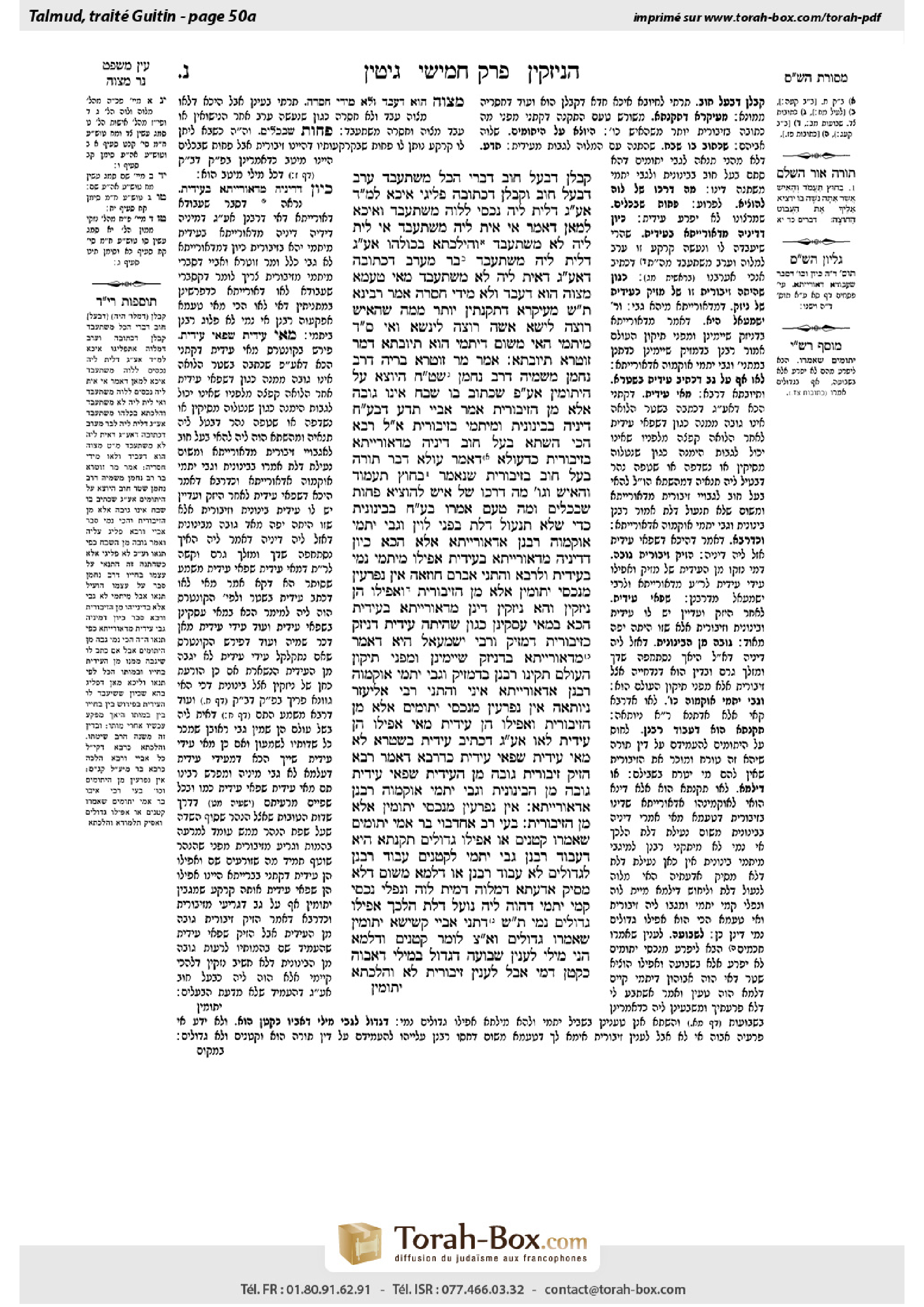
Gittin 50a: Talmud study for Daf Yomi
Study the Talmud for Daf Yomi with scanned pages, Hebrew text, English translations from Sefaria and AI-generated French translations.
Passage selection and English or AI-generated French translation are available where the scan has annotations. Daf Study is independent of Torah-Box and Sefaria.
Browse Gittin · גיטין · All tractatesGittin 50a text and translations
This page of Gittin includes the Aramaic text, an English translation and an AI-generated French translation, alongside the scan above.
גיטין נ׳ א · Aramaic and Hebrew text
קַבְּלָן דְּבַעַל חוֹב – דִּבְרֵי הַכֹּל מִשְׁתַּעְבַּד; עָרֵב דְּבַעַל חוֹב, וְקַבְּלָן דִּכְתוּבָּה – פְּלִיגִי; אִיכָּא לְמַאן דְּאָמַר: אַף עַל גַּב דְּלֵית לֵיהּ נִכְסֵי לְלֹוֶה – מִשְׁתַּעְבַּד, וְאִיכָּא לְמַאן דְּאָמַר: אִי אִית לֵיהּ – מִשְׁתַּעְבַּד, אִי לֵית לֵיהּ – לָא מִשְׁתַּעְבַּד.
וְהִילְכְתָא: בְּכוּלְּהוּ, אַף עַל גַּב דְּלֵית לֵיהּ – מִשְׁתַּעְבַּד; בַּר מֵעָרֵב דִּכְתוּבָּה, דְּאַף עַל גַּב דְּאִית לֵיהּ – לָא מִשְׁתַּעְבַּד.
מַאי טַעְמָא? מִצְוָה הוּא דַּעֲבַד, וְלָא מִידֵּי חַסְּרַהּ.
אָמַר רָבִינָא: תָּא שְׁמַע מֵעִיקָּרָא דְּתַקַּנְתִּין – יוֹתֵר מִמַּה שֶּׁהָאִישׁ רוֹצֶה לִישָּׂא, אִשָּׁה רוֹצָה לִינָּשֵׂא. וְאִי סָלְקָא דַעְתָּךְ מִיַּתְמֵי, הַאי מִשּׁוּם דְּיַתְמֵי הוּא! תְּיוּבְתָּא דְּמָר זוּטְרָא תְּיוּבְתָּא.
אָמַר מָר זוּטְרָא בְּרֵיהּ דְּרַב נַחְמָן, מִשְּׁמֵיהּ דְּרַב נַחְמָן: שְׁטַר חוֹב הַיּוֹצֵא עַל הַיְּתוֹמִין, אַף עַל פִּי שֶׁכָּתוּב בּוֹ שֶׁבַח, אֵינוֹ גּוֹבֶה אֶלָּא מִן הַזִּיבּוּרִית.
אָמַר אַבָּיֵי: תִּדַּע – דְּבַעַל חוֹב דִּינֵיהּ בְּבֵינוֹנִית, וּמִיַּתְמֵי בְּזִיבּוּרִית.
אֲמַר לֵיהּ רָבָא: הָכִי הַשְׁתָּא?! בַּעַל חוֹב דִּינֵיהּ מִדְּאוֹרָיְיתָא בְּזִיבּוּרִית! כִּדְעוּלָּא – דְּאָמַר עוּלָּא: דְּבַר תּוֹרָה, בַּעַל חוֹב בְּזִיבּוּרִית, שֶׁנֶּאֱמַר: ״בַּחוּץ תַּעֲמֹד וְהָאִישׁ וְגוֹ׳״ – מָה דַּרְכּוֹ שֶׁל אִישׁ לְהוֹצִיא, פָּחוּת שֶׁבַּכֵּלִים; וּמָה טַעַם אָמְרוּ בַּעַל חוֹב בְּבֵינוֹנִית? כְּדֵי שֶׁלֹּא תִּנְעוֹל דֶּלֶת בִּפְנֵי לֹוִין – וְגַבֵּי יַתְמֵי אוֹקְמוּהּ רַבָּנַן אַדְּאוֹרָיְיתָא;
אֶלָּא הָכָא, כֵּיוָן דְּדִינֵיהּ מִדְּאוֹרָיְיתָא בְּעִידִּית, אֲפִילּוּ מִיַּתְמֵי נָמֵי בְּעִידִּית!
וּלְרָבָא, וְהָתָנֵי אַבְרָם חוֹזָאָה: אֵין נִפְרָעִין מִנִּכְסֵי יְתוֹמִין אֶלָּא מִן הַזִּיבּוּרִית, וַאֲפִילּוּ הֵן נִיזָּקִין. וְהָא נִיזָּקִין – דִּינָן מִדְּאוֹרָיְיתָא בְּעִידִּית!
הָכָא בְּמַאי עָסְקִינַן – כְּגוֹן שֶׁהָיְתָה עִידִּית דְּנִיזָּק כְּזִיבּוּרִית דְּמַזִּיק;
וְרַבִּי יִשְׁמָעֵאל הִיא, דְּאָמַר: מִדְּאוֹרָיְיתָא בִּדְנִיזָּק שָׁיְימִינַן, וּמִפְּנֵי תִּיקּוּן הָעוֹלָם תַּקִּינוּ רַבָּנַן בִּדְמַזִּיק – וְגַבֵּי יַתְמֵי אוֹקְמוּהּ רַבָּנַן אַדְּאוֹרָיְיתָא.
אִינִי?! וְהָתָנֵי רַבִּי אֱלִיעֶזֶר נָיוֹתָאָה: אֵין נִפְרָעִין מִנִּכְסֵי יְתוֹמִים אֶלָּא מִן הַזִּיבּוּרִית, וַאֲפִילּוּ הֵן עִידִּית. מַאי ״אֲפִילּוּ הֵן עִידִּית״? לָאו אַף עַל גַּב דִּכְתִיב עִידִּית בִּשְׁטָרָא?!
לָא; מַאי ״עִידִּית״ – שְׁפַאי עִידִּית, כִּדְרָבָא –
דְּאָמַר רָבָא: הִזִּיק זִיבּוּרִית – גּוֹבֶה מִן הָעִידִּית. שְׁפַאי עִידִּית, גּוֹבֶה מִן הַבֵּינוֹנִית. וְגַבֵּי יַתְמֵי אוֹקְמוּהּ רַבָּנַן אַדְּאוֹרָיְיתָא.
אֵין נִפְרָעִין מִנִּכְסֵי יְתוֹמִין אֶלָּא מִן הַזִּיבּוּרִית: בָּעֵי רַב אַחָדְבוּי בַּר אַמֵּי: ״יְתוֹמִים״ שֶׁאָמְרוּ – קְטַנִּים, אוֹ אֲפִילּוּ גְּדוֹלִים? תַּקַּנְתָּא הִיא דַּעֲבוּד רַבָּנַן גַּבֵּי יַתְמֵי – לִקְטַנִּים עֲבוּד רַבָּנַן, לִגְדוֹלִים לָא עֲבוּד רַבָּנַן;
אוֹ דִלְמָא – מִשּׁוּם דְּלָא מַסֵּיק אַדַּעְתָּא דְּמַלְוֶה דְּמִית לֹוֶה וְנָפְלִי נִכְסֵי קַמֵּי יַתְמֵי; דְּהָוֵה לֵיהּ נוֹעֵל דֶּלֶת; הִלְכָּךְ אֲפִילּוּ גְּדוֹלִים נָמֵי?
תָּא שְׁמַע, דְּתָנֵי אַבָּיֵי קַשִּׁישָׁא: יְתוֹמִין שֶׁאָמְרוּ – גְּדוֹלִים, וְאֵין צָרִיךְ לוֹמַר קְטַנִּים.
וְדִלְמָא הָנֵי מִילֵּי לְעִנְיַן שְׁבוּעָה – דְּגָדוֹל בְּמִילֵּי דַּאֲבוּהּ כְּקָטָן דָּמֵי; אֲבָל לְעִנְיַן זִיבּוּרִית – לָא.
וְהִלְכְתָא:
Gittin 50a · English translation
Everyone also agrees that an unconditional guarantor for the repayment of a creditor becomes responsible for payment of the borrower’s debt. The Sages disagree with regard to the following cases: A guarantor for the repayment of a creditor and an unconditional guarantor for payment of a marriage contract. There is one Sage who says: Although the borrower does not have property of his own at the time of the loan, the guarantor becomes responsible for payment of the obligation. And there is one Sage who says: If the obligated party has property of his own, then the guarantor becomes responsible; if he does not have property of his own, he does not become responsible.
And the halakha is: In all of these cases, although the obligated party does not have property of his own at the time he assumes the obligation, the guarantor becomes responsible for payment of that obligation. This is so except in the case of a guarantor for payment of a marriage contract, as in that case, even if the husband has property of his own when he gives a marriage contract, the guarantor does not become responsible for payment of the obligation.
What is the reason for this? The intention of the guarantor is performing a mitzva of facilitating a marriage by encouraging the woman to consent to the marriage as a result of his involvement, but he does not truly intend to obligate himself. And furthermore, the woman does not lose anything in exchange for which the guarantor would accept responsibility, as the husband does not borrow money from the woman. Therefore, the Sages instituted that the guarantor does not become responsible for payment of the marriage contract from his own property.
Ravina said: Come and hear a proof concerning the question of whether the mishna’s ruling that payment of a woman’s marriage contract is collected from inferior-quality land applies only when the woman collects from orphans or if it applies even when she collects from her husband. The proof is from the beginning of our ordinance: Why did the Sages say that a woman’s marriage contract is collected from inferior-quality land? It is because more than a man wants to marry a woman, a woman wants to become married to a man. And if it enters your mind that this halakha applies only when the woman collects from orphans, then the reason given for this halakha should be that it is because they are orphans, not because a woman wants to become married. This indicates that the mishna’s ruling applies even when she collects her marriage contract during her husband’s lifetime, contrary to the opinion of Mar Zutra. The Gemara affirms: The refutation of the opinion of Mar Zutra is a conclusive refutation.
§ Apropos a statement attributed to Mar Zutra, son of Rav Naḥman, the Gemara cites another halakha in his name on a similar topic: Mar Zutra, son of Rav Naḥman, said in the name of Rav Naḥman: If a promissory note is presented to orphans for repayment of a loan taken by their father, then although an enhancement of the creditor’s ability to collect, enabling the collection of even superior-value land, is written in it, the creditor can collect only from inferior-quality land.
Abaye said: Know that this is the case, as the halakha governing a creditor is that he collects from intermediate-quality land, but from orphans he collects only from inferior-quality land. If one cannot collect even from intermediate-quality land of orphans, all the more so one cannot collect from their superior-quality land.
Rava said to him: How can these two cases be compared? By Torah law, the halakha governing a creditor is that he collects from inferior-quality land, in accordance with the opinion of Ulla, as Ulla says: By Torah law, a creditor collects from inferior-quality land, as it is stated: “You shall stand outside, and the man to whom you have lent shall bring forth the pledge out to you” (Deuteronomy 24:11). What would a man ordinarily take out as a pledge? The least valuable of his vessels. This demonstrates that the creditor is entitled only to the least valuable of the debtor’s vessels. Similarly, when he collects from land, he collects only from inferior-quality land. And for what reason did the Sages say that a creditor collects from intermediate-quality land? So as not to lock the door before potential borrowers, i.e., so that people do not refrain from extending loans. And with regard to orphans, the Sages left the halakha as it is stated in the Torah.
But here, a stipulation enhancing the creditor’s ability to collect was included in the promissory note. Therefore, since by Torah law the halakha governing this creditor is that he collects from superior-quality land as stipulated in the loan agreement, then he should also collect from superior-quality land even when collecting the debt from orphans.
The Gemara asks: And according to this explanation of Rava, there is a difficulty: Didn’t the Sage Avram Ḥoza’a teach a baraita that states: A father’s debt can be collected from the property of the orphans only from inferior-quality land? The Gemara infers: And this ruling applies even if the property is collected for payment to injured parties. But isn’t it true that by Torah law the halakha governing injured parties is that they collect from superior-quality land? This indicates that even when by Torah law collection should be from superior-quality land, the Sages instituted that one may collect from orphans only inferior-quality land.
The Gemara answers: With what case are we dealing here in the baraita taught by Avram Ḥoza’a? We are dealing with a case where superior-quality land of the injured party is equal in quality to inferior-quality land of the one who caused the damage, i.e., the orphans, and the one who caused the damage also has land of superior quality.
And the baraita is taught in accordance with the opinion of Rabbi Yishmael, who says: By Torah law we appraise the property of the injured party, and therefore the one who caused the damage can pay with his inferior-quality fields that are equal in quality to the superior-quality land owned by the injured party. And for the betterment of the world, the Sages instituted that we appraise the property of the one who caused the damage, and he pays with his superior-quality land. But with regard to orphans, the Sages left the halakha as it is stated in the Torah; they pay from their inferior-quality land that is equal in quality to superior-quality land belonging to the injured party. By contrast, a creditor who holds a promissory note stipulating that the debt can be collected from superior-quality land can collect superior-quality land even from orphans, as stipulated in the loan agreement.
The Gemara asks: Is that so? But didn’t Rabbi Eliezer Nayota’a teach a baraita that states: A father’s debt can be collected from the property of the orphans only from inferior-quality land, even if it is superior-quality land? The Gemara asks: What is the meaning of: Even if it is superior-quality land? Is it not the following: Although superior-quality land is written in the promissory note, the debt can be collected from the orphans only from inferior-quality land.
The Gemara rejects this suggestion: No, what is the meaning of superior-quality land? Orphans can repay the debt even from strips of superior-quality land that due to their location cannot be cultivated or guarded and that consequently have a lower market value than inferior-quality land, as in the statement of Rava.
As Rava says: If one damaged inferior-quality land, the injured party collects from superior-quality land. The one who caused damage is penalized and made to pay from land of much higher quality than that which he damaged. If he damaged strips of superior-quality land that cannot be cultivated, the injured party collects from intermediate-quality land, as the land that was damaged is inferior in value even to inferior-quality land, and therefore it suffices if compensation is paid from intermediate-quality land. And why did Rabbi Eliezer Nayota’a teach that orphans may pay their father’s debt from land of the lowest quality? With regard to orphans, the Sages left the halakha as it is written in the Torah, that a creditor collects from inferior-quality land.
§ The mishna teaches: If one who owed money died and his children inherited his property, the father’s debt can be collected from the property of the orphans only from inferior-quality land. Rav Aḥadevoi bar Ami raised a dilemma with regard to the meaning of this statement: Do the orphans of which they spoke refer specifically to minors or even to adults? The Gemara explains the two sides of the dilemma: Is this an ordinance that the Sages instituted for the benefit of the orphans, in which case it may be argued that the Sages instituted it for minors but they did not institute it for adults?
Or, perhaps the reason is different. The reason that a creditor collects from intermediate-quality land is so that the door not be locked before potential borrowers. Here, this is not a concern, since it does not enter the mind of the creditor that he should not lend money as perhaps the borrower will die and his property will fall to the orphans. As only if he were to consider this possibility, would it be that this would lock the door before potential borrowers. Consequently, the ordinance that a creditor collects from intermediate-quality land was instituted only in the standard case, where the creditor collects from the debtor himself, but not where he collects from the heirs. Therefore, the ordinance that a debt can be collected from the property of orphans only from inferior-quality land should apply also to adult orphans.
The Gemara answers: Come and hear what Abaye the Elder taught: With regard to the orphans of which the Sages spoke, the phrase is referring to adults, and needless to say it is referring also to minors.
The Gemara rejects this proof: But perhaps this statement applies only to the matter of an oath. One who collects a debt from property left by the debtor to his heirs always takes an oath, even if he produces a promissory note. This halakha applies even if the heirs are adults. This is because even an adult son is considered like a minor with regard to his father’s financial matters, since he does not know the details of his father’s business dealings and it is possible that his father had actually repaid the debt before dying. But with regard to collecting the debt from inferior-quality land, no, this halakha applies only to minors.
The Gemara concludes: And the halakha is:
Gittin 50a · Traduction française (IA)
Tous les sages s'accordent sur le fait qu'un garant inconditionnel pour le remboursement d'un créancier devient responsable du paiement de la dette du prêteur. Les sages s'entendent cependant sur les cas suivants : un garant pour le remboursement d'un créancier et un garant inconditionnel pour le paiement d'un contrat de mariage. Un sage dit : Même si le prêteur n'a pas de propriété personnelle au moment du prêt, le garant devient responsable du paiement de l'obligation. Un autre sage dit : Si la partie obligée a une propriété personnelle, alors le garant devient responsable ; s'il n'en a pas, il ne devient pas responsable.
Et la halakha est : Dans tous ces cas, même si la partie obligée n'a pas de propriété personnelle au moment où il assume l'obligation, le garant devient responsable du paiement de cette obligation. Cela est vrai sauf dans le cas d'un garant pour le paiement d'un contrat de mariage, car dans ce cas, même si le mari a une propriété personnelle lorsqu'il donne un contrat de mariage, le garant ne devient pas responsable du paiement de l'obligation.
Quelle est la raison de cela ? L'intention du garant est d'accomplir une mitsva en facilitant le mariage en encourageant la femme à accepter le mariage en raison de son implication, mais il ne souhaite pas véritablement s'engager. De plus, la femme ne perd rien en échange de quoi le garant accepterait la responsabilité, car le mari ne prête pas d'argent à la femme. Ainsi, les sages ont institué que le garant ne devient pas responsable du paiement du contrat de mariage à partir de sa propre propriété.
Ravina dit : Viens écouter une preuve concernant la question de savoir si la décision de la Michna selon laquelle le contrat de mariage d'une femme est recouvré à partir de terres de qualité inférieure s'applique uniquement lorsque la femme recouvre auprès des orphelins ou si elle s'applique même lorsqu'elle recouvre auprès de son mari. La preuve provient du début de notre ordonnance : Pourquoi les Sages ont-ils dit que le contrat de mariage d'une femme est recouvré à partir de terres de qualité inférieure ? C'est parce que plus qu'un homme veut épouser une femme, une femme veut se marier avec un homme. Et si cela t'effleure l'esprit que cette halakha s'applique uniquement lorsque la femme recouvre auprès des orphelins, alors la raison donnée pour cette halakha devrait être que c'est à cause qu'ils sont orphelins, pas à cause qu'une femme veut se marier. Cela montre que la décision de la Michna s'applique même lorsqu'elle recouvre son contrat de mariage pendant la vie de son mari, contrairement à l'opinion de Mar Zutra. La Guemara affirme : La réfutation de l'opinion de Mar Zutra est une réfutation concluante.
§ En ce qui concerne une déclaration attribuée à Mar Zutra, fils de Rav Naḥman, la Guemara cite une autre halakha en son nom sur un sujet similaire : Mar Zutra, fils de Rav Naḥman, a dit en nom de Rav Naḥman : Si un billet de remboursement est présenté aux orphelins pour le remboursement d'un prêt fait par leur père, alors même si une clause renforçant la capacité du créancier à récupérer, permettant la récupération même de terres de qualité supérieure, est inscrite dans ce billet, le créancier ne peut récupérer que des terres de qualité inférieure.
Abaye dit : Sache que c'est ainsi, car la halakha concernant le créancier est qu'il récupère des terres de qualité intermédiaire, mais auprès des orphelins, il récupère uniquement des terres de qualité inférieure. Si l'on ne peut récupérer même des terres de qualité intermédiaire des orphelins, encore davantage on ne peut récupérer des terres de qualité supérieure.
Rava dit à lui : Comment peuvent ces deux cas être comparés ? Selon la loi divine, la halakha concernant le créancier est qu'il récupère des terres de qualité inférieure, conformément à l'opinion d'Ulla, car Ulla dit : Selon la loi divine, le créancier récupère des terres de qualité inférieure, car il est dit : « Tu t'approcheras, et l'homme à qui tu as prêté apportera la garantie devant toi » (Deutéronome 24:11). Quel objet ordinaire un homme prend-il comme garantie ? Le moins précieux de ses objets. Cela démontre que le créancier n'a droit qu'au moins précieux des objets du débiteur. De même, lorsqu'il récupère des terres, il récupère uniquement des terres de qualité inférieure. Et pourquoi les Sages ont-ils dit que le créancier récupère des terres de qualité intermédiaire ? Pour ne pas fermer la porte aux emprunteurs potentiels, c'est-à-dire pour que les gens ne se retournent pas de prêter. Et concernant les orphelins, les Sages ont laissé la halakha telle qu'elle est mentionnée dans la Torah.
Mais ici, une stipulation renforçant la capacité du créancier à récupérer a été incluse dans le billet de remboursement. Ainsi, puisque selon la loi divine la halakha concernant ce créancier est qu'il récupère des terres de qualité supérieure selon la stipulation du contrat de prêt, il devrait également récupérer des terres de qualité supérieure même lorsqu'il récupère la dette auprès des orphelins.
La Guemara pose la question : Et selon cette explication de Rava, il y a une difficulté : N'a-t-on pas appris d'un sage, Avram Ḥoza’a, une baraïta qui dit : La dette du père peut être récupérée à partir de la propriété des orphelins uniquement à partir de terres de qualité inférieure ? La Guemara infère : Et cette décision s'applique même si la propriété est récupérée pour le paiement aux parties blessées. Mais n'est-ce pas vrai que selon la loi divine la halakha concernant les parties blessées est qu'elles récupèrent des terres de qualité supérieure ? Cela montre que même lorsque selon la loi divine la récupération devrait être à partir de terres de qualité supérieure, les Sages ont institué que l'on peut récupérer auprès des orphelins uniquement des terres de qualité inférieure.
La Guemara répond : Avec quel cas sommes-nous en train de traiter dans la baraïta apprise par Avram Ḥoza’a ? Nous traitons d’un cas où la terre de qualité supérieure de la partie blessée est égale en qualité à la terre de qualité inférieure de celui qui a causé le dommage, c’est-à-dire les orphelins, et celui qui a causé le dommage possède également une terre de qualité supérieure.
Et la baraïta est enseignée selon l'opinion du Rabbi Yishmael, qui dit : Selon la loi de la Torah, nous évaluons la propriété de la partie blessée, et donc celui qui a causé le préjudice peut payer avec ses terres de qualité inférieure égales en qualité à la terre de qualité supérieure appartenant à la partie blessée. Et pour le bien du monde, les Sages ont institué que nous évaluons la propriété de celui qui a causé le préjudice, et il paie avec ses terres de qualité supérieure. Mais concernant les orphelins, les Sages ont laissé la halakha telle qu'elle est écrite dans la Torah ; ils paient avec leurs terres de qualité inférieure égales en qualité à la terre de qualité supérieure appartenant à la partie blessée. À l'inverse, un créancier qui détient un billet de change stipulant que le prêt peut être récupéré à partir de terres de qualité supérieure peut récupérer des terres de qualité supérieure même auprès des orphelins, conformément au contrat de prêt.
La Guemara demande : C'est ainsi ? Mais n'a-t-il pas été enseigné par le Rabbi Eliezer Nayota’a une baraïta qui dit : La dette d'un père peut être récupérée à partir de la propriété des orphelins uniquement à partir de terres de qualité inférieure, même si celle-ci est de qualité supérieure ? La Guemara demande : Qu'entend-on par : même si celle-ci est de qualité supérieure ? N'est-ce pas le suivant : Bien que la terre de qualité supérieure soit écrite dans le billet de change, la dette peut être récupérée des orphelins uniquement à partir de terres de qualité inférieure.
La Guemara rejette cette suggestion : Non, qu'entend-on par : terre de qualité supérieure ? Les orphelins peuvent rembourser la dette même à partir de bandes de terres de qualité supérieure qui, en raison de leur localisation, ne peuvent pas être cultivées ou gardées et qui, par conséquent, ont une valeur marchande inférieure à celle des terres de qualité inférieure, comme l'a dit Rava.
Comme Rava le dit : Si l'on a endommagé une terre de qualité inférieure, la partie blessée récupère une terre de qualité supérieure. Celui qui a causé le préjudice est pénalisé et doit payer à partir d'une terre de bien meilleure qualité que celle qu'il a endommagée. Si l'on a endommagé des bandes de terres de qualité supérieure qui ne peuvent pas être cultivées, la partie blessée récupère une terre de qualité intermédiaire, car la terre endommagée est de valeur inférieure même par rapport aux terres de qualité inférieure, et donc il suffit que la compensation soit payée à partir d'une terre de qualité intermédiaire. Et pourquoi Rabbi Eliezer Nayota’a a-t-il enseigné que les orphelins peuvent rembourser la dette de leur père à partir de terres de la qualité la plus basse ? Concernant les orphelins, les Sages ont laissé la halakha telle qu'elle est écrite dans la Torah, à savoir que le créancier récupère à partir de terres de qualité inférieure.
§ La Michna enseigne : Si celui qui devait de l'argent est mort et que ses enfants héritent de sa propriété, la dette du père peut être récupérée à partir de la propriété des orphelins uniquement à partir de terres de qualité inférieure. Rav Aḥadevoi bar Ami a soulevé un dilemme concernant le sens de cette déclaration : Les orphelins dont ils parlent désignent-ils spécifiquement les mineurs ou même les adultes ? La Guemara explique les deux côtés du dilemme : Est-ce une ordonnance que les Sages ont instituée au bénéfice des orphelins, dans ce cas on pourrait argumenter que les Sages l'ont instituée pour les mineurs mais pas pour les adultes ?
Ou peut-être la raison est différente. La raison pour laquelle un créancier récupère à partir de terres de qualité intermédiaire est afin que la porte ne soit pas verrouillée avant les emprunteurs potentiels. Ici, cela n'est pas un problème, car il ne vient pas à l'esprit du créancier qu'il ne devrait pas prêter de l'argent en pensant que l'emprunteur pourrait mourir et que sa propriété pourrait passer aux orphelins. Seulement si l'on considère cette possibilité, serait-ce que cela verrouillerait la porte avant les emprunteurs potentiels. Par conséquent, l'ordonnance selon laquelle un créancier récupère à partir de terres de qualité intermédiaire a été instituée uniquement dans le cas standard, où le créancier récupère directement du débiteur lui-même, mais pas lorsque l'on récupère des héritiers. Ainsi, l'ordonnance selon laquelle une dette peut être récupérée à partir de la propriété des orphelins uniquement à partir de terres de qualité inférieure devrait s'appliquer également aux orphelins adultes.
La Guemara répond : Viens écouter ce que l'Aîné Abaye a enseigné : Concernant les orphelins dont les Sages parlaient, la phrase fait référence aux adultes, et sans doute également aux mineurs.
La Guemara rejette cette preuve : Mais peut-être cette déclaration s'applique uniquement à la question d'un serment. Celui qui récupère une dette à partir de la propriété laissée par le débiteur à ses héritiers prend toujours un serment, même s'il produit un billet de change. Cette halakha s'applique même si les héritiers sont adultes. Cela est dû au fait qu'un fils adulte est considéré comme un mineur concernant les affaires financières de son père, car il ne connaît pas les détails des affaires de son père et il est possible que son père ait déjà remboursé la dette avant de mourir. Mais concernant la récupération de la dette à partir de terres de qualité inférieure, non, cette halakha s'applique uniquement aux mineurs.
La Guemara conclut : Et la halakha est :
Traduction française générée par IA à partir de l’édition anglaise de Sefaria. Vérifie toujours un passage avec le texte source.
Text from Sefaria: William Davidson Edition - Vocalized Aramaic (CC BY NC); William Davidson Edition - English (CC BY NC).