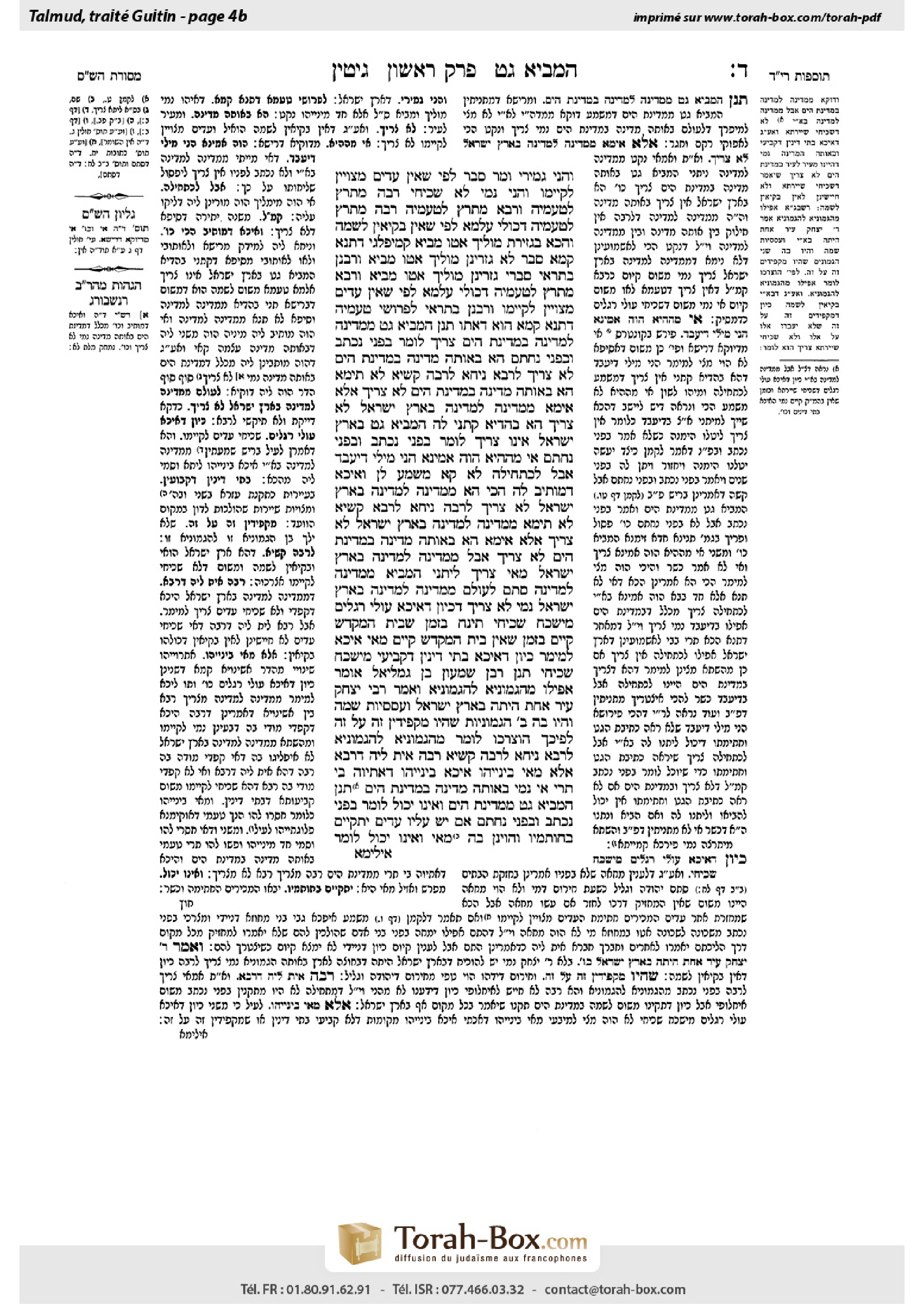
Gittin 4b: Talmud study for Daf Yomi
Study the Talmud for Daf Yomi with scanned pages, Hebrew text, English translations from Sefaria and AI-generated French translations.
Passage selection and English or AI-generated French translation are available where the scan has annotations. Daf Study is independent of Torah-Box and Sefaria.
Browse Gittin · גיטין · All tractatesGittin 4b text and translations
This page of Gittin includes the Aramaic text, an English translation and an AI-generated French translation, alongside the scan above.
גיטין ד׳ ב · Aramaic and Hebrew text
וְהָנֵי גְּמִירִי; וּמָר סָבַר לְפִי שֶׁאֵין עֵדִים מְצוּיִין לְקַיְּימוֹ, וְהָנֵי נָמֵי לָא שְׁכִיחִי?
רַבָּה מְתָרֵץ לְטַעְמֵיהּ, וְרָבָא מְתָרֵץ לְטַעְמֵיהּ. רַבָּה מְתָרֵץ לְטַעְמֵיהּ: דְּכוּלֵּי עָלְמָא לְפִי שֶׁאֵין בְּקִיאִין לִשְׁמָהּ, וְהָכָא בִּגְזֵירַת מוֹלִיךְ אַטּוּ מֵבִיא קָמִיפַּלְגִי –
דְּתַנָּא קַמָּא סָבַר: לָא גָּזְרִינַן מוֹלִיךְ אַטּוּ מֵבִיא.
וְרַבָּנַן בָּתְרָאֵי סָבְרִי: גָּזְרִינַן מוֹלִיךְ אַטּוּ מֵבִיא.
וְרָבָא מְתָרֵץ לְטַעְמֵיהּ: דְּכוּלֵּי עָלְמָא לְפִי שֶׁאֵין עֵדִים מְצוּיִין לְקַיְּימוֹ, וְרַבָּנַן בָּתְרָאֵי – לְפָרוֹשֵׁי טַעְמֵיהּ דְּתַנָּא קַמָּא הוּא דְּאָתוּ.
תְּנַן: הַמֵּבִיא גֵּט מִמְּדִינָה לִמְדִינָה בִּמְדִינַת הַיָּם – צָרִיךְ לוֹמַר ״בְּפָנַי נִכְתַּב וּבְפָנַי נֶחְתַּם״. הָא בְּאוֹתָהּ מְדִינָה בִּמְדִינַת הַיָּם – לֹא צָרִיךְ. לְרָבָא נִיחָא, לְרַבָּה קַשְׁיָא!
לָא תֵּימָא: הָא בְּאוֹתָהּ מְדִינָה בִּמְדִינַת הַיָּם – לֹא צָרִיךְ, אֶלָּא אֵימָא: מִמְּדִינָה לִמְדִינָה בְּאֶרֶץ יִשְׂרָאֵל – לֹא צָרִיךְ.
הָא בְּהֶדְיָא קָתָנֵי לַהּ: הַמֵּבִיא גֵּט בְּאֶרֶץ יִשְׂרָאֵל, אֵינוֹ צָרִיךְ לוֹמַר ״בְּפָנַי נִכְתַּב וּבְפָנַי נֶחְתַּם״! אִי מֵהַהִיא, הֲוָה אָמֵינָא הָנֵי מִילֵּי דִּיעֲבַד, אֲבָל לְכַתְּחִילָּה לָא, קָא מַשְׁמַע לַן.
וְאִיכָּא דְּמוֹתֵיב לַהּ הָכִי: הָא מִמְּדִינָה לִמְדִינָה בְּאֶרֶץ יִשְׂרָאֵל – לֹא צָרִיךְ.
לְרַבָּה נִיחָא, לְרָבָא קַשְׁיָא! לָא תֵּימָא: מִמְּדִינָה לִמְדִינָה בְּאֶרֶץ יִשְׂרָאֵל – לֹא צָרִיךְ, אֶלָּא אֵימָא: הָא בְּאוֹתָהּ מְדִינָה בִּמְדִינַת הַיָּם – לֹא צָרִיךְ.
אֲבָל מִמְּדִינָה לִמְדִינָה בְּאֶרֶץ יִשְׂרָאֵל, מַאי, צָרִיךְ?! לִיתְנֵי: ״הַמֵּבִיא מִמְּדִינָה לִמְדִינָה״ – סְתָם!
לְעוֹלָם מִמְּדִינָה לִמְדִינָה בְּאֶרֶץ יִשְׂרָאֵל נָמֵי לֹא צָרִיךְ, דְּכֵיוָן דְּאִיכָּא עוֹלֵי רְגָלִים, מִישְׁכָּח שְׁכִיחִי.
תִּינַח בִּזְמַן שֶׁבֵּית הַמִּקְדָּשׁ קַיָּים; בִּזְמַן שֶׁאֵין בֵּית הַמִּקְדָּשׁ קַיָּים, מַאי אִיכָּא לְמֵימַר? כֵּיוָן דְּאִיכָּא בָּתֵּי דִינִין דִּקְבִיעִי – מִישְׁכָּח שְׁכִיחִי.
תְּנַן, רַבָּן שִׁמְעוֹן בֶּן גַּמְלִיאֵל אוֹמֵר: אֲפִילּוּ מֵהֶגְמוֹנְיָא לְהֶגְמוֹנְיָא. וְאָמַר רַבִּי יִצְחָק: עִיר אַחַת הָיְתָה בְּאֶרֶץ יִשְׂרָאֵל וַעֲסָסְיוֹת שְׁמָהּ, וְהָיוּ בָּהּ שְׁנֵי הֶגְמוֹנְיוֹת שֶׁהָיוּ מַקְפִּידִין זֶה עַל זֶה, לְפִיכָךְ הוּצְרְכוּ לוֹמַר מֵהֶגְמוֹנְיָא לְהֶגְמוֹנְיָא.
לְרָבָא נִיחָא, לְרַבָּה קַשְׁיָא! רַבָּה אִית לֵיהּ דְּרָבָא.
אֶלָּא מַאי בֵּינַיְיהוּ? אִיכָּא בֵּינַיְיהוּ דְּאַתְיוּהּ בֵּי תְרֵי.
אִי נָמֵי, בְּאוֹתָהּ מְדִינָה בִּמְדִינַת הַיָּם.
תְּנַן: הַמֵּבִיא גֵּט מִמְּדִינַת הַיָּם, וְאֵינוֹ יָכוֹל לוֹמַר ״בְּפָנַי נִכְתַּב וּבְפָנַי נֶחְתַּם״, אִם יֵשׁ עָלָיו עֵדִים – יִתְקַיֵּים בְּחוֹתְמָיו. וַהֲוֵינַן בַּהּ: מַאי ״וְאֵינוֹ יָכוֹל לוֹמַר״?
Gittin 4b · English translation
and these people are learned with regard to this halakha, as a bill of divorce sent from Eretz Yisrael was certainly written in the correct manner. And one Sage, the Rabbis, holds: The reason for the testimony is because there are no witnesses available to ratify it, and these witnesses who travel from Eretz Yisrael overseas are also not frequently available.
The Gemara again rejects the suggestion: One cannot prove that this issue is a dispute of the tanna’im, as Rabba resolves the different opinions in the mishna according to his line of reasoning, and Rava resolves them according to his line of reasoning. Rabba resolves them according to his line of reasoning, as follows: It may be that everyone agrees that the reason is because they are not experts in writing a bill of divorce for her sake, and here they disagree with regard to a decree applied in the case of one who delivers a bill of divorce to Eretz Yisrael due to the concern that it will be confused with the case of one who brings a bill of divorce from Eretz Yisrael.
The Gemara explains that the first tanna holds: The Sages do not decree with regard to one who delivers due to one who brings. In other words, although one who delivers a bill of divorce from overseas to Eretz Yisrael must say: It was written in my presence and it was signed in my presence, one who brings a bill of divorce from Eretz Yisrael to a country overseas need not state this declaration.
And the later Rabbis hold: The Sages do decree with regard to one who delivers due to one who brings the bill of divorce from overseas. The reason for this decree is that one might err and think that just as an agent who delivers a bill of divorce from Eretz Yisrael to a country overseas is not required to testify that it was written and signed in his presence, so too, one who brings a bill of divorce from a country overseas to Eretz Yisrael need not state this declaration. Consequently, the Sages decreed that even one who delivers a bill of divorce from Eretz Yisrael to a country overseas must declare: It was written in my presence and it was signed in my presence.
And Rava also resolves the different opinions in the mishna according to his line of reasoning. How so? He maintains that everyone agrees that the reason for the declaration: It was written in my presence and it was signed in my presence, is because there are no witnesses available to ratify it, and the later Rabbis do not disagree with the previous opinion. Rather, they come to explain the reasoning of the first tanna. In other words, the first tanna agrees that one who takes a bill of divorce from Eretz Yisrael to a country overseas must state the declaration, and he simply taught the halakha in a concise manner.
§ The Gemara attempts to cite another proof: We learned in the mishna: One who brings a bill of divorce from one region to another region within a country overseas must also say: It was written in my presence and it was signed in my presence. The Gemara infers: But if he brought a bill of divorce within one region in a country overseas he is not required to state this declaration. This works out well according to the opinion of Rava, as witnesses are available in the same region. However, according to the opinion of Rabba, the matter is difficult, as overseas residents are not experts in the halakha and therefore it does not matter how closely they are located to each other.
The Gemara answers: According to the opinion of Rabba, do not say that the correct inference is: Within one region in a country overseas, he is not required to state the declaration. Rather, say that one should infer from the mishna: From region to region within Eretz Yisrael, he is not required to do so.
The Gemara raises a difficulty with regard to this answer: But that halakha need not be derived by inference, as the mishna is teaching it explicitly: One who brings a bill of divorce from one place to another within Eretz Yisrael is not required to say: It was written in my presence and it was signed in my presence. The Gemara answers: If this halakha were to be derived from that statement alone, I would say: This applies only after the fact, i.e., if someone acted in this manner then the bill of divorce is not invalidated. However, it might have been thought that one should not act in this manner ab initio; rather, the agent should state the declaration. Therefore, the mishna teaches us by means of this inference from its first section that he need not state the declaration even ab initio.
The Gemara offers an alternate version of this discussion: And some raise this objection like this, by inferring differently from that ruling of the mishna. The mishna teaches: One who brings a bill of divorce from one region to another region within a country overseas must also say: It was written in my presence and it was signed in my presence. The Gemara infers from here that if he brings the document from region to region within Eretz Yisrael, he is not required to state the declaration.
This works out well according to the opinion of Rabba, as the residents of Eretz Yisrael are aware of the halakha that a bill of divorce must be written for the woman’s sake. However, it is difficult according to the opinion of Rava. The Gemara rejects this inference: Do not say that the mishna is teaching that from one region to another region within Eretz Yisrael, he is not required. Rather, say: Within one region in a country overseas he is not required to state the declaration.
The Gemara questions this interpretation: However, if that is so, with regard to an agent who brings a bill of divorce from region to region within Eretz Yisrael, what is the halakha? Is he required to state the declaration? If so, let the mishna teach simply: One who brings a bill of divorce from one region to another region must state the declaration, without specification, and this would apply both overseas and in Eretz Yisrael.
The Gemara answers: Actually, one who brings from region to region within Eretz Yisrael is also not required to state the declaration even according to the opinion of Rava, for the following reason: Since there are those who ascend to Jerusalem for the pilgrimage Festival, witnesses are frequently available and they can come even from one region to another.
The Gemara raises a difficulty: This works out well when the Temple is standing, as there are those who ascend to Jerusalem for the pilgrimage Festival at that time. However, when the Temple is not standing what can be said? The Gemara answers: Since there are central courts that are fixed in a permanent location where everyone goes, witnesses are frequently available to ratify the bill of divorce.
The Gemara suggests a different proof: We learned in the mishna that Rabban Shimon ben Gamliel says that even an agent who brings a bill of divorce from one district to another district must say that it was written and signed in his presence. And Rabbi Yitzḥak said: There was one city in Eretz Yisrael, and Asasiyyot was its name, and it contained two districts that divided the city. And its two governors were so particular with each other that they enacted travel restrictions that made it impossible to cross through the city, and consequently they were required to say the declaration when bringing a bill of divorce from district to district.
The Gemara comments: This works out well according to the opinion of Rava, who holds that the reason is due to witnesses, as the witnesses could not pass from one district to another. However, it is difficult according to the opinion of Rabba, as he maintains that there is no need to state the declaration in Eretz Yisrael because its residents are aware of the halakha that a bill of divorce must be written for the woman’s sake. The Gemara answers: Rabba is of the opinion that the reason is also in accordance with the opinion of Rava, i.e., Rabba agrees that one of the reasons for this halakha is because witnesses are not available to ratify the bill of divorce. He adds another reason, that they are not experts in the halakha of writing the document for her sake.
The Gemara asks: Rather, what then is the difference between them, i.e., between Rava’s explanation and that of Rabba? The Gemara answers: There is a difference between them with regard to a case where two people bring the bill of divorce from a country overseas. According to the opinion of Rava they do not need to say: It was written in my presence and it was signed in my presence, as additional witnesses are not needed to confirm this bill of divorce. However, it is still necessary to declare that the document was written for the sake of the wife.
Alternatively, the difference between the two explanations involves a case where one agent brought the bill of divorce from one place to another within a single region in a country overseas, where witnesses are available to ratify it. According to Rabba it is still necessary for the agent to utter the declaration so that he can confirm that the bill of divorce was written for her sake. According to Rava, he does not have to say: It was written in my presence and it was signed in my presence, as witnesses are readily available if needed.
§ We learned in a mishna (9a): With regard to an agent who brings a bill of divorce from a country overseas, and he is unable to say: It was written in my presence and it was signed in my presence, if the bill of divorce has witnesses signed on it then it shall be ratified by its signatories, i.e., it can be ratified by validating the witnesses’ signatures. And we discussed this halakha: What is the meaning of the phrase: And he is unable to say?
Gittin 4b · Traduction française (IA)
et ces gens sont experts concernant cette halakha, car un acte de divorce envoyé depuis la Terre d'Israël a certainement été rédigé correctement. Et un Sage, les Rabbins, affirme : La raison du témoignage est qu'il n'y a pas de témoins disponibles pour valider l'acte, et ces témoins qui voyagent depuis la Terre d'Israël vers l'étranger ne sont pas fréquemment disponibles.
La Guemara rejette à nouveau cette suggestion : On ne peut prouver que cette question est un débat des tannaïm, car Rabba résout les divergences d'opinions dans la mitsna selon sa propre raisonnement, et Rava le fait selon le sien. Rabba résout selon son raisonnement, comme suit : Il peut être que tout le monde s'accorde sur le fait que la raison est qu'ils ne sont pas experts pour rédiger un acte de divorce à son intention, et ici ils divergent concernant un décret appliqué dans le cas d'une personne qui livre un acte de divorce à la Terre d'Israël en raison de la crainte qu'il soit confondu avec le cas d'une personne qui apporte un acte de divorce depuis la Terre d'Israël.
La Guemara explique que le premier tanna affirme : Les Sages ne décrètent pas concernant celui qui livre en raison de celui qui apporte. En d'autres termes, bien que celui qui livre un acte de divorce depuis l'étranger vers la Terre d'Israël doive dire : Il a été rédigé devant moi et signé devant moi, celui qui apporte un acte de divorce depuis la Terre d'Israël vers un pays étranger n'a pas besoin de faire cette déclaration.
Et les Rabbins ultérieurs affirment que les Sages décrètent concernant celui qui livre l'acte de divorce à celui qui l'apporte depuis l'étranger. La raison de ce décret est que l'on pourrait se tromper et penser que tout comme un agent qui livre un acte de divorce depuis la Terre d'Israël vers un pays étranger n'est pas tenu de témoigner qu'il a été rédigé et signé devant lui, de même celui qui apporte un acte de divorce depuis un pays étranger vers la Terre d'Israël n'a pas besoin de faire cette déclaration. Ainsi, les Sages ont décrété que même celui qui livre un acte de divorce depuis la Terre d'Israël vers un pays étranger doit déclarer : Il a été rédigé devant moi et signé devant moi.
Et Rava résout également les divergences d'opinions dans la mitsna selon son raisonnement. Comment ? Il affirme que tout le monde s'accorde sur la raison de la déclaration : « Il a été rédigé devant moi et signé devant moi », c'est-à-dire que l'on n'a pas de témoins disponibles pour valider l'acte, et les Rabbins ultérieurs ne contestent pas l'opinion précédente. Ils viennent plutôt expliquer la raison du premier tanna. En d'autres termes, le premier tanna est d'accord sur le fait que celui qui apporte un acte de divorce depuis la Terre d'Israël vers un pays étranger doit faire cette déclaration, et il a simplement enseigné la halakha de manière concise.
§ La Guemara tente de citer une autre preuve : Nous avons appris dans la mitsna : Celui qui apporte un acte de divorce d'une région à une autre région dans un pays étranger doit également dire : Il a été rédigé devant moi et signé devant moi. La Guemara infère : Mais si l'on apporte un acte de divorce dans une même région d'un pays étranger, il n'est pas tenu de faire cette déclaration. Cela s'accorde bien avec l'opinion de Rava, car des témoins sont disponibles dans la même région. Cependant, selon l'opinion de Rabba, cela est difficile, car les résidents étrangers ne sont pas experts en halakha et donc cela n'a pas d'importance à quel point ils sont proches les uns des autres.
La Guemara répond : Selon l'opinion de Rabba, ne dites pas que l'inférence correcte est : Dans une même région d'un pays étranger, il n'est pas tenu de faire cette déclaration. Au contraire, dites qu'on doit inférer de la mitsna : De région à région dans la Terre d'Israël, il n'est pas tenu de le faire.
La Guemara soulève une difficulté concernant cette réponse : Mais cette halakha n'a pas besoin d'être dérivée par une inférence, car la mitsna l'enseigne explicitement : Celui qui apporte un acte de divorce d'un lieu à un autre dans la Terre d'Israël n'est pas tenu de dire : Il a été rédigé devant moi et signé devant moi. La Guemara répond : Si cette halakha devait être dérivée uniquement de cette déclaration, je dirais : Cela s'applique uniquement après l'événement, c'est-à-dire si quelqu'un agit ainsi, l'acte de divorce n'est pas invalidé. Cependant, on pourrait penser qu'on ne devrait pas agir ainsi d'abord ; plutôt, l'agent devrait faire cette déclaration. Ainsi, la mitsna nous enseigne par cette inférence tirée de sa première section que l'on n'a pas besoin de faire cette déclaration même d'abord.
La Guemara propose une version alternative de ce débat : Certains soulevèrent cette objection en inférant différemment de cette décision de la mitsna. La mitsna enseigne : Celui qui apporte un acte de divorce d'une région à une autre région dans un pays étranger doit également dire : Il a été rédigé devant moi et signé devant moi. La Guemara infère d'ici que si l'on apporte le document d'une région à une autre dans la Terre d'Israël, il n'est pas tenu de faire cette déclaration.
Cela s'accorde bien selon l'opinion de Rabba, car les résidents de la Terre d'Israël sont conscients de la halakha que l'acte de divorce doit être rédigé à l'intention de la femme. Cependant, cela est difficile selon l'opinion de Rava. La Guemara rejette cette inférence : Ne dites pas que la mitsna enseigne que d'une région à une autre dans la Terre d'Israël, il n'est pas tenu. Au contraire, dites : Dans une même région d'un pays étranger, il n'est pas tenu de faire cette déclaration.
La Guemara questionne cette interprétation : Cependant, si c'est ainsi, concernant un agent qui apporte un acte de divorce d'une région à une autre dans la Terre d'Israël, quelle est la halakha ? Doit-il faire cette déclaration ? Si oui, laissez la mitsna enseigner simplement : Celui qui apporte un acte de divorce d'une région à une autre région doit faire cette déclaration, sans précision, et cela s'appliquerait à la fois à l'étranger et en Terre d'Israël.
La Guemara répond : En réalité, celui qui transporte d'une région à une autre au sein de la Terre d'Israël n'est pas non plus tenu de déclarer la déclaration, même selon l'opinion de Rava, pour la raison suivante : puisque des personnes montent à Jérusalem pour les fêtes de pèlerinage, des témoins sont fréquemment disponibles et ils peuvent même venir d'une région à une autre.
La Guemara soulève une difficulté : cela fonctionne bien lorsque le Temple est debout, car à cette époque, des personnes montent à Jérusalem pour les fêtes de pèlerinage. Cependant, lorsque le Temple n'est pas debout, que peut-on dire ? La Guemara répond : puisque des tribunaux centraux sont fixés dans un lieu permanent où tout le monde va, des témoins sont fréquemment disponibles pour valider le document de divorce.
La Guemara suggère une autre preuve : nous avons appris dans la Michna que Rabban Shimon ben Gamliel dit que même un agent qui transporte un document de divorce d'une région à une autre doit dire qu'il a été écrit et signé en sa présence. Et Rabbi Yitzḥak a dit : il y avait une ville en Terre d'Israël, et son nom était Asasiyyot, et elle contenait deux districts qui divisaient la ville. Et ses deux gouverneurs étaient si exigeants l'un envers l'autre qu'ils avaient établi des restrictions de voyage qui rendaient impossible de traverser la ville, et par conséquent ils étaient obligés de dire la déclaration lorsqu'ils transportaient un document de divorce d'un district à un autre.
La Guemara commente : cela fonctionne bien selon l'opinion de Rava, qui considère que la raison est liée aux témoins, car les témoins ne pouvaient pas passer d'un district à un autre. Cependant, cela est difficile selon l'opinion de Rabba, car il maintient qu'il n'est pas nécessaire de déclarer la déclaration en Terre d'Israël, car ses habitants connaissent la halakha selon laquelle un document de divorce doit être écrit pour le bénéfice de la femme. La Guemara répond : Rabba est de l'avis que la raison est également conformément à l'opinion de Rava, c'est-à-dire que Rabba accepte que l'une des raisons de cette halakha est liée au fait que des témoins ne sont pas disponibles pour valider le document de divorce. Il ajoute une autre raison, à savoir qu'ils ne sont pas experts en matière de halakha concernant l'écriture du document pour son bénéfice.
La Guemara pose une question : plutôt, que représente alors la différence entre eux, c'est-à-dire entre l'explication de Rava et celle de Rabba ? La Guemara répond : il y a une différence entre eux concernant un cas où deux personnes transportent le document de divorce d'un pays étranger. Selon l'opinion de Rava, ils n'ont pas besoin de dire : il a été écrit en ma présence et il a été signé en ma présence, car des témoins supplémentaires ne sont pas nécessaires pour valider ce document de divorce. Cependant, il est encore nécessaire de déclarer que le document a été écrit pour le bénéfice de la femme.
Autrement dit, la différence entre les deux explications concerne un cas où un agent a transporté le document de divorce d'un lieu à un autre au sein d'une même région d'un pays étranger, où des témoins sont disponibles pour valider ce document. Selon Rabba, il est encore nécessaire que l'agent déclare cela afin de confirmer que le document de divorce a été écrit pour son bénéfice. Selon Rava, il n'a pas besoin de dire : il a été écrit en ma présence et il a été signé en ma présence, car des témoins sont facilement disponibles si nécessaire.
§ Nous avons appris dans une mitsna (9a) : concernant un agent qui apporte un document de divorce d'un pays étranger, et qui n'est pas en mesure de dire : il a été écrit en ma présence et il a été signé en ma présence, si le document de divorce a des témoins signataires, il sera validé par ses signataires, c'est-à-dire qu'il peut être validé en validant les signatures des témoins. Et nous avons discuté de cette halakha : que signifie la phrase : et il n'est pas en mesure de dire ?
Traduction française générée par IA à partir de l’édition anglaise de Sefaria. Vérifie toujours un passage avec le texte source.
Text from Sefaria: William Davidson Edition - Vocalized Aramaic (CC BY NC); William Davidson Edition - English (CC BY NC).