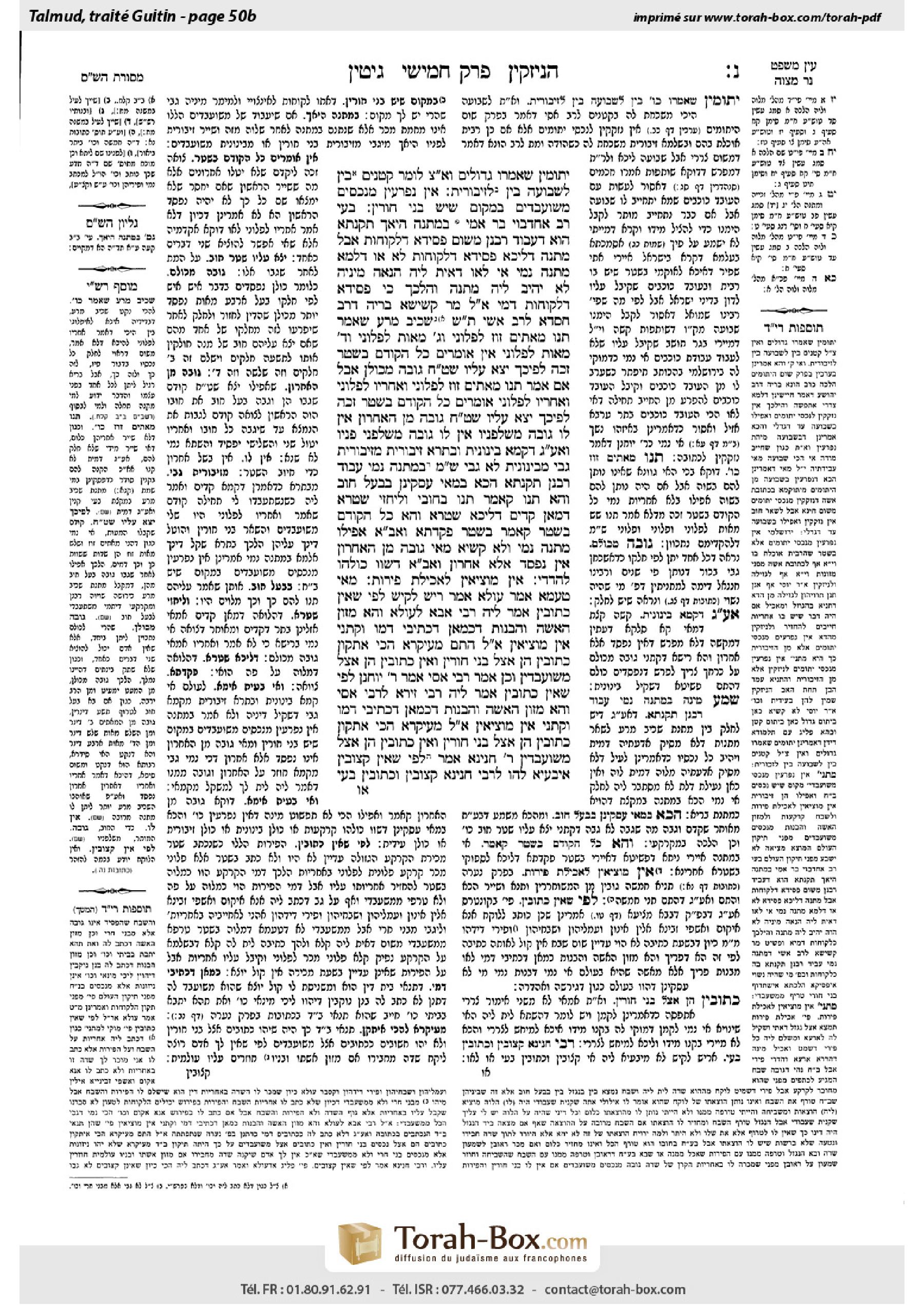
Gittin 50b: Talmud study for Daf Yomi
Study the Talmud for Daf Yomi with scanned pages, Hebrew text, English translations from Sefaria and AI-generated French translations.
Passage selection and English or AI-generated French translation are available where the scan has annotations. Daf Study is independent of Torah-Box and Sefaria.
Browse Gittin · גיטין · All tractatesGittin 50b text and translations
This page of Gittin includes the Aramaic text, an English translation and an AI-generated French translation, alongside the scan above.
גיטין נ׳ ב · Aramaic and Hebrew text
יְתוֹמִין שֶׁאָמְרוּ – גְּדוֹלִים, וְאֵין צָרִיךְ לוֹמַר קְטַנִּים; בֵּין לִשְׁבוּעָה בֵּין לְזִיבּוּרִית.
אֵין נִפְרָעִין מִנְּכָסִים מְשׁוּעְבָּדִים בִּמְקוֹם שֶׁיֵּשׁ בְּנֵי חוֹרִין. בָּעֵי רַב אַחָדְבוּי בַּר אַמֵּי: בְּמַתָּנָה הֵיאַךְ?
תַּקַּנְתָּא הוּא דַּעֲבוּד רַבָּנַן – מִשּׁוּם פְּסֵידָא דְלָקוֹחוֹת, אֲבָל מַתָּנָה, דְּלֵיכָּא פְּסֵידָא דְלָקוֹחוֹת – לָא; אוֹ דִלְמָא מַתָּנָה נָמֵי, אִי לָאו דְּאִית לֵיהּ הֲנָאָה מִינֵּיהּ – לָא יָהֵיב לֵיהּ מַתָּנָה, וְהִלְכָּךְ כִּי פְּסֵידָא דְלָקוֹחוֹת דָּמֵי?
אֲמַר לֵיהּ מָר קַשִּׁישָׁא בְּרֵיהּ דְּרַב חִסְדָּא לְרַב אָשֵׁי, תָּא שְׁמַע, שְׁכִיב מְרַע שֶׁאָמַר: ״תְּנוּ מָאתַיִם זוּז לִפְלוֹנִי, ושְׁלֹשׁ מֵאוֹת לִפְלוֹנִי, וְאַרְבַּע מֵאוֹת לִפְלוֹנִי״ – אֵין אוֹמְרִים: כׇּל הַקּוֹדֵם בִּשְׁטָר זָכָה; לְפִיכָךְ, יָצָא עָלָיו שְׁטַר חוֹב – גּוֹבֶה מִכּוּלָּן.
אֲבָל אִם אָמַר: ״תְּנוּ מָאתַיִם זוּז לִפְלוֹנִי, וְאַחֲרָיו לִפְלוֹנִי, וְאַחֲרָיו לִפְלוֹנִי״ – אוֹמְרִים: כׇּל הַקּוֹדֵם בִּשְׁטָר זָכָה. לְפִיכָךְ, יָצָא עָלָיו שְׁטַר חוֹב – גּוֹבֶה מִן הָאַחֲרוֹן. אֵין לוֹ – גּוֹבֶה מִשֶּׁלְּפָנָיו. אֵין לוֹ – גּוֹבֶה מִשֶּׁלִּפְנֵי פָנָיו.
וְאַף עַל גַּב דְּקַמָּא בֵּינוֹנִית וּבָתְרָא זִיבּוּרִית – מִזִּיבּוּרִית גָּבֵי, מִבֵּינוֹנִית לָא גָּבֵי. שְׁמַע מִינַּהּ, בְּמַתָּנָה נָמֵי עֲבוּד רַבָּנַן תַּקַּנְתָּא.
הָכָא בְּמַאי עָסְקִינַן – בְּבַעַל חוֹב. וְהָא ״תְּנוּ״ קָאָמַר! ״תְּנוּ״ בְּחוֹבִי.
וְלִיחְזֵי שְׁטָרָא דְּמַאן קָדֵים! דְּלֵיכָּא שְׁטָרָא. וְהָא ״כׇּל הַקּוֹדֵם בִּשְׁטָר״ קָאָמַר! בִּשְׁטָר פְּקַדְתָּא.
וְאִיבָּעֵית אֵימָא: אֲפִילּוּ מַתָּנָה נָמֵי. וְלָא קַשְׁיָא – מַאי ״גּוֹבֶה מִן הָאַחֲרוֹן״? אֵין נִפְסָד אֶלָּא אַחֲרוֹן.
וְאִיבָּעֵית אֵימָא: דְּשָׁווּ כּוּלְּהוּ לַהֲדָדֵי.
אֵין מוֹצִיאִין לַאֲכִילַת פֵּירוֹת. מַאי טַעְמָא? אָמַר עוּלָּא אָמַר רֵישׁ לָקִישׁ: לְפִי שֶׁאֵין כְּתוּבִין.
אֲמַר לֵיהּ רַבִּי אַבָּא לְעוּלָּא: וְהָא מְזוֹן הָאִשָּׁה וְהַבָּנוֹת, דִּכְמַאן דִּכְתִיבִי דָּמוּ, וְקָתָנֵי: אֵין מוֹצִיאִין!
אֲמַר לֵיהּ: הָתָם, מֵעִיקָּרָא הָכִי אִתַּקּוּן – כְּתוּבִין הֵן אֵצֶל בְּנֵי חוֹרִין, וְאֵין כְּתוּבִין הֵן אֵצֶל מְשׁוּעְבָּדִין.
וְכֵן אָמַר רַבִּי אַסִּי אָמַר רַבִּי יוֹחָנָן: לְפִי שֶׁאֵין כְּתוּבִין. אֲמַר לֵיהּ רַבִּי זֵירָא לְרַב אַסִּי: וְהָא מְזוֹן הָאִשָּׁה וְהַבָּנוֹת, דִּכְמַאן דִּכְתִיבִי דָּמוּ, וְקָתָנֵי: אֵין מוֹצִיאִין! אֲמַר לֵיהּ: מֵעִיקָּרָא הָכִי אִתַּקּוּן – כְּתוּבִין הֵן אֵצֶל בְּנֵי חוֹרִין, וְאֵין כְּתוּבִין הֵן אֵצֶל מְשׁוּעְבָּדִין.
רַבִּי חֲנִינָא אָמַר: לְפִי שֶׁאֵין קְצוּבִין.
אִיבַּעְיָא לְהוּ: לְרַבִּי חֲנִינָא – קְצוּבִין וּכְתוּבִין בָּעֵי,
Gittin 50b · English translation
With regard to the orphans of which the Sages spoke, the phrase is referring to adults, and needless to say it is referring also to minors, whether with regard to the halakha that a debt can be collected from the property of orphans only with an oath, or whether with regard to the halakha that a debt can be collected from the property of orphans only from inferior-quality land.
§ The mishna teaches: Payment of a debt or other obligation is not collected from liened property that has been sold to a third party when the debtor still has unsold property, even when this unsold property is inferior-quality land. Rav Aḥadevoi bar Ami raised a dilemma: What is the halakha with regard to liened property that the debtor gave to another person as a gift? Is it the halakha that the debt is not collected from liened property that has been given as a gift to a third party when the debtor still has property?
The Gemara presents the two sides to this dilemma: Is the halakha that payment is not collected from liened property that has been sold an ordinance that the Sages instituted due to the loss of the buyers, who would lose the money that they had paid for the property? But in the case of a gift, where there is no issue of loss to the buyers, i.e., the recipients, as the recipients paid nothing for the property, the halakha does not apply. Or perhaps the halakha applies to a gift as well, as, were it not for some benefit that the donor derives from the recipient, he would not have given him the gift. And therefore this loss to the recipient is considered to be like the loss to buyers and payment of the debt is not collected from the recipient of the gift when the debtor still has property in his possession.
Mar Kashisha, son of Rav Ḥisda, said to Rav Ashi: Come and hear what was taught in a baraita (Tosefta, Bava Batra 9:6): If a person on his deathbed said: Give two hundred dinars to so-and-so, and three hundred to so-and-so, and four hundred to so-and-so, in this case one does not say that whoever appears first in the deed acquires his money first. Therefore, if a promissory note emerged against the one who gave the gifts, and it becomes clear that the money given was pledged to a creditor, then the creditor collects from all of them.
But if the person on his deathbed said: Give two hundred dinars to so-and-so, and after him to so-and-so, and after him to so-and-so, then one says: Anyone who appears first in the deed acquires his money first. Therefore, if a promissory note emerged against him, the creditor first collects from the last one of the recipients. If he does not have enough to repay the debt, he collects from the previous person. If he does not have enough to repay the debt, he collects from the person listed before the previous person.
The Gemara infers: And this is the halakha even if the property given to the first recipient is intermediate-quality land and the property given to the last recipient is inferior-quality land. Although a creditor is entitled to collect his debt from intermediate-quality land, the creditor in this case collects from inferior-quality land, as he collects from the last person to receive his gift, and he does not collect from the intermediate-quality land given to the first recipient. Conclude from the baraita that the Sages also instituted this ordinance in the case of a gift, and that payment of a debt is not collected from liened property that has been given as a gift to a third party when the debtor still has property that has not been sold or given away as a gift. The reason is that the second gift is considered to be unsold property in relation to the first gift because, when the first gift was given, the second gift was still in the donor’s possession.
The Gemara rejects this proof: With what are we dealing here? We are not dealing here with a person on his deathbed who is distributing monetary gifts, but rather with a debtor who is dividing his money between his various creditors. The Gemara raises an objection: But didn’t the person on his deathbed say: Give the money to so-and-so, a formulation that indicates that he is granting a gift? The Gemara answers that what this means is: Give this money as payment for my debt.
The Gemara asks: If so, why should the recovery of the debts depend upon the wording of the debtor’s instructions? But let us see whose promissory note was written first, as it is he who collects first. The Gemara answers: We are dealing with a case where there is no promissory note, e.g., where the creditors lost their deeds. The Gemara raises an objection: But didn’t it say in the baraita: Whoever appears first in the deed? This indicates that there is in fact a deed. The Gemara answers: The reference here is not to the promissory notes but to the testamentary deed drawn up by the person on his deathbed.
And if you wish, say: The baraita is referring also to a case of a gift, and even if the mishna’s ordinance does not apply to liened property that had been given away as a gift, the halakha that the creditor collects from the last recipient is not difficult, as what is the meaning of the words: He collects from the last recipient? This means that it is only the last recipient who really loses, as the creditor can collect from intermediate-quality land wherever it is, even if it is in the possession of the first recipient. But after the creditor collects what is due him, the recipients of the gifts distribute the remaining property, in accordance with the order set down in the donor’s testament. Therefore, it will always be the last recipient who loses and no one else.
And if you wish, say: The baraita is referring to a case where all of the properties are of equal quality. There is no reason to collect specifically from the first recipient because he has intermediate-quality land as opposed to the last recipient who does not. In such a case, the debt is collected first from the last recipient. Therefore, there is no proof from here that the mishna’s ordinance applies even to liened property that had been given away as a gift.
§ The mishna teaches: The court does not appropriate liened property that has been sold to a third party for the consumption of produce. If one appropriated a field and sold it, and the buyer worked the land, improved it, and grew produce on it, and then the owner came and took back his field together with the produce, the buyer cannot collect the value of the produce from property that the robber sold to another person. The Gemara asks: What is the reason for this? Ulla says that Reish Lakish says: This is because the produce is not written in the deed of sale. The obligation of a seller to reimburse the buyer if the field he sells him is repossessed by a prior owner or creditor is dependent upon the obligation recorded in the deed of sale. His obligation of reimbursement with regard to the produce is therefore treated like a loan by oral agreement, which is not a matter of public knowledge, and those who subsequently purchased land from the robber are not obligated to pay for debt incurred in a loan by oral agreement, as they had no way to know about it at the time of their purchase.
Rabbi Abba said to Ulla: But isn’t the sustenance of a man’s wife and daughters considered as if it were written, as even if it is not explicitly recorded in the marriage contract it is one of the fixed stipulations of a marriage contract that are imposed by the court? It is known that a man is obligated to provide for the sustenance of his wife and daughters, and yet the mishna teaches: Payment for the sustenance of a man’s wife and daughters cannot be collected from the husband’s liened property.
Ulla said to him: There, with regard to sustenance of a man’s wife and daughters, the Sages instituted it like this from the outset: It is considered as if it were written with regard to unsold property that is still in the man’s possession, so that sustenance can be collected from such property, but it is not considered as if it were written with regard to liened property that has been sold to another party.
And similarly, Rabbi Asi says that Rabbi Yoḥanan says with regard to the mishna: Why can’t the payment for the consumption of produce be collected from property that the robber sold to another person? It is because the produce is not written in the purchaser’s deed of sale. Rabbi Zeira said to Rav Asi: But isn’t the sustenance of a man’s wife and daughters considered as if it were written in the marriage contract, and yet the mishna teaches: Payment for the sustenance of a man’s wife and daughters cannot be collected from the husband’s liened property? Rav Asi said to him: The Sages instituted it like this from the outset: Sustenance is considered as if it were written with regard to unsold property that is still in the man’s possession, so that sustenance can be collected from such property, but it is not considered as if it were written with regard to liened property that has been sold to another party. This concludes the discussion of one reason for the halakha in the mishna.
Rabbi Ḥanina says that it is for a different reason that payment for the consumption of produce cannot be recovered from property that the robber sold to another person: It is because the produce is not of a fixed amount, i.e., it could not be known at the outset how much produce would grow on the field or what its value would be. The Sages instituted that any obligation that is not of a fixed amount cannot be collected from property sold to another person, because the purchaser of the liened property cannot assess the risk he is assuming of having another person come to collect compensation from that property for a loss he has suffered.
A dilemma was raised before the Sages: According to the opinion of Rabbi Ḥanina, in order to collect from liened property, is it necessary that the obligation be both of a fixed amount and also written? If so, this would indicate that Rabbi Ḥanina adds another requirement in addition to that of Rabbi Yoḥanan.
Gittin 50b · Traduction française (IA)
Concernant les orphelins dont les Sages parlaient, la phrase fait référence aux adultes, et sans aucun doute elle fait également référence aux mineurs, qu'il s'agisse de la halakha selon laquelle une dette ne peut être recueillie sur la propriété des orphelins qu'avec un serment, ou qu'il s'agisse de la halakha selon laquelle une dette ne peut être recueillie sur la propriété des orphelins qu'à partir de terres de qualité inférieure.
§ La mitsva enseigne : Le paiement d'une dette ou d'une autre obligation n'est pas recueilli à partir d'une propriété liée qui a été vendue à un tiers, lorsque le débiteur possède encore une propriété non vendue, même si cette propriété non vendue est une terre de qualité inférieure. Rav Aḥadevoi bar Ami a soulevé un dilemme : Quelle est la halakha concernant une propriété liée qui a été donnée par le débiteur à une autre personne en tant que cadeau ? Est-ce que la halakha est que la dette n'est pas recueillie à partir d'une propriété liée qui a été donnée en tant que cadeau à un tiers, lorsque le débiteur possède encore une propriété ?
Le Guemara présente les deux côtés de ce dilemme : Est-ce que la halakha est que le paiement n'est pas recueilli à partir d'une propriété liée qui a été vendue, une ordonnance que les Sages ont instituée en raison de la perte des acheteurs, qui perdraient l'argent qu'ils ont payé pour la propriété ? Mais dans le cas d'un cadeau, où il n'y a pas de problème de perte pour les acheteurs, c'est-à-dire les bénéficiaires, puisque les bénéficiaires n'ont rien payé pour la propriété, la halakha ne s'applique pas. Ou peut-être la halakha s'applique-t-elle également à un cadeau, car, sans ce bénéfice que le donateur tire du bénéficiaire, il ne l'aurait pas donné. Et donc cette perte pour le bénéficiaire est considérée comme étant comme la perte des acheteurs, et le paiement de la dette n'est pas recueilli du bénéficiaire du cadeau lorsque le débiteur possède encore une propriété.
Mar Kashisha, fils de Rav Ḥisda, a dit à Rav Ashi : Viens écouter ce qui a été enseigné dans une baraïta (Tosefta, Bava Batra 9:6) : Si une personne, sur son lit de mort, a dit : Donne deux cents dinars à tel et tel, et trois cents à tel et tel, et quatre cents à tel et tel, dans ce cas, on ne dit pas que celui qui apparaît en premier dans le testament acquiert d'abord son argent. Donc, si un titre de créance émerge contre celui qui a fait les dons, et si cela devient clair que l'argent donné a été mis en gage à un créancier, alors le créancier récupère de tous ceux-ci.
Mais si la personne sur son lit de mort a dit : Donne deux cents dinars à tel et tel, et après lui à tel et tel, et après lui à tel et tel, alors on dit : Celui qui apparaît en premier dans le testament acquiert d'abord son argent. Donc, si un titre de créance émerge contre lui, le créancier récupère d'abord le dernier des bénéficiaires. Si celui-ci n'a pas assez pour rembourser la dette, il récupère du précédent. Si celui-ci n'a pas assez pour rembourser la dette, il récupère de la personne qui a été mentionné avant le précédent.
Le Guemara déduit : Et c'est la halakha même si la propriété donnée au premier bénéficiaire est une terre de qualité intermédiaire et la propriété donnée au dernier bénéficiaire est une terre de qualité inférieure. Bien que le créancier ait le droit de récupérer sa dette à partir d'une terre de qualité intermédiaire, le créancier dans ce cas récupère à partir d'une terre de qualité inférieure, car il récupère du dernier à avoir reçu son cadeau, et il ne récupère pas de la terre de qualité intermédiaire donnée au premier bénéficiaire. Concluez de la baraïta que les Sages ont également institué cette ordonnance dans le cas d'un cadeau, et que le paiement d'une dette n'est pas récupéré à partir d'une propriété liée qui a été donnée en tant que cadeau à un tiers lorsque le débiteur possède encore une propriété non vendue ou non donnée en tant que cadeau. La raison est que le deuxième cadeau est considéré comme une propriété non vendue par rapport au premier cadeau, car, lorsque le premier cadeau a été donné, le deuxième cadeau était encore en possession du donateur.
Le Guemara rejette cette preuve : Avec quoi sommes-nous en train de nous occuper ici ? Nous ne sommes pas en train de nous occuper d'une personne sur son lit de mort qui distribue des cadeaux monétaires, mais plutôt d'un débiteur qui divise son argent entre ses divers créanciers. Le Guemara soulève une objection : Mais n'a-t-il pas dit dans la baraïta : Donne l'argent à tel et tel, une formulation qui indique qu'il fait un cadeau ? Le Guemara répond que cela signifie : Donne cet argent comme paiement de ma dette.
Le Guemara pose la question : Si c'est ainsi, pourquoi la récupération des dettes dépend-elle du contenu des instructions du débiteur ? Mais voyons plutôt qui a rédigé le titre de créance en premier, car c'est lui qui récupère en premier. Le Guemara répond : Nous sommes en train de traiter d'un cas où il n'y a pas de titre de créance, par exemple, où les créanciers ont perdu leurs actes. Le Guemara soulève une objection : Mais n'a-t-il pas dit dans la baraïta : Celui qui apparaît en premier dans l'acte ? Cela indique qu'il y a effectivement un acte. Le Guemara répond : La référence ici n'est pas aux titres de créance, mais au testament établi par la personne sur son lit de mort.
Et si vous le souhaitez, dites : La baraïta fait référence à un cas de don également, et même si l'ordonnance de la mitsva ne s'applique pas à une propriété liée qui a été donnée en tant que cadeau à un tiers, la halakha selon laquelle le créancier récupère du dernier bénéficiaire n'est pas difficile, car que signifie la phrase : Il récupère du dernier bénéficiaire ? Cela signifie que c'est uniquement le dernier bénéficiaire qui perd, car le créancier peut récupérer de la terre de qualité intermédiaire partout où elle est, même si elle est en possession du premier bénéficiaire. Mais après que le créancier ait récupéré ce qui lui est dû, les bénéficiaires des cadeaux distribuent la propriété restante selon l'ordre établi dans le testament du donateur. Ainsi, c'est toujours le dernier bénéficiaire qui perd et personne d'autre.
Et si vous le souhaitez, dites : La baraïta fait référence à un cas où toutes les propriétés sont de la même qualité. Il n'y a pas de raison de récupérer spécifiquement du premier bénéficiaire, car il possède une terre de qualité intermédiaire, contrairement au dernier bénéficiaire qui n'en possède pas. Dans ce cas, la dette est récupérée en premier du dernier bénéficiaire. Ainsi, il n'y a pas de preuve ici que l'ordonnance de la mitsva s'applique même à une propriété liée qui a été donnée en tant que cadeau à un tiers.
§ La Michna enseigne : Le tribunal ne peut pas réclamer la propriété liée vendue à un tiers pour la consommation des produits. Si l'on a réclamé un champ et l'a vendu, et que l'acheteur a travaillé la terre, l'a améliorée et a cultivé des produits, et que l'propriétaire est revenu et a récupéré son champ avec les produits, l'acheteur ne peut pas récupérer la valeur des produits à partir de la propriété vendue par le voleur à une autre personne. La Guemara pose la question : Quelle est la raison de cela ? Ulla dit que Reish Lakish dit : C'est parce que les produits ne sont pas mentionnés dans le contrat de vente. L'obligation du vendeur de rembourser l'acheteur si le champ qu'il lui vend est réclamé par un propriétaire antérieur ou un créancier dépend de l'obligation inscrite dans le contrat de vente. Son obligation de remboursement concernant les produits est donc traitée comme un prêt par accord oral, qui n'est pas une affaire publique, et ceux qui ont ensuite acheté une terre au voleur ne sont pas obligés de payer pour une dette contractée par un prêt par accord oral, car ils n'avaient pas la possibilité de savoir cela au moment de leur achat.
Rabbi Abba dit à Ulla : Mais n'est-ce pas la subsistance de la femme et des filles d'un homme qui est considérée comme écrite, car même si elle n'est pas explicitement inscrite dans le contrat de mariage, elle est l'une des stipulations fixes du contrat de mariage imposées par le tribunal ? On sait que l'homme est tenu de fournir la subsistance à sa femme et à ses filles, et pourtant la Michna enseigne : Le paiement de la subsistance de la femme et des filles d'un homme ne peut pas être réclamé à la propriété liée de l'homme.
Ulla dit à lui : Là, concernant la subsistance de la femme et des filles d'un homme, les Sages l'ont institué ainsi dès le début : On considère cela comme s'il était écrit concernant la propriété non vendue qui est encore en possession de l'homme, afin que la subsistance puisse être réclamée à partir de cette propriété, mais on ne considère pas cela comme s'il était écrit concernant la propriété liée vendue à une autre personne.
Et de même, Rabbi Asi dit que Rabbi Yoḥanan dit concernant la Michna : Pourquoi ne peut-on pas réclamer le paiement de la consommation des produits à partir de la propriété vendue par le voleur à une autre personne ? C'est parce que les produits ne sont pas mentionnés dans le contrat de vente de l'acheteur. Rabbi Zeira dit à Rav Asi : Mais n'est-ce pas la subsistance de la femme et des filles d'un homme qui est considérée comme s'il était écrite dans le contrat de mariage, et pourtant la Michna enseigne : Le paiement de la subsistance de la femme et des filles d'un homme ne peut pas être réclamé à la propriété liée de l'homme ? Rav Asi dit à lui : Les Sages l'ont institué ainsi dès le début : La subsistance est considérée comme s'il était écrite concernant la propriété non vendue qui est encore en possession de l'homme, afin que la subsistance puisse être réclamée à partir de cette propriété, mais on ne considère pas cela comme s'il était écrite concernant la propriété liée vendue à une autre personne. Cela conclut la discussion d'une raison pour la halakha dans la Michna.
Rabbi Ḥanina dit que c'est pour une autre raison que le paiement pour la consommation des produits ne peut être récupéré à partir de la propriété vendue par le voleur à une autre personne : c'est parce que les produits ne sont pas d'une quantité fixe, c'est-à-dire qu'on ne pouvait pas savoir à l'avance combien de produits pouvaient pousser sur le champ ou quelle serait leur valeur. Les Sages ont institué que toute obligation qui n'est pas d'une quantité fixe ne peut pas être récupérée à partir de la propriété vendue à une autre personne, car l'acheteur de la propriété liée ne peut pas évaluer le risque qu'il assume de voir une autre personne venir réclamer une compensation à partir de cette propriété pour une perte qu'il a subie.
Un dilemme a été soulevé devant les Sages : selon l'opinion de Rabbi Ḥanina, pour réclamer à partir de la propriété liée, est-il nécessaire que l'obligation soit à la fois d'une quantité fixe et écrite ? Si c'est le cas, cela indiquerait que Rabbi Ḥanina ajoute une autre exigence en plus de celle de Rabbi Yoḥanan.
Traduction française générée par IA à partir de l’édition anglaise de Sefaria. Vérifie toujours un passage avec le texte source.
Text from Sefaria: William Davidson Edition - Vocalized Aramaic (CC BY NC); William Davidson Edition - English (CC BY NC).