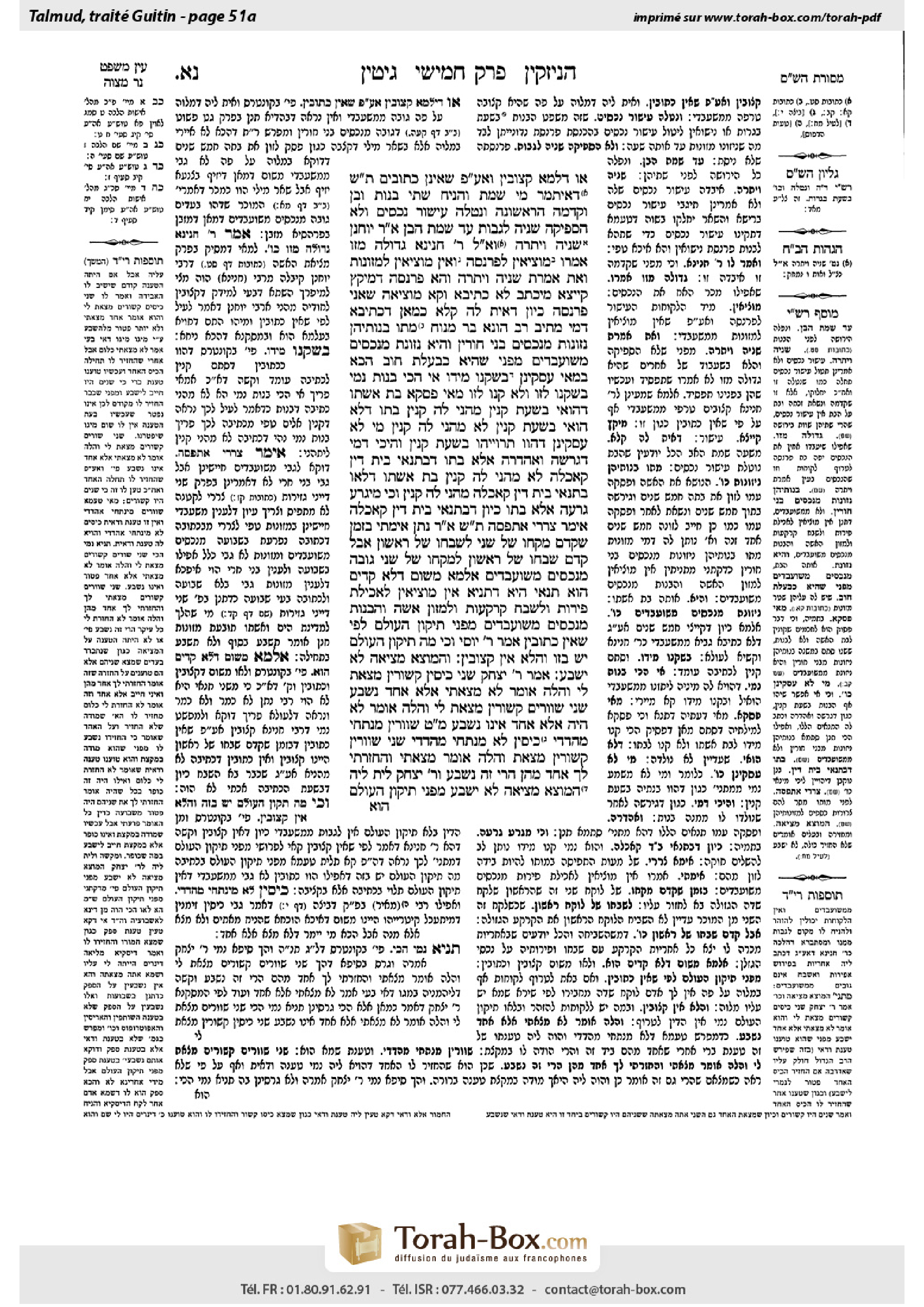
Gittin 51a: Talmud study for Daf Yomi
Study the Talmud for Daf Yomi with scanned pages, Hebrew text, English translations from Sefaria and AI-generated French translations.
Passage selection and English or AI-generated French translation are available where the scan has annotations. Daf Study is independent of Torah-Box and Sefaria.
Browse Gittin · גיטין · All tractatesGittin 51a text and translations
This page of Gittin includes the Aramaic text, an English translation and an AI-generated French translation, alongside the scan above.
גיטין נ״א א · Aramaic and Hebrew text
אוֹ דִּלְמָא קְצוּבִין, וְאַף עַל פִּי שֶׁאֵינָן כְּתוּבִים?
תָּא שְׁמַע, דְּאִיתְּמַר: מִי שֶׁמֵּת וְהִנִּיחַ שְׁתֵּי בָּנוֹת וּבֵן, וְקָדְמָה הָרִאשׁוֹנָה וְנָטְלָה עִישּׂוּר נְכָסִים, וְלֹא הִסְפִּיקָה שְׁנִיָּה לִגְבּוֹת עַד שֶׁמֵּת הַבֵּן.
אָמַר רַבִּי יוֹחָנָן: שְׁנִיָּה וִיתְּרָה. וְאָמַר לוֹ רַבִּי חֲנִינָא, גְּדוֹלָה מִזּוֹ אָמְרוּ: מוֹצִיאִין לְפַרְנָסָה וְאֵין מוֹצִיאִין לִמְזוֹנוֹת; וְאַתְּ אָמְרַתְּ שְׁנִיָּה וִיתְּרָה?!
וְהָא פַּרְנָסָה – דְּמִיקָץ קַיְיצָא, מִיכְתָּב לָא כְּתִיבָא; וְקָא מוֹצִיאָה!
שָׁאנֵי פַּרְנָסָה, כֵּיוָן דְּאִית לַהּ קָלָא, כְּמַאן דִּכְתִיבָא דָּמֵי.
מֵתִיב רַב הוּנָא בַּר מָנוֹחַ: מֵתוּ – בְּנוֹתֵיהֶן נִזּוֹנוֹת מִנְּכָסִים בְּנֵי חוֹרִין,
וְהִיא נִזּוֹנֶת מִנְּכָסִים מְשׁוּעְבָּדִים – מִפְּנֵי שֶׁהִיא כְּבַעֲלַת חוֹב!
הָכָא בְּמַאי עָסְקִינַן – בְּשֶׁקָּנוּ מִיָּדוֹ.
אִי הָכִי, בָּנוֹת נָמֵי! בְּשֶׁקָּנוּ לָזוֹ, וְלֹא קָנוּ לָזוֹ.
מַאי פַּסְקָא? בַּת אִשְׁתּוֹ, דַּהֲוַאי בִּשְׁעַת קִנְיָן – מַהֲנֵי לַהּ קִנְיָן; בִּתּוֹ, דְּלָא הֲוַאי בִּשְׁעַת קִנְיָן – לָא מַהֲנֵי לָהּ קִנְיַן.
מִי לָא עָסְקִינַן דַּהֲווֹ תַּרְוַיְיהוּ בִּשְׁעַת קִנְיָן – וְהֵיכִי דָּמֵי, דְּגָרְשַׁהּ וְאַהְדְּרַהּ?!
אֶלָּא בִּתּוֹ – דְּבִתְנַאי בֵּית דִּין קָאָכְלָה, לָא מַהֲנֵי לַהּ קִנְיַן; בַּת אִשְׁתּוֹ – דְּלָאו בִּתְנַאי בֵּית דִּין קָאָכְלָה, מַהֲנֵי לַהּ קִנְיָן.
וְכִי מִיגְרָע גָּרְעָה?! אֶלָּא בִּתּוֹ – כֵּיוָן דְּבִתְנַאי בֵּית דִּין קָאָכְלָה, אֵימַר צְרָרֵי אַתְפְּסַהּ.
תָּא שְׁמַע, אָמַר רַבִּי נָתָן: אֵימָתַי – בִּזְמַן שֶׁקָּדַם מִקָּחוֹ שֶׁל שֵׁנִי לְשִׁבְחוֹ שֶׁל רִאשׁוֹן;
אֲבָל קָדַם שִׁבְחוֹ שֶׁל רִאשׁוֹן לְמִקָּחוֹ שֶׁל שֵׁנִי – גּוֹבֶה מִנְּכָסִים מְשׁוּעְבָּדִים. אַלְמָא מִשּׁוּם דְּלָא קָדֵים הוּא!
תַּנָּאֵי הִיא, דְּתַנְיָא: אֵין מוֹצִיאִין לַאֲכִילַת פֵּירוֹת, וְלִשְׁבַח קַרְקָעוֹת, וְלִמְזוֹן אִשָּׁה וְהַבָּנוֹת – מִנְּכָסִים מְשׁוּעְבָּדִים, מִפְּנֵי תִּיקּוּן הָעוֹלָם; לְפִי שֶׁאֵין כְּתוּבִין.
אָמַר רַבִּי יוֹסֵי: וְכִי מָה תִּיקּוּן הָעוֹלָם יֵשׁ בָּזוֹ? וַהֲלֹא אֵין קְצוּבִין!
וְהַמּוֹצֵא מְצִיאָה לֹא יִשָּׁבַע. אָמַר רַבִּי יִצְחָק: ״שְׁנֵי כִּיסִין קְשׁוּרִין מָצָאתָ לִי״; וְהַלָּה אוֹמֵר: ״לֹא מָצָאתִי אֶלָּא אֶחָד״ – נִשְׁבָּע. ״שְׁנֵי שְׁוָורִים קְשׁוּרִין מָצָאתָ לִי״; וְהַלָּה אוֹמֵר: ״לֹא הָיָה אֶלָּא אֶחָד״ – אֵינוֹ נִשְׁבָּע.
מַאי טַעְמָא? שְׁווֹרִין מִנַּתְחִי מֵהֲדָדֵי, כִּיסִין לָא מִנַּתְחִי מֵהֲדָדֵי.
״שְׁנֵי שְׁווֹרִין קְשׁוּרִין מָצָאתָ״; וְהַלָּה אוֹמֵר: ״מָצָאתִי וְהֶחְזַרְתִּי לָךְ אֶחָד מֵהֶן״ – הֲרֵי זֶה נִשְׁבָּע.
וְרַבִּי יִצְחָק – לֵית לֵיהּ ״הַמּוֹצֵא מְצִיאָה לָא יִשָּׁבַע – מִפְּנֵי תִּיקּוּן הָעוֹלָם״?!
Gittin 51a · English translation
Or perhaps, in order to collect from liened property, it suffices that the obligation be of a fixed amount, even if it is not written?
The Gemara suggests: Come and hear an answer to this question from what was stated, that the amora’im disagree about the following issue: There is a case of one who died and left two daughters and a son, and the first daughter went ahead and took one-tenth of the estate as her dowry, as sons are obligated to sustain their deceased father’s daughters until they reach majority or become betrothed and to give them part of his estate as a dowry, as daughters do not inherit when there are sons; but the second daughter did not manage to collect her tenth of the estate for her dowry before the son died. Therefore, the entire estate fell to the two daughters, who then divide it between themselves, and there is a dispute as to how they divide the estate.
Rabbi Yoḥanan says: The second daughter forfeited her one-tenth of the estate, and therefore she cannot demand that she should first receive one-tenth of the estate as her dowry, as did her sister, and that only afterward they divide what remains of the estate equally between themselves. And Rabbi Ḥanina said to him: Did they not say even more than this, that if the brother sold off property belonging to his father’s estate, payment for the daughter’s dowry can be appropriated from the buyer, but payment for her sustenance cannot be appropriated from him? If the father’s estate is liened to his daughter’s dowry, so that she can collect her dowry even from a third party who bought the property from the son, she should be able to collect it from her father’s estate before it is divided up between the daughters. And you say that the second daughter forfeited her one-tenth of the estate?
The Gemara tries to draw a conclusion with regard to the question that was raised previously: But isn’t the dowry mentioned by Rabbi Ḥanina, i.e., the dowry to which an orphan daughter is entitled from her father’s estate, of a fixed amount, i.e., one-tenth of the estate, and it is not written? And nevertheless, according to Rabbi Ḥanina, it can be appropriated from liened property that has been sold to another party.
The Gemara rejects this argument: A dowry is different, since it generates publicity. If one dies and is survived by daughters, everyone knows that a portion of his estate is pledged for their dowries. Therefore, the obligation is considered to be as if it were written. In other situations, it might be necessary according to Rabbi Ḥanina that the obligation be both of a fixed amount and written.
Rav Huna bar Manoaḥ raised an objection from a mishna (Ketubot 101b) that addresses the case of a woman who was married to a man with whom she had stipulated that he would sustain her daughter from a previous marriage. After receiving a divorce from him, she married a different man with whom she made the same stipulation, so that the stepdaughter receives sustenance from the two husbands. That mishna states: If the husbands died, then their own daughters, even from that same woman, are sustained only from the unsold property in their estate. This accords with the halakha taught in the mishna above (48b).
The mishna in Ketubot continues: But the stepdaughter is sustained even from liened property that had been sold to a third party. This is due to the fact that her legal status is like that of a creditor, and therefore she has the right to collect her debt from property formerly owned by her stepfather, her debtor. This is difficult according to both opinions, as the stepdaughter’s sustenance is appropriated from liened property that has been sold to another person, despite it being neither a fixed amount nor written.
The Gemara answers: With what are we dealing here? We are dealing with a case where the mother acquired the right to the daughter’s sustenance from his possession, i.e., where they performed an act of acquisition confirming the stipulation. Consequently, it is considered as though the stipulation had been written and publicized, and so the property of the two husbands is liened for the stepdaughter’s sustenance.
The Gemara asks: If that is so, that the mishna is referring to a case where they performed an act acquisition, then the deceased’s own daughters as well should be entitled to collect their sustenance from liened property that has been sold to a third party. The Gemara rejects this argument: The mishna is referring to a case where the mother acquired the right to sustenance on behalf of this one, the stepdaughter, but did not acquire the right to sustenance on behalf of the other daughters.
The Gemara asks: What is the reason for the decision of the tanna to record the halakha in a case where the mother acquired the right for this one but not for that one? The Gemara explains: With regard to his wife’s daughter from her previous marriage, who was alive at the time of the act of acquisition, i.e., when he gave the mother her marriage contract, the act of acquisition is effective for her. With regard to his own daughter from this mother, who was not alive at the time of the act of acquisition, the act of acquisition is not effective for her.
The Gemara raises an objection: Are we not dealing here even with a case where both of them were alive at the time of the act of acquisition? And what are the circumstances? It is a case where after she was married to him and had a daughter from him, he divorced her and later remarried her, at which time an act of acquisition was performed to confirm the stipulation with regard to sustenance. As his own daughter was alive at the time, why is the act of acquisition not effective for his own daughter’s sustenance as it is for that of his stepdaughter?
Rather, the difference between them is as follows: With regard to his own daughter, who eats, i.e., is sustained, from his estate based on a stipulation of the court, as the daughter’s right to sustenance from her father’s estate is an inseparable part of her mother’s marriage contract, the act of acquisition that was performed is not effective for her, because her entitlement is derived from a different source, the stipulation of the court. With regard to his wife’s daughter, who eats from his estate not based on a stipulation of the court, as her entitlement is based on the explicit stipulation made between the husband and the wife, the act of acquisition is effective for her and enables her to collect her sustenance even from liened property that has been sold to a third party.
The Gemara challenges this explanation: But is a right that is rooted in two sources, both a stipulation of the court and an act of acquisition, inferior to a right that is rooted in an act of acquisition alone? The act of acquisition is in addition to the stipulation of the court, and should be effective for her as well. Rather, this is the difference between them: With regard to his own daughter, since his daughter eats from his estate based on a stipulation of the court, say that perhaps he already gave her money during his lifetime for her sustenance. Since there is uncertainty, she cannot recover her sustenance from liened property, even if an act of acquisition was performed to confirm the stipulation. With regard to the stepdaughter, there is no concern that perhaps he already gave her the money while he was alive. Therefore, if an act of acquisition was performed, she can collect her sustenance even from liened property that has been sold to another.
The Gemara continues its discussion with regard to collection from liened property that has been sold to a third party: Come and hear what Rabbi Natan said: When do we say that if one appropriated a field and sold it, and the buyer worked the land and enhanced it, and then the initial owner from whom the field had been appropriated reclaimed the property, the buyer can recover the increase in value of the field resulting from his enhancements only from unsold property in the robber’s possession but not from liened property that has been sold to another party? This is said when the purchase of the second buyer, i.e., the party who purchased the property that rightfully belonged to the robber, preceded the enhancements made by the first buyer to the appropriated property he purchased from the robber.
But if the enhancements made by the first buyer preceded the acquisition of the second buyer, then he can collect the increase in value of the field resulting from his enhancements even from liened property that has been sold to the second buyer. Apparently, he cannot collect the increase in value from liened property because the enhancements did not precede the sale of the other field, not because the increase in value is not of a fixed amount or written in a deed.
The Gemara answers: Proof cannot be brought one way or the other from this baraita, since the issue is the subject of a dispute between tanna’im, as it is taught in another baraita: The court does not appropriate payment from liened property that has been sold to a third party for the consumption of produce or for the enhanced value of land or for the sustenance of a man’s wife and daughters. The reason why one cannot collect these debts from liened property is for the betterment of the world, because all these obligations are not written in any deed. If purchasers are at risk of losing the land they purchased to pay debts of the seller that had not been written, they will have no way to protect themselves, and no one will purchase land.
The baraita continues: Rabbi Yosei said: And what betterment of the world is there in this, in stating that the reason the land is not appropriated is only because the debt was not written? But isn’t the real reason that these obligations cannot be collected from liened property is that they are not of a fixed amount? No one would be willing to purchase land if the land were liened to an unlimited debt. It is clear in this baraita that the criteria for collection from liened property that has been sold to a third party are subject to a tannaitic dispute.
§ The mishna teaches: And it was further instituted that one who finds a lost item and returns it to its rightful owner is not required to take an oath that he did not keep any part of the lost item for himself. This ordinance was also instituted for the betterment of the world. Rabbi Yitzḥak says: If the owner of the lost item brings a claim against the finder, saying: You found two money pouches tied together that belong to me, and the other person says: I found only one pouch, then the finder takes an oath, similar to anyone who admits to part of a claim. If the owner claims: You found two oxen tied together that belong to me, and the other person says: There was only one ox, the finder is not required to take an oath.
The Gemara explains: What is the reason for the difference between the two cases? It is that oxen become detached from each other. Consequently, it is possible that when the oxen were lost, there had been two that were tied together, but afterward they became separated and the finder found only one. By contrast, pouches do not become detached from each other. Since the finder admits that he found one of them, it stands to reason that he actually found both of them.
Rabbi Yitzḥak also says: If the owner of the lost item says to the finder: You found two tied oxen, and the other person says: I found two oxen, but I already returned one of them to you, then the finder takes an oath.
A question may be raised against these rulings of Rabbi Yitzḥak: But does Rabbi Yitzḥak not accept the halakha stated in the mishna that one who finds a lost item is not required to take an oath, this being an enactment instituted for the betterment of the world?
Gittin 51a · Traduction française (IA)
Ou peut-être, afin de réclamer un bien en garantie, il suffit que l'obligation soit d'un montant fixe, même s'il n'est pas écrit ?
La Guemara suggère : Viens écouter une réponse à cette question, à partir de ce qui a été dit, que les amoraïm s'entretiennent sur le suivant : Il y a un cas d'un homme décédé laissant deux filles et un fils, et la première fille a d'abord réclamé un dixième de l'immobilier comme dot, car les fils sont tenus de subvenir aux besoins de leurs sœurs décédées jusqu'à leur majorité ou leur mariage, et de leur donner une part de l'immobilier comme dot, car les filles ne héritent pas en présence de fils ; mais la seconde fille n'a pas réussi à réclamer son dixième de l'immobilier pour sa dot avant la mort du fils. Ainsi, l'ensemble de l'immobilier est tombé aux deux filles, qui le divisent entre elles, et il y a un débat sur la manière dont elles doivent le diviser.
Rabbi Yoḥanan dit : La seconde fille a perdu son dixième de l'immobilier, et par conséquent elle ne peut pas exiger qu'elle reçoive d'abord un dixième de l'immobilier comme dot, comme l'avait fait sa sœur, et ensuite qu'elles divisent ce qui reste de l'immobilier de manière égale entre elles. Rabbi Ḥanina lui répond : N'ont-ils pas dit même plus, que si le frère avait vendu un bien appartenant à l'immobilier paternel, le paiement de la dot de la fille pouvait être réclamé auprès de l'acheteur, mais pas le paiement de son subsistance ? Si l'immobilier paternel est en garantie pour la dot de la fille, de sorte qu'elle puisse réclamer sa dot même auprès d'un tiers qui a acheté le bien auprès du fils, elle devrait pouvoir le réclamer avant que l'immobilier ne soit divisé entre les filles. Et tu dis que la seconde fille a perdu son dixième de l'immobilier ?
La Guemara tente de tirer une conclusion concernant la question soulevée précédemment : Mais n'est-ce pas la dot mentionnée par Rabbi Ḥanina, c'est-à-dire la dot à laquelle une fille orpheline a droit dans l'immobilier paternel, d'un montant fixe, c'est-à-dire un dixième de l'immobilier, et qui n'est pas écrite ? Et pourtant, selon Rabbi Ḥanina, elle peut être réclamée auprès d'un bien en garantie vendu à un tiers.
La Guemara rejette cet argument : La dot est différente, car elle génère une publicité. Si l'on meurt et qu'il reste des filles, tout le monde sait qu'une part de son immobilier est en garantie pour leurs dots. Par conséquent, l'obligation est considérée comme si elle était écrite. Dans d'autres situations, il pourrait être nécessaire selon Rabbi Ḥanina que l'obligation soit à la fois d'un montant fixe et écrite.
Rav Huna bar Manoaḥ a soulevé une objection à partir d'une mitsva (Ketubot 101b) qui traite du cas d'une femme mariée à un homme avec lequel elle avait stipulé qu'il subventionnerait sa fille issue d'un précédent mariage. Après avoir reçu un divorce de lui, elle a épousé un autre homme avec lequel elle a fait la même stipulation, de sorte que la fille de sauter est subventionnée par les deux maris. Cette mitsva stipule : Si les maris sont décédés, alors leurs propres filles, même issues de cette même femme, sont subventionnées uniquement à partir des biens non vendus de leur immobilier. Cela correspond à la halakha enseignée dans la mitsva ci-dessus (48b).
La mitsva dans Ketubot continue : Mais la fille de sauter est subventionnée même à partir d'un bien en garantie vendu à un tiers. Cela est dû au fait que son statut juridique est celui d'un créancier, et par conséquent elle a le droit de réclamer son créance à partir d'un bien autrefois appartenant à son père de substitution, son débiteur. Cela est difficile selon les deux opinions, car la subsistance de la fille de sauter est réclamée à partir d'un bien en garantie vendu à un autre, malgré qu'il ne soit ni d'un montant fixe ni écrit.
La Guemara répond : Avec quels cas sommes-nous en train de travailler ? Nous sommes en train de travailler avec un cas où la mère a acquis le droit à la subsistance de la fille, c'est-à-dire où ils ont effectué un acte d'acquisition confirmant la stipulation. Par conséquent, cela est considéré comme si la stipulation avait été écrite et publiée, et par conséquent l'immobilier des deux maris est en garantie pour la subsistance de la fille de sauter.
La Guemara pose une question : Si c'est ainsi, c'est-à-dire que la mitsva fait référence à un cas où ils ont effectué un acte d'acquisition, alors les filles décédées du défunt devraient également avoir le droit de réclamer leur subsistance à partir d'un bien en garantie vendu à un tiers. La Guemara rejette cet argument : La mitsva fait référence à un cas où la mère a acquis le droit à la subsistance en faveur de cette une, la fille de sauter, mais pas en faveur des autres filles.
La Guemara pose la question : Quel est le motif de la décision du tanna d'inscrire la halakha dans un cas où la mère a acquis le droit pour cette fille mais pas pour celle-ci ? La Guemara explique : En ce qui concerne la fille issue de son précédent mariage, qui était vivante au moment de l'acte d'acquisition, c'est-à-dire lorsqu'il a donné le contrat de mariage à la mère, l'acte d'acquisition est efficace pour elle. En ce qui concerne sa propre fille issue de cette mère, qui n'était pas vivante au moment de l'acte d'acquisition, l'acte d'acquisition n'est pas efficace pour elle.
La Guemara soulève une objection : N'êtes-vous pas en train de traiter ici d'un cas où les deux étaient vivantes au moment de l'acte d'acquisition ? Et quels sont les circonstances ? Il s'agit d'un cas où, après qu'elle ait épousé lui et eu une fille de lui, il l'a divorcée et a plus tard remarié avec elle, à l'occasion de quoi un acte d'acquisition a été effectué pour confirmer la stipulation concernant la subsistance. Comme sa propre fille était vivante au moment, pourquoi l'acte d'acquisition n'est-il pas efficace pour la subsistance de sa propre fille, comme pour celle de sa fille de suite ?
En réalité, la différence entre eux est la suivante : concernant sa propre fille, qui mange, c'est-à-dire est nourrie, à partir de son patrimoine selon une stipulation du tribunal, puisque le droit de la fille à la subsistance provenant du patrimoine de son père est une partie intégrante du contrat de mariage de sa mère, l'acte d'acquisition effectué n'est pas efficace pour elle, car son droit provient d'une source différente, la stipulation du tribunal. Concernant la fille de sa femme, qui mange à partir de son patrimoine sans être fondée sur une stipulation du tribunal, puisque son droit provient de la stipulation explicite faite entre l'époux et l'épouse, l'acte d'acquisition est efficace pour elle et lui permet de récupérer sa subsistance même à partir d'un bien liéné vendu à un tiers.
Le Guemara conteste cette explication : mais un droit qui repose sur deux sources, à la fois une stipulation du tribunal et un acte d'acquisition, est-il inférieur à un droit qui repose uniquement sur un acte d'acquisition ? L'acte d'acquisition est en plus de la stipulation du tribunal, et devrait être efficace pour elle également. En réalité, c'est la différence entre eux : concernant sa propre fille, puisque sa fille mange à partir de son patrimoine selon une stipulation du tribunal, disons qu'il est possible qu'il ait déjà donné de l'argent pendant sa vie pour sa subsistance. Puisque c'est incertain, elle ne peut récupérer sa subsistance à partir d'un bien liéné, même si un acte d'acquisition a été effectué pour confirmer la stipulation. Concernant la belle-fille, il n'y a pas de crainte qu'il ait déjà donné l'argent pendant sa vie. Par conséquent, si un acte d'acquisition a été effectué, elle peut récupérer sa subsistance même à partir d'un bien liéné vendu à un autre.
Le Guemara poursuit sa discussion concernant la récupération à partir d'un bien liéné vendu à un tiers : viens écouter ce que Rabbi Natan a dit : quand disons-nous que si l'on a approprié un champ et l'a vendu, et que l'acheteur a travaillé la terre et l'a améliorée, et que l'propriétaire initial d'où le champ avait été approprié a récupéré la propriété, l'acheteur peut récupérer l'augmentation de valeur du champ résultant de ses améliorations uniquement à partir des biens non vendus chez l'appropriateur, mais pas à partir d'un bien liéné vendu à un autre acheteur ? Cela est dit lorsque l'achat du second acheteur, c'est-à-dire la personne qui a acheté la propriété qui appartenait légitimement à l'appropriateur, a précédé les améliorations faites par le premier acheteur sur la propriété appropriée qu'il avait achetée à l'appropriateur.
Mais si les améliorations faites par le premier acheteur ont précédé l'achat du second acheteur, alors il peut récupérer l'augmentation de valeur du champ résultant de ses améliorations même à partir d'un bien liéné vendu au second acheteur. Apparemment, il ne peut récupérer l'augmentation de valeur à partir d'un bien liéné car les améliorations n'ont pas précédé la vente de l'autre champ, pas parce que l'augmentation de valeur n'est pas d'un montant fixe ou inscrite dans un acte notarié.
Le Guemara répond : on ne peut pas apporter de preuve dans un sens ou dans l'autre à partir de cette baraïta, car l'issue est l'objet d'un débat entre les tannaïm, comme il est enseigné dans une autre baraïta : le tribunal ne réclame pas le paiement d'un bien liéné vendu à un tiers pour la consommation des produits ou pour la valeur augmentée du terrain ou pour la subsistance de la femme et des filles d'un homme. La raison pour laquelle on ne peut pas récupérer ces dettes à partir d'un bien liéné est pour le bien de l'humanité, car toutes ces obligations ne sont pas inscrites dans aucun acte. Si les acheteurs sont à risque de perdre la terre qu'ils ont achetée pour payer des dettes de l'acheteur qui n'étaient pas écrites, ils n'auront aucun moyen de se protéger, et personne ne voudra acheter de terre.
La baraïta continue : Rabbi Yosei a dit : et qu'est-ce qui est bien pour l'humanité dans cela, en disant que la raison pour laquelle la terre n'est pas réclamée est seulement parce que la dette n'était pas écrite ? Mais n'est-ce pas la vraie raison que ces obligations ne peuvent pas être récupérées à partir d'un bien liéné car elles ne sont pas d'un montant fixe ? Personne ne voudrait acheter de terre si la terre était liée à une dette illimitée. Il est clair dans cette baraïta que les critères pour la récupération à partir d'un bien liéné vendu à un tiers sont sujets à un débat tannaitique.
§ La mitsva enseigne : il fut institué de plus que celui qui trouve un objet perdu et le rend à son propriétaire n'est pas tenu de jurer qu'il n'a pas gardé une partie de l'objet perdu pour lui-même. Cette ordonnance fut aussi instituée pour le bien de l'humanité. Rabbi Yitzhak dit : si le propriétaire de l'objet perdu fait une réclamation contre le trouveur, disant : tu as trouvé deux sacs de monnaie liés ensemble qui m'appartiennent, et l'autre dit : j'ai trouvé seulement un sac, alors le trouveur jure, semblable à celui qui admet à une partie d'une réclamation. Si le propriétaire affirme : tu as trouvé deux bœufs liés ensemble qui m'appartiennent, et l'autre dit : il y avait seulement un bœuf, le trouveur n'est pas tenu de jurer.
Le Guemara explique : quelle est la raison de la différence entre les deux cas ? C'est que les bœufs se détachent les uns des autres. Par conséquent, il est possible que lorsque les bœufs ont été perdus, il y avait deux qui étaient liés ensemble, mais ensuite ils se sont séparés et le trouveur a trouvé seulement un. En revanche, les sacs ne se détachent pas les uns des autres. Puisque le trouveur admet qu'il a trouvé l'un d'eux, il est logique qu'il ait trouvé les deux.
Rabbi Yitzhak dit aussi : si le propriétaire de l'objet perdu dit au trouveur : tu as trouvé deux bœufs liés, et l'autre dit : j'ai trouvé deux bœufs, mais j'ai déjà rendu l'un d'eux à toi, alors le trouveur jure.
Une question peut être soulevée contre ces décisions de Rabbi Yitzhak : mais Rabbi Yitzhak ne accepte-t-il pas la halakha énoncée dans la mitsna que celui qui trouve un objet perdu n'est pas tenu de jurer, cette disposition étant une ordonnance instituée pour le bien de l'humanité ?
Traduction française générée par IA à partir de l’édition anglaise de Sefaria. Vérifie toujours un passage avec le texte source.
Text from Sefaria: William Davidson Edition - Vocalized Aramaic (CC BY NC); William Davidson Edition - English (CC BY NC).