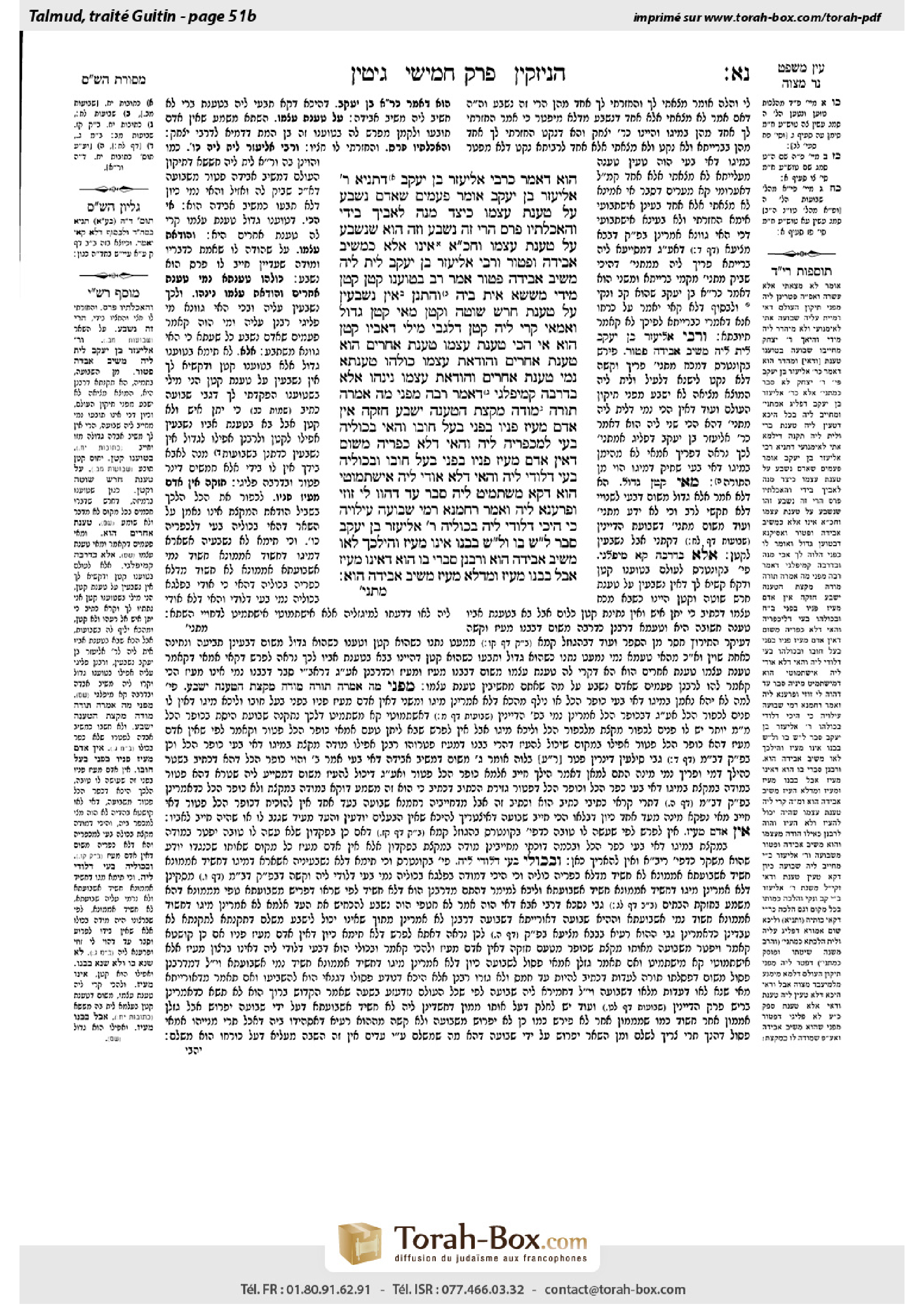
Gittin 51b: Talmud study for Daf Yomi
Study the Talmud for Daf Yomi with scanned pages, Hebrew text, English translations from Sefaria and AI-generated French translations.
Passage selection and English or AI-generated French translation are available where the scan has annotations. Daf Study is independent of Torah-Box and Sefaria.
Browse Gittin · גיטין · All tractatesGittin 51b text and translations
This page of Gittin includes the Aramaic text, an English translation and an AI-generated French translation, alongside the scan above.
גיטין נ״א ב · Aramaic and Hebrew text
הוּא דְּאָמַר, כְּרַבִּי אֱלִיעֶזֶר בֶּן יַעֲקֹב – דְּתַנְיָא, רַבִּי אֱלִיעֶזֶר בֶּן יַעֲקֹב אוֹמֵר: פְּעָמִים שֶׁאָדָם נִשְׁבָּע עַל טַעֲנַת עַצְמוֹ. כֵּיצַד? ״מָנֶה לְאָבִיךְ בְּיָדִי, וְהֶאֱכַלְתִּיו פְּרָס״ – הֲרֵי זֶה נִשְׁבָּע. וְזֶה הוּא שֶׁנִּשְׁבָּע עַל טַעֲנַת עַצְמוֹ.
וַחֲכָמִים אוֹמְרִים: אֵינוֹ אֶלָּא כְּמֵשִׁיב אֲבֵידָה, וּפָטוּר.
וְרַבִּי אֱלִיעֶזֶר בֶּן יַעֲקֹב – לֵית לֵיהּ: ״מֵשִׁיב אֲבֵידָה – פָּטוּר״?! אָמַר רַב: בְּטוֹעֲנוֹ קָטָן.
קָטָן, מִידֵּי מְשָׁשָׁא אִית בֵּיהּ?! וְהָתְנַן: אֵין נִשְׁבָּעִין עַל טַעֲנַת חֵרֵשׁ, שׁוֹטֶה וְקָטָן!
מַאי ״קָטָן״ – גָּדוֹל; וְאַמַּאי קָרֵי לֵיהּ ״קָטָן״? דִּלְגַבֵּי מִילֵּי דְאָבִיו, קָטָן הוּא.
אִי הָכִי, טַעֲנַת עַצְמוֹ?! טַעֲנַת אֲחֵרִים הוּא! טַעֲנַת אֲחֵרִים, וְהוֹדָאַת עַצְמוֹ.
כּוּלְּהוּ טַעֲנָתָא נָמֵי, טַעֲנַת אֲחֵרִים וְהוֹדָאַת עַצְמוֹ נִינְהוּ! אֶלָּא בִּדְרַבָּה קָמִיפַּלְגִי – דְּאָמַר רַבָּה, מִפְּנֵי מָה אָמְרָה תּוֹרָה: מוֹדֶה מִקְצָת הַטַּעֲנָה – יִשָּׁבַע? חֲזָקָה – אֵין אָדָם מֵעִיז פָּנָיו בִּפְנֵי בַּעַל חוֹבוֹ;
וְהַאי, בְּכוּלֵּיהּ בָּעֵי לְמִכְפְּרֵיהּ לֵיהּ, וְהַאי דְּלָא כַּפְרֵיהּ – מִשּׁוּם דְּאֵין אָדָם מֵעִיז פָּנָיו בִּפְנֵי בַּעַל חוֹבוֹ; וּבְכוּלֵּיהּ בָּעֵי דְּלוֹדֵי לֵיהּ, וְהַאי דְּלָא אוֹדִי לֵיהּ – אִישְׁתְּמוֹטֵי הוּא דְּקָא מִשְׁתְּמִיט לֵיהּ – סָבַר: עַד דְּהָווּ לִי זוּזֵי וּפָרַעְנָא לֵיהּ; וְאָמַר רַחֲמָנָא: רְמִי שְׁבוּעָה עִילָּוֵיהּ, כִּי הֵיכִי דְּלוֹדֵי לֵיהּ בְּכוּלֵּיהּ.
רַבִּי אֱלִיעֶזֶר בֶּן יַעֲקֹב סָבַר: לָא שְׁנָא בּוֹ וְלָא שְׁנָא בִּבְנוֹ – אֵינוֹ מֵעֵיז, וְהִילְכָּךְ לָאו מֵשִׁיב אֲבֵידָה הוּא; וְרַבָּנַן סָבְרִי: בּוֹ הוּא דְּאֵינוֹ מֵעֵיז, אֲבָל בִּבְנוֹ מֵעֵיז, וּמִדְּלֹא מֵעֵיז – מֵשִׁיב אֲבֵידָה הוּא.
Gittin 51b · English translation
The Gemara answers: Rabbi Yitzḥak stated his opinion in accordance with the opinion of Rabbi Eliezer ben Ya’akov, as it is taught in a baraita (Tosefta, Shevuot 5:10) that Rabbi Eliezer ben Ya’akov says: There are times when a person takes an oath about his own claim. How so? One says to another: One hundred dinars of your deceased father’s was in my possession, as I had borrowed that sum from him. And I already paid him part [peras] of it, but I still owe you fifty dinars. In this case, he is not believed unless he takes an oath that he repaid the half, like anyone who admits to part of a claim. And this is an example of a case where one takes an oath about his own claim. Although nobody has claimed anything from him, he still takes an oath on the basis of his own statement.
But the Rabbis say: In such a case, the borrower is regarded only as someone who is returning a lost item, and therefore he is exempt from an oath. Rabbi Yitzḥak’s position is similar to that of Rabbi Eliezer ben Ya’akov. Since the finder says that he found only half of what the owner claims was lost, he is treated like someone who admits to part of a claim and therefore takes an oath.
The Gemara asks: But does Rabbi Eliezer ben Ya’akov not maintain that someone who returns a lost item is exempt from an oath? Rav says: The case in dispute between Rabbi Eliezer ben Ya’akov and the Rabbis is not one where nobody has claimed anything from the borrower, as in such a case all agree that the borrower is exempt from taking an oath. Rather, it is a case where the creditor has died, leaving a child as his heir, and this minor confronts the borrower and claims a hundred dinars from him, which he alleges was lent by his late father. The other admits to having borrowed the money but claims that he already repaid half the sum. Since he admits to part of the claim, he takes an oath that he did repay the other part.
The Gemara asks: Does the claim of a minor have any substance? But didn’t we learn in a mishna (Shevuot 38b): One does not take an oath in response to the claim of a deaf-mute, an imbecile, or a minor, as the claim of one who lacks halakhic competence has no significance whatsoever. According to this, if a minor brought a claim against the borrower, it is as though there were no claim at all but only the borrower’s admission, and so the borrower should be exempt from taking an oath.
The Gemara answers: To which kind of minor was Rav referring? It was to an adult son of the creditor. And why does Rav call him a minor, if he is in fact an adult? It is as with regard to his father’s affairs he is like a minor. He does not know with certainty how much money the borrower repaid but merely says that he thinks he owes his father more.
The Gemara asks: If that is so, that we are dealing with a case where the deceased creditor’s adult son made a claim against the debtor, how can Rabbi Eliezer ben Ya’akov say about this claim that it is his own claim? Is this an oath taken about his own claim? It is an oath taken about the claim of others, i.e., the son. The Gemara answers: Rabbi Eliezer ben Ya’akov calls it an oath taken about one’s own claim, although it is really the claim of others, because it is his own admission that obligates him to take the oath.
The Gemara objects: All claims that lead to the oath of one who admits to part of the claim are also a combination of the claim of others and the defendant’s own admission. Rather, Rabbi Eliezer ben Ya’akov and the Rabbis disagree with regard to the following explanation given by Rabba, as Rabba says: For what reason did the Torah say that one who admits to part of the claim brought against him takes an oath with regard to the rest of the claim, which he denies, whereas one who denies the entire claim is not required to take an oath? Rabba answers: The oath of partial admission is based on a presumption with regard to the defendant’s behavior. There is a presumption that a person would not be so brazen as to stand before his creditor and deny his debt when his creditor knows that he is lying.
Rabba continues: And this one who admits to part of the claim would want to deny all of it, and the only reason he does not deny all of it is because a person would not be so brazen before his creditor. And in fact, he would want to admit to all of the claim to him. And the reason that he did not admit the whole claim to him and say that in fact he owes him the entire sum is that he was evading his obligation temporarily. The debtor is short of money and he thinks: I will pay my creditor as much as I can afford now, and I will evade paying the rest until I have enough money, and then I will repay him the rest, to which I have not yet admitted. Therefore, the Merciful One states: Impose an oath on the debtor in order to induce him to admit all of the debt to the creditor.
Following Rabba’s reasoning, the difference of opinion between Rabbi Eliezer ben Ya’akov and the Rabbis can be explained as follows: Rabbi Eliezer ben Ya’akov holds that there is no difference between the creditor himself and the creditor’s son, as in all cases the debtor would not be so brazen as to deny his debt. Therefore, the debtor is not considered like someone who is returning a lost item. Rabbi Eliezer ben Ya’akov maintains that Rabba’s reasoning applies in this case as well, so he is required to take an oath. And the Rabbis hold that he would not be so brazen as to deny a debt before the creditor himself, but toward his creditor’s son he would be brazen and deny the claim completely. And since he was not so brazen as to deny the entire claim, but admitted to part of it, he is considered like someone returning a lost item, and therefore he is exempt from taking an oath.
Gittin 51b · Traduction française (IA)
Le Guemara répond : Rabbi Yitzḥak a exprimé son opinion conformément à celle de Rabbi Eliezer ben Ya’akov, comme il est enseigné dans une baraïta (Tosefta, Shevuot 5:10) que Rabbi Eliezer ben Ya’akov dit : Il y a des moments où une personne jure sur sa propre revendication. Comment cela se passe-t-il ? L’un dit à l’autre : Cent dinars de ton père décédé étaient en mon possession, car j’ai emprunté cette somme à lui. Et j’ai déjà payé une partie [peras] de cela, mais je dois encore te rembourser cinquante dinars. Dans ce cas, il n’est pas cru à moins qu’il ne jure qu’il ait déjà remboursé la moitié, comme quelqu’un qui admet une partie d’une revendication. Et c’est un exemple de cas où l’on jure sur sa propre revendication. Bien que personne ne lui ait réclamé quelque chose, il jure sur la base de son propre déclaration.
Mais les Rabbins disent : Dans un tel cas, le prêteur est considéré comme quelqu’un qui rend un objet perdu, et par conséquent il est exempt de jurer. La position de Rabbi Yitzḥak est semblable à celle de Rabbi Eliezer ben Ya’akov. Puisque le trouvateur dit qu’il a trouvé seulement la moitié de ce que l’propriétaire affirme avoir perdu, il est traité comme quelqu’un qui admet une partie d’une revendication et par conséquent jure.
Le Guemara pose la question : Mais Rabbi Eliezer ben Ya’akov ne maintient-il pas que celui qui rend un objet perdu est exempt de jurer ? Rav dit : Le cas en débat entre Rabbi Eliezer ben Ya’akov et les Rabbins n’est pas celui où personne ne réclame rien au prêteur, car dans ce cas tous s'accordent à dire que le prêteur est exempt de jurer. En revanche, il s’agit d’un cas où le créancier est décédé, laissant un enfant comme héritier, et ce mineur confronte le prêteur et réclame cent dinars, qu’il affirme avoir été empruntés par son père décédé. L’autre admet avoir emprunté l’argent mais affirme avoir déjà remboursé la moitié. Puisqu’il admet une partie de la revendication, il jure qu’il a remboursé l’autre moitié.
Le Guemara pose la question : La réclamation d'un mineur a-t-elle un fondement ? Mais n'avons-nous pas appris dans une mitsva (Shevuot 38b) : On ne jure pas en réponse à la réclamation d'un sourd-muet, d'un imbécile ou d'un mineur, car la réclamation d'une personne dont la compétence halakhique est manquante n'a aucune importance. Selon cela, si un mineur a porté une réclamation contre le prêteur, cela est comme s'il n'y avait pas de réclamation du tout, mais seulement l'admission du prêteur, et par conséquent le prêteur devrait être exempt de jurer.
Le Guemara répond : À quel genre de mineur Rav faisait-il référence ? À un fils adulte du créancier. Et pourquoi Rav l'appelle un mineur, s'il est en fait un adulte ? C'est comme s'il était mineur en ce qui concerne les affaires de son père. Il ne sait pas avec certitude combien l'emprunteur a remboursé, mais il dit simplement qu'il pense qu'il doit à son père plus.
Le Guemara pose la question : Si c'est ainsi, que nous sommes en présence d'un cas où le fils adulte du créancier a porté une réclamation contre le débiteur, comment Rabbi Eliezer ben Ya’akov peut-il dire que cette réclamation est sa propre revendication ? C'est une réclamation portée par autrui, c'est-à-dire le fils. Le Guemara répond : Rabbi Eliezer ben Ya’akov appelle cela une réclamation propre, bien qu'il s'agisse en réalité de la réclamation d'autrui, car c'est son propre aveu qui l'oblige à jurer.
Le Guemara s'oppose : Toutes les réclamations qui mènent à la jure d'une personne qui admet une partie de la réclamation sont également une combinaison de la réclamation d'autrui et de l'admission du défendeur. En revanche, Rabbi Eliezer ben Ya’akov et les Rabbins s'opposent sur l'explication donnée par Rabba, comme Rabba dit : Pourquoi la Torah dit-elle qu'une personne qui admet une partie de la réclamation portée contre lui jure sur le reste de la réclamation qu'il nie, alors qu'une personne qui nie toute la réclamation n'est pas tenu de jurer ? Rabba répond : La jure d'admission partielle est basée sur une présomption concernant le comportement du défendeur. Il y a une présomption que personne ne serait si audacieux pour se tenir face à son créancier et nier sa dette, sachant qu'il ment.
Rabba continue : Et celui qui admet une partie de la réclamation voudrait nier toute la réclamation, et la seule raison pour laquelle il ne nie pas toute la réclamation est que personne ne serait si audacieux devant son créancier. En réalité, il voudrait admettre toute la réclamation à lui. Et la raison pour laquelle il n'a pas admis toute la réclamation à lui et dit qu'en fait il doit tout à lui est qu'il voulait éviter temporairement son obligation. Le débiteur manque d'argent et il pense : Je paierai à mon créancier autant que je peux maintenant, et j'éviterai de payer le reste jusqu'à ce que j'aie assez d'argent, et alors je rembourserai le reste, à quoi je n'ai pas encore admis. Par conséquent, le Tout-Puissant dit : Imposons une jure au débiteur afin de le pousser à admettre toute la dette à son créancier.
En suivant la raison de Rabba, la différence d'opinion entre Rabbi Eliezer ben Ya’akov et les Rabbins peut être expliquée comme suit : Rabbi Eliezer ben Ya’akov affirme qu'il n'y a pas de différence entre le créancier lui-même et le fils du créancier, car dans tous les cas le débiteur ne serait pas si audacieux pour nier sa dette. Par conséquent, le débiteur n'est pas considéré comme quelqu'un qui rend un objet perdu. Rabbi Eliezer ben Ya’akov affirme que la raison de Rabba s'applique également à ce cas, donc il est tenu de jurer. Et les Rabbins affirment que le débiteur ne serait pas si audacieux pour nier une dette devant le créancier lui-même, mais devant le fils du créancier il serait audacieux et nierait la réclamation entièrement. Et puisque le débiteur n'était pas si audacieux pour nier toute la réclamation, mais admettait une partie, il est considéré comme quelqu'un qui rend un objet perdu, et par conséquent il est exempt de jurer.
Traduction française générée par IA à partir de l’édition anglaise de Sefaria. Vérifie toujours un passage avec le texte source.
Text from Sefaria: William Davidson Edition - Vocalized Aramaic (CC BY NC); William Davidson Edition - English (CC BY NC).