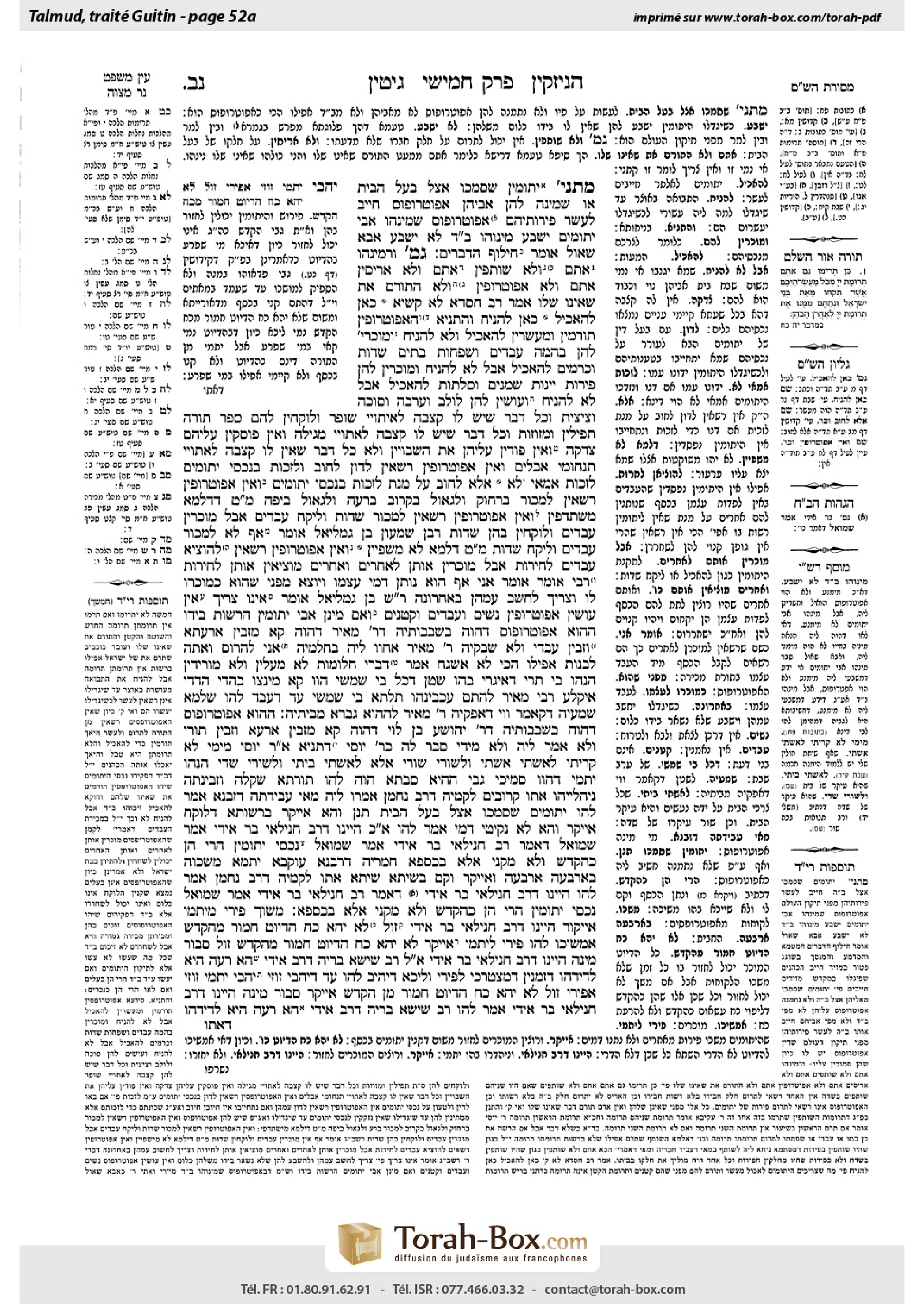
Gittin 52a: Talmud study for Daf Yomi
Study the Talmud for Daf Yomi with scanned pages, Hebrew text, English translations from Sefaria and AI-generated French translations.
Passage selection and English or AI-generated French translation are available where the scan has annotations. Daf Study is independent of Torah-Box and Sefaria.
Browse Gittin · גיטין · All tractatesGittin 52a text and translations
This page of Gittin includes the Aramaic text, an English translation and an AI-generated French translation, alongside the scan above.
גיטין נ״ב א · Aramaic and Hebrew text
מַתְנִי׳ יְתוֹמִין שֶׁסָּמְכוּ אֵצֶל בַּעַל הַבַּיִת, אוֹ שֶׁמִּינָּה לָהֶן אֲבִיהֶן אַפּוֹטְרוֹפּוֹס – חַיָּיב לְעַשֵּׂר פֵּירוֹתֵיהֶם.
אַפּוֹטְרוֹפּוֹס שֶׁמִּינָּהוּ אֲבִי יְתוֹמִים, יִשָּׁבַע. מִינּוּהוּ בֵּית דִּין – לֹא יִשָּׁבַע. אַבָּא שָׁאוּל אוֹמֵר: חִילּוּף הַדְּבָרִים.
גְּמָ׳ וּרְמִינְהוּ: ״אַתֶּם״ – וְלֹא שׁוּתָּפִין; ״אַתֶּם״ – וְלֹא אֲרִיסִין; ״אַתֶּם״ – וְלֹא אַפּוֹטְרוֹפִּין, וְלֹא הַתּוֹרֵם אֶת שֶׁאֵינוֹ שֶׁלּוֹ!
אָמַר רַב חִסְדָּא, לָא קַשְׁיָא: כָּאן לְהַאֲכִיל, כָּאן לְהַנִּיחַ.
וְהָתַנְיָא: הָאַפּוֹטְרוֹפִּין תּוֹרְמִין וּמְעַשְּׂרִין – לְהַאֲכִיל וְלֹא לְהַנִּיחַ. וּמוֹכְרִין לָהֶן בְּהֵמָה, עֲבָדִים וּשְׁפָחוֹת, בָּתִּים, שָׂדוֹת וּכְרָמִים – לְהַאֲכִיל, אֲבָל לֹא לְהַנִּיחַ. וּמוֹכְרִין לָהֶן פֵּירוֹת, יֵינוֹת, שְׁמָנִים וּסְלָתוֹת – לְהַאֲכִיל אֲבָל לֹא לְהַנִּיחַ.
וְעוֹשִׂין לָהֶן לוּלָב וַעֲרָבָה וְסוּכָּה וְצִיצִית, וְכׇל דָּבָר שֶׁיֵּשׁ לוֹ קִצְבָה; לְאֵיתוֹיֵי שׁוֹפָר. וְלוֹקְחִין לָהֶם סֵפֶר תּוֹרָה, תְּפִילִּין וּמְזוּזוֹת, וְכׇל דָּבָר שֶׁיֵּשׁ לוֹ קִצְבָה; לְאֵתוֹיֵי מְגִילָּה.
וְאֵין פּוֹסְקִין עֲלֵיהֶם צְדָקָה, וְאֵין פּוֹדִין עֲלֵיהֶן אֶת הַשְּׁבוּיִין, וְלֹא כׇּל דָּבָר שֶׁאֵין לוֹ קִצְבָה; לְאֵתוֹיֵי תַּנְחוּמֵי אֲבֵלִים.
וְאֵין אַפּוֹטְרוֹפִּין רַשָּׁאִין לָדוּן – לָחוּב וְלִזְכּוֹת – בְּנִכְסֵי יְתוֹמִים. לִזְכּוֹת – אַמַּאי לָא? אֶלָּא ״לָחוּב עַל מְנָת לִזְכּוֹת״ בְּנִכְסֵי יְתוֹמִים.
וְאֵין אַפּוֹטְרוֹפִּין רַשָּׁאִין לִמְכּוֹר בְּרָחוֹק וְלִגְאוֹל בְּקָרוֹב; בְּרָעָה וְלִגְאוֹל בְּיָפָה. מַאי טַעְמָא? דְּדִלְמָא מִשְׁתַּדְּפִין.
וְאֵין אַפּוֹטְרוֹפִּין רַשָּׁאִין לִמְכּוֹר שָׂדוֹת – וְלִיקַּח עֲבָדִים, אֲבָל מוֹכְרִין עֲבָדִים – וְלוֹקְחִין בָּהֶן שָׂדוֹת. רַבָּן שִׁמְעוֹן בֶּן גַּמְלִיאֵל אוֹמֵר: אַף לֹא לִמְכּוֹר עֲבָדִים וְלִיקַּח שָׂדוֹת. מַאי טַעְמָא? דִּלְמָא לָא מְשַׁפְּיָין.
וְאֵין אַפּוֹטְרוֹפִּין רַשָּׁאִין לְהוֹצִיא עֲבָדִים לְחֵירוּת; אֲבָל מוֹכְרִין אוֹתָן לַאֲחֵרִים, וַאֲחֵרִים מוֹצִיאִין אוֹתָן לְחֵירוּת. רַבִּי אוֹמֵר: אוֹמֵר אֲנִי, אַף הוּא – נוֹתֵן דְּמֵי עַצְמוֹ וְיוֹצֵא, מִפְּנֵי שֶׁהוּא כְּמוֹכְרוֹ לוֹ;
וְצָרִיךְ לְחַשֵּׁב עִמָּהֶן בָּאַחֲרוֹנָה. רַבָּן שִׁמְעוֹן בֶּן גַּמְלִיאֵל אוֹמֵר: אֵינוֹ צָרִיךְ. אֵין עוֹשִׂין אַפּוֹטְרוֹפִּין נָשִׁים וַעֲבָדִים וּקְטַנִּים, וְאִם מִינָּן אֲבִי יְתוֹמִין – הָרְשׁוּת בְּיָדוֹ.
הָהוּא אַפּוֹטְרוֹפּוֹס דַּהֲוָה בְּשִׁבָבוּתֵיהּ דְּרַבִּי מֵאִיר, דַּהֲוָה קָא מְזַבֵּין אַרְעָתָא וְזָבֵין עַבְדֵי, וְלָא שַׁבְקֵיהּ רַבִּי מֵאִיר. אַחְווֹ לֵיהּ בְּחֶלְמֵיהּ ״אֲנִי לַהֲרוֹס וְאַתָּה לִבְנוֹת?!״ אֲפִילּוּ הָכִי לָא אַשְׁגַּח, אֲמַר: דִּבְרֵי חֲלוֹמוֹת לֹא מַעֲלִין וְלֹא מוֹרִידִין.
הָנְהוּ בֵּי תְרֵי דְּאִיגָּרִי בְּהוּ שָׂטָן, דְּכֹל בֵּי שִׁמְשֵׁי הֲווֹ קָא מִינְּצוּ בַּהֲדֵי הֲדָדֵי. אִיקְּלַע רַבִּי מֵאִיר לְהָתָם, עַכְּבִינְהוּ תְּלָתָא בֵּי שִׁמְשֵׁי, עַד דַּעֲבַד לְהוּ שְׁלָמָא. שַׁמְעֵיהּ דְּקָאָמַר: וַוי, דְּאַפְּקֵיהּ רַבִּי מֵאִיר לְהָהוּא גַּבְרָא מִבֵּיתֵיהּ.
הָהוּא אַפּוֹטְרוֹפּוֹס דַּהֲוָה בְּשִׁבָבוּתֵיהּ דְּרַבִּי יְהוֹשֻׁעַ בֶּן לֵוִי, דַּהֲוָה קָא מְזַבֵּין אַרְעָא וְזָבֵין תּוֹרֵי, וְלָא אֲמַר לֵיהּ וְלָא מִידֵּי; סָבַר לַהּ כְּרַבִּי יוֹסֵי – דְּתַנְיָא, אָמַר רַבִּי יוֹסֵי: מִיָּמַי לֹא קָרִיתִי לְאִשְׁתִּי ״אִשְׁתִּי״ וּלְשׁוֹרִי ״שׁוֹרִי״, אֶלָּא לְאִשְׁתִּי ״בֵּיתִי״, וּלְשׁוֹרִי ״שָׂדִי״.
הָנְהוּ יַתְמֵי דַּהֲווֹ סְמִיכִי גַּבֵּי הָהִיא סָבְתָּא. הֲוָה לְהוּ תּוֹרְתָּא, שְׁקַלָה וְזַבֵּינְתַּהּ נִיהֲלַיְיהוּ. אֲתוֹ קְרוֹבִים לְקַמֵּיהּ דְּרַב נַחְמָן, אֲמַרוּ לֵיהּ: מַאי עֲבִידְתַּהּ דִּמְזַבְּנָא? אֲמַר לְהוּ: ״יְתוֹמִים שֶׁסָּמְכוּ אֵצֶל בַּעַל הַבַּיִת״ תְּנַן.
וְהָא אִיַּיקַּר! בִּרְשׁוּתָא דְלוֹקֵחַ אִיַּיקַּר. וְהָא לָא נְקִיטִי דְּמֵי!
אֲמַר לְהוּ: אִם כֵּן, הַיְינוּ דְּרַב חֲנִילַאי בַּר אִידֵּי אָמַר שְׁמוּאֵל – דְּאָמַר רַב חֲנִילַאי בַּר אִידֵּי אָמַר שְׁמוּאֵל: נִכְסֵי יְתוֹמִין הֲרֵי הֵן כְּהֶקְדֵּשׁ, וְלָא מִקְּנֵי אֶלָּא בְּכַסְפָּא.
חַמְרֵיהּ דְּרַבְנָא עוּקְבָא יַתְמָא – מַשְׁכוּהּ בְּאַרְבְּעָה אַרְבְּעָה, וְאִיַּיקַּר וְקָם בְּשִׁיתָּא שִׁיתָּא. אֲתוֹ לְקַמֵּיהּ דְּרַב נַחְמָן, אֲמַר לְהוּ: הַיְינוּ דְּרַב חֲנִילַאי בַּר אִידִי – דְּאָמַר רַב חֲנִילַאי בַּר אִידִי אָמַר שְׁמוּאֵל: נִכְסֵי יְתוֹמִין הֲרֵי הֵן כְּהֶקְדֵּשׁ, וְלָא מִקְּנֵי אֶלָּא בְּכַסְפָּא.
מְשׁוּךְ פֵּירֵי מִיַּתְמֵי; אִיַּיקּוּר – הַיְינוּ דְּרַב חֲנִילַאי בַּר אִידִי. זוּל – לֹא יְהֵא כֹּחַ הֶדְיוֹט חָמוּר מֵהֶקְדֵּשׁ.
אִמְּשִׁיכוּ לְהוּ פֵּירֵי לְיַתְמֵי; אִיַּיקַּר – לֹא יְהֵא כֹּחַ הֶדְיוֹט חָמוּר מֵהֶקְדֵּשׁ. זוּל – סְבוּר מִינָּה, הַיְינוּ דְּרַב חֲנִילַאי בַּר אִידִי;
אֲמַר לְהוּ רַב שִׁישָׁא בְּרֵיהּ דְּרַב אִידִי: הָא רָעָה הִיא לְדִידְהוּ – דְּזִמְנִין דְּמִצְטַרְכִי לְפֵירֵי, וְלֵיכָּא דְּיָהֵיב לְהוּ עַד דְּיָהֲבִי זוּזֵי.
יָהֲבִי יַתְמֵי זוּזֵי אַפֵּירֵי; זוּל – לֹא יְהֵא כֹּחַ הֶדְיוֹט חָמוּר מִן הֶקְדֵּשׁ. אִיַּיקַּר – סְבוּר מִינַּהּ, הַיְינוּ דְּרַב חֲנִילַאי בַּר אִידִי;
אֲמַר לְהוּ רַב שִׁישָׁא בְּרֵיהּ דְּרַב אִידִי: הָא רָעָה הִיא לְדִידְהוּ –
Gittin 52a · English translation
MISHNA: With regard to orphans who are living with a homeowner who takes care of all their needs and affairs, even if neither their father nor the court officially appointed him to this task, or if their father appointed a steward [apotropos] for them, this person is obligated to tithe their produce.
With regard to a steward who was appointed by the orphans’ father, when he returns all of the property to the orphans upon their reaching adulthood, he takes an oath that he took nothing of theirs for himself. By contrast, if the court appointed him to serve as a steward for them, then he is not required to take such an oath. Abba Shaul says: The matters are reversed. A steward appointed by the court takes an oath, but a steward appointed by the orphans’ father is not required to do so.
GEMARA: The mishna teaches that a steward is obligated to tithe the produce of the orphans in his charge. The Gemara raises a contradiction from a baraita that expounds a verse dealing with the teruma of the tithe, given by a Levite to a priest: “Thus you, also you, shall offer a gift to the Lord” (Numbers 18:28). The emphasis placed on the word “you” teaches as follows: “You” separate teruma, but not partners, meaning that one partner may not separate teruma on behalf of the other. “You” separate teruma, but not sharecroppers. “You” separate teruma, but not stewards, and “you” separate teruma, but not one who separates teruma from produce that is not his. How, then, can the mishna say that a steward is able to, and is even required to, tithe the produce of the orphans in his charge, when that produce does not belong to him?
Rav Ḥisda said that this is not difficult: Here the mishna is dealing with a steward who tithes the orphans’ produce in order to feed it to them. Since he is not permitted to feed them untithed produce, the Sages allowed him to tithe that which he gives them to eat. There the baraita is referring to produce that is not needed for the orphans’ sustenance; rather, the steward wishes to put it aside in a tithed state. Since he is not the owner of the produce, he lacks the authority to tithe it.
And it is taught in a baraita (Tosefta, Terumot 1:10) that this distinction is made based on whether the steward intends to feed the produce to the orphans or store it: Stewards can separate teruma and tithes from the produce of the orphans in their charge in order to feed the produce to them, but not with the intention to put it aside. And stewards may sell the orphans’ possessions for them as follows: Cattle, male and female slaves, houses, fields, and vineyards, in order to feed the orphans, so that they will have something to eat immediately, but not with the intention to put aside the proceeds for future use. And they may also sell produce, wine, oil, and flour for them in order to feed them, but not with the intention to put aside the proceeds for a later date.
The baraita continues: And stewards make the following items that are required for the fulfillment of a mitzva for the orphans, from their property: A lulav, a willow branch, a sukka, ritual fringes, and any item used for a mitzva that involves a fixed expense. The Gemara notes that the words: Any item used for a mitzva, serve to include a shofar. And they may purchase a Torah scroll, phylacteries, mezuzot, and any other item used for a mitzva that involves a fixed expense. The Gemara comments that these last words serve to include a Megilla, the Scroll of Esther, read on Purim.
The baraita continues: But stewards may not undertake to give charity on behalf of orphans, and they may not redeem captives on their behalf with their property. Nor may they do anything with the orphans’ property that does not involve a fixed expense. The Gemara explains that this last phrase serves to include that which is brought to comfort mourners. A steward may not use property belonging to the orphans in his charge for this purpose.
The baraita continues: And stewards are not permitted to involve themselves in litigation, if the purpose is to accept an obligation or to secure gain for the property of the orphans. The Gemara asks: Why may they not enter into litigation to secure gain? The Gemara clarifies: Rather, this means that stewards are not permitted to involve themselves in litigation in which they will accept financial obligation upon the orphans’ estate, even if they do so in order to ultimately secure gain for the property of the orphan.
The baraita continues: And stewards are not permitted to sell a field belonging to the orphans that is located in a distant place and use the proceeds to redeem a field that their father had sold in a nearby place, although this is ordinarily considered to be a favorable exchange. Similarly, stewards are not permitted to sell a bad field and use the proceeds to redeem a good one. The Gemara explains: What is the reason for this? The reason is that perhaps the bought fields will become blighted, and it will turn out that the steward has caused the orphans a loss with his purchase.
The baraita continues: And stewards are not permitted to sell fields belonging to the orphans and use the proceeds to purchase slaves. But they may sell the orphans’ slaves and use their proceeds to purchase fields, as land is considered to be a more stable asset. Rabban Shimon ben Gamliel says: Stewards may not even sell slaves and use the proceeds to purchase fields. The Gemara explains: What is the reason for this? Perhaps it will turn out that the property is not secure [meshappeyan], the ownership of the fields being contested by others, and consequently the steward will have made matters more complicated for the orphans as a result of his purchase.
The baraita continues: And stewards are not permitted to free slaves belonging to the orphans in their charge, even if it is necessary to do so for any reason. But they may sell them to others, and then those others may free them. Rabbi Yehuda HaNasi says: I say that even he, the slave himself, may give his own monetary value to the steward and thereby go free, due to the fact that it is as if the steward sold the slave to the slave himself. It is irrelevant whether it is some other person or the slave himself who pays his purchase price.
The baraita continues: And the steward must calculate with the orphans in the end, when they reach adulthood and he hands over the property to them. At that time, he calculates all of the expenses and income generated by their property during the period that he served as steward. Rabban Shimon ben Gamliel says: He is not required do so, as the court relies on his integrity. The court does not appoint women, slaves, or minors as stewards, but if the father of the orphans appointed one of them as his orphans’ steward, he has permission to do so.
It is related that there was a certain steward who was in Rabbi Meir’s neighborhood who was selling land belonging to the orphans and purchasing slaves with the proceeds, and Rabbi Meir did not allow him to do this, as the practice is contrary to halakha. They showed him in his dream the words: I wish to destroy and you build? He understood this as a sign that God wanted the orphans to suffer financial collapse, and therefore it would be preferable to allow the steward to continue his practice. Even so, Rabbi Meir paid no heed to his dream, and said: Words appearing in dreams do not bring up and do not take down; they should not be taken into consideration.
Apropos an incident involving Rabbi Meir, the Gemara relates another story about him: There were two people who, incited by Satan, would argue with each other every Friday afternoon at twilight. Rabbi Meir happened to come to the place where they argued. He stopped them from fighting three Friday afternoons at twilight, until finally he made peace between them. He then heard Satan say: Woe, that Rabbi Meir removed that man, Satan, from his house. This indicates that Satan himself lives among those who have discord.
It is related that there was a certain steward of orphans who was in the neighborhood of Rabbi Yehoshua ben Levi who was selling land and buying oxen on behalf of the orphans, and he did not say anything to the steward to the effect that he was acting improperly. The Gemara explains that Rabbi Yehoshua ben Levi holds in accordance with the opinion of Rabbi Yosei, as it is taught in a baraita that Rabbi Yosei said: In all my days, I did not call my wife: My wife, nor my ox: My ox. Rather, I called my wife: My home, because she is the essence of my home, and I called my ox: My field, because the primary force behind enhancements to the field is the ox that plows it. Similarly, Rabbi Yehoshua ben Levi maintains that purchasing oxen to work the land is considered like purchasing land itself and that consequently a protest should not be raised against the steward, who sold land belonging to the orphans in order to purchase oxen with the proceeds.
It is further related that certain orphans who lived with an old woman had an ox, and she took it and sold it on their behalf. Relatives of those orphans came before Rav Naḥman and said to him: What is she doing selling the orphans’ property? Who authorized her to do so? Rav Naḥman said to them: We learned from the phrase in the mishna: If orphans are living with a homeowner, that official appointment as a steward is not necessary. The fact that the orphans lived with the woman and she took care of them sufficed to bestow upon her the authority of a steward.
The relatives continued with their objection to the sale: But didn’t the animal afterward increase in value, which is reason to invalidate the transaction? Rav Naḥman answered: The animal increased in value while in the possession of the buyer, and this is not considered as a loss suffered by the orphans. The relatives said to him: But they did not yet receive the money, and consequently the sale was incomplete.
Rav Naḥman said to them: If so, this is what Rav Ḥanilai bar Idi says that Shmuel says, as Rav Ḥanilai bar Idi says that Shmuel says: Orphans’ property is like consecrated property and is fully acquired only with the transfer of money. Since they did not yet receive the money, they can raise the purchase price or renege on the entire sale.
Similarly, it is related that those who came to buy the wine of Rabbana Ukva the orphan pulled it into their possession after having agreed on a purchase price of four dinars per barrel. But before the buyers actually paid for the wine, it increased in value and its price stood at six dinars per barrel. The parties came before Rav Naḥman for a ruling on the matter. He said to them: This is subject to what Rav Ḥanilai bar Idi said, as Rav Ḥanilai bar Idi says that Shmuel says: Orphans’ property is like consecrated property, and is fully acquired only with the transfer of money. Consequently, the buyers pay the current, higher price or the sale can be rendered void.
The Gemara records several additional laws relating to this topic: If the buyers pulled into their possession produce belonging to orphans but did not yet pay for it, and afterward the produce increased in value, this is subject to what Rav Ḥanilai bar Idi said: Orphans’ property is fully acquired only with the transfer of money, and until payment is made the transaction can still be rendered void. But if the produce decreased in value, and the buyers wish to renege on the sale, one can argue: Just as it is said that the power of an ordinary person should not be greater than that of the Temple treasury, so too, the power of orphans should not be less than that of other people. Since the buyers pulled the orphans’ property into their possession, thereby performing an act of acquisition, the sale is valid and the buyers cannot retract.
If the steward pulled produce into his possession on behalf of the orphans, but did not yet pay for it, and afterward it increased in value, then just as the power of an ordinary person should not be greater than that of the Temple treasury, so too, the power of orphans should not be less than that of other people. Therefore, the orphans acquire the produce based on its price at the time the steward pulled it into their possession. But if the produce decreased in value, and now the steward wishes to cancel the sale, the students in the study hall understood from here that this is included in what Rav Ḥanilai bar Idi said, that transactions involving orphans are completed only with the transfer of money, and therefore the steward can renege on the sale and acquire the produce at the lower price.
Rav Sheisha, son of Rav Idi, said to them: This would be bad for the orphans were they treated in this manner, as they might at times need produce and nobody will give it to them before they actually pay the money. It is preferable for them to be treated like other buyers, who finalize their acquisition when they pull the produce into their possession.
If the orphans gave money for the purchase of produce but did not yet physically transfer it into their possession, and afterward the produce decreased in value, then one applies the principle that the power of an ordinary person, the seller, should not be greater than the Temple treasury. Therefore, the orphans can renege on the purchase, as an act of acquisition has not yet been performed. But if the produce increased in value, and the orphans wish to uphold the sale, the students in the study hall understood from here that this is included in what Rav Ḥanilai bar Idi said, that transactions involving orphans are completed with the transfer of money, and therefore the orphans acquire the produce at the lower price.
Rav Sheisha, son of Rav Idi, said to them: This would be bad for the orphans were they treated this way,
Gittin 52a · Traduction française (IA)
MICHNA: Concerning orphans living with a homeowner who takes care of all their needs and affairs, even if neither their father nor the court officially appointed him to this task, or if their father appointed a steward [apotropos] for them, this person is obligated to tithe their produce.
Concerning a steward appointed by the orphans’ father, when he returns all the property to the orphans upon their reaching adulthood, he takes an oath that he took nothing of theirs for himself. By contrast, if the court appointed him to serve as a steward for them, then he is not required to take such an oath. Abba Shaul says: The matters are reversed. A steward appointed by the court takes an oath, but a steward appointed by the orphans’ father is not required to do so.
GUEMARA: The mishna teaches that a steward is obligated to tithe the produce of the orphans in his charge. The Guemara raises a contradiction from a baraïta that expounds a verse dealing with the terouma of the tithe, given by a Levite to a priest: «Ainsi, aussi toi, tu offriras un don à l'Éternel» (Nombres 18:28). The emphasis placed on the word «toi» teaches as follows: «toi» separates terouma, but not partners, meaning that one partner may not separate terouma on behalf of the other. «toi» separates terouma, but not sharecroppers. «toi» separates terouma, but not stewards, and «toi» separates terouma, but not one who separates terouma from produce that is not his. How, then, can the mishna say that a steward is able to, and is even required to, tithe the produce of the orphans in his charge, when that produce does not belong to him?
Rav Ḥisda a dit que cela n'est pas difficile : ici la Michna traite d'un steward qui taille les dîmes des produits des orphelins afin de les nourrir. Puisque celui-ci n'est pas autorisé à nourrir les orphelins avec des produits non tithés, les Sages ont permis à ce dernier de tithé ce qu'il leur donne à manger. Là, la baraïta fait référence à des produits non nécessaires pour la subsistance des orphelins ; plutôt, le steward souhaite les mettre de côté dans un état tithé. Puisque ce n'est pas le propriétaire des produits, il n'a pas l'autorité de les tithé.
Et il est enseigné dans une baraïta (Tosefta, Terouma 1:10) que cette distinction est faite selon que le steward a l'intention de nourrir les orphelins avec les produits ou de les stocker : les stewards peuvent séparer la terouma et les dîmes des produits des orphelins sous leur charge afin de les nourrir, mais pas avec l'intention de les mettre de côté. Et les stewards peuvent vendre les biens des orphelins pour eux, comme suit : bœufs, esclaves hommes et femmes, maisons, champs et vignobles, afin de les nourrir, de sorte qu'ils aient quelque chose à manger immédiatement, mais pas avec l'intention de mettre de côté les recettes pour une utilisation future. Et ils peuvent également vendre des produits, du vin, de l'huile et du blé pour eux afin de les nourrir, mais pas avec l'intention de mettre de côté les recettes pour une date ultérieure.
La baraïta continue : et les stewards préparent les objets nécessaires pour la réalisation d'une mitsva pour les orphelins, à partir de leurs biens : un lulav, une branche de saule, une sukka, des franges rituelles et tout objet utilisé pour une mitsva impliquant une dépense fixe. La Guemara note que les mots : tout objet utilisé pour une mitsva, servent à inclure un corne. Et ils peuvent acheter un rouleau de Torah, des phylactères, des mezuzot et tout autre objet utilisé pour une mitsva impliquant une dépense fixe. La Guemara commente que ces derniers mots servent à inclure un Megilla, le rouleau d'Esther, lu pendant Purim.
La baraïta continue : Mais les stewards ne peuvent pas s'engager à donner des charités au nom des orphelins, ni ne peuvent-ils racheter des captifs à leur place avec leurs biens. Ils ne peuvent pas non plus faire quoi que ce soit avec les biens des orphelins qui ne concerne pas une dépense fixe. La Guemara explique que cette dernière phrase sert à inclure ce qui est apporté pour consoler les veuves. Un steward ne peut pas utiliser les biens appartenant aux orphelins sous sa charge à cette fin.
La baraïta continue : Les administrateurs ne sont pas autorisés à s'impliquer dans un litige, si l'objectif est d'accepter une obligation ou de garantir un bénéfice pour la propriété des orphelins. La Guemara demande : Pourquoi ne peuvent-ils pas entrer en litige pour garantir un bénéfice ? La Guemara précise : Cela signifie que les administrateurs ne sont pas autorisés à s'impliquer dans un litige où ils accepteraient une obligation financière sur l'actif des orphelins, même s'ils le font afin de garantir finalement un bénéfice pour la propriété de l'orphelin.
La baraïta continue : Les stewards ne sont pas autorisés à vendre un champ appartenant aux orphelins, situé dans un lieu éloigné, et à utiliser les recettes pour racheter un champ que leur père avait vendu dans un lieu proche, bien que cela soit généralement considéré comme un échange avantageux. De même, les stewards ne sont pas autorisés à vendre un mauvais champ et à utiliser les recettes pour racheter un bon champ. La Guemara explique : Quelle est la raison de cela ? La raison est que peut-être les champs achetés deviendront blanchis, et il se pourrait que le steward ait causé aux orphelins une perte avec son achat.
La baraïta continue : Les administrateurs ne sont pas autorisés à vendre des champs appartenant aux orphelins et à utiliser les recettes pour acheter des esclaves. Mais ils peuvent vendre les esclaves des orphelins et utiliser les recettes pour acheter des champs, car la terre est considérée comme un actif plus stable. Rabban Shimon ben Gamliel dit : Les administrateurs ne peuvent même pas vendre des esclaves et utiliser les recettes pour acheter des champs. La Guemara explique : Quelle est la raison de cela ? Peut-être que cela se révélera que la propriété n'est pas sécurisée [meshappeyan], la propriété des champs étant contestée par d'autres, et en conséquence l'administrateur aura rendu les choses plus compliquées pour les orphelins en raison de son achat.
La baraïta continue : Les administrateurs ne sont pas autorisés à libérer les esclaves appartenant aux orphelins sous leur charge, même si cela est nécessaire pour une raison que ce soit. Mais ils peuvent les vendre à d'autres, et ceux-ci pourront alors les libérer. Rabbi Yehuda HaNasi dit : Je dis que même lui, l'esclave lui-même, peut donner sa valeur monétaire à l'administrateur et ainsi obtenir sa liberté, car c'est comme si l'administrateur avait vendu l'esclave à l'esclave lui-même. Il n'a pas d'importance que ce soit une autre personne ou l'esclave lui-même qui paie le prix d'achat.
La baraïta continue : L'administrateur doit calculer avec les orphelins à la fin, lorsqu'ils atteignent l'âge adulte et qu'il leur remet la propriété. À ce moment-là, il calcule toutes les dépenses et les revenus générés par leur propriété pendant la période durant laquelle il a été administrateur. Rabban Shimon ben Gamliel dit : Il n'est pas tenu de le faire, car la cour fait confiance à son honnêteté. La cour ne nomme pas de femmes, d'esclaves ou de mineurs comme administrateurs, mais si le père des orphelins a désigné l'un d'eux comme administrateur, il a le droit de le faire.
On raconte qu'il y avait un certain administrateur dans le quartier de Rabbi Meir qui vendait des terres appartenant aux orphelins et achetait des esclaves avec les recettes, et Rabbi Meir n'a pas permis cela, car cette pratique est contraire à la halakha. On lui a montré dans son rêve les mots : Je veux détruire et toi tu bâtis ? Il a compris cela comme un signe que Dieu voulait que les orphelins souffrent une ruine financière, et donc il aurait été préférable de permettre à l'administrateur de continuer sa pratique. Cependant, Rabbi Meir n'a pas prêté attention à son rêve et a dit : Les paroles qui apparaissent dans les rêves ne montent pas et ne descendent pas ; elles ne devraient pas être prises en compte.
À propos d'un incident impliquant Rabbi Meir, la Guemara raconte une autre histoire à son sujet : Il y avait deux personnes qui, incités par le Diable, s'entretenaient chaque vendredi après-midi à l'heure du crépuscule. Rabbi Meir arriva au lieu où ils s'entretenaient. Il arrêta leur combat trois vendredis après-midis à l'heure du crépuscule, jusqu'à ce qu'il parvienne à les faire s'entendre. Il entendit alors le Diable dire : Malheur, que Rabbi Meir ait expulsé ce Diable de sa maison. Cela montre que le Diable lui-même vit parmi ceux qui ont des désaccords.
On raconte qu'il y avait un certain administrateur des orphelins dans le quartier de Rabbi Yehoshua ben Levi qui vendait des terres et achetait des bœufs au nom des orphelins, et il n'a pas dit une seule parole à l'administrateur pour indiquer qu'il agissait de manière inappropriée. La Guemara explique que Rabbi Yehoshua ben Levi suit l'opinion de Rabbi Yosei, car il est enseigné dans une baraïta que Rabbi Yosei a dit : Pendant toute ma vie, je n'ai jamais appelé ma femme : Ma femme, ni mon bœuf : Mon bœuf. Plutôt, j'ai appelé ma femme : Mon foyer, car elle est l'essence de mon foyer, et j'ai appelé mon bœuf : Mon champ, car la force principale qui améliore le champ est le bœuf qui le laboure. De même, Rabbi Yehoshua ben Levi considère que l'achat de bœufs pour travailler la terre est considéré comme l'achat de la terre elle-même, et par conséquent, il ne devrait pas y avoir de protestation contre l'administrateur, qui a vendu la terre appartenant aux orphelins afin d'acheter des bœufs avec les recettes.
On raconte également qu'il y avait certains orphelins qui vivaient avec une vieille femme, et elle prit leur bœuf et le vendit à leur place. Les parents des orphelins vinrent devant Rav Naḥman et lui dirent : Qu'est-ce qu'elle fait en vendant la propriété des orphelins ? Qui l'a autorisée à le faire ? Rav Naḥman répondit à eux : Nous avons appris de la phrase dans la Michna : Si les orphelins vivent avec un propriétaire, l'appointment officiel en tant qu'administrateur n'est pas nécessaire. Le fait que les orphelins vivent avec la femme et qu'elle s'occupe d'eux suffit à lui conférer l'autorité d'administrateur.
Les parents continuèrent leur objection concernant la vente : Mais n'est-ce pas que l'animal a ensuite augmenté en valeur, ce qui rendrait la transaction invalide ? Rav Naḥman répondit : L'animal a augmenté en valeur pendant la possession du acheteur, et cela n'est pas considéré comme une perte subie par les orphelins. Les parents dirent à lui : Mais ils n'ont pas encore reçu l'argent, et par conséquent la vente était incomplète.
Rav Naḥman dit à eux : Si c'est ainsi, c'est ce que Rav Ḥanilai bar Idi dit que Shmuel dit, car Rav Ḥanilai bar Idi dit que Shmuel dit : La propriété des orphelins est comme la propriété consacrée et n'est pleinement acquise qu'avec le transfert de l'argent. Comme ils n'ont pas encore reçu l'argent, ils peuvent augmenter le prix d'achat ou annuler entièrement la vente.
De même, on raconte que ceux qui vinrent acheter le vin de Rabbana Ukva, l'orphelin le fit entrer en leur possession après avoir convenu d'un prix d'achat de quatre dinars par baril. Mais avant que les acheteurs ne paient effectivement le vin, sa valeur augmenta et son prix atteignit six dinars par baril. Les parties vinrent devant Rav Naḥman pour obtenir un avis sur la question. Il dit à eux : Cela relève de ce que Rav Ḥanilai bar Idi a dit, car Rav Ḥanilai bar Idi dit que Shmuel dit : La propriété des orphelins est comme la propriété consacrée, et n'est pleinement acquise qu'avec le transfert de l'argent. Par conséquent, les acheteurs paient le prix actuel, plus élevé, ou la vente peut être annulée.
La Guemara enregistre plusieurs autres lois relatives à ce sujet : Si les acheteurs firent entrer en leur possession des produits appartenant aux orphelins mais n'avaient pas encore payé pour eux, et ensuite les produits augmentèrent en valeur, cela relève de ce que Rav Ḥanilai bar Idi a dit : La propriété des orphelins n'est pleinement acquise qu'avec le transfert de l'argent, et jusqu'à ce que le paiement soit effectué, la transaction peut encore être annulée. Mais si les produits diminuèrent en valeur, et que les acheteurs souhaitent annuler la vente, on peut argumenter : Comme il est dit que la puissance d'une personne ordinaire ne devrait pas être supérieure à celle du trésor du Temple, de même, la puissance des orphelins ne devrait pas être inférieure à celle des autres personnes. Comme les acheteurs firent entrer la propriété des orphelins en leur possession, effectuant ainsi un acte d'acquisition, la vente est valide et les acheteurs ne peuvent pas rétracter.
Si le steward a tiré des produits dans ses possessions en faveur des orphelins, mais n'a pas encore payé pour eux, et que ces produits ont ensuite augmenté en valeur, alors comme la puissance d'un homme ordinaire ne devrait pas être supérieure à celle du trésor du Temple, de même la puissance des orphelins ne devrait pas être inférieure à celle des autres personnes. Ainsi, les orphelins acquièrent les produits selon leur prix au moment où le steward les a tirés dans leurs possessions. Mais si les produits ont diminué en valeur, et que maintenant le steward souhaite annuler la vente, les étudiants dans la salle de étude ont compris d'ici que cela est inclus dans ce que Rav Ḥanilai bar Idi a dit, à savoir que les transactions impliquant des orphelins sont achevées uniquement avec le transfert de l'argent, et donc le steward peut annuler la vente et acquérir les produits au prix inférieur.
Rav Sheisha, fils de Rav Idi, leur a dit : Cela serait mauvais pour les orphelins s'ils étaient traités ainsi, car ils pourraient parfois avoir besoin de produits et personne ne leur donnerait ces produits avant qu'ils ne paient l'argent. Il est préférable qu'ils soient traités comme les autres acheteurs, qui finalisent leur acquisition lorsqu'ils tirent les produits dans leurs possessions.
Si les orphelins ont donné de l'argent pour l'achat de produits, mais n'ont pas encore physiquement transféré ces produits dans leurs possessions, et que ces produits ont ensuite diminué en valeur, alors on applique le principe que la puissance d'un homme ordinaire, le vendeur, ne devrait pas être supérieure à celle du trésor du Temple. Ainsi, les orphelins peuvent annuler l'achat, car une acquisition n'a pas encore été accomplie. Mais si les produits ont augmenté en valeur, et que les orphelins souhaitent maintenir la vente, les étudiants dans la salle de étude ont compris d'ici que cela est inclus dans ce que Rav Ḥanilai bar Idi a dit, à savoir que les transactions impliquant des orphelins sont achevées avec le transfert de l'argent, et donc les orphelins acquièrent les produits au prix inférieur.
Rav Sheisha, fils de Rav Idi, leur a dit : Cela serait mauvais pour les orphelins s'ils étaient traités ainsi,
Traduction française générée par IA à partir de l’édition anglaise de Sefaria. Vérifie toujours un passage avec le texte source.
Text from Sefaria: William Davidson Edition - Vocalized Aramaic (CC BY NC); William Davidson Edition - English (CC BY NC).