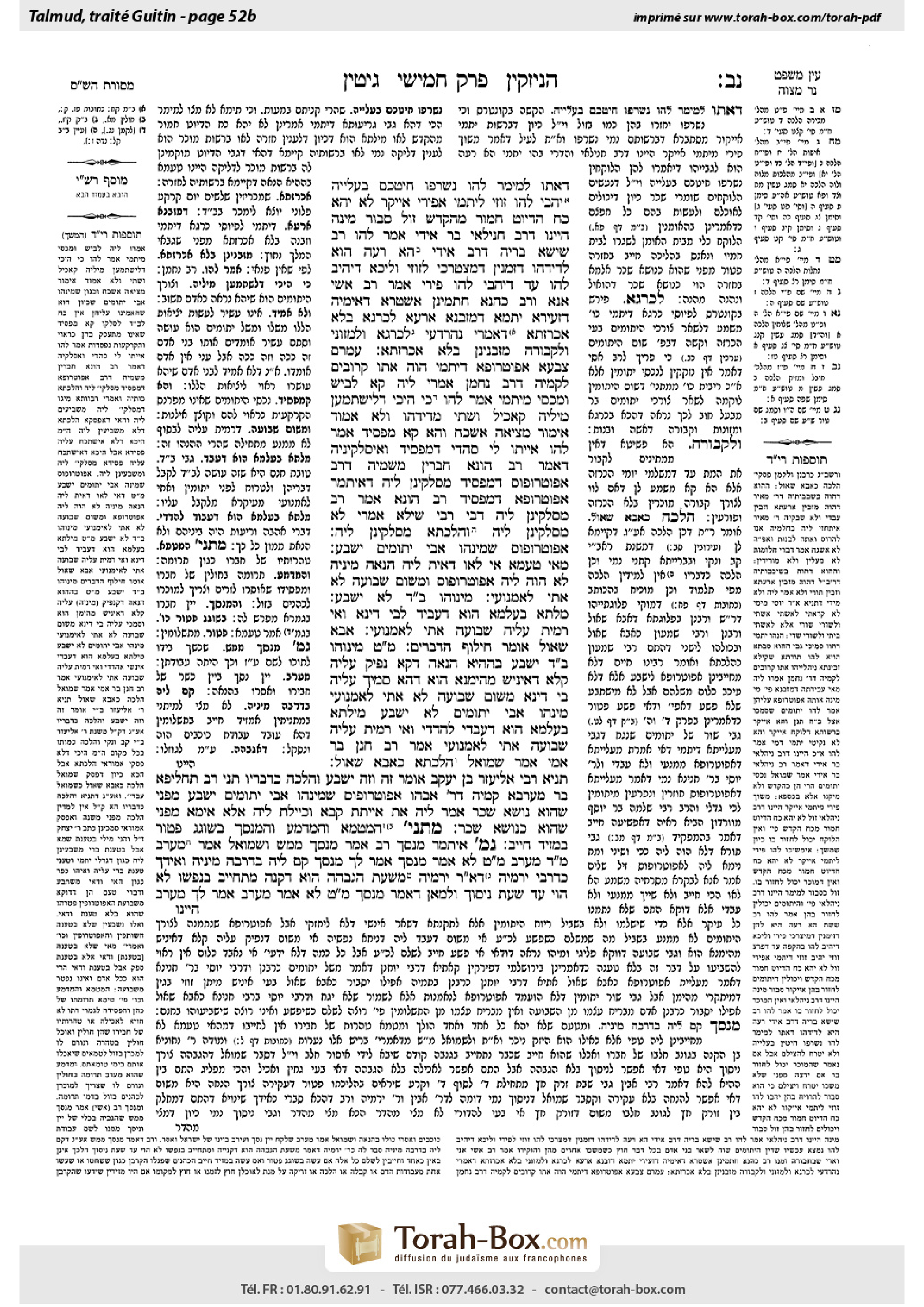
Gittin 52b: Talmud study for Daf Yomi
Study the Talmud for Daf Yomi with scanned pages, Hebrew text, English translations from Sefaria and AI-generated French translations.
Passage selection and English or AI-generated French translation are available where the scan has annotations. Daf Study is independent of Torah-Box and Sefaria.
Browse Gittin · גיטין · All tractatesGittin 52b text and translations
This page of Gittin includes the Aramaic text, an English translation and an AI-generated French translation, alongside the scan above.
גיטין נ״ב ב · Aramaic and Hebrew text
דְּאָתוּ לְמֵימַר לְהוּ: נִשְׂרְפוּ חִיטֵּיכֶם בַּעֲלִיָּיה.
יָהֲבִי לְהוּ זוּזֵי לְיַתְמֵי אַפֵּירֵי; אִיַּיקַּר – לֹא יְהֵא כֹּחַ הֶדְיוֹט חָמוּר מֵהֶקְדֵּשׁ. זוּל – סְבוּר מִינָּה, הַיְינוּ דְּרַב חֲנִילַאי בַּר אִידִי;
אֲמַר לְהוּ רַב שִׁישָׁא בְּרֵיהּ דְּרַב אִידִי: הָא רָעָה הוּא לְדִידְהוּ – דְּזִמְנִין דְּמִצְטַרְכִי לְזוּזֵי, וְלֵיכָּא דְּיָהֵיב לְהוּ עַד דְּיָהֲבִי לְהוּ פֵּירֵי.
אָמַר רַב אָשֵׁי: אֲנָא וְרַב כָּהֲנָא חָתְמִינַן אַשְּׁטָרָא דְּאִימֵּיהּ דִּזְעֵירָא יַתְמָא, דִּמְזַבְּנָא אַרְעָא לִכְרָגָא בְּלָא אַכְרַזְתָּא; דְּאָמְרִי נְהַרְדָּעֵי: לִכְרָגָא וְלִמְזוֹנֵי וְלִקְבוּרָה – מְזַבְּנִינַן בְּלָא אַכְרַזְתָּא.
עַמְרָם צַבָּעָא אַפּוֹטְרוֹפָּא דְיַתְמֵי הֲוָה, אֲתוֹ קְרוֹבִים לְקַמֵּיהּ דְּרַב נַחְמָן, אָמְרִי לֵיהּ: קָא לָבֵישׁ וּמִכַּסֵּי מִיַּתְמֵי! אֲמַר לְהוּ: כִּי הֵיכִי דְּלִישְׁתַּמְעָן מִילֵּיהּ.
קָאָכֵיל וְשָׁתֵי מִדִּידְהוּ, וְלָא אֲמִיד! אֵימוֹר מְצִיאָה אַשְׁכַּח. וְהָא קָא מַפְסֵיד! אֲמַר לְהוּ: אַיְיתוֹ לִי סָהֲדִי דְּמַפְסֵיד, וְאֵיסַלְּקִינֵּיהּ; דְּאָמַר רַב הוּנָא חַבְרִין מִשְּׁמֵיהּ דְּרַב: אַפּוֹטְרוֹפּוֹס דְּמַפְסֵיד, מְסַלְּקִינַן לֵיהּ. דְּאִיתְּמַר: אַפּוֹטְרוֹפָּא דְּמַפְסֵיד, רַב הוּנָא אָמַר רַב: מְסַלְּקִינַן לֵיהּ; דְּבֵי רַבִּי שֵׁילָא אָמְרִי: לָא מְסַלְּקִינַן לֵיהּ. וְהִלְכְתָא: מְסַלְּקִינַן לֵיהּ.
אַפּוֹטְרוֹפּוֹס שֶׁמִּינָּהוּ אֲבִי יְתוֹמִים – יִשָּׁבַע: מַאי טַעְמָא? אִי לָאו דְּאִית לֵיהּ הֲנָאָה מִינֵּיהּ – לָא הֲוָה לֵיהּ אַפּוֹטְרוֹפּוֹס; וּמִשּׁוּם שְׁבוּעָה לָא אָתֵי לְאִמְּנוֹעֵי.
מִינּוּהוּ בֵּית דִּין – לֹא יִשָּׁבַע: מִלְּתָא בְּעָלְמָא הוּא דְּעָבֵיד לְבֵי דִינָא; וְאִי רָמֵית עֲלֵיהּ שְׁבוּעָה אָתֵי לְאִמְּנוֹעֵי.
אַבָּא שָׁאוּל אוֹמֵר: חִילּוּף הַדְּבָרִים: מַאי טַעְמָא מִינּוּהוּ בֵּית דִּין – יִשָּׁבַע? בְּהַהִיא הֲנָאָה דְּקָא נָפֵיק עֲלֵיהּ קָלָא דְּאִינִישׁ מְהֵימְנָא הוּא – דְּהָא סָמֵיךְ עֲלֵיהּ בֵּי דִינָא – מִשּׁוּם שְׁבוּעָה לָא אָתֵי לְאִמְּנוֹעֵי.
מִינָּהוּ אֲבִי יְתוֹמִים, לֹא יִשָּׁבַע – מִילְּתָא בְּעָלְמָא הוּא דְּעָבְדִי לַהֲדָדֵי, וְאִי רָמֵית עֲלֵיהּ שְׁבוּעָה – אָתֵי לְאִמְּנוֹעֵי. אָמַר רַב חָנָן בַּר אַמֵּי אָמַר שְׁמוּאֵל: הִלְכְתָא כְּאַבָּא שָׁאוּל.
תַּנְיָא, רַבִּי אֱלִיעֶזֶר בֶּן יַעֲקֹב אוֹמֵר: זֶה וָזֶה יִשָּׁבַע, וַהֲלָכָה כִּדְבָרָיו.
תָּנֵי רַב תַּחְלִיפָא בַּר מַעְרְבָא קַמֵּיהּ דְּרַבִּי אֲבָהוּ: אַפּוֹטְרוֹפּוֹס שֶׁמִּינָּהוּ אֲבִי יְתוֹמִים – יִשָּׁבַע, מִפְּנֵי שֶׁהוּא נוֹשֵׂא שָׂכָר. אֲמַר לֵיהּ: אַתְּ אַיְיתֵת קַבָּא וְכָיְילַתְּ לֵיהּ? אֶלָּא אֵימָא: מִפְּנֵי שֶׁהוּא כְּנוֹשֵׂא שָׂכָר.
מַתְנִי׳ הַמְטַמֵּא, וְהַמְדַמֵּעַ, וְהַמְנַסֵּךְ; בְּשׁוֹגֵג – פָּטוּר, בְּמֵזִיד – חַיָּיב.
גְּמָ׳ אִיתְּמַר: ״מְנַסֵּךְ״ – רַב אָמַר: מְנַסֵּךְ מַמָּשׁ, וּשְׁמוּאֵל אָמַר: מְעָרֵב.
מַאן דְּאָמַר מְעָרֵב, מַאי טַעְמָא לָא אָמַר מְנַסֵּךְ? אָמַר לָךְ: מְנַסֵּךְ – קָם לֵיהּ בִּדְרַבָּה מִינֵּיהּ.
וְאִידַּךְ, כִּדְרַבִּי יִרְמְיָה – דְּאָמַר רַבִּי יִרְמְיָה: מִשְּׁעַת הַגְבָּהָה הוּא דִּקְנָה; מִתְחַיֵּיב בְּנַפְשׁוֹ לָא הָוֵי עַד שְׁעַת נִיסּוּךְ.
וּלְמַאן דְּאָמַר מְנַסֵּךְ, מַאי טַעְמָא לָא אָמַר מְעָרֵב? אָמַר לָךְ: מְעָרֵב
Gittin 52b · English translation
as the sellers will come to say to them: Your wheat was burned in the upper story of my house, and you have lost everything. If a fire breaks out, the sellers will not attempt to save the produce because they already received payment for it and it now belongs to the orphans.
If buyers gave the orphans money for the purchase of produce, but did not yet physically transfer it into their possession, and afterward the produce increased in value, then one applies the principle that the power of an ordinary person should not be greater than that of the Temple treasury, and therefore the orphans can renege on the sale, as a valid act of acquisition had not yet been performed. If the produce decreased in value, and the orphans wish to uphold the sale, the students understood from here that this is subject to what Rav Ḥanilai bar Idi said, that transactions involving orphans are finalized with the transfer of money, and therefore the orphans should acquire the produce at the lower price.
Rav Sheisha, son of Rav Idi, said to them: This would be bad for the orphans were they treated this way, as there may be times that the orphans need money and no one will give it to them before they actually give them the produce. Consequently, it is preferable for them to be treated like other sellers, who finalize their sales only once the merchandise is pulled by the buyers.
§ Rav Ashi said: Rav Kahana and I signed a deed of sale for the mother of Ze’eira the orphan, who, as the child’s steward, sold land without first making a public announcement in order to pay the head tax [karga]. It was permitted for her to act in this manner due to what the Sages of Neharde’a said: When an orphan’s property is sold, a public announcement of the sale is first made in order to ensure that the seller will receive the highest price. But when the property is sold to raise money for the payment of the head tax, or to provide for sustenance for orphans, or to pay for burial of the deceased, the money is needed immediately, so the property may be sold even without a public announcement.
The Gemara relates: Amram the dyer was a steward for orphans, and the orphans’ relatives once came before Rav Naḥman and said to him: He dresses and covers himself with clothing purchased from the property of the orphans. Rav Naḥman said to them: Perhaps he does this in order that his words be heard, meaning that he dresses himself in finery at the orphans’ expense in order to better manage their property, as he will be ignored if he appears to be a poor person.
They said to him: He eats and drinks lavishly from the orphan’s property and is not known to be rich enough to be able to afford such large expenditures from his own money. Rav Naḥman said to them: Say that perhaps he found a lost item, with the help of which he can allow himself to maintain a high standard of living. They said to him: But he is damaging the orphans’ property and thereby causing them financial loss. Rav Naḥman said to them: Bring me witnesses that he is damaging their property and I will remove him from his stewardship, as our colleague Rav Huna said in the name of Rav that in the case of a steward who damages the property of the orphans, the court removes him. As it was stated: With regard to a steward who damages orphans’ property, Rav Huna says that Rav says: The court removes him. In the school of Rabbi Sheila they say: The court does not remove him. The Gemara concludes: And the halakha is that the court removes him.
§ The mishna teaches: With regard to a steward who was appointed by the orphans’ father, when he returns all of the property to the orphans upon their reaching adulthood, he takes an oath that he took nothing of theirs for himself. The Gemara explains: What is the reason for this? If the steward had not received some benefit from the father during his life, he would not have agreed to become a steward for his children. And he will not come to avoid becoming a steward merely because of an oath that the court will impose upon him some time in the future
The mishna then teaches: By contrast, if the court appointed him to serve as a steward for them, then he is not required to take such an oath. The Gemara explains: The reason for this is that it is merely a favor that the steward does for the court, as he derives no benefit from accepting the position. And if you also cast an obligation upon him to take an oath, he will come to avoid becoming a steward, and the orphans will suffer a loss, as people will not be willing to administer their affairs.
The mishna then teaches: Abba Shaul says: The matters are reversed; it is not a steward appointed by the orphans’ father but a steward appointed by the court who takes an oath. The Gemara clarifies Abba Shaul’s opinion: What is the reason that if the court appointed the steward, he takes an oath? Since he derives a certain benefit from his appointment, that publicity is generated about him that he is a trustworthy man, as is demonstrated by the fact that the court relies upon him and appoints him to a position of responsibility, he will not come to avoid becoming a steward merely because of an oath that the court will impose upon him.
By contrast, if the orphans’ father appointed him as a steward, he is not required to take an oath. Why so? It is merely a favor that these people do for each other. And if you cast an additional obligation upon the steward to take an oath, he will come to avoid accepting the position, and the orphans will suffer a loss, as people will not be willing to administer their affairs. Rav Ḥanan bar Ami says that Shmuel says: The halakha is in accordance with the opinion of Abba Shaul.
It is taught in a baraita that Rabbi Eliezer ben Ya’akov says: Both this one, a steward appointed by the father, and that one, a court-appointed steward, take an oath, and the halakha is in accordance with his statement.
Rav Taḥalifa, from the West, Eretz Yisrael, taught a baraita before Rabbi Abbahu: In the case of a steward who was appointed to that position by the father of the orphans, he takes an oath when the orphans reach adulthood and he returns the property to them, because he receives payment, i.e., he derives a certain benefit from managing the orphans’ property. Rabbi Abbahu said to him: Did you bring a kav and measure how much the steward earns from his efforts? Rather, say that he takes an oath because it is as if he received payment. Presumably he agreed to serve as the orphans’ steward because of a benefit that he derived from their father during his lifetime, and consequently it is as if he received payment for accepting the stewardship.
MISHNA: With regard to one who renders another’s food ritually impure, or one who mixes teruma with another’s non-sacred produce, or one who pours another’s wine as a libation before an idol, in each of these cases causing the other a monetary loss, if he acted unintentionally, he is exempt from paying for the damage. If he acted intentionally, he is liable to pay.
GEMARA: It was stated that the amora’im disagreed with regard to the meaning of the word pours mentioned in the mishna. Rav says: It means that he actually takes the wine and pours it as a libation before an idol. And Shmuel says: It means that he mixes together kosher wine with wine that had been used in rites of idolatry, so that now it is prohibited to drink or derive any other benefit from the mixture.
The Gemara asks: With regard to Shmuel, the one who says that it means mixing, what is the reason that he did not say that it means actually pouring? The Gemara answers: He could have said to you: One who has committed two or more transgressions with a single act is exempt from punishment for the less severe transgression. Consequently, one who committed an act warranting both court-imposed capital punishment and the payment of monetary compensation is put to death but is exempt from the monetary payment. Therefore, one who pours another’s wine as a libation before an idol receives the greater punishment, i.e., the death penalty for transgressing the prohibition against idol worship, but he is exempt from the less severe penalty of monetary payment for the financial loss he caused the other person.
And the other Sage, Rav, holds in accordance with the statement of Rabbi Yirmeya, as Rabbi Yirmeya says: One who pours another person’s wine as a libation acquires it as his own from the time that he lifts it in order to take it for himself, as does any thief, and at that moment he becomes liable for the payment of monetary compensation. But he does not become liable to receive the death penalty for violating the prohibition against idol worship until he actually pours the wine before the idol. Consequently, the monetary penalty takes effect first, and he also becomes liable to receive the death penalty afterward in a separate act.
The Gemara asks: And according to Rav, the one who says that it means actually pouring, what is the reason that he did not say that it means mixing? The Gemara answers: He could have said to you: Mixing libation wine with kosher wine
Gittin 52b · Traduction française (IA)
alors que les vendeurs viendront dire aux orphelins : Votre blé a brûlé dans l'étage supérieur de ma maison, et vous avez perdu tout. Si un incendie éclate, les vendeurs ne tenteront pas de sauver les produits, car ils ont déjà reçu leur paiement et ils appartiennent maintenant aux orphelins.
Si les acheteurs ont donné aux orphelins de l'argent pour l'achat de produits, mais n'ont pas encore physiquement transféré cet argent en leur possession, et que par la suite les produits ont augmenté en valeur, alors on applique le principe que la puissance d'un homme ordinaire ne doit pas être supérieure à celle du trésor du Temple, et par conséquent les orphelins peuvent annuler la vente, car un acte d'acquisition valide n'avait pas encore été accompli. Si les produits ont diminué en valeur, et que les orphelins souhaitent maintenir la vente, les étudiants ont compris à partir de là que cela est soumis à ce que Rav Ḥanilai bar Idi a dit, à savoir que les transactions impliquant des orphelins sont finalisées avec le transfert de l'argent, et par conséquent les orphelins devraient acquérir les produits au prix inférieur.
Rav Sheisha, fils de Rav Idi, a dit à ceux-ci : Cela serait mauvais pour les orphelins s'ils étaient traités ainsi, car il peut y avoir des moments où les orphelins ont besoin d'argent et personne ne leur donnera cet argent avant qu'ils ne leur donnent les produits. Par conséquent, il est préférable qu'ils soient traités comme les autres vendeurs, qui finalisent leurs ventes seulement lorsque les marchandises sont récupérées par les acheteurs.
§ Rav Ashi a dit : Rav Kahana et moi avons signé un acte de vente pour la mère de Ze’eira l'orphelin, qui, en tant que gardienne du jeune enfant, a vendu une terre sans avoir d'abord fait une annonce publique afin de payer l'impôt de tête [karga]. Il était permis qu'elle agisse ainsi en raison de ce que les Sages de Neharde’a avaient dit : Lorsqu'une propriété d'orphelin est vendue, une annonce publique de la vente est d'abord faite afin d'assurer que le vendeur recevra le prix le plus élevé. Mais lorsqu'une propriété est vendue pour obtenir de l'argent pour payer l'impôt de tête, ou pour subvenir aux besoins des orphelins, ou pour payer les funérailles du défunt, l'argent est nécessaire immédiatement, donc la propriété peut être vendue même sans une annonce publique.
La Guemara rapporte : Amram le teinturier était un gardien des orphelins, et les parents des orphelins vinrent devant Rav Naḥman et lui dirent : Il s'habille et se couvre avec des vêtements achetés à la propriété des orphelins. Rav Naḥman lui dit : Peut-être fait-il cela afin que ses paroles soient entendues, c'est-à-dire qu'il s'habille en grand style à leur détriment afin de mieux gérer leur propriété, car il sera ignoré s'il apparaît comme une personne pauvre.
Ils lui dirent : Il mange et boit de manière luxueuse à partir de la propriété des orphelins et n'est pas connu pour être suffisamment riche pour pouvoir s'offrir de tels dépenses à partir de ses propres deniers. Rav Naḥman leur dit : Dites que peut-être il a trouvé un objet perdu, grâce auquel il peut permettre à lui-même de maintenir un niveau de vie élevé. Ils lui dirent : Mais il endommage la propriété des orphelins et cause ainsi un préjudice financier. Rav Naḥman leur dit : Apportez-moi des témoins qu'il endommage leur propriété et je le retirerai de son poste de gardien, car notre collègue Rav Huna a dit en nom de Rav que dans le cas d'un gardien qui endommage la propriété des orphelins, le tribunal le retire. Comme il a été dit : En ce qui concerne un gardien qui endommage la propriété des orphelins, Rav Huna dit que Rav dit : Le tribunal le retire. Dans l'école de Rabbi Sheila, ils disent : Le tribunal ne le retire pas. La Guemara conclut : Et la halakha est que le tribunal le retire.
§ La mitsva enseigne : En ce qui concerne un gardien qui a été nommé par le père des orphelins, lorsqu'il rend toute la propriété aux orphelins lorsqu'ils atteignent l'âge adulte, il prend un serment qu'il n'a rien pris pour lui-même. La Guemara explique : Quelle est la raison de cela ? Si le gardien n'avait pas reçu un certain bénéfice du père pendant sa vie, il ne serait pas venu à devenir un gardien pour ses enfants. Et il ne viendra pas à éviter de devenir un gardien simplement parce qu'un serment que le tribunal imposera à l'avenir.
La mitsva enseigne ensuite : Par contraste, si le tribunal l'a nommé pour servir de gardien pour eux, alors il n'est pas tenu de prendre un tel serment. La Guemara explique : La raison de cela est que c'est simplement un service que le gardien rend au tribunal, car il ne tire aucun bénéfice de l'acceptation du poste. Et si vous imposez également à lui une obligation de prendre un serment, il viendra à éviter de devenir un gardien, et les orphelins subiront un préjudice, car les gens ne seront pas prêts à gérer leurs affaires.
La mitsva enseigne ensuite : Abba Shaul dit : Les choses sont inversées ; ce n'est pas un gardien nommé par le père des orphelins mais un gardien nommé par le tribunal qui prend un serment. La Guemara clarifie l'opinion d'Abba Shaul : Quelle est la raison que si le tribunal a nommé le gardien, il prend un serment ? Parce qu'il tire un certain bénéfice de son nomination, que cela génère une publicité sur lui qu'il est un homme de confiance, comme le démontre le fait que le tribunal repose sur lui et le nomme à un poste de responsabilité, il ne viendra pas à éviter de devenir un gardien simplement parce qu'un serment que le tribunal imposera à l'avenir.
Par contraste, si le père des orphelins l'a nommé comme gardien, il n'est pas tenu de prendre un serment. Pourquoi ainsi ? C'est simplement un service que ces gens font les uns aux autres. Et si vous imposez une obligation supplémentaire au gardien de prendre un serment, il viendra à éviter d'accepter le poste, et les orphelins subiront un préjudice, car les gens ne seront pas prêts à gérer leurs affaires. Rav Ḥanan bar Ami dit que Shmuel dit : La halakha est selon l'opinion d'Abba Shaul.
Il est enseigné dans une baraïta que Rabbi Eliezer ben Ya’akov dit : Les deux, celui qui est un gardien nommé par le père et celui qui est un gardien nommé par le tribunal, prennent un serment, et la halakha suit son avis.
Rav Taḥalifa, du West, d’Eretz Yisrael, a enseigné une baraïta devant Rabbi Abbahu : Dans le cas d’un steward qui a été nommé à ce poste par le père des orphelins, il prend un serment lorsque les orphelins atteignent l’âge adulte et il restitue la propriété à ceux-ci, car il reçoit une rémunération, c’est-à-dire qu’il tire un certain avantage de la gestion de la propriété des orphelins. Rabbi Abbahu a dit à lui : As-tu apporté un kav et mesuré combien le steward gagne de ses efforts ? Plutôt, dis qu’il prend un serment parce qu’il est comme s’il avait reçu une rémunération. Il est probable qu’il ait accepté de servir en tant que steward des orphelins en raison d’un avantage qu’il avait tiré de leur père pendant sa vie, et par conséquent, c’est comme s’il avait reçu une rémunération pour accepter ce poste.
MICHNA : Concernant celui qui rend la nourriture d’un autre impure rituellement, ou celui qui mélange la terouma avec les produits non sacrés d’un autre, ou celui qui verse le vin d’un autre en offrande devant un idole, dans chaque cas causant à l’autre une perte financière, s’il agit sans intention, il est exempt de payer pour le préjudice. S’il agit intentionnellement, il est tenu responsable de payer.
GUEMARA : Il a été dit que les amora’im s’entendaient sur la signification du mot « verse » mentionné dans la mishna. Rav dit : Cela signifie qu’il prend effectivement le vin et le verse en offrande devant un idole. Et Shmuel dit : Cela signifie qu’il mélange du vin kasher avec du vin utilisé dans des rites d’idolâtrie, de sorte que désormais il est interdit de boire ou d’obtenir tout autre bénéfice du mélange.
La Guemara pose la question : Concernant Shmuel, celui qui dit que cela signifie le mélange, quelle est la raison qu’il n’a pas dit que cela signifie effectivement le versement ? La Guemara répond : Il aurait pu te dire : Celui qui commet deux ou plusieurs transgressions avec une seule action est exempt de punition pour la transgression moins grave. Par conséquent, celui qui commet une action méritant à la fois la peine de mort imposée par la cour et le paiement de dommages est mis à mort mais est exempt du paiement de dommages. Ainsi, celui qui verse le vin d’un autre en offrande devant un idole reçoit la punition plus grave, c’est-à-dire la peine de mort pour avoir transgressé l’interdiction d’adorer les idoles, mais il est exempt de la punition moins grave de paiement de dommages pour la perte financière qu’il a causée à l’autre personne.
Et l’autre Sage, Rav, adopte la déclaration de Rabbi Yirmeya, car Rabbi Yirmeya dit : Celui qui verse le vin d’une autre personne en offrande acquiert ce vin comme sien dès qu’il le soulève pour le prendre pour lui-même, comme le fait un voleur, et à ce moment-là il devient responsable du paiement de dommages. Mais il ne devient responsable de la peine de mort pour avoir violé l’interdiction d’adorer les idoles qu’après qu’il a effectivement versé le vin devant l’idole. Par conséquent, la sanction financière s’applique d’abord, et il devient également responsable de la peine de mort plus tard dans une action séparée.
La Guemara pose la question : Et selon Rav, celui qui dit que cela signifie effectivement le versement, quelle est la raison qu’il n’a pas dit que cela signifie le mélange ? La Guemara répond : Il aurait pu te dire : Mélanger du vin d’offrande avec du vin kasher
Traduction française générée par IA à partir de l’édition anglaise de Sefaria. Vérifie toujours un passage avec le texte source.
Text from Sefaria: William Davidson Edition - Vocalized Aramaic (CC BY NC); William Davidson Edition - English (CC BY NC).