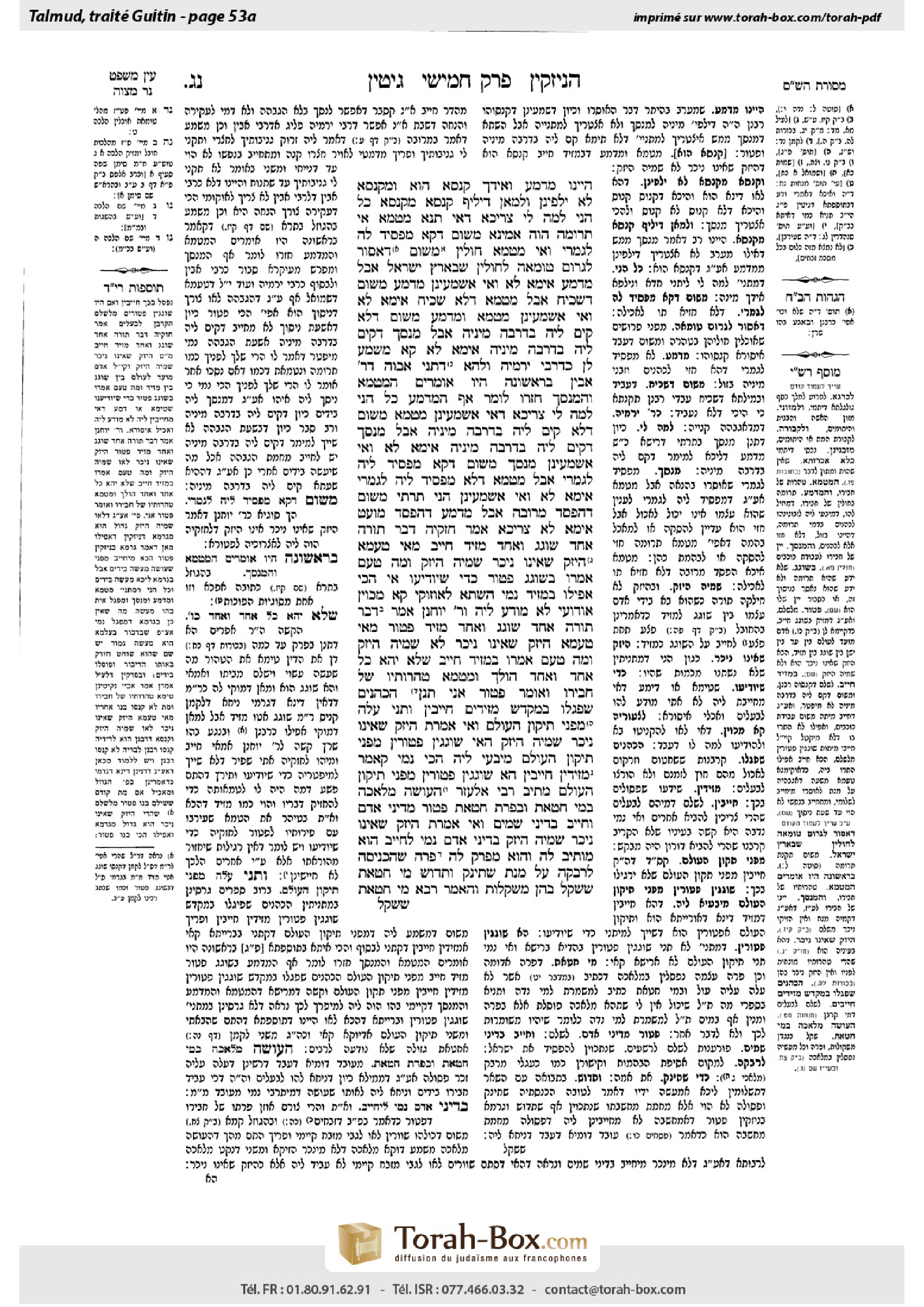
Gittin 53a: Talmud study for Daf Yomi
Study the Talmud for Daf Yomi with scanned pages, Hebrew text, English translations from Sefaria and AI-generated French translations.
Passage selection and English or AI-generated French translation are available where the scan has annotations. Daf Study is independent of Torah-Box and Sefaria.
Browse Gittin · גיטין · All tractatesGittin 53a text and translations
This page of Gittin includes the Aramaic text, an English translation and an AI-generated French translation, alongside the scan above.
גיטין נ״ג א · Aramaic and Hebrew text
הַיְינוּ ״מְדַמֵּעַ״.
וְאִידָּךְ – קְנָסָא הוּא, וּמִקְּנָסָא לָא יָלְפִינַן.
וּלְמַאן דְּיָלֵיף קְנָסָא מִקְּנָסָא – כֹּל הָנֵי לְמָה לִי?
צְרִיכָא; דְּאִי תְּנָא מְטַמֵּא; אִי תְּרוּמָה – הֲוָה אָמֵינָא מִשּׁוּם דְּקָא מַפְסֵיד לַהּ לִגְמָרֵי, וְאִי מְטַמֵּא חוּלִּין – מִשּׁוּם דְּאָסוּר לִגְרוֹם טוּמְאָה לְחוּלִּין שֶׁבְּאֶרֶץ יִשְׂרָאֵל; אֲבָל מְדַמֵּעַ – אֵימָא לָא.
וְאִי אַשְׁמְעִינַן מְדַמֵּעַ – מִשּׁוּם דִּשְׁכִיחַ, אֲבָל מְטַמֵּא, דְּלָא שְׁכִיחַ – אֵימָא לָא.
וְאִי אַשְׁמְעִינַן מְטַמֵּא וּמְדַמֵּעַ – מִשּׁוּם דְּלָא קִים לֵיהּ בִּדְרַבָּה מִינֵּיהּ,
אֲבָל מְנַסֵּךְ, דְּקִים לֵיהּ בִּדְרַבָּה מִינֵּיהּ – אֵימָא לָא; קָא מַשְׁמַע לַן – כִּדְרַבִּי יִרְמְיָה.
וּלְהָא דְּתָנֵי אֲבוּהּ דְּרַבִּי אָבִין: בָּרִאשׁוֹנָה הָיוּ אוֹמְרִים הַמְטַמֵּא וְהַמְנַסֵּךְ, חָזְרוּ לוֹמַר אַף הַמְדַמֵּעַ, כֹּל הָנֵי לְמָה לִי?
צְרִיכָא; דְּאִי אַשְׁמְעִינַן מְטַמֵּא – מִשּׁוּם דְּלָא קִים לֵיהּ בִּדְרַבָּה מִינֵּיהּ; אֲבָל מְנַסֵּךְ, דְּקִים לֵיהּ בִּדְרַבָּה מִינֵּיהּ – אֵימָא לָא;
וְאִי אַשְׁמְעִינַן מְנַסֵּךְ – מִשּׁוּם דְּקָא מַפְסֵיד לֵיהּ לִגְמָרֵי; אֲבָל מְטַמֵּא, דְּלָא מַפְסֵיד לֵיהּ לִגְמָרֵי – אֵימָא לָא;
וְאִי אַשְׁמְעִינַן הָנֵי תַּרְתֵּי – מִשּׁוּם דְּהֶפְסֵד מְרוּבֶּה; אֲבָל מְדַמֵּעַ, דְּהֶפְסֵד מוּעָט – אֵימָא לָא; צְרִיכָא.
אָמַר חִזְקִיָּה: דְּבַר תּוֹרָה – אֶחָד שׁוֹגֵג, וְאֶחָד מֵזִיד – חַיָּיב. מַאי טַעְמָא? הֶיזֵּק שֶׁאֵינוֹ נִיכָּר שְׁמֵיהּ הֶיזֵּק.
וּמַה טַּעַם אָמְרוּ בְּשׁוֹגֵג פָּטוּר – כְּדֵי שֶׁיּוֹדִיעוֹ.
אִי הָכִי, אֲפִילּוּ בְּמֵזִיד נָמֵי! הַשְׁתָּא לְאוֹזוֹקֵי קָא מְכַוֵּין, אוֹדוֹעֵי לָא מוֹדַע לֵיהּ?!
וְרַבִּי יוֹחָנָן אָמַר: דְּבַר תּוֹרָה – אֶחָד שׁוֹגֵג, וְאֶחָד מֵזִיד – פָּטוּר. מַאי טַעְמָא? הֶיזֵּק שֶׁאֵינוֹ נִיכָּר – לָא שְׁמֵיהּ הֶיזֵּק. וּמַה טַּעַם אָמְרוּ בְּמֵזִיד חַיָּיב – שֶׁלֹּא יְהֵא כׇּל אֶחָד וְאֶחָד הוֹלֵךְ וּמְטַמֵּא טׇהֳרוֹתָיו שֶׁל חֲבֵירוֹ, וְאוֹמֵר ״פָּטוּר אֲנִי״.
תְּנַן: הַכֹּהֲנִים שֶׁפִּגְּלוּ בַּמִּקְדָּשׁ, מְזִידִים – חַיָּיבִין; וְתָנֵי עֲלַהּ: מִפְּנֵי תִּיקּוּן הָעוֹלָם.
וְאִי אָמְרַתְּ הֶיזֵּק שֶׁאֵינוֹ נִיכָּר שְׁמֵיהּ הֶיזֵּק, הַאי ״שׁוֹגְגִין פְּטוּרִין מִפְּנֵי תִּיקּוּן הָעוֹלָם״ מִיבְּעֵי לֵיהּ!
הָכִי נָמֵי קָאָמַר: מְזִידִין – חַיָּיבִין; הָא שׁוֹגְגִין – פְּטוּרִין מִפְּנֵי תִּיקּוּן הָעוֹלָם.
מֵתִיב רַבִּי אֶלְעָזָר: הָעוֹשֶׂה מְלָאכָה בְּמֵי חַטָּאת וּבְפָרַת חַטָּאת, פָּטוּר מִדִּינֵי אָדָם וְחַיָּיב בְּדִינֵי שָׁמַיִם. וְאִי אָמְרַתְּ הֶיזֵּק שֶׁאֵינוֹ נִיכָּר שְׁמֵיהּ הֶיזֵּק, בְּדִינֵי אָדָם נָמֵי לְחַיֵּיב!
הוּא מוֹתֵיב לַהּ – וְהוּא מְפָרֵק לַהּ: פָּרָה – שֶׁהִכְנִיסָהּ לְרִבְקָה עַל מְנָת שֶׁתִּינַק וְתָדוּשׁ; מֵי חַטָּאת – שֶׁשָּׁקַל בָּהֶן מִשְׁקָלוֹת.
וְהָאָמַר רָבָא: מֵי חַטָּאת
Gittin 53a · English translation
is the same as mixing teruma with non-sacred produce, as both involve intermingling that which is forbidden with that which is permitted, so that the entire mixture becomes forbidden. There is no difference between these actions, so there would be no need to mention both of them in the mishna.
And the other Sage, Shmuel, holds that one who mixes teruma with another person’s non-sacred produce is liable for a fine. And we do not derive a fine in one case from a fine stated in another case, even if the two cases are similar. Consequently, liability for the fine must be mentioned separately for each case.
The Gemara asks: And according to the one who says that we do derive a fine in one case from a fine in another case, why do I need all these cases mentioned in the mishna, i.e., one who renders another person’s food ritually impure, one who mixes teruma with another’s non-sacred produce, and one who pours another person’s wine in a rite of idolatry?
The Gemara answers: All three rulings are necessary, as, had the mishna taught only the case of one who renders another’s food impure, there are two possibilities: If it is referring to one who renders another’s teruma non-sacred, then I would say that they imposed a penalty because he ruined it entirely, as it can no longer be consumed by anyone, neither a priest nor an ordinary Israelite. And if it is referring to one who renders another’s non-sacred food impure, then I would say the fine is imposed because it is prohibited to cause impurity to non-sacred food in Eretz Yisrael. But in the case of one who mixes teruma with another’s non-sacred produce, since he neither caused a substantial loss, as the mixture can still be sold to a priest, nor spread impurity in Eretz Yisrael, one might say that a fine is not imposed upon him.
And had the mishna taught us only the case of one who mixes teruma with another person’s non-sacred produce, I would say that a fine is imposed in that case, because mixing two different items together is a common occurrence. But concerning one who renders another person’s food impure, which is uncommon, one might say that a fine is not imposed, as the Sages did not impose penalties in uncommon cases.
And had the mishna taught us both the case of one who renders another person’s food impure and the case of one who mixes teruma with another person’s non-sacred produce, I would say that fines are imposed in both those cases, because there is no application of the principle that one who has committed two transgressions with a single act, each carrying its own punishment, receives the greater punishment of the two. Neither of these actions carries a punishment beyond paying the fine.
But concerning one who pours another person’s wine as a libation before an idol, where one does apply the principle that one who has committed two transgressions with a single act receives the greater punishment of the two for which he is liable, as he is liable to receive court imposed capital punishment for having transgressed the prohibition against idolatry, I would say that a fine is not imposed. Therefore, the mishna teaches us that he is in fact liable to pay the fine. And the reason for this is in accordance with the statement of Rabbi Yirmeya, that since he acquired the wine from the moment he lifted it, he became liable to pay the fine before he became liable to receive court imposed capital punishment, and therefore he is subject to both punishments.
The Gemara asks: And according to this version of the halakha that the father of Rabbi Avin taught (Tosefta 4:5): Initially the Sages would say that one who renders another person’s food impure and one who pours another’s wine as a libation before an idol are subject to a fine, and later they returned to say that even one who mixes teruma with another person’s non-sacred produce is liable to pay a fine, why do I need all these cases? In this version, the halakha of one who mixes was added later. After the halakhot concerning one who renders another person’s food impure and one who pours another’s wine were taught, why could the halakha of one who mixes not be derived from those halakhot?
The Gemara answers: All three rulings are necessary, as, had the baraita in the Tosefta taught us only the case of one who renders another person’s food impure, I would say that a fine is imposed, because there is no application of the principle that one who has committed two transgressions with a single act, each carrying its own punishment, receives the greater punishment of the two. But with regard to one who pours another’s wine as a rite in idolatry, where one does apply the principle that one who has committed two transgressions with a single act receives the greater punishment of the two for which he is liable, one might say that a fine is not imposed.
And had the baraita taught us only the case of one who pours another’s wine as a libation before an idol, I would say that they imposed a penalty because he ruined it entirely, as it is now prohibited for one to derive any benefit from it whatsoever. But for one who renders another person’s food impure, which does not ruin it entirely, as one may derive benefit from it, e.g., by using it as fuel while it is being burned or by feeding it to his animal, one might say that a fine is not imposed.
And had the baraita taught us only these two cases, I would say that here they imposed fines because in each case there is a substantial loss. But with regard to one who mixes teruma with another person’s non-sacred produce, where the loss he causes is minimal because the owner can still sell the mixture to priests at the price of teruma, one might say that a penalty is not imposed. Therefore, all three rulings are necessary.
§ The mishna teaches: If one unintentionally committed one of these offenses, either rendering another’s food impure, mixing teruma with another’s produce, or pouring another’s wine before an idol, he is exempt from paying for the damage. If he acted intentionally, he is liable to pay. Ḥizkiyya says: By Torah law, one who commits one of the offenses listed in the mishna, whether he did so unintentionally or intentionally, is liable to pay for the damage he caused, like any other person who causes damage. What is the reason for this? The reason is that even damage that is not evident is categorized as damage. One is liable for damage not only when the damage is evident, i.e., when he causes a change in the item’s physical state, but also when the damage is not evident, i.e., when he causes a reduction in the item’s value due to a change in its halakhic status, e.g., when he renders it impure.
And what is the reason that the Sages said that if he committed one of these acts unintentionally he is exempt? This is so that the one who caused the damage will inform the injured party about what happened. If a fine were imposed even in a case where the damage is caused unintentionally, there would be a concern that the guilty party might not report the damage so as to avoid the penalty. In such a situation the injured party will not know what happened, as the damage is not evident, and he will inadvertently use that which has become impure, mixed with teruma, or poured before an idol.
The Gemara asks: If it is so that there is a concern about this, then he should be exempt from liability even if he committed one of these offenses intentionally, so that he will inform the owner of the item. The Gemara answers: Now, since it was his intention to cause him damage, will he not inform him? If he does not tell him, the other person will never know that he suffered damage. Consequently, he will certainly inform him of what he did and that his property is now subject to a prohibition, and there is no concern that the injured party will inadvertently come to transgress the prohibition. This is Ḥizkiyya’s opinion.
And Rabbi Yoḥanan says: By Torah law, one who commits one of the offenses listed in the mishna, whether he did so unintentionally or intentionally, is exempt from liability for the damage he caused. What is the reason for this? The reason is that damage that is not evident is not categorized as damage. And what is the reason that the Sages said that if he committed one of these acts intentionally he is liable? This is so that each and every person who has a grievance with his neighbor and wishes to cause him harm should not go and render impure the other person’s pure foods, and say: I am exempt from liability.
The Gemara raises an objection to the opinion of Ḥizkiyya from what we learned in a mishna (54b): With regard to priests who disqualified an offering through improper intention in the Temple, by expressing, while sacrificing the offering, the intention of sprinkling the blood of the offering, burning its fats on the altar, or consuming it after its appointed time, if they did so intentionally, they are liable to pay the value of the offering to its owner, who must now bring another offering. And it is taught with regard to this mishna that the Sages instituted this obligation for the betterment of the world, so that priests should not act in this manner toward people to whom they wish to cause harm.
And if you say that damage that is not evident is nevertheless categorized as damage, it should have said that if they acted unintentionally they are exempt due to the betterment of the world. This is because according to Ḥizkiyya, if they acted intentionally they should be liable by Torah law for the damage they caused, and not by rabbinic ordinance instituted for the betterment of the world.
The Gemara answers: That is also what the tanna is saying, and the mishna should be understood as follows: If they acted intentionally, they are liable, but if they acted unintentionally, they are exempt. And the reason that they are exempt is for the betterment of the world.
Rabbi Elazar raised an objection based on what was taught: With regard to one who performs a task with the water of purification, i.e., water that is to be mixed with the ashes of the red heifer, which was used to purify people and objects that had contracted ritual impurity by contact with a corpse, or performed labor with the red heifer of purification, and by doing so he disqualifies it, he is exempt according to human laws but is liable according to the laws of Heaven. And if you say that damage that is not evident is nevertheless categorized as damage, then according to human laws he should also be liable.
The Gemara comments that he, Rabbi Elazar, raised the objection and subsequently he himself resolved it: That which they said, that he performed labor with the red heifer, means that he placed it in a pen [lirvaka] so that it would nurse from its mother and would incidentally thresh, meaning that his action is not defined as having the heifer perform labor. And that which they said, that he performed a task with the water of purification, means that he weighed weights with the water, which is not an actual task performed with the water.
The Gemara asks: But doesn’t Rava say: Water of purification
Gittin 53a · Traduction française (IA)
est identique à mélanger la terouma avec les produits non sacrés, car les deux comportent un mélange de ce qui est interdit avec ce qui est permis, de sorte que l'ensemble du mélange devient interdit. Il n'y a pas de différence entre ces actions, donc il n'aurait pas été nécessaire de mentionner les deux dans la michna.
Et l'autre Sage, Shmuel, affirme que celui qui mélange la terouma avec les produits non sacrés d'un autre est puni d'une amende. Et nous ne dérivons pas une amende d'un cas à un autre, même si les deux cas sont semblables. Ainsi, la responsabilité d'une amende doit être mentionnée séparément pour chaque cas.
La Guemara pose la question : Et selon celui qui affirme que nous dérivons une amende d'un cas à un autre, pourquoi ai-je besoin de tous ces cas mentionnés dans la michna, c'est-à-dire celui qui rend le repas d'un autre impur, celui qui mélange la terouma avec les produits non sacrés d'un autre, et celui qui verse le vin d'un autre dans un rite d'idolâtrie ?
La Guemara répond : Les trois décisions sont nécessaires, car, si la michna avait enseigné seulement le cas de celui qui rend impur le repas d'un autre, il y aurait deux possibilités : s'il s'agit de celui qui rend la terouma non sacrée, je dirais qu'on impose une amende parce qu'il l'a rendue irréparable, car elle ne peut plus être consommée par personne, ni par un prêtre ni par un Israelite ordinaire. Et s'il s'agit de celui qui rend impur le repas non sacré d'un autre, je dirais qu'on impose une amende parce qu'il est interdit de rendre impur les produits non sacrés en Eretz Yisrael. Mais dans le cas de celui qui mélange la terouma avec les produits non sacrés d'un autre, puisqu'il n'a pas causé une perte substantielle, car le mélange peut encore être vendu à un prêtre, ni répandu l'impureté en Eretz Yisrael, on pourrait dire qu'une amende n'est pas imposée à son égard.
Et si la michna nous avait enseigné seulement le cas de celui qui mélange la terouma avec les produits non sacrés d'un autre, je dirais qu'une amende est imposée dans ce cas, car mélanger deux choses différentes est une occurrence courante. Mais concernant celui qui rend impur le repas d'une autre personne, qui est rare, on pourrait dire qu'une amende n'est pas imposée, car les Sages n'imposent pas de sanctions dans les cas rares.
Et si la michna nous avait enseigné à la fois le cas de celui qui rend impur le repas d'une autre personne et celui qui mélange la terouma avec les produits non sacrés d'un autre, je dirais qu'une amende est imposée dans les deux cas, car il n'y a pas d'application du principe selon lequel celui qui a commis deux transgressions avec une seule action, chacune portant sa propre punition, reçoit la punition la plus grave des deux. Aucune de ces actions ne porte une punition au-delà du paiement de l'amende.
Mais concernant celui qui verse le vin d'une autre personne en offrande devant un idole, où l'on applique le principe selon lequel celui qui a commis deux transgressions avec une seule action reçoit la punition la plus grave des deux pour lesquelles il est responsable, car il est responsable de recevoir la peine de mort imposée par le tribunal pour avoir transgressé l'interdiction d'idolâtrie, je dirais qu'une amende n'est pas imposée. Ainsi, la michna nous enseigne que l'amende est effectivement imposée. Et la raison de cela est conformément à l'affirmation de Rabbi Yirmeya, que puisqu'il a acquis le vin dès qu'il l'a soulevé, il était responsable de payer l'amende avant d'être responsable de recevoir la peine de mort imposée par le tribunal, et donc il est soumis à ces deux punitions.
La Guemara pose la question : Et selon cette version de la halakha que le père de Rabbi Avin a enseignée (Tosefta 4:5) : Initialement, les Sages disaient que celui qui rend le repas d'une autre personne impur et celui qui verse le vin d'une autre personne en offrande devant un idole sont soumis à une amende, et plus tard ils ont rétabli que même celui qui mélange la terouma avec les produits non sacrés d'une autre personne est responsable de payer une amende, pourquoi ai-je besoin de tous ces cas ? Dans cette version, la halakha concernant le mélange a été ajoutée plus tard. Après que les halakhot concernant celui qui rend le repas d'une autre personne impur et celui qui verse le vin d'une autre personne en offrande devant un idole aient été enseignées, pourquoi ne pouvait-on pas déduire la halakha concernant le mélange à partir de ces halakhot ?
La Guemara répond : Les trois décisions sont nécessaires, car, si la baraïta de la Tosefta nous avait enseigné seulement le cas de celui qui rend le repas d'une autre personne impur, je dirais qu'une amende est imposée, car il n'y a pas d'application du principe selon lequel celui qui a commis deux transgressions avec une seule action, chacune portant sa propre punition, reçoit la punition la plus grave des deux. Mais concernant celui qui verse le vin d'une autre personne en offrande devant un idole, où l'on applique le principe selon lequel celui qui a commis deux transgressions avec une seule action reçoit la punition la plus grave des deux pour lesquelles il est responsable, on pourrait dire qu'une amende n'est pas imposée.
Et si la baraïta nous avait enseigné seulement le cas de celui qui verse le vin d'une autre personne en offrande devant un idole, je dirais qu'ils imposent une amende parce qu'il a rendu le vin irréparable, car il est désormais interdit de tirer quelque bénéfice que ce soit de lui. Mais concernant celui qui rend le repas d'une autre personne impur, qui ne le rend pas irréparable, car on peut en tirer un bénéfice, par exemple en l'utilisant comme combustible pendant qu'il brûle ou en le nourrissant à son animal, on pourrait dire qu'une amende n'est pas imposée.
Et si la baraïta nous avait enseigné seulement ces deux cas, je dirais qu'ils imposent des amendes car dans chaque cas il y a une perte substantielle. Mais concernant celui qui mélange la terouma avec les produits non sacrés d'une autre personne, où la perte qu'il cause est minime car le propriétaire peut encore vendre le mélange aux prêtres au prix de la terouma, on pourrait dire qu'une amende n'est pas imposée. Ainsi, toutes les trois décisions sont nécessaires.
§ La mitsna enseigne : Si une personne a commis involontairement l'une de ces infractions, soit en rendant impur le repas d'autrui, soit en mélangeant la terouma avec les produits d'autrui, soit en versant le vin d'autrui devant un idole, elle est exemptée de payer pour le préjudice. Si elle a agi intentionnellement, elle est tenue de payer. Ḥizkiyya dit : Selon la loi divine, celui qui commet l'une des infractions énumérées dans la mitsna, qu'il l'ait commise involontairement ou intentionnellement, est tenu de payer pour le préjudice qu'il a causé, comme tout autre qui cause un préjudice. Pourquoi est-ce ainsi ? La raison est que même un préjudice non évident est considéré comme un préjudice. On est tenu de payer pour un préjudice non seulement lorsqu'il est évident, c'est-à-dire lorsqu'on modifie l'état physique de l'objet, mais aussi lorsqu'il n'est pas évident, c'est-à-dire lorsqu'on cause une diminution de la valeur de l'objet en raison d'un changement de son statut halakhique, par exemple lorsqu'on le rend impur.
Et pourquoi les Sages ont-ils dit que si l'on a commis l'une de ces actions involontairement, on est exempt ? C'est afin que celui qui a causé le préjudice informe la personne blessée de ce qui s'est produit. Si une amende était imposée même dans le cas où le préjudice est causé involontairement, il y aurait une crainte que la personne coupable ne rapporte pas le préjudice afin d'éviter la sanction. Dans ce cas, la personne blessée ne saurait pas ce qui s'est produit, car le préjudice n'est pas évident, et il utiliserait inadvertamment ce qui est devenu impur, mélangé avec la terouma, ou versé devant un idole.
La Guemara pose une question : Si c'est ainsi que la crainte existe, alors il devrait être exempt de responsabilité même s'il a commis l'une de ces infractions intentionnellement, afin qu'il informe l'owner de l'objet. La Guemara répond : Maintenant, puisque c'était son intention de causer un préjudice, ne le dirait-il pas pas informer ? Si il ne le dit pas, l'autre personne ne saura jamais qu'il a subi un préjudice. Par conséquent, il informera certainement de ce qu'il a fait et que sa propriété est désormais soumise à une interdiction, et il n'y a pas de crainte que la personne blessée vienne à transgresser l'interdiction par inadvertance. C'est l'opinion de Ḥizkiyya.
Et Rabbi Yoḥanan dit : Selon la loi divine, celui qui commet l'une des infractions énumérées dans la mitsna, qu'il l'ait commise involontairement ou intentionnellement, est exempt de responsabilité pour le préjudice qu'il a causé. Pourquoi est-ce ainsi ? La raison est que le préjudice non évident n'est pas considéré comme un préjudice. Et pourquoi les Sages ont-ils dit que si l'on a commis l'une de ces actions intentionnellement, on est tenu ? C'est afin que chaque personne qui a une plainte contre son voisin et qui veut le nuire ne va pas rendre impur les aliments purs de l'autre et dire : Je suis exempt de responsabilité.
La Guemara soulève un objet contre l'opinion de Ḥizkiyya à partir de ce que nous avons appris dans une mitsna (54b) : Concernant les prêtres qui ont disqualifié une offrande par une intention inappropriée dans le Temple, en exprimant, lors de la sacrifice de l'offrande, l'intention de verser le sang de l'offrande, de brûler ses graisses sur l'autel ou de consommer l'offrande après son moment assigné, s'ils l'ont fait intentionnellement, ils sont tenus de payer la valeur de l'offrande à son propriétaire, qui doit maintenant apporter une autre offrande. Et il est enseigné à propos de cette mitsna que les Sages ont institué cette obligation pour le bien du monde, afin que les prêtres ne fassent pas ainsi envers les personnes auxquelles ils veulent causer du mal.
Et si vous dites que le préjudice non évident est néanmoins considéré comme un préjudice, il aurait dû dire que s'ils ont agi involontairement, ils sont exemptés pour le bien du monde. C'est parce que selon Ḥizkiyya, s'ils ont agi intentionnellement, ils devraient être tenus par la loi divine pour le préjudice qu'ils ont causé, et non par un ordonnance rabbinique instituée pour le bien du monde.
La Guemara répond : C'est aussi ce que dit le tanna, et la mitsna devrait être comprise ainsi : S'ils ont agi intentionnellement, ils sont tenus, mais s'ils ont agi involontairement, ils sont exemptés. Et la raison pour laquelle ils sont exemptés est pour le bien du monde.
Rabbi Elazar a soulevé une objection basée sur ce qui a été enseigné : Concernant celui qui effectue une tâche avec l'eau de purification, c'est-à-dire l'eau à mélanger avec les cendres de la bête rouge, utilisée pour purifier les personnes et les objets ayant contracté une impureté rituelle par contact avec un cadavre, ou effectue un travail avec la bête rouge de purification, et en faisant cela il disqualifie celle-ci, il est exempt selon les lois humaines mais tenu selon les lois du Ciel. Et si vous dites que le préjudice non évident est néanmoins considéré comme un préjudice, alors selon les lois humaines il devrait être tenu également.
La Guemara commente que Rabbi Elazar a soulevé l'objection et a ensuite résolu lui-même : Ce que l'on a dit, qu'il a effectué un travail avec la bête rouge, signifie qu'il l'a mise dans un enclos [lirvaka] afin qu'elle allaitât de sa mère et qu'elle trierait accidentellement, c'est-à-dire que son action n'est pas définie comme un travail effectué par la bête. Et ce que l'on a dit, qu'il a effectué une tâche avec l'eau de purification, signifie qu'il a pesé des poids avec l'eau, ce qui n'est pas une tâche réelle effectuée avec l'eau.
La Guemara pose une question : Mais ne dit pas Rava : Eau de purification
Traduction française générée par IA à partir de l’édition anglaise de Sefaria. Vérifie toujours un passage avec le texte source.
Text from Sefaria: William Davidson Edition - Vocalized Aramaic (CC BY NC); William Davidson Edition - English (CC BY NC).