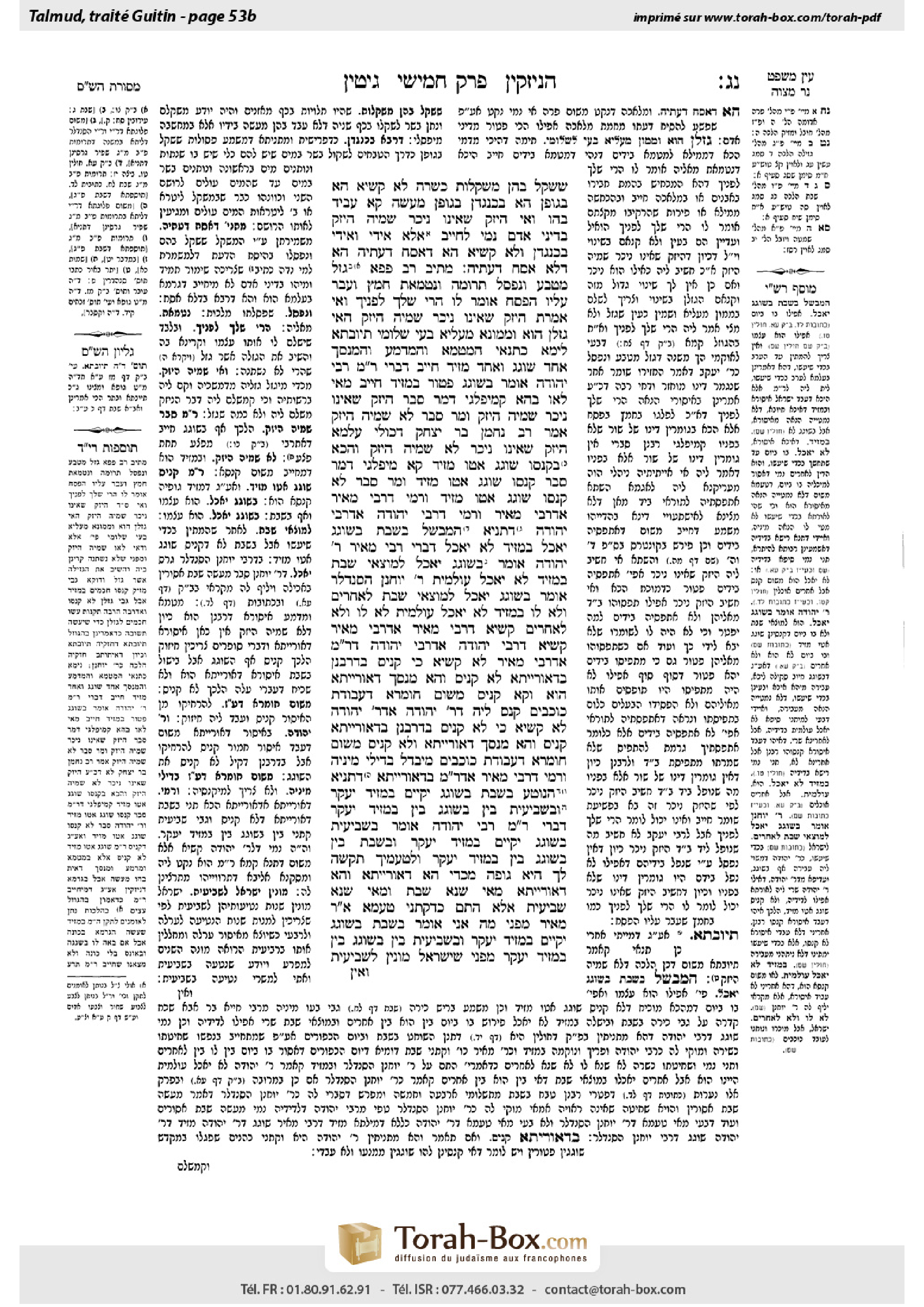
Gittin 53b: Talmud study for Daf Yomi
Study the Talmud for Daf Yomi with scanned pages, Hebrew text, English translations from Sefaria and AI-generated French translations.
Passage selection and English or AI-generated French translation are available where the scan has annotations. Daf Study is independent of Torah-Box and Sefaria.
Browse Gittin · גיטין · All tractatesGittin 53b text and translations
This page of Gittin includes the Aramaic text, an English translation and an AI-generated French translation, alongside the scan above.
גיטין נ״ג ב · Aramaic and Hebrew text
שֶׁשָּׁקַל בָּהֶן מִשְׁקָלוֹת, כְּשֵׁרָה! לָא קַשְׁיָא: הָא בְּגוּפָן, הָא בִּכְנֶגְדָּן.
בְּגוּפָן – מַעֲשֶׂה קָא עָבֵיד בְּהוּ; וְאִי הֶיזֵּק שֶׁאֵינוֹ נִיכָּר שְׁמֵיהּ הֶיזֵּק, בְּדִינֵי אָדָם נָמֵי לְחַיֵּיב! אֶלָּא אִידֵּי וְאִידֵּי בִּכְנֶגְדָּן; וְלָא קַשְׁיָא – הָא דְּאַסַּח דַּעְתֵּיהּ. הָא דְּלָא אַסַּח דַּעְתֵּיהּ.
מֵתִיב רַב פָּפָּא: גָּזַל מַטְבֵּעַ, וְנִפְסַל; תְּרוּמָה, וְנִטְמֵאת; חָמֵץ, וְעָבַר עָלָיו הַפֶּסַח; אוֹמֵר לוֹ: ״הֲרֵי שֶׁלְּךָ לְפָנֶיךָ״.
וְאִי אָמְרַתְּ הֶיזֵּק שֶׁאֵינוֹ נִיכָּר שְׁמֵיהּ הֶיזֵּק, הַאי גַּזְלָן הוּא, מָמוֹנָא מְעַלְּיָא בָּעֵי שַׁלּוֹמֵי! תְּיוּבְתָּא.
לֵימָא כְּתַנָּאֵי: הַמְטַמֵּא וְהַמְדַמֵּעַ וְהַמְנַסֵּךְ, אֶחָד שׁוֹגֵג וְאֶחָד מֵזִיד – חַיָּיב, דִּבְרֵי רַבִּי מֵאִיר. רַבִּי יְהוּדָה אוֹמֵר: בְּשׁוֹגֵג – פָּטוּר, בְּמֵזִיד – חַיָּיב.
מַאי, לָאו בְּהָא קָמִיפַּלְגִי – דְּמָר סָבַר: הֶיזֵּק שֶׁאֵינוֹ נִיכָּר שְׁמֵיהּ הֶיזֵּק; וּמָר סָבַר: לָא שְׁמֵיהּ הֶיזֵּק?
אָמַר רַב נַחְמָן בַּר יִצְחָק: דְּכוּלֵּי עָלְמָא הֶיזֵּק שֶׁאֵינוֹ נִיכָּר לָא שְׁמֵיהּ הֶיזֵּק; וְהָכָא בְּקָנְסוּ שׁוֹגֵג אַטּוּ מֵזִיד קָא מִיפַּלְגִי – דְּמָר סָבַר: קָנְסוּ שׁוֹגֵג אַטּוּ מֵזִיד; וּמָר סָבַר: לֹא קָנְסוּ שׁוֹגֵג אַטּוּ מֵזִיד.
וְרָמֵי דְּרַבִּי מֵאִיר אַדְּרַבִּי מֵאִיר, וְרָמֵי דְּרַבִּי יְהוּדָה אַדְּרַבִּי יְהוּדָה – דְּתַנְיָא: הַמְבַשֵּׁל בְּשַׁבָּת; בְּשׁוֹגֵג – יֵאָכֵל, בְּמֵזִיד – לֹא יֵאָכֵל, דִּבְרֵי רַבִּי מֵאִיר. רַבִּי יְהוּדָה אוֹמֵר: בְּשׁוֹגֵג – יֵאָכֵל לְמוֹצָאֵי שַׁבָּת, בְּמֵזִיד – לֹא יֵאָכֵל עוֹלָמִית.
רַבִּי יוֹחָנָן הַסַּנְדְּלָר אוֹמֵר: בְּשׁוֹגֵג, יֵאָכֵל לְמוֹצָאֵי שַׁבָּת – לַאֲחֵרִים, וְלֹא לוֹ; בְּמֵזִיד, לֹא יֵאָכֵל עוֹלָמִית – לֹא לוֹ, וְלֹא לַאֲחֵרִים. קַשְׁיָא דְּרַבִּי מֵאִיר אַדְּרַבִּי מֵאִיר, קַשְׁיָא דְּרַבִּי יְהוּדָה אַדְּרַבִּי יְהוּדָה!
דְּרַבִּי מֵאִיר אַדְּרַבִּי מֵאִיר לָא קַשְׁיָא – כִּי קָנֵיס, בִּדְרַבָּנַן; בִּדְאוֹרָיְיתָא לָא קָנֵיס.
וְהָא מְנַסֵּךְ דְּאוֹרָיְיתָא הוּא, וְקָא קָנֵיס! מִשּׁוּם חוּמְרָא דַּעֲבוֹדָה זָרָה, קָנֵס לֵיהּ.
דְּרַבִּי יְהוּדָה אַדְּרַבִּי יְהוּדָה לָא קַשְׁיָא – כִּי לָא קָנֵיס, בִּדְרַבָּנַן; בִּדְאוֹרָיְיתָא – קָנֵיס. וְהָא מְנַסֵּךְ דְּאוֹרָיְיתָא, וְלָא קָנֵיס! מִשּׁוּם חוּמְרָא דַּעֲבוֹדָה זָרָה. מִיבְדָּל בְּדִילִי מִינֵּיהּ.
וְרָמֵי דְּרַבִּי מֵאִיר אַדְּרַבִּי מֵאִיר בִּדְאוֹרָיְיתָא – דְּתַנְיָא: הַנּוֹטֵעַ בַּשַּׁבָּת, בְּשׁוֹגֵג – יְקַיֵּים; בְּמֵזִיד – יַעֲקֹר; וּבַשְּׁבִיעִית – בֵּין בְּשׁוֹגֵג בֵּין בְּמֵזִיד יַעֲקֹר, דִּבְרֵי רַבִּי מֵאִיר.
רַבִּי יְהוּדָה אוֹמֵר: בַּשְּׁבִיעִית – בְּשׁוֹגֵג יְקַיֵּים, בְּמֵזִיד יַעֲקֹר; וּבַשַּׁבָּת – בֵּין בְּשׁוֹגֵג בֵּין בְּמֵזִיד, יַעֲקֹר.
וּלְטַעְמָיךְ, תִּקָּשֶׁה לָךְ הִיא גּוּפַהּ – מִכְּדֵי הָא דְּאוֹרָיְיתָא וְהָא דְּאוֹרָיְיתָא, מַאי שְׁנָא שַׁבָּת וּמַאי שְׁנָא שְׁבִיעִית?
אֶלָּא הָתָם, כִּדְקָתָנֵי טַעְמָא – אָמַר רַבִּי מֵאִיר: מִפְּנֵי מָה אֲנִי אוֹמֵר בַּשַּׁבָּת – בְּשׁוֹגֵג יְקַיֵּים, בְּמֵזִיד יַעֲקֹר; וּבַשְּׁבִיעִית – בֵּין בְּשׁוֹגֵג בֵּין בְּמֵזִיד יַעֲקֹר? מִפְּנֵי שֶׁיִּשְׂרָאֵל מוֹנִין לַשְּׁבִיעִית,
Gittin 53b · English translation
with which he weighed weights is fit? The Gemara answers: It is not difficult: This baraita is referring to a case where he weighs an object with the water itself, and therefore the water is disqualified. And this statement of Rava’s, that the water is fit, is referring to a case where he weighs an object against the water.
The Gemara asks: If he weighs an object with the water itself, then he performs a real task with it, and if damage that is not evident is nevertheless categorized as damage, then he should also be liable according to human laws to pay for performing a task with the water. Rather, it is necessary to say that both this and that refer to a case where he weighed an object against the water, and still it is not difficult: This baraita is referring to a case where in the course of the weighing the object his attention was diverted from guarding the water, and owing to this lapse in attention the water became disqualified. And that statement of Rava’s is referring to a case where his attention was not diverted, and therefore the water did not become disqualified.
Rav Pappa raises an objection against Ḥizkiyya’s opinion from that which is taught in a baraita: If one robbed another of a coin and afterward the coin was rendered invalid by the government, or if he robbed another of teruma and it became ritually impure, or if he robbed another of leavened bread and Passover then elapsed over it, rendering it forbidden, in each of these cases the robber can return the item and say to the robbery victim: That which is yours is before you. Since the robber returned the stolen item, he is not required to compensate the victim of the robbery for his monetary loss, although the stolen items are currently of minimal or no value.
And if you say that damage that is not evident is categorized as damage, then this man is a robber, and he should be required to pay full compensation for the damage he caused. The Gemara concludes: This is a conclusive refutation, and the opinion of Ḥizkiyya is rejected.
The Gemara suggests: Let us say that this amoraic dispute is parallel to a dispute between tanna’im, as it was taught in a baraita: With regard to one who renders another’s food ritually impure, or one who mixes teruma with another’s non-sacred produce, or one who pours another’s wine as a libation before an idol, whether he did so unintentionally or intentionally, he is liable to pay for the damage he caused; this is the statement of Rabbi Meir. Rabbi Yehuda says: If he acted unintentionally, he is exempt; if he acted intentionally, he is liable to pay.
The Gemara suggests: What, is it not that they disagree about this very issue? As one Sage, Rabbi Meir, holds that damage that is not evident is nevertheless categorized as damage. Consequently, one is liable to pay even if he caused the damage unintentionally. And one Sage, Rabbi Yehuda, holds that such damage is not categorized as damage, and consequently one is liable to pay only if he caused the damage intentionally, as this is a rabbinically instituted fine.
Rav Naḥman bar Yitzḥak said that it is possible to say that everyone, including Rabbi Meir, agrees that damage that is not evident is not categorized as damage. And here, they disagree with regard to this question: Did the Sages penalize an unintentional offender due to an intentional offender? As one Sage, Rabbi Meir, who states that the one who caused the damage is liable even if he acted unintentionally, holds that the Sages penalized an unintentional offender due to an intentional offender. And one Sage, Rabbi Yehuda, who states that one is liable only if he acted intentionally, holds that they did not penalize an unintentional offender due to an intentional offender.
The Gemara comments: But then it is possible to raise a contradiction between this statement of Rabbi Meir and another statement of Rabbi Meir; and it is also possible to raise a contradiction between this statement of Rabbi Yehuda and another statement of Rabbi Yehuda. The other statements are as it is taught in a baraita (Tosefta, Shabbat 2:5): With regard to one who cooks on Shabbat, if he did so unintentionally, he may eat what he cooked. If he acted intentionally, he may not eat what he cooked; this is the statement of Rabbi Meir. Rabbi Yehuda says: If he cooked the food unintentionally, he may eat what he cooked, but only at the conclusion of Shabbat. If he cooked it intentionally, he may never eat what he cooked.
The baraita continues: Rabbi Yoḥanan HaSandlar says: If he acted unintentionally, what he cooked may be eaten at the conclusion of Shabbat by others, but not by him, as the food is forbidden to him forever. If he cooked the food intentionally, what he cooked may never be eaten, neither by him nor by others. Consequently, there is a contradiction between one statement of Rabbi Meir and the other statement of Rabbi Meir, and there is also a contradiction between one statement of Rabbi Yehuda and the other statement of Rabbi Yehuda.
The Gemara answers: There is no contradiction between one statement of Rabbi Meir and the other statement of Rabbi Meir, because one can draw a distinction between them. When Rabbi Meir penalizes an offender for even an unintentional offense, it is where the offender violated a rabbinic law, e.g., he rendered food impure. But where he violated a Torah law, e.g., he cooked on Shabbat, he does not penalize him. The reason for this distinction is that people treat Torah prohibitions more seriously, and consequently there is no need to impose a fine for unintentional transgression in order to distance people from the transgression.
The Gemara asks: But isn’t pouring wine as a libation before an idol prohibited by Torah law, and even so Rabbi Meir penalizes the offender, even if his transgression is unintentional? The Gemara answers: This is an exception to the principle. Due to the severity of the prohibition against idol worship, Rabbi Meir penalizes the offender even if he acts unintentionally.
The Gemara continues: And there is also no contradiction between one statement of Rabbi Yehuda and the other statement of Rabbi Yehuda. When Rabbi Yehuda does not penalize an offender for an unintentional offense, it is where he violated a rabbinic law. But where he violated a Torah law, he penalizes him even if he transgressed unintentionally, owing to the severity of the transgression. The Gemara asks: But isn’t pouring wine as a libation before an idol prohibited by Torah law, and even so Rabbi Yehuda does not penalize the offender if he acted unintentionally? The Gemara answers: The argument raised previously can be reversed: Due to the exceptional severity of the prohibition against idol worship people avoid it on their own, and so there is no need to impose a fine for unintentional transgression in order to distance people from it.
The Gemara comments: But then it is possible to raise a contradiction between one statement of Rabbi Meir and another statement of Rabbi Meir even with respect to matters that are prohibited by Torah law, as it is taught in a baraita (Tosefta, Shabbat 2:11): With regard to one who plants a tree on Shabbat, if he does so unintentionally, he may keep the tree. If he acted intentionally, it must be uprooted. And if he planted the tree during the Sabbatical Year, then whether he did so unintentionally or intentionally, it must be uprooted; this is the statement of Rabbi Meir.
Rabbi Yehuda says: With regard to planting a tree in the Sabbatical Year, if one does so unintentionally, he may keep the tree. If he acted intentionally, it must be uprooted. And if he planted the tree on Shabbat, then whether he did so unintentionally or intentionally, it must be uprooted. Although it is prohibited by Torah law to plant a tree in the Sabbatical Year, Rabbi Meir penalizes the offender and requires that the tree be uprooted, even if he acted unintentionally. This seems to contradict Rabbi Meir’s ruling in the previously mentioned baraita, that one who unintentionally cooked on Shabbat is not penalized.
The Gemara asks: And according to your reasoning, that you raise such a contradiction, raise a contradiction in this baraita itself. Since this prohibition of planting on Shabbat is by Torah law and this prohibition of planting in the Sabbatical Year is by Torah law, what is different about Shabbat and what is different about the Sabbatical Year, that both Sages distinguish between the two halakhot.
Rather, there the reason is as is taught explicitly: Rabbi Meir said: For what reason do I say: If one planted a tree on Shabbat unintentionally, he may keep the tree, but if he did so intentionally, it must be uprooted; but in the Sabbatical Year, whether the tree was planted unintentionally or intentionally, it must be uprooted? It is because Jews count the years of the tree, with regard to the prohibition against eating the fruit of a tree during the first three years after its planting [orla] and with regard to the halakha of fourth-year produce, from the Sabbatical Year. Therefore, if the tree was planted in the Sabbatical Year, people will remember, and they might come to think planting a tree in the Sabbatical Year is permitted. For this reason, Rabbi Meir imposed a fine and required that the tree be uprooted.
Gittin 53b · Traduction française (IA)
Avec quoi il a pesé les poids est-il propre? La Guemara répond : Ce n’est pas difficile : cette baraïta fait référence à un cas où il pèse un objet avec l’eau elle-même, et donc l’eau est disqualifiée. Et cette déclaration de Rava, selon laquelle l’eau est propre, fait référence à un cas où il pèse un objet contre l’eau.
La Guemara pose la question : Si il pèse un objet avec l’eau elle-même, alors il effectue une tâche réelle avec elle, et si un dommage non évident est néanmoins catégorisé comme dommage, alors il devrait également être tenu responsable selon les lois humaines de payer pour avoir utilisé l’eau. En revanche, il faut dire que ces deux cas font référence à un cas où il pèse un objet contre l’eau, et encore, ce n’est pas difficile : cette baraïta fait référence à un cas où, pendant la pesée, son attention a été détournée de la garde de l’eau, et en raison de cette négligence, l’eau est devenue disqualifiée. Et cette déclaration de Rava fait référence à un cas où son attention n’a pas été détournée, et donc l’eau n’est pas devenue disqualifiée.
Rav Pappa soulève un objection contre l’opinion de Chizkiyya à partir de ce qui est enseigné dans une baraïta : Si l’on a volé à un autre une pièce et que plus tard la pièce a été rendue invalide par l’État, ou si l’on a volé à un autre de la terouma et qu’elle est devenue impure rituellement, ou si l’on a volé à un autre du pain levé et que la Pâque est passée sur elle, la rendant interdite, dans chacun de ces cas, le voleur peut rendre l’objet et dire au victime du vol : Ce qui est à toi est devant toi. Puisque le voleur a rendu l’objet volé, il n’est pas tenu de compenser la victime du vol pour sa perte monétaire, même si les objets volés sont actuellement de valeur minimale ou nulle.
Et si vous dites que le dommage non évident est catégorisé comme dommage, alors cette personne est un voleur, et il doit payer la compensation totale pour le dommage qu’il a causé. La Guemara conclut : C’est une réfutation concluante, et l’opinion de Chizkiyya est rejetée.
La Guemara suggère : Disons que ce débat entre les amoraïm est parallèle à un débat entre les tannaïm, comme il est enseigné dans une baraïta : Concernant celui qui rend la nourriture d’un autre impure rituellement, ou celui qui mélange la terouma avec les produits non sacrés d’un autre, ou celui qui verse le vin d’un autre en offrande devant un idole, que ce soit intentionnellement ou non, il est tenu responsable de payer pour le dommage qu’il a causé ; c’est l’affirmation de Rabbi Meir. Rabbi Yehuda dit : Si il a agi non intentionnellement, il est exempt ; si il a agi intentionnellement, il est tenu responsable de payer.
La Guemara suggère : Qu’est-ce que cela signifie, n’est-ce pas qu’ils discutent de cette même question ? Comme un Sage, Rabbi Meir, affirme que le dommage non évident est néanmoins catégorisé comme dommage. Par conséquent, on est tenu responsable même s’il a causé le dommage non intentionnellement. Et un Sage, Rabbi Yehuda, affirme que ce dommage n’est pas catégorisé comme dommage, et par conséquent on est tenu responsable de payer uniquement s’il a causé le dommage intentionnellement, comme c’est une amende rabbinique.
Rav Naḥman bar Yitzḥak a dit que l’on peut dire que tout le monde, y compris Rabbi Meir, est d’accord que le dommage non évident n’est pas considéré comme dommage. Et ici, ils discutent de cette question : Les Sages ont-ils pénalisé un fauteur de dommage non intentionnel en raison d’un fauteur de dommage intentionnel ? Comme un Sage, Rabbi Meir, qui affirme que celui qui a causé le dommage est tenu responsable même s’il a agi non intentionnellement, affirme que les Sages ont pénalisé un fauteur de dommage non intentionnel en raison d’un fauteur de dommage intentionnel. Et un Sage, Rabbi Yehuda, qui affirme que l’on est tenu responsable uniquement s’il a agi intentionnellement, affirme qu’ils n’ont pas pénalisé un fauteur de dommage non intentionnel en raison d’un fauteur de dommage intentionnel.
La Guemara commente : Mais alors il est possible de soulever une contradiction entre cette déclaration de Rabbi Meir et une autre déclaration de Rabbi Meir ; et il est également possible de soulever une contradiction entre cette déclaration de Rabbi Yehuda et une autre déclaration de Rabbi Yehuda. Les autres déclarations sont comme il est enseigné dans une baraïta (Tosefta, Shabbat 2:5) : Concernant celui qui cuisine le sabbat, s'il l'a fait non intentionnellement, il peut manger ce qu'il a cuisiné. S'il l'a fait intentionnellement, il ne peut pas manger ce qu'il a cuisiné ; c'est l'affirmation de Rabbi Meir. Rabbi Yehuda dit : S'il a cuisiné la nourriture non intentionnellement, il peut manger ce qu'il a cuisiné, mais seulement à la fin du sabbat. S'il l'a fait intentionnellement, il ne peut jamais manger ce qu'il a cuisiné.
La baraïta continue : Rabbi Yoḥanan HaSandlar dit : S'il a agi non intentionnellement, ce qu'il a cuisiné peut être mangé à la fin du sabbat par les autres, mais pas par lui-même, car la nourriture est interdite à lui pour toujours. S'il a cuisiné intentionnellement, ce qu'il a cuisiné ne peut jamais être mangé, ni par lui-même ni par les autres. Par conséquent, il y a une contradiction entre une déclaration de Rabbi Meir et une autre déclaration de Rabbi Meir, et il y a également une contradiction entre une déclaration de Rabbi Yehuda et une autre déclaration de Rabbi Yehuda.
La Guemara répond : Il n’y a pas de contradiction entre une déclaration de Rabbi Meir et une autre déclaration de Rabbi Meir, car on peut distinguer entre elles. Lorsque Rabbi Meir pénalise un fauteur de dommage même pour une faute non intentionnelle, c’est dans le cas où le fauteur a violé une loi rabbinique, par exemple, il a rendu la nourriture impure. Mais dans le cas où il a violé une loi de la Torah, par exemple, il a cuisiné le sabbat, il ne pénalise pas. La raison de cette distinction est que les gens traitent les prohibitions de la Torah plus sérieusement, et par conséquent il n’est pas nécessaire d’imposer une amende pour une transgression non intentionnelle afin de distancer les gens de la transgression.
La Guemara pose la question : Mais n’est-ce pas que verser du vin en offrande devant un idole est interdit par la loi de la Torah, et même ainsi Rabbi Meir pénalise le fauteur, même s’il a agi non intentionnellement ? La Guemara répond : C’est une exception à ce principe. En raison de la gravité de la prohibition contre l’idolâtrie, Rabbi Meir pénalise le fauteur même s’il agit non intentionnellement.
La Guemara continue : Il n'y a pas non plus de contradiction entre l'une des déclarations du Rabbi Yéhuda et l'autre déclaration du Rabbi Yéhuda. Lorsque le Rabbi Yéhuda ne punit pas un transgresseur pour un péché non intentionnel, c'est lorsque celui-ci a violé une loi rabbinique. Mais lorsque celui-ci a violé une loi de la Torah, il le punit même s'il a transgressé de manière non intentionnelle, en raison de la gravité du péché. La Guemara pose la question : Mais n'est-ce pas verser du vin en offrande devant un idole interdit par la loi de la Torah, et même ainsi le Rabbi Yéhuda ne punit pas le transgresseur s'il a agi de manière non intentionnelle ? La Guemara répond : L'argument soulevé précédemment peut être inversé : En raison de la gravité exceptionnelle de l'interdiction de l'idolâtrie, les gens évitent d'elle de leur propre initiative, et par conséquent il n'est pas nécessaire d'imposer une amende pour une transgression non intentionnelle afin de distancer les gens de cette pratique.
La Guemara commente : Mais alors il est possible de soulever une contradiction entre l'une des déclarations du Rabbi Méir et l'autre déclaration du Rabbi Méir même concernant des choses interdites par la loi de la Torah, comme il est enseigné dans une baraïta (Tosefta, Shabbat 2:11) : Concernant celui qui plante un arbre le sabbat, s'il le fait de manière non intentionnelle, il peut garder l'arbre. S'il a agi intentionnellement, il doit être arraché. Et si l'arbre a été planté pendant l'année sainte, alors que ce soit de manière non intentionnelle ou intentionnelle, il doit être arraché ; c'est la déclaration du Rabbi Méir.
Le Rabbi Yéhuda dit : Concernant la plantation d'un arbre pendant l'année sainte, si l'on le fait de manière non intentionnelle, il peut le garder. S'il a agi intentionnellement, il doit être arraché. Et si l'arbre a été planté le sabbat, alors que ce soit de manière non intentionnelle ou intentionnelle, il doit être arraché. Bien que la plantation d'un arbre pendant l'année sainte soit interdite par la loi de la Torah, le Rabbi Méir punit le transgresseur et exige que l'arbre soit arraché, même s'il a agi de manière non intentionnelle. Cela semble contredire la déclaration du Rabbi Méir dans la baraïta mentionnée précédemment, selon laquelle celui qui a cuisiné intentionnellement le sabbat est puni, mais celui qui l'a fait de manière non intentionnelle ne l'est pas.
La Guemara pose la question : Et selon votre raisonnement, que vous soulevez de telle contradiction, soulevez une contradiction dans cette baraïta elle-même. Puisque cette interdiction de planter un arbre le sabbat est une loi de la Torah et cette interdiction de planter un arbre pendant l'année sainte est une loi de la Torah, qu'y a-t-il de différent entre le sabbat et l'année sainte, qui permette aux Sages de distinguer entre ces deux halakhot.
Plutôt, la raison est comme il est enseigné explicitement : Le Rabbi Méir dit : Pour quelle raison dis-je : Si l'on a planté un arbre le sabbat de manière non intentionnelle, il peut le garder, mais si l'on l'a fait intentionnellement, il doit être arraché ; mais concernant l'année sainte, que l'arbre ait été planté de manière non intentionnelle ou intentionnelle, il doit être arraché ? C'est parce que les Juifs comptent les années de l'arbre, concernant l'interdiction de manger les fruits d'un arbre durant les trois premières années après sa plantation [orla] et concernant la halakha des fruits du quatrième année, à partir de l'année sainte. Ainsi, si l'arbre a été planté pendant l'année sainte, les gens se souviendront et pourraient penser que la plantation d'un arbre pendant l'année sainte est permise. Pour cette raison, le Rabbi Méir a imposé une amende et exige que l'arbre soit arraché.
Traduction française générée par IA à partir de l’édition anglaise de Sefaria. Vérifie toujours un passage avec le texte source.
Text from Sefaria: William Davidson Edition - Vocalized Aramaic (CC BY NC); William Davidson Edition - English (CC BY NC).