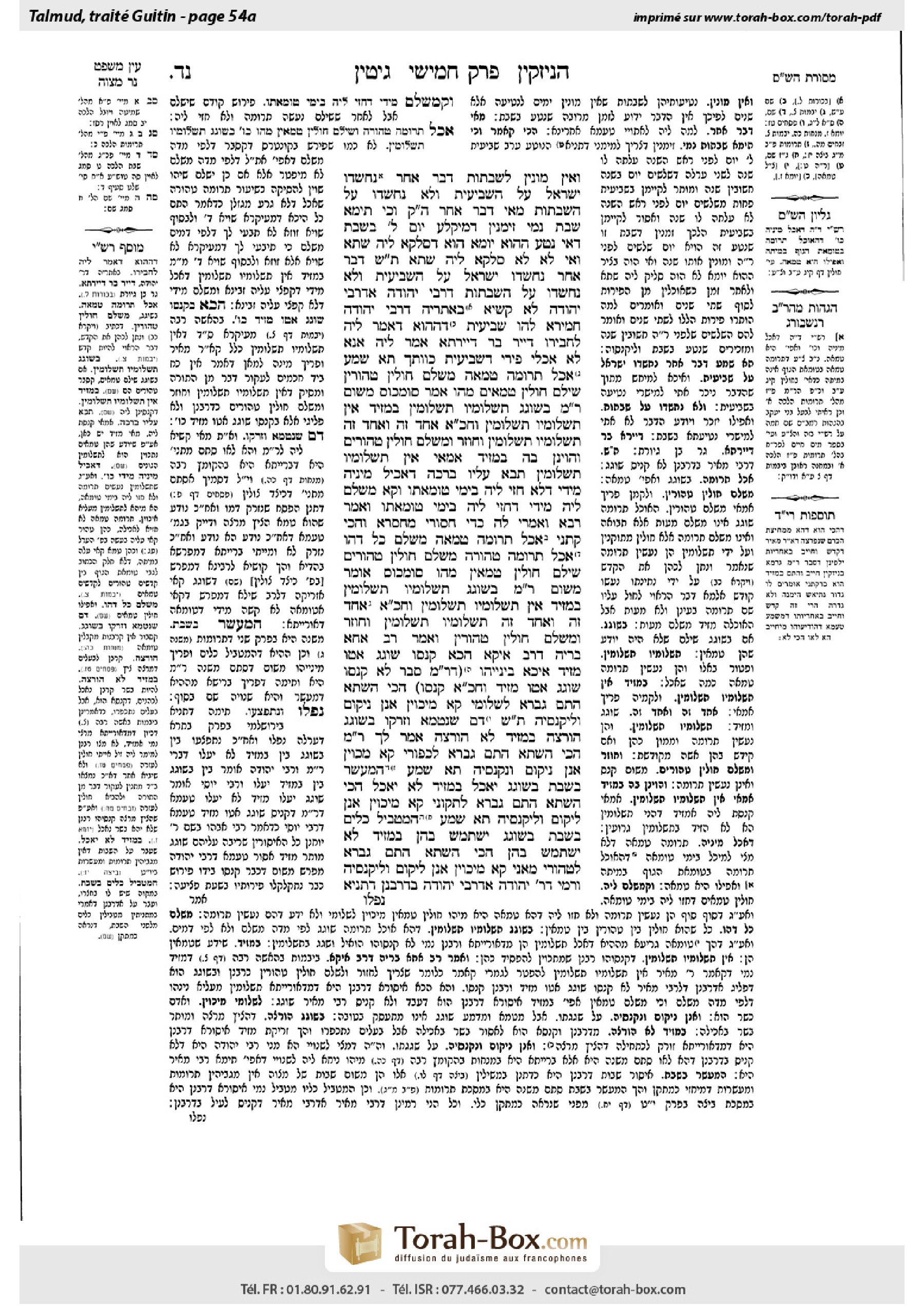
Gittin 54a: Talmud study for Daf Yomi
Study the Talmud for Daf Yomi with scanned pages, Hebrew text, English translations from Sefaria and AI-generated French translations.
Passage selection and English or AI-generated French translation are available where the scan has annotations. Daf Study is independent of Torah-Box and Sefaria.
Browse Gittin · גיטין · All tractatesGittin 54a text and translations
This page of Gittin includes the Aramaic text, an English translation and an AI-generated French translation, alongside the scan above.
גיטין נ״ד א · Aramaic and Hebrew text
וְאֵין מוֹנִין לְשַׁבָּתוֹת.
דָּבָר אַחֵר: נֶחְשְׁדוּ יִשְׂרָאֵל עַל הַשְּׁבִיעִית, וְלֹא נֶחְשְׁדוּ עַל הַשַּׁבָּתוֹת.
מַאי ״דָּבָר אַחֵר״? הָכִי קָאָמַר: וְכִי תֵּימָא שַׁבָּת נָמֵי, זִימְנִין דְּמִיקְּלַע יוֹם שְׁלֹשִׁים – בְּשַׁבָּת, דְּאִי נָטַע הַהוּא יוֹמָא הוּא דְּסָלְקָא לֵיהּ שַׁתָּא, וְאִי לָא – לָא סָלְקָא לֵיהּ שַׁתָּא,
תָּא שְׁמַע דָּבָר אַחֵר: נֶחְשְׁדוּ יִשְׂרָאֵל עַל הַשְּׁבִיעִית, וְלֹא נֶחְשְׁדוּ עַל הַשַּׁבָּתוֹת.
דְּרַבִּי יְהוּדָה אַדְּרַבִּי יְהוּדָה לָא קַשְׁיָא – בְּאַתְרֵיהּ דְּרַבִּי יְהוּדָה חֲמִירָא לְהוּ שְׁבִיעִית.
דְּהָהוּא דַּאֲמַר לֵיהּ לַחֲבֵירוֹ: דַּיָּיר בַּר דַּיָּירְתָּא! אֲמַר לֵיהּ: אֲנָא לָא אָכְלִי פֵּירֵי דִשְׁבִיעִית כְּווֹתָךְ.
תָּא שְׁמַע: אָכַל תְּרוּמָה טְמֵאָה – מְשַׁלֵּם חוּלִּין טְהוֹרִין. שִׁילֵּם חוּלִּין טְמֵאִים, מַהוּ? אָמַר סוֹמְכוֹס מִשּׁוּם רַבִּי מֵאִיר: בְּשׁוֹגֵג – תַּשְׁלוּמָיו תַּשְׁלוּמִין, בְּמֵזִיד – אֵין תַּשְׁלוּמָיו תַּשְׁלוּמִין. וַחֲכָמִים אוֹמְרִים: אֶחָד זֶה וְאֶחָד זֶה תַּשְׁלוּמָיו תַּשְׁלוּמִין, וְחוֹזֵר וּמְשַׁלֵּם חוּלִּין טְהוֹרִים.
וְהָוֵינַן בַּהּ: בְּמֵזִיד – אַמַּאי אֵין תַּשְׁלוּמָיו תַּשְׁלוּמִין? תָּבֹא עָלָיו בְּרָכָה – דְּאָכֵיל מִינֵּיהּ מִידֵּי דְּלָא חֲזֵי לֵיהּ בִּימֵי טוּמְאָתוֹ, וְקָא מְשַׁלֵּם לֵיהּ מִידֵּי דַּחֲזֵי לֵיהּ בִּימֵי טוּמְאָתוֹ!
וְאָמַר רָבָא, וְאָמְרִי לַהּ כְּדִי: חַסּוֹרֵי מְחַסְּרָא, וְהָכִי קָתָנֵי: אָכַל תְּרוּמָה טְמֵאָה – מְשַׁלֵּם כָּל דְּהוּ. אָכַל תְּרוּמָה טְהוֹרָה – מְשַׁלֵּם חוּלִּין טְהוֹרִים. שִׁילֵּם חוּלִּין טְמֵאִין, מַהוּ? סוֹמְכוֹס אוֹמֵר מִשּׁוּם רַבִּי מֵאִיר: בְּשׁוֹגֵג – תַּשְׁלוּמָיו תַּשְׁלוּמִין, בְּמֵזִיד – אֵין תַּשְׁלוּמָיו תַּשְׁלוּמִין. וַחֲכָמִים אוֹמְרִים: אֶחָד זֶה וְאֶחָד זֶה – תַּשְׁלוּמָיו תַּשְׁלוּמִין, וְחוֹזֵר וּמְשַׁלֵּם חוּלִּין טְהוֹרִין.
וְאָמַר רַב אַחָא בְּרֵיהּ דְּרַב אִיקָא: הָכָא בְּקָנְסוּ שׁוֹגֵג אַטּוּ מֵזִיד אִיכָּא בֵּינַיְיהוּ (דְּרַבִּי מֵאִיר סָבַר: לֹא קָנְסוּ שׁוֹגֵג אַטּוּ מֵזִיד, וַחֲכָמִים אוֹמְרִים: קָנְסוּ)!
הָכִי הַשְׁתָּא?! הָתָם – גַּבְרָא לְשַׁלּוֹמֵי קָא מִיכַּוֵּין, אֲנַן נֵיקוּם וְלִיקְנְסֵיהּ?!
תָּא שְׁמַע: דָּם שֶׁנִּטְמָא, וּזְרָקוֹ; בְּשׁוֹגֵג – הוּרְצָה, בְּמֵזִיד – לֹא הוּרְצָה.
אָמַר לָךְ רַבִּי מֵאִיר: הָכִי הַשְׁתָּא?! הָתָם – גַּבְרָא לְכַפּוֹרֵי קָא מְכַוֵּין, אֲנַן נֵיקוּם וְנִקְנְסֵיהּ?!
תָּא שְׁמַע: הַמְעַשֵּׂר בַּשַּׁבָּת; בְּשׁוֹגֵג – יֹאכַל, בְּמֵזִיד – לֹא יֹאכַל. הָכִי הַשְׁתָּא?! הָתָם – גַּבְרָא לְתַקּוֹנֵי קָא מִיכַּוֵּין, אֲנַן לֵיקוּם וְלִיקְנְסֵיהּ?!
תָּא שְׁמַע: הַמַּטְבִּיל כֵּלִים בַּשַּׁבָּת; בְּשׁוֹגֵג – יִשְׁתַּמֵּשׁ בָּהֶן, בְּמֵזִיד – לֹא יִשְׁתַּמֵּשׁ בָּהֶן! הָכִי הַשְׁתָּא?! הָתָם – גַּבְרָא לְטַהוֹרֵי מָאנֵי קָא מִיכַּוֵּין, אֲנַן לֵיקוּם וְלִיקְנְסֵיהּ?!
וְרָמֵי דְּרַבִּי יְהוּדָה אַדְּרַבִּי יְהוּדָה – בִּדְרַבָּנַן, דְּתַנְיָא:
Gittin 54a · English translation
But they do not count from Shabbat, as there is no significance to the day of the week on which the tree was planted, and consequently no one remembers that the tree was planted on Shabbat.
Alternatively, the difference between Shabbat and the Sabbatical Year can be explained as follows: Jews are suspected of desecrating the Sabbatical Year, but they are not suspected of desecrating Shabbat. Therefore, Rabbi Meir imposes a penalty for the unintentional desecration of the Sabbatical Year, but he imposes no such penalty for the unintentional desecration of Shabbat.
The Gemara asks: What is the point of Rabbi Meir adding the second reason, introduced with the term alternatively? The Gemara answers: This is what Rabbi Meir is saying: And if you would say to contest the first reason: Jews also count from Shabbat, and unless the tree is uprooted, people will remember that it was planted on Shabbat, as at times the thirtieth day before Rosh HaShana falls on Shabbat. As, if he planted the tree on that day, the time from when he planted it counts for him as a full year with regard to the prohibition of fruit that grows during the first three years after the tree was planted. And if he did not plant it on that Shabbat, but rather on the next day, the twenty-ninth day before Rosh HaShana, it does not count for him as a full year. In such a case people will remember that the tree was planted on Shabbat, and they might come to think that planting a tree on Shabbat is permitted.
Consequently, Rabbi Meir adds: Come and hear that alternatively, the difference between Shabbat and the Sabbatical Year can be explained as follows: Jews are suspected of desecrating the Sabbatical Year, but they are not suspected of desecrating Shabbat. Therefore, Rabbi Meir imposes a penalty for the unintentional desecration of the Sabbatical Year, but not for the unintentional desecration of Shabbat.
The Gemara continues: And there is also no contradiction between one statement of Rabbi Yehuda with regard to the Sabbatical Year and the other statement of Rabbi Yehuda with regard to Shabbat. This is because in Rabbi Yehuda’s place the prohibition against desecrating the Sabbatical Year was regarded by them as a most serious one, and therefore there was no need to impose a penalty for its unintentional desecration, although it is a Torah law.
The Gemara adduces proof that this is true: It once happened that there was a certain person who said to another to insult him: Convert [dayyar], son of a convert. In anger the second person said to the first in response: At least I don’t eat produce of the Sabbatical Year as you do. This indicates that the Sabbatical Year was treated in that place as a very serious prohibition; therefore, Rabbi Yehuda deemed it unnecessary to impose a penalty for its unintentional desecration.
The Gemara proceeds to discuss another apparent contradiction between rulings of Rabbi Meir with regard to penalties imposed for the unintentional transgression of a rabbinic law: Come and hear what was taught in a baraita (Tosefta, Terumot 7:7): If one partook of teruma,which is the property of a priest, and it was ritually impure, he pays restitution with ritually pure, non-sacred produce. What is the halakha if he paid restitution with ritually impure, non-sacred produce? Sumakhos said in the name of Rabbi Meir: If he paid restitution with ritually impure, non-sacred produce unintentionally, his payment is valid. But if he did so intentionally, his payment is not valid. And the Rabbis say: Although both in this case and in that case his payment is valid, the Sages imposed a penalty and said that he returns and pays restitution a second time with ritually pure, non-sacred produce.
And we discussed the following question concerning the opinion of Rabbi Meir: In the case where he paid restitution with ritually impure, non-sacred produce intentionally, why is his payment not valid? On the contrary, blessing should come upon him, as he partook of something that is not fit for the priest to partake of even during the days of his impurity, since it is prohibited for a priest to partake of impure teruma, whether he himself is pure or impure, and he pays restitution to him with something, i.e., impure, non-sacred produce, which is at least fit for him to partake of during the days of his impurity.
And Rava said, and some say it is unattributed: The baraita is incomplete and this is what it is teaching: If one partook of ritually impure teruma, he can pay restitution with anything, even impure, non-sacred produce. If he partook of ritually pure teruma, he pays restitution with ritually pure, non-sacred produce. The baraita continues: What is the halakha if he paid restitution for ritually pure teruma with ritually impure, non-sacred produce? There is a tannaitic dispute about this. Sumakhos said in the name of Rabbi Meir: If he paid restitution with ritually impure, non-sacred produce unintentionally, his payment is valid. But if he did so intentionally, his payment is not valid. And the Rabbis say: Both in this case and in that case, his payment is valid, but the Sages imposed a penalty and said that he returns and pays restitution a second time with ritually pure, non-sacred produce.
And Rav Aḥa, son of Rav Ika, said: Here, the practical difference between Rabbi Meir and the Rabbis relates to the question of whether or not the Sages penalized an unintentional offender due to an intentional offender. Rabbi Meir holds that they did not penalize an unintentional offender due to an intentional offender, and the Rabbis say that they penalized him. Consequently, Rabbi Meir does not impose a penalty for an unintentional transgression of a rabbinic law, as by Torah law one can pay restitution to a priest with anything if he partakes of teruma. This contradicts what was stated previously, that in the case of a violation of rabbinic law, Rabbi Meir imposes a penalty even for an unintentional offense.
The Gemara answers: How can these cases be compared? There, the man intends to pay; should we arise and penalize him? It is specifically with regard to this case that Rabbi Meir holds that no penalty is imposed, as his mistake was made in the course of performing a laudatory action. By contrast, in cases where one rendered another’s produce impure and the like, there is a penalty, as the mistake was made while performing an action he should not have been performing.
The Gemara tries to bring proof concerning the previously stated opinion of Rabbi Meir that a penalty is imposed in a case of an unintentional transgression of a rabbinical law: Come and hear what was taught in a baraita: In the case of blood of an offering that became impure and a priest sprinkled it on the altar, if he did so unintentionally, the offering is accepted and achieves atonement for the owner of the offering. If he sprinkled the blood intentionally, the offering is not accepted. In any event, the tanna of this baraita did not penalize the unintentional offender due to an intentional offender, and this sprinkling of blood is prohibited by rabbinic law.
The Gemara answers: Rabbi Meir could have said to you: How can these cases be compared? There, the person intends to do a mitzva and atone; should we arise and penalize him? Here too, the mistake was made while performing a laudatory act. In such a case, even Rabbi Meir agrees that an unintentional offender is not penalized due to an intentional offender.
The Gemara attempts to adduce further proof: Come and hear what was taught in a mishna (Terumot 2:3): With regard to one who tithes produce on Shabbat, which is prohibited by rabbinic law because it appears as though he were repairing an article that requires repair, if he did this unintentionally, he may consume the produce, as it has been tithed and rendered fit for consumption. But if he did this intentionally, he may not consume it. Apparently, the Sages did not penalize the unintentional offender due to an intentional offender, although tithing produce on Shabbat is prohibited by rabbinic law. The Gemara answers: How can these cases be compared? There, the man intends to do a worthy deed and repair the produce by tithing it; should we arise and penalize him? As above, Rabbi Meir would agree that in such a case the unintentional offender is not penalized.
The Gemara brings yet another proof: Come and hear what was taught in that same mishna (Terumot 2:3): With regard to one who immerses utensils in a ritual bath on Shabbat, which is also prohibited by the Sages because it appears as if he were repairing an article that requires repair, if he immerses them unintentionally, he may use them. But if he immerses them intentionally, he may not use them. Here too the Sages did not penalize the unintentional offender due to an intentional offender. The Gemara answers as before: How can these cases be compared? There, the man intends to do a praiseworthy act and purify the utensils; should we arise and penalize him? The same distinction stated previously applies in this mishna as well.
The Gemara discusses the opinion of Rabbi Yehuda: And they raised a contradiction between one statement of Rabbi Yehuda and another statement of Rabbi Yehuda with regard to matters that are prohibited only by rabbinic law. As it is taught in a baraita:
Gittin 54a · Traduction française (IA)
Mais ils ne comptent pas à partir du sabbat, car il n'y a pas d'importance au jour de la semaine où l'arbre a été planté, et par conséquent personne ne se souvient que l'arbre a été planté le sabbat.
Une autre explication de la différence entre le sabbat et l'année sainte peut être la suivante : les Juifs sont soupçonnés de transgresser l'année sainte, mais ils ne sont pas soupçonnés de transgresser le sabbat. Ainsi, le maître Meir impose une sanction pour la transgression involontaire de l'année sainte, mais il ne sanctionne pas la transgression involontaire du sabbat.
La Guemara demande : Quel est le but que le maître Meir ajoute cette deuxième raison, introduite par le mot « ou bien » ? La Guemara répond : C'est ce que le maître Meir dit : Et si l'on dit pour contester la première raison : les Juifs comptent aussi à partir du sabbat, et sauf si l'arbre est arraché, les gens se souviendront qu'il a été planté le sabbat, car parfois le trentième jour avant le Rosh HaShana tombe un sabbat. En effet, si l'on a planté l'arbre ce jour-là, le temps écoulé depuis la plantation compte pour lui comme un an concernant l'interdiction des fruits qui croissent pendant les trois premières années après la plantation. Et si l'on n'a pas planté l'arbre ce sabbat, mais plutôt le lendemain, le vingt-neuvième jour avant le Rosh HaShana, cela ne compte pas pour lui comme un an. Dans ce cas, les gens se souviendront que l'arbre a été planté le sabbat, et ils pourraient penser que planter un arbre le sabbat est permis.
Par conséquent, le maître Meir ajoute : Viens écouter, la différence entre le sabbat et l'année sainte peut être expliquée ainsi : les Juifs sont soupçonnés de transgresser l'année sainte, mais ils ne sont pas soupçonnés de transgresser le sabbat. Ainsi, le maître Meir impose une sanction pour la transgression involontaire de l'année sainte, mais pas pour la transgression involontaire du sabbat.
La Guemara continue : Il n'y a pas non plus de contradiction entre l'une des déclarations du maître Yéhuda concernant l'année sainte et l'autre concernant le sabbat. Cela est dû au fait que, dans la place du maître Yéhuda, la transgression de l'année sainte était considérée comme une prohibition très grave, et par conséquent il n'était pas nécessaire d'imposer une sanction pour sa transgression involontaire, bien que ce soit une loi de la Torah.
La Guemara établit une preuve de cela : Il arriva un jour qu'un certain homme dit à un autre de le provoquer : Converti, fils d'un converti. En colère, le second dit à l'homme : Au moins je ne mange pas les produits de l'année sainte comme toi. Cela montre que l'année sainte était traitée dans cette place comme une prohibition très grave ; par conséquent, le maître Yéhuda jugeait inutile d'imposer une sanction pour sa transgression involontaire.
La Guemara poursuit en discutant d'une autre contradiction apparente entre les décisions du maître Meir concernant les sanctions imposées pour la transgression involontaire d'une loi rabbinique : Viens écouter ce qui a été enseigné dans une baraïta (Tosefta, Terumot 7:7) : Si l'on a mangé de la terouma, qui est la propriété d'un prêtre, et qu'elle était impure, il doit réparer avec un produit non sacré et pur. Quelle est la halakha si l'on a réparé avec un produit non sacré et impur ? Sumakhos a dit en nom du maître Meir : Si l'on a réparé avec un produit non sacré et impur de manière involontaire, son réparateur est valide. Mais si l'on l'a fait intentionnellement, son réparateur n'est pas valide. Et les Sages disent : Bien que dans ce cas et dans celui-là son réparateur soit valide, les Sages ont imposé une sanction et dit qu'il doit revenir et réparer une deuxième fois avec un produit non sacré et pur.
Et nous avons discuté de la question suivante concernant l'opinion du maître Meir : Dans le cas où l'on a réparé avec un produit non sacré et impur intentionnellement, pourquoi son réparateur n'est-il pas valide ? Au contraire, la bénédiction devrait lui revenir, car il a mangé quelque chose qui n'est pas adapté au prêtre à manger même pendant les jours de sa impureté, car il est interdit au prêtre de manger de la terouma impure, qu'il soit pur ou impur, et il répare avec quelque chose, c'est-à-dire un produit impur et non sacré, qui est au moins adapté pour lui à manger pendant les jours de sa impureté.
Et Rava a dit, et certains disent qu'il n'est pas attribué : La baraïta est incomplète et voici ce qu'elle enseigne : Si l'on a mangé de la terouma impure, il peut réparer avec n'importe quoi, même un produit impur et non sacré. Si l'on a mangé de la terouma pure, il doit réparer avec un produit pur et non sacré. La baraïta continue : Quelle est la halakha si l'on a réparé pour la terouma pure avec un produit impur et non sacré ? Il y a un débat tannaitique à ce sujet. Sumakhos a dit en nom du maître Meir : Si l'on a réparé avec un produit impur et non sacré de manière involontaire, son réparateur est valide. Mais si l'on l'a fait intentionnellement, son réparateur n'est pas valide. Et les Sages disent : Dans ce cas et dans celui-là, son réparateur est valide, mais les Sages ont imposé une sanction et dit qu'il doit revenir et réparer une deuxième fois avec un produit pur et non sacré.
Et Rav Aḥa, fils de Rav Ika, a dit : Ici, la différence pratique entre le maître Meir et les Sages concerne la question de savoir si les Sages sanctionnaient un transgresseur involontaire en raison d'un transgresseur intentionnel. Le maître Meir considère qu'ils ne sanctionnaient pas un transgresseur involontaire en raison d'un transgresseur intentionnel, et les Sages disent qu'ils sanctionnaient. Par conséquent, le maître Meir ne sanctionne pas la transgression involontaire d'une loi rabbinique, car, selon la loi de la Torah, on peut réparer un prêtre avec n'importe quoi si l'on mange de la terouma. Cela contredit ce qui a été dit précédemment, à savoir que, dans le cas d'une violation d'une loi rabbinique, le maître Meir imposait une sanction même pour une transgression involontaire.
La Guemara répond : Comment ces cas peuvent-ils être comparés ? Là, l'homme a l'intention de payer ; devons-nous nous lever et pénaliser ? C'est précisément dans ce cas que le maître Méri affirme qu'il n'y a pas de pénalité, car son erreur a été commise lors de l'accomplissement d'une action louable. À l'inverse, dans les cas où l'on a rendu impur le produit d'autrui et ainsi de suite, il y a une pénalité, car l'erreur a été commise lors d'une action qu'il ne devait pas accomplir.
La Guemara tente de présenter un témoignage concernant l'opinion précédemment évoquée du maître Méri selon laquelle une pénalité est imposée dans le cas d'une transgression involontaire d'une loi rabbinique : Viens écouter ce qui a été enseigné dans une baraïta : Dans le cas du sang d'un sacrifice devenu impur et d'un prêtre qui l'a aspergé sur l'autel, si cela s'est produit involontairement, l'offrande est acceptée et obtient l'atonement pour l'propriétaire de l'offrande. Si l'asperge volontairement, l'offrande n'est pas acceptée. En tout cas, le tanna de cette baraïta n'a pas pénalisé l'offendeur involontaire en raison de l'offendeur volontaire, et cette aspersion du sang est interdite par la loi rabbinique.
La Guemara répond : Le maître Méri aurait pu te dire : Comment ces cas peuvent-ils être comparés ? Là, la personne a l'intention d'accomplir une mitsva et d'obtenir l'atonement ; devons-nous nous lever et pénaliser ? Ici aussi, l'erreur a été commise lors de l'accomplissement d'une action louable. Dans ce cas, même le maître Méri convient que l'offendeur involontaire n'est pas pénalisé en raison de l'offendeur volontaire.
La Guemara tente d'apporter une preuve supplémentaire : Viens écouter ce qui a été enseigné dans une mitsva (Teroumot 2:3) : Concernant celui qui titre des produits le sabbat, ce qui est interdit par la loi rabbinique car cela semble comme s'il réparait un objet qui nécessitait une réparation, si cela s'est produit involontairement, il peut consommer les produits, car ils ont été titrés et rendus aptes à la consommation. Mais si cela s'est produit volontairement, il ne peut pas les consommer. Apparemment, les Sages n'ont pas pénalisé l'offendeur involontaire en raison de l'offendeur volontaire, bien que le titrage des produits le sabbat soit interdit par la loi rabbinique. La Guemara répond : Comment ces cas peuvent-ils être comparés ? Là, l'homme a l'intention d'accomplir une bonne action et de réparer les produits en les titrant ; devons-nous nous lever et pénaliser ? Comme ci-dessus, le maître Méri serait d'accord pour dire que dans ce cas l'offendeur involontaire n'est pas pénalisé.
La Guemara présente une autre preuve : Viens écouter ce qui a été enseigné dans cette même mitsva (Teroumot 2:3) : Concernant celui qui immerge des ustensiles dans un mikvé le sabbat, ce qui est également interdit par les Sages car cela semble comme s'il réparait un objet qui nécessitait une réparation, si cela s'est produit involontairement, il peut utiliser les ustensiles. Mais si cela s'est produit volontairement, il ne peut pas les utiliser. Ici aussi, les Sages n'ont pas pénalisé l'offendeur involontaire en raison de l'offendeur volontaire. La Guemara répond comme avant : Comment ces cas peuvent-ils être comparés ? Là, l'homme a l'intention d'accomplir une action louable et de purifier les ustensiles ; devons-nous nous lever et pénaliser ? La même distinction évoquée précédemment s'applique également dans cette mitsva.
La Guemara discute de l'opinion du maître Yéhuda : Et ils ont élevé une contradiction entre une déclaration du maître Yéhuda et une autre déclaration du maître Yéhuda concernant les choses interdites uniquement par la loi rabbinique. Comme il est enseigné dans une baraïta :
Traduction française générée par IA à partir de l’édition anglaise de Sefaria. Vérifie toujours un passage avec le texte source.
Text from Sefaria: William Davidson Edition - Vocalized Aramaic (CC BY NC); William Davidson Edition - English (CC BY NC).