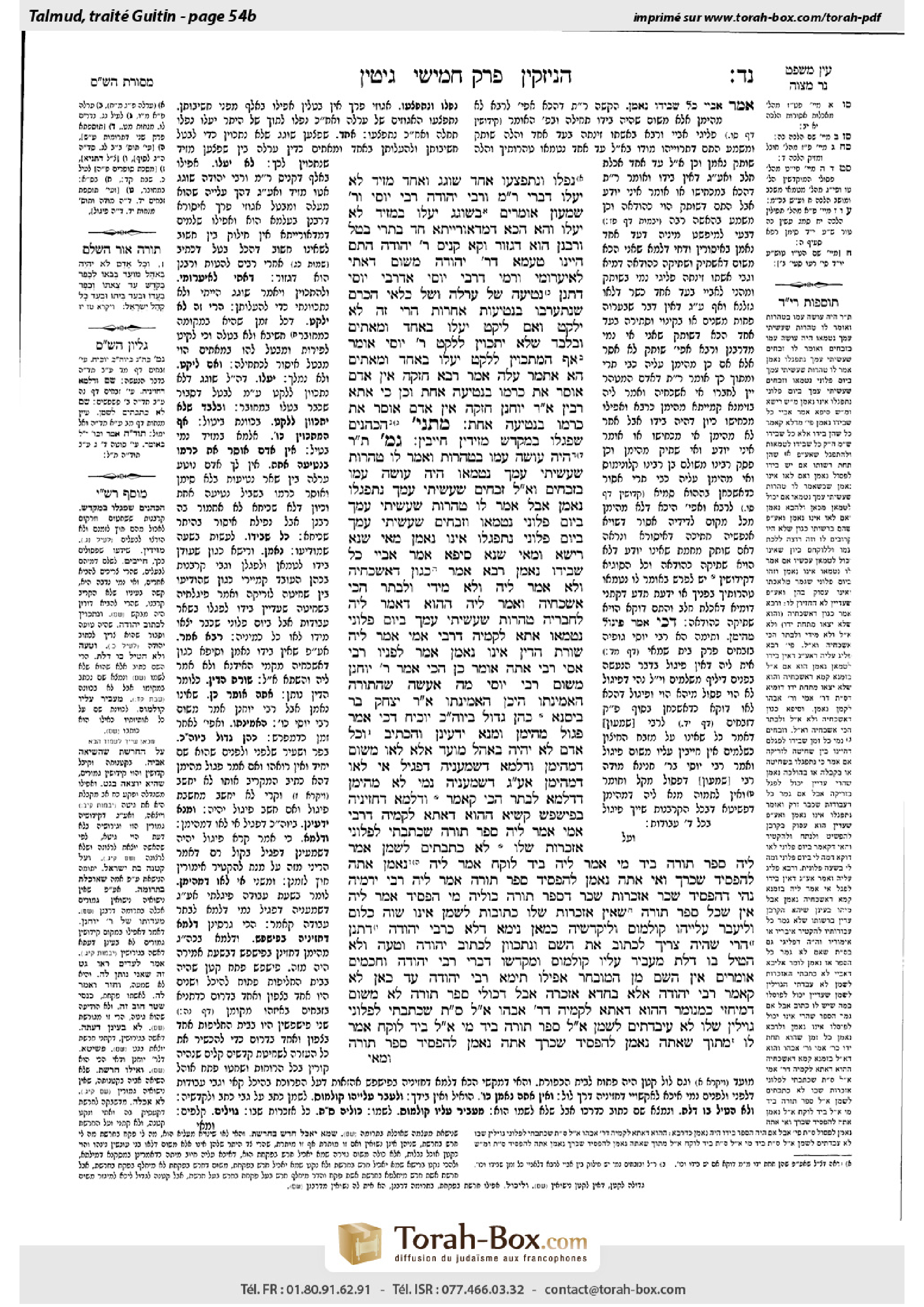
Gittin 54b: Talmud study for Daf Yomi
Study the Talmud for Daf Yomi with scanned pages, Hebrew text, English translations from Sefaria and AI-generated French translations.
Passage selection and English or AI-generated French translation are available where the scan has annotations. Daf Study is independent of Torah-Box and Sefaria.
Browse Gittin · גיטין · All tractatesGittin 54b text and translations
This page of Gittin includes the Aramaic text, an English translation and an AI-generated French translation, alongside the scan above.
גיטין נ״ד ב · Aramaic and Hebrew text
נָפְלוּ וְנִתְפַּצְּעוּ; אֶחָד שׁוֹגֵג, וְאֶחָד מֵזִיד – לֹא יַעֲלוּ, דִּבְרֵי רַבִּי מֵאִיר וְרַבִּי יְהוּדָה. רַבִּי יוֹסֵי וְרַבִּי שִׁמְעוֹן אוֹמְרִים: בְּשׁוֹגֵג – יַעֲלוּ, בְּמֵזִיד – לֹא יַעֲלוּ.
וְהָא הָכָא, דְּמִדְּאוֹרָיְיתָא חַד בִּתְרֵי בָּטֵל, וְרַבָּנַן הוּא דִּגְזוּר, וְקָא קָנֵיס רַבִּי יְהוּדָה! הָתָם הַיְינוּ טַעְמָא דְּרַבִּי יְהוּדָה, מִשּׁוּם דְּאָתֵי לְאִיעָרוֹמֵי.
וְרָמֵי דְּרַבִּי יוֹסֵי אַדְּרַבִּי יוֹסֵי – דִּתְנַן: נְטִיעָה שֶׁל עׇרְלָה וְשֶׁל כִּלְאֵי הַכֶּרֶם שֶׁנִּתְעָרְבוּ בִּנְטִיעוֹת אֲחֵרוֹת, הֲרֵי זֶה לֹא יְלַקֵּט. וְאִם לִיקֵּט – יַעֲלוּ בְּאֶחָד וּמָאתַיִם, וּבִלְבַד שֶׁלֹּא יִתְכַּוֵּין לְלַקֵּט.
רַבִּי יוֹסֵי אוֹמֵר: אַף הַמִּתְכַּוֵּין לְלַקֵּט – יַעֲלוּ בְּאֶחָד וּמָאתַיִם!
הָא אִתְּמַר עֲלַהּ, אָמַר רָבָא: חֲזָקָה אֵין אָדָם אוֹסֵר אֶת כַּרְמוֹ בִּנְטִיעָה אַחַת. וְכֵן כִּי אֲתָא רָבִין אָמַר רַבִּי יוֹחָנָן: חֲזָקָה אֵין אָדָם אוֹסֵר אֶת כַּרְמוֹ בִּנְטִיעָה אַחַת.
מַתְנִי׳ הַכֹּהֲנִים שֶׁפִּגְּלוּ בַּמִּקְדָּשׁ, מְזִידִין – חַיָּיבִין.
גְּמָ׳ תָּנוּ רַבָּנַן: הָיָה עוֹשֶׂה עִמּוֹ בִּטְהָרוֹת, וְאָמַר לוֹ: טְהָרוֹת שֶׁעָשִׂיתִי עִמְּךָ, נִטְמְאוּ; הָיָה עוֹשֶׂה עִמּוֹ בִּזְבָחִים, וְאָמַר לוֹ: זְבָחִים שֶׁעָשִׂיתִי עִמְּךָ, נִתְפַּגְּלוּ – נֶאֱמָן. אֲבָל אָמַר לוֹ: טְהָרוֹת שֶׁעָשִׂיתִי עִמְּךָ בְּיוֹם פְּלוֹנִי נִטְמְאוּ, וּזְבָחִים שֶׁעָשִׂיתִי עִמְּךָ בְּיוֹם פְּלוֹנִי נִתְפַּגְּלוּ – אֵינוֹ נֶאֱמָן.
מַאי שְׁנָא רֵישָׁא, וּמַאי שְׁנָא סֵיפָא? אָמַר אַבָּיֵי: כֹּל שֶׁבְּיָדוֹ – נֶאֱמָן.
רָבָא אָמַר: כְּגוֹן דְּאַשְׁכְּחֵיהּ וְלָא אֲמַר לֵיהּ וְלָא מִידֵּי, וּלְבָתַר הָכִי אַשְׁכְּחֵיהּ וַאֲמַר לֵיהּ.
הָהוּא דַּאֲמַר לֵיהּ לְחַבְרֵיהּ: טְהָרוֹת שֶׁעָשִׂיתִי עִמְּךָ בְּיוֹם פְּלוֹנִי – נִטְמְאוּ, אֲתָא לְקַמֵּיהּ דְּרַבִּי אַמֵּי, אֲמַר לֵיהּ: שׁוּרַת הַדִּין אֵינוֹ נֶאֱמָן. אָמַר לְפָנָיו רַבִּי אַסִּי: רַבִּי, אַתָּה אוֹמֵר כֵּן? הָכִי אָמַר רַבִּי יוֹחָנָן מִשּׁוּם רַבִּי יוֹסֵי: מָה אֶעֱשֶׂה שֶׁהַתּוֹרָה הֶאֱמִינַתּוּ.
הֵיכָן הֶאֱמִינַתּוּ? אָמַר רַבִּי יִצְחָק בַּר בִּיסְנָא: כֹּהֵן גָּדוֹל בְּיוֹם הַכִּפּוּרִים יוֹכִיחַ, דְּכִי אָמַר פִּגּוּל – מְהֵימַן; וּמְנָא יָדְעִינַן? וְהָכְתִיב: ״וְכׇל אָדָם לֹא יִהְיֶה בְּאֹהֶל מוֹעֵד״! אֶלָּא לָאו מִשּׁוּם דִּמְהֵימַן?
וְדִלְמָא דִּשְׁמַעְנֵיהּ דְּפַגֵּיל! אִי לָאו דִּמְהֵימַן, אַף עַל גַּב דִּשְׁמַעְנֵיהּ נָמֵי לָא מְהֵימַן, דְּדִלְמָא לְבָתַר הָכִי קָאָמַר.
וְדִלְמָא דַּחֲזֵינֵיהּ בְּפִישְׁפָּשׁ? קַשְׁיָא.
הַהוּא דַּאֲתָא לְקַמֵּיהּ דְּרַבִּי אַמֵּי, אֲמַר לֵיהּ: סֵפֶר תּוֹרָה שֶׁכָּתַבְתִּי לִפְלוֹנִי, אַזְכָּרוֹת שֶׁלּוֹ לֹא כְּתַבְתִּים לִשְׁמָן. אֲמַר לֵיהּ: סֵפֶר תּוֹרָה בְּיַד מִי? אֲמַר לֵיהּ: בְּיַד לוֹקֵחַ. אֲמַר לֵיהּ: נֶאֱמָן אַתָּה לְהַפְסִיד שְׂכָרְךָ, וְאִי אַתָּה נֶאֱמָן לְהַפְסִיד סֵפֶר תּוֹרָה.
אֲמַר לֵיהּ רַבִּי יִרְמְיָה: נְהִי דְּהִפְסִיד שְׂכַר אַזְכָּרוֹת, שְׂכַר דְּסֵפֶר תּוֹרָה כּוּלֵּיהּ מִי הִפְסִיד?! אֲמַר לֵיהּ: אִין, שֶׁכׇּל סֵפֶר תּוֹרָה שֶׁאֵין אַזְכָּרוֹת שֶׁלּוֹ כְּתוּבוֹת לִשְׁמָן – אֵינוֹ שָׁוֶה כְּלוּם.
וְלִיעַבַּר עֲלַיְיהוּ קוּלְמוֹס, וְלִיקַדְּשֵׁיהּ! כְּמַאן – נֵימָא דְּלָא כְּרַבִּי יְהוּדָה?
דִּתְנַן: הֲרֵי שֶׁהָיָה צָרִיךְ לִכְתּוֹב אֶת הַשֵּׁם; וְנִתְכַּוֵּון לִכְתּוֹב ״יְהוּדָה״, וְטָעָה וְלֹא הֵטִיל בּוֹ דָּלֶת; מַעֲבִיר עָלָיו קוּלְמוֹס, וּמְקַדְּשׁוֹ, דִּבְרֵי רַבִּי יְהוּדָה. וַחֲכָמִים אוֹמְרִים: אֵין הַשֵּׁם מִן הַמּוּבְחָר.
אֲפִילּוּ תֵּימָא רַבִּי יְהוּדָה – עַד כָּאן לָא קָאָמַר רַבִּי יְהוּדָה אֶלָּא בַּחֲדָא אַזְכָּרָה, אֲבָל דְּכוּלֵּי סֵפֶר תּוֹרָה – לָא, מִשּׁוּם דְּמִיחֲזֵי כִּמְנוּמָּר.
הַהוּא דַּאֲתָא לְקַמֵּיהּ דְּרַבִּי אֲבָהוּ, אֲמַר לֵיהּ: סֵפֶר תּוֹרָה שֶׁכָּתַבְתִּי לִפְלוֹנִי, גְּוִילִין שֶׁלּוֹ לֹא עִיבַּדְתִּים לִשְׁמָן. אֲמַר לֵיהּ: סֵפֶר תּוֹרָה בְּיַד מִי? אֲמַר לֵיהּ: בְּיַד לוֹקֵחַ. אָמַר לוֹ: מִתּוֹךְ שֶׁאַתָּה נֶאֱמָן לְהַפְסִיד שְׂכָרְךָ, אַתָּה נֶאֱמָן לְהַפְסִיד סֵפֶר תּוֹרָה.
Gittin 54b · English translation
If there are nuts from Perekh that are orla, and they fell into other nuts and became intermingled with them, the entire mixture is forbidden, even if the nuts that are orla are few in number. This is because they are deemed significant when they are whole and they are not nullified in a mixture. If the nuts were broken afterward, whether they were broken unintentionally or they were broken intentionally, they are not nullified in the mixture, despite the fact that they are no longer regarded as significant and should therefore be subject to nullification; this is the statement of Rabbi Meir and Rabbi Yehuda. Rabbi Yosei and Rabbi Shimon disagree and say: If they were broken unintentionally, they are nullified, but if they were broken intentionally, they are not nullified.
The Gemara asks: But here, by Torah law the forbidden substance is nullified if its ratio in the mixture is not more than one in two, i.e., when the majority of the mixture is permitted, and it was the Sages who decreed that significant items are not subject to nullification. And nevertheless, Rabbi Yehuda penalizes an unintentional offender due to an intentional offender. This seems to contradict what was stated previously, that Rabbi Yehuda does not impose a penalty for an unintentional offense if the transgression involves the violation of a rabbinic law. The Gemara answers: There, this is the reasoning of Rabbi Yehuda, that a penalty was imposed in the case where he unintentionally broke the nuts due to the concern that without a penalty he will come to employ artifice and intentionally break the nuts in order to effect nullification of the Perekh nuts.
The Gemara discusses the previous baraita: And they raised a contradiction between one statement of Rabbi Yosei and another statement of Rabbi Yosei, as we learned in a mishna (Orla 1:6): If a sapling that has the status of orla or a grapevine sapling has the status of diverse kinds in a vineyard, e.g., one vine in a vineyard had grain planted near it and become prohibited, and the grain was then uprooted, became intermingled with other saplings, and one does not know which is the forbidden sapling, he may not gather the produce of any of the saplings. And if he gathered the produce, the forbidden produce is nullified if its ratio in the mixture is not more than one part forbidden produce in two hundred parts permitted produce, provided that he did not intend to gather the produce in order that the forbidden produce will become nullified.
Rabbi Yosei says: Even if he intentionally gathered the produce in order that the forbidden produce would become nullified, the forbidden produce is nullified if its ratio in the mixture is not more than one part forbidden produce in two hundred parts permitted produce. This seems to contradict what Rabbi Yosei said in the baraita cited previously with regard to nuts, that if the nuts were broken intentionally, they are not nullified.
The Gemara answers: Wasn’t it already stated with regard to that mishna in explanation of Rabbi Yosei’s opinion that Rava says: There is a presumption that a person does not render his entire vineyard forbidden for the sake of one sapling. Therefore, it can be assumed that one does not intentionally plant a sapling that has the status of orla or of diverse kinds in a vineyard among other saplings without properly marking it. If he did so, it is uncommon, and the Sages did not impose a penalty in an uncommon case. And similarly, when Ravin came from Eretz Yisrael to Babylonia, he said that Rabbi Yoḥanan says: There is a presumption that a person does not render his vineyard forbidden for the sake of one sapling, and therefore the Sages did not impose a penalty.
MISHNA: If priests disqualified an offering with improper intention in the Temple, by expressing, while sacrificing the offering, the intention of sprinkling the blood of the offering, burning its fats on the altar, or consuming it, after its appointed time, and they did so intentionally, they are liable to pay the value of the offering to its owner, who must now bring another offering.
GEMARA: The Sages taught in a baraita (Tosefta, Terumot 2:2): If one was preparing ritually pure food with another, and he said to him: The ritually pure food that I prepared with you became ritually impure, or if he was preparing sacrifices with another person, and he said to him: The sacrifices that I prepared with you became disqualified due to improper intention, he is deemed credible with regard to these claims. But if he said to the other: The ritually pure food that I prepared with you on such and such a day became ritually impure, or the sacrifices that I prepared with you on such and such a day became disqualified due to improper intention, he is not deemed credible.
The Gemara asks: What is different in the first clause of the baraita and what is different in the latter clause, that in the first clause he is deemed credible, whereas in the latter clause he is not? Abaye says that the principle is as follows: As long as it is still in his power to do what he said he had done, he is deemed credible. Therefore, while he is involved in the preparation of the ritually pure food or the sacrifices, and consequently he is still able to disqualify them, he is deemed credible when he says that they already became disqualified. But once he makes a statement about actions he performed in the past and he is no longer able to disqualify the objects of those actions, he is not deemed credible.
Rava said: Both the first clause and the latter clause deal with testimony about the past. The difference is that the latter clause is referring to a case where he found him a first time and told him nothing about disqualification, and then afterward he found him a second time and told him what had purportedly happened. In such a case he is suspected of lying, as, if it were true that the pure food had become impure or the offering had become disqualified, he would have imparted that information earlier. Since he had said nothing at the time, and he spoke up only later, it is assumed that he was lying and that his intention was merely to annoy the other.
§ It is related that there was a certain person who said to another: The ritually pure food that I prepared with you on such and such a day became ritually impure. The owner of the food came before Rabbi Ami, asking him what to do. Rabbi Ami said to him: You may continue to treat the food as ritually pure, as in principle, the other person is not deemed credible. Rabbi Asi said before him: My teacher, do you say this? So said Rabbi Yoḥanan in the name of Rabbi Yosei: What can I do when I see that the Torah deemed him credible in such a case?
The Gemara asks: Where does it deem him credible? Rabbi Yitzḥak bar Bisna says: The High Priest on Yom Kippur will prove this point, as when he says that he had improper intent, he is deemed credible. And from where do we know that he had improper intent? But isn’t it written: “And no man shall be in the Tent of Meeting when he goes in to make atonement for the holy place” (Leviticus 16:17)? Rather, is it not because he is deemed credible in his testimony even after he performed the service, and it is no longer in his power to disqualify the offering?
The Gemara rejects this argument: But perhaps we heard that he disqualified the offering with improper intention, i.e., maybe he stated his intention out loud while performing the service and it was heard outside. The Gemara answers: Were he not deemed credible about the matter, then even if we heard him voice his intention, he would also not be deemed credible. Why? The reason is that perhaps he actually sprinkled the blood with the proper intention, and it was only afterward that he said what he said, and at that time he could no longer disqualify the offering. Rather, he is certainly deemed credible when he says that he disqualified the offering with improper intention.
The Gemara raises another objection: But perhaps we saw what the High Priest was doing through a small door, through which it was possible to monitor his actions, and we saw that he sprinkled the blood with improper intention. The Gemara says: This is difficult for Rabbi Yitzḥak bar Bisna, as his proof can be refuted.
§ It is similarly related that there was a certain person who came before Rabbi Ami and said to him: In the Torah scroll that I wrote for so-and-so, I did not write the mentions of God’s name with the proper intention that is required when writing a holy name, and therefore the scroll is not valid. Rabbi Ami said to him: This Torah scroll is currently in whose possession? The scribe said to him: It is now in the buyer’s possession. Rabbi Ami said to him: You are deemed credible to cause the loss of your wage, as you admit that you wrote the Torah scroll in a faulty manner, and therefore the buyer can refuse to pay you. But you are not deemed credible to cause a loss to, i.e., to invalidate, the Torah scroll.
Rabbi Yirmeya said to him: Although he lost his wage with regard to the mentions of God’s name that he wrote in a faulty manner, did he lose his wage with regard to the entire Torah scroll, which he wrote correctly? Rabbi Ami said to him: Yes, he lost his wage for the entire Torah scroll, as any Torah scroll in which the mentions of God’s name have not been written with the proper intention is not worth anything.
The Gemara asks: But let the scribe pass a reed pen [kulemos] with additional ink over instances of God’s name and sanctify them, going over the names with the proper intention. And since there is no option to correct the Torah scroll in this manner, in accordance with whose opinion was this ruling issued? Shall we say that it is not in accordance with the opinion of Rabbi Yehuda?
This is as we learned in a baraita: If a scribe writing a Torah scroll was at a point in the text that he needed to write the name of God, spelled yod, heh, vav, heh; and he erred and intended to write Yehuda, spelled yod, heh, vav, dalet, heh, but he made a mistake when writing Yehuda and did not place a dalet in the word, thereby unintentionally writing the name of God in the correct place, then he should pass over it with a reed pen. He writes over what was written and sanctifies it with the intention that he is writing the name of God. This is the statement of Rabbi Yehuda. And the Rabbis say: Even if he adds a second layer of ink, the name has not been written in the optimal manner. The fact that Rabbi Ami did not offer the option to rewrite the mentions of God’s name to correct the scroll indicates that the halakha is in accordance with the opinion of the Rabbis, and not in accordance with that of Rabbi Yehuda.
The Gemara rejects this argument: You can even say that in general the halakha is in accordance with the opinion of Rabbi Yehuda, but there is a distinction between the cases. Rabbi Yehuda states his opinion only with regard to a single mention of God’s name that was initially written without the proper intention. In such a case, it is possible to pass over the name with additional ink and thereby sanctify it. But passing over all of the holy names found in an entire Torah scroll is not possible. Why not? Because if the scribe would pass his pen over all the names of God found in a Torah scroll, it would look speckled, as the instances of the Divine Name would be written with a thicker layer of ink and stand out.
It is further related that there was a certain person who came before Rabbi Abbahu and said to him: With regard to the Torah scroll that I wrote for so-and-so, I did not process its parchment with the proper intention. Rabbi Abbahu said to him: The Torah scroll is currently in whose possession? The scribe said to him: It is in the possession of the buyer. Rabbi Abbahu said to him: Since you are deemed credible to cause the loss of your wage, as you have admitted that the parchment upon which the Torah scroll was written is invalid, you are deemed credible to cause a loss to, i.e., disqualify, the Torah scroll.
Gittin 54b · Traduction française (IA)
Si des noix provenant de Perekh qui sont orla sont tombées parmi d'autres noix et se sont mélangées avec elles, l'ensemble du mélange est interdit, même si les noix orla sont peu nombreuses. Cela est dû au fait qu'elles sont considérées comme importantes lorsqu'elles sont entières et qu'elles ne sont pas annulées dans un mélange. Si les noix ont été brisées ensuite, qu'elles aient été brisées intentionnellement ou non, elles ne sont pas annulées dans le mélange, malgré le fait qu'elles ne soient plus considérées comme importantes et devraient donc être soumises à l'annulation ; c'est la déclaration du Rabbi Meir et du Rabbi Yéhuda. Les Rabbis Yosei et Shim'on s'opposent et disent : Si elles ont été brisées accidentellement, elles sont annulées, mais si elles ont été brisées intentionnellement, elles ne sont pas annulées.
Le Guemara pose la question : Mais selon la loi divine, la substance interdite est annulée si sa proportion dans le mélange ne dépasse pas un sur deux, c'est-à-dire lorsque la majorité du mélange est permise, et c'est les Sages qui ont décrété que les objets importants ne sont pas soumis à l'annulation. Et pourtant, le Rabbi Yéhuda punit un fauteur d'offense accidentelle en raison d'un fauteur d'offense intentionnel. Cela semble contredire ce qui a été dit précédemment, à savoir que le Rabbi Yéhuda ne punit pas un fauteur d'offense accidentelle si la transgression implique la violation d'une loi rabbinique. Le Guemara répond : Là, c'est la raison du Rabbi Yéhuda, que pénalité a été imposée dans le cas où il a brisé accidentellement les noix en raison de la crainte qu'il ne vienne à employer des artifices pour briser intentionnellement les noix afin d'annuler les noix de Perekh.
Le Guemara discute de la baraïta précédente : Ils ont levé une contradiction entre une déclaration du Rabbi Yosei et une autre déclaration du Rabbi Yosei, comme nous l'avons appris dans une mitsva (Orla 1:6) : Si un jeune arbre ayant le statut d'orla ou un jeune vignoble ayant le statut de diverses espèces est dans un vignoble, par exemple, une vigne dans un vignoble a des céréales plantées à côté d'elle et devenant interdite, et les céréales ont ensuite été arrachées, se sont mélangées avec d'autres jeunes arbres, et l'on ne sait plus laquelle est la vigne interdite, on ne peut pas récolter les produits de ces jeunes arbres. Et si l'on a récolté les produits, les produits interdits sont annulés si leur proportion dans le mélange ne dépasse pas un produit interdit sur deux cents produits permis, à condition que l'on n'ait pas eu l'intention de récolter les produits afin que les produits interdits deviennent annulés.
Le Rabbi Yosei dit : Même si l'on a récolté intentionnellement les produits afin que les produits interdits deviennent annulés, les produits interdits sont annulés si leur proportion dans le mélange ne dépasse pas un produit interdit sur deux cents produits permis. Cela semble contredire ce que le Rabbi Yosei a dit dans la baraïta citée précédemment concernant les noix, à savoir que si les noix ont été brisées intentionnellement, elles ne sont pas annulées.
Le Guemara répond : N'était-ce pas déjà évoqué concernant cette mitsna, en expliquant l'opinion du Rabbi Yosei, que Rava dit : Il y a une présomption que personne ne rend son vignoble interdit à cause d'un seul jeune arbre. Par conséquent, on peut supposer qu'on ne plante pas intentionnellement un jeune arbre ayant le statut d'orla ou de diverses espèces dans un vignoble parmi d'autres jeunes arbres sans le marquer correctement. S'il a fait cela, c'est inhabituel, et les Sages n'ont pas imposé une peine dans un cas inhabituel. De même, lorsque Ravin est venu de la Terre d'Israël en Babylone, il a dit que le Rabbi Yochanan dit : Il y a une présomption que personne ne rend son vignoble interdit à cause d'un seul jeune arbre, et par conséquent les Sages n'ont pas imposé une peine.
MICHNA : Si des prêtres ont disqualifié une offrande avec une intention incorrecte dans le Temple, en exprimant, lors de la sacrifice de l'offrande, l'intention de verser le sang de l'offrande, de brûler ses graisses sur l'autel, ou de la consommer après son temps assigné, et s'ils l'ont fait intentionnellement, ils sont tenus de payer la valeur de l'offrande à son propriétaire, qui doit alors apporter une autre offrande.
GUEMARA : Les Sages ont enseigné dans une baraïta (Tosefta, Terouma 2:2) : Si l'on préparait un aliment rituellement pur avec un autre, et il disait à l'autre : L'aliment rituellement pur que j'ai préparé avec toi est devenu rituellement impur, ou si l'on préparait des sacrifices avec une autre personne, et il disait à l'autre : Les sacrifices que j'ai préparés avec toi sont devenus disqualifiés en raison d'une intention incorrecte, il est considéré comme crédible concernant ces déclarations. Mais si il disait à l'autre : L'aliment rituellement pur que j'ai préparé avec toi le tel jour est devenu rituellement impur, ou les sacrifices que j'ai préparés avec toi le tel jour sont devenus disqualifiés en raison d'une intention incorrecte, il n'est pas considéré comme crédible.
Le Guemara pose la question : Qu'est-ce qui diffère dans la première clause de la baraïta et dans la seconde clause, que dans la première clause il est considéré comme crédible, tandis que dans la seconde clause il ne l'est pas ? Abaye dit que le principe est le suivant : tant qu'il est encore en mesure de faire ce qu'il a dit avoir fait, il est considéré comme crédible. Par conséquent, pendant qu'il est impliqué dans la préparation de l'aliment rituellement pur ou des sacrifices, et par conséquent qu'il est encore capable de les disqualifier, il est considéré comme crédible lorsqu'il dit qu'ils sont déjà disqualifiés. Mais une fois qu'il fait une déclaration concernant des actions qu'il a effectuées dans le passé et qu'il n'est plus en mesure de disqualifier les objets de ces actions, il n'est pas considéré comme crédible.
Rava dit : Les deux clauses traitent de témoignages concernant le passé. La différence est que la seconde clause fait référence à un cas où il a trouvé la première fois et lui a dit rien à propos de la disqualification, et ensuite, après cela, il l'a trouvé une deuxième fois et lui a dit ce qui avait pu arriver. Dans ce cas, il est soupçonné de mentir, car, si c'était vrai que l'aliment pur était devenu impur ou l'offrande était devenue disqualifiée, il aurait transmis cette information plus tôt. Puisqu'il a dit rien à ce moment-là, et qu'il a parlé plus tard, on suppose qu'il mentait et que son intention était simplement de déranger l'autre.
§ On relate que quelqu'un a dit à un autre : La nourriture rituellement pure que j'ai préparée avec toi un tel jour est devenue impure. L'owner de la nourriture est venu devant Rabbi Ami, lui demandant ce qu'il devait faire. Rabbi Ami lui a dit : Tu peux continuer à traiter la nourriture comme rituellement pure, car en principe, l'autre personne n'est pas considérée comme crédible. Rabbi Asi a dit devant lui : Mon maître, tu dis cela ? Ainsi a dit Rabbi Yoḥanan au nom de Rabbi Yosei : Que puis-je faire lorsque je vois que la Torah considère lui comme crédible dans un tel cas ?
La Guemara pose la question : Où la Torah considère-t-elle lui comme crédible ? Rabbi Yitzḥak bar Bisna dit : Le Grand Prêtre le jour de la Journée d'atonement prouvera ce point, car lorsqu'il dit qu'il avait l'intention incorrecte, il est considéré comme crédible. Et d'où savons-nous qu'il avait l'intention incorrecte ? Mais n'est-il pas écrit : « Et aucun homme ne sera dans la Tente de la Rencontre lorsqu'il entrera pour faire l'atonement du lieu saint » (Lévitique 16:17) ? Plutôt, n'est-ce pas parce qu'il est considéré comme crédible dans son témoignage même après avoir accompli le service, et il n'est plus en mesure de disqualifier l'offrande ?
La Guemara rejette cet argument : Mais peut-être avons-nous entendu qu'il a disqualifié l'offrande avec une intention incorrecte, c'est-à-dire peut-être a-t-il déclaré son intention à voix haute pendant qu'il accomplissait le service et cela a été entendu à l'extérieur. La Guemara répond : S'il n'était pas considéré comme crédible concernant cette affaire, alors même si nous avons entendu qu'il a déclaré son intention, il ne serait pas considéré comme crédible. Pourquoi ? Parce que peut-être il a effectivement aspergé le sang avec l'intention correcte, et c'est seulement après qu'il a dit ce qu'il a dit, et à ce moment-là il ne pouvait plus disqualifier l'offrande. Plutôt, il est certainement considéré comme crédible lorsqu'il dit qu'il a disqualifié l'offrande avec une intention incorrecte.
La Guemara soulève une autre objection : Mais peut-être avons-nous vu ce que faisait le Grand Prêtre à travers une petite porte, à travers laquelle il était possible de surveiller ses actions, et nous avons vu qu'il aspergeait le sang avec une intention incorrecte. La Guemara dit : Cela pose problème pour Rabbi Yitzḥak bar Bisna, car sa preuve peut être réfutée.
§ On relate de même que quelqu'un est venu devant Rabbi Ami et lui a dit : Dans la Torah que j'ai écrite pour tel, j'ai omis d'écrire les mentions du nom de Dieu avec l'intention appropriée requise pour écrire un nom saint, et donc la Torah n'est pas valide. Rabbi Ami lui a dit : Cette Torah est actuellement en possession de qui ? Le scribe lui a dit : Elle est maintenant en possession de l'acheteur. Rabbi Ami lui a dit : Tu es considéré comme crédible pour causer la perte de ton salaire, car tu admettes que tu as écrit la Torah de manière incorrecte, et donc l'acheteur peut refuser de te payer. Mais tu n'es pas considéré comme crédible pour causer une perte, c'est-à-dire pour invalider, la Torah.
Rabbi Yirmeya a dit à lui : Bien qu'il ait perdu son salaire concernant les mentions du nom de Dieu qu'il a écrit de manière incorrecte, a-t-il perdu son salaire concernant toute la Torah, qui il a écrit correctement ? Rabbi Ami a dit à lui : Oui, il a perdu son salaire pour toute la Torah, car toute Torah dans laquelle les mentions du nom de Dieu n'ont pas été écrites avec l'intention appropriée n'a aucune valeur.
La Guemara pose la question : Mais que le scribe passe un pinceau en roseau [kulemos] avec de l'encre supplémentaire sur les mentions du nom de Dieu et les sanctifie, en passant sur les noms avec l'intention appropriée. Et puisque il n'y a pas d'option pour corriger la Torah de cette manière, selon quel avis a été rendu cette décision ? Devons-nous dire que ce n'est pas selon l'avis de Rabbi Yehuda ?
C'est comme nous avons appris dans une baraïta : Si un scribe écrivant une Torah avait un point dans le texte où il devait écrire le nom de Dieu, écrit yod, heh, vav, heh ; et il s'était trompé et avait l'intention d'écrire Yehuda, écrit yod, heh, vav, dalet, heh, mais il avait fait une erreur en écrivant Yehuda et n'avait pas mis un dalet dans le mot, écrivant ainsi accidentellement le nom de Dieu à l'endroit correct, alors il devrait passer sur ce mot avec un pinceau en roseau. Il écrit sur ce qui a été écrit et le sanctifie avec l'intention qu'il écrit le nom de Dieu. C'est l'avis de Rabbi Yehuda. Et les Rabbins disent : Même s'il ajoute une couche d'encre supplémentaire, le nom n'a pas été écrit de manière optimale. Le fait que Rabbi Ami n'ait pas proposé l'option de réécrire les mentions du nom de Dieu pour corriger la Torah indique que la halakha est selon l'avis des Rabbins, et non selon celui de Rabbi Yehuda.
La Guemara rejette cet argument : On peut même dire que la halakha est selon l'avis de Rabbi Yehuda en général, mais il y a une distinction entre les cas. Rabbi Yehuda énonce son avis uniquement concernant une seule mention du nom de Dieu qui a été écrite sans l'intention appropriée. Dans ce cas, il est possible de passer sur le nom avec de l'encre supplémentaire et ainsi le sanctifier. Mais passer sur tous les noms saints trouvés dans une Torah entière n'est pas possible. Pourquoi ? Parce que si le scribe passerait son pinceau sur tous les noms de Dieu trouvés dans une Torah, cela ressemblerait à des taches, car les mentions du Nom Divin seraient écrites avec une couche d'encre plus épaisse et se détacheraient.
On relate de plus qu'un certain homme est venu devant Rabbi Abbahu et lui a dit : Concernant le rouleau de Torah que j'ai écrit pour tel et tel, j'ai ne pas traité son parchemin avec l'intention appropriée. Rabbi Abbahu lui a dit : Le rouleau de Torah est actuellement en possession de qui ? Le scribe lui a dit : Il est en possession de l'acheteur. Rabbi Abbahu lui a dit : Comme tu es considéré comme crédible pour causer la perte de ton salaire, car tu as admis que le parchemin sur lequel le rouleau de Torah a été écrit est invalide, tu es considéré comme crédible pour causer une perte, c'est-à-dire pour invalider, le rouleau de Torah.
Traduction française générée par IA à partir de l’édition anglaise de Sefaria. Vérifie toujours un passage avec le texte source.
Text from Sefaria: William Davidson Edition - Vocalized Aramaic (CC BY NC); William Davidson Edition - English (CC BY NC).