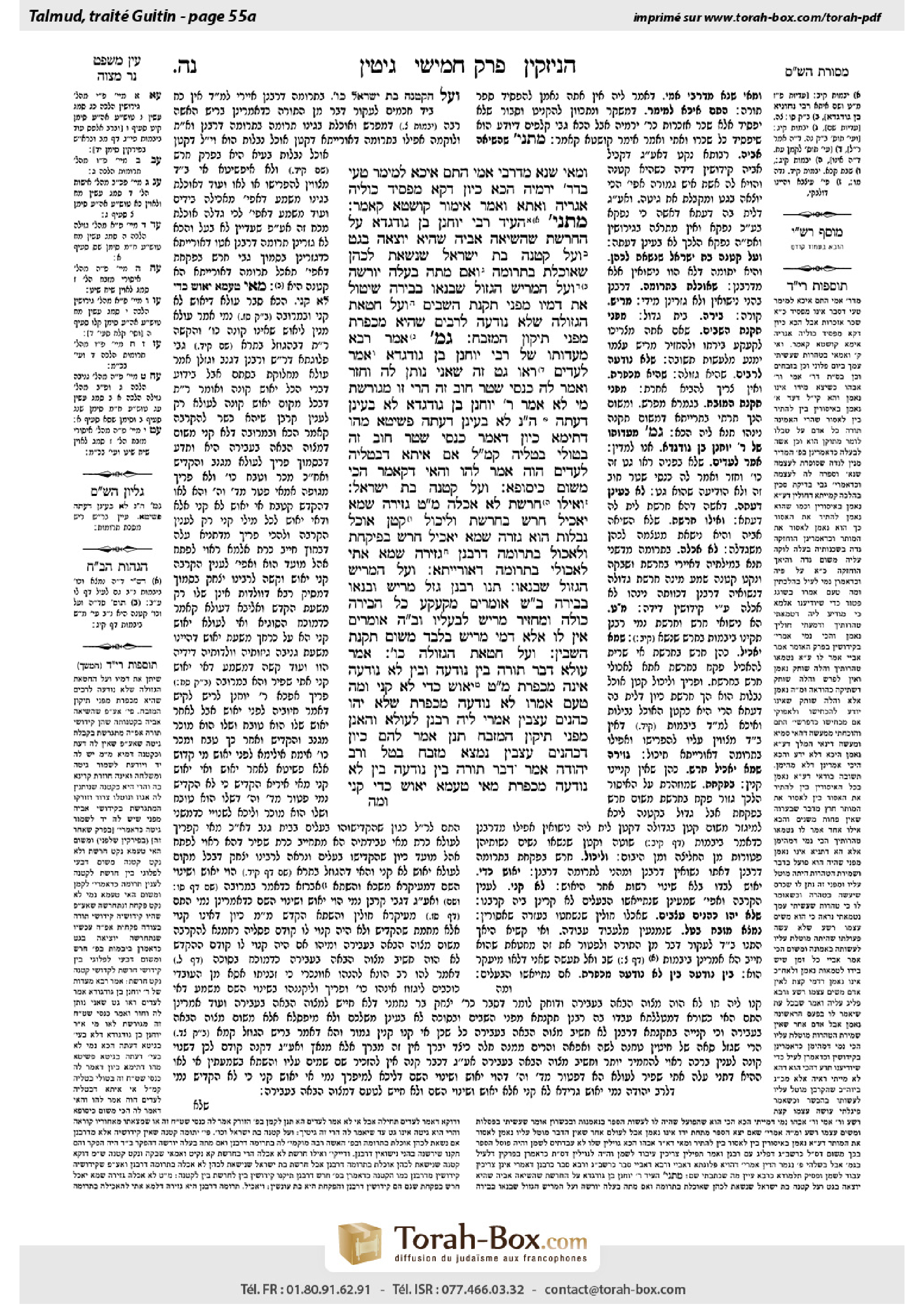
Gittin 55a: Talmud study for Daf Yomi
Study the Talmud for Daf Yomi with scanned pages, Hebrew text, English translations from Sefaria and AI-generated French translations.
Passage selection and English or AI-generated French translation are available where the scan has annotations. Daf Study is independent of Torah-Box and Sefaria.
Browse Gittin · גיטין · All tractatesGittin 55a text and translations
This page of Gittin includes the Aramaic text, an English translation and an AI-generated French translation, alongside the scan above.
גיטין נ״ה א · Aramaic and Hebrew text
וּמַאי שְׁנָא מִדְּרַבִּי אַמֵּי? הָתָם, אִיכָּא לְמֵימַר טָעֵי בִּדְרַבִּי יִרְמְיָה. הָכָא, כֵּיוָן דְּקָא מַפְסֵיד כּוּלֵּיהּ אַגְרֵיהּ – וַאֲתָא וַאֲמַר, אֵימוֹר קוּשְׁטָא קָאָמַר.
מַתְנִי׳ הֵעִיד רַבִּי יוֹחָנָן בֶּן גּוּדְגְּדָא עַל הַחֵרֶשֶׁת שֶׁהִשִּׂיאָהּ אָבִיהָ, שֶׁהִיא יוֹצְאָה בְּגֵט;
וְעַל קְטַנָּה בַּת יִשְׂרָאֵל שֶׁנִּשֵּׂאת לְכֹהֵן, שֶׁאוֹכֶלֶת בִּתְרוּמָה, וְאִם מֵתָה – בַּעְלָהּ יוֹרְשָׁהּ;
וְעַל הַמָּרִישׁ הַגָּזוּל שֶׁבְּנָאוֹ בְּבִירָה, שֶׁיִּטּוֹל אֶת דָּמָיו, מִפְּנֵי תַּקָּנַת הַשָּׁבִים;
וְעַל חַטָּאת הַגְּזוּלָה שֶׁלֹּא נוֹדְעָה לְרַבִּים – שֶׁהִיא מְכַפֶּרֶת, מִפְּנֵי תִּיקּוּן הַמִּזְבֵּחַ.
גְּמָ׳ אָמַר רָבָא: מֵעֵדוּתוֹ שֶׁל רַבִּי יוֹחָנָן בֶּן גּוּדְגְּדָא – אָמַר לְעֵדִים: רָאוּ גֵּט זֶה שֶׁאֲנִי נוֹתֵן לָהּ, וְחָזַר וְאָמַר לָהּ: כִּנְסִי שְׁטַר חוֹב זֶה – הֲרֵי זוֹ מְגוֹרֶשֶׁת. מִי לָא אָמַר רַבִּי יוֹחָנָן בֶּן גּוּדְגְּדָא לָא בָּעֵינַן דַּעְתַּהּ? הָכָא נָמֵי לָא בָּעֵינַן דַּעְתַּהּ.
פְּשִׁיטָא! מַהוּ דְּתֵימָא, כֵּיוָן דְּאָמַר: ״כִּנְסִי שְׁטַר חוֹב זֶה״, בַּטּוֹלֵי בַּטְּלֵיהּ; קָא מַשְׁמַע לַן, אִם אִיתָא דְּבַטְּלֵיהּ – לְעֵדִים הֲוָה אָמַר לְהוּ. וְהַאי דְּקָאָמַר הָכִי – מִשּׁוּם כִּיסּוּפָא.
וְעַל קְטַנָּה בַּת יִשְׂרָאֵל: וְאִילּוּ חֵרֶשֶׁת – לָא אָכְלָה. מַאי טַעְמָא? גְּזֵירָה שֶׁמָּא יַאֲכִיל חֵרֵשׁ בְּחֵרֶשֶׁת.
וְלֹיכֵול – קָטָן אוֹכֵל נְבֵלוֹת הוּא!
גְּזֵרָה שֶׁמָּא יַאֲכִיל חֵרֵשׁ בְּפִיקַּחַת.
וְלֹאכֵול בִּתְרוּמָה דְּרַבָּנַן! גְּזֵירָה שֶׁמָּא אָתֵי לְאוֹכוֹלֵי בִּתְרוּמָה דְּאוֹרָיְיתָא.
וְעַל הַמָּרִישׁ הַגָּזוּל שֶׁבְּנָאוֹ: תָּנוּ רַבָּנַן: גָּזַל מָרִישׁ וּבְנָאוֹ בְּבִירָה – בֵּית שַׁמַּאי אוֹמְרִים: מְקַעְקֵעַ כׇּל הַבִּירָה כּוּלָּהּ וּמַחְזִיר מָרִישׁ לִבְעָלָיו; וּבֵית הִלֵּל אוֹמְרִים: אֵין לוֹ אֶלָּא דְּמֵי מָרִישׁ בִּלְבַד, מִשּׁוּם תַּקָּנַת הַשָּׁבִין.
וְעַל חַטָּאת הַגְּזוּלָה כּוּ׳: אָמַר עוּלָּא: דְּבַר תּוֹרָה, בֵּין נוֹדְעָה וּבֵין לֹא נוֹדְעָה – אֵינָהּ מְכַפֶּרֶת;
מַאי טַעְמָא? יֵאוּשׁ כְּדִי לָא קָנֵי; וּמָה טַעַם אָמְרוּ: לֹא נוֹדְעָה מְכַפֶּרֶת? שֶׁלֹּא יְהוּ כֹּהֲנִים עֲצֵבִין.
אָמְרִי לֵיהּ רַבָּנַן לְעוּלָּא: וְהָאֲנַן – ״מִפְּנֵי תִּיקּוּן הַמִּזְבֵּחַ״ תְּנַן? אָמַר לָהֶם: כֵּיוָן דְּכֹהֲנִים עֲצֵבִין, נִמְצָא מִזְבֵּחַ בָּטֵל.
וְרַב יְהוּדָה אָמַר: דְּבַר תּוֹרָה, בֵּין נוֹדְעָה בֵּין לֹא נוֹדְעָה – מְכַפֶּרֶת; מַאי טַעְמָא? יֵאוּשׁ כְּדִי קָנֵי;
Gittin 55a · English translation
The Gemara asks: And in what way is this case different from the case in which Rabbi Ami said that the scribe is not deemed credible to disqualify the Torah scroll? The Gemara answers: There it can be said that the scribe was lying and merely wished to distress the purchaser of the Torah scroll. He claimed that he had written God’s names without the proper intention because he made the mistake of Rabbi Yirmeya. He thought, as Rabbi Yirmeya did, that as a result of his purported admission he would lose only his wage for writing the holy names, but he would still receive payment for the rest of the scroll. Here, by contrast, since the scribe knows that by claiming that he did not process the parchment with the proper intention, he causes the loss of his entire wage, and he nevertheless comes and says this, you should say that he speaks the truth and should be deemed credible. Since he is deemed credible and there is no concern that he merely wished to distress the purchaser, the Torah scroll is disqualified.
MISHNA: Rabbi Yoḥanan ben Gudgeda testified before the Sages about the case of a deaf-mute woman who was married off by her father when she was a minor, so that her marriage took effect by Torah law. He said that she can be released from her marriage through a bill of divorce, whether as a minor or after she reaches adulthood. Although as a deaf-mute woman she is not legally competent to give her consent, the divorce is effective because divorce does not require the woman’s consent.
And similarly, he testified about the case of the minor daughter of a non-priest who was orphaned from her father and then married off to a priest by her mother or brother, so that her marriage took effect by rabbinic law. He said that nevertheless she may partake of teruma, although by Torah law it is prohibited for one who is not in a priestly household to partake of teruma. And furthermore if this girl dies, then her husband inherits her estate. It is not said that because the validity of the marriage is by rabbinic law and not Torah law he is not entitled to inherit from her.
And Rabbi Yoḥanan ben Gudgeda further testified about a stolen beam that was already built into a large building [bira], that the victim of the robbery receives only the value of the beam but not the beam itself, due to an ordinance instituted for the penitent. By Torah law, a robber is obligated to return any stolen item in his possession, provided that its form has not been altered. If one stole a beam and incorporated it into a building, then by Torah law he would have to destroy the building and return the beam. In order to encourage repentance, the Sages were lenient and allowed a robber to return the value of the beam.
And lastly, Rabbi Yoḥanan ben Gudgeda testified about a sin-offering that was obtained through robbery but that was not publicly known to have been obtained in that manner. He said that it effects atonement for the robber who sacrifices it, for the benefit of the altar, as will be explained in the Gemara.
GEMARA: Rava says: Learn from the testimony of Rabbi Yoḥanan ben Gudgeda in the mishna that if the husband secretly says to witnesses: See this bill of divorce that I am about to give to my wife, and then he says to his wife: Take this promissory note, then she is divorced even when she herself does not know that the document in her hand is a bill of divorce. Didn’t Rabbi Yoḥanan ben Gudgeda say that we do not require the woman’s consent for a bill of divorce, as the divorce takes effect even when she is a deaf-mute, who is not legally competent to give her consent? Here too, one should say that we do not require the woman’s consent.
The Gemara asks: Isn’t this obvious? Why would the divorce not be valid? The Gemara explains: Lest you say: Since he said to his wife: Take this promissory note, after talking to the witnesses, he meant to cancel the bill of divorce with these words, Rava therefore teaches us: If it is so that he meant to cancel the bill of divorce, he would have told the witnesses that this was his intention. The fact that he did not do so indicates that he had no intention of canceling it. And the reason he said to his wife that he was handing her a promissory note is due to embarrassment, as he was ashamed to tell her that he was giving her a bill of divorce. Consequently, he gave it to her in such a way that she did not immediately know that it was a bill of divorce that she received.
§ The mishna teaches that Rabbi Yoḥanan ben Gudgeda testified about the case of a minor daughter of a non-priest who was married to a priest, and said that she may partake of teruma. The Gemara comments: This indicates that only the minor daughter can partake of teruma, while one can infer from this that a deaf-mute woman who was married to a priest may not partake of teruma. The Gemara explains: What is the reason for this? The Sages decreed that a deaf-mute woman married to a priest may not partake of teruma lest a deaf-mute priest come to feed teruma to his deaf-mute wife, as it is common for deaf-mute men to marry deaf-mute women, but their marriage is not effective by Torah law.
The Gemara asks: Why does this matter? And let him feed her teruma. Isn’t she like a minor who eats forbidden animal carcasses? Since the deaf-mute woman is not considered to be legally competent, she is not subject to the prohibition against partaking of teruma. As in the case of a minor who is eating forbidden food, there is no requirement to prevent her from doing so.
The Gemara answers: Rather, the Sages decreed that a deaf-mute woman married to a priest may not partake of teruma lest a deaf-mute priest come to feed teruma to his halakhically competent wife. Since the validity of their marriage is by rabbinic law, it is therefore prohibited for the woman to partake of teruma, as by Torah law, she is not the wife of a priest. There is a concern that a distinction will not be made between the marriage of a halakhically competent man and deaf-mute woman, in which case the woman is permitted to partake of teruma, and the marriage of a deaf-mute man and a halakhically competent woman, in which case the woman is prohibited from partaking of teruma. Owing to this error, a deaf-mute man might come to feed his wife something that is forbidden to her.
The Gemara asks: But let her partake of teruma that is defined as such by rabbinic law, as marriage that is valid by rabbinic law should suffice to permit partaking of such teruma. The Gemara answers: The Sages decreed that he may not feed her teruma even by rabbinic law, lest he come to feed her teruma by Torah law.
§ The mishna teaches that Rabbi Yoḥanan ben Gudgeda further testified about a stolen beam that was already built into a building and said that the injured party receives the value of the beam but not the beam itself. With regard to this, the Sages taught in a baraita (Tosefta, Bava Kamma 10:5): If one robbed another of a beam and built it into a building, Beit Shammai say: He must destroy the entire building and return the beam to its owners. And Beit Hillel say: The injured party receives only the value of the beam but not the beam itself, due to an ordinance instituted for the sake of the penitent. In order to encourage repentance, the Sages were lenient and required the robber to return only the value of the beam. The mishna was taught in accordance with the opinion of Beit Hillel.
§ The mishna teaches that Rabbi Yoḥanan ben Gudgeda testified about a sin-offering that was obtained through robbery, and said that provided that it was not publicly known to have been obtained in that manner, it effects atonement for the robber. Ulla says: By Torah law, the halakha is as follows: Whether it is known or whether it is not known that the sin-offering was obtained through robbery, it does not effect atonement for the robber who sacrifices it.
What is the reason for this? The owner’s despair of recovering an article that was stolen from him does not by itself enable the robber to acquire the stolen item. Since the stolen animal was not altered in any way, it does not belong to the robber, and he cannot sacrifice it as an offering and achieve atonement through it. And what is the reason that the Sages said that if it was not publicly known that the sin-offering was obtained through robbery it effects atonement? It is so that the priests not be distraught about having sacrificed an animal unfit for the altar.
The Rabbis said to Ulla: How can you explain the issue in this manner? But didn’t we learn in the mishna: It effects atonement for the benefit of the altar, which indicates that the halakha was enacted for the benefit of the altar, not for the benefit of the priests? Ulla said to them: When the priests are distraught, the altar is found idle. The priests will not sacrifice all of the offerings when they are distraught.
This is one explanation, but Rav Yehuda says: By Torah law, whether it is known or it is not known that the sin-offering was obtained through robbery, it effects atonement for the robber who sacrifices it. What is the reason for this? The owner’s despair of recovering an article that was stolen from him by itself enables the robber to acquire the stolen item. Once the owner despairs of regaining possession, the stolen item becomes the robber’s property and he can consecrate it. Therefore, the offering was sacrificed in a fitting manner, and it effects atonement for the robber.
Gittin 55a · Traduction française (IA)
La Guemara pose la question : Dans quel cas cette situation diffère-t-elle de celle où le maître Ami a affirmé que le scribe n'était pas considéré comme crédible pour invalider un rouleau de Torah ? La Guemara répond : Là, on peut dire que le scribe mentait et voulait simplement troubler l'acheteur du rouleau de Torah. Il affirmait avoir écrit les noms de Dieu sans l'intention appropriée, car il avait commis l'erreur du maître Yirmeya. Il pensait, comme le maître Yirmeya, que par son admission prétendue, il perdrait seulement sa rémunération pour avoir écrit les noms saints, mais il continuerait à recevoir le reste du rouleau. Ici, en revanche, puisque le scribe sait que par son affirmation qu'il n'avait pas traité le parchemin avec l'intention appropriée, il cause la perte totale de sa rémunération, et qu'il vient tout de même affirmer cela, on doit dire qu'il parle la vérité et qu'il est crédible. Puisque le scribe est crédible et qu'il n'y a pas de crainte qu'il ait simplement voulu troubler l'acheteur, le rouleau de Torah est invalide.
MICHNA : Le maître Yoḥanan ben Gudgeda a témoigné devant les Sages sur le cas d'une femme sourde-muette mariée par son père lorsqu'elle était mineure, de sorte que son mariage était valide selon la Loi juive. Il a dit qu'elle pouvait être libérée par un divorce, qu'elle soit mineure ou après avoir atteint l'âge adulte. Bien que, comme femme sourde-muette, elle ne soit pas juridiquement compétente pour donner son consentement, le divorce est efficace car le divorce ne nécessite pas le consentement de la femme.
Et de même, il a témoigné sur le cas d'une fille mineure d'un non-prêtre, orpheline de son père, mariée par sa mère ou son frère à un prêtre, de sorte que son mariage était valide selon la Loi rabbinique. Il a dit qu'elle pouvait néanmoins consommer la terouma, bien que selon la Loi juive cela soit interdit pour celui qui n'appartient pas à une famille de prêtres. Et de plus, si cette fille meurt, son mari hérite de ses biens. On ne dit pas que, puisque le mariage est valide selon la Loi rabbinique et non selon la Loi juive, il n'a pas le droit d'hériter de ses biens.
Et le maître Yoḥanan ben Gudgeda a encore témoigné sur le cas d'une poutre volée qui avait déjà été intégrée dans un grand bâtiment [bira], disant que la victime du vol reçoit seulement la valeur de la poutre et non la poutre elle-même, en raison d'un ordonnance instituée pour le repentant. Selon la Loi juive, un voleur est tenu de rendre tout objet volé qu'il possède, à condition que sa forme n'ait pas été altérée. Si l'on a volé une poutre et l'a intégrée dans un bâtiment, alors selon la Loi juive, il devrait détruire le bâtiment et rendre la poutre. Afin d'encourager le repentir, les Sages ont été lenis et ont permis au voleur de rendre la valeur de la poutre.
Et enfin, le maître Yoḥanan ben Gudgeda a témoigné sur un sacrifice expiatoire obtenu par vol, mais dont la provenance n'était pas publiquement connue. Il a dit que ce sacrifice expiatoire efface le péché du voleur qui le sacrifie, au bénéfice de l'autel, comme cela sera expliqué dans la Guemara.
GUEMARA : Rava dit : Apprenez de la déclaration du maître Yoḥanan ben Gudgeda dans la Michna que si le mari dit secrètement aux témoins : Voyez ce divorce que je vais donner à ma femme, et ensuite dit à sa femme : Prends ce billet de créance, alors elle est divorcée même si elle ne sait pas que le document entre ses mains est un divorce. N’a-t-on pas dit que le maître Yoḥanan ben Gudgeda a affirmé que nous n’avons pas besoin du consentement de la femme pour un divorce, car le divorce est efficace même si elle est sourde-muette, qui n’est pas juridiquement compétente pour donner son consentement ? Ici aussi, on devrait dire que nous n’avons pas besoin du consentement de la femme.
La Guemara pose la question : N'est-ce pas évident ? Pourquoi le divorce ne serait-il pas valide ? La Guemara explique : De peur que l'on dise : Puisque le mari a dit à sa femme : Prends ce billet de créance, après avoir parlé aux témoins, il voulait annuler le divorce avec ces mots, Rava enseigne donc : Si c'est ainsi que l'intention était, il aurait dit aux témoins que c'était son intention. Le fait qu'il n'ait pas fait cela indique qu'il n'avait pas l'intention d'annuler le divorce. Et la raison pour laquelle il a dit à sa femme qu'il lui donnait un billet de créance est due à l'embarras, car il était honteux de lui dire qu'il lui donnait un divorce. Il a donc donné le document de telle sorte qu'elle ne savait pas immédiatement qu'elle avait reçu un divorce.
§ La Michna enseigne que le maître Yoḥanan ben Gudgeda a témoigné sur le cas d'une fille mineure d'un non-prêtre mariée à un prêtre, et a dit qu'elle pouvait consommer la terouma. La Guemara commente : Cela indique que seule la fille mineure peut consommer la terouma, tandis que l'on peut en déduire que la femme sourde-muette mariée à un prêtre ne peut pas consommer la terouma. La Guemara explique : Quelle est la raison de cela ? Les Sages ont ordonné que la femme sourde-muette mariée à un prêtre ne puisse pas consommer la terouma, de peur qu'un prêtre sourd vienne nourrir sa femme sourde de terouma, car il est courant que les hommes sourds épousent des femmes sourdes, mais leur mariage n'est pas valide selon la Loi juive.
La Guemara pose la question : Pourquoi cela importe-t-il ? Et qu'elle mange la terouma. N'est-elle pas comme une mineure qui mange des cadavres d'animaux interdits ? Puisque la femme sourde-muette n'est pas considérée comme juridiquement compétente, elle n'est pas soumise à l'interdiction de consommer la terouma. Comme dans le cas d'une mineure qui mange de la nourriture interdite, il n'y a pas de nécessité de l'en empêcher.
La Guemara répond : En réalité, les Sages ont institué une décision selon laquelle une femme sourde-muette mariée à un prêtre ne doit pas consommer la terouma, de peur qu’un prêtre compétent halakha vienne nourrir sa femme sourde-muette de terouma. Puisque la validité de leur mariage est selon la loi rabbinique, il est donc interdit à la femme de consommer la terouma, car selon la loi divine, elle n’est pas la femme d’un prêtre. Il y a une crainte que l’on ne fasse pas la distinction entre le mariage d’un homme compétent halakha et d’une femme sourde-muette, dans lequel cas la femme est autorisée à consommer la terouma, et le mariage d’un homme sourd-muette et d’une femme compétente halakha, dans lequel cas la femme est interdite de consommer la terouma. En raison de cette erreur, un homme sourd-muette pourrait venir nourrir sa femme quelque chose qui lui est interdit.
La Guemara demande : Mais qu’elle consomme la terouma définie ainsi par la loi rabbinique, car un mariage valide selon la loi rabbinique devrait suffire à permettre la consommation de cette terouma. La Guemara répond : Les Sages ont institué une décision selon laquelle il ne doit pas nourrir sa femme de terouma même selon la loi rabbinique, de peur qu’il vienne nourrir sa femme de terouma selon la loi divine.
§ La mitsna enseigne que Rabbi Yoḥanan ben Gudgeda a témoigné davantage sur un poteau volé qui avait déjà été construit dans un bâtiment et a dit que la partie blessée reçoit la valeur du poteau mais pas le poteau lui-même. En ce qui concerne cela, les Sages ont enseigné dans une baraïta (Tosefta, Bava Kamma 10:5) : Si l’on a volé à quelqu’un un poteau et l’a construit dans un bâtiment, Beit Shammai disent : Il doit détruire l’ensemble du bâtiment et rendre le poteau à ses propriétaires. Et Beit Hillel disent : La partie blessée reçoit seulement la valeur du poteau mais pas le poteau lui-même, en raison d’un ordonnance instituée à l’intention du repentant. Afin d’encourager la repentance, les Sages ont été cléments et exigé que le voleur rendît seulement la valeur du poteau. La mitsna a été enseignée conformément à l’opinion de Beit Hillel.
§ La mitsna enseigne que Rabbi Yoḥanan ben Gudgeda a témoigné sur un sacrifice expiatoire obtenu par vol et a dit que, si cela n'était pas connu publiquement avoir été obtenu ainsi, cela efface le péché du voleur. Ulla dit : Selon la loi divine, la halakha est la suivante : Qu'importe qu'il soit connu ou non que le sacrifice expiatoire ait été obtenu par vol, cela ne efface pas le péché du voleur qui le sacrifie.
Quelle est la raison de cela ? La désespérance de l'propriétaire de récupérer un objet volé ne permet pas par elle-même au voleur d'acquérir l'objet volé. Puisque l'animal volé n'a pas été modifié de quelque manière que ce soit, il n'appartient pas au voleur, et il ne peut le sacrifier comme un sacrifice et obtenir le pardon par lui. Et quelle est la raison que les Sages aient dit que si cela n'était pas connu publiquement que le sacrifice expiatoire ait été obtenu par vol, cela efface le péché ? C'est afin que les prêtres ne soient pas troublés d'avoir sacrifié un animal inadapté à l'autel.
Les Rabbins dirent à Ulla : Comment peux-tu expliquer l'affaire ainsi ? Mais n'avons-nous pas appris dans la mitsna : Cela efface le péché pour l'avantage de l'autel, ce qui indique que la halakha a été instituée pour l'avantage de l'autel, pas pour l'avantage des prêtres ? Ulla dit à eux : Lorsque les prêtres sont troublés, l'autel est trouvé inactif. Les prêtres ne sacrifieront pas tous les offrandes lorsqu'ils sont troublés.
C’est une explication, mais Rav Yehuda dit : Selon la loi divine, qu’importe qu’il soit connu ou non que le sacrifice expiatoire ait été obtenu par vol, cela efface le péché du voleur qui le sacrifie. Quelle est la raison de cela ? La désespérance de l’propriétaire de récupérer un objet volé par elle-même permet au voleur d’acquérir l’objet volé. Une fois que l’propriétaire désespère de récupérer la possession, l’objet volé devient la propriété du voleur et il peut le consacrer. Ainsi, l’offrande a été sacrifiée de manière appropriée, et cela efface le péché du voleur.
Traduction française générée par IA à partir de l’édition anglaise de Sefaria. Vérifie toujours un passage avec le texte source.
Text from Sefaria: William Davidson Edition - Vocalized Aramaic (CC BY NC); William Davidson Edition - English (CC BY NC).