Gittin 55b: Talmud study for Daf Yomi
Study the Talmud for Daf Yomi with scanned pages, Hebrew text, English translations from Sefaria and AI-generated French translations.
Passage selection and English or AI-generated French translation are available where the scan has annotations. Daf Study is independent of Torah-Box and Sefaria.
Browse Gittin · גיטין · All tractatesGittin 55b text and translations
This page of Gittin includes the Aramaic text, an English translation and an AI-generated French translation, alongside the scan above.
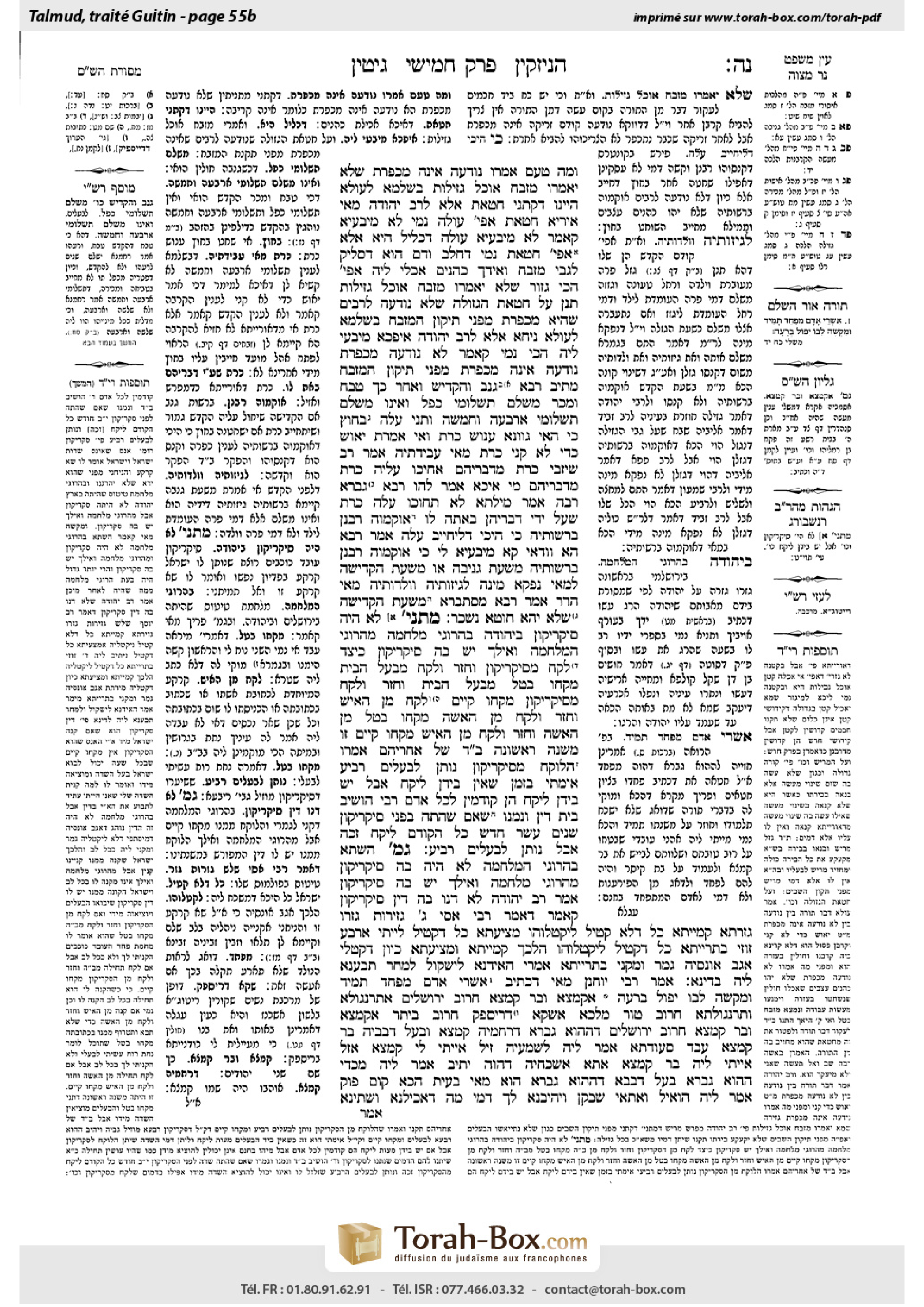
גיטין נ״ה ב · Aramaic and Hebrew text
וּמָה טַעַם אָמְרוּ נוֹדְעָה אֵינָהּ מְכַפֶּרֶת? שֶׁלֹּא יֹאמְרוּ מִזְבֵּחַ אוֹכֵל גְּזֵילוֹת.
בִּשְׁלָמָא לְעוּלָּא – הַיְינוּ דְּקָתָנֵי חַטָּאת. אֶלָּא לְרַב יְהוּדָה – מַאי אִירְיָא חַטָּאת, אֲפִילּוּ עוֹלָה נָמֵי!
לָא מִיבַּעְיָא קָאָמַר – לָא מִיבַּעְיָא עוֹלָה, דְּכָלִיל הִיא; אֶלָּא אֲפִילּוּ חַטָּאת נָמֵי, דְּחֵלֶב וָדָם הוּא דְּסָלֵיק לְגַבֵּי מִזְבֵּחַ, וְאִידַּךְ כֹּהֲנִים אָכְלִי לֵיהּ; אֲפִילּוּ הָכִי גְּזוּר, שֶׁלֹּא יֹאמְרוּ מִזְבֵּחַ אוֹכֵל גְּזֵילוֹת.
תְּנַן: עַל חַטָּאת הַגְּזוּלָה שֶׁלֹּא נוֹדְעָה לְרַבִּים, שֶׁהִיא מְכַפֶּרֶת – מִפְּנֵי תִּיקּוּן הַמִּזְבֵּחַ. בִּשְׁלָמָא לְעוּלָּא – נִיחָא, אֶלָּא לְרַב יְהוּדָה – אִיפְּכָא מִיבְּעֵי לֵיהּ!
הָכִי נָמֵי קָאָמַר: לָא נוֹדְעָה – מְכַפֶּרֶת, נוֹדְעָה – אֵינָהּ מְכַפֶּרֶת, מִפְּנֵי תִּיקּוּן הַמִּזְבֵּחַ.
מֵתִיב רָבָא: גָּנַב וְהִקְדִּישׁ, וְאַחַר כָּךְ טָבַח וּמָכַר – מְשַׁלֵּם תַּשְׁלוּמֵי כֶפֶל, וְאֵינוֹ מְשַׁלֵּם תַּשְׁלוּמֵי אַרְבָּעָה וַחֲמִשָּׁה. וְתָנֵי עֲלַהּ: בַּחוּץ כִּי הַאי גַוְונָא – עָנוּשׁ כָּרֵת. וְאִי אָמְרַתְּ יֵאוּשׁ כְּדִי לָא קָנֵי, כָּרֵת מַאי עֲבִידְתֵּיהּ?
אָמַר רַב שֵׁיזְבִי: כָּרֵת מִדִּבְרֵיהֶם. אַחִיכוּ עֲלֵיהּ – כָּרֵת מִדִּבְרֵיהֶם מִי אִיכָּא?! אֲמַר לְהוּ רָבָא: גַּבְרָא רַבָּה אָמַר מִילְּתָא, לָא תְּחוּכוּ עֲלַהּ; כָּרֵת שֶׁעַל יְדֵי דִּבְרֵיהֶן בָּאתָה לוֹ – אוֹקְמוּהָ רַבָּנַן בִּרְשׁוּתֵיהּ כִּי הֵיכִי דְּלִיחַיַּיב עֲלַהּ.
אָמַר רָבָא: הָא וַודַּאי קָא מִיבַּעְיָא לִי – כִּי אוֹקְמוּהָ רַבָּנַן בִּרְשׁוּתֵיהּ, מִשְּׁעַת גְּנֵיבָה אוֹ מִשְּׁעַת הֶקְדֵּישָׁהּ? לְמַאי נָפְקָא מִינַּהּ? לְגִיזּוֹתֶיהָ וּוַלְדוֹתֶיהָ. מַאי? הֲדַר אָמַר רָבָא: מִסְתַּבְּרָא – מִשְּׁעַת הֶקְדֵּישָׁהּ, שֶׁלֹּא יְהֵא חוֹטֵא נִשְׂכָּר.
מַתְנִי׳ לֹא הָיָה סִיקָרִיקוֹן בִּיהוּדָה בַּהֲרוּגֵי מִלְחָמָה. מֵהֲרוּגֵי הַמִּלְחָמָה וְאֵילָךְ, יֵשׁ בָּהּ סִיקָרִיקוֹן. כֵּיצַד? לָקַח מִסִּיקָרִיקוֹן, וְחָזַר וְלָקַח מִבַּעַל הַבַּיִת, מִקָּחוֹ בָּטֵל. מִבַּעַל הַבַּיִת, וְחָזַר וְלָקַח מִסִּיקָרִיקוֹן – מִקָּחוֹ קַיָּים.
לָקַח מִן הָאִישׁ וְחָזַר וְלָקַח מִן הָאִשָּׁה – מִקָּחוֹ בָּטֵל. מִן הָאִשָּׁה וְחָזַר וְלָקַח מִן הָאִישׁ – מִקָּחוֹ קַיָּים. זוֹ מִשְׁנָה רִאשׁוֹנָה.
בֵּית דִּין שֶׁל אַחֲרֵיהֶם אָמְרוּ: הַלּוֹקֵחַ מִסִּיקָרִיקוֹן, נוֹתֵן לַבְּעָלִים רְבִיעַ. אֵימָתַי – בִּזְמַן שֶׁאֵין בְּיָדָן לִיקַּח, אֲבָל יֵשׁ בְּיָדָן לִיקַּח – הֵן קוֹדְמִין לְכׇל אָדָם.
רַבִּי הוֹשִׁיב בֵּית דִּין וְנִמְנוּ, שֶׁאִם שָׁהֲתָה בִּפְנֵי סִיקָרִיקוֹן שְׁנֵים עָשָׂר חֹדֶשׁ, כׇּל הַקּוֹדֵם לִיקַּח – זָכָה; אֲבָל נוֹתֵן לַבְּעָלִים רְבִיעַ.
גְּמָ׳ הַשְׁתָּא בַּהֲרוּגֵי הַמִּלְחָמָה לֹא הָיָה בָּהּ סִיקָרִיקוֹן, מֵהֲרוּגֵי מִלְחָמָה וְאֵילָךְ, יֵשׁ בָּהּ סִיקָרִיקוֹן?!
אָמַר רַב יְהוּדָה: ״לֹא דָּנוּ בָּהּ דִּין סִיקָרִיקוֹן״ קָאָמַר. דְּאָמַר רַבִּי אַסִּי: שָׁלֹשׁ גְּזֵירוֹת גָּזְרוּ. גְּזֵרְתָּא קַמַּיְיתָא: כֹּל דְּלָא קָטֵיל – לִיקְטְלוּהּ. מְצִיעֲתָא: כֹּל דְּקָטֵיל – לַיְיתֵי אַרְבַּע זוּזֵי. בָּתְרָיְיתָא: כֹּל דְּקָטֵיל – לִיקְטְלוּהּ. הִלְכָּךְ, קַמַּיְיתָא וּמְצִיעֲתָא, כֵּיוָן דְּקָטְלִי – אַגַּב אוּנְסֵיהּ גָּמַר וּמַקְנֵי.
בָּתְרָיְיתָא אָמְרִי: הָאִידָּנָא לִישְׁקוֹל, לִמְחַר תָּבַעְנָא לֵיהּ בְּדִינָא.
אָמַר רַבִּי יוֹחָנָן, מַאי דִּכְתִיב: ״אַשְׁרֵי אָדָם מְפַחֵד תָּמִיד וּמַקְשֶׁה לִבּוֹ יִפּוֹל בְּרָעָה״? אַקַּמְצָא וּבַר קַמְצָא חֲרוּב יְרוּשָׁלַיִם, אַתַּרְנְגוֹלָא וְתַרְנְגוֹלְתָּא חֲרוּב טוּר מַלְכָּא, אַשָּׁקָא דְרִיסְפַּק חֲרוּב בֵּיתֵּר.
אַקַּמְצָא וּבַר קַמְצָא חֲרוּב יְרוּשָׁלַיִם – דְּהָהוּא גַּבְרָא דְּרָחֲמֵיהּ קַמְצָא, וּבְעֵל דְּבָבֵיהּ בַּר קַמְצָא. עֲבַד סְעוֹדְתָּא, אֲמַר לֵיהּ לְשַׁמָּעֵיהּ: זִיל אַיְיתִי לִי קַמְצָא. אֲזַל אַיְיתִי לֵיהּ בַּר קַמְצָא.
אֲתָא, אַשְׁכְּחֵיהּ דַּהֲוָה יָתֵיב. אֲמַר לֵיהּ: מִכְּדֵי הָהוּא גַּבְרָא בְּעֵל דְּבָבֵאּ דְּהָהוּא גַּבְרָא הוּא, מַאי בָּעֵית הָכָא? קוּם פּוֹק! אֲמַר לֵיהּ: הוֹאִיל וַאֲתַאי, שִׁבְקַן וְיָהֵיבְנָא לָךְ דְּמֵי מָה דְּאָכֵילְנָא וְשָׁתֵינָא.
Gittin 55b · English translation
And what is the reason that the Sages said that if it is known that the sin-offering was obtained through robbery, it does not effect atonement? It is so that people not say that the altar consumes stolen property.
The Gemara attempts to clarify the two explanations. Granted, according to the opinion of Ulla, that the concern stems from the fact that the priests will be distraught, this is the reason that the tanna teaches the halakha with regard to a sin-offering: The priests partake of the meat of a sin-offering. If they find out that they ate an animal that was forbidden to them, i.e., an offering slaughtered counter to halakha, they are likely to become distraught. But according to the opinion of Rav Yehuda, that the concern is about the honor of the altar, why does the mishna mention specifically the case of a sin-offering; shouldn’t the same concern apply to a burnt-offering, as well, as it too is burned on the altar?
The Gemara answers: The mishna is speaking utilizing the style of: It is not necessary, and the mishna should be understood as follows: It is not necessary to teach the halakha in the case of a burnt-offering, which is entirely consumed on the altar. In that case, people will certainly say that the altar consumes stolen property. But even in the case of a sin-offering, where only the fat and the blood go up to be consumed on the altar and the rest is consumed by the priests, even so they issued a decree and said that the stolen sin-offering does not effect atonement, so that people should not say that the altar consumes stolen property.
The Gemara further clarifies the two understandings: We learned in the mishna: Rabbi Yoḥanan ben Gudgeda testified about a sin-offering that had been obtained through robbery but that is not publicly known to have been obtained in that manner, and said that it effects atonement for the robber who sacrifices it, for the benefit of the altar. Granted, according to the opinion of Ulla, it works out well, as he understands that the Sages instituted that if it was not publicly known that the sin-offering was obtained through robbery, it does effect atonement. But according to the opinion of Rav Yehuda, it should have stated just the opposite, namely, that if it was publicly known that the sin-offering was obtained through robbery, it does not effect atonement.
The Gemara answers: That is also what the mishna is saying: If it is not known that the sin-offering was obtained through robbery, it effects atonement, but if this is known, it does not effect atonement, for the benefit of the altar.
Rava raises an objection from what was learned in a mishna (Bava Kamma 74a): If one stole an animal and consecrated it, and afterward he slaughtered or sold it, he pays double payment like a thief (see Exodus 22:3), but he does not pay fourfold or fivefold payment, as one must ordinarily pay when he slaughters or sells an ox or a sheep that he stole from another person (Exodus 21:37). And it is taught in a baraita with regard to this mishna: If one slaughtered an animal outside the Temple in a case like this, he is punishable by karet for having sacrificed an offering outside the Temple. And if you say that the owner’s despair of recovering an item that was stolen from him does not by itself enable the thief to acquire the stolen item, what is the relevance of mentioning karet? The punishment of karet should not apply, as the thief cannot consecrate an animal that does not belong to him.
Rav Sheizevi said: This means that he is liable to receive karet by rabbinic law. Those who heard this laughed at him. Is there such a thing as karet by rabbinic law? Rava said to them: A great man has spoken, do not laugh at him. What Rav Sheizevi means is karet that comes to him through the words of the Sages, who declared that the thief’s consecration is valid. It is the Sages who placed the animal in his possession, so that he would become liable for it.
Rava said: Although I agree with Rav Sheizevi, this matter is certainly a dilemma for me. When the Sages placed the animal in his possession, did they do so from the time of the theft or from the time of the consecration? What is the difference between these possibilities? There is a difference with regard to its wool and with regard to its offspring. If the animal was placed in his possession from the time of the theft, the wool that it grows and the offspring that it births are his, and he is not required to return them to the animal’s owner. But if the animal becomes his only when he consecrates it, he is required to return them. What is the halakha? Rava then said, in answer to his own question: It stands to reason that the Sages placed the animal in his possession from the time of the consecration. This is so that the sinner not profit from his crime. Otherwise, the thief would benefit from the rabbinic decree that was instituted to increase his liability.
MISHNA: The law of Sicarii [Sikarikon] did not apply in Judea in the time that people were being killed in the war. From the time that people were being killed in the war and onward, the law of Sicarii did apply there. What is this law of Sicarii? If one first purchased land from a Sicarius, who extorted the field from its prior owners with threats, and afterward the buyer returned and purchased the same field a second time from the prior landowner, his purchase is void. The prior owner of the field can say that he did not actually mean to sell him the field. By contrast, if he first acquired the field from the prior owner and afterward he returned and purchased the same field from a Sicarius, his purchase stands.
Similarly, if one first purchased from the husband the rights to use a field belonging to his wife, and afterward he returned and purchased the same field from the wife, so that if the husband were to predecease or divorce her, the purchaser would then own it fully, his purchase is void. The woman can claim that she did not wish to quarrel with her husband and to object to the transaction but that in truth she did not agree to the sale. By contrast, if he first acquired the field from the wife, and afterward he returned and purchased the same field from the husband, his purchase stands. This is the initial version of this mishna.
Later, the court of those who came after the Sages who composed that mishna said: With regard to one who purchased a field from a Sicarius, he must give the prior owner one-fourth of the field’s value. When does this apply? At a time when the prior owner is unable to purchase the field himself. But if he is able to purchase it himself, he precedes anyone else.
Rabbi Yehuda HaNasi later convened a court, and they counted their votes and determined that if the field remained before, i.e., in the possession of, the Sicarius for twelve months, whoever first purchases the field acquires possession of it, but he must give the prior owner one-fourth of the field’s value.
GEMARA: The Gemara challenges the mishna’s assertion that the law of Sicarii did not apply in Judea in the time that people were being killed in the war: Now if in the time that people were being killed in the war, there were no Sicarii stealing land, is it possible that from the time that people were being killed in the war and onward there were Sicarii?
Rav Yehuda said: The mishna is saying that in the time that people were being killed in the war they did not apply the law of Sicarii, but rather they would confirm the purchases of land made from the Sicarii. The reason for this is in accordance with what Rabbi Asi said: The gentile authorities issued three decrees during and in the aftermath of the war that ended in the destruction of the Temple. The first decree was that anyone who does not kill a Jew should himself be killed. The second decree was that anyone who kills a Jew should pay four dinars as a fine. The last decree was that anyone who kills a Jew should himself be killed. Therefore, during the time of the first and second decrees, the time when people were being killed in the war, since the gentile would kill Jews, then the owner of the field, owing to the danger posed to his life, would fully transfer ownership of his field to the Sicarius.
Then, during the time of the last decree, after the time when people were being killed in the war, anybody whose field was stolen by a Sicarius would say to himself: Now let him take the field; tomorrow I will claim it from him in court. Although the gentile had the advantage and could force the owner to give him the field, the assumption is that the owner did not fully transfer possession of the field to him, as he thought that he would still be able to recover it in court.
§ Apropos the war that led to the destruction of the Second Temple, the Gemara examines several aspects of the destruction of that Temple in greater detail: Rabbi Yoḥanan said: What is the meaning of that which is written: “Happy is the man who fears always, but he who hardens his heart shall fall into mischief” (Proverbs 28:14)? Jerusalem was destroyed on account of Kamtza and bar Kamtza. The place known as the King’s Mountain was destroyed on account of a rooster and a hen. The city of Beitar was destroyed on account of a shaft from a chariot [rispak].
The Gemara explains: Jerusalem was destroyed on account of Kamtza and bar Kamtza. This is as there was a certain man whose friend was named Kamtza and whose enemy was named bar Kamtza. He once made a large feast and said to his servant: Go bring me my friend Kamtza. The servant went and mistakenly brought him his enemy bar Kamtza.
The man who was hosting the feast came and found bar Kamtza sitting at the feast. The host said to bar Kamtza. That man is the enemy [ba’al devava] of that man, that is, you are my enemy. What then do you want here? Arise and leave. Bar Kamtza said to him: Since I have already come, let me stay and I will give you money for whatever I eat and drink. Just do not embarrass me by sending me out.
Gittin 55b · Traduction française (IA)
Et quelle est la raison pour laquelle les Sages ont dit que si on sait que l'offrande expiatoire a été obtenue par vol, elle ne procure pas l'atonement ? C'est afin que les gens ne disent pas que l'autel consomme des biens volés.
La Guemara tente de clarifier les deux explications. En effet, selon l'opinion d'Ulla, la préoccupation vient du fait que les prêtres seront attristés, c'est la raison pour laquelle le tanna enseigne la halakha concernant l'offrande expiatoire : les prêtres mangent la viande de l'offrande expiatoire. S'ils découvrent qu'ils ont mangé un animal interdit à leur consommation, c'est-à-dire un sacrifice tué contre la halakha, ils sont susceptibles de s'attrister. Mais selon l'opinion de Rav Yehuda, la préoccupation est liée à l'honneur de l'autel, pourquoi alors la mitsva mentionne-t-elle spécifiquement l'offrande expiatoire ? Ne devrait-il pas s'appliquer de la même manière à l'holocauste, puisqu'elle est aussi brûlée sur l'autel ?
La Guemara répond : la mitsva parle dans le style suivant : il n'est pas nécessaire, et la mitsva devrait être comprise ainsi : il n'est pas nécessaire d'enseigner la halakha concernant l'holocauste, qui est entièrement consommée sur l'autel. Dans ce cas, les gens diront certainement que l'autel consomme des biens volés. Mais même dans le cas de l'offrande expiatoire, où seulement la graisse et le sang montent être consommés sur l'autel et le reste est consommé par les prêtres, même alors ils ont émis un décret et dit que l'offrande expiatoire volée ne procure pas l'atonement, afin que les gens ne disent pas que l'autel consomme des biens volés.
La Guemara clarifie davantage les deux interprétations : nous avons appris dans la mitsna : Rabbi Yoḥanan ben Gudgeda a témoigné sur une offrande expiatoire obtenue par vol, mais dont la provenance n'était pas publiquement connue, et a dit qu'elle procurait l'atonement pour le voleur qui la sacrifie, au bénéfice de l'autel. En effet, selon l'opinion d'Ulla, cela s'explique bien, car il comprend que les Sages ont institué que si l'offrande expiatoire n'était pas publiquement connue avoir été obtenue par vol, elle procurait l'atonement. Mais selon l'opinion de Rav Yehuda, cela devrait avoir été dit tout le contraire, c'est-à-dire que si l'offrande expiatoire était publiquement connue avoir été obtenue par vol, elle ne procurait pas l'atonement.
La Guemara répond : c'est aussi ce que la mitsna dit : si on ne sait pas que l'offrande expiatoire a été obtenue par vol, elle procurait l'atonement, mais si cela est connu, elle ne procurait pas l'atonement, au bénéfice de l'autel.
Rava soulève un objet à partir de ce qui a été appris dans une mitsna (Bava Kamma 74a) : si l'on a volé un animal et l'a consacré, et ensuite l'a tué ou vendu, il paie double comme un voleur (voir Exode 22:3), mais il ne paie pas quatre fois ou cinq fois comme on le fait normalement lorsqu'on tue ou vend un bœuf ou une brebis volé à un autre (Exode 21:37). Et il est enseigné dans une baraïta concernant cette mitsna : si l'on a tué un animal en dehors du Temple dans un cas comme celui-ci, il est puni par karet pour avoir sacrifié un sacrifice en dehors du Temple. Et si l'on dit que la détresse de l'propriétaire de récupérer un objet volé ne permet pas par elle-même au voleur d'acquérir l'objet volé, à quoi sert alors la mention de karet ? La punition de karet ne devrait pas s'appliquer, car le voleur ne peut pas consacrer un animal qui ne lui appartient pas.
Rav Sheizevi a dit : cela signifie qu'il est tenu responsable de karet selon la loi rabbinique. Ceux qui l'ont entendu ont ri de lui. Est-ce qu'il existe un karet selon la loi rabbinique ? Rava a dit à ceux-ci : un grand homme a parlé, ne riez pas de lui. Ce que Rav Sheizevi veut dire est un karet qui vient à lui par les paroles des Sages, qui ont déclaré que la consécration du voleur est valide. C'est les Sages qui ont mis l'animal en son possession, afin qu'il devienne responsable de lui.
Rava a dit : bien que je sois d'accord avec Rav Sheizevi, cette question est certainement un dilemme pour moi. Lorsque les Sages ont mis l'animal en son possession, l'ont-ils fait depuis le moment du vol ou depuis le moment de la consécration ? Quelle est la différence entre ces deux possibilités ? Il y a une différence concernant la laine et les petits de l'animal. Si l'animal a été mis en possession depuis le moment du vol, la laine qu'il produit et les petits qu'il engendre sont à lui, et il n'est pas tenu de les rendre à l'propriétaire. Mais si l'animal devient à lui seulement lors de sa consécration, il est tenu de les rendre. Quelle est la halakha ? Rava a alors dit, en réponse à sa propre question : il est logique que les Sages aient mis l'animal en possession depuis le moment de la consécration. C'est ainsi que le coupable ne profite pas de son crime. Sinon, le voleur bénéficierait du décret rabbinique institué pour augmenter sa responsabilité.
MICHNA : La loi des Sicarii [Sikarikon] ne s'appliquait pas en Judée lorsqu'on tuait des gens dans la guerre. Depuis que des gens étaient tués dans la guerre et après, la loi des Sicarii s'appliquait là. Quelle est cette loi des Sicarii ? Si l'on a d'abord acheté un terrain d'un Sicarius, qui avait extorqué le champ à ses propriétaires précédents par des menaces, et ensuite l'acheteur est revenu et a acheté le même champ une deuxième fois auprès du propriétaire précédent, son achat est nul. Le propriétaire précédent du champ peut dire qu'il n'avait pas réellement l'intention de vendre le champ. En revanche, si l'on a d'abord acquis le champ auprès du propriétaire précédent et ensuite est revenu et a acheté le même champ auprès d'un Sicarius, son achat est valide.
De même, si l'on achète d'abord du mari les droits d'utilisation d'un champ appartenant à sa femme, puis qu'on revient et qu'on achète le même champ de la femme, de sorte que si le mari meurt ou divorce, l'acheteur possédera alors le champ entièrement, l'achat est nul. La femme peut réclamer qu'elle n'avait pas souhaité se disputer avec son mari ni s'opposer à la transaction, mais qu'en réalité elle n'avait pas accepté la vente. À l'inverse, si l'on acquiert d'abord le champ de la femme, puis qu'on revient et qu'on achète le même champ du mari, l'achat est valide. C'est la première version de cette mitsna.
Plus tard, la cour de ceux qui vinrent après les Sages qui composèrent cette mitsna a dit : Concernant celui qui achète un champ d'un Sicarius, il doit donner au propriétaire antérieur un quart de la valeur du champ. À quel moment cela s'applique-t-il ? Lorsque le propriétaire antérieur n'est pas en mesure d'acheter lui-même le champ. Mais si celui-ci est capable d'acheter lui-même le champ, il précède tout le monde.
Rabbi Yehuda HaNasi a ensuite convoqué une cour, et ils ont compté leurs votes et ont décidé que si le champ restait avant, c'est-à-dire en possession du Sicarius, pendant un an, celui qui achète d'abord le champ acquiert possession de celui-ci, mais il doit donner au propriétaire antérieur un quart de la valeur du champ.
GUEMARA : La Guemara remet en question l'affirmation de la mitsva selon laquelle la loi des Sicarii ne s'appliquait pas en Judée lorsqu'on tuait des gens en guerre : Maintenant, si lorsqu'on tuait des gens en guerre, il n'y avait pas de Sicarii volant des terres, est-il possible que depuis que des gens étaient tués en guerre et après cela, il y ait eu des Sicarii ?
Rav Yehuda a dit : La mitsva dit que lorsqu'on tuait des gens en guerre, la loi des Sicarii ne s'appliquait pas, mais plutôt on confirmait les achats de terres faits auprès des Sicarii. La raison de cela est selon ce que Rabbi Asi a dit : Les autorités païennes ont émis trois décrets pendant et après la guerre qui a conduit à la destruction du Temple. Le premier décret était que celui qui ne tue pas un Juif devrait lui-même être tué. Le deuxième décret était que celui qui tue un Juif devrait payer quatre dinars comme amendes. Le dernier décret était que celui qui tue un Juif devrait lui-même être tué. Ainsi, durant la période des deux premiers décrets, la période où des gens étaient tués en guerre, puisque les païens tuaient les Juifs, le propriétaire du champ, en raison du danger pour sa vie, transférait entièrement la propriété de son champ au Sicarius.
Puis, durant la période du dernier décret, après la période où des gens étaient tués en guerre, tout celui dont le champ avait été volé par un Sicarius se disait à lui-même : Maintenant, qu'il prenne le champ ; demain je le réclamerai devant le tribunal. Bien que les païens aient l'avantage et pussent forcer le propriétaire à lui donner le champ, l'hypothèse est que le propriétaire n'avait pas transféré entièrement la possession du champ à lui, car il pensait qu'il pourrait encore le récupérer devant le tribunal.
§ A propos de la guerre qui a conduit à la destruction du Second Temple, la Guemara examine plusieurs aspects de la destruction de ce Temple plus en détail : Rabbi Yoḥanan a dit : Quelle est la signification de ce qui est écrit : « Heureux l'homme qui craint toujours, mais celui qui durcit son cœur tombera dans le mal » (Proverbes 28:14) ? Jérusalem a été détruite à cause de Kamtza et de bar Kamtza. Le lieu connu comme la Montagne du Roi a été détruit à cause d'un coq et d'une poule. La ville de Béitar a été détruite à cause d'une pièce de chariot [rispak].
La Guemara explique : Jérusalem a été détruite à cause de Kamtza et de bar Kamtza. C'est ainsi qu'il y avait un certain homme dont l'ami s'appelait Kamtza et dont l'ennemi s'appelait bar Kamtza. Il avait organisé un grand festin et avait dit à son serviteur : Va me chercher mon ami Kamtza. Le serviteur est allé et a malencontreusement apporté son ennemi bar Kamtza.
L'homme qui organisait le festin est venu et a trouvé bar Kamtza assis au festin. Le propriétaire a dit à bar Kamtza : Ce homme est l'ennemi [ba’al devava] de cet homme, c'est-à-dire que tu es mon ennemi. Qu'est-ce que tu fais ici ? Lève-toi et va-t'en. Bar Kamtza a dit à lui : Puisque je suis déjà venu, laisse-moi rester et je te donnerai de l'argent pour tout ce que j'aurai mangé et bu. Juste ne m'humilie pas en m'envoyant dehors.
Traduction française générée par IA à partir de l’édition anglaise de Sefaria. Vérifie toujours un passage avec le texte source.
Text from Sefaria: William Davidson Edition - Vocalized Aramaic (CC BY NC); William Davidson Edition - English (CC BY NC).