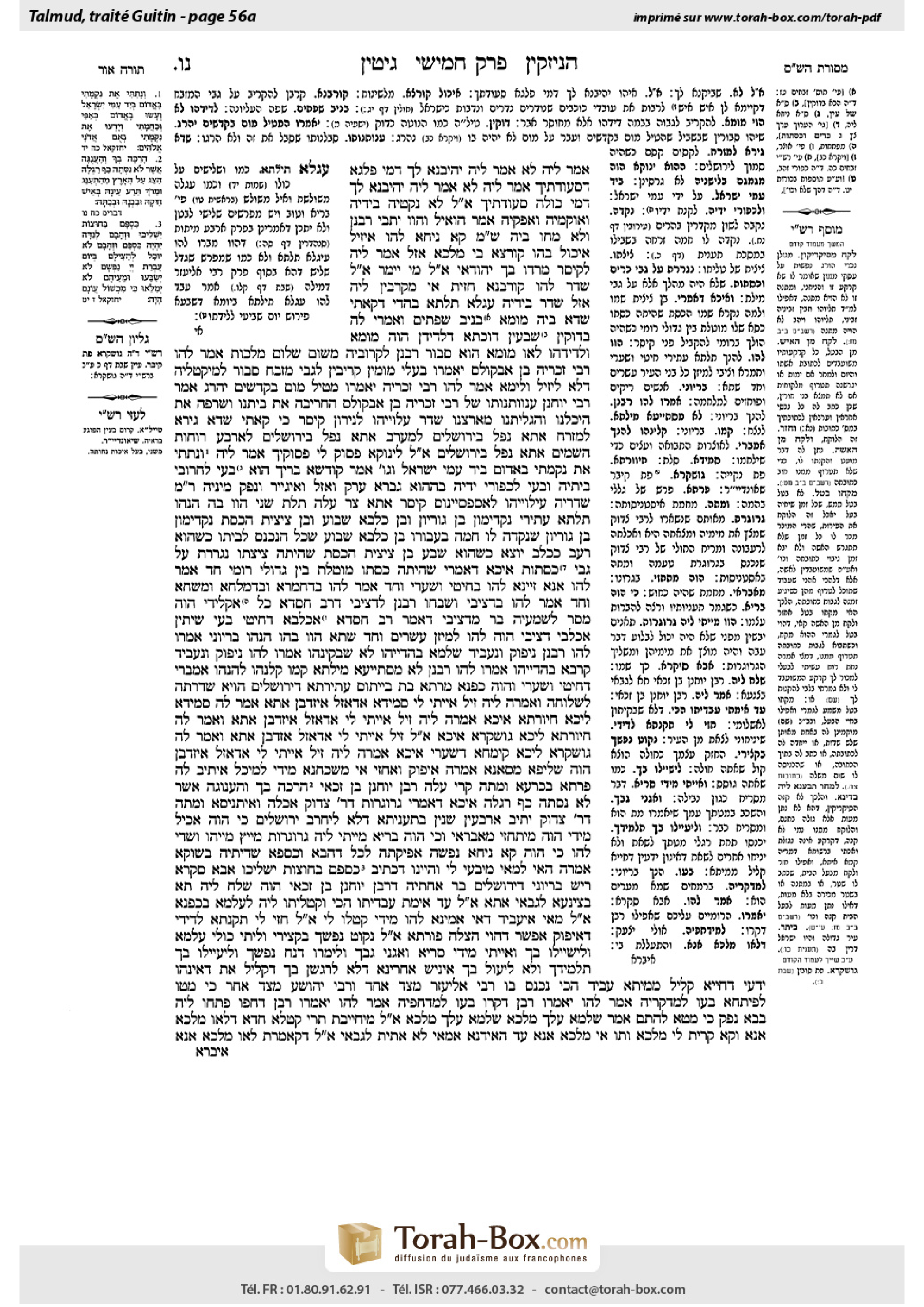
Gittin 56a: Talmud study for Daf Yomi
Study the Talmud for Daf Yomi with scanned pages, Hebrew text, English translations from Sefaria and AI-generated French translations.
Passage selection and English or AI-generated French translation are available where the scan has annotations. Daf Study is independent of Torah-Box and Sefaria.
Browse Gittin · גיטין · All tractatesGittin 56a text and translations
This page of Gittin includes the Aramaic text, an English translation and an AI-generated French translation, alongside the scan above.
גיטין נ״ו א · Aramaic and Hebrew text
אֲמַר לֵיהּ: לָא. אֲמַר לֵיהּ: יָהֵיבְנָא לָךְ דְּמֵי פַּלְגָא דִּסְעוֹדְתָּיךְ! אֲמַר לֵיהּ: לָא. אֲמַר לֵיהּ: יָהֵיבְנָא לָךְ דְּמֵי כּוּלַּהּ סְעוֹדְתָּיךְ! אֲמַר לֵיהּ: לָא. נַקְטֵיהּ בִּידֵיהּ וְאוֹקְמֵיהּ וְאַפְּקֵיהּ.
אָמַר: הוֹאִיל וַהֲווֹ יָתְבִי רַבָּנַן וְלָא מַחוֹ בֵּיהּ, שְׁמַע מִינַּהּ קָא נִיחָא לְהוּ, אֵיזִיל אֵיכוֹל בְּהוּ קוּרְצָא בֵּי מַלְכָּא. אֲזַל אֲמַר לֵיהּ לְקֵיסָר: מְרַדוּ בָּךְ יְהוּדָאֵי! אֲמַר לֵיהּ: מִי יֵימַר? אֲמַר לֵיהּ: שַׁדַּר לְהוּ קוּרְבָּנָא, חָזֵית אִי מַקְרְבִין לֵיהּ.
אֲזַל שַׁדַּר בִּידֵיהּ עִגְלָא תִּלְתָּא. בַּהֲדֵי דְּקָאָתֵי שְׁדָא בֵּיהּ מוּמָא בְּנִיב שְׂפָתַיִם, וְאָמְרִי לַהּ בְּדוּקִּין שֶׁבָּעַיִן – דּוּכְתָּא דִּלְדִידַן הָוֵה מוּמָא, וּלְדִידְהוּ לָאו מוּמָא הוּא.
סְבוּר רַבָּנַן לְקָרוֹבֵיהּ מִשּׁוּם שְׁלוֹם מַלְכוּת. אֲמַר לְהוּ רַבִּי זְכַרְיָה בֶּן אַבְקוּלָס: יֹאמְרוּ בַּעֲלֵי מוּמִין קְרֵיבִין לְגַבֵּי מִזְבֵּחַ! סְבוּר לְמִיקְטְלֵיהּ דְּלָא לֵיזִיל וְלֵימָא. אֲמַר לְהוּ רַבִּי זְכַרְיָה: יֹאמְרוּ מֵטִיל מוּם בַּקֳּדָשִׁים יֵהָרֵג!
אָמַר רַבִּי יוֹחָנָן: עִנְוְותָנוּתוֹ שֶׁל רַבִּי זְכַרְיָה בֶּן אַבְקוּלָס, הֶחְרִיבָה אֶת בֵּיתֵנוּ, וְשָׂרְפָה אֶת הֵיכָלֵנוּ, וְהִגְלְתָנוּ מֵאַרְצֵנוּ.
שַׁדַּר עִלָּוַיְיהוּ לְנֵירוֹן קֵיסָר. כִּי קָאָתֵי; שְׁדָא גִּירָא לְמִזְרָח – אֲתָא נְפַל בִּירוּשָׁלַיִם. לְמַעֲרָב – אֲתָא נְפַל בִּירוּשָׁלַיִם. לְאַרְבַּע רוּחוֹת הַשָּׁמַיִם – אֲתָא נְפַל בִּירוּשָׁלַיִם.
אֲמַר לֵיהּ לְיָנוֹקָא: פְּסוֹק לִי פְּסוּקָיךְ. אֲמַר לֵיהּ: ״וְנָתַתִּי אֶת נִקְמָתִי בֶּאֱדוֹם בְּיַד עַמִּי יִשְׂרָאֵל וְגוֹ׳״. אָמַר: קוּדְשָׁא בְּרִיךְ הוּא בָּעֵי לַחֲרוֹבֵי בֵּיתֵיהּ, וּבָעֵי לְכַפּוֹרֵי יְדֵיהּ בְּהָהוּא גַּבְרָא. עֲרַק וַאֲזַל וְאִיגַּיַּיר, וּנְפַק מִינֵּיהּ רַבִּי מֵאִיר.
שַׁדְּרֵיהּ עִילָּוַיְיהוּ לְאַסְפַּסְיָינוּס קֵיסָר. אֲתָא, צָר עֲלַהּ תְּלָת שְׁנֵי. הֲווֹ בַּהּ הָנְהוּ תְּלָתָא עַתִּירֵי: נַקְדִּימוֹן בֶּן גּוּרְיוֹן, וּבֶן כַּלְבָּא שָׂבוּעַ, וּבֶן צִיצִית הַכֶּסֶת. נַקְדִּימוֹן בֶּן גּוּרְיוֹן – שֶׁנָּקְדָה לוֹ חַמָּה בַּעֲבוּרוֹ. בֶּן כַּלְבָּא שָׂבוּעַ, שֶׁכׇּל הַנִּכְנָס לְבֵיתוֹ כְּשֶׁהוּא רָעֵב כְּכֶלֶב, יוֹצֵא כְּשֶׁהוּא שָׂבֵעַ. בֶּן צִיצִית הַכֶּסֶת – שֶׁהָיְתָה צִיצָתוֹ נִגְרֶרֶת עַל גַּבֵּי כְּסָתוֹת. אִיכָּא דְּאָמְרִי: שֶׁהָיְתָה כִּסְתּוֹ מוּטֶּלֶת בֵּין גְּדוֹלֵי רוֹמִי.
חַד אֲמַר לְהוּ: אֲנָא זָיֵינָּא לְהוּ בְּחִיטֵּי וּשְׂעָרֵי, וְחַד אֲמַר לְהוּ: בִּדְחַמְרָא וּבִדְמִלְחָא וּמִשְׁחָא, וְחַד אֲמַר לְהוּ: בִּדְצִיבֵי. וְשַׁבַּחוּ רַבָּנַן לִדְצִיבֵי, דְּרַב חִסְדָּא כֹּל אַקְלִידֵי הֲוָה מָסַר לְשַׁמָּעֵיהּ, בַּר מִדְּצִיבֵי. דְּאָמַר רַב חִסְדָּא: אֲכַלְבָּא דְחִיטֵּי בָּעֵי שִׁיתִּין אֲכַלְבֵּי דְצִיבֵי. הֲוָה לְהוּ לְמֵיזַן עֶשְׂרִים וְחַד שַׁתָּא.
הֲווֹ בְּהוּ הָנְהוּ בִּרְיוֹנֵי, אֲמַרוּ לְהוּ רַבָּנַן: נִיפּוֹק וְנַעֲבֵיד שְׁלָמָא בַּהֲדַיְיהוּ. לָא שַׁבְקִינְהוּ. אֲמַרוּ לְהוּ: נִיפּוֹק וְנַעֲבֵיד קְרָבָא בַּהֲדַיְיהוּ, אֲמַרוּ לְהוּ רַבָּנַן: לָא מִסְתַּיְּיעָא מִילְּתָא. קָמוּ קְלֹנְהוּ לְהָנְהוּ אַמְבָּרֵי דְּחִיטֵּי וּשְׂעָרֵי, וַהֲוָה כַּפְנָא.
מָרְתָּא בַּת בַּיְיתּוֹס עַתִּירְתָּא דִּירוּשָׁלַיִם הַוְיָא. שַׁדַּרְתֵּהּ לִשְׁלוּחַה,ּ וַאֲמַרָה לֵיהּ: זִיל אַיְיתִי לִי סְמִידָא. אַדַּאֲזַל אִיזְדַּבַּן. אֲתָא אֲמַר לַהּ: סְמִידָא לֵיכָּא, חִיוָּרְתָּא אִיכָּא. אֲמַרָה לֵיהּ: זִיל אַיְיתִי לִי. אַדַּאֲזַל אִיזְדַּבַּן. אֲתָא וַאֲמַר לַהּ: חִיוָּרְתָּא לֵיכָּא, גּוּשְׁקְרָא אִיכָּא. אֲמַרָה לֵיהּ: זִיל אַיְיתִי לִי. אַדַּאֲזַל אִזְדַּבַּן. אֲתָא וַאֲמַר לַהּ: גּוּשְׁקְרָא לֵיכָּא, קִימְחָא דִשְׂעָרֵי אִיכָּא. אֲמַרָה לֵיהּ: זִיל אַיְיתִי לִי. אַדַּאֲזַל אִיזְדַּבַּן.
הֲוָה שְׁלִיפָא מְסָאנָא, אֲמַרָה: אִיפּוֹק וְאֶחְזֵי אִי מַשְׁכַּחְנָא מִידֵּי לְמֵיכַל. אִיתִיב לַהּ פַּרְתָּא בְּכַרְעַאּ, וּמִתָה.
קָרֵי עֲלַהּ רַבָּן יוֹחָנָן בֶּן זַכַּאי: ״הָרַכָּה בְךָ וְהָעֲנוּגָּה אֲשֶׁר לֹא נִסְּתָה כַף רַגְלָהּ״. אִיכָּא דְּאָמְרִי: גְּרוֹגֶרֶת דְּרַבִּי צָדוֹק אֲכַלָה, וְאִיתְּנִיסָא וּמִתָה. דְּרַבִּי צָדוֹק יְתֵיב אַרְבְּעִין שְׁנִין בְּתַעֲנִיתָא דְּלָא לֵיחָרֵב יְרוּשָׁלַיִם, כִּי הֲוָה אָכֵיל מִידֵּי הֲוָה מִיתְחֲזֵי מֵאַבָּרַאי. וְכִי הֲוָה בָּרֵיא, מַיְיתִי לֵיהּ גְּרוֹגְרוֹת, מָיֵיץ מַיַּיְהוּ וְשָׁדֵי לְהוּ.
כִּי הֲוָה קָא נִיחָא נַפְשַׁהּ, אַפִּיקְתֵּהּ לְכֹל דַּהֲבַהּ וְכַסְפַּהּ שְׁדֵיתֵיהּ בְּשׁוּקָא, אֲמַרָה: הַאי לְמַאי מִיבְּעֵי לִי! וְהַיְינוּ דִּכְתִיב: ״כַּסְפָּם בְּחוּצוֹת יַשְׁלִיכוּ״.
אַבָּא סִקְרָא – רֵישׁ בִּרְיוֹנֵי דִּירוּשָׁלַיִם, בַּר אֲחָתֵיהּ דְּרַבָּן יוֹחָנָן בֶּן זַכַּאי הֲוָה. שְׁלַח לֵיהּ: תָּא בְּצִינְעָא לְגַבַּאי. אֲתָא. אֲמַר לֵיהּ: עַד אֵימַת עָבְדִיתוּ הָכִי, וְקָטְלִיתוּ לֵיהּ לְעָלְמָא בְּכַפְנָא? אֲמַר לֵיהּ: מַאי אֶיעֱבֵיד, דְּאִי אָמֵינָא לְהוּ מִידֵּי קָטְלוּ לִי! אֲמַר לֵיהּ: חֲזִי לִי תַּקַּנְתָּא לְדִידִי דְּאֶיפּוֹק, אֶפְשָׁר דְּהָוֵי הַצָּלָה פּוּרְתָּא.
אֲמַר לֵיהּ: נְקוֹט נַפְשָׁךְ בִּקְצִירֵי, וְלֵיתוֹ כּוּלֵּי עָלְמָא וְלִישַׁיְּילוּ בָּךְ, וְאַיְיתִי מִידֵּי סַרְיָא וְאַגְנִי גַּבָּךְ, וְלֵימְרוּ דְּנָח נַפְשָׁךְ. וְלִיעַיְּילוּ בָּךְ תַּלְמִידָךְ וְלָא לֵיעוּל בָּךְ אִינִישׁ אַחֲרִינָא, דְּלָא לַרְגְּשׁוּן בָּךְ דְּקַלִּיל אַתְּ, דְּאִינְהוּ יָדְעִי דְּחַיָּיא קַלִּיל מִמִּיתָא.
עָבֵיד הָכִי. נִכְנַס בּוֹ רַבִּי אֱלִיעֶזֶר מִצַּד אֶחָד, וְרַבִּי יְהוֹשֻׁעַ מִצַּד אַחֵר. כִּי מְטוֹ לְפִיתְחָא, בְּעוֹ לְמִדְקְרֵיהּ. אֲמַר לְהוּ: יֹאמְרוּ: רַבָּן דָּקְרוּ! בְּעוֹ לְמִדְחֲפֵיהּ. אֲמַר לְהוּ: יֹאמְרוּ: רַבָּן דָּחֲפוּ! פְּתַחוּ לֵיהּ בָּבָא, נְפַק.
כִּי מְטָא לְהָתָם, אֲמַר: שְׁלָמָא עֲלָךְ מַלְכָּא, שְׁלָמָא עֲלָךְ מַלְכָּא. אֲמַר לֵיהּ: מִיחַיְּיבַתְּ תְּרֵי (קְטָלָא) [קָטְלִי], חֲדָא דְּלָאו מַלְכָּא אֲנָא וְקָא קָרֵית לִי מַלְכָּא, וְתוּ אִי מַלְכָּא אֲנָא עַד הָאִידָּנָא אַמַּאי לָא אָתֵית לְגַבַּאי. אֲמַר לֵיהּ: דְּקָאָמְרַתְּ לָאו מַלְכָּא אֲנָא,
Gittin 56a · English translation
The host said to him: No, you must leave. Bar Kamtza said to him: I will give you money for half of the feast; just do not send me away. The host said to him: No, you must leave. Bar Kamtza then said to him: I will give you money for the entire feast; just let me stay. The host said to him: No, you must leave. Finally, the host took bar Kamtza by his hand, stood him up, and took him out.
After having been cast out from the feast, bar Kamtza said to himself: Since the Sages were sitting there and did not protest the actions of the host, although they saw how he humiliated me, learn from it that they were content with what he did. I will therefore go and inform [eikhul kurtza] against them to the king. He went and said to the emperor: The Jews have rebelled against you. The emperor said to him: Who says that this is the case? Bar Kamtza said to him: Go and test them; send them an offering to be brought in honor of the government, and see whether they will sacrifice it.
The emperor went and sent with him a choice three-year-old calf. While bar Kamtza was coming with the calf to the Temple, he made a blemish on the calf’s upper lip. And some say he made the blemish on its eyelids, a place where according to us, i.e., halakha, it is a blemish, but according to them, gentile rules for their offerings, it is not a blemish. Therefore, when bar Kamtza brought the animal to the Temple, the priests would not sacrifice it on the altar since it was blemished, but they also could not explain this satisfactorily to the gentile authorities, who did not consider it to be blemished.
The blemish notwithstanding, the Sages thought to sacrifice the animal as an offering due to the imperative to maintain peace with the government. Rabbi Zekharya ben Avkolas said to them: If the priests do that, people will say that blemished animals may be sacrificed as offerings on the altar. The Sages said: If we do not sacrifice it, then we must prevent bar Kamtza from reporting this to the emperor. The Sages thought to kill him so that he would not go and speak against them. Rabbi Zekharya said to them: If you kill him, people will say that one who makes a blemish on sacrificial animals is to be killed. As a result, they did nothing, bar Kamtza’s slander was accepted by the authorities, and consequently the war between the Jews and the Romans began.
Rabbi Yoḥanan says: The excessive humility of Rabbi Zekharya ben Avkolas destroyed our Temple, burned our Sanctuary, and exiled us from our land.
The Roman authorities then sent Nero Caesar against the Jews. When he came to Jerusalem, he wished to test his fate. He shot an arrow to the east and the arrow came and fell in Jerusalem. He then shot another arrow to the west and it also fell in Jerusalem. He shot an arrow in all four directions of the heavens, and each time the arrow fell in Jerusalem.
Nero then conducted another test: He said to a child: Tell me a verse that you learned today. He said to him as follows: “And I will lay My vengeance upon Edom by the hand of My people Israel” (Ezekiel 25:14). Nero said: The Holy One, Blessed be He, wishes to destroy His Temple, and He wishes to wipe his hands with that man, i.e., with me. The Romans are associated with Edom, the descendants of Esau. If I continue on this mission, I will eventually be punished for having served as God’s agent to bring about the destruction. So he fled and became a convert, and ultimately Rabbi Meir descended from him.
The Roman authorities then sent Vespasian Caesar against the Jews. He came and laid siege to Jerusalem for three years. There were at that time in Jerusalem these three wealthy people: Nakdimon ben Guryon, ben Kalba Savua, and ben Tzitzit HaKesat. The Gemara explains their names: Nakdimon ben Guryon was called by that name because the sun shined [nakad] on his behalf, as it is related elsewhere (see Ta’anit 19b) that the sun once continued to shine in order to prevent him from suffering a substantial loss. Ben Kalba Savua was called this because anyone who entered his house when he was hungry as a dog [kelev] would leave satiated [save’a]. Ben Tzitzit HaKesat was referred to by that name because his ritual fringes [tzitzit] dragged along on blankets [keset], meaning that he would not walk in the street with his feet on the ground, but rather they would place blankets beneath him. There are those who say that his seat [kiseh] was found among the nobles of Rome, meaning that he would sit among them.
These three wealthy people offered their assistance. One of them said to the leaders of the city: I will feed the residents with wheat and barley. And one of them said to leaders of the city: I will provide the residents with wine, salt, and oil. And one of them said to the leaders of the city: I will supply the residents with wood. The Gemara comments: And the Sages gave special praise to he who gave the wood, since this was an especially expensive gift. As Rav Ḥisda would give all of the keys [aklidei] to his servant, except for the key to his shed for storing wood, which he deemed the most important of them all. As Rav Ḥisda said: One storehouse [akhleva] of wheat requires sixty storehouses of wood for cooking and baking fuel. These three wealthy men had between them enough commodities to sustain the besieged for twenty-one years.
There were certain zealots among the people of Jerusalem. The Sages said to them: Let us go out and make peace with the Romans. But the zealots did not allow them to do this. The zealots said to the Sages: Let us go out and engage in battle against the Romans. But the Sages said to them: You will not be successful. It would be better for you to wait until the siege is broken. In order to force the residents of the city to engage in battle, the zealots arose and burned down these storehouses [ambarei] of wheat and barley, and there was a general famine.
With regard to this famine it is related that Marta bat Baitos was one of the wealthy women of Jerusalem. She sent out her agent and said to him: Go bring me fine flour [semida]. By the time he went, the fine flour was already sold. He came and said to her: There is no fine flour, but there is ordinary flour. She said to him: Go then and bring me ordinary flour. By the time he went, the ordinary flour was also sold. He came and said to her: There is no ordinary flour, but there is coarse flour [gushkera]. She said to him: Go then and bring me coarse flour. By the time he went, the coarse flour was already sold. He came and said to her: There is no coarse flour, but there is barley flour. She said to him: Go then and bring me barley flour. But once again, by the time he went, the barley flour was also sold.
She had just removed her shoes, but she said: I will go out myself and see if I can find something to eat. She stepped on some dung, which stuck to her foot, and, overcome by disgust, she died.
Rabban Yoḥanan ben Zakkai read concerning her a verse found in the section of the Torah listing the curses that will befall Israel: “The tender and delicate woman among you who would not adventure to set the sole of her foot upon the ground” (Deuteronomy 28:56). There are those who say that she did not step on dung, but rather she ate a fig of Rabbi Tzadok, and became disgusted and died. What are these figs? Rabbi Tzadok observed fasts for forty years, praying that Jerusalem would not be destroyed. He became so emaciated from fasting that when he would eat something it was visible from the outside of his body. And when he would eat after a fast they would bring him figs and he would suck out their liquid and cast the rest away. It was one such fig that Marta bat Baitos found and that caused her death.
It is further related that as she was dying, she took out all of her gold and silver and threw it in the marketplace. She said: Why do I need this? And this is as it is written: “They shall cast their silver in the streets and their gold shall be as an impure thing; their silver and their gold shall not be able to deliver them in the day of the wrath of the Lord; they shall not satisfy their souls, neither fill their bowels” (Ezekiel 7:19).
§ The Gemara relates: Abba Sikkara was the leader of the zealots [biryonei] of Jerusalem and the son of the sister of Rabban Yoḥanan ben Zakkai. Rabban Yoḥanan ben Zakkai sent a message to him: Come to me in secret. He came, and Rabban Yoḥanan ben Zakkai said to him: Until when will you do this and kill everyone through starvation? Abba Sikkara said to him: What can I do, for if I say something to them they will kill me. Rabban Yoḥanan ben Zakkai said to him: Show me a method so that I will be able to leave the city, and it is possible that through this there will be some small salvation.
Abba Sikkara said to him: This is what you should do: Pretend to be sick, and have everyone come and ask about your welfare, so that word will spread about your ailing condition. Afterward bring something putrid and place it near you, so that people will say that you have died and are decomposing. And then, have your students enter to bring you to burial, and let no one else come in so that the zealots not notice that you are still light. As the zealots know that a living person is lighter than a dead person.
Rabban Yoḥanan ben Zakkai did this. Rabbi Eliezer entered from one side and Rabbi Yehoshua from the other side to take him out. When they arrived at the entrance of the city on the inside, the guards, who were of the faction of the zealots, wanted to pierce him with their swords in order to ascertain that he was actually dead, as was the common practice. Abba Sikkara said to them: The Romans will say that they pierce even their teacher. The guards then wanted at least to push him to see whether he was still alive, in which case he would cry out on account of the pushing. Abba Sikkara said to them: They will say that they push even their teacher. The guards then opened the gate and he was taken out.
When Rabban Yoḥanan ben Zakkai reached there, i.e., the Roman camp, he said: Greetings to you, the king; greetings to you, the king. Vespasian said to him: You are liable for two death penalties, one because I am not a king and yet you call me king, and furthermore, if I am a king, why didn’t you come to me until now? Rabban Yoḥanan ben Zakkai said to him: As for what you said about yourself: I am not a king,
Gittin 56a · Traduction française (IA)
Le maître lui dit : Non, vous devez partir. Bar Kamtza lui dit : Je vous donnerai de l'argent pour la moitié du festin ; ne m'envoyez pas loin. Le maître lui dit : Non, vous devez partir. Bar Kamtza lui dit alors : Je vous donnerai de l'argent pour l'ensemble du festin ; laissez-moi rester. Le maître lui dit : Non, vous devez partir. Enfin, le maître prit Bar Kamtza par la main, le releva et le sortit.
Après avoir été expulsé du festin, Bar Kamtza se dit : Puisque les Sages étaient assis là et n'ont pas protesté contre les actions du maître, bien qu'ils aient vu comment il l'avait humilié, apprenez-en qu'ils étaient satisfaits de ce qu'il avait fait. Je vais donc aller informer [eikhul kurtza] contre eux auprès de l'empereur. Il alla et dit à l'empereur : Les Juifs ont rebelle contre vous. L'empereur dit à lui : Qui dit que c'est le cas ? Bar Kamtza dit à lui : Allez et testez-les ; envoyez-leur une offrande à présenter en honneur de la gouvernance, et voyez si ils sacrifieront.
L'empereur alla et envoya avec lui un veau de trois ans, d'une qualité exceptionnelle. Tandis que Bar Kamtza venait avec le veau vers le Temple, il fit une tache sur la lèvre supérieure du veau. Et certains disent qu'il fit la tache sur ses paupières, un lieu où, selon nous, c'est une tache, mais selon eux, les règles des Gentils pour leurs offrandes, ce n'est pas une tache. Ainsi, lorsque Bar Kamtza présenta l'animal au Temple, les prêtres ne le sacrifieraient pas sur l'autel, car il était taché, mais ils ne pouvaient pas expliquer cela de manière satisfaisante aux autorités gentiles, qui ne considéraient pas cela comme une tache.
Malgré la tache, les Sages pensèrent à sacrifier l'animal comme offrande en raison de l'impératif de maintenir la paix avec la gouvernance. Rabbi Zekharya ben Avkolas dit à eux : Si les prêtres font cela, les gens diront que les animaux tachés peuvent être sacrifiés comme offrandes sur l'autel. Les Sages dirent : Si nous ne sacrifions pas, nous devons empêcher Bar Kamtza de rapporter cela à l'empereur. Les Sages pensèrent à le tuer afin qu'il ne parte pas et parle contre eux. Rabbi Zekharya dit à eux : Si vous le tuez, les gens diront qu'on doit tuer celui qui fait une tache sur les animaux sacrés. En conséquence, ils firent rien, la calomnie de Bar Kamtza fut acceptée par les autorités, et ainsi la guerre entre les Juifs et les Romains commença.
Rabbi Yoḥanan dit : L'humilité excessive de Rabbi Zekharya ben Avkolas a détruit notre Temple, brûlé notre Sanctuaire et nous a expulsés de notre terre.
Les autorités romaines envoyèrent alors Néron César contre les Juifs. Lorsqu'il vint à Jérusalem, il voulait tester son destin. Il lança une flèche vers l'est et la flèche vint et tomba à Jérusalem. Il lança alors une autre flèche vers l'ouest et elle tomba aussi à Jérusalem. Il lança une flèche dans toutes les directions du ciel, et chaque fois la flèche tomba à Jérusalem.
Néron fit alors un autre test : Il dit à un enfant : Dis-moi un verset que tu as appris aujourd'hui. Il dit à lui comme suit : « Et je mettrai ma colère sur Edom par la main de mon peuple Israël » (Ezéchiel 25:14). Néron dit : Le Saint, le Très Haut, veut détruire Son Temple, et Il veut se débarrasser de Sa main avec cette personne, c'est-à-dire avec moi. Les Romains sont associés à Edom, les descendants d'Ésaü. Si je continue sur cette mission, je finirai par être puni pour avoir servi comme agent de Dieu pour provoquer la destruction. Il s'enfuit donc et devint un converti, et finalement Rabbi Meir descendit de lui.
Les autorités romaines envoyèrent alors Vespasien César contre les Juifs. Il vint et mit siège à Jérusalem pendant trois ans. À cette époque, à Jérusalem, il y avait ces trois personnes riches : Nakdimon ben Guryon, ben Kalba Savua, et ben Tzitzit HaKesat. La Guemara explique leurs noms : Nakdimon ben Guryon était appelé ainsi parce que le soleil brillait [nakad] en son honneur, comme il est rapporté ailleurs (voir Ta'anit 19b) que le soleil continua à briller afin de lui éviter une perte considérable. Ben Kalba Savua était appelé ainsi parce que quiconque entrait dans sa maison lorsqu'il était affamé comme un chien [kelev] partait rassasié [save’a]. Ben Tzitzit HaKesat était désigné ainsi parce que ses franges rituelles [tzitzit] traînaient sur des couvertures [keset], ce qui signifiait qu'il ne marchait pas sur le sol, mais qu'on posait des couvertures sous lui. Certains disent que son siège [kiseh] fut trouvé parmi les nobles de Rome, c'est-à-dire qu'il s'asseyait parmi eux.
Ces trois personnes riches offrirent leur aide. L'un d'eux dit aux chefs de la ville : Je nourrirai les habitants avec du blé et du seigle. Et l'un d'eux dit aux chefs de la ville : Je fournirai aux habitants du vin, du sel et de l'huile. Et l'un d'eux dit aux chefs de la ville : Je fournirai aux habitants du bois. La Guemara commente : Et les Sages donnèrent une louange spéciale à celui qui offrit le bois, car c'était un cadeau particulièrement coûteux. Comme Rav Ḥisda donnait toutes les clés [aklidei] à son serviteur, sauf la clé de son grenier pour le bois, qu'il considérait comme la plus importante de toutes. Comme Rav Ḥisda dit : Une seule grange [akhleva] de blé nécessite soixante granges de bois pour le bois de cuisson et de boulangerie. Ces trois personnes riches avaient entre eux suffisamment de marchandises pour nourrir les assiégés pendant vingt-et-un ans.
Il y avait certains zélotes parmi les habitants de Jérusalem. Les Sages dirent à eux : Allons sortir et faire la paix avec les Romains. Mais les zélotes ne permirent pas qu'ils fassent cela. Les zélotes dirent aux Sages : Allons sortir et entrer en guerre contre les Romains. Mais les Sages dirent à eux : Vous ne réussirez pas. Il serait mieux pour vous d'attendre jusqu'à ce que le siège soit levé. Afin de forcer les habitants de la ville à entrer en guerre, les zélotes se levèrent et brûlèrent ces entrepôts [ambarei] de blé et de seigle, et il y eut une famine générale.
Concernant cette famine, il est rapporté que Marta fille de Baitos était l'une des femmes riches de Jérusalem. Elle envoya un agent et lui dit : Va me chercher du farine fine [semida]. Lorsqu'il alla, la farine fine avait déjà été vendue. Il revint et dit à elle : Il n'y a plus de farine fine, mais il y a de la farine ordinaire. Elle lui dit : Va alors me chercher de la farine ordinaire. Lorsqu'il alla, la farine ordinaire avait aussi été vendue. Il revint et dit à elle : Il n'y a plus de farine ordinaire, mais il y a de la farine grossière [gushkera]. Elle lui dit : Va alors me chercher de la farine grossière. Lorsqu'il alla, la farine grossière avait déjà été vendue. Il revint et dit à elle : Il n'y a plus de farine grossière, mais il y a de la farine de blé. Elle lui dit : Va alors me chercher de la farine de blé. Mais à nouveau, lorsqu'il alla, la farine de blé avait aussi été vendue.
Elle avait juste enlevé ses chaussures, mais elle dit : Je vais sortir moi-même et voir si je peux trouver quelque chose à manger. Elle marcha sur de la crottine, qui colla à son pied, et, submergée par la dégoût, elle mourut.
Rabban Yoḥanan ben Zakkai cita un verset trouvé dans la section de la Torah qui liste les fléaux qui tomberont sur Israël : « La femme tendre et délicate parmi vous qui ne s'audaçerait pas de poser le pied sur la terre » (Deutéronome 28:56). Certains disent qu'elle n'avait pas marché sur la crottine, mais qu'elle avait mangé un figu de Rabbi Tzadok, et s'était dégoûtée et était morte. Quels sont ces figues ? Rabbi Tzadok observa des jeûnes pendant quarante ans, priant que Jérusalem ne fût pas détruite. Il était si maigre à cause des jeûnes qu'en mangeant quelque chose, cela était visible à l'extérieur de son corps. Et lorsqu'il mangeait après un jeûne, on lui apportait des figues et il suçait leur liquide et jetait le reste. C'était une telle figue que Marta fille de Baitos trouva et qui causa sa mort.
Il est également rapporté qu'en mourant, elle sortit tout son or et son argent et les jeta sur le marché. Elle dit : Pourquoi ai-je besoin de cela ? Et c'est ce qui est écrit : « Ils jetteront leur argent dans les rues et leur or sera comme une chose impure ; leur argent et leur or ne pourront pas les sauver le jour de la colère du Seigneur ; ils ne sauront pas satisfaire leur âme, ni remplir leur ventre » (Ezéchiel 7:19).
§ Le Guemara rapporte : Abba Sikkara était le chef des zélotes [biryonei] de Jérusalem et le fils de la sœur de Rabban Yoḥanan ben Zakkai. Rabban Yoḥanan ben Zakkai envoya un message à lui : Viens vers moi en secret. Il vint, et Rabban Yoḥanan ben Zakkai lui dit : Jusqu'à quand vas-tu faire cela et tuer tout le monde par la famine ? Abba Sikkara lui dit : Que puis-je faire, car si je dis quelque chose à eux, ils me tueront. Rabban Yoḥanan ben Zakkai lui dit : Montre-moi une méthode afin que je puisse sortir de la ville, et peut-être y aura-t-il une petite salut.
Abba Sikkara lui dit : Cela, tu dois faire : Fais semblant d'être malade, et fais venir tout le monde pour demander après ton état de santé, afin que la nouvelle se répande sur ton malaise. Après, apporte quelque chose pourri et place-le près de toi, afin que les gens disent que tu es mort et en décomposition. Et ensuite, fais entrer tes élèves pour te porter à l'enterrement, et ne laisse personne d'autre entrer afin que les zélotes ne remarquent pas que tu es encore léger. Car les zélotes savent qu'un homme vivant est plus léger qu'un mort.
Rabban Yoḥanan ben Zakkai fit cela. Rabbi Eliezer entra d'un côté et Rabbi Yehoshua de l'autre pour le sortir. Lorsqu'ils arrivèrent à l'entrée de la ville à l'intérieur, les gardes, qui étaient de la faction des zélotes, voulaient le percer avec leurs épées afin de vérifier qu'il était effectivement mort, comme était la pratique courante. Abba Sikkara dit aux gardes : Les Romains diront qu'ils piquent même leur maître. Les gardes voulaient au moins le pousser pour voir s'il était encore vivant, dans ce cas il crierait à cause du poussage. Abba Sikkara dit aux gardes : Ils diront qu'ils poussent même leur maître. Les gardes ouvrirent alors la porte et il fut sorti.
Lorsque Rabban Yoḥanan ben Zakkai arriva là, c'est-à-dire au camp romain, il dit : Salutations à vous, le roi ; salutations à vous, le roi. Vespasien lui dit : Vous êtes responsable de deux peines de mort, une parce que je ne suis pas un roi et pourtant vous m'appelez roi, et en outre, si je suis un roi, pourquoi n'êtes-vous pas venu me voir jusqu'à présent ? Rabban Yoḥanan ben Zakkai lui dit : En ce qui concerne ce que vous avez dit sur vous-même : Je ne suis pas un roi,
Traduction française générée par IA à partir de l’édition anglaise de Sefaria. Vérifie toujours un passage avec le texte source.
Text from Sefaria: William Davidson Edition - Vocalized Aramaic (CC BY NC); William Davidson Edition - English (CC BY NC).