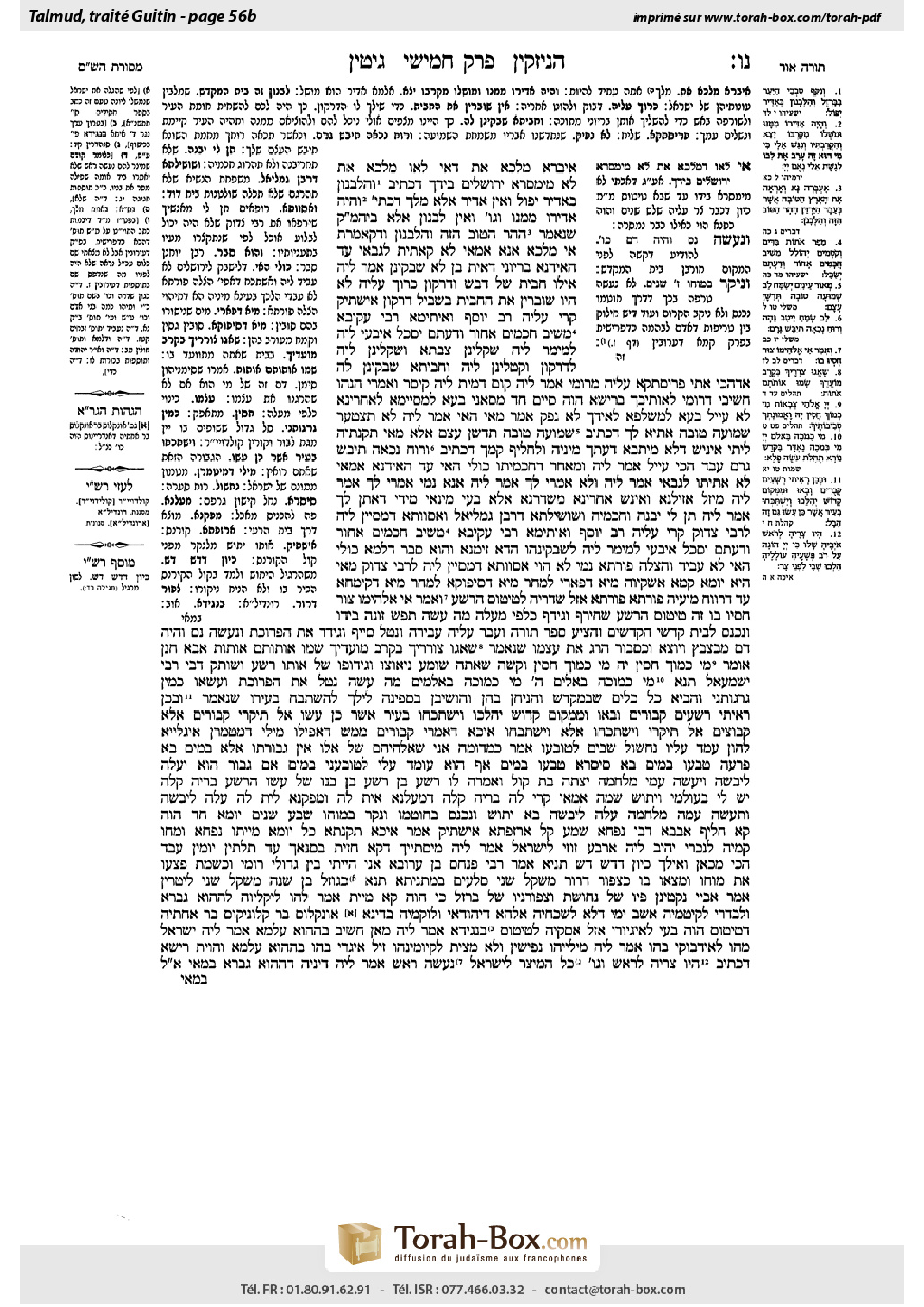
Gittin 56b: Talmud study for Daf Yomi
Study the Talmud for Daf Yomi with scanned pages, Hebrew text, English translations from Sefaria and AI-generated French translations.
Passage selection and English or AI-generated French translation are available where the scan has annotations. Daf Study is independent of Torah-Box and Sefaria.
Browse Gittin · גיטין · All tractatesGittin 56b text and translations
This page of Gittin includes the Aramaic text, an English translation and an AI-generated French translation, alongside the scan above.
גיטין נ״ו ב · Aramaic and Hebrew text
אִיבְרָא מַלְכָּא אַתְּ; דְּאִי לָאו מַלְכָּא אַתְּ לָא מִימַּסְרָא יְרוּשָׁלַיִם בִּידָךְ, דִּכְתִיב: ״וְהַלְּבָנוֹן בְּאַדִּיר יִפּוֹל״ – וְאֵין ״אַדִּיר״ אֶלָּא מֶלֶךְ, דִּכְתִיב: ״וְהָיָה אַדִּירוֹ מִמֶּנּוּ וְגוֹ׳״; וְאֵין ״לְבָנוֹן״ אֶלָּא בֵּית הַמִּקְדָּשׁ, שֶׁנֶּאֱמַר: ״הָהָר הַטּוֹב הַזֶּה וְהַלְּבָנוֹן״. וּדְקָאָמְרַתְּ: אִי מַלְכָּא אֲנָא, אַמַּאי לָא קָאָתֵית לְגַבַּאי עַד הָאִידָּנָא – בִּרְיוֹנֵי דְּאִית בַּן לָא שָׁבְקִינַן.
אֲמַר לֵיהּ: אִילּוּ חָבִית שֶׁל דְּבַשׁ וּדְרָקוֹן כָּרוּךְ עָלֶיהָ, לֹא הָיוּ שׁוֹבְרִין אֶת הֶחָבִית בִּשְׁבִיל דְּרָקוֹן? אִישְׁתִּיק. קָרֵי עֲלֵיהּ רַב יוֹסֵף, וְאִיתֵּימָא רַבִּי עֲקִיבָא: ״מֵשִׁיב חֲכָמִים אָחוֹר וְדַעְתָּם יְסַכֵּל״, אִיבְּעִי לֵיהּ לְמֵימַר לֵיהּ: שָׁקְלִינַן צְבָתָא וְשָׁקְלִינַן לֵיהּ לִדְרָקוֹן וְקָטְלִינַן לֵיהּ, וְחָבִיתָא שָׁבְקִינַן לַהּ.
אַדְּהָכִי, אֲתָא פְּרֵיסְתְּקָא עֲלֵיהּ מֵרוֹמִי, אֲמַר לֵיהּ: קוּם, דְּמִית לֵיהּ קֵיסָר, וְאָמְרִי הָנְהוּ חֲשִׁיבֵי דְּרוֹמִי לְאוֹתֹיבָךָ בְּרֵישָׁא. הֲוָה סָיֵים חַד (מסאני) [מְסָאנֵיהּ]. בְּעָא לְמִסְיְימֵהּ לְאַחֲרִינָא, לָא עָיֵיל. בְּעָא לְמִישְׁלְפֵיהּ לְאִידַּךְ, לָא נְפַק. אֲמַר: מַאי הַאי?
אֲמַר לֵיהּ: לָא תִּצְטַעַר, שְׁמוּעָה טוֹבָה אַתְיָא לָךְ, דִּכְתִיב: ״שְׁמוּעָה טוֹבָה תְּדַשֶּׁן עָצֶם״. אֶלָּא מַאי תַּקַּנְתֵּיהּ? לֵיתֵי אִינִישׁ דְּלָא מְיַתְּבָא דַּעְתָּךְ מִינֵּיהּ, וְלַחֲלֹיף קַמָּךְ, דִּכְתִיב: ״וְרוּחַ נְכֵאָה תְּיַבֶּשׁ גָּרֶם״. עֲבַד הָכִי, עֲיַיל. אֲמַר לֵיהּ: וּמֵאַחַר דְּחָכְמִיתוּ כּוּלֵּי הַאי, עַד הָאִידָּנָא אַמַּאי לָא אָתֵיתוּ לְגַבַּאי? אֲמַר לֵיהּ: וְלָא אֲמַרִי לָךְ?! אֲמַר לֵיהּ: אֲנָא נָמֵי אֲמַרִי לָךְ!
אֲמַר לֵיהּ: מֵיזָל אָזֵילְנָא, וְאִינָשׁ אַחֲרִינָא מְשַׁדַּרְנָא; אֶלָּא בָּעֵי מִינַּאי מִידֵּי דְּאֶתֵּן לָךְ. אֲמַר לֵיהּ: תֵּן לִי יַבְנֶה וַחֲכָמֶיהָ, וְשׁוּשִׁילְתָּא דְּרַבָּן גַּמְלִיאֵל, וְאָסְווֹתָא דְּמַסַּיִין לֵיהּ לְרַבִּי צָדוֹק. קָרֵי עֲלֵיהּ רַב יוֹסֵף, וְאִיתֵּימָא רַבִּי עֲקִיבָא: ״מֵשִׁיב חֲכָמִים אָחוֹר וְדַעְתָּם יְסַכֵּל״, אִיבְּעִי לְמֵימַר לֵיהּ: לִשְׁבְּקִינְהוּ הָדָא זִימְנָא.
וְהוּא סָבַר: דִּלְמָא כּוּלֵּי הַאי לָא עָבֵיד, וְהַצָּלָה פּוּרְתָּא נָמֵי לָא הָוֵי.
אָסְווֹתָא דְּמַסַּיִין לֵיהּ לְרַבִּי צָדוֹק – מַאי הִיא? יוֹמָא קַמָּא אַשְׁקְיוּהּ מַיָּא דְפָארֵי, לִמְחַר מַיָּא דְסִיפּוּקָא, לִמְחַר מַיָּא דְקִימְחָא, עַד דִּרְוַוח מְיעֵיהּ פּוּרְתָּא פּוּרְתָּא.
אֲזַל שַׁדַּרֵיהּ לְטִיטוּס. ״וְאָמַר אֵי אֱלֹהֵימוֹ צוּר חָסָיוּ בוֹ״ – זֶה טִיטוּס הָרָשָׁע שֶׁחֵירַף וְגִידֵּף כְּלַפֵּי מַעְלָה.
מָה עָשָׂה? תָּפַשׂ זוֹנָה בְּיָדוֹ וְנִכְנַס לְבֵית קׇדְשֵׁי הַקֳּדָשִׁים, וְהִצִּיעַ סֵפֶר תּוֹרָה וְעָבַר עָלֶיהָ עֲבֵירָה. וְנָטַל סַיִיף וְגִידֵּר אֶת הַפָּרוֹכֶת, וְנַעֲשָׂה נֵס וְהָיָה דָּם מְבַצְבֵּץ וְיוֹצֵא, וּכְסָבוּר הָרַג אֶת עַצְמוֹ, שֶׁנֶּאֱמַר: ״שָׁאֲגוּ צוֹרְרֶיךָ בְּקֶרֶב מוֹעֲדֶיךָ שָׂמוּ אוֹתוֹתָם אוֹתוֹת״.
אַבָּא חָנָן אוֹמֵר: ״מִי כָמוֹךָ חֲסִין יָהּ״ – מִי כָמוֹךָ חָסִין וְקָשֶׁה, שֶׁאַתָּה שׁוֹמֵעַ נִיאוּצוֹ וְגִידּוּפוֹ שֶׁל אוֹתוֹ רָשָׁע, וְשׁוֹתֵק. דְּבֵי רַבִּי יִשְׁמָעֵאל תָּנָא: ״מִי כָּמֹכָה בָּאֵלִים ה׳״ – מִי כָּמוֹכָה בָּאִלְּמִים.
מָה עָשָׂה? נָטַל אֶת הַפָּרוֹכֶת וַעֲשָׂאוֹ כְּמִין גַּרְגּוּתְנִי, וְהֵבִיא כׇּל כֵּלִים שֶׁבַּמִּקְדָּשׁ וְהִנִּיחָן בָּהֶן, וְהוֹשִׁיבָן בִּסְפִינָה לֵילֵךְ לְהִשְׁתַּבֵּחַ בְּעִירוֹ, שֶׁנֶּאֱמַר: ״וּבְכֵן רָאִיתִי רְשָׁעִים קְבוּרִים וָבָאוּ, וּמִמְּקוֹם קָדוֹשׁ יְהַלֵּכוּ, וְיִשְׁתַּכְּחוּ בָעִיר אֲשֶׁר כֵּן עָשׂוּ״ – אַל תִּיקְרֵי ״קְבוּרִים״ אֶלָּא ״קְבוּצִים״; אַל תִּיקְרֵי ״וְיִשְׁתַּכְּחוּ״ אֶלָּא ״וְיִשְׁתַּבְּחוּ״.
אִיכָּא דְּאָמְרִי, קְבוּרִים מַמָּשׁ – דַּאֲפִילּוּ מִילֵּי דְּמִטַּמְּרָן, אִיגַּלְיָין לְהוֹן.
עָמַד עָלָיו נַחְשׁוֹל שֶׁבַּיָּם לְטוֹבְעוֹ, אָמַר: כִּמְדוּמֶּה אֲנִי שֶׁאֱלֹהֵיהֶם שֶׁל אֵלּוּ, אֵין גְּבוּרָתוֹ אֶלָּא בַּמַּיִם; בָּא פַּרְעֹה – טְבָעוֹ בַּמַּיִם, בָּא סִיסְרָא – טְבָעוֹ בַּמַּיִם; אַף הוּא עוֹמֵד עָלַי לְטוֹבְעֵנִי בַּמַּיִם. אִם גִּבּוֹר הוּא, יַעֲלֶה לַיַּבָּשָׁה וְיַעֲשֶׂה עִמִּי מִלְחָמָה! יָצְתָה בַּת קוֹל וְאָמְרָה לוֹ: רָשָׁע בֶּן רָשָׁע בֶּן בְּנוֹ שֶׁל עֵשָׂו הָרָשָׁע, בְּרִיָּה קַלָּה יֵשׁ לִי בְּעוֹלָמִי, וְיַתּוּשׁ שְׁמָהּ.
אַמַּאי קָרֵי לַהּ ״בְּרִיָּה קַלָּה״? דְּמַעֲלָנָא אִית לַהּ, וּמַפְּקָנָא לֵית לַהּ.
עֲלֵה לַיַּבָּשָׁה וְתַעֲשֶׂה עִמָּהּ מִלְחָמָה. עָלָה לַיַּבָּשָׁה, בָּא יַתּוּשׁ וְנִכְנַס בְּחוֹטְמוֹ, וְנִקֵּר בְּמוֹחוֹ שֶׁבַע שָׁנִים. יוֹמָא חַד הֲוָה קָא חָלֵיף אַבָּבָא דְּבֵי נַפָּחָא, שְׁמַע קָל אַרְזַפְתָּא, אִישְׁתִּיק; אֲמַר: אִיכָּא תַּקַּנְתָּא. כֹּל יוֹמָא מַיְיתוּ נַפָּחָא וּמָחוּ קַמֵּיה. לְגוֹי – יָהֵיב לֵיהּ אַרְבַּע זוּזֵי, יִשְׂרָאֵל – אֲמַר לֵיהּ: מִיסָּתְיָיךְ דְּקָא חָזֵית בְּסָנְאָךְ. עַד תְּלָתִין יוֹמִין עֲבַד הָכִי; מִכָּאן וְאֵילָךְ, כֵּיוָן דְּדָשׁ, דָּשׁ.
תַּנְיָא, אָמַר רַבִּי פִּנְחָס בֶּן עֲרוּבָא: אֲנִי הָיִיתִי בֵּין גְּדוֹלֵי רוֹמִי, וּכְשֶׁמֵּת פָּצְעוּ אֶת מוֹחוֹ, וּמָצְאוּ בּוֹ כְּצִפּוֹר דְּרוֹר מִשְׁקַל שְׁנֵי סְלָעִים. בְּמַתְנִיתָא תָּנָא: כְּגוֹזָל בֶּן שָׁנָה – מִשְׁקַל שְׁנֵי לִיטְרִין.
אָמַר אַבָּיֵי: נָקְטִינַן, פִּיו שֶׁל נְחוֹשֶׁת וְצִפּוֹרְנָיו שֶׁל בַּרְזֶל. כִּי הֲוָה קָא מָיֵית, אֲמַר לְהוּ: לִיקְלְיוּהּ לְהָהוּא גַּבְרָא וּבַדַּרוּ לְקִיטְמֵיהּ אַשַּׁב יַמִּי, דְּלָא לַשְׁכְּחֵיהּ אֱלָהָא דִיהוּדָאֵי וְלוֹקְמֵיהּ בְּדִינָא.
אוּנְקְלוֹס בַּר קְלוֹנִיקוּס בַּר אֲחָתֵיהּ דְּטִיטוּס הֲוָה. בָּעֵי לְאִיגַּיּוֹרֵי, אֲזַל אַסְּקֵיהּ לְטִיטוּס בִּנְגִידָא, אֲמַר לֵיהּ: מַאן חֲשִׁיב בְּהָהוּא עָלְמָא? אֲמַר לֵיהּ: יִשְׂרָאֵל. מַהוּ לְאִידַּבּוֹקֵי בְּהוּ? אֲמַר לֵיהּ: מִילַּיְיהוּ נְפִישִׁין, וְלָא מָצֵית לְקַיּוֹמִינְהוּ. זִיל אִיגָּרִי בְּהוּ בְּהָהוּא עָלְמָא וְהָוֵית רֵישָׁא, דִּכְתִיב: ״הָיוּ צָרֶיהָ לְרֹאשׁ וְגוֹ׳״ – כׇּל הַמֵּיצַר לְיִשְׂרָאֵל נַעֲשָׂה רֹאשׁ. אֲמַר לֵיהּ: דִּינֵיהּ דְּהָהוּא גַּבְרָא בְּמַאי? אֲמַר לֵיהּ:
Gittin 56b · English translation
in truth, you are a king, if not now, then in the future. As if you are not a king, Jerusalem will not be handed over into your hand, as it is written: “And the Lebanon shall fall by a mighty one” (Isaiah 10:34). And “mighty one” means only a king, as it is written: “And their mighty one shall be of themselves, and their ruler shall proceed from the midst of them” (Jeremiah 30:21), indicating that “mighty one” parallels “ruler.” And “Lebanon” means only the Temple, as it is stated: “That good mountain and the Lebanon” (Deuteronomy 3:25). And as for what you said with your second comment: If I am a king why didn’t you come to me until now, there are zealots among us who did not allow us to do this.
Understanding that Rabban Yoḥanan ben Zakkai was prepared to ask him not to destroy the Temple, Vespasian said to him: If there is a barrel of honey and a snake [derakon] is wrapped around it, wouldn’t they break the barrel in order to kill the snake? In similar fashion, I am forced to destroy the city of Jerusalem in order to kill the zealots barricaded within it. Rabban Yoḥanan ben Zakkai was silent and did not answer. In light of this, Rav Yosef later read the following verse about him, and some say that it was Rabbi Akiva who applied the verse to Rabban Yoḥanan ben Zakkai: “I am the Lord…Who turns wise men backward and makes their knowledge foolish” (Isaiah 44:25). As Rabban Yoḥanan ben Zakkai should have said the following to Vespasian in response: In such a case, we take tongs, remove the snake, and kill it, and in this way we leave the barrel intact. So too, you should kill the rebels and leave the city as it is.
In the meantime, as they were talking, a messenger [feristaka] arrived from Rome, and said to him: Rise, for the emperor has died, and the noblemen of Rome plan to appoint you as their leader and make you the next emperor. At that time Vespasian was wearing only one shoe, and when he tried to put on the other one, it would not go on his foot. He then tried to remove the other shoe that he was already wearing, but it would not come off. He said: What is this?
Rabban Yoḥanan ben Zakkai said to him: Be not distressed or troubled, for good tidings have reached you, as it is written: “Good tidings make the bone fat” (Proverbs 15:30), and your feet have grown fatter out of joy and satisfaction. Vespasian said to him: But what is the remedy? What must I do in order to put on my shoe? Rabban Yoḥanan ben Zakkai said to him: Have someone with whom you are displeased come and pass before you, as it is written: “A broken spirit dries the bones” (Proverbs 17:22). He did this, and his shoe went on his foot. Vespasian said to him: Since you are so wise, why didn’t you come to see me until now? Rabban Yoḥanan ben Zakkai said to him: But didn’t I already tell you? Vespasian said to him: I also told you what I had to say.
Vespasian then said to Rabban Yoḥanan ben Zakkai: I will be going to Rome to accept my new position, and I will send someone else in my place to continue besieging the city and waging war against it. But before I leave, ask something of me that I can give you. Rabban Yoḥanan ben Zakkai said to him: Give me Yavne and its Sages and do not destroy it, and spare the dynasty of Rabban Gamliel and do not kill them as if they were rebels, and lastly give me doctors to heal Rabbi Tzadok. Rav Yosef read the following verse about him, and some say that it was Rabbi Akiva who applied the verse to Rabban Yoḥanan ben Zakkai: “I am the Lord…Who turns wise men backward and makes their knowledge foolish” (Isaiah 44:25), as he should have said to him to leave the Jews alone this time.
And why didn’t Rabban Yoḥanan ben Zakkai make this request? He maintained that Vespasian might not do that much for him, and there would not be even a small amount of salvation. Therefore, he made only a modest request, in the hope that he would receive at least that much.
The Gemara asks: What was he requesting when he asked for doctors to heal Rabbi Tzadok? How did they heal him? The first day they gave him water to drink that contained bran [parei]. The next day they gave him water containing flour mixed with bran [sipuka]. The following day they gave him water containing flour. In this way they slowly restored his ability to eat, allowing his stomach to broaden little by little.
§ Vespasian went back to Rome and sent Titus in his place. The Gemara cites a verse that was expounded as referring to Titus: “And he shall say: Where is their God, their rock in whom they trusted?” (Deuteronomy 32:37). This is the wicked Titus, who insulted and blasphemed God on High.
What did Titus do when he conquered the Temple? He took a prostitute with his hand, and entered the Holy of Holies with her. He then spread out a Torah scroll underneath him and committed a sin, i.e., engaged in sexual intercourse, on it. Afterward he took a sword and cut into the curtain separating between the Sanctuary and the Holy of Holies. And a miracle was performed and blood spurted forth. Seeing the blood, he mistakenly thought that he had killed himself. Here, the term himself is a euphemism for God. Titus saw blood issuing forth from the curtain in God’s meeting place, the Temple, and he took it as a sign that he had succeeded in killing God Himself. As it is stated: “Your enemies roar in the midst of Your meeting place; they have set up their own signs for signs” (Psalms 74:4).
Abba Ḥanan says: The verse states: “Who is strong like You, O Lord?” (Psalms 89:9). Who is strong and indurate like You, as You hear the abuse and the blasphemy of that wicked man and remain silent. Similarly, the school of Rabbi Yishmael taught that the verse: “Who is like You, O Lord, among the gods [elim]” (Exodus 15:11), should be read as: Who is like You among the mute [ilmim], for You conduct Yourself like a mute and remain silent in the face of Your blasphemers.
What else did Titus do? He took the curtain and formed it like a large basket, and brought all of the sacred vessels of the Temple and placed them in it. And he put them on a ship to go and be praised in his city that he had conquered Jerusalem, as it is stated: “And so I saw the wicked buried, and come to their rest; but those that had done right were gone from the holy place, and were forgotten in the city; this also is vanity” (Ecclesiastes 8:10). Do not read the word as “buried [kevurim].” Rather, read it as collected [kevutzim]. And do not read the word as “and were forgotten [veyishtakeḥu].” Rather, read it as: And they were praised [veyishtabeḥu]. According to this interpretation, the verse speaks of those who will gather and collect items “from the holy place,” the Temple, and be praised in their city about what they had done.
There are those who say that the verse is to be read as written, as it is referring to items that were actually buried. This is because even items that had been buried were revealed to them, i.e., Titus and his soldiers, as they found all of the sacred vessels.
It is further related about Titus that he was once traveling at sea and a wave rose up against him and threatened to drown him. Titus said: It seems to me that their God, the God of Israel, has power only in water. Pharaoh rose against them and He drowned him in water. Sisera rose against them and He drowned him in water. Here too, He has risen up against me to drown me in water. If He is really mighty, let Him go up on dry land and there wage war against me. A Divine Voice issued forth and said to him: Wicked one, son of a wicked one, grandson of Esau the wicked, for you are among his descendants and act just like him, I have a lowly creature in My world and it is called a gnat.
The Gemara interjects: Why is it called a lowly creature? It is called this because it has an entrance for taking in food, but it does not have an exit for excretion.
The Gemara resumes its story about Titus. The Divine Voice continued: Go up on dry land and make war with it. He went up on dry land, and a gnat came, entered his nostril, and picked at his brain for seven years. Titus suffered greatly from this until one day he passed by the gate of a blacksmith’s shop. The gnat heard the sound of a hammer and was silent and still. Titus said: I see that there is a remedy for my pain. Every day they would bring a blacksmith who hammered before him. He would give four dinars as payment to a gentile blacksmith, and to a Jew he would simply say: It is enough for you that you see your enemy in so much pain. He did this for thirty days and it was effective until then. From that point forward, since the gnat became accustomed to the hammering, it became accustomed to it, and once again it began to pick away at Titus’s brain.
It is taught in a baraita that Rabbi Pineḥas ben Arova said: I was at that time among the noblemen of Rome, and when Titus died they split open his head and found that the gnat had grown to the size of a sparrow weighing two sela. It was taught in another baraita: It was like a one-year-old pigeon weighing two litra.
Abaye said: We have a tradition that its mouth was made of copper and its claws were fashioned of iron. When Titus was dying, he said to his attendants: Burn that man, i.e., me, and scatter his ashes across the seven seas, so that the God of the Jews should not find me and stand me for judgment.
§ The Gemara relates: Onkelos bar Kalonikos, the son of Titus’s sister, wanted to convert to Judaism. He went and raised Titus from the grave through necromancy, and said to him: Who is most important in that world where you are now? Titus said to him: The Jewish people. Onkelos asked him: Should I then attach myself to them here in this world? Titus said to him: Their commandments are numerous, and you will not be able to fulfill them. It is best that you do as follows: Go out and battle against them in that world, and you will become the chief, as it is written: “Her adversaries [tzareha] have become the chief” (Lamentations 1:5), which means: Anyone who distresses [meitzer] Israel will become the chief. Onkelos said to him: What is the punishment of that man, a euphemism for Titus himself, in the next world? Titus said to him:
Gittin 56b · Traduction française (IA)
En vérité, tu es un roi, si ce n'est maintenant, alors à l'avenir. Comme si tu n'étais pas un roi, Jérusalem ne sera pas remise entre tes mains, comme il est écrit : « Et le Liban tombera par un puissant » (Isaïe 10:34). Et « puissant » signifie uniquement un roi, comme il est écrit : « Et leur puissant sera d'eux-mêmes, et leur chef sortira du milieu d'eux » (Jérémie 30:21), indiquant que « puissant » correspond à « chef ». Et « Liban » signifie uniquement le Temple, comme il est dit : « Ce bon mont et le Liban » (Deutéronome 3:25). Et quant à ce que tu as dit avec ton deuxième commentaire : Si je suis un roi, pourquoi ne t'es-tu pas présenté à moi jusqu'à présent, il y a des zélotes parmi nous qui n'ont pas permis de faire cela.
Comprendre que Rabban Yoḥanan ben Zakkai était prêt à lui demander de ne pas détruire le Temple, Vespasien lui dit : Si il y a une barrique de miel et un serpent [derakon] est enroulé autour d'elle, ne devraient-ils pas briser la barrique pour tuer le serpent ? De la même manière, je suis contraint de détruire la ville de Jérusalem afin de tuer les zélotes barricadés à l'intérieur. Rabban Yoḥanan ben Zakkai resta silencieux et ne répondit pas. En ce sens, Rav Yosef a plus tard lu le verset suivant à son sujet, et certains disent que c'était Rabbi Akiva qui a appliqué le verset à Rabban Yoḥanan ben Zakkai : « Je suis l'Éternel... Qui fait reculer les sages et rend leur connaissance folle » (Isaïe 44:25). Comme Rabban Yoḥanan ben Zakkai aurait dû dire à Vespasien en réponse : Dans ce cas, nous prenons des tenailles, retirons le serpent et le tuons, et ainsi nous laissons la barrique intacte. De même, tu devrais tuer les révoltés et laisser la ville telle quelle.
En attendant, alors qu'ils parlaient, un messager [feristaka] arriva de Rome, et dit à lui : Lève-toi, car l'empereur est mort, et les nobles de Rome projettent de t'élire comme leur chef et de t'installer comme l'empereur suivant. À cette époque Vespasien portait seulement une seule chaussure, et lorsqu'il essaya de mettre la seconde, elle ne voulait pas aller sur son pied. Il essaya alors de retirer la chaussure qu'il portait déjà, mais elle ne voulait pas s'enlever. Il dit : Qu'est-ce que c'est cela ?
Rabban Yoḥanan ben Zakkai lui dit : Ne sois pas troublé ou inquiet, car de bonnes nouvelles t'ont atteint, comme il est écrit : « Les bonnes nouvelles font grossir les os » (Proverbes 15:30), et tes pieds sont devenus plus épais à cause de la joie et de la satisfaction. Vespasien lui dit : Mais quelle est la solution ? Quel est le remède que je dois faire pour mettre ma chaussure ? Rabban Yoḥanan ben Zakkai lui dit : Fais venir quelqu'un avec lequel tu es mécontent et passe devant toi, comme il est écrit : « Un esprit brisé dessèche les os » (Proverbes 17:22). Il fit cela, et sa chaussure alla sur son pied. Vespasien lui dit : Puisque tu es si sage, pourquoi ne t'es-tu pas présenté à moi jusqu'à présent ? Rabban Yoḥanan ben Zakkai lui dit : Mais n'ai-je pas déjà dit cela ? Vespasien lui dit : J'ai aussi dit ce que j'avais à dire.
Vespasien dit alors à Rabban Yoḥanan ben Zakkai : Je vais aller à Rome pour accepter mon nouveau poste, et je vais envoyer quelqu'un d'autre à ma place pour continuer à assiéger la ville et à la combattre. Mais avant de partir, demande-moi quelque chose que je puisse te donner. Rabban Yoḥanan ben Zakkai lui dit : Donne-moi Yavne et ses Sages et ne le détruis pas, et épargne la dynastie de Rabban Gamliel et ne les tue pas comme si ils étaient des révoltés, et enfin donne-moi des médecins pour guérir Rabbi Tzadok. Rav Yosef a lu la suivante verset à son sujet, et certains disent que c'était Rabbi Akiva qui a appliqué le verset à Rabban Yoḥanan ben Zakkai : « Je suis l'Éternel... Qui fait reculer les sages et rend leur connaissance folle » (Isaïe 44:25), comme il aurait dû lui dire de laisser les Juifs tranquilles cette fois-ci.
Et pourquoi Rabban Yoḥanan ben Zakkai n'a-t-il pas fait cette demande ? Il estimait que Vespasien ne ferait pas autant pour lui, et qu'il n'y aurait même pas une petite quantité de salut. Par conséquent, il a fait une demande modeste, en espérant qu'il recevrait au moins cela.
La Guemara demande : Qu'est-ce qu'il demandait lorsqu'il a demandé des médecins pour guérir Rabbi Tzadok ? Comment les ont-ils guéri ? Le premier jour, ils lui ont donné de l'eau à boire qui contenait des céréales [parei]. Le deuxième jour, ils lui ont donné de l'eau contenant du blé mélangé avec des céréales [sipuka]. Le troisième jour, ils lui ont donné de l'eau contenant du blé. Ainsi, ils ont lentement restauré sa capacité à manger, permettant à son estomac de s'élargir petit à petit.
§ Vespasien est retourné à Rome et a envoyé Titus à sa place. La Guemara cite un verset qui a été interprété comme se référant à Titus : « Et il dira : Où est leur Dieu, leur rocher en qui ils avaient confiance ? » (Deutéronome 32:37). C'est le méchant Titus, qui a insulté et blasphémé Dieu au-dessus du Trône.
Qu'est-ce que Titus a fait lorsqu'il a conquis le Temple ? Il a pris une prostituée avec sa main, et est entré dans le Saint des Saints avec elle. Il a ensuite étendu un rouleau de Torah sous lui et a commis un péché, c'est-à-dire s'est livré à un acte sexuel sur lui. Ensuite, il a pris une épée et a coupé le rideau séparant le Sanctuaire du Saint des Saints. Et un miracle a été accompli et du sang est sorti. Voyant le sang, il a mal compris qu'il avait tué lui-même. Ici, le terme « lui-même » est un euphémisme pour Dieu. Titus a vu du sang sortir du rideau dans le lieu de rencontre de Dieu, le Temple, et l'a pris comme un signe qu'il avait réussi à tuer Dieu Lui-même. Comme il est dit : « Vos ennemis rugissent au milieu de Votre lieu de rencontre ; ils ont dressé leurs propres signes pour des signes » (Psaumes 74:4).
Abba Ḥanan dit : Le verset dit : « Qui est puissant comme toi, ô Éternel ? » (Psaumes 89:9). Qui est puissant et induré comme toi, comme tu entends l'abuse et le blasphème de ce méchant homme et restes silencieux. De même, l'école de Rabbi Yishmael enseignait que le verset : « Qui est comme toi, ô Éternel, parmi les dieux [elim] » (Exode 15:11), devrait être lu comme : Qui est comme toi parmi les muets [ilmim], car tu t'adresses comme un muet et restes silencieux face à tes blasphémateurs.
Qu'est-ce que Titus a encore fait ? Il a pris la couverture et l'a façonnée comme un grand panier, et a transporté tous les vases sacrés du Temple et les a mis dedans. Et il les a mis sur un bateau pour aller être glorifiés dans sa ville qu'il avait conquise, Jérusalem, comme il est dit : « Et ainsi je vis les méchants rassemblés, et ils sont allés à leur repos ; mais ceux qui avaient fait le bien étaient partis du lieu saint, et ils furent glorifiés dans la ville ; ceci aussi est vanité » (Ecclésiaste 8:10). Ne lis pas le mot comme « enterrés [kevurim] », mais comme « rassemblés [kevutzim] ». Et ne lis pas le mot comme « et ils furent oubliés [veyishtakeḥu] », mais comme : « et ils furent glorifiés [veyishtabeḥu] ». Selon cette interprétation, la parole parle de ceux qui réuniront et rassembleront des objets « du lieu saint », le Temple, et seront glorifiés dans leur ville sur ce qu'ils avaient fait.
Certains disent que la parole est à lire telle quelle, comme elle fait référence à des objets qui ont été effectivement enterrés. Cela est dû au fait que même les objets qui avaient été enterrés furent découverts par eux, c'est-à-dire Titus et ses soldats, car ils trouvèrent tous les vases sacrés.
Il est rapporté davantage à propos de Titus qu'il voyageait une fois en mer et une vague s'est levée contre lui et menaçait de le noyer. Titus a dit : Il me semble que leur Dieu, le Dieu d'Israël, a une puissance seulement dans l'eau. Pharaon s'est levé contre eux et Il l'a noyé dans l'eau. Sisera s'est levé contre eux et Il l'a noyé dans l'eau. Ici aussi, Il s'est levé contre moi pour me noyer dans l'eau. Si Il est vraiment puissant, qu'Il monte sur la terre ferme et là Il me fera la guerre. Une Voix Divine est sortie et a dit à lui : Mauvais homme, fils d'un mauvais homme, petit-fils d'Ésaü le mauvais, car tu es parmi ses descendants et tu agis tout comme lui, J'ai un petit être dans Mon monde et il s'appelle une mouche.
La Guemara interrompt : Pourquoi est-ce appelé un petit être ? C'est ainsi parce qu'il a une entrée pour prendre de la nourriture, mais il n'a pas de sortie pour l'évacuer.
La Guemara reprend son histoire à propos de Titus. La Voix Divine a continué : Monte sur la terre ferme et fais la guerre contre lui. Il est monté sur la terre ferme, et une mouche est venue, est entrée dans son nez, et a gratté son cerveau pendant sept ans. Titus a souffert beaucoup de cela jusqu'à ce qu'un jour il passe devant la porte d'une forge. La mouche a entendu le bruit du marteau et s'est tue. Titus a dit : Je vois qu'il y a un remède à ma douleur. Chaque jour, on apportait un forgeron qui frappait devant lui. Il lui donnait quatre dinars comme paiement à un forgeron païen, et à un Juif il disait simplement : Il est suffisant pour toi que tu voies ton ennemi dans tant de douleur. Il a fait cela pendant trente jours et cela a été efficace jusqu'à ce moment-là. À partir de ce point, puisque la mouche s'était habituée au bruit du marteau, elle s'était habituée à cela, et une fois de plus elle a recommencé à gratter le cerveau de Titus.
Il est enseigné dans une baraïta que Rabbi Pinḥas ben Arova a dit : J'étais à ce moment-là parmi les nobles de Rome, et quand Titus est mort, ils ont ouvert sa tête et ont trouvé que la mouche avait grandi jusqu'à la taille d'un moineau pesant deux sela. Il est enseigné dans une autre baraïta : Elle était comme un petit pigeon d'un an pesant deux litra.
Abaye a dit : Nous avons une tradition que sa bouche était faite de cuivre et ses griffes étaient façonnées en fer. Quand Titus mourait, il a dit à ses serviteurs : Brûle ce homme, c'est-à-dire moi, et épars ses cendres sur les sept mers, afin que le Dieu des Juifs ne me trouve pas et ne me juge pas.
§ La Guemara rapporte : Onkelos bar Kalonikos, le fils de la sœur de Titus, voulait se convertir au judaïsme. Il est allé et a ressuscité Titus du tombeau par la nécromancie, et a dit à lui : Qui est le plus important dans ce monde où tu es maintenant ? Titus a dit à lui : Le peuple juif. Onkelos a demandé : Devrais-je alors m'attacher à eux ici dans ce monde ? Titus a dit à lui : Leurs commandements sont nombreux, et tu ne pourras pas les accomplir. Il est préférable que tu fasses ainsi : Va et combats contre eux dans ce monde, et tu deviendras le chef, comme il est écrit : « Ses adversaires [tzareha] sont devenus le chef » (Lamentations 1:5), ce qui signifie : Quiconque opprime [meitzer] Israël deviendra le chef. Onkelos a dit à lui : Quelle est la punition de cette personne, un euphémisme pour Titus lui-même, dans le monde à venir ? Titus a dit à lui :
Traduction française générée par IA à partir de l’édition anglaise de Sefaria. Vérifie toujours un passage avec le texte source.
Text from Sefaria: William Davidson Edition - Vocalized Aramaic (CC BY NC); William Davidson Edition - English (CC BY NC).