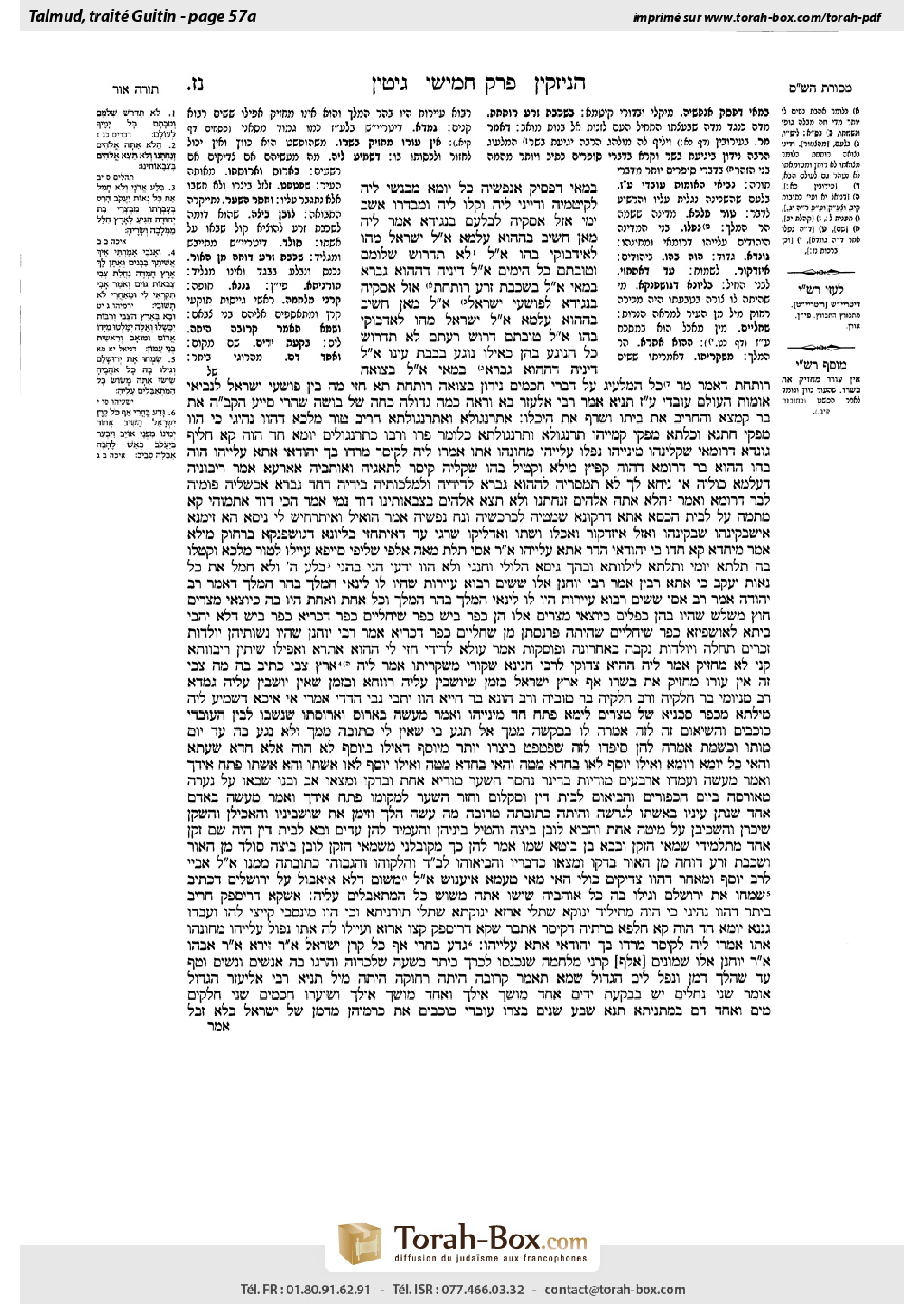
Gittin 57a: Talmud study for Daf Yomi
Study the Talmud for Daf Yomi with scanned pages, Hebrew text, English translations from Sefaria and AI-generated French translations.
Passage selection and English or AI-generated French translation are available where the scan has annotations. Daf Study is independent of Torah-Box and Sefaria.
Browse Gittin · גיטין · All tractatesGittin 57a text and translations
This page of Gittin includes the Aramaic text, an English translation and an AI-generated French translation, alongside the scan above.
גיטין נ״ז א · Aramaic and Hebrew text
בְּמַאי דִּפְסַיק אַנַּפְשֵׁיהּ – כֹּל יוֹמָא מְכַנְּשִׁי לֵיהּ לְקִיטְמֵיהּ וְדָיְינִי לֵיהּ, וְקָלוּ לֵיהּ וּמְבַדְּרוּ [לֵיהּ] אַשַּׁב יַמֵּי.
אֲזַל אַסְּקֵיהּ לְבִלְעָם בִּנְגִידָא, אֲמַר לֵיהּ: מַאן חֲשִׁיב בְּהָהוּא עָלְמָא? אֲמַר לֵיהּ: יִשְׂרָאֵל. מַהוּ לְאִידַּבּוֹקֵי בְּהוּ? אֲמַר לֵיהּ: ״לֹא תִדְרוֹשׁ שְׁלוֹמָם וְטוֹבָתָם כׇּל הַיָּמִים״. אֲמַר לֵיהּ: דִּינֵיהּ דְּהָהוּא גַּבְרָא בְּמַאי? אֲמַר לֵיהּ: בְּשִׁכְבַת זֶרַע רוֹתַחַת.
אֲזַל אַסְּקֵיהּ בִּנְגִידָא לְיֵשׁוּ הַנּוֹצְרִי, אֲמַר לֵיהּ: מַאן חֲשִׁיב בְּהָהוּא עָלְמָא? אֲמַר לֵיהּ: יִשְׂרָאֵל. מַהוּ לְאִדַּבּוֹקֵי בְּהוּ? אֲמַר לֵיהּ: טוֹבָתָם דְּרוֹשׁ, רָעָתָם לֹא תִּדְרוֹשׁ, כׇּל הַנּוֹגֵעַ בָּהֶן כְּאִילּוּ נוֹגֵעַ בְּבָבַת עֵינוֹ.
אֲמַר לֵיהּ: דִּינֵיהּ דְּהָהוּא גַּבְרָא בְּמַאי? אֲמַר לֵיהּ: בְּצוֹאָה רוֹתַחַת. דְּאָמַר מָר: כׇּל הַמַּלְעִיג עַל דִּבְרֵי חֲכָמִים נִידּוֹן בְּצוֹאָה רוֹתַחַת. תָּא חֲזִי מָה בֵּין פּוֹשְׁעֵי יִשְׂרָאֵל לִנְבִיאֵי אוּמּוֹת הָעוֹלָם.
תַּנְיָא, אָמַר רַבִּי אֶלְעָזָר: בֹּא וּרְאֵה כַּמָּה גָּדוֹל(ה) כֹּחָהּ שֶׁל בּוּשָׁה, שֶׁהֲרֵי סִיַּיע הַקָּדוֹשׁ בָּרוּךְ הוּא אֶת בַּר קַמְצָא, וְהֶחְרִיב אֶת בֵּיתוֹ, וְשָׂרַף אֶת הֵיכָלוֹ.
אַתַּרְנְגוֹלָא וְאַתַּרְנְגוֹלְתָּא חֲרִיב טוּר מַלְכָּא: דַּהֲווֹ נְהִיגִי כִּי הֲווֹ מַפְּקִי חַתְנָא וְכַלְּתָא, מַפְּקִי קַמַּיְיהוּ תַּרְנְגוֹלָא וְתַרְנְגוֹלְתָּא, כְּלוֹמַר: פְּרוּ וּרְבוּ כְּתַרְנְגוֹלִים.
יוֹמָא חַד הֲוָה קָא חָלֵיף גּוּנְדָּא דְרוֹמָאֵי, שַׁקְלִינְהוּ מִינַּיְיהוּ. נְפַלוּ עֲלַיְיהוּ מְחוֹנְהוּ. אֲתוֹ אֲמַרוּ לֵיהּ לְקֵיסָר: מְרַדוּ בָּךְ יְהוּדָאֵי! אֲתָא עֲלַיְיהוּ. הֲוָה בְּהוּ הָהוּא בַּר דָּרוֹמָא, דַּהֲוָה קָפֵיץ מִילָא וְקָטֵיל בְּהוּ. שַׁקְלֵיהּ קֵיסָר לְתָאגֵיהּ וְאוֹתְבֵיהּ אַאַרְעָא. אֲמַר: רִיבּוֹנֵיהּ דְּעָלְמָא כּוּלֵּיהּ, אִי נִיחָא לָךְ, לָא תִּמְסְרֵיהּ לְהָהוּא גַּבְרָא – לְדִידֵיהּ וּלְמַלְכוּתֵיהּ, בִּידֵיהּ דְּחַד גַּבְרָא!
אַכְשְׁלֵיהּ פּוּמֵּיהּ לְבַר דָּרוֹמָא, וַאֲמַר: ״הֲלֹא אַתָּה אֱלֹהִים זְנַחְתָּנוּ וְלֹא תֵצֵא אֱלֹהִים בְּצִבְאוֹתֵינוּ״. דָּוִד נָמֵי אָמַר הָכִי! דָּוִד אַתְמוֹהֵי קָא מַתְמַהּ.
עָל לְבֵית הַכִּסֵּא, אֲתָא דְּרָקוֹנָא שַׁמְטֵיהּ לְכַרְכְּשֵׁיהּ וְנָח נַפְשֵׁיהּ. אֲמַר: הוֹאִיל וְאִיתְרְחִישׁ לִי נִיסָּא, הָא זִימְנָא אֶישְׁבְּקִינְהוּ. שַׁבְקִינְהוּ וַאֲזַל. אִיזְדְּקוּר וַאֲכַלוּ וּשְׁתוֹ, וְאַדְלִיקוּ שְׁרָגֵי, עַד דְּאִיתְחֲזִי בִּלְיוֹנָא דְגוּשְׁפַּנְקָא בְּרָחוֹק מִילָא. אֲמַר: מִיחְדָּא קָא חָדוּ בִּי יְהוּדָאֵי! הֲדַר אֲתָא עֲלַיְיהוּ.
אָמַר רַבִּי אַסִּי: תְּלָת מְאָה אַלְפֵי שְׁלִיפֵי סַיְיפָא עֲיַילוּ לְטוּר מַלְכָּא, וּקְטַלוּ בַּהּ תְּלָתָא יוֹמֵי וּתְלָתָא לֵילָווֹתָא; וּבְהָךְ גִּיסָא הִלּוּלֵי וְחִנְגֵי, וְלָא הֲווֹ יָדְעִי הָנֵי בְּהָנֵי.
״בִּלַּע ה׳ וְלֹא חָמַל אֵת כׇּל נְאוֹת יַעֲקֹב״ – כִּי אֲתָא רָבִין אָמַר רַבִּי יוֹחָנָן: אֵלּוּ שִׁשִּׁים רִבּוֹא עֲיָירוֹת שֶׁהָיוּ לוֹ לְיַנַּאי הַמֶּלֶךְ בְּהַר הַמֶּלֶךְ. דְּאָמַר רַב יְהוּדָה אָמַר רַב אַסִּי: שִׁשִּׁים רִבּוֹא עֲיָירוֹת הָיוּ לוֹ לְיַנַּאי הַמֶּלֶךְ בְּהַר הַמֶּלֶךְ, וְכׇל אַחַת וְאַחַת הָיוּ בָּהּ כְּיוֹצְאֵי מִצְרַיִם, חוּץ מִשָּׁלֹשׁ שֶׁהָיוּ בָּהֶן כִּפְלַיִם כְּיוֹצְאֵי מִצְרַיִם.
אֵלּוּ הֵן: כְּפַר בִּישׁ, כְּפַר שַׁיחֲלַיִים, כְּפַר דִּכְרַיָּא. כְּפַר בִּישׁ – דְּלָא יָהֲבִי בֵּיתָא לְאוּשְׁפִּיזָא. כְּפַר שַׁיחֲלַיִים – שֶׁהָיְתָה פַּרְנָסָתָן מִן שַׁחֲלַיִים. כְּפַר דִּכְרַיָּא – אָמַר רַבִּי יוֹחָנָן: שֶׁהָיוּ נְשׁוֹתֵיהֶן יוֹלְדוֹת זְכָרִים תְּחִלָּה, וְיוֹלְדוֹת נְקֵבָה בָּאַחֲרוֹנָה, וּפוֹסְקוֹת.
אָמַר עוּלָּא: לְדִידִי חֲזֵי לִי הָהוּא אַתְרָא, וַאֲפִילּוּ שִׁיתִּין רִיבְּווֹתָא קְנֵי לָא מַחְזֵיק. אֲמַר לֵיהּ הָהוּא מִינָא לְרַבִּי חֲנִינָא: שַׁקּוֹרֵי מְשַׁקְּרִיתוּ! אֲמַר לֵיהּ: ״אֶרֶץ צְבִי״ כְּתִיב בַּהּ, מָה צְבִי זֶה – אֵין עוֹרוֹ מַחֲזִיק אֶת בְּשָׂרוֹ, אַף אֶרֶץ יִשְׂרָאֵל – בִּזְמַן שֶׁיּוֹשְׁבִין עָלֶיהָ רָוְוחָא, וּבִזְמַן שֶׁאֵין יוֹשְׁבִין עָלֶיהָ גָּמְדָא.
רַב מִנְיוֹמֵי בַּר חִלְקִיָּה וְרַב חִלְקִיָּה בַּר טוֹבִיָּה וְרַב הוּנָא בַּר חִיָּיא הָווּ יָתְבִי גַּבֵּי הֲדָדֵי, אָמְרִי: אִי אִיכָּא דִּשְׁמִיעַ לֵיהּ מִילְּתָא מִכְּפַר סְכַנְיָא שֶׁל מִצְרַיִם, לֵימָא.
פְּתַח חַד מִינַּיְיהוּ וַאֲמַר: מַעֲשֶׂה בְּאָרוּס וַאֲרוּסָתוֹ שֶׁנִּשְׁבּוּ לְבֵין הַגּוֹיִם, וְהִשִּׂיאוּם זֶה לָזֶה. אָמְרָה לוֹ: ״בְּבַקָּשָׁה מִמְּךָ, אַל תִּגַּע בִּי, שֶׁאֵין לִי כְּתוּבָּה מִמְּךָ״, וְלֹא נָגַע בָּהּ עַד יוֹם מוֹתוֹ.
וּכְשֶׁמֵּת, אָמְרָה לָהֶן: סִיפְדוּ לָזֶה, שֶׁפִּטְפֵּט בְּיִצְרוֹ יוֹתֵר מִיּוֹסֵף; דְּאִילּוּ בְּיוֹסֵף לָא הֲוָה אֶלָּא חֲדָא שַׁעְתָּא, וְהַאי כֹּל יוֹמָא וְיוֹמָא. וְאִילּוּ יוֹסֵף לָאו בַּחֲדָא מִטָּה, וְהַאי בַּחֲדָא מִטָּה. וְאִילּוּ יוֹסֵף לָאו אִשְׁתּוֹ, וְהָא אִשְׁתּוֹ.
פְּתַח אִידַּךְ וַאֲמַר: מַעֲשֶׂה וְעָמְדוּ אַרְבָּעִים מוֹדִיּוֹת בְּדִינָר; נֶחְסַר הַשַּׁעַר מוֹדְיָא אַחַת, וּבָדְקוּ, וּמָצְאוּ אָב וּבְנוֹ שֶׁבָּאוּ עַל נַעֲרָה מְאוֹרָסָה בְּיוֹם הַכִּפּוּרִים; וֶהֱבִיאוּם לְבֵית דִּין וּסְקָלוּם, וְחָזַר הַשַּׁעַר לִמְקוֹמוֹ.
פְּתַח אִידַּךְ וַאֲמַר: מַעֲשֶׂה בְּאָדָם אֶחָד שֶׁנָּתַן עֵינָיו בְּאִשְׁתּוֹ לְגָרְשָׁהּ, וְהָיְתָה כְּתוּבָּתָהּ מְרוּבָּה. מָה עָשָׂה? הָלַךְ וְזִימֵּן אֶת שׁוֹשְׁבִינָיו וְהֶאֱכִילָן וְהִשְׁקָן, שִׁיכְּרָן וְהִשְׁכִּיבָן עַל מִיטָּה אַחַת, וְהֵבִיא לוֹבֶן בֵּיצָה וְהִטִּיל בֵּינֵיהֶן, וְהֶעֱמִיד לָהֶן עֵדִים, וּבָא לְבֵית דִּין.
הָיָה שָׁם זָקֵן אֶחָד מִתַּלְמִידֵי שַׁמַּאי הַזָּקֵן, וּבָבָא בֶּן בּוּטָא שְׁמוֹ. אָמַר לָהֶן, כָּךְ מְקוּבְּלַנִי מִשַּׁמַּאי הַזָּקֵן: לוֹבֶן בֵּיצָה סוֹלֵד מִן הָאוּר, וְשִׁכְבַת זֶרַע דּוֹחָה מִן הָאוּר. בָּדְקוּ וּמָצְאוּ כִּדְבָרָיו, וֶהֱבִיאוּהוּ לְבֵית דִּין וְהִלְקוּהוּ, וְהִגְבּוּהוּ כְּתוּבָּתָהּ מִמֶּנּוּ.
אֲמַר לֵיהּ אַבָּיֵי לְרַב יוֹסֵף: וּמֵאַחַר דַּהֲווֹ צַדִּיקִים כּוּלֵּי הַאי, מַאי טַעְמָא אִיעֲנוּשׁ? אֲמַר לֵיהּ: מִשּׁוּם דְּלָא אִיאַבּוּל עַל יְרוּשָׁלַיִם, דִּכְתִיב: ״שִׂמְחוּ אֶת יְרוּשָׁלִַם וְגִילוּ בָהּ כׇּל אוֹהֲבֶיהָ, שִׂישׂוּ אִתָּהּ מָשׂוֹשׂ כׇּל הַמִּתְאַבְּלִים עָלֶיהָ״.
אַשָּׁקָא דְרִיסְפַּק חֲרִיב בֵּיתֵּר: דַּהֲווֹ נְהִיגִי כִּי הֲוָה מִתְיְלִיד יָנוֹקָא – שָׁתְלִי אַרְזָא, יָנוֹקְתָּא – שָׁתְלִי תּוּרְנִיתָא; וְכִי הֲווֹ מִינַּסְבִי, קָיְיצִי לְהוּ וְעָבְדִי גְּנָנָא. יוֹמָא חַד הֲוָה קָא חָלְפָא בְּרַתֵּיה דְּקֵיסָר, אִתְּבַר שָׁקָא דְרִיסְפַּק. קַצּוּ אַרְזָא וְעַיִּילוּ לַהּ. אֲתוֹ נְפוּל עֲלַיְיהוּ מְחוֹנְהוּ. אֲתוֹ אֲמַרוּ לֵיהּ לְקֵיסָר: מְרַדוּ בָּךְ יְהוּדָאֵי! אֲתָא עֲלַיְיהוּ.
״גָּדַע בׇּחֳרִי אַף כֹּל קֶרֶן יִשְׂרָאֵל״ – אָמַר רַבִּי זֵירָא אָמַר רַבִּי אֲבָהוּ אָמַר רַבִּי יוֹחָנָן: אֵלּוּ שְׁמוֹנִים [אֶלֶף] קַרְנֵי מִלְחָמָה שֶׁנִּכְנְסוּ לִכְרַךְ בֵּיתֵּר בְּשָׁעָה שֶׁלְּכָדוּהָ, וְהָרְגוּ בָּהּ אֲנָשִׁים וְנָשִׁים וָטַף, עַד שֶׁהָלַךְ דָּמָן וְנָפַל לַיָּם הַגָּדוֹל. שֶׁמָּא תֹּאמַר קְרוֹבָה הָיְתָה? רְחוֹקָה הָיְתָה מִיל.
תַּנְיָא, רַבִּי אֱלִיעֶזֶר הַגָּדוֹל אוֹמֵר: שְׁנֵי נְחָלִים יֵשׁ בְּבִקְעַת יָדַיִם, אֶחָד מוֹשֵׁךְ אֵילָךְ, וְאֶחָד מוֹשֵׁךְ אֵילָךְ, וְשִׁיעֲרוּ חֲכָמִים שְׁנֵי חֲלָקִים מַיִם וְאֶחָד דָּם. בְּמַתְנִיתָא תָּנָא: שֶׁבַע שָׁנִים בָּצְרוּ גּוֹיִם אֶת כַּרְמֵיהֶן מִדָּמָן שֶׁל יִשְׂרָאֵל, בְּלֹא זֶבֶל.
Gittin 57a · English translation
That which he decreed against himself, as he undergoes the following: Every day his ashes are gathered, and they judge him, and they burn him, and they scatter him over the seven seas.
Onkelos then went and raised Balaam from the grave through necromancy. He said to him: Who is most important in that world where you are now? Balaam said to him: The Jewish people. Onkelos asked him: Should I then attach myself to them here in this world? Balaam said to him: You shall not seek their peace or their welfare all the days (see Deuteronomy 23:7). Onkelos said to him: What is the punishment of that man, a euphemism for Balaam himself, in the next world? Balaam said to him: He is cooked in boiling semen, as he caused Israel to engage in licentious behavior with the daughters of Moab.
Onkelos then went and raised Jesus the Nazarene from the grave through necromancy. Onkelos said to him: Who is most important in that world where you are now? Jesus said to him: The Jewish people. Onkelos asked him: Should I then attach myself to them in this world? Jesus said to him: Their welfare you shall seek, their misfortune you shall not seek, for anyone who touches them is regarded as if he were touching the apple of his eye (see Zechariah 2:12).
Onkelos said to him: What is the punishment of that man, a euphemism for Jesus himself, in the next world? Jesus said to him: He is punished with boiling excrement. As the Master said: Anyone who mocks the words of the Sages will be sentenced to boiling excrement. And this was his sin, as he mocked the words of the Sages. The Gemara comments: Come and see the difference between the sinners of Israel and the prophets of the nations of the world. As Balaam, who was a prophet, wished Israel harm, whereas Jesus the Nazarene, who was a Jewish sinner, sought their well-being.
To conclude the story of Kamtza and bar Kamtza and the destruction of Jerusalem, the Gemara cites a baraita. It is taught: Rabbi Elazar says: Come and see how great is the power of shame, for the Holy One, Blessed be He, assisted bar Kamtza, who had been humiliated, and due to this humiliation and shame He destroyed His Temple and burned His Sanctuary.
§ It was previously mentioned (55b) that the place known as the King’s Mountain [Tur Malka] was destroyed on account of a rooster and a hen. The details of what happened are as follows: It was customary in that place that when they would lead a bride and groom to their wedding, they would take out a rooster and a hen before them, as if to say in the manner of a good omen: Be fruitful and multiply like chickens.
One day a troop [gunda] of Roman soldiers passed by there while a wedding was taking place and took the rooster and hen from them. The residents of the city fell upon them and beat them. The soldiers came and said to the emperor: The Jews have rebelled against you. The emperor then came against them in war. Among the residents of the King’s Mountain there was a certain man named bar Deroma who could jump the distance of a mil, and he killed many of the Romans, who were powerless to stand up against him. The emperor then took his crown and set it on the ground as a sign of mourning. He said: Master of the Universe, if it is pleasing to You, do not give over that man, a euphemism for himself, and his kingdom into the hands of only one man.
In the end it was the words issuing from his own mouth that caused bar Deroma to stumble, as he uttered this verse in complaint against God: “Have You not rejected us, O God, so that You go not forth, O God, with our hosts?” (Psalms 60:12). The Gemara asks: But did not David also say this? The Gemara answers: David uttered these words as a question, wondering whether they were true, whereas bar Deroma pronounced them as a statement of fact.
The Gemara recounts what happened to bar Deroma: He entered an outhouse, a snake came and eviscerated him, and he died. The emperor said: Since a miracle was performed for me, as I had no part in bar Deroma’s death, I will let the rest of the people be this time and take no further action against them. He let them be and went on his way. They leapt about, ate, drank, and lit so many candles in celebration that the image [bilyona] imprinted on a seal [gushpanka] was visible from a distance of a mil. The emperor then said: The Jews are rejoicing over me. So he went back and came against them.
Rav Asi says: Three hundred thousand men with drawn swords entered the King’s Mountain and massacred its inhabitants for three days and three nights. And at the same time on the other side of the mountain, weddings and other festivities continued to be celebrated, and they did not know about each other, owing to the enormous size of the place.
§ Concerning the verse: “The Lord has swallowed up without pity all the habitations of Jacob” (Lamentations 2:2), it is related that when Ravin came from Eretz Yisrael to Babylonia he said that Rabbi Yoḥanan says: This is referring to the six hundred thousand cities that King Yannai had in the King’s Mountain. As Rav Yehuda says that Rav Asi says: King Yannai had six hundred thousand cities in the King’s Mountain, and each of them had a population as great as the number of those who left Egypt, except for three of those cities, the population of which was double the number of those who left Egypt.
These are those three cities: Kefar Bish, Kefar Shiḥalayim, and Kefar Dikhrayya. The Gemara explains the meaning of these place-names. Kefar Bish, Evil Town, was called by that name because its inhabitants would not open their houses to guests. Kefar Shiḥalayim was referred to by that name because their livelihood was derived from the cultivation of cress [shaḥalayim]. As for Kefar Dikhrayya, Town of Males, Rabbi Yoḥanan says: Their women would first give birth to boys, and afterward give birth to girls, and then they would stop having children.
Ulla said: I myself saw that place, and it could not hold even six hundred thousand reeds, all the more so that number of people. A certain heretic said to Rabbi Ḥanina: You lie with your exorbitant exaggerations. Rabbi Ḥanina said to him: With regard to Eretz Yisrael it is written: Land of the deer (see Jeremiah 3:19). Just as the skin of a deer cannot hold its flesh, for after the animal is skinned, its hide shrinks, so too, with regard to Eretz Yisrael, when it is settled, it expands, but when it is not settled, it contracts. This explains how a place that is so small today could have been so highly populated prior to the Temple’s destruction.
§ The Gemara relates that Rav Minyumi bar Ḥilkiya, Rav Ḥilkiya bar Toviya, and Rav Huna bar Ḥiyya were once sitting together. They said: If there is someone who has heard anything about Kefar Sekhanya of Egypt, which was in that region, let him relate it.
One of them began the discussion and said: There was an incident involving a betrothed man and woman from there who were taken captive by gentiles and the latter married them off to each other. The woman said to the man: Please do not touch me, as I do not have a marriage contract from you, and it is prohibited for us to live together without one. And until the day of his death the man did not touch the woman.
And when he died without having touched her, the woman said to the Sages: Eulogize this man who conquered [shepitpet] his passion [beyitzro] more than Joseph. As in the case of Joseph it was only for a short time that he had to overpower his inclination and resist Potiphar’s wife (see Genesis, chapter 39), whereas this man struggled with his passion each and every day. Furthermore, Joseph was not in one bed with Potiphar’s wife, whereas this man was in one bed with his wife. In addition, with Joseph the woman was not his wife, whereas with this man she was his wife, as she was already betrothed to him.
Another Sage began his remarks and said: It once happened that the market price of forty se’a of grain stood at one dinar. And then the rate went down one se’a [modeya], so that only thirty-nine se’a were sold for a dinar. And they checked to see what sin had caused this, and they found a father and son who had engaged in sexual intercourse with a betrothed young woman on Yom Kippur. They brought the offenders to court and stoned them, and the rate returned to its former level.
Yet another Sage began his remarks and said: There was an incident there involving a man who set his eyes upon his wife to divorce her, but her marriage contract was large and he wished to avoid having to pay it. What did he do? He went and invited his friends, gave them food and drink, made them drunk, and lay his friends and his wife in one bed. He then brought the white of an egg, which has the appearance of semen, and placed it on the sheet between them. He then stood witnesses over them so that they could offer testimony, and went to court claiming that his wife had committed adultery.
A certain Elder of the disciples of Shammai the Elder was there, and Bava ben Buta was his name. He said to them: This is the tradition that I received from Shammai the Elder: Egg white on a bedsheet contracts and hardens when heated by fire, whereas semen is absorbed into the sheet by the fire. They checked the matter and found in accordance with his statement that the substance on the sheet was not semen but egg white. They then brought the husband to court, administered lashes to him, and made him pay his wife’s marriage contract in full.
Abaye said to Rav Yosef: But since those in the city were so righteous, what is the reason that they were punished and destroyed? Rav Yosef said to him: It is because they did not mourn for Jerusalem, as it is written: “Rejoice with Jerusalem, and be glad with her, all you that love her, rejoice with joy with her, all you that did mourn for her” (Isaiah 66:10). The verse teaches that one who mourns for Jerusalem will rejoice in its rebuilding, and one who fails to mourn for Jerusalem is destroyed.
§ It was stated earlier that the city of Beitar was destroyed on account of a shaft from a carriage. The Gemara explains that it was customary in Beitar that when a boy was born they would plant a cedar tree and when a girl was born they would plant a cypress [tornita]. And when they would later marry each other they would cut down these trees and construct a wedding canopy for them with their branches. One day the emperor’s daughter passed by there and the shaft of the carriage in which she was riding broke. Her attendants chopped down a cedar from among those trees and brought it to her. Owing to the importance that they attached to their custom, the residents of Beitar came and fell upon them and beat them. The attendants came and said to the emperor: The Jews have rebelled against you. The emperor then came against them in war.
It was in connection with the war that ensued that the Sages expounded the following verse: “He has cut off in His fierce anger all the horn of Israel” (Lamentations 2:3). Rabbi Zeira says that Rabbi Abbahu says that Rabbi Yoḥanan says: These are the eighty thousand officers bearing battle trumpets in their hands, who entered the city of Beitar when the enemy took it and killed men, women, and children until their blood flowed into the Great Sea. Lest you say that the city was close to the sea, know that it was a mil away.
It is similarly taught in a baraita that Rabbi Eliezer the Great says: There are two rivers in the Yadayim Valley in that region, one flowing one way and one flowing the other way. And the Sages estimated that in the aftermath of this war these rivers were filled with two parts water to one part blood. Likewise, it was taught in a baraita: For seven years the gentiles harvested their vineyards that had been soaked with the blood of Israel without requiring any additional fertilizer.
Gittin 57a · Traduction française (IA)
Ce qu'il a décrété contre lui-même, il subit ce qui suit : chaque jour ses cendres sont ramassées, on le juge, on le brûle et on le disperse sur les sept mers.
Onkelos alla alors chercher Balaam du cimetière par la magie noire. Il lui dit : Qui est le plus important dans ce monde où tu es maintenant ? Balaam lui répondit : Le peuple juif. Onkelos demanda : Dois-je alors m'attacher à eux ici, dans ce monde ? Balaam répondit : Tu ne devrais pas rechercher leur bien-être ni leur paix toute la vie (cf. Deutéronome 23:7). Onkelos demanda : Quelle est la punition de cette personne, un euphémisme pour Balaam lui-même, dans le monde à venir ? Balaam répondit : Il est cuisiné dans du sperme bouillant, car il a causé à Israël de se livrer à des comportements licencieux avec les filles de Moab.
Onkelos alla alors chercher Jésus le Nazareen du cimetière par la magie noire. Onkelos lui dit : Qui est le plus important dans ce monde où tu es maintenant ? Jésus lui répondit : Le peuple juif. Onkelos demanda : Dois-je alors m'attacher à eux ici, dans ce monde ? Jésus répondit : Tu devrais rechercher leur bien-être, mais pas leur malheur, car celui qui touche à eux est comme s'il touchait l'œil de son propre regard (cf. Zacharie 2:12).
Onkelos lui demanda : Quelle est la punition de cette personne, un euphémisme pour Jésus lui-même, dans le monde à venir ? Jésus répondit : Il est puni avec de l'excrément bouillant. Comme le Maître a dit : Celui qui moque les paroles des Sages sera condamné à l'excrément bouillant. Et c'était son péché, car il a moqué les paroles des Sages. La Guemara commente : Viens voir la différence entre les pécheurs d'Israël et les prophètes des nations du monde. Car Balaam, qui était un prophète, souhaitait malheur à Israël, tandis que Jésus le Nazareen, qui était un pécheur juif, recherchait leur bien-être.
Pour conclure l'histoire de Kamtza et de bar Kamtza et la destruction de Jérusalem, la Guemara cite une baraïta. Elle enseigne : Rabbi Eléazar dit : Viens voir à quel point la honte est puissante, car le Saint, le Très Haut, a aidé bar Kamtza, qui avait été humilié, et à cause de cette humiliation et de cette honte, Il a détruit Son Temple et a brûlé Son Sanctuaire.
§ Il a été mentionné précédemment (55b) que la place connue sous le nom de la Montagne du Roi [Tur Malka] a été détruite à cause d'un coq et d'une poule. Les détails de ce qui s'est passé sont les suivants : Il était coutume dans cette place que lorsqu'ils conduisaient une mariée et un mari à leur mariage, ils sortaient un coq et une poule devant eux, comme si on disait en manière de bon présage : Faites des enfants et multipliez comme les poules.
Un jour, un groupe [gunda] de soldats romains passa par là pendant qu'un mariage avait lieu et ils emportèrent le coq et la poule. Les habitants de la ville s'attaquèrent à eux et les battirent. Les soldats dirent à l'empereur : Les Juifs ont rebelle contre vous. L'empereur vint alors les combattre en guerre. Parmi les habitants de la Montagne du Roi, il y avait un certain homme nommé bar Deroma qui pouvait sauter une distance d'un mil, et il tua beaucoup des Romains, qui étaient impuissants à se lever contre lui. L'empereur prit alors son couronne et la posa sur le sol comme signe de deuil. Il dit : Seigneur du Monde, si cela te plaît, ne remets pas cet homme, un euphémisme pour lui-même, et son royaume entre les mains d'un seul homme.
Au final, ce furent les paroles sortant de sa propre bouche qui firent trébucher bar Deroma, car il prononça cette verset en complainte contre Dieu : « N'avez-vous pas rejeté nous, ô Dieu, de sorte que vous ne sortez pas, ô Dieu, avec nos armées ? » (Psaumes 60:12). La Guemara demande : N'a-t-il pas dit David cela aussi ? La Guemara répond : David a prononcé ces paroles comme une question, se demandant si elles étaient vraies, tandis que bar Deroma les a proclamées comme un fait.
La Guemara raconte ce qui s'est passé à bar Deroma : Il entra dans une cabane d'aisance, un serpent vint et lui arracha les entrailles, et il mourut. L'empereur dit : Puisque un miracle a été fait pour moi, car je n'étais pas impliqué dans la mort de bar Deroma, je laisserai les autres personnes cette fois-ci et ne prendrai plus d'actions contre eux. Il les laissa être et s'en alla. Ils sautèrent, mangèrent, burent et allumèrent tant de bougies en célébration que l'image [bilyona] imprimée sur un sceau [gushpanka] était visible à une distance d'un mil. L'empereur dit alors : Les Juifs se réjouissent de moi. Il revint donc et vint à nouveau les combattre.
Rav Asi dit : Trois cent mille hommes armés de lances entrèrent dans la Montagne du Roi et massacrèrent ses habitants pendant trois jours et trois nuits. Et en même temps, de l'autre côté de la montagne, des mariages et d'autres fêtes continuaient à être célébrés, et ils ne savaient pas l'un de l'autre, en raison de la vaste étendue de la place.
§ Concernant la verset : « L'Éternel a englouti sans pitié toutes les habitations de Jacob » (Lamentations 2:2), il est rapporté que lorsqu'Ravin vint de la Terre d'Israël vers Babylone, il dit que Rabbi Yoḥanan dit : Cela fait référence aux six cent mille villes que le roi Yannai avait dans la Montagne du Roi. Comme Rav Yehuda dit que Rav Asi dit : Le roi Yannai avait six cent mille villes dans la Montagne du Roi, et chacune d'entre elles avait une population aussi grande que le nombre de ceux qui sont sortis d'Égypte, sauf trois de ces villes, dont la population était double du nombre de ceux qui sont sortis d'Égypte.
Ces trois villes sont : Kefar Bish, Kefar Shiḥalayim et Kefar Dikhrayya. La Guemara explique le sens de ces noms de lieux. Kefar Bish, Ville Mauvaise, était appelée ainsi car ses habitants ne s'ouvraient pas leurs maisons aux hôtes. Kefar Shiḥalayim était désigné ainsi car leur subsistance provenait de la culture du cresson [shaḥalayim]. Quant à Kefar Dikhrayya, Ville des Hommes, Rabbi Yoḥanan dit : Leur femmes accouchaient d'abord de garçons, puis de filles, et ensuite elles cessaient d'avoir des enfants.
Ulla a dit : J'ai moi-même vu ce lieu, et il ne pouvait pas contenir même six cents mille tiges, encore moins ce nombre de personnes. Un certain hérétique a dit à Rabbi Ḥanina : Vous mentez avec vos exagérations excessives. Rabbi Ḥanina a répondu à lui : En ce qui concerne la Terre d'Israël, il est écrit : Terre des cerfs (voir Jérémie 3:19). Aussi bien que la peau d'un cerf ne peut pas contenir sa chair, car après que l'animal est dépouillé, sa peau se rétrécit, de même, en ce qui concerne la Terre d'Israël, lorsqu'elle est habitée, elle s'étend, mais lorsqu'elle n'est pas habitée, elle se contracte. Cela explique comment un lieu si petit aujourd'hui pouvait avoir été si peuplé avant la destruction du Temple.
§ Le Guemara rapporte que Rav Minyumi bar Ḥilkiya, Rav Ḥilkiya bar Toviya et Rav Huna bar Ḥiyya étaient une fois ensemble. Ils dirent : Si quelqu'un a entendu quelque chose à propos de Kefar Sekhanya en Égypte, qui était dans cette région, qu'il le rapporte.
L'un d'eux a commencé la discussion et a dit : Il y avait un incident concernant un homme fiancé et une femme de là-bas qui furent enlevés par des païens et la femme les mariait l'un à l'autre. La femme a dit à l'homme : S'il te plaît, ne me touche pas, car je n'ai pas un contrat de mariage de ta part, et il est interdit pour nous de vivre ensemble sans cela. Et jusqu'au jour de sa mort, l'homme n'a pas touché la femme.
Et lorsqu'il est mort sans avoir touché la femme, la femme a dit aux Sages : Bénissez cet homme qui a surmonté [shepitpet] sa passion [beyitzro] plus que Joseph. Comme dans le cas de Joseph, il n'était que pour une courte durée qu'il avait dû surmonter son inclination et résister à la femme de Potiphar (voir Genèse, chapitre 39), tandis que cet homme luttait contre sa passion chaque jour. De plus, Joseph n'était pas dans un lit avec la femme de Potiphar, tandis que cet homme était dans un lit avec sa femme. En outre, avec Joseph la femme n'était pas sa femme, tandis que chez cet homme elle était déjà fiancée à lui.
Un autre Sage a commencé ses remarques et a dit : Il s'était produit un incident où le prix du marché de quarante se'ah de blé était d'un dinar. Et puis le taux est tombé d'une se'ah [modeya], de sorte que seulement trente-neuf se'ah furent vendus pour un dinar. Et ils ont vérifié quel péché avait causé cela, et ils ont trouvé un père et un fils qui avaient eu des relations sexuelles avec une jeune femme fiancée le jour de l'Expiation. Ils ont amené les coupables devant le tribunal et les ont lapidés, et le taux est retourné à son niveau précédent.
Un autre Sage a commencé ses remarques et a dit : Il y avait un incident là concernant un homme qui avait des yeux sur sa femme pour la divorcer, mais son contrat de mariage était grand et il voulait éviter de devoir le payer. Qu'est-ce qu'il a fait ? Il est allé inviter ses amis, leur a donné de la nourriture et du vin, les a mis en état d'ébriété, et a mis ses amis et sa femme dans un lit. Il a ensuite pris la blanche d'un œuf, qui a l'apparence du sperme, et l'a placé sur le drap entre eux. Il a ensuite fait témoigner sur eux afin qu'ils puissent témoigner, et est allé devant le tribunal en affirmant que sa femme avait commis l'adultère.
Un certain Ancien des disciples de Shammai le Vieux était là, et son nom était Bava ben Buta. Il a dit à eux : C'est la tradition que j'ai reçue de Shammai le Vieux : La blanche d'un œuf sur un drap se contracte et durcit lorsqu'elle est chauffée par le feu, tandis que le sperme est absorbé par le drap par le feu. Ils ont vérifié la question et ont trouvé conformément à son déclaration que la substance sur le drap n'était pas du sperme mais de la blanche d'œuf. Ils ont ensuite amené l'époux devant le tribunal, lui ont administré des coups de fouet et l'ont fait payer le contrat de mariage de sa femme en totalité.
Abaye a dit à Rav Yosef : Mais puisque les gens de la ville étaient si justes, quelle est la raison qu'ils ont été punis et détruits ? Rav Yosef a dit à lui : C'est parce qu'ils n'ont pas pleuré Jérusalem, comme il est écrit : « Réjouissez-vous avec Jérusalem, et soyez joyeux avec elle, tous ceux qui l'aiment, réjouissez-vous de joie avec elle, tous ceux qui ont pleuré pour elle » (Michna 66:10). Le verset enseigne que celui qui pleure Jérusalem se réjouira de sa reconstruction, et celui qui néglige de pleurer Jérusalem est détruit.
§ Il a été dit plus tôt que la ville de Béitar a été détruite à cause d'une poutre d'une charrette. Le Guemara explique que c'était coutume à Béitar que lorsqu'un garçon était né, ils plantaient un arbre de cèdre, et lorsqu'une fille était née, ils plantaient un cèdre [tornita]. Et lorsqu'ils allaient plus tard se marier, ils coupaient ces arbres et construisaient un toit de mariage avec leurs branches. Un jour, la fille de l'empereur passait par là et la poutre de la charrette dans laquelle elle était montée a cassé. Ses serviteurs ont coupé un cèdre parmi ces arbres et l'ont apporté à elle. En raison de l'importance qu'ils attachaient à leur coutume, les habitants de Béitar sont venus et ont attaqué les serviteurs et les ont battus. Les serviteurs sont venus et ont dit à l'empereur : Les Juifs ont rebelle contre vous. L'empereur est alors venu contre eux en guerre.
C'était en rapport avec la guerre qui s'est ensuivie que les Sages ont expliqué le verset suivant : « Il a coupé en son courroux féroce tous les cornes d'Israël » (Lamentations 2:3). Rabbi Zeira dit que Rabbi Abbahu dit que Rabbi Yoḥanan dit : Ce sont les soixante-dix mille officiers portant des trompettes de guerre, qui sont entrés dans la ville de Béitar lorsqu'elle a été prise par l'ennemi et ont tué hommes, femmes et enfants jusqu'à ce que leur sang coule dans la Grande Mer. De peur que l'on dise que la ville était proche de la mer, sachez qu'elle était à un mil.
Il est également enseigné dans une baraïta que Rabbi Eliezer le Grand dit : Il y a deux rivières dans la vallée des Yadayim dans cette région, l'une qui coule dans une direction et l'autre dans l'autre. Et les Sages estimaient que, après cette guerre, ces rivières étaient remplies de deux parties d'eau à une partie de sang. De même, il a été enseigné dans une baraïta : Pendant sept ans, les païens ont récolté leurs vignobles qui avaient été imbibés du sang d'Israël sans avoir besoin d'aucun engrais supplémentaire.
Traduction française générée par IA à partir de l’édition anglaise de Sefaria. Vérifie toujours un passage avec le texte source.
Text from Sefaria: William Davidson Edition - Vocalized Aramaic (CC BY NC); William Davidson Edition - English (CC BY NC).