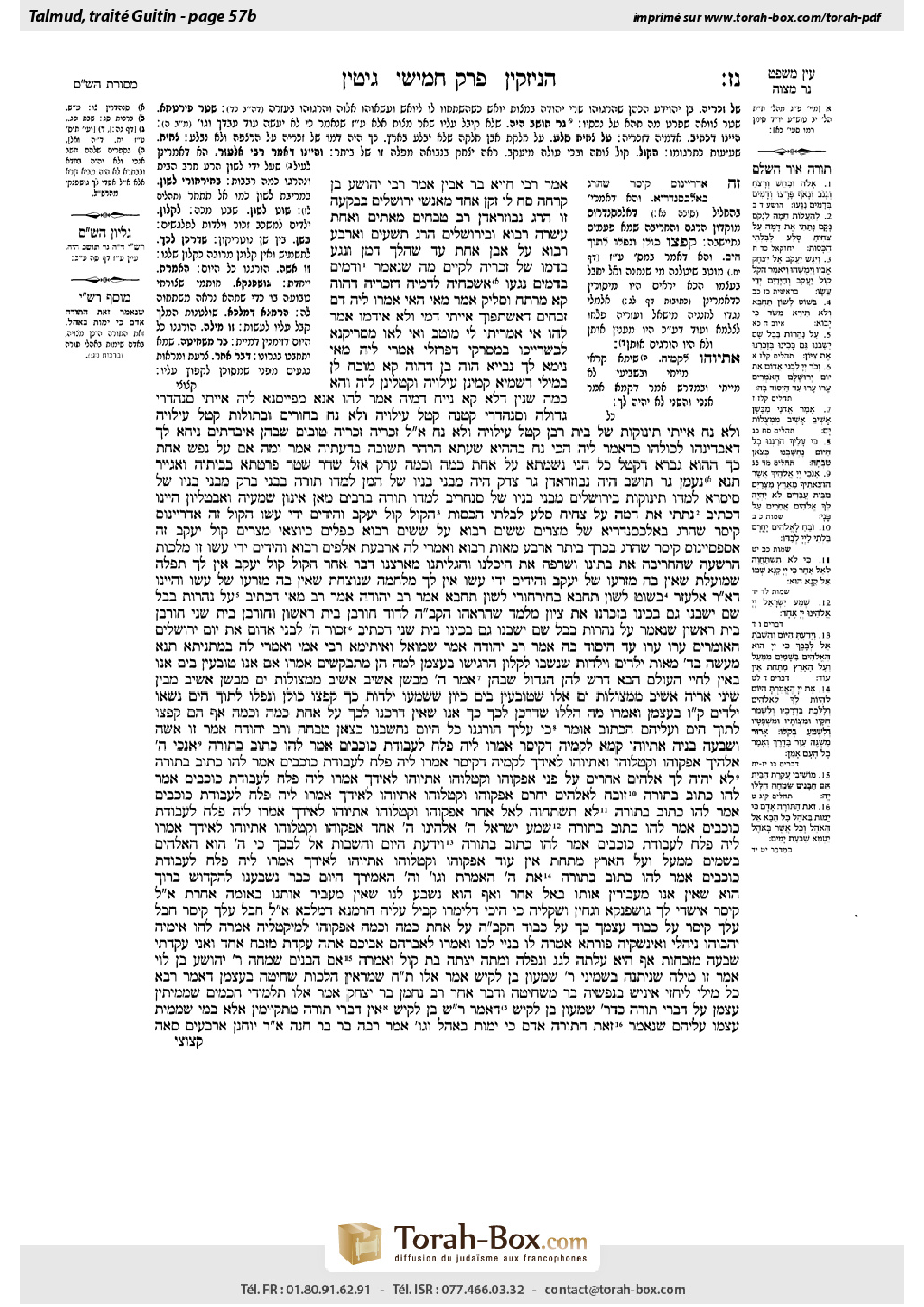
Gittin 57b: Talmud study for Daf Yomi
Study the Talmud for Daf Yomi with scanned pages, Hebrew text, English translations from Sefaria and AI-generated French translations.
Passage selection and English or AI-generated French translation are available where the scan has annotations. Daf Study is independent of Torah-Box and Sefaria.
Browse Gittin · גיטין · All tractatesGittin 57b text and translations
This page of Gittin includes the Aramaic text, an English translation and an AI-generated French translation, alongside the scan above.
גיטין נ״ז ב · Aramaic and Hebrew text
אָמַר רַבִּי חִיָּיא בַּר אָבִין אָמַר רַבִּי יְהוֹשֻׁעַ בֶּן קׇרְחָה, סָח לִי זָקֵן אֶחָד מֵאַנְשֵׁי יְרוּשָׁלַיִם: בְּבִקְעָה זוֹ הָרַג נְבוּזַרְאֲדָן רַב טַבָּחִים מָאתַיִם וְאַחַת עֶשְׂרֵה רִבּוֹא, וּבִירוּשָׁלַיִם הָרַג תִּשְׁעִים וְאַרְבַּע רִבּוֹא עַל אֶבֶן אַחַת, עַד שֶׁהָלַךְ דָּמָן וְנָגַע בְּדָמוֹ שֶׁל זְכַרְיָה, לְקַיֵּים מַה שֶּׁנֶּאֱמַר: ״וְדָמִים בְּדָמִים נָגְעוּ״.
אַשְׁכְּחֵיהּ לִדְמֵיהּ דִּזְכַרְיָה דַּהֲוָה קָא מִרְתַח וְסָלֵיק, אֲמַר: מַאי הַאי? אֲמַרוּ לֵיהּ: דַּם זְבָחִים דְּאִשְׁתְּפוּךְ. אַיְיתִי דְּמֵי וְלָא אִידְּמוֹ.
אֲמַר לְהוּ: אִי אָמְרִיתוּ לִי – מוּטָב, וְאִי לָאו – מְסָרֵיקְנָא לְבִשְׂרַיְיכוּ בְּמַסְרְקֵי דְפַרְזְלֵי. אָמְרִי לֵיהּ: מַאי נֵימָא לָךְ? נְבִיָּיא הֲוָה בַּן דַּהֲוָה קָא מוֹכַח לַן בְּמִילֵּי דִשְׁמַיָּא, קַמְינַן עִילָּוֵיהּ וּקְטַלְינַן לֵיהּ, וְהָא כַּמָּה שְׁנִין דְּלָא קָא נָיַיח דְּמֵיהּ.
אֲמַר לְהוּ: אֲנָא מְפַיֵּיסְנָא לֵיהּ. אַיְיתִי סַנְהֶדְרִי גְּדוֹלָה וְסַנְהֶדְרִי קְטַנָּה קְטַל עִילָּוֵיהּ, וְלָא נָח. בַּחוּרִים וּבְתוּלוֹת קְטַל עִילָּוֵיהּ, וְלָא נָח. אַיְיתִי תִּינוֹקוֹת שֶׁל בֵּית רַבָּן קְטַל עִילָּוֵיהּ, וְלָא נָח. אֲמַר לֵיהּ: זְכַרְיָה, זְכַרְיָה, טוֹבִים שֶׁבָּהֶן אִיבַּדְתִּים, נִיחָא לָךְ דְּאֹבְדִינְהוּ לְכוּלְּהוּ? כְּדַאֲמַר לֵיהּ הָכִי, נָח.
בְּהַהִיא שַׁעְתָּא הַרְהַר תְּשׁוּבָה בְּדַעְתֵּיהּ, אֲמַר: וּמָה אִם עַל נֶפֶשׁ אַחַת, כָּךְ; הָהוּא גַּבְרָא דִּקְטַל כׇּל הָנֵי נִשְׁמָתָא – עַל אַחַת כַּמָּה וְכַמָּה! עֲרַק, אֲזַל שַׁדַּר שְׁטַר פִּרְטְתָא בְּבֵיתֵיהּ, וְאִגַּיַּיר.
תָּנָא: נַעֲמָן גֵּר תּוֹשָׁב הָיָה; נְבוּזַרְאֲדָן גֵּר צֶדֶק הָיָה;
מִבְּנֵי בָנָיו שֶׁל הָמָן לִמְּדוּ תּוֹרָה בִּבְנֵי בְרַק; מִבְּנֵי בָנָיו שֶׁל סִיסְרָא לִמְּדוּ תִּינוֹקוֹת בִּירוּשָׁלַיִם; מִבְּנֵי בָנָיו שֶׁל סַנְחֵרִיב לִמְּדוּ תּוֹרָה בָּרַבִּים – מַאן אִינּוּן? שְׁמַעְיָה וְאַבְטַלְיוֹן.
הַיְינוּ דִּכְתִיב: ״נָתַתִּי אֶת דָּמָהּ עַל צְחִיחַ סָלַע לְבִלְתִּי הִכָּסוֹת״.
״הַקּוֹל קוֹל יַעֲקֹב וְהַיָּדַיִם יְדֵי עֵשָׂו״ – ״הַקּוֹל״, זֶה אַדְרִיָּינוּס קֵיסָר, שֶׁהָרַג בַּאֲלֶכְּסַנְדְּרִיָּא שֶׁל מִצְרַיִם שִׁשִּׁים רִבּוֹא עַל שִׁשִּׁים רִבּוֹא, כִּפְלַיִם כְּיוֹצְאֵי מִצְרַיִם. ״קוֹל יַעֲקֹב״ – זֶה אַסְפַּסְיָינוּס קֵיסָר, שֶׁהָרַג בִּכְרַךְ בֵּיתֵּר אַרְבַּע מֵאוֹת רִבּוֹא, וְאָמְרִי לַהּ: אַרְבַּעַת אֲלָפִים רִבּוֹא. ״וְהַיָּדַיִם יְדֵי עֵשָׂו״ – זוֹ מַלְכוּת הָרְשָׁעָה, שֶׁהֶחְרִיבָה אֶת בָּתֵּינוּ, וְשָׂרְפָה אֶת הֵיכָלֵנוּ, וְהִגְלְתָנוּ מֵאַרְצֵנוּ.
דָּבָר אַחֵר: ״הַקּוֹל קוֹל יַעֲקֹב״ – אֵין לְךָ תְּפִלָּה שֶׁמּוֹעֶלֶת, שֶׁאֵין בָּהּ מִזַּרְעוֹ שֶׁל יַעֲקֹב. ״וְהַיָּדַיִם יְדֵי עֵשָׂו״ – אֵין לְךָ מִלְחָמָה שֶׁנּוֹצַחַת, שֶׁאֵין בָּהּ מִזַּרְעוֹ שֶׁל עֵשָׂו.
וְהַיְינוּ דְּאָמַר רַבִּי אֶלְעָזָר: ״בְּשׁוֹט לָשׁוֹן תֵּחָבֵא״ – בְּחִירְחוּרֵי לָשׁוֹן תֵּחָבֵא. אָמַר רַב יְהוּדָה אָמַר רַב, מַאי דִּכְתִיב: ״עַל נַהֲרוֹת בָּבֶל, שָׁם יָשַׁבְנוּ גַּם בָּכִינוּ בְּזׇכְרֵנוּ אֶת צִיּוֹן״? מְלַמֵּד שֶׁהֶרְאָהוּ הַקָּדוֹשׁ בָּרוּךְ הוּא לְדָוִד חוּרְבַּן בַּיִת רִאשׁוֹן וְחוּרְבַּן בַּיִת שֵׁנִי. חוּרְבַּן בַּיִת רִאשׁוֹן – שֶׁנֶּאֱמַר: ״עַל נַהֲרוֹת בָּבֶל שָׁם יָשַׁבְנוּ גַּם בָּכִינוּ״. בַּיִת שֵׁנִי – דִּכְתִיב: ״זְכוֹר ה׳ לִבְנֵי אֱדוֹם אֵת יוֹם יְרוּשָׁלִָים, הָאוֹמְרִים עָרוּ עָרוּ עַד הַיְסוֹד בָּהּ״.
אָמַר רַב יְהוּדָה אָמַר שְׁמוּאֵל, וְאִיתֵּימָא רַבִּי אַמֵּי, וְאָמְרִי לַהּ בְּמַתְנִיתָא תָּנָא: מַעֲשֶׂה בְּאַרְבַּע מֵאוֹת יְלָדִים וִילָדוֹת שֶׁנִּשְׁבּוּ לְקָלוֹן, הִרְגִּישׁוּ בְּעַצְמָן לְמָה הֵן מִתְבַּקְּשִׁים, אָמְרוּ: אִם אָנוּ טוֹבְעִין בַּיָּם – אָנוּ בָּאִין לְחַיֵּי הָעוֹלָם הַבָּא? דָּרַשׁ לָהֶן הַגָּדוֹל שֶׁבָּהֶן: ״אָמַר ה׳ מִבָּשָׁן אָשִׁיב, אָשִׁיב מִמְּצוּלוֹת יָם״ – ״מִבָּשָׁן אָשִׁיב״, מִבֵּין שִׁינֵּי אַרְיֵה; ״אָשִׁיב מִמְּצוּלוֹת יָם״, אֵלּוּ שֶׁטּוֹבְעִין בַּיָּם.
כֵּיוָן שֶׁשָּׁמְעוּ יְלָדוֹת כָּךְ, קָפְצוּ כּוּלָּן וְנָפְלוּ לְתוֹךְ הַיָּם. נָשְׂאוּ יְלָדִים קַל וָחוֹמֶר בְּעַצְמָן, וְאָמְרוּ: מָה הַלָּלוּ, שֶׁדַּרְכָּן לְכָךְ – כָּךְ; אָנוּ, שֶׁאֵין דַּרְכֵּנוּ לְכָךְ – עַל אַחַת כַּמָּה וְכַמָּה! אַף הֵם קָפְצוּ לְתוֹךְ הַיָּם. וַעֲלֵיהֶם הַכָּתוּב אוֹמֵר: ״כִּי עָלֶיךָ הֹרַגְנוּ כׇל הַיּוֹם, נֶחְשַׁבְנוּ כְּצֹאן טִבְחָה״.
וְרַב יְהוּדָה אָמַר: זוֹ אִשָּׁה וְשִׁבְעָה בָּנֶיהָ – אַתְיוּהּ לְקַמָּא לְקַמֵּיהּ דְּקֵיסָר, אֲמַרוּ לֵיהּ: פְּלַח לַעֲבוֹדָה זָרָה! אֲמַר לְהוּ, כָּתוּב בַּתּוֹרָה: ״אָנֹכִי ה׳ אֱלֹהֶיךָ״. אַפְּקוּהּ וְקַטְלוּהּ.
אַתְיוּהּ לְאִידַּךְ לְקַמֵּיהּ דְּקֵיסָר, אֲמַרוּ לֵיהּ: פְּלַח לַעֲבוֹדָה זָרָה! אֲמַר לְהוּ, כָּתוּב בַּתּוֹרָה: ״לֹא יִהְיֶה לְךָ אֱלֹהִים אֲחֵרִים עַל פָּנָי״. אַפְּקוּהּ וְקַטְלוּהּ. אַתְיוּהּ לְאִידַּךְ, אֲמַרוּ לֵיהּ: פְּלַח לַעֲבוֹדָה זָרָה! אֲמַר לְהוּ, כָּתוּב בַּתּוֹרָה: ״זוֹבֵחַ לֵאלֹהִים יׇחֳרָם״. אַפְּקוּהּ וְקַטְלוּהּ.
אַתְיוּהּ לְאִידַּךְ, אֲמַרוּ לֵיהּ: פְּלַח לַעֲבוֹדָה זָרָה! אֲמַר לְהוּ, כָּתוּב בַּתּוֹרָה: ״לֹא תִשְׁתַּחֲוֶה לְאֵל אַחֵר״. אַפְּקוּהּ וְקַטְלוּהּ. אַתְיוּהּ לְאִידַּךְ, אֲמַרוּ לֵיהּ: פְּלַח לַעֲבוֹדָה זָרָה! אֲמַר לְהוּ, כָּתוּב בַּתּוֹרָה: ״שְׁמַע יִשְׂרָאֵל ה׳ אֱלֹהֵינוּ ה׳ אֶחָד״. אַפְּקוּהּ וְקַטְלוּהּ.
אַתְיוּהּ לְאִידַּךְ, אֲמַרוּ לֵיהּ: פְּלַח לַעֲבוֹדָה זָרָה! אֲמַר לְהוּ, כָּתוּב בַּתּוֹרָה: ״וְיָדַעְתָּ הַיּוֹם וַהֲשֵׁבוֹתָ אֶל לְבָבֶךָ, כִּי ה׳ הוּא הָאֱלֹהִים בַּשָּׁמַיִם מִמַּעַל וְעַל הָאָרֶץ מִתָּחַת, אֵין עוֹד״. אַפְּקוּהּ וְקַטְלוּהּ.
אַתְיוּהּ לְאִידַּךְ, אֲמַרוּ לֵיהּ: פְּלַח לַעֲבוֹדָה זָרָה! אֲמַר לְהוּ, כָּתוּב בַּתּוֹרָה: ״אֶת ה׳ הֶאֱמַרְתָּ וְגוֹ׳ וַה׳ הֶאֱמִירְךָ הַיּוֹם״, כְּבָר נִשְׁבַּעְנוּ לְהַקָּדוֹשׁ בָּרוּךְ הוּא שֶׁאֵין אָנוּ מַעֲבִירִין אוֹתוֹ בְּאֵל אַחֵר, וְאַף הוּא נִשְׁבַּע לָנוּ שֶׁאֵין מַעֲבִיר אוֹתָנוּ בְּאוּמָּה אַחֶרֶת.
אֲמַר לֵיהּ קֵיסָר: אֶישְׁדֵּי לָךְ גּוּשְׁפַּנְקָא וּגְחֵין וְשִׁקְלֵיהּ, כִּי הֵיכִי דְּלֵימְרוּ: קַבֵּיל עֲלֵיהּ הַרְמָנָא דְּמַלְכָּא. אֲמַר לֵיהּ: חֲבָל עֲלָךְ קֵיסָר, חֲבָל עֲלָךְ קֵיסָר; עַל כְּבוֹד עַצְמְךָ כָּךְ, עַל כְּבוֹד הַקָּדוֹשׁ בָּרוּךְ הוּא עַל אַחַת כַּמָּה וְכַמָּה!
אַפְּקוּהּ לְמִיקְטְלֵיהּ, אֲמַרָה לְהוּ אִימֵּיהּ: יַהֲבוּהּ נִיהֲלִי וְאֶינַשְּׁקֵיהּ פּוּרְתָּא. אָמְרָה לוֹ: בָּנַיי, לְכוּ וְאִמְרוּ לְאַבְרָהָם אֲבִיכֶם: אַתָּה עָקַדְתָּ מִזְבֵּחַ אֶחָד וַאֲנִי עָקַדְתִּי שִׁבְעָה מִזְבְּחוֹת! אַף הִיא עָלְתָה לַגַּג וְנָפְלָה וּמֵתָה. יָצְתָה בַּת קוֹל וְאָמְרָה: ״אֵם הַבָּנִים שְׂמֵחָה״.
רַבִּי יְהוֹשֻׁעַ בֶּן לֵוִי אָמַר: זוֹ מִילָה שֶׁנִּיתְּנָה בַּשְּׁמִינִי. רַבִּי שִׁמְעוֹן בֶּן לָקִישׁ אָמַר: אֵלּוּ תַּלְמִידֵי חֲכָמִים שֶׁמַּרְאִין הִלְכוֹת שְׁחִיטָה בְּעַצְמָן, דְּאָמַר רָבָא: כֹּל מִילֵּי לִיחְזֵי אִינִישׁ בְּנַפְשֵׁיהּ, בַּר מִשְּׁחִיטָה וְדָבָר אַחֵר.
רַב נַחְמָן בַּר יִצְחָק אָמַר: אֵלּוּ תַּלְמִידֵי חֲכָמִים שֶׁמְּמִיתִין עַצְמָן עַל דִּבְרֵי תוֹרָה, כִּדְרַבִּי שִׁמְעוֹן בֶּן לָקִישׁ – דְּאָמַר רַבִּי שִׁמְעוֹן בֶּן לָקִישׁ: אֵין דִּבְרֵי תוֹרָה מִתְקַיְּימִין אֶלָּא בְּמִי שֶׁמֵּמִית עַצְמוֹ עֲלֵיהֶם, שֶׁנֶּאֱמַר: ״זֹאת הַתּוֹרָה אָדָם כִּי יָמוּת בְּאֹהֶל וְגוֹ׳״. אָמַר רַבָּה בַּר בַּר חָנָה אָמַר רַבִּי יוֹחָנָן: אַרְבָּעִים סְאָה
Gittin 57b · English translation
§ With regard to the Babylonian exile following the destruction of the First Temple, Rabbi Ḥiyya bar Avin says that Rabbi Yehoshua ben Korḥa says: An old man from among the inhabitants of Jerusalem related to me: In this valley that lies before you, Nebuzaradan, captain of the guard of the Babylonian king Nebuchadnezzar, killed 2,110,000 people. And in Jerusalem itself he killed 940,000 people on one stone, until the blood of his victims flowed and touched the blood of Zechariah to fulfill what is stated: “And blood touches blood” (Hosea 4:2).
The Gemara clarifies the details of what happened: Nebuzaradan found the blood of Zechariah, the son of Jehoiada the priest, and saw that it was bubbling up from the ground, and he said: What is this? Those in the Temple said to him: It is sacrificial blood that had been poured there. He brought animal blood, compared it to the blood bubbling up from the ground, and saw that it was not similar to it.
Nebuzaradan said to them: If you tell me whose blood this is, it will be well for you. But if not, I will comb your flesh with iron combs. They said to him: What shall we say to you? He was a prophet among us, who used to rebuke us about heavenly matters, and we rose up against him, and killed him (II Chronicles 24:20–22), and for many years now his blood has not settled.
Nebuzaradan said to them: I will appease Zechariah. He brought the members of the Great Sanhedrin and of a lesser Sanhedrin and killed them alongside the bubbling blood, but it still did not settle. He then brought young men and virgins and killed them alongside it, but it still did not settle. He then brought schoolchildren and killed them alongside it, but it still did not settle. Finally Nebuzaradan said to him: Zechariah, Zechariah, I have killed the best of them. Would it please you if I destroyed them all? When he said this, the blood at last settled.
At that moment Nebuzaradan contemplated the idea of repentance and said to himself: If, for the death of one soul, that of Zechariah, God punishes the Jewish people in this manner, then that man, that is to say, I, who has killed all of those souls, all the more so will be I be subject to great punishment from God. He fled, sent to his house a document detailing what was to be done with his property, and converted to Judaism.
A Sage taught a baraita relating to this matter: Naaman, commander of the army of the king of Aram (see II Kings, chapter 5), was not a convert, as he did not accept all of the mitzvot, but rather he was a ger toshav, a gentile who resides in Eretz Israel and observes the seven Noahide mitzvot. Nebuzaradan, by contrast, was a convert, as explained previously.
The Gemara adds that some of Haman’s descendants studied Torah in Bnei Brak, and some of Sisera’s descendants taught children Torah in Jerusalem, and some of Sennacherib’s descendants taught Torah in public. Who are they? They are Shemaya and Avtalyon, the teachers of Hillel the Elder.
As for the incident involving the blood of Zechariah, this is alluded to by that which is written: “I have set her blood upon the bare rock that it should not be covered” (Ezekiel 24:8).
§ Apropos its discussion of the destruction of the Temple and the calamities that befell Israel, the Gemara cites the verse: “The voice is the voice of Jacob, but the hands are the hands of Esau” (Genesis 27:22), which the Sages expounded as follows: “The voice”; this is the cry stirred up by the emperor Hadrian, who caused the Jewish people to cry out when he killed six hundred thousand on six hundred thousand in Alexandria of Egypt, twice the number of men who left Egypt. “The voice of Jacob”; this is the cry aroused by the emperor Vespasian, who killed four million people in the city of Beitar. And some say: He killed forty million people. “And the hands are the hands of Esau”; this is the wicked kingdom of Rome that destroyed our Temple, burned our Sanctuary, and exiled us from our land.
Alternatively, “the voice is the voice of Jacob” means that no prayer is effective in the world unless some member of the seed of Jacob has a part in it. The second clause in the verse, “and the hands are the hands of Esau,” means that no war grants victory unless some member of the seed of Esau has a part in it.
And this is what Rabbi Elazar says: The verse that says: “You shall be hid from the scourge of the tongue” (Job 5:21), means: You shall need to hide on account of quarrels provoked by the tongue. Rav Yehuda says that Rav says: What is the meaning of that which is written: “By the rivers of Babylonia, there we sat down and wept, when we remembered Zion” (Psalms 137:1)? This teaches that the Holy One, Blessed be He, showed David the destruction of the First Temple and the destruction of the Second Temple. He saw the destruction of the First Temple, as it is stated: “By the rivers of Babylon, there we sat down and wept.” He saw the destruction of the Second Temple, as it is written later in that same psalm: “Remember, O Lord, against the children of Edom the day of Jerusalem, when they said: Raze it, raze it, to its very foundation” (Psalms 137:7), as the Second Temple was destroyed by the Romans, “the children of Edom.”
Rav Yehuda says that Shmuel says, and some say that it was Rabbi Ami who says this, and some say that it was taught in a baraita: There was an incident involving four hundred boys and girls who were taken as captives for the purpose of prostitution. These children sensed on their own what they were expected to do, and they said: If we commit suicide and drown in the sea, will we come to eternal life in the World-to-Come? The oldest child among them expounded the verse: “The Lord said, I will bring back from Bashan, I will bring them back from the depths of the sea” (Psalms 68:23). “I will bring back from Bashan,” i.e., from between the teeth [bein shen] of the lion, and “I will bring them back from the depths of the sea” is referring to those who drown in the sea for the sake of Heaven.
When the girls heard this, they all leapt and fell into the sea. The boys then drew an a fortiori inference with regard to themselves and said: If these girls, for whom sexual intercourse with men is their natural way, act in such a manner, then we, for whom sexual intercourse with men is not our natural way, should all the more so conduct ourselves likewise. They too leapt into the sea. Concerning them and others like them the verse states: “As For Your sake we are killed all the day long; we are reckoned as sheep for the slaughter” (Psalms 44:23).
And Rav Yehuda said: This verse applies to the woman and her seven sons who died as martyrs for the sake of the sanctification of God’s name. The incident occurred as follows: They brought in the first of the woman’s sons before the emperor and said to him: Worship the idol. He said to them: I cannot do so, as it is written in the Torah: “I am the Lord your God” (Exodus 20:2). They immediately took him out and killed him.
And they then brought in another son before the emperor, and said to him: Worship the idol. He said to them: I cannot do so, as it is written in the Torah: “You shall have no other gods beside Me” (Exodus 20:3). And so they took him out and killed him. They then brought in yet another son before the emperor, and said to him: Worship the idol. He said to them: I cannot do so, as it is written in the Torah: “He that sacrifices to any god, save to the Lord only, he shall be utterly destroyed” (Exodus 22:19). And so they took him out and killed him.
They then brought in another son, and said to him: Worship the idol. He said to them: I cannot do so, as it is written in the Torah: “You shall not bow down to any other god” (Exodus 34:14). And so they took him out and killed him. They then brought in yet another son, and said to him: Worship the idol. He said to them: I cannot do so, as it is written in the Torah: “Hear, O Israel, the Lord is our God, the Lord is One” (Deuteronomy 6:4). And so they took him out and killed him.
They then brought in another son, and said to him: Worship the idol. He said to them: I cannot do so, as it is written in the Torah: “Know therefore this today, and consider it in your heart, that the Lord, He is God in heaven above and upon the earth beneath; there is no other” (Deuteronomy 4:39). And so they took him out and killed him.
They then brought in yet another son, and said to him: Worship the idol. He said to them: I cannot do so, as it is written in the Torah: “You have avouched the Lord this day to be your God…and the Lord has avouched you this day to be a people for His own possession” (Deuteronomy 26:17–18). We already took an oath to the Holy One, Blessed be He, that we will not exchange Him for a different god, and He too has taken an oath to us that He will not exchange us for another nation.
It was the youngest brother who had said this, and the emperor pitied him. Seeking a way to spare the boy’s life, the emperor said to him: I will throw down my seal before you; bend over and pick it up, so that people will say that he has accepted the king’s authority [harmana]. The boy said to him: Woe [ḥaval] to you, Caesar, woe to you, Caesar. If you think that for the sake of your honor I should fulfill your command and do this, then for the sake of the honor of the Holy One, Blessed be He, all the more so should I fulfill His command.
As they were taking him out to be killed, his mother said to them: Give him to me so that I may give him a small kiss. She said to him: My son, go and say to your father Abraham, You bound one son to the altar, but I bound seven altars. She too in the end went up to the roof, fell, and died. A Divine Voice emerged and said: “A joyful mother of children” (Psalms 113:9), as she raised her children to be devoted in their service of God.
Rabbi Yehoshua ben Levi says concerning the verse: “For Your sake we are killed all the day long” (Psalms 44:23), that this is referring to circumcision, which was given for the eighth day, as the blood of our newborn sons is spilled for the sake of the covenant with God. Rabbi Shimon ben Lakish says: This verse was stated in reference to Torah scholars who demonstrate the halakhot of slaughter on themselves, meaning that they demonstrate on their own bodies how ritual slaughter should be performed and occasionally injure themselves in the process. This is as Rava says: A person may demonstrate anything using himself to illustrate the act except for slaughter and another matter, a euphemism for sexual intercourse.
Rav Naḥman bar Yitzḥak says: These people in the verse are Torah scholars who kill themselves over the words of Torah, in accordance with the statement of Rabbi Shimon ben Lakish. As Rabbi Shimon ben Lakish says: The words of the Torah endure only for one who kills himself over them, as it is stated: “This is the Torah, when a man dies in a tent” (Numbers 19:14). Rabba bar bar Ḥana says that Rabbi Yoḥanan says: Forty se’a
Gittin 57b · Traduction française (IA)
§ Concernant l'exil babylonien suivant la destruction du Premier Temple, le Rabbi Ḥiyya bar Avin dit que le Rabbi Yehoshua ben Korḥa dit : Un vieillard parmi les habitants de Jérusalem me raconta : Dans cette vallée qui se trouve devant vous, Nebuzaradan, chef de la garde du roi babylonien Nebuchadnezzar, tua 2 110 000 personnes. Et à Jérusalem même, il tua 940 000 personnes sur une seule pierre, jusqu'au sang de ses victimes coula et toucha le sang de Zacharie pour accomplir ce qui est dit : « Et le sang touche le sang » (Osée 4:2).
La Guemara clarifie les détails de ce qui s'est produit : Nebuzaradan trouva le sang de Zacharie, fils de Jéhoida le prêtre, et vit qu'il bouillait depuis le sol, et il dit : Qu'est-ce que c'est ? Ceux présents dans le Temple lui dirent : C'est le sang d'un sacrifice qui avait été versé là. Il apporta du sang d'animaux, le comparant au sang qui bouillait depuis le sol, et vit qu'il n'était pas semblable à celui-ci.
Nebuzaradan dit à ceux-ci : Si vous me dites dont est ce sang, ce sera bien pour vous. Mais si non, je vous arracherai la peau avec des brosses en fer. Ils dirent à lui : Que devons-nous vous dire ? Il était un prophète parmi nous, qui avait l'habitude de nous réprimander sur les affaires célestes, et nous nous sommes levés contre lui et l'avons tué (II Chroniques 24:20–22), et depuis de nombreuses années maintenant son sang ne s'est pas encore établi.
Nebuzaradan dit à ceux-ci : Je vais apaiser Zacharie. Il apporta les membres du Grand Sanhédrin et d'un Sanhédrin mineur et les tua avec le sang bouillonnant, mais cela ne s'apaisa pas. Il apporta ensuite des jeunes hommes et des jeunes filles et les tua avec lui, mais cela ne s'apaisa pas. Il apporta ensuite des enfants d'école et les tua avec lui, mais cela ne s'apaisa pas. Enfin Nebuzaradan dit à lui : Zacharie, Zacharie, j'ai tué les meilleurs d'entre eux. Serait-il content que je détruisisse tous ceux-ci ? Lorsqu'il dit cela, le sang s'apaisa enfin.
À ce moment-là, Nebuzaradan médita sur l'idée de la repentance et se dit : Si, pour la mort d'une seule âme, celle de Zacharie, Dieu punit le peuple juif ainsi, alors ce homme, c'est-à-dire moi, qui a tué toutes ces âmes, sera-t-il encore davantage puni par Dieu. Il s'enfuit, envoya à sa maison un document détaillant ce qui devait être fait de ses biens, et se convertit au judaïsme.
Un Sage enseigna une baraïta concernant cette affaire : Naaman, chef de l'armée du roi d'Aram (voir II Rois, chapitre 5), n'était pas un converti, car il n'acceptait pas toutes les mitsvot, mais plutôt il était un ger toshav, un gentil résidant en Eretz Israel et observant les sept mitsvot de Noé. Nebuzaradan, en revanche, était un converti, comme expliqué précédemment.
La Guemara ajoute que certains descendants d'Haman étudièrent la Torah à Bnei Brak, et certains descendants de Sisera enseignèrent la Torah aux enfants à Jérusalem, et certains descendants de Sennacherib enseignèrent la Torah en public. Qui sont-ils ? Ce sont Shemaya et Avtalyon, les maîtres de Hillel le Vieil.
En ce qui concerne l'incident lié au sang de Zacharie, cela est allégué par ce qui est écrit : "J'ai versé son sang sur la pierre nue afin qu'il ne soit pas recouvert" (Ezéchiel 24:8).
§ En ce qui concerne sa discussion sur la destruction du Temple et les calamités qui frappèrent Israël, la Guemara cite la parole : "La voix est la voix de Jacob, mais les mains sont les mains d'Ésaü" (Genèse 27:22), que les Sages ont expliqué ainsi : "La voix" ; c'est la plainte provoquée par l'empereur Hadrien, qui fit pleurer le peuple juif lorsqu'il tua six cent mille hommes, six cent mille à Alexandrie d'Égypte, double du nombre de personnes qui sortirent d'Égypte. "La voix de Jacob" ; c'est la plainte causée par l'empereur Vespasien, qui tua quatre millions de personnes dans la ville de Béthar. Et certains disent : Il tua quarante millions de personnes. "Et les mains sont les mains d'Ésaü" ; c'est le malheureux royaume de Rome qui détruisit notre Temple, brûla notre Sanctuaire et nous expulsa de notre terre.
Autrement dit, "la voix est la voix de Jacob" signifie que aucune prière n'est efficace dans le monde à moins qu'un membre de la descendance de Jacob n'en ait une part. La seconde partie de la versette, "et les mains sont les mains d'Ésaü", signifie que aucune guerre ne donne la victoire à moins qu'un membre de la descendance d'Ésaü n'en ait une part.
Et c'est ce que dit Rabbi Elazar : La versette qui dit : "Tu seras caché de la verge de la langue" (Job 5:21), signifie : Tu devras t'enfuir à cause des querelles provoquées par la langue. Rav Yehuda dit que Rav dit : Quelle est la signification de ce qui est écrit : "Au bord des rivières de Babylone, nous avons campé et pleuré, en nous souvenant de Jérusalem" (Psaumes 137:1) ? Cela enseigne que le Saint, le Très Haut, a montré à David la destruction du Premier Temple et la destruction du Second Temple. Il a vu la destruction du Premier Temple, comme il est dit : "Au bord des rivières de Babylone, nous avons campé et pleuré." Il a vu la destruction du Second Temple, comme il est écrit plus tard dans le même psalm : "Souviens-toi, Seigneur, contre les enfants d'Édom le jour de Jérusalem, lorsqu'ils dirent : Démolis-la, démolis-la, jusqu'à ses fondations" (Psaumes 137:7), car le Second Temple a été détruit par les Romains, "les enfants d'Édom."
Rav Yehuda dit que Shmuel a dit, et certains disent que c'est Rabbi Ami qui a dit cela, et d'autres disent que cela a été enseigné dans une baraïta : Il y avait un incident concernant quatre cents garçons et filles qui avaient été enlevés à des fins de prostitution. Ces enfants avaient eux-mêmes compris ce qu'on leur attendait de faire, et ils dirent : Si nous nous suicidons et que nous sombrons dans la mer, atteindrons-nous une vie éternelle dans le Monde à Venir ? Le plus âgé d'entre eux interpréta la parole : « L'Éternel a dit, je ramènerai d'Éphraïm, je ramènerai ceux-ci des profondeurs de la mer » (Psaumes 68:23). « Je ramènerai d'Éphraïm », c'est-à-dire entre les dents [bein shen] du lion, et « je ramènerai ceux-ci des profondeurs de la mer » fait référence à ceux qui sombrent dans la mer pour la cause du Ciel.
Quand les filles entendirent cela, elles sautèrent toutes et tombèrent dans la mer. Les garçons firent alors une déduction a fortiori concernant eux-mêmes et dirent : Si ces filles, pour qui l'acte sexuel avec les hommes est leur manière naturelle, agissent ainsi, nous, pour qui l'acte sexuel avec les hommes n'est pas notre manière naturelle, devons encore davantage nous comporter ainsi. Ils sautèrent donc également dans la mer. En ce qui les concerne et d'autres semblables à elles, la Sainte Écriture dit : « Pour votre compte nous sommes tués tous les jours ; nous sommes comptés comme des brebis à la boucherie » (Psaumes 44:23).
Et Rav Yehuda dit : Cette versette s'applique à la femme et à ses sept fils qui moururent comme martyrs pour la sanctification du nom de Dieu. L'incident se passa ainsi : Ils amenèrent le premier des fils de la femme devant l'empereur et dirent à lui : Adore l'idole. Il leur dit : Je ne peux pas le faire, car il est écrit dans la Torah : « Je suis le Seigneur votre Dieu » (Exode 20:2). Ils le sortirent immédiatement et le tuèrent.
Et ils amenèrent alors un autre fils devant l'empereur et dirent à lui : Adore l'idole. Il leur dit : Je ne peux pas le faire, car il est écrit dans la Torah : « Tu n'auras pas d'autres dieux outre Moi » (Exode 20:3). Et ainsi ils le sortirent et le tuèrent. Ils amenèrent alors un autre fils devant l'empereur et dirent à lui : Adore l'idole. Il leur dit : Je ne peux pas le faire, car il est écrit dans la Torah : « Celui qui sacrifie à un dieu quelconque, à l'exception du Seigneur seul, sera détruit de toute éternité » (Exode 22:19). Et ainsi ils le sortirent et le tuèrent.
Ils amenèrent alors un autre fils et dirent à lui : Adore l'idole. Il leur dit : Je ne peux pas le faire, car il est écrit dans la Torah : « Tu ne te prosterneras pas devant aucun autre dieu » (Exode 34:14). Et ainsi ils le sortirent et le tuèrent. Ils amenèrent alors un autre fils et dirent à lui : Adore l'idole. Il leur dit : Je ne peux pas le faire, car il est écrit dans la Torah : « Écoute, Israël, le Seigneur est notre Dieu, le Seigneur est un » (Deutéronome 6:4). Et ainsi ils le sortirent et le tuèrent.
Ils amenèrent alors un autre fils et dirent à lui : Adore l'idole. Il leur dit : Je ne peux pas le faire, car il est écrit dans la Torah : « Connais donc cela aujourd'hui, et considère-le dans ton cœur, que le Seigneur, c'est Lui, Dieu au ciel et sur la terre, et qu'il n'y a pas d'autre » (Deutéronome 4:39). Et ainsi ils le sortirent et le tuèrent.
Ils amenèrent alors un autre fils et dirent à lui : Adore l'idole. Il leur dit : Je ne peux pas le faire, car il est écrit dans la Torah : « Vous avez consacré le Seigneur aujourd'hui à être votre Dieu, et le Seigneur a consacré vous-même aujourd'hui à être un peuple pour Sa possession » (Deutéronome 26:17–18). Nous avons déjà pris serment devant le Saint, béni soit-Il, que nous ne le remplacerons pas par un autre dieu, et Il lui-même a pris serment envers nous qu'Il ne nous remplacera pas par une autre nation.
C'était le jeune frère qui avait dit cela, et l'empereur pitié pour lui. Cherchant un moyen de sauver la vie du garçon, l'empereur lui dit : Je vais poser mon sceau devant toi ; incline-toi et prends-le, afin que les gens disent qu'il a accepté l'autorité du roi [harmana]. Le garçon lui répondit : Malheur [ḥaval] à toi, César, malheur à toi, César. Si tu penses que pour ton honneur je devrais exécuter ta commande et le faire, alors pour l'honneur du Saint, béni soit-Il, encore davantage devrais-je exécuter Sa commande.
Alors qu'ils le sortaient pour le tuer, sa mère leur dit : Donnez-le-moi afin que je puisse lui donner un petit baiser. Elle lui dit : Mon fils, va et dis à ton père Abraham : Tu as lié un fils à l'autel, mais moi j'ai lié sept autels. Elle aussi, à la fin, monta sur le toit, tomba et mourut. Une Voix Divine s'éleva et dit : « Une mère joyeuse d'enfants » (Psaumes 113:9), car elle éleva ses enfants pour servir Dieu avec dévotion.
Le Rabbi Yéhoshua ben Levi dit concernant la verset : « Pour ton compte nous sommes tués toute la journée » (Psaumes 44:23), que cela fait référence à la circoncision, donnée le huitième jour, car le sang de nos fils nouveaux-nés est versé pour le compte du pacte avec Dieu. Le Rabbi Shimon ben Lakish dit : Cette verset a été dite à propos des savants de la Torah qui démontrent les halakhot de la boucherie sur eux-mêmes, c'est-à-dire qu'ils démontrent sur leurs propres corps comment doit être effectuée la boucherie rituelle et s'injurent parfois dans le processus. C'est ce que dit Rava : Une personne peut démontrer n'importe quoi en utilisant son propre corps pour illustrer l'acte, sauf la boucherie et une autre chose, une expression équivoque pour l'acte sexuel.
Rav Naḥman bar Yitzḥak dit : Ces gens dans la verset sont des savants de la Torah qui se tuent pour les paroles de la Torah, conformément à la déclaration du Rabbi Shimon ben Lakish. Comme le Rabbi Shimon ben Lakish dit : Les paroles de la Torah subsistent seulement pour celui qui se tue pour elles, car il est dit : « C'est la Torah, quand un homme meurt dans une tente » (Nombres 19:14). Rabba bar bar Ḥana dit que le Rabbi Yoḥanan dit : Quarante se'a
Traduction française générée par IA à partir de l’édition anglaise de Sefaria. Vérifie toujours un passage avec le texte source.
Text from Sefaria: William Davidson Edition - Vocalized Aramaic (CC BY NC); William Davidson Edition - English (CC BY NC).