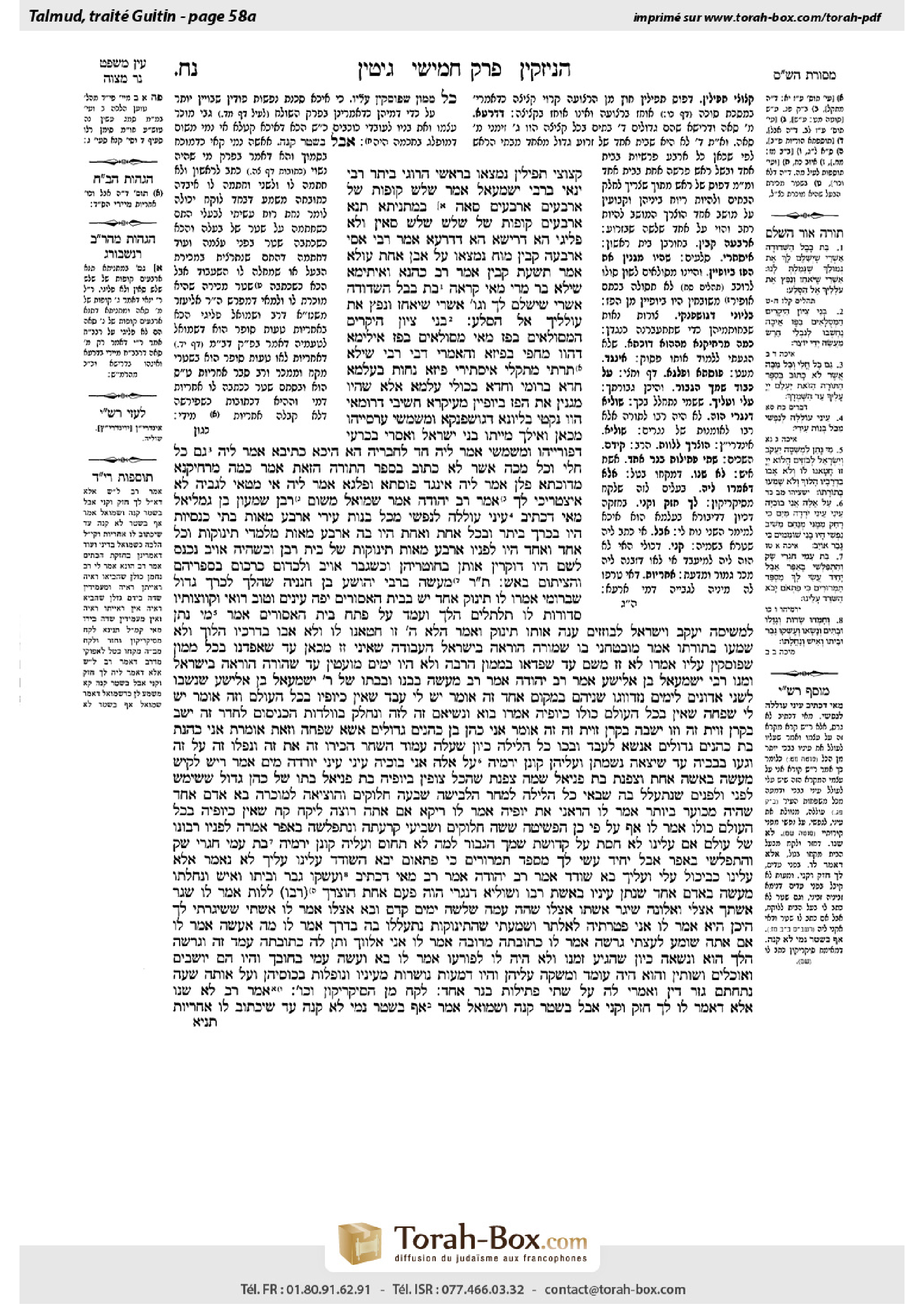
Gittin 58a: Talmud study for Daf Yomi
Study the Talmud for Daf Yomi with scanned pages, Hebrew text, English translations from Sefaria and AI-generated French translations.
Passage selection and English or AI-generated French translation are available where the scan has annotations. Daf Study is independent of Torah-Box and Sefaria.
Browse Gittin · גיטין · All tractatesGittin 58a text and translations
This page of Gittin includes the Aramaic text, an English translation and an AI-generated French translation, alongside the scan above.
גיטין נ״ח א · Aramaic and Hebrew text
קְצוּצֵי תְפִילִּין נִמְצְאוּ בְּרָאשֵׁי הֲרוּגֵי בֵיתֵּר. רַבִּי יַנַּאי בְּרַבִּי יִשְׁמָעֵאל אָמַר: שָׁלֹשׁ קוּפּוֹת שֶׁל אַרְבָּעִים אַרְבָּעִים סְאָה. בְּמַתְנִיתָא תָּנָא: אַרְבָּעִים קוּפּוֹת שֶׁל שָׁלֹשׁ שָׁלֹשׁ סְאִין.
וְלָא פְּלִיגִי: הָא דְּרֵישָׁא, הָא דִּדְרָעָא.
אָמַר רַבִּי אַסִּי: אַרְבָּעָה קַבִּין מוֹחַ נִמְצְאוּ עַל אֶבֶן אַחַת. עוּלָּא אָמַר: תִּשְׁעַת קַבִּין. אָמַר רַב כָּהֲנָא וְאִיתֵּימָא שֵׁילָא בַּר מָרִי: מַאי קְרָאָה? ״בַּת בָּבֶל הַשְּׁדוּדָה, אַשְׁרֵי שֶׁיְשַׁלֶּם לָךְ וְגוֹ׳, אַשְׁרֵי שֶׁיֹּאחֵז וְנִפֵּץ אֶת עוֹלָלַיִךְ אֶל הַסָּלַע״.
״בְּנֵי צִיּוֹן הַיְקָרִים הַמְסוּלָּאִים בַּפָּז״ – מַאי ״מְסוּלָּאִים בַּפָּז״? אִילֵּימָא דַּהֲווֹ מְחַפִּי בְּפִיזָּא, וְהָאָמְרִי דְּבֵי רַבִּי שֵׁילָא: תַּרְתֵּי מַתְקָלֵי אִיסְתֵּירֵי פִּיזָּא נְחוּת בְּעָלְמָא – חֲדָא בְּרוֹמִי, וַחֲדָא בְּכוּלֵּי עָלְמָא! אֶלָּא שֶׁהָיוּ מְגַנִּין אֶת הַפָּז בְּיוֹפְיָין.
מֵעִיקָּרָא, חֲשִׁיבִי דְרוֹמָאֵי הֲווֹ נָקְטִי בִּלְיוֹנָא דְגוּשְׁפַּנְקָא, וּמְשַׁמְּשִׁי עַרְסַיְיהוּ; מִכָּאן וְאֵילָךְ, מַיְיתוּ בְּנֵי יִשְׂרָאֵל וְאָסְרִי בְּכַרְעֵי דְּפוּרַיְיהוּ, וּמְשַׁמְּשִׁי.
אֲמַר לֵיהּ חַד לְחַבְרֵיהּ: הָא, הֵיכָא כְּתִיבָא? אֲמַר לֵיהּ: ״גַּם כׇּל חֳלִי וְכׇל מַכָּה אֲשֶׁר לֹא כָתוּב בְּסֵפֶר הַתּוֹרָה הַזֹּאת״. אֲמַר: כַּמָּה מְרַחַיקְנָא מִדּוּכְתָּא פְּלָן? אֲמַר לֵיהּ: אִינְּגֵד פּוּסְתָּא וּפַלְגָא. אֲמַר לֵיהּ: אִי מְטַאי לְגַבֵּיהּ לָא אִיצְטְרִיכִי לָךְ.
אָמַר רַב יְהוּדָה אָמַר שְׁמוּאֵל מִשּׁוּם רַבָּן שִׁמְעוֹן בֶּן גַּמְלִיאֵל, מַאי דִּכְתִיב: ״עֵינִי עוֹלְלָה לְנַפְשִׁי מִכֹּל בְּנוֹת עִירִי״? אַרְבַּע מֵאוֹת בָּתֵּי כְנֵסִיּוֹת הָיוּ בִּכְרַךְ בֵּיתֵּר, וּבְכׇל אַחַת וְאַחַת הָיוּ בָּהּ אַרְבַּע מֵאוֹת מְלַמְּדֵי תִּינוֹקוֹת, וְכׇל אֶחָד וְאֶחָד הָיוּ לְפָנָיו אַרְבַּע מֵאוֹת תִּינוֹקוֹת שֶׁל בֵּית רַבָּן,
וּכְשֶׁהָיָה אוֹיֵב נִכְנָס לְשָׁם הָיוּ דּוֹקְרִין אוֹתָן בְּחוֹטְרֵיהֶן. וּכְשֶׁגָּבַר אוֹיֵב וּלְכָדוּם, כְּרָכוּם בְּסִפְרֵיהֶם וְהִצִּיתוּם בָּאֵשׁ.
תָּנוּ רַבָּנַן: מַעֲשֶׂה בְּרַבִּי יְהוֹשֻׁעַ בֶּן חֲנַנְיָה שֶׁהָלַךְ לִכְרַךְ גָּדוֹל שֶׁבְּרוֹמִי, אָמְרוּ לוֹ: תִּינוֹק אֶחָד יֵשׁ בְּבֵית הָאֲסוּרִים, יְפֵה עֵינַיִם וְטוֹב רוֹאִי וּקְווּצּוֹתָיו סְדוּרוֹת לוֹ תַּלְתַּלִּים. הָלַךְ וְעָמַד עַל פֶּתַח בֵּית הָאֲסוּרִים, אָמַר: ״מִי נָתַן לִמְשִׁיסָּה יַעֲקֹב וְיִשְׂרָאֵל לְבוֹזְזִים״? עָנָה אוֹתוֹ תִּינוֹק וְאָמַר: ״הֲלֹא ה׳ זוּ חָטָאנוּ לוֹ וְלֹא אָבוּ בִדְרָכָיו הָלוֹךְ וְלֹא שָׁמְעוּ בְּתוֹרָתוֹ״.
אָמַר: מוּבְטְחַנִי בּוֹ שֶׁמּוֹרֶה הוֹרָאָה בְּיִשְׂרָאֵל, הָעֲבוֹדָה! שֶׁאֵינִי זָז מִכָּאן עַד שֶׁאֶפְדֶּנּוּ בְּכׇל מָמוֹן שֶׁפּוֹסְקִין עָלָיו. אָמְרוּ: לֹא זָז מִשָּׁם עַד שֶׁפְּדָאוֹ בְּמָמוֹן הַרְבֵּה, וְלֹא הָיוּ יָמִים מוּעָטִין עַד שֶׁהוֹרָה הוֹרָאָה בְּיִשְׂרָאֵל. וּמַנּוּ? רַבִּי יִשְׁמָעֵאל בֶּן אֱלִישָׁע.
אָמַר רַב יְהוּדָה אָמַר רַב: מַעֲשֶׂה בִּבְנוֹ וּבְבִתּוֹ שֶׁל רַבִּי יִשְׁמָעֵאל בֶּן אֱלִישָׁע שֶׁנִּשְׁבּוּ לִשְׁנֵי אֲדוֹנִים. לְיָמִים נִזְדַּוְּוגוּ שְׁנֵיהֶם בִּמְקוֹם אֶחָד, זֶה אוֹמֵר: יֵשׁ לִי עֶבֶד שֶׁאֵין כְּיוֹפְיוֹ בְּכׇל הָעוֹלָם, וְזֶה אוֹמֵר: יֵשׁ לִי שִׁפְחָה שֶׁאֵין בְּכׇל הָעוֹלָם כּוּלּוֹ כְּיוֹפְיָהּ.
אָמְרוּ: בּוֹא וְנַשִּׂיאֵם זֶה לָזֶה, וּנְחַלֵּק בַּוְּולָדוֹת. הִכְנִיסוּם לְחֶדֶר. זֶה יָשַׁב בְּקֶרֶן זָוִית זֶה, וְזוֹ יָשְׁבָה בְּקֶרֶן זָוִית זֶה, זֶה אוֹמֵר: אֲנִי, כֹּהֵן בֶּן כֹּהֲנִים גְּדוֹלִים, אֶשָּׂא שִׁפְחָה?! וְזֹאת אוֹמֶרֶת: אֲנִי, כֹּהֶנֶת בַּת כֹּהֲנִים גְּדוֹלִים, אֶנָּשֵׂא לְעֶבֶד?! וּבָכוּ כׇּל הַלַּיְלָה.
כֵּיוָן שֶׁעָלָה עַמּוּד הַשַּׁחַר, הִכִּירוּ זֶה אֶת זֶה, וְנָפְלוּ זֶה עַל זֶה וְגָעוּ בִּבְכִיָּה עַד שֶׁיָּצְאָה נִשְׁמָתָן. וַעֲלֵיהֶן קוֹנֵן יִרְמְיָה: ״עַל אֵלֶּה אֲנִי בוֹכִיָּה, עֵינִי עֵינִי יוֹרְדָה מַּיִם״.
אָמַר רֵישׁ לָקִישׁ: מַעֲשֶׂה בְּאִשָּׁה אַחַת, וְצָפְנַת בַּת פְּנִיאֵל שְׁמָהּ; ״צָפְנַת״ – שֶׁהַכֹּל צוֹפִין בְּיוֹפְיָהּ, ״בַּת פְּנִיאֵל״ – בִּתּוֹ שֶׁל כֹּהֵן גָּדוֹל שֶׁשִּׁימֵּשׁ לִפְנַי וְלִפְנִים;
שֶׁנִּתְעַלֵּל בָּהּ שַׁבַּאי כׇּל הַלַּיְלָה. לְמָחָר הִלְבִּישָׁהּ שִׁבְעָה חֲלוּקִים, וְהוֹצִיאָהּ לְמוֹכְרָהּ. בָּא אָדָם אֶחָד שֶׁהָיָה מְכוֹעָר בְּיוֹתֵר, אָמַר לוֹ: הַרְאֵנִי אֶת יוֹפְיָהּ. אָמַר לוֹ: רֵיקָא! אִם אַתָּה רוֹצֶה לִיקַּח – קַח, שֶׁאֵין כְּיוֹפְיָהּ בְּכׇל הָעוֹלָם כּוּלּוֹ.
אָמַר לוֹ: אַף עַל פִּי כֵן. הִפְשִׁיטָהּ שִׁשָּׁה חֲלוּקִים, וּשְׁבִיעִי קְרָעַתּוּ וְנִתְפַּלְּשָׁה בָּאֵפֶר, אָמְרָה לְפָנָיו: רִבּוֹנוֹ שֶׁל עוֹלָם, אִם עָלֵינוּ לֹא חַסְתָּ, עַל קְדוּשַּׁת שִׁמְךָ (הַגִּבּוֹר) [הַגָּדוֹל] לָמָּה לֹא תָּחוּס.
וְעָלֶיהָ קוֹנֵן יִרְמְיָה: ״בַּת עַמִּי חִגְרִי שָׂק וְהִתְפַּלְּשִׁי בָאֵפֶר, אֵבֶל יָחִיד עֲשִׂי לָךְ מִסְפַּד תַּמְרוּרִים, כִּי פִתְאוֹם יָבֹא הַשּׁוֹדֵד עָלֵינוּ״ – ״עָלַיִךְ״ לֹא נֶאֱמַר, אֶלָּא ״עָלֵינוּ״; כִּבְיָכוֹל, עָלַי וְעָלַיִךְ בָּא שׁוֹדֵד.
אָמַר רַב יְהוּדָה אָמַר רַב, מַאי דִּכְתִיב: ״וְעָשְׁקוּ גֶּבֶר וּבֵיתוֹ וְאִישׁ וְנַחֲלָתוֹ״? מַעֲשֶׂה בְּאָדָם אֶחָד שֶׁנָּתַן עֵינָיו בְּאֵשֶׁת רַבּוֹ, וּשְׁוַלְיָא דְנַגָּרֵי הֲוָה.
פַּעַם אַחַת הוּצְרַךְ (רַבּוֹ) לִלְוֹת, אָמַר לוֹ: שַׁגֵּר אִשְׁתְּךָ אֶצְלִי וְאַלְוֶנָּה. שִׁיגֵּר אִשְׁתּוֹ אֶצְלוֹ, שָׁהָה עִמָּהּ שְׁלֹשָׁה יָמִים. קָדַם וּבָא אֶצְלוֹ, אָמַר לוֹ: אִשְׁתִּי שֶׁשִּׁיגַּרְתִּי לְךָ הֵיכָן הִיא? אָמַר לוֹ: אֲנִי פְּטַרְתִּיהָ לְאַלְתַּר, וְשָׁמַעְתִּי שֶׁהַתִּינוֹקוֹת נִתְעַלְּלוּ בָּהּ בַּדֶּרֶךְ.
אָמַר לוֹ: מָה אֶעֱשֶׂה? אָמַר לוֹ: אִם אַתָּה שׁוֹמֵעַ לַעֲצָתִי, גָּרְשָׁהּ. אָמַר לוֹ: כְּתוּבָּתָהּ מְרוּבָּה. אָמַר לוֹ: אֲנִי אַלְוְוךָ וְתֵן לָהּ כְּתוּבָּתָהּ. עָמַד זֶה וְגֵרְשָׁהּ, הָלַךְ הוּא וּנְשָׂאָהּ.
כֵּיוָן שֶׁהִגִּיעַ זְמַנּוֹ וְלֹא הָיָה לוֹ לְפוֹרְעוֹ, אָמַר לוֹ: בֹּא וַעֲשֵׂה עִמִּי בְּחוֹבְךָ. וְהָיוּ הֵם יוֹשְׁבִים וְאוֹכְלִים וְשׁוֹתִין, וְהוּא הָיָה עוֹמֵד וּמַשְׁקֶה עֲלֵיהֶן, וְהָיוּ דְּמָעוֹת נוֹשְׁרוֹת מֵעֵינָיו וְנוֹפְלוֹת בְּכוֹסֵיהֶן. וְעַל אוֹתָהּ שָׁעָה נִתְחַתֵּם גְּזַר דִּין. וְאָמְרִי לַהּ: עַל שְׁתֵּי פְתִילוֹת בְּנֵר אֶחָד.
לָקַח מִן הַסִּיקָרִיקוֹן וְכוּ׳: אָמַר רַב: לֹא שָׁנוּ אֶלָּא דְּאָמַר לוֹ: ״לֵךְ, חֲזֵק וּקְנִי״, אֲבָל בִּשְׁטָר – קָנָה. וּשְׁמוּאֵל אָמַר: אַף בִּשְׁטָר נָמֵי לֹא קָנָה, עַד שֶׁיִּכְתּוֹב לוֹ אַחְרָיוּת.
Gittin 58a · English translation
of phylactery boxes were found on the heads of those killed in Beitar. Rabbi Yannai, son of Rabbi Yishmael, says: There were found three large baskets each holding forty se’a of phylactery boxes. And it was taught in a baraita: There were forty large baskets each holding three se’a.
The Gemara notes: And these Sages do not disagree: This Sage is referring to phylacteries of the head, whereas this Sage is referring to phylacteries of the arm, for owing to the different manners in which they are fashioned, they are also different in size.
Rabbi Asi says: Four kav of brains from children whose skulls were smashed were found on one stone. Ulla says: Nine kav. Rav Kahana said, and some say that it was Sheila bar Mari who said: What is the verse from which it is derived? “O daughter of Babylon, marked for devastation; happy is he who shall repay you your recompense for what you have done to us. Happy is he who shall seize and dash your little ones against the rock” (Psalms 137:8–9).
§ The verse states: “The precious sons of Zion, comparable to fine gold” (Lamentations 4:2). What is the meaning of the expression “comparable to fine gold”? If we say that it means they were covered in fine gold [piza], this is difficult; but didn’t the school of Rabbi Sheila say: Two istira weights of fine gold came down into the world, one in Rome and one in all the rest of the world. If so, it is certainly impossible to cover the inhabitants of Jerusalem with fine gold, as there is not enough of it in the entire world to do so. Rather, this means that they would be so attractive that they would disgrace fine gold because of their beauty.
The Gemara relates that initially the noblemen of Rome would keep an image imprinted on a seal by their beds and engage in sexual intercourse opposite that image, so that they would beget children of similar beauty. From this point forward, from the time of the Great Revolt, they would bring Jewish children, tie them to the foot of their beds, and engage in sexual intercourse across from them, because they were so handsome.
It is related that it once happened that they did this to two children, and one of them said to the other: Where is this affliction written in the Torah? The other said to him: As it is written: “Also every sickness, and every plague, which is not written in the book of this Torah” (Deuteronomy 28:61). The first one said: How far am I in my studies from this, i.e., how much more would I have had to learn in order to reach this verse? The other said: Had you gone on one and a half columns [pusta], you would have reached this. The first child said to the other: Had I reached this verse, I would not have needed you, as I would have known on my own that the verse was speaking about this.
Rav Yehuda says that Shmuel says in the name of Rabban Shimon ben Gamliel: What is the meaning of that which is written: “My eye affects my soul because of all the daughters of my city” (Lamentations 3:51)? There were four hundred synagogues in the city of Beitar, and in each and every one of them there were four hundred schoolteachers, and each and every one of these teachers had four hundred schoolchildren.
And when the enemy entered there, these schoolchildren stabbed them with their pens [beḥotreihen]. And when the enemy prevailed and caught them, they wrapped the children in their scrolls and lit them on fire.
The Sages taught another baraita (Tosefta, Horayot 2:5) relating to the fate of the Jewish children: There was an incident involving Rabbi Yehoshua ben Ḥananya who once went to the great city of Rome, where they said to him: There is a child in prison with beautiful eyes and an attractive appearance, and his curly hair is arranged in locks. Rabbi Yehoshua went and stood by the entrance to the prison. He said, as if speaking to himself: “Who gave Jacob for a spoil, and Israel to the robbers?” (Isaiah 42:24). That child answered by reciting the continuation of the verse: “Did not the Lord, He against Whom we have sinned, and in Whose ways they would not walk, neither were they obedient to His law?”
Rabbi Yehoshua said: I am certain that, if given the opportunity, this child will issue halakhic rulings in Israel, as he is already exceedingly wise. He said: I take an oath by the Temple service that I will not move from here until I ransom him for whatever sum of money they set for him. They said that he did not move from there until he ransomed him for a great sum of money, and not even a few days had passed when this child then issued halakhic rulings in Israel. And who was this child? This was Rabbi Yishmael ben Elisha.
Rav Yehuda says that Rav says: There was an incident involving the son and the daughter of Rabbi Yishmael ben Elisha the High Priest, who were taken captive and sold into slavery to two different masters. After some time the two masters met in a certain place. This master said: I have a male slave whose beauty is unmatched in all of the world, and that master said: I have a female slave whose beauty is unmatched in all of the world.
The two masters said: Come, let us marry these two slaves to one another and divide the children born to them between us, as they will certainly be very beautiful. They secluded them in a room. This one, the son, sat in one corner, and that one, the daughter, sat in the other corner. He said: I am a priest and the descendant of High Priests. Shall I marry a female slave? And she said: I am the daughter of a priest and the descendant of High Priests. Shall I be married to a male slave? And they wept all through the night.
When dawn arrived they recognized each other and saw that they were brother and sister. They fell on each other and burst into tears until their souls departed due to their great distress. And with regard to them and others like them, Jeremiah lamented: “For these things I weep; my eye, my eye runs down with water” (Lamentations 1:16).
Reish Lakish says: There was an incident involving a certain woman named Tzafenat bat Peniel. And why was she called this? She was called Tzafenat because they would all gaze [tzofin] at her beauty, and she was called bat Peniel because she was the daughter [bat] of the High Priest who served in the innermost sanctum [lifnai velefnim] of the Temple.
And it happened that she was taken captive and her captor abused and raped her all night. The next day he dressed her in seven garments and took her out to sell her. A certain man who was especially ugly came and said to the man who was selling her: Show me her beauty. He said to him: Good-for-nothing, if you wish to buy her then buy her, for there is no beauty like hers in all of the world.
The potential buyer said to the seller: Even so, I wish to see for myself. He removed the six outermost garments, and she herself tore the seventh, and rolled in ashes. She said before God: Master of the Universe, even if You have shown no pity to us, and have allowed us to be disgraced in this way, why have You not shown pity to the sanctity of Your mighty name by which we are called?
And with regard to her and others like her, Jeremiah lamented: “O daughter of My people, gird yourself with sackcloth and roll in ashes; make you mourning as for an only son, most bitter lamentation, for the spoiler shall suddenly come upon us” (Jeremiah 6:26). It is not stated: Upon you, but rather “upon us,” for the spoiler shall come, as it were, both over Me and over you. God Himself shares this pain and His name is also disgraced.
§ Rav Yehuda says that Rav says: What is the meaning of that which is written: “And they covet fields, and take them by violence; and houses, and take them away; so they oppress a man and his house, even a man and his heritage” (Micah 2:2)? There was an incident involving a certain man who set his eyes on his master’s wife, and he was a carpenter’s apprentice [shulya].
One time his master needed to borrow some money, and his apprentice said to him: Send your wife to me and I will lend her the money. He sent his wife to him, and the apprentice stayed with her for three days. He then went back to his master before she did, and the master said to him: Where is my wife whom I sent to you? The apprentice said to him: I sent her back immediately, but I heard that the youth abused and raped her on the way.
The master said to his apprentice: What shall I do? The apprentice said to him: If you listen to my advice, divorce her. He said to him: But her marriage contract is large and I do not have the money to pay it. The apprentice said to him: I will lend you the money, and you will give her payment of her marriage contract. The master arose and divorced her, and the apprentice went and married her.
When the time came that the debt was due, and he did not have the means with which to repay it, the apprentice said to his master: Come and work off your debt with me. And they, the apprentice and his wife, would sit and eat and drink, while he, the woman’s first husband, would stand over them and serve them their drinks. And tears would drop from his eyes and fall into their cups, and at that time the Jewish people’s sentence was sealed, for remaining silent in the face of this injustice. And some say that the Jewish people were punished for two wicks in one lamp, a euphemism for the sin of adultery committed by this couple while the master was still married to the woman.
§ The Gemara returns to the mishna, which states: If one first purchased land from a Sicarius, and afterward returned and purchased the same field from the prior landowner, so that he will be considered the legal owner of the field, his purchase is void. Rav says: They taught that the purchase is void only in a case where the prior owner says to the buyer when he came to acquire the field from him: Go, take possession of the field and thereby acquire it, as in such a case the prior owner can say that he did not actually mean to sell him the field. But if he sold it to him with a bill of sale, the buyer acquires the field. And Shmuel says: Even if he sold it to him with a bill of sale, the buyer does not acquire it unless the prior owner writes him a guarantee that if the field is repossessed by a creditor of the prior owner, the prior owner, who sold him the field, will compensate him for his loss, as by writing this guarantee he demonstrates that this is a true sale.
Gittin 58a · Traduction française (IA)
Des boîtes de phylactères ont été trouvées sur la tête de ceux tués à Béitar. Rabbi Yannai, fils de Rabbi Yishmael, dit : On a trouvé trois grandes corbeilles, chacune contenant quarante se'ah de boîtes de phylactères. Et il a été enseigné dans une baraïta : On avait quarante grandes corbeilles, chacune contenant trois se'ah.
La Guemara note : Ces Sages ne s'entendent pas : ce Sage parle des phylactères de la tête, tandis que ce Sage parle des phylactères de l'avant-bras, car, en raison des différences dans leur fabrication, ils diffèrent aussi en taille.
Rabbi Asi dit : Quatre kav de cerveaux d'enfants dont les crânes avaient été écrasés ont été trouvés sur une seule pierre. Ulla dit : Neuf kav. Rav Kahana dit, et certains disent que c'était Sheila bar Mari qui a dit : De quelle verset cela est-il tiré ? « Ô fille de Babylone, marquée pour la ruine ; heureux celui qui te rendra selon ce que tu as fait à nous. Heureux celui qui te saisira et écrasera tes petits contre la pierre » (Psaumes 137:8–9).
§ Le verset dit : « Les précieux fils de Jérusalem, comparables à l'or fin » (Lamentations 4:2). Quelle est la signification de l'expression « comparables à l'or fin » ? Si nous disons qu'il s'agit de ceux qui étaient recouverts d'or fin [piza], cela est difficile ; mais n'avait-il pas dit la maison de Rabbi Sheila : Deux poids d'istira d'or fin sont tombés dans le monde, un à Rome et un dans tout le reste du monde. Si c'est ainsi, il est certainement impossible de recouvrir les habitants de Jérusalem d'or fin, car il n'y a pas assez d'or dans tout le monde pour cela. Plutôt, cela signifie qu'ils étaient si beaux qu'ils disgraciaient l'or fin à cause de leur beauté.
La Guemara rapporte que les nobles de Rome conservaient initialement une image gravée sur un sceau à leurs côtés et faisaient l'amour face à cette image, afin d'avoir des enfants de beauté semblable. À partir de ce moment, à partir de la période de la Grande Révolte, ils apportaient des enfants juifs, les attachaient aux pieds de leurs lits et faisaient l'amour face à eux, car ils étaient si beaux.
Il est rapporté qu'un jour ils firent cela à deux enfants, et l'un d'eux dit à l'autre : Où est-ce écrit dans la Torah ? L'autre dit à lui : Comme il est écrit : « Aussi toute maladie et toute plaie qui n'est pas écrite dans le livre de cette Torah » (Deutéronome 28:61). Le premier dit : À quel point suis-je loin dans mes études de cela, c'est-à-dire à quel point dois-je encore apprendre pour atteindre ce verset ? L'autre dit : Si tu avais avancé d'une et demie colonne [pusta], tu aurais atteint cela. Le premier enfant dit à l'autre : Si j'avais atteint ce verset, je n'aurais pas eu besoin de toi, car je l'aurais su tout seul.
Rav Yehuda dit que Shmuel dit au nom de Rabban Shimon ben Gamliel : Quelle est la signification de ce qui est écrit : « Mon œil affecte mon âme à cause de toutes les filles de ma ville » (Lamentations 3:51) ? Il y avait quatre cents synagogues dans la ville de Béitar, et dans chacune d'entre elles, il y avait quatre cents maîtres d'école, et chaque maître d'école avait quatre cent élèves.
Et lorsqu'ennemis entrèrent là, ces élèves transperçaient les ennemis avec leurs stylos [beḥotreihen]. Et lorsqu'ennemis l'emportèrent et les capturèrent, ils enveloppèrent les enfants dans leurs manuscrits et les brûlèrent.
Les Sages enseignèrent une autre baraïta (Tosefta, Horayot 2:5) concernant le sort des enfants juifs : Il y avait un incident impliquant Rabbi Yehoshua ben Ḥananya qui alla une fois à la grande ville de Rome, où ils dirent à lui : Il y a un enfant en prison avec des yeux beaux et une apparence attrayante, et ses cheveux bouclés sont ordonnés en boucles. Rabbi Yehoshua alla et se tint à l'entrée de la prison. Il dit, comme s'il parlait à lui-même : « Qui a donné Jacob pour une proie, et Israel aux voleurs ? » (Isaïe 42:24). Cet enfant répondit en récitant la continuation du verset : « N'était-ce pas le Seigneur, contre lequel nous avons péché, et dans dont ils ne marchaient pas, ni ne suivaient Sa loi ? »
Rabbi Yehoshua dit : Je suis certain que, si on lui donnait l'occasion, cet enfant émettrait des décisions halakhiques en Israël, car il est déjà extrêmement sage. Il dit : Je jure par le service du Temple que je ne bougerai pas d'ici jusqu'à ce que je le rachète pour la somme qu'ils fixeront. Ils dirent qu'il ne bougea pas d'ici jusqu'à ce qu'il le rachète pour une grande somme, et pas même quelques jours s'étaient écoulés quand cet enfant émit des décisions halakhiques en Israël. Et qui était cet enfant ? C'était Rabbi Yishmael ben Elisha.
Rav Yehuda dit que Rav dit : Il y avait un incident concernant le fils et la fille de Rabbi Yishmael ben Elisha le grand prêtre, qui furent capturés et vendus en esclavage à deux maîtres différents. Après un certain temps, les deux maîtres se rencontrèrent dans un certain lieu. Ce maître dit : J'ai un esclave masculin dont la beauté est inégalée dans tout le monde, et ce maître dit : J'ai une esclave féminine dont la beauté est inégalée dans tout le monde.
Les deux maîtres dirent : Viens, marions ces deux esclaves l'un à l'autre et partageons les enfants nés d'eux entre nous, car ils seront certainement très beaux. Ils les mirent dans une pièce. Celui-ci, le fils, s'assit dans un coin, et celle-ci, la fille, s'assit dans l'autre coin. Il dit : Je suis un prêtre et descendant des grands prêtres. Dois-je épouser une esclave ? Et elle dit : Je suis la fille d'un prêtre et descendant des grands prêtres. Dois-je être mariée à un esclave ? Et ils pleurèrent toute la nuit.
Lorsque l'aube arriva, ils se reconnurent et virent qu'ils étaient frère et sœur. Ils se jetèrent l'un sur l'autre et éclatèrent en larmes jusqu'à ce que leurs âmes s'échappent à cause de leur grande détresse. Et concernant eux et d'autres comme eux, Jérémie lamentait : « Pour ces choses je pleure ; mon œil, mon œil coule de larmes » (Lamentations 1:16).
Reish Lakish dit : Il y avait un incident concernant une certaine femme nommée Tzafenat bat Peniel. Et pourquoi était-elle appelée ainsi ? Elle était appelée Tzafenat parce qu'on la contemplait tous [tzofin] pour sa beauté, et elle était appelée bat Peniel parce qu'elle était la fille [bat] du grand prêtre qui servait dans la partie la plus intime [lifnai velefnim] du Temple.
Et il arriva qu'elle fut enlevée et que son ravisseur l'abusa et la viola toute la nuit. Le lendemain, il la vêtit de sept vêtements et la sortit pour la vendre. Un certain homme qui était particulièrement laid dit à l'homme qui la vendait : Montre-moi sa beauté. Il lui répondit : Nul, si tu veux l'acheter, achète-la, car il n'y a pas de beauté semblable à la sienne dans tout le monde.
L'acheteur potentiel dit au vendeur : Même ainsi, je veux la voir moi-même. Il retira les six vêtements extérieurs, et elle-même déchira le septième et se roula dans la cendre. Elle dit devant Dieu : Seigneur du Monde, même si Tu n'as pas éprouvé de miséricorde envers nous, et as permis que nous soyons humiliés ainsi, pourquoi n'as-Tu pas éprouvé de miséricorde envers la sainteté de Ton nom puissant par lequel nous sommes appelés ?
Et concernant elle et d'autres semblables, Jérémie pleura : « Ô fille de mon peuple, attire-toi la cilice et roule-toi dans la cendre ; fais ton deuil comme pour un seul fils, lamentation la plus amère, car l'envahisseur viendra soudainement sur nous » (Jérémie 6:26). Il n'est pas dit : Sur toi, mais plutôt « sur nous », car l'envahisseur viendra, comme si c'était à la fois sur Moi et sur toi. Dieu lui-même partage cette douleur et Son nom est également profané.
§ Rav Yehuda dit que Rav dit : Quelle est la signification de ce qui est écrit : « Et ils convoitent des champs, et les prennent par la force ; et des maisons, et les prennent ; ainsi ils oppriment un homme et sa maison, même un homme et son héritage » (Micha 2:2) ? Il y avait un incident concernant un certain homme qui fixa ses yeux sur la femme de son maître, et il était un apprenti charpentier [shulya].
Une fois, son maître avait besoin de prêter de l'argent, et son apprenti lui dit : Envoie ta femme à moi et je te prêterai l'argent. Il envoya sa femme à lui, et l'apprenti resta avec elle trois jours. Il alla ensuite retrouver son maître avant qu'elle ne le fasse, et le maître lui demanda : Où est ma femme que j'ai envoyée à toi ? L'apprenti lui répondit : J'ai immédiatement renvoyé sa femme, mais j'ai entendu dire que le jeune homme l'avait abusée et violée en chemin.
Le maître demanda à son apprenti : Que dois-je faire ? L'apprenti lui dit : Si tu écoutes mon conseil, divorce-la. Il lui dit : Mais son contrat de mariage est important et je n'ai pas l'argent pour le payer. L'apprenti lui dit : Je te prêterai l'argent, et tu lui paieras son contrat de mariage. Le maître se leva et divorça d'elle, et l'apprenti alla l'épouser.
Lorsque vint le moment où la dette était due, et qu'il n'avait pas les moyens de la rembourser, l'apprenti dit à son maître : Viens et travaille avec moi pour rembourser ta dette. Et ils, l'apprenti et sa femme, s'assirent et mangèrent et burent, tandis que lui, l'homme marié à la femme, se tenait debout sur eux et leur servait à boire. Et des larmes tombaient de ses yeux et tombaient dans leurs coupes, et à ce moment-là, la sentence du peuple juif fut scellée, pour avoir resté muet face à cette injustice. Et certains disent que le peuple juif fut puni pour deux bougies dans une lampe, une expression pour le péché d'adultère commis par ce couple pendant que le maître était encore marié à la femme.
§ La Guemara reprend la Michna, qui stipule : Si l'on achète d'abord une terre d'un Sicarius, et ensuite revient et achète la même terre du propriétaire précédent, de sorte qu'on soit considéré comme le propriétaire légal de la terre, son achat est nul. Rav dit : Ils enseignèrent que l'achat est nul uniquement dans le cas où le propriétaire précédent dit à l'acheteur lorsqu'il vint acheter la terre de lui : Va, prends possession de la terre et ainsi l'acquiers, car dans ce cas le propriétaire précédent peut dire qu'il n'avait pas réellement l'intention de vendre la terre à l'acheteur. Mais si il la lui vendit avec un contrat de vente, l'acheteur acquiert la terre. Et Shmuel dit : Même si il la lui vendit avec un contrat de vente, l'acheteur ne l'acquiert pas à moins que le propriétaire précédent lui écrive une garantie disant que si la terre est reprise par un créancier du propriétaire précédent, le propriétaire précédent, qui lui avait vendu la terre, compensera sa perte, car en écrivant cette garantie il démontre que c'est une vente réelle.
Traduction française générée par IA à partir de l’édition anglaise de Sefaria. Vérifie toujours un passage avec le texte source.
Text from Sefaria: William Davidson Edition - Vocalized Aramaic (CC BY NC); William Davidson Edition - English (CC BY NC).