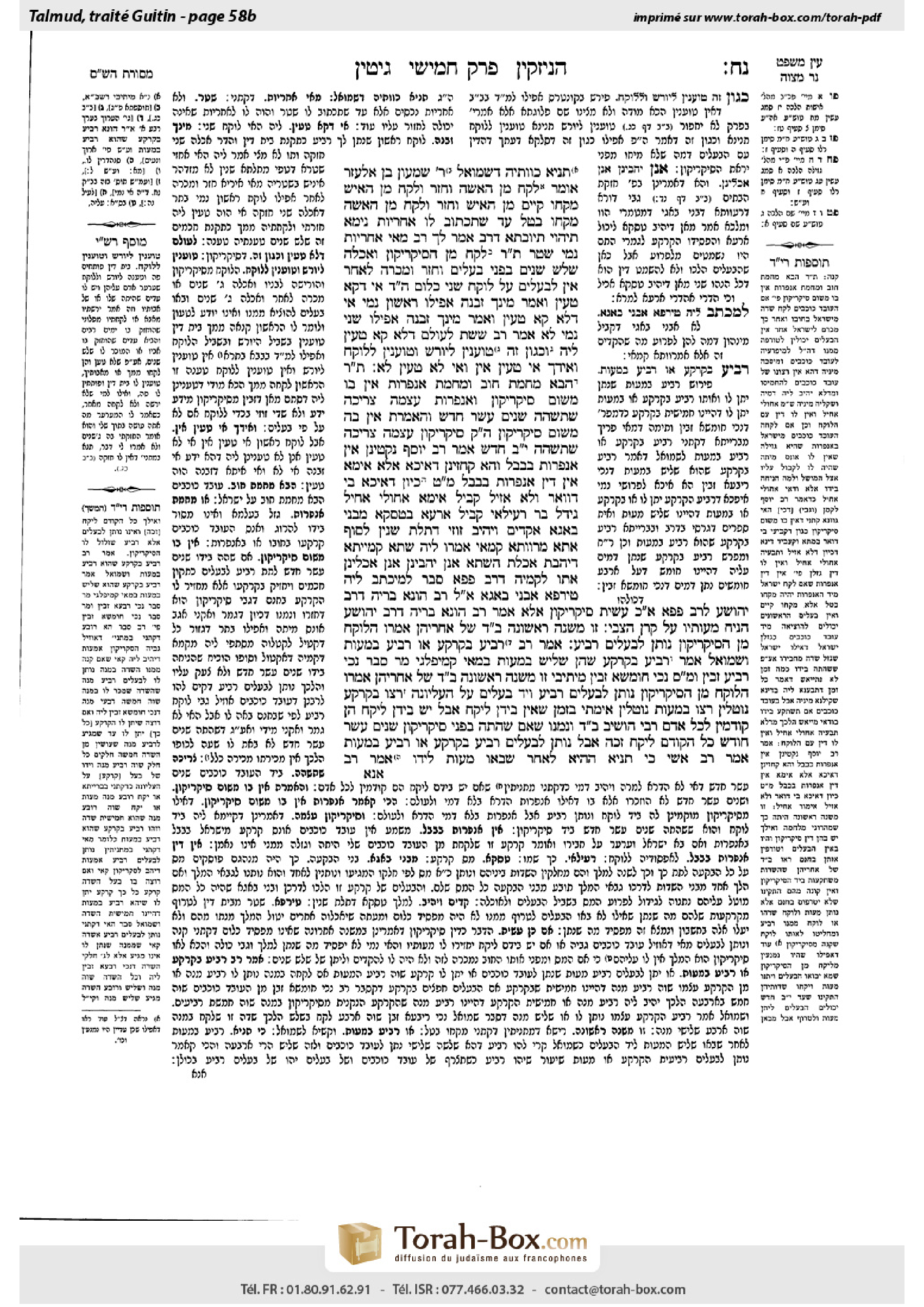
Gittin 58b: Talmud study for Daf Yomi
Study the Talmud for Daf Yomi with scanned pages, Hebrew text, English translations from Sefaria and AI-generated French translations.
Passage selection and English or AI-generated French translation are available where the scan has annotations. Daf Study is independent of Torah-Box and Sefaria.
Browse Gittin · גיטין · All tractatesGittin 58b text and translations
This page of Gittin includes the Aramaic text, an English translation and an AI-generated French translation, alongside the scan above.
גיטין נ״ח ב · Aramaic and Hebrew text
תַּנְיָא כְּווֹתֵיהּ דִּשְׁמוּאֵל, רַבִּי שִׁמְעוֹן בֶּן אֶלְעָזָר אוֹמֵר: לָקַח מִן הָאִשָּׁה, וְחָזַר וְלָקַח מִן הָאִישׁ – מִקָּחוֹ קַיָּים. מִן הָאִישׁ, וְחָזַר וְלָקַח מִן הָאִשָּׁה – מִקָּחוֹ בָּטֵל, עַד שֶׁתִּכְתּוֹב לוֹ אַחְרָיוּת.
נֵימָא תֶּיהְוֵי תְּיוּבְתָּא דְּרַב? אָמַר לְךָ רַב: מַאי ״אַחְרָיוּת״ – נָמֵי שְׁטָר.
תָּנוּ רַבָּנַן: לָקַח מִן הַסִּיקָרִיקוֹן, וַאֲכָלָהּ שָׁלֹשׁ שָׁנִים בִּפְנֵי בְּעָלִים, וְחָזַר וּמְכָרָהּ לְאַחֵר – אֵין לַבְּעָלִים עַל לוֹקֵחַ שֵׁנִי כְּלוּם.
הֵיכִי דָמֵי? אִי דְּקָא טָעֵין וְאָמַר: ״מִינָּךְ זַבְנַהּ״ – אֲפִילּוּ רִאשׁוֹן נָמֵי! אִי דְּלָא קָא טָעֵין וְאָמַר: ״מִינָּךְ זַבְנַהּ״, אֲפִילּוּ שֵׁנִי נָמֵי לָא!
אָמַר רַב שֵׁשֶׁת: לְעוֹלָם דְּלָא קָא טָעֵין לֵיהּ, וּכְגוֹן זֶה – טוֹעֲנִין לְיוֹרֵשׁ, וְטוֹעֲנִין לְלוֹקֵחַ.
וְאִידַּךְ, אִי טָעֵין – אִין, וְאִי לָא טָעֵין – לָא.
תָּנוּ רַבָּנַן: הַבָּא מֵחֲמַת חוֹב וּמֵחֲמַת אַנְפָּרוּת – אֵין בּוֹ מִשּׁוּם סִיקָרִיקוֹן, וְאַנְפָּרוּת עַצְמָהּ – צְרִיכָה שֶׁתִּשְׁהֶה שְׁנֵים עָשָׂר חֹדֶשׁ.
וְהָאָמְרַתְּ אֵין בָּהּ מִשּׁוּם סִיקָרִיקוֹן! הָכִי קָאָמַר: סִיקָרִיקוֹן עַצְמָהּ – צְרִיכָה שֶׁתִּשְׁהֶה שְׁנֵים עָשָׂר חֹדֶשׁ.
אָמַר רַב יוֹסֵף, נָקְטִינַן: אֵין אַנְפָּרוּת בְּבָבֶל. וְהָא קָחָזֵינַן דְּאִיכָּא! אֶלָּא אֵימָא: אֵין דִּין אַנְפָּרוּת בְּבָבֶל. מַאי טַעְמָא? כֵּיוָן דְּאִיכָּא בֵּי דַוּוֹאר וְלָא אָזֵיל קָבֵיל, אֵימָא אַחוֹלֵי אַחֵיל.
גִּידּוּל בַּר רְעִילַאי קַבֵּיל אַרְעָא בְּטַסְקָא מִבְּנֵי בָאגָא. אַקְדֵּים וְיָהֵיב זוּזֵי דִּתְלָת שְׁנִין. לְסוֹף אֲתָא מָרְווֹתָא קַמָּאֵי, אֲמַרוּ לֵיהּ: שַׁתָּא קַמַּיְיתָא דִּיהַבְתְּ – אֲכַלְתְּ, הַשְׁתָּא אֲנַן יָהֲבִינַן – אֲנַן אָכְלִינַן.
אֲתוֹ לְקַמֵּיהּ דְּרַב פָּפָּא, סָבַר מִיכְתַּב לֵיהּ טִירְפָא אַבְּנֵי בָאגָא. אֲמַר לֵיהּ רַב הוּנָא בְּרֵיהּ דְּרַב יְהוֹשֻׁעַ לְרַב פָּפָּא: אִם כֵּן, עָשִׂיתָ סִיקָרִיקוֹן! אֶלָּא אָמַר רַב הוּנָא בְּרֵיהּ דְּרַב יְהוֹשֻׁעַ: הִנִּיחַ מְעוֹתָיו עַל קֶרֶן הַצְּבִי.
זוֹ מִשְׁנָה רִאשׁוֹנָה. בֵּית דִּין שֶׁל אַחֲרֵיהֶן אָמְרוּ: הַלּוֹקֵחַ מִן הַסִּיקָרִיקוֹן נוֹתֵן לַבְּעָלִים רְבִיעַ: אָמַר רַב: רְבִיעַ בְּקַרְקַע, אוֹ רְבִיעַ בְּמָעוֹת. וּשְׁמוּאֵל אָמַר: רְבִיעַ בְּקַרְקַע – שֶׁהֵן שְׁלִישׁ בְּמָעוֹת.
בְּמַאי קָמִיפַּלְגִי? מָר סָבַר: נְכֵי רְבִיעַ זָבֵין, וּמָר סָבַר: נְכֵי חוּמְשָׁא זָבֵין.
מֵיתִיבִי: זוֹ מִשְׁנָה רִאשׁוֹנָה. בֵּית דִּין שֶׁל אַחֲרֵיהֶן אָמְרוּ: הַלּוֹקֵחַ מִן הַסִּיקָרִיקוֹן, נוֹתֵן לַבְּעָלִים רְבִיעַ, וְיַד בְּעָלִים עַל הָעֶלְיוֹנָה – רָצוּ בְּקַרְקַע נוֹטְלִין, רָצוּ בְּמָעוֹת נוֹטְלִין. אֵימָתַי – בִּזְמַן שֶׁאֵין בְּיָדָן לִיקַּח, אֲבָל יֵשׁ בְּיָדָן לִיקַּח – הֵן קוֹדְמִין לְכׇל אָדָם.
רַבִּי הוֹשִׁיב בֵּית דִּין וְנִמְנוּ, שֶׁאִם שָׁהֲתָה בִּפְנֵי סִיקָרִיקוֹן שְׁנֵים עָשָׂר חוֹדֶשׁ, כׇּל הַקּוֹדֵם לִיקַּח – זָכָה, אֲבָל נוֹתֵן לַבְּעָלִים רְבִיעַ בְּקַרְקַע אוֹ רְבִיעַ בְּמָעוֹת!
אָמַר רַב אָשֵׁי: כִּי תַּנְיָא הָהִיא, לְאַחַר שֶׁבָּאוּ מָעוֹת לְיָדוֹ. אָמַר רַב:
Gittin 58b · English translation
It is taught in a baraita (Tosefta 5:2) in accordance with the opinion of Shmuel that Rabbi Shimon ben Elazar says: If one first purchased a field belonging to a married woman from the wife, so that if her husband were to predecease or divorce her, the purchaser would then own it fully, and afterward he returned and purchased the same field from the husband, so that he will have the right to use it in the interim, his purchase stands. If he first acquired the field from the husband, and afterward he returned and purchased the same field from the wife, his purchase is void, unless the woman writes him a guarantee. This supports Shmuel’s opinion that only when the prior owner writes the buyer a guarantee is it assumed that he sold him the field wholeheartedly.
The Gemara asks: Let us say that this baraita is a conclusive refutation of the opinion of Rav, who said that a written bill of sale suffices and a guarantee is not required. The Gemara answers: Rav could have said to you: What is the guarantee mentioned here? It too is referring to a bill of sale, as it suffices that she sell him the field with a bill of sale, and it is not necessary for her to write him a guarantee in addition.
The Sages taught in a baraita: If one purchased land from a Sicarius and consumed its produce for three years in the presence of the prior owner, and then the one who purchased it from the Sicarius returned and sold it to another person, the prior owner has no claim against the second buyer.
The Gemara clarifies: What are the circumstances of the case? If the second buyer claims and says to the prior owner: After buying the property from the Sicarius, the first buyer returned and purchased it from you, providing you with proper reimbursement, then even the first buyer should be deemed credible if he claims that he purchased the property from the prior owner. This is because he has been physically in possession of the property for three years, and this can serve as proof that he is in fact the legal owner. And if the second buyer does not claim and say to the prior owner: He purchased the property from you, then even the second buyer should also not retain possession of the property. This is in accordance with the principle that physical possession of property that is not accompanied by a claim that the property was legally acquired cannot serve as proof of ownership.
Rav Sheshet says: Actually, it is referring to a case where the second buyer does not claim that the first buyer purchased the property from the prior owner. And although in general, physical possession of property that is not accompanied by a claim that the property was legally acquired cannot serve as proof of ownership, in a case such as this the court makes a claim on behalf of an heir and the court makes a claim on behalf of a buyer. Since heirs and buyers are generally unaware of the circumstances in which their predecessor obtained possession of the property, the court advances the claim on their behalf that it had been acquired legally.
And as to the other party, the first buyer, if he claims that he purchased the property from the prior owner, yes, he retains possession of the property, as his physical possession of the property is accompanied by a proper claim. But if he does not make such a claim, he does not retain possession, because the court does not make the claim on his behalf.
§ The Sages taught in a baraita (Tosefta 5:2): If property comes into one’s possession due to payment of a debt or due to unjust seizure [anparot] of the land by a gentile, the previously mentioned laws of Sicarii do not apply. And the unjustly seized land itself must remain in the possession of the gentile who seized it for at least twelve months before another buyer can take possession of it.
The Gemara raises an objection based on the fact that the twelve-month waiting period is relevant to the laws of Sicarii: But didn’t you say that the laws of Sicarii do not apply in this case? The Gemara answers: This is what the baraita is saying: Property purchased from the Sicarius himself must remain in his possession for at least twelve months.
Rav Yosef says that we have a tradition that there is no unjust seizure of land in Babylonia. The Gemara objects: But don’t we see that there is unjust seizure of land in Babylonia? Rather, say that there is no law of unjust seizure in Babylonia, meaning that this law is not applied in Babylonia. What is the reason for this? Since there is a regional seat of government [bei davar], and yet the owner does not go and complain before it that his property had been seized, say that he waived his rights to the property and consequently is unable to bring a claim about it.
It is related that Giddel bar Re’ilai received land from the residents of a certain valley in exchange for payment of the land tax [taska]. All of the residents of the valley would jointly pay the land tax. After some of the residents had gone away, those who remained authorized Giddel bar Re’ilai to use the land of the absentee owners, on condition that Giddel would pay the land tax on their behalf. Giddel gave the money for three years in advance, although the tax was ordinarily paid annually. Eventually, after the first year, the prior owners came and said to Giddel: With regard to the first year for which you paid the tax, you have already consumed the produce. Now we will pay the taxes and we will consume the produce, and you shall have no further rights to it.
The parties came before Rav Pappa to decide the case. At first he thought of writing for Giddel a document of authorization to repossess the property against the residents of the valley [baga], allowing Giddel to hold the land for two more years in compensation for the money that he had advanced for the taxes. Rav Huna, son of Rav Yehoshua, said to Rav Pappa: If so, you made this law like that applying to a Sicarius, and it has already been established that the law of Sicarii does not apply in Babylonia. Rather, Rav Huna, son of Rav Yehoshua, said: In this case Giddel placed his money on the horn of a deer, meaning that he himself put his money in jeopardy. The money he had advanced is regarded as a gift, and he has no right to demand that he be reimbursed.
§ The mishna teaches: This is the initial version of the mishna. Later, the court of those who came after the Sages who composed that mishna said: With regard to one who purchased a field from a Sicarius, he must give the prior owner one-fourth of the field’s value. Rav says: He gives him one-fourth of what he paid by giving him a portion of the land, or else one-fourth in money, whichever he prefers. And Shmuel says: He gives him one-fourth of the land, which is one-third of the money that he paid.
The Gemara explains: With regard to what do these amora’im disagree? One Sage, Shmuel, holds that the Sicarius sold the field to the buyer for one-fourth less than its actual value. Consequently, the buyer must return to the prior owner the amount by which he profited when he bought the property from the Sicarius, which is one-third of the money that he actually paid. And one Sage, Rav, holds that the Sicarius sold the field to the buyer for one-fifth less than its actual value. Consequently, the buyer is required to return to the prior owner only one-fifth of the actual value, which is one-fourth of what he actually paid.
The Gemara raises an objection from what is taught in a baraita: This is the initial version of the mishna. Later, the court of those who came after the Sages who composed that mishna said: With regard to one who purchased a field from a Sicarius, he must give the prior owner one-fourth of the field’s value, and the prior owner has the advantage. If he wants land, he takes what is due him in land, and if he wants money, he takes what is due him in money. When does this apply? At a time when the prior owner is unable to purchase the field himself; but if he is able to purchase it himself, he precedes anyone else.
Rabbi Yehuda HaNasi later convened a court, and they counted their votes and determined that if the field remained before, i.e., in the possession of, the Sicarius for twelve months, whoever first purchases the field acquires possession of it, but he must give the prior owner one-fourth of its value by giving him a portion of the land or one-fourth in money. This is in accordance with the statement of Rav, but it is difficult for Shmuel.
Rav Ashi said: When that baraita is taught, it is referring to one-fourth of the total amount after the money reached the prior owner’s possession. In other words, it does not refer to one-fourth of the money that the buyer paid the Sicarius, but one-fourth of the field’s actual value, which is one-third of what the buyer paid the Sicarius. Rav says:
Gittin 58b · Traduction française (IA)
Il est enseigné dans une baraïta (Tosefta 5:2) conformément à l'opinion de Shmuel que Rabbi Shimon ben Elazar dit : Si l'on achète d'abord un champ appartenant à une femme mariée auprès de la femme, de sorte que si son mari meurt ou divorce d'elle, l'acheteur possédera alors le champ entièrement, et ensuite il revient et achète le même champ auprès du mari, de sorte qu'il aura le droit d'en user pendant l'intervalle, son achat est valide. Si l'on achète d'abord le champ auprès du mari, et ensuite l'acheteur revient et achète le même champ auprès de la femme, son achat est nul, à moins que la femme ne lui écrive une garantie. Cela soutient l'opinion de Shmuel selon laquelle seul lorsqu'un propriétaire précédent écrit à l'acheteur une garantie, on considère qu'il a vendu le champ sincèrement.
Le Guemara demande : Supposons que cette baraïta constitue une réfutation définitive de l'opinion de Rav, qui disait qu'un billet de vente suffit et qu'une garantie n'est pas nécessaire. Le Guemara répond : Rav pourrait avoir dit à vous : Quel est le garantie mentionné ici ? Il s'agit également d'un billet de vente, car il suffit qu'elle lui vende le champ avec un billet de vente, et il n'est pas nécessaire qu'elle lui écrive une garantie en plus.
Les Sages ont enseigné dans une baraïta : Si l'on achète un terrain auprès d'un Sicarius et qu'on consomme ses produits pendant trois ans en présence du propriétaire précédent, et ensuite celui qui l'avait acheté auprès du Sicarius revient et le vend à une autre personne, le propriétaire précédent n'a aucun droit contre l'acheteur suivant.
Le Guemara précise : Quelles sont les circonstances de ce cas ? Si l'acheteur suivant affirme et dit au propriétaire précédent : Après avoir acheté la propriété auprès du Sicarius, l'acheteur initial est revenu et l'a achetée auprès de vous, en lui fournissant une rémunération appropriée, alors même que l'acheteur initial affirme avoir acheté la propriété auprès du propriétaire précédent, il sera considéré comme crédible. Cela est dû au fait qu'il a été en possession physique de la propriété pendant trois ans, et cela peut servir de preuve qu'il est effectivement le propriétaire légal. Et si l'acheteur suivant ne fait pas d'affirmation et ne dit pas au propriétaire précédent : Il a acheté la propriété auprès de vous, alors même que l'acheteur suivant ne devrait pas conserver la possession de la propriété. Cela s'inscrit dans le principe selon lequel la possession physique d'une propriété, sans être accompagnée d'une revendication selon laquelle la propriété a été légalement acquise, ne peut pas servir de preuve de propriété.
Rav Sheshet dit : En réalité, il s'agit d'un cas où l'acheteur suivant ne fait pas d'affirmation selon laquelle l'acheteur initial a acheté la propriété auprès du propriétaire précédent. Et bien que, en général, la possession physique d'une propriété, sans être accompagnée d'une revendication selon laquelle la propriété a été légalement acquise, ne puisse pas servir de preuve de propriété, dans un cas tel que celui-ci, la cour fait une revendication à l'endroit d'un héritier et la cour fait une revendication à l'endroit d'un acheteur. Puisque les héritiers et les acheteurs sont généralement ignorants des circonstances selon lesquelles leur prédécesseur a acquis la possession de la propriété, la cour avance la revendication à leur place selon laquelle elle avait été acquise légalement.
Et concernant l'autre partie, l'acheteur initial, si il affirme avoir acheté la propriété auprès du propriétaire précédent, oui, il conserve la possession de la propriété, car sa possession physique de la propriété est accompagnée d'une revendication appropriée. Mais si il ne fait pas cette revendication, il ne conserve pas la possession, car la cour ne fait pas la revendication à son endroit.
§ Les Sages ont enseigné dans une baraïta (Tosefta 5:2) : Si une propriété entre dans la possession d'une personne en raison du paiement d'une dette ou en raison de la saisie injuste du terrain par un non-Juif, les lois précitées concernant les Sicarii ne s'appliquent pas. Et le terrain injustement saisi lui-même doit rester en possession du non-Juif qui l'a saisi pendant au moins douze mois avant qu'un autre acheteur ne puisse en prendre possession.
Le Guemara soulève une objection en raison du fait que la période d'attente de douze mois est pertinente pour les lois des Sicarii : Mais n'avez-vous pas dit que les lois des Sicarii ne s'appliquent pas dans ce cas ? Le Guemara répond : C'est ce que la baraïta dit : La propriété achetée auprès du Sicarius lui-même doit rester en son possession pendant au moins douze mois.
Rav Yosef dit que nous avons une tradition selon laquelle il n'y a pas de saisie injuste de terrain en Babylonie. Le Guemara s'oppose : Mais ne voyons-nous pas qu'il y a une saisie injuste de terrain en Babylonie ? Plutôt, disons qu'il n'y a pas de loi de saisie injuste en Babylonie, c'est-à-dire que cette loi n'est pas appliquée en Babylonie. Quelle est la raison de cela ? Puisque il y a un siège administratif, et pourtant l'propriétaire ne va pas se plaindre devant lui que sa propriété a été saisie, disons qu'il a renoncé à ses droits sur la propriété et par conséquent il ne peut pas présenter une réclamation à ce sujet.
Il est rapporté que Giddel bar Re’ilai a reçu un terrain des habitants d'une certaine vallée en échange du paiement de la taxe foncière [taska]. Tous les habitants de la vallée paient ensemble la taxe foncière. Après que certains habitants eurent quitté, ceux qui restaient ont autorisé Giddel bar Re’ilai à utiliser la terre des propriétaires absents, sous condition que Giddel paie la taxe foncière à leur place. Giddel a versé l'argent pour trois ans à l'avance, bien que la taxe soit normalement payée annuellement. Finalement, après la première année, les propriétaires précédents sont revenus et ont dit à Giddel : Concernant la première année pour laquelle vous avez payé la taxe, vous avez déjà consommé les produits. Maintenant nous paierons les taxes et nous consommerons les produits, et vous n'aurez plus aucun droit sur cela.
Les parties sont venues devant Rav Pappa pour décider ce cas. Au début, il a pensé à écrire pour Giddel un document d'autorisation lui permettant de reprendre la propriété contre les habitants de la vallée [baga], permettant à Giddel de conserver la terre pendant deux ans de plus en compensation de l'argent qu'il avait avancé pour les impôts. Rav Huna, fils de Rav Yehoshua, a dit à Rav Pappa : Si c'est ainsi, vous avez fait cette loi comme si elle s'appliquait à un Sicarius, et il a déjà été établi que la loi des Sicarii ne s'applique pas en Babylonie. En réalité, Rav Huna, fils de Rav Yehoshua, a dit : Dans ce cas, Giddel a mis son argent sur le cor d'un cerf, c'est-à-dire qu'il a lui-même mis son argent en danger. L'argent qu'il avait avancé est considéré comme un don, et il n'a pas le droit de demander qu'il lui soit remboursé.
§ La mitsna enseigne : C'est la version initiale de la mitsna. Plus tard, le tribunal de ceux qui sont venus après les Sages qui ont composé cette mitsna a dit : Concernant celui qui achète un champ à un Sicarius, il doit donner au propriétaire précédent un quart de la valeur du champ. Rav dit : Il lui donne un quart de ce qu'il a payé, en lui donnant une part du terrain, ou bien un quart en argent, selon ce qu'il préfère. Et Shmuel dit : Il lui donne un quart du terrain, ce qui équivaut à un tiers de l'argent qu'il a payé.
La Guemara explique : À l'égard de quoi ces amora’im discutent-ils ? Un Sage, Shmuel, considère que le Sicarius a vendu le champ à l'acheteur pour un quart moins de sa valeur réelle. Par conséquent, l'acheteur doit rendre au propriétaire précédent la somme qu'il a gagnée en achetant le terrain au Sicarius, ce qui équivaut à un tiers de l'argent qu'il a effectivement payé. Un autre Sage, Rav, considère que le Sicarius a vendu le champ à l'acheteur pour un cinquième moins de sa valeur réelle. Par conséquent, l'acheteur est tenu de rendre au propriétaire précédent seulement un cinquième de la valeur réelle, ce qui équivaut à un quart de ce qu'il a effectivement payé.
La Guemara soulève une objection fondée sur ce qui est enseigné dans une baraïta : C'est la version initiale de la mitsna. Plus tard, le tribunal des Sages qui sont venus après ceux qui ont composé cette mitsna a dit : Concernant celui qui achète un champ à un Sicarius, il doit donner au propriétaire précédent un quart de la valeur du champ, et le propriétaire précédent a l'avantage. Si l'acheteur veut du terrain, il prend ce qui lui est dû en terrain, et si l'acheteur veut de l'argent, il prend ce qui lui est dû en argent. À quel moment cela s'applique-t-il ? Lorsque le propriétaire précédent n'est pas en mesure d'acheter lui-même le champ ; mais si le propriétaire précédent est en mesure d'acheter lui-même le champ, il précède tout le monde.
Rabbi Yehuda HaNasi a ensuite convoqué un tribunal, et ils ont compté leurs votes et ont décidé que si le champ restait avant, c'est-à-dire en possession du Sicarius, pendant un an, celui qui achète le champ en premier acquiert la possession de celui-ci, mais il doit donner au propriétaire précédent un quart de sa valeur en lui donnant une part du terrain ou un quart en argent. Cela correspond à l'affirmation de Rav, mais cela pose des difficultés pour Shmuel.
Rav Ashi a dit : Lorsque cette baraïta est enseignée, elle fait référence à un quart de la somme après que l'argent ait atteint la possession du propriétaire précédent. En d'autres termes, elle ne fait pas référence à un quart de l'argent que l'acheteur a payé au Sicarius, mais à un quart de la valeur réelle du champ, ce qui équivaut à un tiers de ce que l'acheteur a payé au Sicarius. Rav dit :
Traduction française générée par IA à partir de l’édition anglaise de Sefaria. Vérifie toujours un passage avec le texte source.
Text from Sefaria: William Davidson Edition - Vocalized Aramaic (CC BY NC); William Davidson Edition - English (CC BY NC).