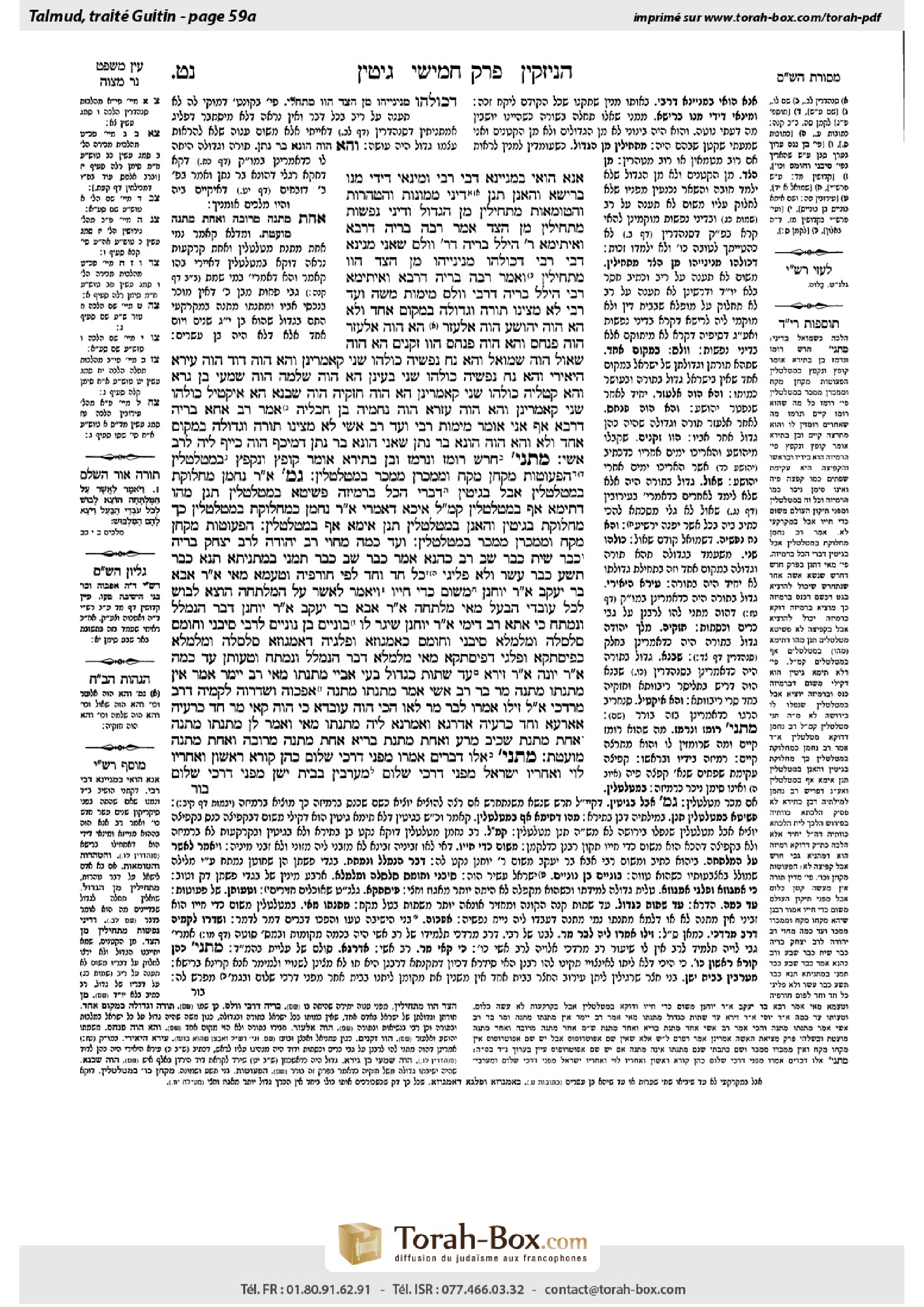
Gittin 59a: Talmud study for Daf Yomi
Study the Talmud for Daf Yomi with scanned pages, Hebrew text, English translations from Sefaria and AI-generated French translations.
Passage selection and English or AI-generated French translation are available where the scan has annotations. Daf Study is independent of Torah-Box and Sefaria.
Browse Gittin · גיטין · All tractatesGittin 59a text and translations
This page of Gittin includes the Aramaic text, an English translation and an AI-generated French translation, alongside the scan above.
גיטין נ״ט א · Aramaic and Hebrew text
אֲנָא הֲוַאי בְּמִנְיָינָא דְּבֵי רַבִּי, וּמִינַּאי דִּידִי מְנוֹ בְּרֵישָׁא.
וְהָאֲנַן תְּנַן: דִּינֵי מָמוֹנוֹת וְהַטְּהָרוֹת וְהַטְּמָאוֹת – מַתְחִילִין מִן הַגָּדוֹל, וְדִינֵי נְפָשׁוֹת מַתְחִילִין מִן הַצַּד!
אָמַר רַבָּה בְּרֵיהּ דְּרָבָא, וְאִיתֵּימָא רַבִּי הִילֵּל בְּרֵיהּ דְּרַבִּי וָולָס: שָׁאנֵי מִנְיָנָא דְּבֵי רַבִּי, דְּכוּלְּהוּ מִנְיָנַיְיהוּ מִן הַצַּד הֲווֹ מַתְחִילִין.
וְאָמַר רַבָּה בְּרֵיהּ דְּרָבָא, וְאִיתֵּימָא רַבִּי הִילֵּל בְּרֵיהּ דְּרַבִּי ווֹלֶס: מִימוֹת מֹשֶׁה וְעַד רַבִּי לֹא מָצִינוּ תּוֹרָה וּגְדוּלָּה בְּמָקוֹם אֶחָד.
וְלָא?! הָא הֲוָה יְהוֹשֻׁעַ! הֲוָה אֶלְעָזָר. הָא הֲוָה אֶלְעָזָר! הֲוָה פִּנְחָס. וְהָא הֲוָה פִּנְחָס! הֲווֹ זְקֵנִים.
הָא הֲוָה שָׁאוּל! הֲוָה שְׁמוּאֵל. וְהָא נָח נַפְשֵׁיהּ! כּוּלְּהוּ שְׁנֵי קָאָמְרִינַן. וְהָא הֲוָה דָּוִד! הֲוָה עִירָא הַיָּאִירִי.
וְהָא נָח נַפְשֵׁיהּ! כּוּלְּהוּ שְׁנֵי בָּעֵינַן. הָא הֲוָה שְׁלֹמֹה! הֲוָה שִׁמְעִי בֶּן גֵּרָא. וְהָא קַטְלֵיהּ! כּוּלְּהוּ שְׁנֵי קָאָמְרִינַן.
הָא הֲוָה חִזְקִיָּה! הֲוָה שֶׁבְנָא. הָא אִיקְּטִיל! כּוּלְּהוּ שְׁנֵי קָאָמְרִינַן. וְהָא הֲוָה עֶזְרָא! הֲוָה נְחֶמְיָה בֶּן חֲכַלְיָה.
אָמַר רַב אַחָא בְּרֵיהּ דְּרָבָא: אַף אֲנִי אוֹמֵר, מִימוֹת רַבִּי וְעַד רַב אָשֵׁי לֹא מָצִינוּ תּוֹרָה וּגְדוּלָּה בְּמָקוֹם אֶחָד. וְלָא?! וְהָא הֲוָה הוּנָא בַּר נָתָן! שָׁאנֵי הוּנָא בַּר נָתָן, דְּמֵיכָף הֲוָה כַּיִיף לֵיהּ לְרַב אָשֵׁי.
מַתְנִי׳ חֵרֵשׁ רוֹמֵז וְנִרְמָז. וּבֶן בְּתִירָא אוֹמֵר: קוֹפֵץ וְנִקְפָּץ – בְּמִטַּלְטְלִין. הַפָּעוֹטוֹת מִקָּחָן מִקָּח וּמִמְכָּרָן מִמְכָּר – בְּמִטַּלְטְלִין.
גְּמָ׳ אָמַר רַב נַחְמָן: מַחֲלוֹקֶת בְּמִטַּלְטְלִין, אֲבָל בְּגִיטִּין – דִּבְרֵי הַכֹּל בִּרְמִיזָה.
פְּשִׁיטָא, ״בְּמִטַּלְטְלִין״ תְּנַן! מַהוּ דְּתֵימָא ״אַף בְּמִטַּלְטְלִין״, קָא מַשְׁמַע לַן.
אִיכָּא דְּאָמְרִי, אָמַר רַב נַחְמָן: כְּמַחְלוֹקֶת בְּמִטַּלְטְלִין כָּךְ מַחְלוֹקֶת בְּגִיטִּין. וְהָאֲנַן ״בְּמִטַּלְטְלִין״ תְּנַן! אֵימָא: ״אַף בְּמִטַּלְטְלִין״.
הַפָּעוֹטוֹת מִקָּחָן מִקָּח וּמִמְכָּרָן מִמְכָּר – בְּמִטַּלְטְלִין. וְעַד כַּמָּה? מַחְוֵי רַב יְהוּדָה לְרַב יִצְחָק בְּרֵיהּ: כְּבַר שֵׁית – כְּבָר שַׁב. רַב כָּהֲנָא אָמַר: כְּבַר שַׁב – כְּבַר תַּמְנֵי. בְּמַתְנִיתָא תָּנָא: כְּבַר תֵּשַׁע – כְּבַר עֶשֶׂר.
וְלָא פְּלִיגִי; כֹּל חַד וְחַד לְפִי חוּרְפֵּיהּ. וְטַעְמָא מַאי? אָמַר רַבִּי אַבָּא בַּר יַעֲקֹב אָמַר רַבִּי יוֹחָנָן: מִשּׁוּם כְּדֵי חַיָּיו.
״וַיֹּאמֶר לַאֲשֶׁר עַל הַמֶּלְתָּחָה, הוֹצֵא לְבוּשׁ לְכֹל עוֹבְדֵי הַבָּעַל״ – מַאי ״מֶלְתָּחָה״? אָמַר רַבִּי אַבָּא בַּר יַעֲקֹב אָמַר רַבִּי יוֹחָנָן: דְּבַר הַנִּמְלָל וְנִמְתָּח.
כִּי אֲתָא רַב דִּימִי אָמַר רַבִּי יוֹחָנָן: שִׁיגֵּר לוֹ בּוּנְיָים בֶּן נוּנְיָים לְרַבִּי – סִיבְנִי, וְחוֹמֶס, סַלְסָלָה, וּמַלְמָלָא. סִיבְנִי וְחוֹמֶס – כְּאַמְגּוּזָא וּפַלְגֵיהּ דְּאַמְגּוּזָא. סַלְסָלָה וּמַלְמָלָא – כְּפִיסְתְּקָא וּפַלְגוּ דְּפִיסְתְּקָא. מַאי מַלְמָלָא? דָּבָר הַנִּמְלָל וְנִמְתָּח.
וְטָעוּתָן עַד כַּמָּה? אָמַר רַבִּי יוֹנָה אָמַר רַבִּי זֵירָא: עַד שְׁתוּת כְּגָדוֹל.
בָּעֵי אַבָּיֵי: מַתְּנָתוֹ, מַאי? רַב יֵימַר אֲמַר: אֵין מַתְּנָתוֹ מַתָּנָה; מָר בַּר רַב אָשֵׁי אָמַר: מַתְּנָתוֹ מַתָּנָה.
אַפְכוּהָ וְשַׁדְּרוּהָ לְקַמֵּיהּ דְּרַב מׇרְדֳּכַי. אֲמַר לֵיהּ: זִילוּ אֱמַרוּ לְבַר מָר, לָאו הָכִי הֲוָה עוֹבָדָא? כִּי הֲוָה קָאֵי מָר – חַד כַּרְעֵיהּ אַאַרְעָא וְחַד כַּרְעֵיהּ אַדַּרְגָּא, וַאֲמַרְנָא לֵיהּ: מַתְּנָתוֹ מַאי? וַאֲמַר לַן: מַתְּנָתוֹ מַתָּנָה – אַחַת מַתְּנַת שְׁכִיב מְרַע וְאַחַת מַתְּנַת בָּרִיא, אַחַת מַתָּנָה מְרוּבָּה וְאַחַת מַתָּנָה מוּעֶטֶת.
מַתְנִי׳ אֵלּוּ דְּבָרִים אָמְרוּ מִפְּנֵי דַּרְכֵי שָׁלוֹם: כֹּהֵן קוֹרֵא רִאשׁוֹן, וְאַחֲרָיו לֵוִי וְאַחֲרָיו יִשְׂרָאֵל – מִפְּנֵי דַּרְכֵי שָׁלוֹם. מְעָרְבִין בְּבַיִת יָשָׁן – מִפְּנֵי דַּרְכֵי שָׁלוֹם.
Gittin 59a · English translation
I was present for the counting of the vote in the court set up in the school of Rabbi Yehuda HaNasi when they established this ordinance, and they would start with me first, asking for my opinion on the matter, although I was the youngest member of the court.
The Gemara asks: But didn’t we learn in the mishna (Sanhedrin 32a): In cases of monetary law and in cases involving ritual purities and impurities, the judges begin their deliberations with the opinion of the most learned member sitting on the bench, as a demonstration of honor to him. But in cases of capital law, they begin their deliberations with the opinion of the youngest member who sits on one of the side benches of the court, lest the junior members be unduly influenced by the opinion of their elders, and people come to be wrongfully executed as a result. The matter involving Rav was not a capital case. Why did they begin their deliberations with Rav, who was certainly not the most learned member of the court, as that designation clearly belonged to Rabbi Yehuda HaNasi?
And Rabba, son of Rava, says, and some say that it was Rabbi Hillel, son of Rabbi Volas, who says: The counting of the vote in the court in the school of Rabbi Yehuda HaNasi was different, as all of their deliberations and countings of the vote would begin with the junior members sitting on the side. This was because Rabbi Yehuda HaNasi was held in such high esteem that once he expressed his opinion, nobody would be so brazen as to contradict him.
And apropos of the greatness of Rabbi Yehuda HaNasi, Rabba, son of Rava, says, and some say that it was Rabbi Hillel, son of Rabbi Volas, who says: From the days of Moses and until the days of Rabbi Yehuda HaNasi we do not find unparalleled greatness in Torah knowledge and unparalleled greatness in secular matters, including wealth and high political office, combined in one place, i.e., in a single individual.
The Gemara asks: But was there not such a person? Wasn’t there Joshua, who was unparalleled in both domains? The Gemara answers: During his day there was Elazar, who was Joshua’s equal in Torah knowledge. The Gemara asks: Wasn’t there Elazar, who outlived Joshua? The Gemara answers: During his day, there was Pinehas, who was Elazar’s equal in Torah knowledge. The Gemara objects: Wasn’t there Pinehas, who outlived Elazar? The Gemara answers: There were the Elders, who were equal to Pinehas in Torah knowledge.
The Gemara further objects: Wasn’t there Saul, who was unparalleled in both domains? The Gemara answers: There was Samuel, who was Saul’s equal in Torah knowledge. The Gemara asks: But didn’t Samuel pass away in Saul’s lifetime, leaving Saul the leading figure in both domains? The Gemara answers: We meant to say that from the days of Moses to the days of Rabbi Yehuda HaNasi there was no other single individual who reigned supreme in Torah and greatness for all the years that he was the leader of the Jewish people. The Gemara asks: But wasn’t there David, who was both the greatest Torah authority and the most powerful temporal authority of his day? The Gemara answers: There was Ira the Jairite, who was David’s equal in Torah knowledge.
The Gemara objects: But didn’t Ira the Jairite pass away in David’s lifetime? The Gemara answers: In order to qualify for this designation, we require that he be the leading figure in both Torah and high office for all the years that he is the leader of the Jewish people. The Gemara asks: Wasn’t there Solomon, who was unparalleled in both domains? The Gemara answers: During his day there was Shimi ben Gera, who was Solomon’s master in Torah knowledge. The Gemara objects: But didn’t Solomon kill him at the beginning of his reign (see I Kings, chapter 2)? The Gemara answers: We meant to say that from the days of Moses to the days of Rabbi Yehuda HaNasi there was no other single individual who reigned supreme in Torah and greatness all of his years.
The Gemara further objects: Wasn’t there Hezekiah, who was both the leading Torah scholar of his age and also the king of his people? The Gemara answers: There was Shebnah in that generation, who was Hezekiah’s equal in Torah knowledge. The Gemara asks: Wasn’t he killed in the war against Sennacherib? The Gemara answers: We meant to say that there was no similar individual who reigned supreme in both Torah and high office all of his years. The Gemara asks: But wasn’t there Ezra, who was the greatest Torah sage of his day and the leader of the Jewish people? The Gemara answers: There was Nehemiah ben Hacaliah who was his equal.
Rav Aḥa, son of Rava, says: I also say something similar, that from the days of Rabbi Yehuda HaNasi and until the days of Rav Ashi, we do not find unparalleled greatness in Torah knowledge and unparalleled greatness in secular matters, including wealth and high political office, combined in one place, i.e., in a single individual. The Gemara asks: But was there not such a person? But wasn’t there Huna bar Natan, who enjoyed both great Torah scholarship and great wealth, who lived during the time of Rav Ashi? The Gemara answers: Huna bar Natan is different, as he himself was subordinate to Rav Ashi, who was his superior in both domains.
MISHNA: The following enactments were also made for the betterment of the world: A deaf-mute may express his wishes through gestures [romez]; that is to say, he can signal that he wishes to buy or sell a certain item, and the purchase or sale is valid. And similarly he may respond to others through gestures; that is to say, he can signal that he agrees to a transaction initiated by another party, and the transaction is valid. And ben Beteira says: Signals are not necessary, as even if he expresses his wishes to buy or sell through lip movements [kofetz] or responds to others through lip movements, the transaction is valid. These halakhot apply to transactions involving movable property. It was similarly enacted that a purchase made by young children [paotot] is a valid purchase, and a sale made by them is a valid sale. These halakhot apply to transactions involving movable property.
GEMARA: Rav Naḥman says in clarification of the scope of the dispute between the first tanna and ben Beteira: The dispute is only with regard to the purchase or sale of movable property. But with regard to bills of divorce, all agree, even ben Beteira, that a deaf-mute can communicate only through gestures and not through lip movements.
The Gemara asks: It is obvious that this is the case, as didn’t we learn in the mishna: These halakhot apply to transactions involving movable property? The Gemara answers: Rav Naḥman’s statement is necessary, lest you say that the mishna means that these halakhot apply even to transactions involving movable property, and they similarly apply to other matters, such as bills of divorce. Therefore, Rav Naḥman teaches us that ben Beteira’s validation of lip movements applies only to transactions involving movable property, but not to bills of divorce.
There are those who say an alternative version of the previous passage, that Rav Naḥman says as follows: Just as there is a dispute between the first tanna and ben Beteira with regard to transactions involving movable property, so too, there is a dispute with regard to bills of divorce. The Gemara objects: But didn’t we learn in the mishna: These halakhot apply to transactions involving movable property? The Gemara answers: Say that the mishna means as follows: These halakhot apply even to transactions involving movable property, and similarly they apply to other matters, such as bills of divorce.
§ The mishna teaches that a purchase made by young children is a valid purchase, and a sale made by them is a valid sale. These halakhot apply to transactions involving movable property. The Gemara asks: And from what age are children included in this enactment? Rav Yehuda pointed to Rav Yitzḥak, his son: From the age of about six or seven. Rav Kahana said: From the age of about seven or eight. It was taught in a baraita: From the age of about nine or ten.
The Gemara comments: And they do not disagree about the issue itself; rather, each child is evaluated according to his sharpness. Some children are gifted and understand the nature of business transactions from an earlier age, while others are slower and do not reach the requisite understanding until they are older. The Gemara asks: What is the reason that the Sages instituted this enactment for young children? Rabbi Abba bar Ya’akov says that Rabbi Yoḥanan says: In order to provide for the child’s livelihood, as there may be times a child will have no other way to support himself but to engage in some type of business. If his transactions are not valid, he will go hungry.
Having cited a tradition reported by Rabbi Abba bar Ya’akov, the Gemara cites another such statement with regard to a different matter: The verse states: “And he said to him who was over the wardrobe [meltaḥa]: Bring forth garments for all the worshippers of the Ba’al” (II Kings 10:22). What is the meaning of the word “meltaḥa”? Rabbi Abba bar Ya’akov says that Rabbi Yoḥanan says: It is something that can be compressed and then stretched [nimlal venimtaḥ] back to its former size; i.e., a certain type of garment that can be folded up so that it is very small, and afterward unfolded so that it is very large.
When Rav Dimi came from Eretz Yisrael to Babylonia, he said that Rabbi Yoḥanan says: A wealthy man named Bonyam ben Nunyam once sent Rabbi Yehuda HaNasi a gift comprised of the following items: Sivni and ḥoms, salsela and malmala, which were all special types of linen. The Gemara explains what was unique about each of these fabrics: When folded, the sivni and ḥoms could be compressed to the size, respectively, of a nut and half a nut. When the salsela and malmala were folded, they could be compressed to the size, respectively, of a pistachio nut and half a pistachio nut. These fabrics were so thin that they could be compressed to a small size, but when they were unfolded they were large enough to cover Rabbi Yehuda HaNasi’s body. The Gemara explains further: What is the meaning of the term malmala? It is something that can be compressed and stretched.
The Gemara returns to examine the matter of the transactions of young children and asks: And up to how much is their mistake? What is the maximum amount a child can underpay or overcharge without the mistake canceling the sale? Rabbi Yona says that Rabbi Zeira says: Up to one-sixth of the article’s value, like the mistake of an adult. If the buyer or seller underpaid or overcharged up to one-sixth of the article’s true value, the wronged party can demand reimbursement. If the error in price was greater than one-sixth, the transaction is annulled.
Abaye raises a dilemma: What is the halakha with regard to a young child’s gift? Rav Yeimar says: His gift is not a valid gift. Mar bar Rav Ashi says: His gift is a valid gift.
The Sages reversed the attributions of these two statements and sent word of this dispute to Rav Mordekhai, leading him to understand that it was Mar bar Rav Ashi who said that the child’s gift is not valid. Rav Mordekhai said to them: Go say to Mar son of my Master, Rav Ashi: Wasn’t the incident as follows? When the Master, Rav Ashi, was standing with one foot on the ground and one foot on the step, we said to him: What is the halakha with regard to a young child’s gift? And he said to us: His gift is a valid gift, whether it is the gift of a person on his deathbed, who gives instructions before his death concerning the disposal of his property, or it is the gift of a healthy person, whether it is a large gift or it is a small gift. In all cases the gift is valid.
MISHNA: Having mentioned a series of enactments instituted by the Sages for the sake of the betterment of the world, the Gemara continues: These are the matters that the Sages instituted on account of the ways of peace, i.e., to foster peace and prevent strife and controversy: At public readings of the Torah, a priest reads first, and after him a Levite, and after him an Israelite. The Sages instituted this order on account of the ways of peace, so that people should not quarrel about who is the most distinguished member of the community. Similarly, the Sages enacted that a joining of courtyards is placed in an old house where it had regularly been placed on account of the ways of peace, as will be explained in the Gemara.
Gittin 59a · Traduction française (IA)
J'étais présent lors du décompte des votes dans la cour instituée dans l'école de Rabbi Yehuda HaNasi lorsqu'ils ont établi cette ordonnance, et ils commençaient par moi en premier, en me demandant mon avis sur la question, bien que j'eusse été le plus jeune membre de la cour.
La Guemara pose la question : Mais n'avons-nous pas appris dans la Michna (Sanhedrin 32a) : Dans les affaires de droit civil et dans les affaires concernant la pureté et l'impureté rituelle, les juges commencent leurs délibérations par l'opinion du membre le plus savant assis sur la tribune, comme un signe d'honneur envers lui. Mais dans les affaires de droit capital, ils commencent leurs délibérations par l'opinion du jeune membre qui siège sur l'une des tribunes latérales de la cour, afin que les membres juniors ne soient pas excessivement influencés par l'opinion de leurs aînés, et que les gens ne soient pas exécutés à tort à cause de cela. L'affaire concernant Rav n'était pas une affaire capital. Pourquoi donc ont-ils commencé leurs délibérations avec Rav, qui était certainement le moins savant parmi les membres de la cour, puisque cette désignation appartenait clairement à Rabbi Yehuda HaNasi ?
Et Rabba, fils de Rava, dit, et certains disent que c'était Rabbi Hillel, fils de Rabbi Volas, qui dit : Le décompte des votes dans la cour de l'école de Rabbi Yehuda HaNasi était différent, car toutes leurs délibérations et décomptes de votes commençaient par les membres juniors assis sur les tribunes latérales. C'était parce que Rabbi Yehuda HaNasi était considéré à un tel degré d'estime que, dès qu'il exprimait son avis, personne ne serait aussi osé pour le contredire.
Et à propos de la grandeur de Rabbi Yehuda HaNasi, Rabba, fils de Rava, dit, et certains disent que c'était Rabbi Hillel, fils de Rabbi Volas, qui dit : Depuis les jours de Moïse jusqu'aux jours de Rabbi Yehuda HaNasi, nous ne trouvons pas de grandeur inégalée dans la connaissance de la Torah et de la grandeur inégalée dans les affaires profanes, y compris la richesse et les hautes fonctions politiques, combinées dans un seul lieu, c'est-à-dire dans une seule personne.
La Guemara pose la question : Mais n'y avait-il pas une telle personne ? N'était-ce pas Josué, qui était inégalé dans les deux domaines ? La Guemara répond : Pendant sa vie, il y avait Eléazar, qui était égal à Josué en connaissance de la Torah. La Guemara pose la question : N'était-ce pas Eléazar, qui a survécu à Josué ? La Guemara répond : Pendant sa vie, il y avait Pinhas, qui était égal à Eléazar en connaissance de la Torah. La Guemara s'oppose : N'était-ce pas Pinhas, qui a survécu à Eléazar ? La Guemara répond : Il y avait les Anciens, qui étaient égaux à Pinhas en connaissance de la Torah.
La Guemara s'oppose davantage : N'était-ce pas Saül, qui était inégalé dans les deux domaines ? La Guemara répond : Il y avait Samuel, qui était égal à Saül en connaissance de la Torah. La Guemara pose la question : Mais n'est-ce pas Samuel qui est décédé pendant la vie de Saül, laissant Saül comme figure dominante dans les deux domaines ? La Guemara répond : Nous voulions dire que depuis les jours de Moïse jusqu'aux jours de Rabbi Yehuda HaNasi, il n'y avait pas d'autre individu unique qui dominait en Torah et en grandeur pendant toutes les années qu'il était le chef du peuple juif. La Guemara pose la question : N'était-ce pas David, qui était à la fois le plus grand autorité en Torah et le plus puissant autorité temporelle de son époque ? La Guemara répond : Il y avait Ir le Jairite, qui était égal à David en connaissance de la Torah.
La Guemara s'oppose : N'était-ce pas Ir le Jairite qui est décédé pendant la vie de David ? La Guemara répond : Pour qualifier pour cette désignation, nous exigeons qu'il soit la figure dominante dans les deux domaines pendant toutes les années qu'il est le chef du peuple juif. La Guemara pose la question : N'était-ce pas Salomon, qui était inégalé dans les deux domaines ? La Guemara répond : Pendant sa vie, il y avait Shimé ben Gera, qui était le maître de Salomon en connaissance de la Torah. La Guemara s'oppose : N'était-ce pas Shimé ben Gera, qui a été tué au début du règne de Salomon (voir I Rois, chapitre 2) ? La Guemara répond : Nous voulions dire que depuis les jours de Moïse jusqu'aux jours de Rabbi Yehuda HaNasi, il n'y avait pas d'autre individu unique qui dominait en Torah et en grandeur pendant toutes ses années.
La Guemara s'oppose davantage : N'était-ce pas Hachia, qui était à la fois le savant en Torah de son époque et le roi de son peuple ? La Guemara répond : Il y avait Shebnah dans cette génération, qui était égal à Hachia en connaissance de la Torah. La Guemara pose la question : N'était-ce pas lui qui a été tué dans la guerre contre Sennacherib ? La Guemara répond : Nous voulions dire qu'il n'y avait pas d'individu similaire qui dominait en Torah et en haute fonction pendant toutes ses années. La Guemara pose la question : N'était-ce pas Ezra, qui était le plus grand savant en Torah de son époque et le chef du peuple juif ? La Guemara répond : Il y avait Némiyah ben Hacaliah, qui était égal à lui.
Rav Acha, fils de Rava, dit : Je dis également quelque chose de similaire, à savoir que depuis les jours de Rabbi Yehuda HaNasi jusqu'aux jours de Rav Ashi, nous ne trouvons pas de grandeur inégalée en connaissance de la Torah et de grandeur inégalée dans les affaires profanes, y compris la richesse et les hautes fonctions politiques, combinées dans un seul lieu, c'est-à-dire dans une seule personne. La Guemara pose la question : Mais n'y avait-il pas une telle personne ? N'était-ce pas Huna bar Natan, qui possédait à la fois une grande connaissance de la Torah et une grande richesse, qui vivait pendant la période de Rav Ashi ? La Guemara répond : Huna bar Natan est différent, car il était lui-même subordonné à Rav Ashi, qui était son supérieur dans les deux domaines.
MICHNA : Les édicts suivants furent également édictés pour le bien du monde : un sourd-muet peut exprimer ses désirs par des gestes [romez] ; c'est-à-dire qu'il peut signaler qu'il souhaite acheter ou vendre un certain objet, et l'achat ou la vente est valide. De même, il peut répondre à autrui par des gestes ; c'est-à-dire qu'il peut signaler qu'il accepte une transaction initiée par une autre partie, et la transaction est valide. Et ben Bétéira dit : Les signaux ne sont pas nécessaires, car même s'il exprime ses désirs d'acheter ou de vendre par des mouvements de lèvres [kofetz] ou répond à autrui par des mouvements de lèvres, la transaction est valide. Ces halakhot s'appliquent aux transactions concernant les biens mobiliers. Il fut également édicté que l'achat réalisé par les jeunes enfants [paotot] est un achat valide, et la vente réalisée par eux est une vente valide. Ces halakhot s'appliquent aux transactions concernant les biens mobiliers.
GUEMARA : Rav Naḥman dit, dans la clarification de l'étendue du débat entre le premier tanna et ben Beteira : le débat porte uniquement sur l'achat ou la vente de biens mobiliers. Mais concernant les bills de divorce, tous s'accordent, même ben Beteira, sur le fait qu'un sourd-muet ne peut communiquer qu'à travers des gestes et non par des mouvements de lèvres.
La Guemara demande : Cela est évident, ne l'avons-nous pas appris dans la mitsna : ces halakhot s'appliquent aux transactions concernant les biens mobiliers ? La Guemara répond : la déclaration de Rav Naḥman est nécessaire, afin que l'on ne dise pas que la mitsna signifie que ces halakhot s'appliquent même aux transactions concernant les biens mobiliers, et qu'elles s'appliquent également à d'autres choses, comme les bills de divorce. Ainsi, Rav Naḥman nous enseigne que la validation des mouvements de lèvres par ben Beteira s'applique uniquement aux transactions concernant les biens mobiliers, mais pas aux bills de divorce.
Certains disent une version alternative du passage précédent, que Rav Naḥman dit comme suit : Tout comme il y a un débat entre le premier tanna et ben Beteira concernant les transactions concernant les biens mobiliers, ainsi y a-t-il un débat concernant les bills de divorce. La Guemara s'oppose : Ne l'avons-nous pas appris dans la mitsna : ces halakhot s'appliquent aux transactions concernant les biens mobiliers ? La Guemara répond : Dites que la mitsna signifie comme suit : ces halakhot s'appliquent même aux transactions concernant les biens mobiliers, et ils s'appliquent également à d'autres choses, comme les bills de divorce.
La mitsna enseigne que l'achat fait par des enfants est un achat valide, et la vente faite par eux est une vente valide. Ces halakhot s'appliquent aux transactions concernant les biens mobiliers. La Guemara demande : À partir de quel âge les enfants sont-ils inclus dans cette ordonnance ? Rav Yehuda désigna Rav Yitzḥak, son fils : à l'âge d'environ six ou sept ans. Rav Kahana dit : à l'âge d'environ sept ou huit ans. Il a été enseigné dans une baraïta : à l'âge d'environ neuf ou dix ans.
La Guemara commente : Et ils ne divergent pas sur la question elle-même ; plutôt, chaque enfant est évalué selon sa perspicacité. Certains enfants sont doués et comprennent la nature des transactions commerciales à un âge plus jeune, tandis que d'autres sont plus lents et ne parviennent pas à la compréhension nécessaire jusqu'à un âge plus avancé. La Guemara demande : Quelle est la raison pour laquelle les Sages ont institué cette ordonnance pour les enfants ? Rabbi Abba bar Ya’akov dit que Rabbi Yoḥanan dit : afin de permettre à l'enfant de subsister, car il peut y avoir des moments où un enfant n'aura pas d'autre moyen de subsistance que d'engager dans un type d'activité commerciale. Si ses transactions ne sont pas valides, il mourra de faim.
Ayant cité une tradition rapportée par Rabbi Abba bar Ya’akov, la Guemara cite une autre déclaration concernant une autre question : La parabole dit : « Et il dit à celui qui était en charge du wardrobe [meltaḥa] : Apporte des vêtements pour tous les adorateurs du Ba’al » (II Rois 10:22). Quelle est la signification du mot « meltaḥa » ? Rabbi Abba bar Ya’akov dit que Rabbi Yoḥanan dit : C'est quelque chose qui peut être comprimé et ensuite étiré [nimlal venimtaḥ] jusqu'à sa taille originale ; c'est-à-dire un certain type de vêtement qui peut être plié pour être très petit, puis déplié pour être très grand.
Quand Rav Dimi est venu de la Terre d'Israël vers Babylone, il a dit que Rabbi Yoḥanan dit : Un homme riche nommé Bonyam ben Nunyam a un jour envoyé à Rabbi Yehuda HaNasi un cadeau composé des éléments suivants : Sivni et ḥoms, salsela et malmala, qui étaient tous des types spéciaux de lin. La Guemara explique ce qui rendait ces tissus uniques : lorsqu'ils étaient pliés, le sivni et le ḥoms pouvaient être comprimés à la taille respective d'une noix et d'une demi-noix. Lorsque le salsela et le malmala étaient pliés, ils pouvaient être comprimés à la taille respective d'une noix de pistache et d'une demi-noix de pistache. Ces tissus étaient si fins qu'ils pouvaient être comprimés à une taille réduite, mais lorsqu'ils étaient dépliés, ils étaient suffisamment grands pour couvrir le corps de Rabbi Yehuda HaNasi. La Guemara explique davantage : Quelle est la signification du terme malmala ? C'est quelque chose qui peut être comprimé et étiré.
La Guemara retourne à l'examen de la question des transactions des enfants et demande : Jusqu'à quel point est-ce une erreur ? Quel est le montant maximum que l'enfant peut sous-estimer ou sur-estimer sans que l'erreur annule la vente ? Rabbi Yona dit que Rabbi Zeira dit : Jusqu'à un sixième de la valeur de l'article, comme l'erreur d'un adulte. Si l'acheteur ou le vendeur sous-estime ou sur-estime le prix jusqu'à un sixième de la valeur réelle de l'article, la partie trompée peut exiger une réparation. Si l'erreur de prix était supérieure à un sixième, la transaction est annulée.
Abaye soulève un dilemme : Quelle est la halakha concernant le don d'un enfant ? Rav Yeimar dit : Son don n'est pas un don valide. Mar bar Rav Ashi dit : Son don est un don valide.
Les Sages ont inversé les attributions de ces deux déclarations et ont envoyé un message concernant ce débat à Rav Mordekhai, ce qui l'a conduit à comprendre que c'était Mar bar Rav Ashi qui avait dit que le don de l'enfant n'était pas valide. Rav Mordekhai a dit à ceux-ci : Dites à Mar, fils de mon maître, Rav Ashi : N'était-ce pas l'incident suivant ? Quand le Maître, Rav Ashi, était debout avec un pied sur le sol et un pied sur l'escalier, nous avons dit à lui : Quelle est la halakha concernant le don d'un enfant ? Et il a dit à nous : Son don est un don valide, qu'il s'agisse du don d'une personne sur son lit de mort, qui donne des instructions avant sa mort concernant la disposition de ses biens, ou du don d'une personne en bonne santé, qu'il s'agisse d'un don important ou d'un don petit. Dans tous les cas, le don est valide.
MICHNA : Ayant mentionné une série d'ordonnances instituées par les Sages au bénéfice du monde, la Guemara continue : Ces sont les choses que les Sages ont instituées en raison des voies de paix, c'est-à-dire pour favoriser la paix et prévenir les conflits et les controverses : Lors des lectures publiques de la Torah, un prêtre lit d'abord, puis un Lévite, puis un Israélite. Les Sages ont institué cet ordre en raison des voies de paix, afin que les gens ne se disputent pas sur qui est le membre le plus distingué de la communauté. De même, les Sages ont ordonné que la jonction des courtyards soit placée dans une maison ancienne où elle avait régulièrement été placée, en raison des voies de paix, comme cela sera expliqué dans la Guemara.
Traduction française générée par IA à partir de l’édition anglaise de Sefaria. Vérifie toujours un passage avec le texte source.
Text from Sefaria: William Davidson Edition - Vocalized Aramaic (CC BY NC); William Davidson Edition - English (CC BY NC).