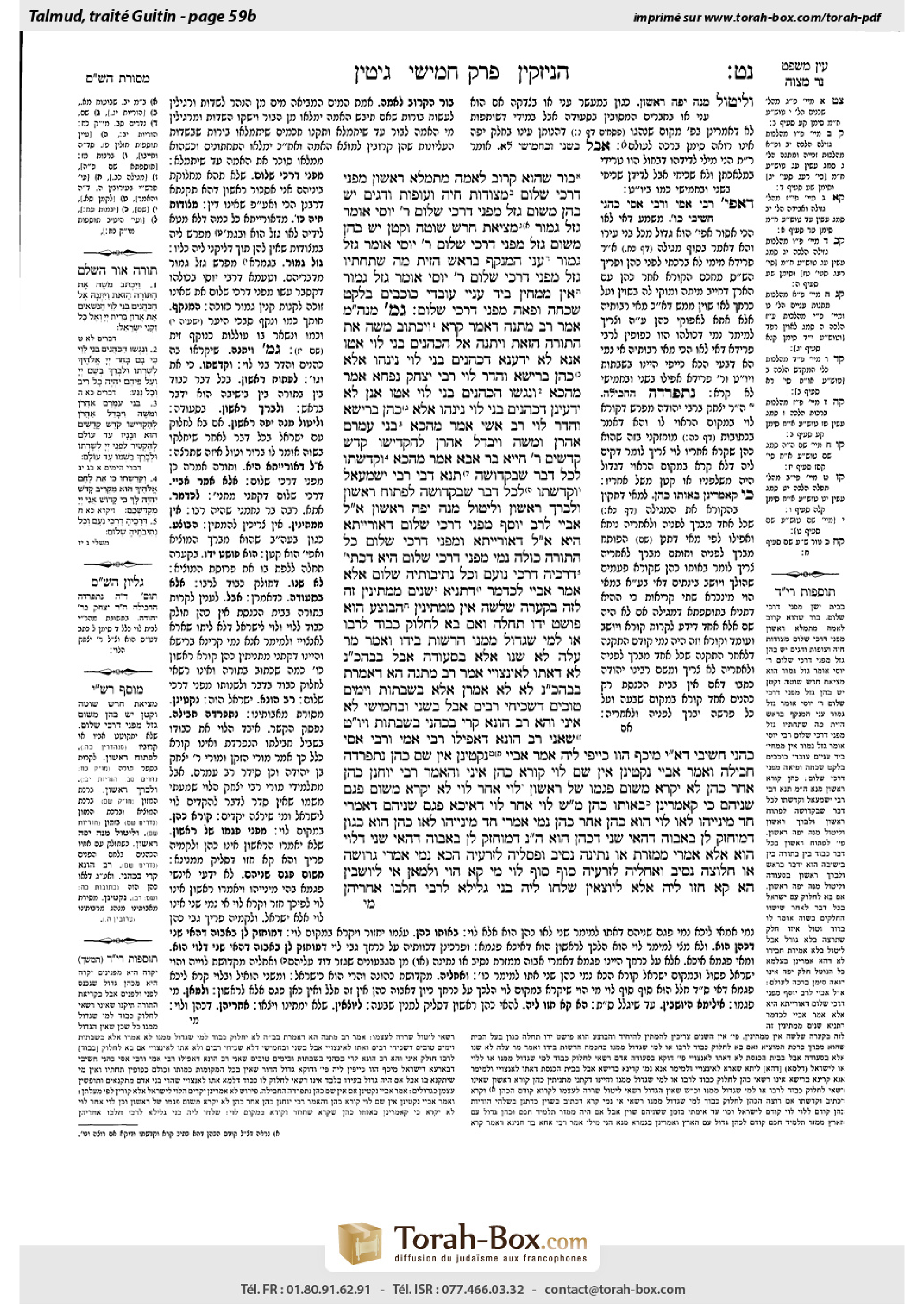
Gittin 59b: Talmud study for Daf Yomi
Study the Talmud for Daf Yomi with scanned pages, Hebrew text, English translations from Sefaria and AI-generated French translations.
Passage selection and English or AI-generated French translation are available where the scan has annotations. Daf Study is independent of Torah-Box and Sefaria.
Browse Gittin · גיטין · All tractatesGittin 59b text and translations
This page of Gittin includes the Aramaic text, an English translation and an AI-generated French translation, alongside the scan above.
גיטין נ״ט ב · Aramaic and Hebrew text
בּוֹר שֶׁהוּא קָרוֹב לָאַמָּה מִתְמַלֵּא רִאשׁוֹן – מִפְּנֵי דַּרְכֵי שָׁלוֹם.
מְצוּדוֹת חַיָּה וְעוֹפוֹת וְדָגִים, יֵשׁ בָּהֶן מִשּׁוּם גָּזֵל – מִפְּנֵי דַּרְכֵי שָׁלוֹם; רַבִּי יוֹסֵי אוֹמֵר: גָּזֵל גָּמוּר.
מְצִיאַת חֵרֵשׁ שׁוֹטֶה וְקָטָן, יֵשׁ בָּהֶן מִשּׁוּם גָּזֵל – מִפְּנֵי דַּרְכֵי שָׁלוֹם; רַבִּי יוֹסֵי אוֹמֵר: גָּזֵל גָּמוּר.
עָנִי הַמְנַקֵּף בְּרֹאשׁ הַזַּיִת, מַה שֶּׁתַּחְתָּיו גָּזֵל – מִפְּנֵי דַּרְכֵי שָׁלוֹם; רַבִּי יוֹסֵי אוֹמֵר: גָּזֵל גָּמוּר.
אֵין מְמַחִין בְּיַד עֲנִיֵּי גּוֹיִם בְּלֶקֶט שִׁכְחָה וּפֵאָה – מִפְּנֵי דַּרְכֵי שָׁלוֹם.
גְּמָ׳ מְנָא הָנֵי מִילֵּי? אָמַר רַב מַתְנָה, דְּאָמַר קְרָא: ״וַיִּכְתּוֹב מֹשֶׁה אֶת הַתּוֹרָה הַזֹּאת וַיִּתְּנָהּ אֶל הַכֹּהֲנִים בְּנֵי לֵוִי״ – אַטּוּ אֲנָא לָא יָדַעְנָא דְּכֹהֲנִים, בְּנֵי לֵוִי נִינְהוּ? אֶלָּא כֹּהֵן בְּרֵישָׁא, וַהֲדַר לֵוִי.
רַבִּי יִצְחָק נַפָּחָא אָמַר, מֵהָכָא: ״וְנִגְּשׁוּ הַכֹּהֲנִים בְּנֵי לֵוִי״ – אַטּוּ אֲנַן לָא יָדְעִינַן דְּכֹהֲנִים, בְּנֵי לֵוִי נִינְהוּ? אֶלָּא כֹּהֵן בְּרֵישָׁא, וַהֲדַר לֵוִי.
רַב אָשֵׁי אָמַר מֵהָכָא: ״בְּנֵי עַמְרָם אַהֲרֹן וּמֹשֶׁה, וַיִּבָּדֵל אַהֲרֹן לְהַקְדִּישׁוֹ קֹדֶשׁ קֳדָשִׁים״.
רַבִּי חִיָּיא בַּר אַבָּא אָמַר מֵהָכָא: ״וְקִדַּשְׁתּוֹ״ – לְכׇל דָּבָר שֶׁבִּקְדוּשָּׁה. תָּנָא דְּבֵי רַבִּי יִשְׁמָעֵאל: ״וְקִדַּשְׁתּוֹ״ – לְכׇל דָּבָר שֶׁבִּקְדוּשָּׁה; לִפְתּוֹחַ רִאשׁוֹן, וּלְבָרֵךְ רִאשׁוֹן, וְלִיטּוֹל מָנָה יָפָה רִאשׁוֹן.
אֲמַר לֵיהּ אַבָּיֵי לְרַב יוֹסֵף: מִפְּנֵי דַּרְכֵי שָׁלוֹם?! דְּאוֹרָיְיתָא הִיא! אֲמַר לֵיהּ: דְּאוֹרָיְיתָא, וּמִפְּנֵי דַּרְכֵי שָׁלוֹם.
כׇּל הַתּוֹרָה כּוּלָּהּ נָמֵי מִפְּנֵי דַּרְכֵי שָׁלוֹם הִיא, דִּכְתִיב: ״דְּרָכֶיהָ דַרְכֵי נוֹעַם וְכׇל נְתִיבוֹתֶיהָ שָׁלוֹם״!
אֶלָּא אָמַר אַבָּיֵי: לְכִדְמַר; דְּתַנְיָא: שְׁנַיִם – מַמְתִּינִין זֶה לָזֶה בַּקְּעָרָה. שְׁלֹשָׁה – אֵין מַמְתִּינִין. הַבּוֹצֵעַ – הוּא פּוֹשֵׁט יָדוֹ תְּחִלָּה, וְאִם בָּא לַחְלוֹק כָּבוֹד לְרַבּוֹ אוֹ לְמִי שֶׁגָּדוֹל מִמֶּנּוּ – הָרְשׁוּת בְּיָדוֹ.
וְאָמַר מָר עֲלַהּ: לֹא שָׁנוּ אֶלָּא בִּסְעוּדָה, אֲבָל בְּבֵית הַכְּנֶסֶת לֹא, דְּאָתוּ לְאִינְּצוֹיֵי.
אָמַר רַב מַתְנָה: הָא דְּאָמְרַתְּ בְּבֵית הַכְּנֶסֶת לֹא, לָא אֲמַרַן אֶלָּא בְּשַׁבָּתוֹת וְיָמִים טוֹבִים – דִּשְׁכִיחִי רַבִּים, אֲבָל בְּשֵׁנִי וּבַחֲמִישִׁי – לָא.
אִינִי?! וְהָא רַב הוּנָא קָרֵי בְּכָהֲנֵי בְּשַׁבָּתוֹת וְיוֹם טוֹב! שָׁאנֵי רַב הוּנָא, דַּאֲפִילּוּ רַבִּי אַמֵּי וְרַבִּי אַסִּי – כָּהֲנֵי חֲשִׁיבִי דְּאֶרֶץ יִשְׂרָאֵל – מֵיכָף הֲווֹ כַּיְיפִי לֵיהּ.
אָמַר אַבָּיֵי, נָקְטִינַן: אֵין שָׁם כֹּהֵן – נִתְפָּרְדָה חֲבִילָה. וְאָמַר אַבָּיֵי, נָקְטִינַן: אֵין שָׁם לֵוִי – קוֹרֵא כֹּהֵן.
אִינִי?! וְהָאָמַר רַבִּי יוֹחָנָן: כֹּהֵן אַחַר כֹּהֵן לֹא יִקְרָא, מִשּׁוּם פְּגָמוֹ שֶׁל רִאשׁוֹן. לֵוִי אַחַר לֵוִי לֹא יִקְרָא מִשּׁוּם פְּגַם שְׁנֵיהֶם! כִּי קָאָמְרִינַן, בְּאוֹתוֹ כֹּהֵן.
מַאי שְׁנָא לֵוִי אַחַר לֵוִי, דְּאִיכָּא פְּגַם שְׁנֵיהֶם – דְּאָמְרִי: חַד מִינַּיְיהוּ לָאו לֵוִי הוּא; כֹּהֵן אַחֵר כֹּהֵן נָמֵי, אָמְרִי: חַד מִינַּיְיהוּ לָאו כֹּהֵן הוּא! כְּגוֹן דְּמוּחְזָק לַן בַּאֲבוּהּ דְּהַאי שֵׁנִי, דְּכֹהֵן הוּא.
הָכָא נָמֵי, דְּמוּחְזָק לַן בַּאֲבוּהּ דְּהַאי שֵׁנִי, דְּלֵוִי הוּא! אֶלָּא אָמְרִי: מַמְזֶרֶת אוֹ נְתִינָה נְסֵיב, וּפַסְלֵיהּ לְזַרְעֵיהּ. הָכָא נָמֵי, אָמְרִי: גְּרוּשָׁה אוֹ חֲלוּצָה נְסֵיב, וְאַחֲלֵיהּ לְזַרְעֵיהּ!
סוֹף סוֹף, לֵוִי מִי קָא הָוֵי?!
וּלְמַאן? אִי לְיוֹשְׁבִין – הָא קָא חָזוּ לֵיהּ! אֶלָּא לְיוֹצְאִין.
שְׁלַחוּ לֵיהּ בְּנֵי גָלִילָא לְרַבִּי חֶלְבּוֹ: אַחֲרֵיהֶן,
Gittin 59b · English translation
The Sages enacted that the pit that is nearest to the irrigation channel that supplies water to several pits or fields is filled first on account of the ways of peace. They established a fixed order for the irrigation of fields, so that people would not quarrel over who is given precedence.
Animals, birds, or fish that were caught in traps are not acquired by the one who set the traps until he actually takes possession of them. Nevertheless, if another person comes and takes them, it is considered robbery on account of the ways of peace. Rabbi Yosei says: This is full-fledged robbery.
Similarly, a lost item found by a deaf-mute, an imbecile, or a minor is not acquired by him, since he lacks the legal competence to effect acquisition. Nevertheless, taking such an item from him is considered robbery on account of the ways of peace. Rabbi Yosei says: This is full-fledged robbery.
If a poor person gleans olives at the top of an olive tree and olives fall to the ground under the tree, then taking those olives that are beneath it is considered robbery on account of the ways of peace. Rabbi Yosei says: This is full-fledged robbery.
One does not protest against poor gentiles who come to take gleanings, forgotten sheaves, and the produce in the corner of the field, which is given to the poor [pe’a], although they are meant exclusively for the Jewish poor, on account of the ways of peace.
GEMARA: The mishna teaches that at public readings of the Torah, a priest reads first, and after him a Levite. The Gemara asks: From where are these matters derived? What is the source of this halakha in the Torah? Rav Mattana said: As the verse states: “And Moses wrote this Torah, and delivered it to the priests, the sons of Levi” (Deuteronomy 31:9). The Gemara explains the inference: Is that to say I do not know that the priests are the sons of Levi? Why is it necessary for the verse to say this? Rather, the Torah was first delivered to the priests and afterward to the other Levites, and this serves as the source for the enactment that first a priest reads from the Torah, and after him a Levite.
Rabbi Yitzḥak Nappaḥa said that this halakha is derived from here, as it is written: “And the priests, the sons of Levi, shall come near” (Deuteronomy 21:5). The Gemara asks: Is that to say I do not know that the priests are the sons of Levi? Rather, the Torah was first given to the priests and afterward to the other Levites, and from this we learn that first a priest reads from the Torah, and after him a Levite.
Rav Ashi said that this halakha is derived from here: “The sons of Amram, Aaron and Moses; and Aaron was separated, that he should be sanctified as most holy” (I Chronicles 23:13). This indicates that Aaron and his descendants, the priests, are considered to be holier than the rest of the tribe of Levi. Consequently, they are given precedence in public Torah readings.
Rabbi Ḥiyya bar Abba said that this halakha is derived from here, as it is stated with regard to a priest: “And you shall sanctify him” (Leviticus 21:8), giving a priest priority for every matter of sanctity. And with regard to this verse, a Sage from the school of Rabbi Yishmael taught: “And you shall sanctify him,” giving a priest priority for every matter of sanctity: To open the discussion in the study hall first, to recite the blessing of Grace after Meals first, and to take a fine portion at a meal first, meaning that he can choose any portion at a meal for himself.
Abaye said to Rav Yosef: According to this, why does the mishna teach that the priest reads first from the Torah on account of the ways of peace, indicating that this is a rabbinic enactment? Is it not by Torah law that he reads first? Rav Yosef said to Abaye: Indeed, it is by Torah law, but the reason that the priest reads first is on account of the ways of peace.
Abaye objected: Aren’t the halakhot of the entire Torah also given on account of the ways of peace, as it is written: “Her ways are ways of pleasantness, and all her paths are peace” (Proverbs 3:17)? Consequently, this halakha is no different from the other halakhot in the Torah, all of which were given to increase pleasantness and tranquility in the world.
Rather, Abaye said: The mishna’s statement that a priest reads first from the Torah on account of the ways of peace is in accordance with what was said by my master, Rabba. As it is taught in a baraita (Tosefta, Berakhot 5:3): When two people are eating together from a single dish, they must wait for each other, but if there are three, each eats when he wishes and they do not need to wait for each other. Generally, the one who breaks bread extends his hand to take food first, but if he wishes to show respect to his teacher or to one who is greater than he and allow him to take first, he has permission to do so.
And the Master, Rabba, said with regard to this baraita: They taught this with regard to a meal, that one may show honor to a person of greater stature and allow him to take food first. But in the synagogue, one may not show another honor, because the congregants are liable to come to quarrel about who is the most distinguished among them. Accordingly, the ruling of the mishna is that to prevent strife and controversy, it is not permitted for a priest to honor an Israelite and allow him to read first from the Torah in his place.
Rav Mattana said: With regard to this matter that you stated, that in the synagogue a priest is not permitted to honor an Israelite and allow him to read first, we said this only concerning Shabbatot and Festivals, when many people are present for the services, but not on Mondays and Thursdays, when only a small number of people are there. On those days it is permitted for one to honor his superior, and there is no concern that this will lead to a quarrel.
The Gemara asks: Is that so? Is it actually prohibited for a priest to honor his teacher and allow him to read first in his place? But didn’t Rav Huna, who was not a priest, read the Torah section ordinarily reserved for priests, even on Shabbatot and Festivals? The Gemara answers: Rav Huna is different, as even Rabbi Ami and Rabbi Asi, the most important priests in Eretz Yisrael, were subject to his jurisdiction. Therefore, there was no concern about a quarrel, because everyone agreed that he was the leading authority of the generation and it was fitting that he should read from the Torah first.
§ Abaye said that we have a tradition that if there is no priest there in the synagogue at the time of the Torah reading, the bundle is separated, i.e., a Levite is not shown precedence over Israelites. And Abaye said that we have a tradition that if there is no Levite there in the synagogue, a priest reads in his place.
The Gemara asks: Is that so? But didn’t Rabbi Yoḥanan say: One priest should not read after another priest, because people might mistakenly think that the second priest was called to read due to a flaw that was found in the status of the first one, i.e., that he was found not to be a priest. And one Levite should not read after another Levite, because people might mistakenly think that there is a flaw in both of them. If two Levites read one after the other, people might say that the second is not a Levite but an Israelite, or else that the first was not a Levite, and therefore a real Levite was called to read in his place. The Gemara answers: When we said that when there is no Levite present a priest reads in his place, we were speaking of the same priest who had already read from the Torah, for in that case there is no concern that people will think that a flaw had been found in his status.
The Gemara raises a question with regard to Rabbi Yoḥanan’s statement: What is different that in the case where one Levite reads from the Torah after another Levite, Rabbi Yoḥanan says that there is concern that people might mistakenly think that there is a flaw in both of them? It must be that he is concerned that people might say that one of them, either the first or the second, is certainly not a Levite. If so, in the case where one priest reads from the Torah after another priest, he should also be concerned that people might say that one of them, either the first or the second, is certainly not a priest. Why, then, was Rabbi Yoḥanan concerned only about suspicions that might be raised about the first priest? The Gemara answers: He speaks about a case where we have a presumption concerning the father of the second one, that he is a priest.
The Gemara asks: If so, here too, in the case of the Levites let us say that we have a presumption concerning the father of the second one, that he is a Levite. Rather, the concern here is that even if it is known that he is the son of a Levite, people might say that perhaps the father married a mamzeret, a daughter born from an incestuous or adulterous relationship, or a Gibeonite woman, and thereby disqualified his children, so that they are considered Israelites rather than Levites. If so, then here too, in the case of the priests, there is concern that people might say that perhaps the priest’s father married a divorced woman or a yevama who underwent ḥalitza [ḥalutza] and thereby disqualified his children from the priesthood (see Leviticus 21:7).
The Gemara answers: Ultimately, is he a Levite? If the priest is disqualified from the priesthood owing to his blemished lineage, he has the status of an Israelite, not a Levite. Therefore, if he reads from the Torah after another priest, and it is known that his father is a priest, then it must be that he too is a qualified priest. Therefore, the only reason for concern is that people might say that there is a flaw in the status of the first priest.
With regard to the concern itself, the Gemara asks: And about whom is there a concern? Who might mistakenly think that the first priest’s status is blemished? If you say that the concern is for those sitting in the synagogue until the end of the Torah reading, that is not a valid concern, as they see that he is counted as one of the seven who must read from the Torah, and therefore he must certainly be a qualified priest. Rather, the concern is for those who leave before the conclusion of the reading, and do not know that he was counted among the seven readers.
The people of the Galilee sent a question to Rabbi Ḥelbo: After them, the priest and the Levite,
Gittin 59b · Traduction française (IA)
Les Sages ont institué que le puits le plus proche du canal d'irrigation qui alimente plusieurs puits ou champs est rempli en premier, en raison des voies de la paix. Ils ont établi un ordre fixe pour l'irrigation des champs, afin que les gens ne se disputent pas sur qui est donné la priorité.
Les animaux, les oiseaux ou les poissons capturés dans des pièges ne sont pas acquis par celui qui a posé les pièges jusqu'à ce qu'il prenne possession d'eux. Cependant, si une autre personne vient les prendre, cela est considéré comme un vol en raison des voies de la paix. Rabbi Yosei dit : Cela constitue un vol complet.
De même, un objet perdu trouvé par un muet, un imbécile ou un mineur n'est pas acquis par lui, car il manque de compétence juridique pour effectuer l'acquisition. Cependant, prendre un tel objet chez lui est considéré comme un vol en raison des voies de la paix. Rabbi Yosei dit : Cela constitue un vol complet.
Si un pauvre ramasse des olives en haut d'un arbre à olives et des olives tombent au sol sous l'arbre, alors prendre ces olives qui sont en dessous est considéré comme un vol en raison des voies de la paix. Rabbi Yosei dit : Cela constitue un vol complet.
On ne proteste pas contre les gentils pauvres qui viennent prendre les épis oubliés, les gerbes oubliées et les produits dans le coin du champ, qui sont donnés aux pauvres [pe’a], même s'ils sont exclusivement destinés aux pauvres juifs, en raison des voies de la paix.
GUEMARA : La mitsva enseigne que lors des lectures publiques de la Torah, un prêtre lit d'abord, puis un Lévite. La Guemara demande : D'où provient cette halakha ? Quel est la source de cette halakha dans la Torah ? Rav Mattana a dit : Comme il est écrit : « Et Moïse a écrit cette Torah, et l'a remis aux prêtres, les fils de Lévi » (Deutéronome 31:9). La Guemara explique l'inférence : Est-ce pour dire que je ne sais pas que les prêtres sont les fils de Lévi ? Pourquoi est-il nécessaire que la versette le dise ainsi ? Plutôt, la Torah a été d'abord remise aux prêtres, puis aux autres Lévitiques, et cela sert de source pour l'ordonnance selon laquelle d'abord un prêtre lit de la Torah, puis un Lévite.
Rabbi Yitzḥak Nappaḥa a dit que cette halakha provient d'ici, comme il est écrit : « Et les prêtres, les fils de Lévi, viendront près » (Deutéronome 21:5). La Guemara demande : Est-ce pour dire que je ne sais pas que les prêtres sont les fils de Lévi ? Plutôt, la Torah a été d'abord donnée aux prêtres, puis aux autres Lévitiques, et d'ici nous apprenons que d'abord un prêtre lit de la Torah, puis un Lévite.
Rav Ashi a dit que cette halakha provient d'ici : « Les fils d'Amran, Aaron et Moïse ; et Aaron fut séparé, afin qu'il soit sanctifié comme le plus saint » (I Chroniques 23:13). Cela indique que Aaron et ses descendants, les prêtres, sont considérés comme plus saints que le reste du tribu de Lévi. Par conséquent, ils sont donnés la priorité lors des lectures publiques de la Torah.
Rabbi Ḥiyya bar Abba a dit que cette halakha provient d'ici, comme il est dit concernant un prêtre : « Et vous sanctifierez-le » (Lévitique 21:8), donnant la priorité au prêtre pour toute affaire de sanctité. Et concernant cette versette, un Sage de l'école de Rabbi Yishmael a enseigné : « Et vous sanctifierez-le », donnant la priorité au prêtre pour toute affaire de sanctité : Ouvrir la discussion dans la salle de étude d'abord, réciter la bénédiction de la Grâce après les repas d'abord, et prendre une portion fine lors d'un repas d'abord, signifiant qu'il peut choisir toute portion du repas pour lui-même.
Abaye a dit à Rav Yosef : Selon cela, pourquoi la mitsva enseigne que le prêtre lit d'abord de la Torah en raison des voies de la paix, indiquant que c'est une ordonnance rabbinique ? N'est-ce pas par la loi de la Torah qu'il lit d'abord ? Rav Yosef a dit à Abaye : En effet, c'est par la loi de la Torah, mais la raison pour laquelle le prêtre lit d'abord est en raison des voies de la paix.
Abaye a objecté : Ne sont pas les halakhot de toute la Torah également données en raison des voies de la paix, comme il est écrit : « Ses voies sont des voies de douceur, et toutes ses voies sont la paix » (Proverbes 3:17) ? Par conséquent, cette halakha n'est pas différente des autres halakhot de la Torah, toutes ayant été données pour augmenter la douceur et la tranquillité dans le monde.
Plutôt, Abaye a dit : L'affirmation de la mitsva que le prêtre lit d'abord de la Torah en raison des voies de la paix est en conformité avec ce que dit mon maître, Rabba. Comme il est enseigné dans une baraïta (Tosefta, Berakhot 5:3) : Lorsque deux personnes mangent ensemble d'un même plat, ils doivent attendre l'un l'autre, mais si trois personnes sont présentes, chacun mange quand il veut et ils n'ont pas besoin d'attendre l'autre. Généralement, celui qui brise le pain tend la main pour prendre la nourriture d'abord, mais s'il veut montrer du respect à son maître ou à celui qui est supérieur à lui et permettre à celui-ci de prendre d'abord, il a le droit de le faire.
Et le Maître, Rabba, a dit concernant cette baraïta : Ils ont enseigné cela concernant un repas, que l'on peut montrer l'honneur à une personne de statut supérieur et permettre à celui-ci de prendre la nourriture d'abord. Mais dans la synagogue, on ne peut pas montrer l'honneur à une autre personne, car les fidèles sont susceptibles de se disputer sur qui est le plus distingué parmi eux. Par conséquent, la décision de la mitsna est que pour prévenir les querelles et les controverses, il n'est pas permis au prêtre d'honorer un Israélite et de lui permettre de lire d'abord la Torah à sa place.
Rav Mattana a dit : Concernant cette affaire que vous avez mentionnée, que dans la synagogue un prêtre n'est pas autorisé à honorer un Israélite et à lui permettre de lire d'abord, nous avons dit cela uniquement concernant les Sabbats et les fêtes, lorsque beaucoup de personnes sont présentes pour les services, mais pas les mardis et les jeudis, lorsque seulement un petit nombre de personnes sont présentes. Sur ces jours-là, il est permis à l'un d'honorer son supérieur, et il n'y a pas de crainte que cela entraîne une querelle.
La Guemara pose la question : C’est ainsi ? Est-il vraiment interdit à un prêtre de honorer son maître et de lui permettre de lire en premier à sa place ? Mais n’a-t-il pas dit Rav Huna, qui n’était pas un prêtre, de lire la section de la Torah normalement réservée aux prêtres, même le Sabbat et les Fêtes ? La Guemara répond : Rav Huna est particulier, car même Rabbi Ami et Rabbi Asi, les prêtres les plus importants en Terre d’Israël, étaient soumis à son autorité. Ainsi, il n’y avait pas de crainte d’un conflit, car tout le monde reconnaissait qu’il était l’autorité principale de la génération et il était convenable qu’il lise en premier de la Torah.
§ Abaye a dit qu’on a une tradition selon laquelle si aucun prêtre n’est présent dans la synagogue lors de la lecture de la Torah, on sépare le faisceau, c’est-à-dire qu’un Lévite n’est pas mis en avant par rapport aux Israélites. Et Abaye a dit qu’on a une tradition selon laquelle si aucun Lévite n’est présent dans la synagogue, un prêtre lit à sa place.
La Guemara pose la question : C’est ainsi ? Mais n’a-t-il pas dit Rabbi Yoḥanan : Un prêtre ne doit pas lire après un autre prêtre, car les gens pourraient penser à tort que le second prêtre a été appelé à lire en raison d’une imperfection trouvée dans le statut du premier, c’est-à-dire qu’il a été trouvé ne pas être prêtre. De même, un Lévite ne doit pas lire après un autre Lévite, car les gens pourraient penser à tort qu’il y a une imperfection dans les deux d’entre eux. Si deux Lévites lisent l’un après l’autre, les gens pourraient dire que le second n’est pas un Lévite mais un Israélite, ou bien que le premier n’était pas un Lévite, et donc un Lévite réel a été appelé à lire à sa place. La Guemara répond : Lorsque nous disions qu’en l’absence de Lévite un prêtre lit à sa place, nous parlions du même prêtre qui avait déjà lu de la Torah, car dans ce cas-là, il n’y a pas de crainte que les gens pensent qu’une imperfection a été trouvée dans son statut.
La Guemara soulève une question concernant l’affirmation de Rabbi Yoḥanan : Qu’est-ce qui est différent dans le cas où un Lévite lit de la Torah après un autre Lévite, et Rabbi Yoḥanan dit qu’il y a crainte que les gens pensent à tort qu’il y a une imperfection dans les deux d’entre eux ? Il doit être que Rabbi Yoḥanan craint que les gens disent que l’un d’eux, soit le premier ou le second, n’est certainement pas un Lévite. Si c’est ainsi, dans le cas où un prêtre lit de la Torah après un autre prêtre, il devrait aussi y avoir crainte que les gens disent que l’un d’eux, soit le premier ou le second, n’est certainement pas un prêtre. Pourquoi, alors, Rabbi Yoḥanan craint-il seulement les soupçons qui pourraient être évoqués concernant le premier prêtre ? La Guemara répond : Il parle d’un cas où nous avons une présomption concernant le père du second, qu’il est un prêtre.
La Guemara pose la question : Si c’est ainsi, ici aussi, dans le cas des Lévites, disons que nous avons une présomption concernant le père du second, qu’il est un Lévite. Plutôt, la crainte ici est que même si on sait qu’il est le fils d’un Lévite, les gens pourraient dire que peut-être le père a épousé une mamzeret, une fille née d’un mariage incestueux ou adultère, ou une femme Gibéonite, et a ainsi disqualifié ses enfants, de sorte qu’ils sont considérés comme des Israélites plutôt que des Lévites. Si c’est ainsi, alors ici aussi, dans le cas des prêtres, il y a crainte que les gens disent que peut-être le père du prêtre a épousé une femme divorcée ou une yevama qui a subi la ḥalitza [ḥalutza], et a ainsi disqualifié ses enfants du sacerdoce (voir Lévitique 21:7).
La Guemara répond : Finalement, est-ce qu’il est un Lévite ? Si le prêtre est disqualifié du sacerdoce en raison de sa lignée blemie, il a le statut d’un Israélite, pas d’un Lévite. Ainsi, s’il lit de la Torah après un autre prêtre, et qu’on sait que son père est un prêtre, alors il doit être considéré comme un prêtre qualifié. Ainsi, la seule raison de crainte est que les gens pourraient penser qu’il y a une imperfection dans le statut du premier prêtre.
Concernant la crainte elle-même, la Guemara pose la question : À qui est-ce que la crainte s’applique ? Qui pourrait penser à tort que le statut du premier prêtre est blemie ? Si vous dites que la crainte est pour ceux qui restent dans la synagogue jusqu’à la fin de la lecture de la Torah, cela n’est pas une crainte valable, car ils voient qu’il est compté parmi les sept qui doivent lire de la Torah, et donc il doit certainement être un prêtre qualifié. Plutôt, la crainte est pour ceux qui partent avant la fin de la lecture et ne savent pas qu’il était compté parmi les sept lecteurs.
Les habitants de la Galilée ont envoyé une question à Rabbi Ḥelbo : Après eux, le prêtre et le Lévite,
Traduction française générée par IA à partir de l’édition anglaise de Sefaria. Vérifie toujours un passage avec le texte source.
Text from Sefaria: William Davidson Edition - Vocalized Aramaic (CC BY NC); William Davidson Edition - English (CC BY NC).