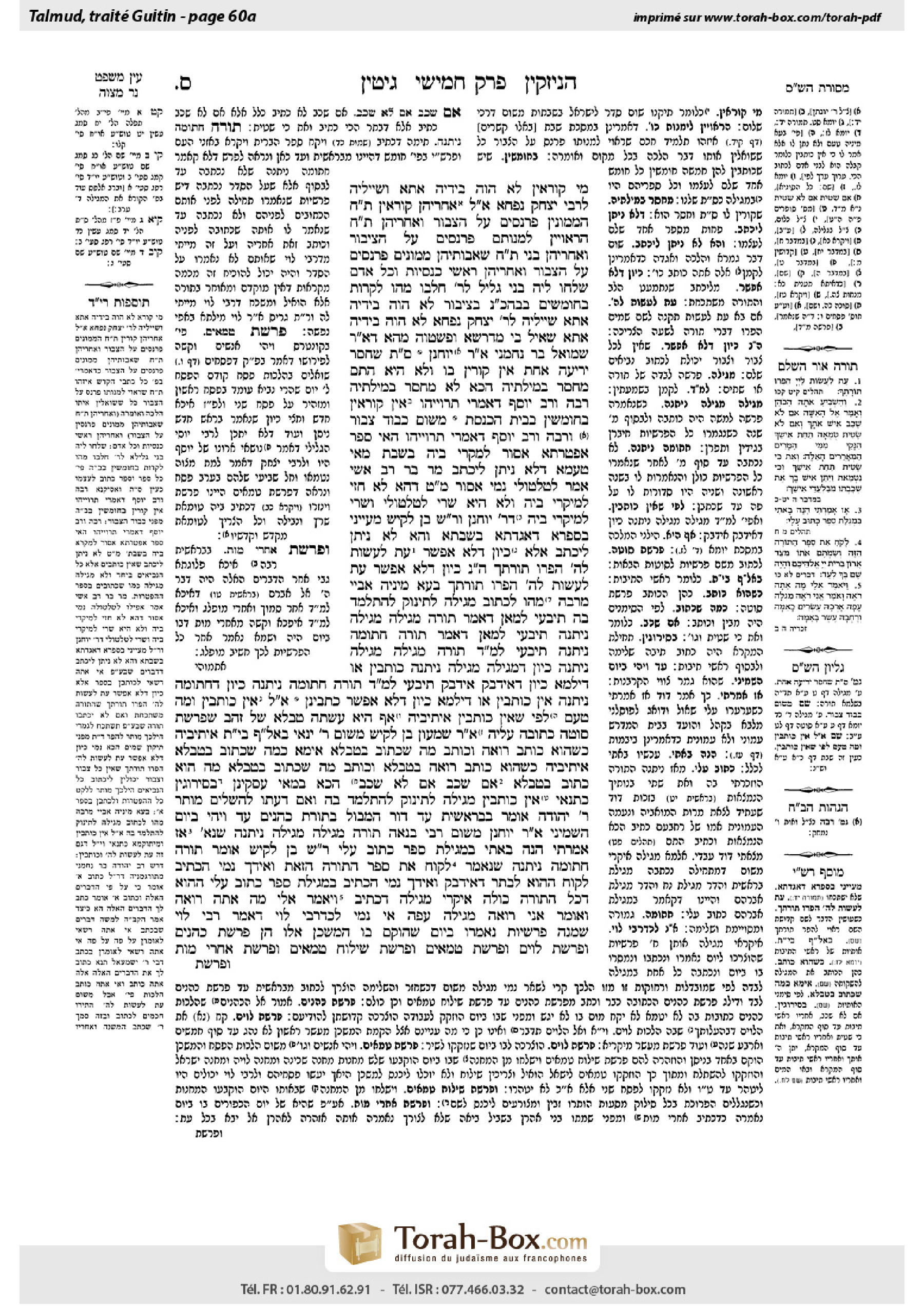
Gittin 60a: Talmud study for Daf Yomi
Study the Talmud for Daf Yomi with scanned pages, Hebrew text, English translations from Sefaria and AI-generated French translations.
Passage selection and English or AI-generated French translation are available where the scan has annotations. Daf Study is independent of Torah-Box and Sefaria.
Browse Gittin · גיטין · All tractatesGittin 60a text and translations
This page of Gittin includes the Aramaic text, an English translation and an AI-generated French translation, alongside the scan above.
גיטין ס׳ א · Aramaic and Hebrew text
מִי קוֹרְאִין? לָא הֲוָה בִּידֵיהּ. אֲתָא וְשַׁיְילֵיהּ לְרַבִּי יִצְחָק נַפָּחָא, אָמַר לֵיהּ: אַחֲרֵיהֶן קוֹרְאִין תַּלְמִידֵי חֲכָמִים הַמְמוּנִּין פַּרְנָסִים עַל הַצִּבּוּר, וְאַחֲרֵיהֶן תַּלְמִידֵי חֲכָמִים הָרְאוּיִין לְמַנּוֹתָם פַּרְנָסִים עַל הַצִּיבּוּר, וְאַחֲרֵיהֶן בְּנֵי תַּלְמִידֵי חֲכָמִים שֶׁאֲבוֹתֵיהֶן מְמוּנִּים פַּרְנָסִים עַל הַצִּבּוּר, וְאַחֲרֵיהֶן רָאשֵׁי כְנֵסִיּוֹת וְכׇל אָדָם.
שְׁלַחוּ לֵיהּ בְּנֵי גָלִיל לְרַבִּי חֶלְבּוֹ: מַהוּ לִקְרוֹת בְּחוּמָּשִׁים בְּבֵית הַכְּנֶסֶת בְּצִיבּוּר? לָא הֲוָה בִּידֵיהּ. אֲתָא שַׁיְילֵיהּ לְרַבִּי יִצְחָק נַפָּחָא, לָא הֲוָה בִּידֵיהּ. אֲתָא שְׁאֵיל בֵּי מִדְרְשָׁא, וּפַשְׁטוּהָ מֵהָא דְּאָמַר רַבִּי שְׁמוּאֵל בַּר נַחְמָנִי אָמַר רַבִּי יוֹחָנָן: סֵפֶר תּוֹרָה שֶׁחָסַר יְרִיעָה אַחַת – אֵין קוֹרִין בּוֹ.
וְלָא הִיא, הָתָם מְחַסַּר בְּמִילְּתֵיהּ, הָכָא לָא מְחַסַּר בְּמִילְּתֵיהּ. רַבָּה וְרַב יוֹסֵף דְּאָמְרִי תַּרְוַיְיהוּ: אֵין קוֹרְאִין בְּחוּמָּשִׁין בְּבֵית הַכְּנֶסֶת, מִשּׁוּם כְּבוֹד צִבּוּר.
וְרַבָּה וְרַב יוֹסֵף דְּאָמְרִי תַּרְוַיְיהוּ: הַאי סֵפֶר אַפְטָרָתָא – אָסוּר לְמִקְרֵי בֵּיהּ בְּשַׁבָּת. מַאי טַעְמָא? דְּלֹא נִיתַּן לִיכָּתֵב.
מָר בַּר רַב אָשֵׁי אָמַר: לְטַלְטוֹלֵי נָמֵי אָסוּר. מַאי טַעְמָא? דְּהָא לָא חֲזֵי לְמִיקְרֵי בֵּיהּ. וְלָא הִיא, שְׁרֵי לְטַלְטוֹלֵי וּשְׁרֵי לְמִיקְרֵי בֵּיהּ –
דְּרַבִּי יוֹחָנָן וְרַבִּי שִׁמְעוֹן בֶּן לָקִישׁ מְעַיְּינִי בְּסִפְרָא דְאַגַּדְתָּא בְּשַׁבְּתָא; וְהָא לֹא נִיתַּן לִיכָּתֵב, אֶלָּא כֵּיוָן דְּלָא אֶפְשָׁר, ״עֵת לַעֲשׂוֹת לַה׳ הֵפֵרוּ תּוֹרָתֶךָ״; הָכָא נָמֵי, כֵּיוָן דְּלָא אֶפְשָׁר, ״עֵת לַעֲשׂוֹת לַה׳ הֵפֵרוּ תּוֹרָתֶךָ״.
בְּעָא מִינֵּיהּ אַבָּיֵי מֵרַבָּה: מַהוּ לִכְתּוֹב מְגִילָּה לְתִינוֹק לְהִתְלַמֵּד בָּהּ? תִּיבְּעֵי לְמַאן דְּאָמַר: תּוֹרָה מְגִילָּה מְגִילָּה נִיתְּנָה; תִּיבְּעֵי לְמַאן דְּאָמַר: תּוֹרָה חֲתוּמָה נִיתְּנָה.
תִּיבְּעֵי לְמַאן דְּאָמַר תּוֹרָה מְגִילָּה מְגִילָּה נִיתְּנָה – כֵּיוָן דִּמְגִילָּה מְגִילָּה נִיתְּנָה, כּוֹתְבִין; אוֹ דִילְמָא, כֵּיוָן דְּאִידְּבַק – אִידְּבַק.
תִּיבְּעֵי לְמַאן דְּאָמַר תּוֹרָה חֲתוּמָה נִיתְּנָה – כֵּיוָן דַּחֲתוּמָה נִיתְּנָה, אֵין כּוֹתְבִין; אוֹ דִילְמָא, כֵּיוָן דְּלָא אֶפְשָׁר – כָּתְבִינַן? אֲמַר לֵיהּ: אֵין כּוֹתְבִין. וּמָה טַעַם? לְפִי שֶׁאֵין כּוֹתְבִין.
אֵיתִיבֵיהּ: אַף הִיא עָשְׂתָה טַבְלָא שֶׁל זָהָב, שֶׁפָּרָשַׁת סוֹטָה כְּתוּבָה עָלֶיהָ! אָמַר רַבִּי שִׁמְעוֹן בֶּן לָקִישׁ מִשּׁוּם רַבִּי יַנַּאי: בְּאָלֶף בֵּית.
אֵיתִיבֵיהּ: כְּשֶׁהוּא כּוֹתֵב, רוֹאֶה וְכוֹתֵב מַה שֶּׁכָּתוּב בַּטַּבְלָא! אֵימָא: ״כְּמָה שֶׁכָּתוּב בַּטַּבְלָא״.
אֵיתִיבֵיהּ: כְּשֶׁהוּא כּוֹתֵב, רוֹאֶה בַּטַּבְלָא וְכוֹתֵב מַה שֶּׁכָּתוּב בַּטַּבְלָא. מָה הוּא כָּתוּב בַּטַּבְלָא? ״אִם שָׁכַב״, ״אִם לֹא שָׁכַב״! הָכָא בְּמַאי עָסְקִינַן – בְּסֵירוּגִין.
כְּתַנָּאֵי: אֵין כּוֹתְבִין מְגִילָּה לְתִינוֹק לְהִתְלַמֵּד בָּהּ, וְאִם דַּעְתּוֹ לְהַשְׁלִים – מוּתָּר. רַבִּי יְהוּדָה אוֹמֵר: בִּבְרֵאשִׁית – עַד דּוֹר הַמַּבּוּל. בְּתוֹרַת כֹּהֲנִים – עַד ״וַיְהִי בַּיּוֹם הַשְּׁמִינִי״.
אָמַר רַבִּי יוֹחָנָן מִשּׁוּם רַבִּי בְּנָאָה: תּוֹרָה – מְגִילָּה מְגִילָּה נִיתְּנָה, שֶׁנֶּאֱמַר: ״אָז אָמַרְתִּי הִנֵּה בָאתִי בִּמְגִילַּת סֵפֶר כָּתוּב עָלָי״. רַבִּי שִׁמְעוֹן בֶּן לָקִישׁ אוֹמֵר: תּוֹרָה – חֲתוּמָה נִיתְּנָה, שֶׁנֶּאֱמַר: ״לָקוֹחַ אֵת סֵפֶר הַתּוֹרָה הַזֹּאת״.
וְאִידַּךְ נָמֵי, הָכְתִיב ״לָקוֹחַ״! הָהוּא לְבָתַר דְּאִידְּבַק.
וְאִידַּךְ נָמֵי, הָכְתִיב ״בִּמְגִילַּת סֵפֶר כָּתוּב עָלָי״! הַהוּא, דְּכׇל הַתּוֹרָה כּוּלָּהּ אִיקְּרִי מְגִילָּה, דִּכְתִיב: ״וַיֹּאמֶר אֵלַי מָה אַתָּה רוֹאֶה, וָאוֹמַר אֲנִי רוֹאֶה מְגִילָּה עָפָה״.
אִי נָמֵי, לְכִדְרַבִּי לֵוִי – דְּאָמַר רַבִּי לֵוִי: שְׁמֹנֶה פָּרָשִׁיּוֹת נֶאֶמְרוּ בַּיּוֹם שֶׁהוּקַם בּוֹ הַמִּשְׁכָּן, אֵלּוּ הֵן: פָּרָשַׁת כֹּהֲנִים, וּפָרָשַׁת לְוִיִּם, וּפָרָשַׁת טְמֵאִים, וּפָרָשַׁת שִׁילּוּחַ טְמֵאִים, וּפָרָשַׁת ״אַחֲרֵי מוֹת״,
Gittin 60a · English translation
who reads from the Torah? An answer was not readily available to him. He came and asked Rabbi Yitzḥak Nappaḥa, who said to him: After them read the Torah scholars who are appointed as leaders [parnasim] of the community. And after them read Torah scholars who are fit to be appointed as leaders of the community, even if in practice they received no such appointment. The Sages said that a Torah scholar who knows how to answer any question asked of him is fit to be appointed as leader of the community. And after them read the sons of Torah scholars whose fathers were appointed as leaders of the community. And after them read the heads of synagogues, and after them any person.
The people of the Galilee sent a question to Rabbi Ḥelbo: What is the halakha with regard to reading from ḥumashim, i.e., scrolls containing only one of the five books of the Torah, in the synagogue in public? Is this permitted, or is it necessary to read from a complete Torah scroll? An answer was not readily available to him. He came and asked Rabbi Yitzḥak Nappaḥa, but an answer was not readily available to him either. Rabbi Yitzḥak Nappaḥa came and asked this question in the study hall, and they resolved the difficulty from that which Rabbi Shmuel bar Naḥmani says that Rabbi Yoḥanan says: With regard to a Torah scroll that is missing even one sheet of parchment, one may not read from it in public. This indicates that an incomplete Torah scroll may not be used for a public Torah reading.
The Gemara rejects this argument: But that is not so, i.e., this cannot serve as a proof to the matter at hand. There, it is lacking part of the matter it is addressing, as a sheet of parchment is missing, whereas here, it is not lacking part of the matter it is addressing, as it contains a complete book. Rabba and Rav Yosef both say: One does not read from ḥumashim in the synagogue out of respect for the community.
And Rabba and Rav Yosef both say: It is prohibited to publicly read the haftara, the portion from the Prophets that is read after the weekly Torah portion, on Shabbat, from a scroll containing only the haftarot. What is the reason for this? It is because this type of scroll may not be written, as the words of the Prophets must also be written as complete books.
Mar bar Rav Ashi said: To handle such a scroll on Shabbat is also prohibited. What is the reason for this? It is because it is not fit to be read. Consequently, it is treated as set-aside [muktze] on Shabbat. The Gemara rejects this argument: But that is not so; rather, it is permitted to handle such a scroll and it is permitted to read from it.
And a proof for this is that Rabbi Yoḥanan and Rabbi Shimon ben Lakish used to read from a scroll of aggada containing the words of the Sages on Shabbat. But such a scroll may not be written, for in principle, the statements of the Oral Law may not be committed to writing. Rather, since it is not possible to remember the Oral Law without writing it down, it is permitted to violate the halakha, as indicated by the verse: “It is time to act for the Lord; they have nullified your Torah” (Psalms 119:126). Here too, in the case of a haftara scroll, since it is not always possible to write complete books of the Bible, due to the expense, it is permitted to apply the reasoning of “It is time to act for the Lord; they have nullified your Torah.”
Abaye raised a dilemma before Rabba: What is the halakha with regard to whether it is permitted to write a scroll containing only one portion of the Torah for the purpose of enabling a child to study it? The Gemara notes: Let the dilemma be raised according to the one who says that the Torah was given from the outset scroll by scroll, meaning that Moses would teach the Jewish people one portion of the Torah, and then write it down, and then teach them the next portion of the Torah, and then write that down, and continue in this way until he committed the entire Torah to writing. And let the dilemma also be raised according to the one who says that the Torah was given as a complete book, meaning that the Torah was not written down incrementally, but rather, after teaching the Jewish people the entire Torah, Moses committed it to writing all at once.
The Gemara explains the two sides of the dilemma according to each opinion: Let the dilemma be raised according to the one who says that the Torah was given scroll by scroll. On the one hand it is possible to say that since the Torah was originally given scroll by scroll, today as well one may write the Torah in separate scrolls. Or on the other hand, perhaps one should say that since it was ultimately joined together to form a single scroll, it was joined together and can no longer be written in separate scrolls.
And let the dilemma also be raised according to the one who says that the Torah was given as a complete book. On the one hand it is possible to say that since it was given from the outset as a complete book, one may not write it today in separate scrolls. Or on the other hand, perhaps one could say that since it is not always possible to write a complete Torah, one may write it in separate scrolls. Rabba said to him: One may not write the Torah in separate scrolls. And what is the reason? Because one may not write a scroll that is only part of the Torah.
Abaye raised an objection to his opinion from a mishna (Yoma 37b) where it was taught: Queen Helene also fashioned a golden tablet as a gift for the Temple on which the Torah portion discussing a sota was written. When the priest would write the scroll of a sota in the Temple, he would copy this Torah portion from the tablet, so that a Torah scroll need not be taken out for that purpose. This indicates that it is permitted for one to write a single portion of the Torah. Rabbi Shimon ben Lakish says in the name of Rabbi Yannai: There is no proof from this mishna, as the tablet prepared by Queen Helene was not written in an ordinary manner, but rather it consisted of the letters of the alef-beit, i.e., only the first letter of each word was written on the tablet, and by looking at it the priest writing the sota scroll would remember what to write.
The Gemara raised an objection from a baraita that teaches: When the priest writes the sota scroll, he looks at and writes that which is written on the tablet, which indicates that the full text of the passage was written on the tablet. The Gemara rejects this argument: Emend the baraita and say that it should read as follows: He looks at and writes like that which is written on the tablet. The tablet aids the priest in remembering the text that must actually be written.
The Gemara raised an objection from a different baraita: When he writes, he looks at the tablet and writes that which is written on the tablet. And what is written on the tablet? “If a man lay with you…and if he did not lay with you” (see Numbers 5:19). Apparently, the full text of the passage was written on the tablet. The Gemara answers: With what are we dealing here? The tablet fashioned by Queen Helene was written by alternating complete words and initials. The first words of each verse were written there, but the rest of the words in the verse were represented by initials. Therefore, this contribution of Queen Helene does not resolve the question of whether writing a scroll for a child is permitted.
The Gemara comments: The question of whether or not writing a scroll for a child is permitted is subject to a dispute between tanna’im, as it is taught in the following baraita: One may not write a scroll containing only one portion of the Torah for the purpose of enabling a child to study, but if the writer’s intention is to complete the scroll, it is permitted. Rabbi Yehuda says: In the book of Genesis he may write a scroll from the beginning until the generation of the flood. In Torat Kohanim, the book of Leviticus, he may write a scroll from the beginning until “And it came to pass on the eighth day” (Leviticus 9:1).
The Gemara returns to discuss the previously mentioned dispute. Rabbi Yoḥanan says in the name of Rabbi Bana’a: The Torah was given from the outset scroll by scroll, as it is stated: “Then I said, behold, I come with the scroll of the book that is written for me” (Psalms 40:8). King David is saying about himself that there is a section of the Torah, “the scroll of the book,” that alludes to him, i.e., “that is written for me.” This indicates that each portion of the Torah constitutes a separate scroll. Rabbi Shimon ben Lakish says: The Torah was given as a complete book, as it is stated: “Take this scroll of the Torah” (Deuteronomy 31:26), which teaches that from the outset the Torah was given as a complete unit.
The Gemara asks: And according to the other Sage, Rabbi Yoḥanan, as well, isn’t it written “take,” indicating that the Torah scroll was given whole? How does he explain this verse? The Gemara answers: That verse is speaking about the Torah after it was joined together to form a single unit.
The Gemara asks: And according to the other Sage, Reish Lakish, as well, isn’t it written: “With the scroll of the book that is written for me,” indicating that the Torah was given scroll by scroll? How does he explain this verse? The Gemara answers: That verse teaches that the entire Torah is called a scroll. This is indicated in another verse as well, as it is written: “And He said to me: What do you see? And I said: I see a flying scroll” (Zechariah 5:2).
Alternatively, this verse serves to allude to the sections of the Torah discussed in that statement of Rabbi Levi, as Rabbi Levi says: Eight sections were said on the day that the Tabernacle was erected, on the first of Nisan. They are: The section of the priests (Leviticus 21:1–22:26); the section of the Levites (Numbers 8:5–26); the section of the impure (Leviticus 13:1– 14:57); the section of the sending away of the impure (Numbers 5:1–4); the section beginning with the words “After the death” (Leviticus, chapter 16);
Gittin 60a · Traduction française (IA)
Qui lit la Torah ? Il n'avait pas de réponse immédiate. Il vint demander à Rabbi Yitzḥak Nappaḥa, qui lui dit : Après eux, lisent les savants de la Torah désignés comme chefs [parnasim] de la communauté. Et après eux, lisent les savants de la Torah dignes d'être désignés comme chefs de la communauté, même s'ils n'ont pas reçu en pratique une telle désignation. Les Sages dirent qu'un savant de la Torah qui sait répondre à toute question posée est digne d'être désigné comme chef de la communauté. Et après eux, lisent les fils des savants de la Torah dont les pères étaient désignés comme chefs de la communauté. Et après eux, lisent les présidents des synagogues, et après eux, toute personne.
Les gens de la Galilée envoyèrent une question à Rabbi Ḥelbo : Quelle est la halakha concernant la lecture publique à partir de ḥumashim, c'est-à-dire des scrolls contenant seulement l'un des cinq livres de la Torah, dans la synagogue ? Est-ce permis, ou est-il nécessaire de lire à partir d'un scroll complet de la Torah ? Il n'avait pas de réponse immédiate. Il vint demander à Rabbi Yitzḥak Nappaḥa, mais il n'avait pas non plus de réponse immédiate. Rabbi Yitzḥak Nappaḥa vint poser cette question dans la salle de étude, et ils résolurent la difficulté à partir de ce que Rabbi Shmuel bar Naḥmani dit que Rabbi Yoḥanan dit : Concernant un scroll de la Torah manquant même d'une feuille de parchemin, on ne peut pas le lire publiquement. Cela indique qu'un scroll de la Torah incomplet ne peut pas être utilisé pour une lecture publique de la Torah.
La Guemara rejette cet argument : Mais cela n'est pas ainsi, c'est-à-dire cela ne peut pas servir de preuve pour l'affaire en question. Là, il manque une partie de l'affaire qu'il traite, car une feuille de parchemin est manquante, alors que ici, il ne manque pas une partie de l'affaire qu'il traite, car il contient un livre complet. Rabba et Rav Yosef disent tous les deux : On ne lit pas à partir de ḥumashim dans la synagogue par respect pour la communauté.
Et Rabba et Rav Yosef disent tous les deux : Il est interdit de lire publiquement la haftara, la portion des Prophètes lue après la portion de la Torah hebdomadaire, le sabbat, à partir d'un scroll contenant seulement la haftara. Quelle est la raison de cela ? C'est parce que ce type de scroll ne peut pas être écrit, car les paroles des Prophètes doivent également être écrites comme des livres complets.
Mar bar Rav Ashi dit : Il est interdit de manipuler tel scroll le sabbat. Quelle est la raison de cela ? C'est parce qu'il n'est pas adapté à la lecture. Par conséquent, il est traité comme objet interdit [muktze] le sabbat. La Guemara rejette cet argument : Mais cela n'est pas ainsi ; plutôt, il est permis de manipuler tel scroll et il est permis de le lire.
Et une preuve de cela est que Rabbi Yoḥanan et Rabbi Shimon ben Lakish avaient l'habitude de lire à partir d'un scroll d'aggada contenant les paroles des Sages le sabbat. Mais tel scroll ne peut pas être écrit, car en principe, les déclarations de la Loi orale ne peuvent pas être écrites. Cependant, puisque sans écriture il est impossible de retenir la Loi orale, il est permis de violer la halakha, comme indiqué par la parole : « Il est temps d'agir pour l'Éternel ; ils ont annulé votre Torah » (Psaumes 119:126). Ici aussi, dans le cas d'un scroll de haftara, puisque ce n'est pas toujours possible d'écrire des livres complets de la Bible en raison des coûts, il est permis d'appliquer la raison de « Il est temps d'agir pour l'Éternel ; ils ont annulé votre Torah. »
Abaye posa un dilemme devant Rabba : Quelle est la halakha concernant la permission de rédiger un scroll contenant seulement une portion de la Torah à des fins d'étude par un enfant ? La Guemara explique : Fassez-le dilemme selon celui qui dit que la Torah fut donnée dès le début scroll par scroll, c'est-à-dire que Moïse enseignait à la communauté juive une portion de la Torah, puis la rédigeait, puis enseignait la prochaine portion de la Torah, puis la rédigeait, et ainsi de suite jusqu'à ce qu'il rédige la Torah entière. Et fassez-le dilemme aussi selon celui qui dit que la Torah fut donnée comme un livre complet, c'est-à-dire que la Torah n'a pas été rédigée progressivement, mais plutôt, après avoir enseigné la Torah entière à la communauté juive, Moïse la rédigea d'un seul coup.
La Guemara explique les deux côtés du dilemme selon chaque opinion : Fassez-le dilemme selon celui qui dit que la Torah fut donnée scroll par scroll. D'un côté, on peut dire que puisque la Torah fut initialement donnée scroll par scroll, aujourd'hui aussi on peut rédiger la Torah en scrolls séparés. Ou d'un autre côté, peut-être devrait-on dire que puisque finalement elle fut unie pour former un seul scroll, elle est unie et ne peut plus être rédigée en scrolls séparés.
Et fassez-le dilemme aussi selon celui qui dit que la Torah fut donnée comme un livre complet. D'un côté, on peut dire que puisque la Torah fut donnée dès le début comme un livre complet, on ne peut pas la rédiger aujourd'hui en scrolls séparés. Ou d'un autre côté, peut-être pourrait-on dire que puisque ce n'est pas toujours possible de rédiger une Torah complète, on peut la rédiger en scrolls séparés. Rabba dit à lui : On ne peut pas rédiger la Torah en scrolls séparés. Et quelle est la raison ? Parce qu'on ne peut pas rédiger un scroll qui est seulement une partie de la Torah.
Abaye opposa un contre-argument à son opinion à partir d'une mishna (Yoma 37b) où il est dit : La reine Hélène fit aussi un tablette d'or en tant que cadeau pour le Temple, sur laquelle était écrite la portion de la Torah concernant la sota. Lorsque le prêtre écrivait le scroll de la sota dans le Temple, il copiait cette portion de la Torah à partir de la tablette, de sorte qu'il ne fallait pas sortir un scroll de la Torah à cet effet. Cela indique qu'il est permis de rédiger une seule portion de la Torah. Rabbi Shimon ben Lakish dit en nom de Rabbi Yannai : Il n'y a pas de preuve à partir de cette mishna, car la tablette préparée par la reine Hélène n'était pas écrite de manière ordinaire, mais plutôt elle consistait en les lettres de l'alef-beit, c'est-à-dire que seule la première lettre de chaque mot était écrite sur la tablette, et en la regardant, le prêtre écrivant le scroll de la sota se souvenait de ce qu'il devait écrire.
La Guemara soulève un objet tiré d'une baraïta qui enseigne : Lorsque le prêtre écrit le rouleau de la sota, il regarde et écrit ce qui est écrit sur la tablette, ce qui indique que le texte complet du passage était inscrit sur la tablette. La Guemara rejette cet argument : Corrigez la baraïta et dites qu'elle devrait lire ainsi : Il regarde et écrit comme ce qui est écrit sur la tablette. La tablette aide le prêtre à se souvenir du texte qui doit être réellement écrit.
La Guemara soulève une autre objection tirée d'une autre baraïta : Lorsqu'il écrit, il regarde la tablette et écrit ce qui est écrit sur la tablette. Et ce qui est écrit sur la tablette ? « Si un homme coucha avec toi… et s'il ne coucha pas avec toi » (cf. Nombres 5:19). Apparemment, le texte complet du passage était inscrit sur la tablette. La Guemara répond : Avec quoi sommes-nous en train de nous occuper ? La tablette conçue par la reine Hélène était écrite en alternant des mots complets et des initiales. Les premiers mots de chaque verset y étaient inscrits, mais les autres mots du verset étaient représentés par des initiales. Ainsi, cette contribution de la reine Hélène ne résout pas la question de savoir si il est permis d'écrire un rouleau pour un enfant.
La Guemara commente : La question de savoir si il est permis d'écrire un rouleau pour un enfant est l'objet d'un débat entre les tannaïm, comme il est enseigné dans la baraïta suivante : On ne peut pas écrire un rouleau contenant qu'une seule portion de la Torah à l'intention de permettre à un enfant d'étudier, mais si l'intention du rédacteur est de terminer le rouleau, cela est permis. Rabbi Yéhuda dit : Dans le livre de la Genèse, il peut écrire un rouleau du début jusqu'à la génération de la Déluge. Dans la Torat Kohanim, le livre de Lévi, il peut écrire un rouleau du début jusqu'à « Et il advint le huitième jour » (Lévitique 9:1).
La Guemara reprend la discussion sur le débat mentionné précédemment. Rabbi Yoḥanan, en nom de Rabbi Bana’a, dit : La Torah fut donnée dès le début, rouleau par rouleau, comme il est dit : « Alors je dis, voici, je viens avec le rouleau du livre qui est écrit pour moi » (Psaumes 40:8). David, roi, dit à propos de lui-même qu'il y a une section de la Torah, « le rouleau du livre », qui fait allusion à lui, c'est-à-dire « qui est écrit pour moi ». Cela indique que chaque portion de la Torah constitue un rouleau distinct. Rabbi Shimon ben Lakish dit : La Torah fut donnée comme un livre complet, comme il est dit : « Prends ce rouleau de la Torah » (Deutéronome 31:26), ce qui enseigne que dès le début la Torah fut donnée comme une unité complète.
La Guemara demande : Et selon l'autre Sage, Rabbi Yoḥanan, n'est-il pas écrit « prends », ce qui indique que le rouleau de la Torah fut donné en entier ? Comment explique-t-il cette verset ? La Guemara répond : Ce verset parle de la Torah après qu'elle eut été assemblée pour former une unité unique.
La Guemara demande : Et selon l'autre Sage, Reish Lakish, n'est-il pas écrit : « Avec le rouleau du livre qui est écrit pour moi », ce qui indique que la Torah fut donnée rouleau par rouleau ? Comment explique-t-il ce verset ? La Guemara répond : Ce verset enseigne que toute la Torah est appelée un rouleau. Cela est indiqué dans un autre verset également, comme il est dit : « Et il dit à moi : Qu'est-ce que tu vois ? Et je dis : Je vois un rouleau volant » (Zacharie 5:2).
Alternativement, ce verset sert à faire référence aux sections de la Torah évoquées dans la déclaration de Rabbi Levi, comme Rabbi Levi le dit : Huit sections furent énoncées le jour où le Tabernacle fut érigé, le premier de Nisan. Elles sont : La section des prêtres (Lévitique 21:1–22:26) ; la section des Lévites (Nombres 8:5–26) ; la section des impurs (Lévitique 13:1–14:57) ; la section de l'expulsion des impurs (Nombres 5:1–4) ; la section commençant par les mots « Après la mort » (Lévitique, chapitre 16) ;
Traduction française générée par IA à partir de l’édition anglaise de Sefaria. Vérifie toujours un passage avec le texte source.
Text from Sefaria: William Davidson Edition - Vocalized Aramaic (CC BY NC); William Davidson Edition - English (CC BY NC).