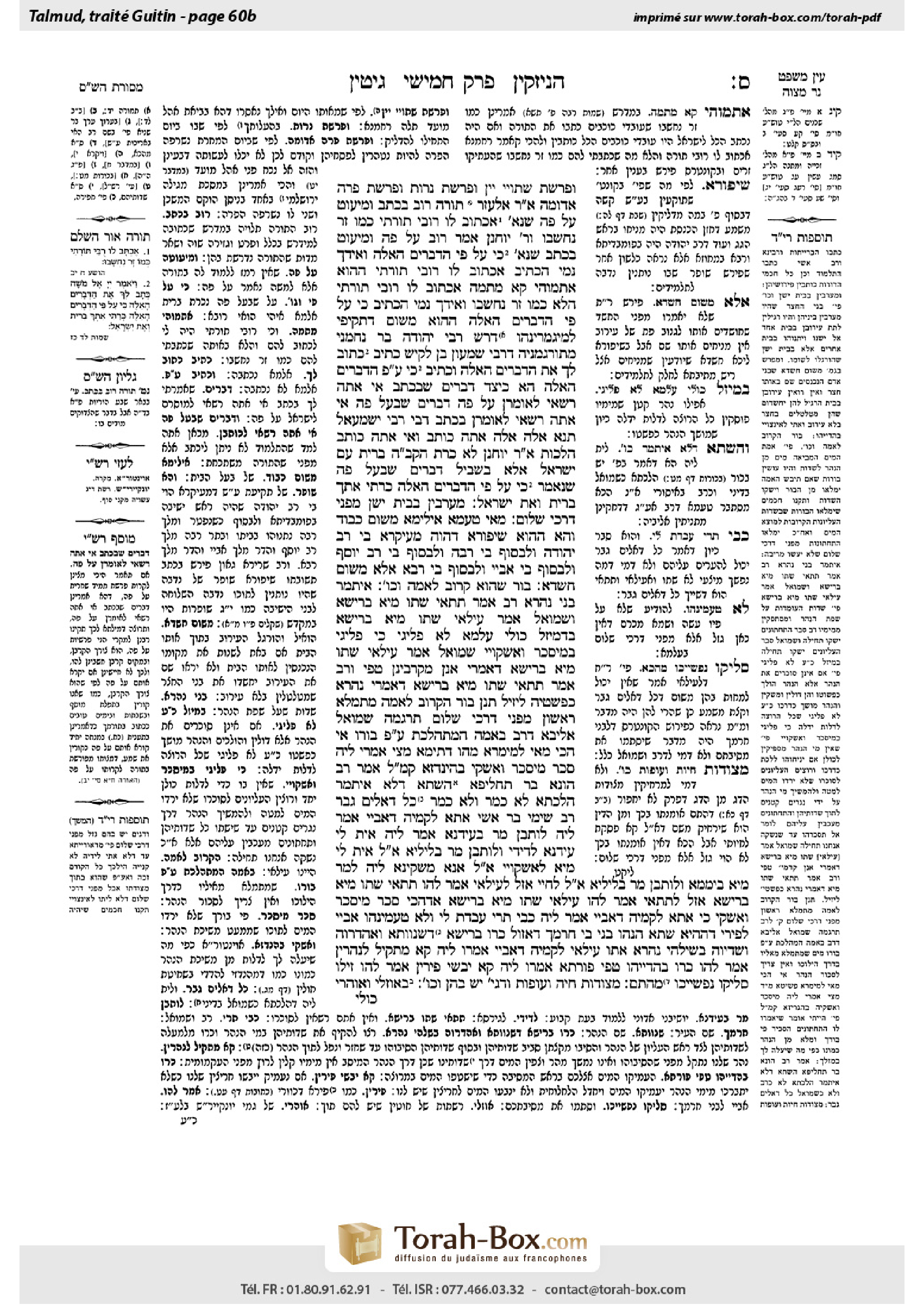
Gittin 60b: Talmud study for Daf Yomi
Study the Talmud for Daf Yomi with scanned pages, Hebrew text, English translations from Sefaria and AI-generated French translations.
Passage selection and English or AI-generated French translation are available where the scan has annotations. Daf Study is independent of Torah-Box and Sefaria.
Browse Gittin · גיטין · All tractatesGittin 60b text and translations
This page of Gittin includes the Aramaic text, an English translation and an AI-generated French translation, alongside the scan above.
גיטין ס׳ ב · Aramaic and Hebrew text
וּפָרָשַׁת שְׁתוּיֵי יַיִן, וּפָרָשַׁת נֵרוֹת, וּפָרָשַׁת פָּרָה אֲדוּמָּה.
אָמַר רַבִּי אֶלְעָזָר: תּוֹרָה – רוֹב בִּכְתָב וּמִיעוּט עַל פֶּה, שֶׁנֶּאֱמַר: ״אֶכְתּוֹב לוֹ רוּבֵּי תּוֹרָתִי כְּמוֹ זָר נֶחְשָׁבוּ״. וְרַבִּי יוֹחָנָן אָמַר: רוֹב עַל פֶּה וּמִיעוּט בִּכְתָב, שֶׁנֶּאֱמַר: ״כִּי עַל פִּי הַדְּבָרִים הָאֵלֶּה״.
וְאִידַּךְ נָמֵי, הָכְתִיב: ״אֶכְתּוֹב לוֹ רוּבֵּי תּוֹרָתִי״! הָהוּא, אַתְמוֹהֵי קָא מַתְמַהּ: אֶכְתּוֹב לוֹ רוּבֵּי תּוֹרָתִי?! הֲלֹא ״כְּמוֹ זָר נֶחְשָׁבוּ״!
וְאִידַּךְ נָמֵי, הָכְתִיב: ״כִּי עַל פִּי הַדְּבָרִים הָאֵלֶּה״! הַהוּא – מִשּׁוּם דְּתַקִּיפִי לְמִיגְמְרִינְהוּ.
דָּרֵשׁ רַבִּי יְהוּדָה בַּר נַחְמָנִי, מְתוּרְגְּמָנֵיהּ דְּרַבִּי שִׁמְעוֹן בֶּן לָקִישׁ, כְּתִיב: ״כְּתוֹב לְךָ אֶת הַדְּבָרִים הָאֵלֶּה״, וּכְתִיב: ״כִּי עַל פִּי הַדְּבָרִים הָאֵלֶּה״ – הָא כֵּיצַד? דְּבָרִים שֶׁבִּכְתָב אִי אַתָּה רַשַּׁאי לְאוֹמְרָן עַל פֶּה, דְּבָרִים שֶׁבְּעַל פֶּה אִי אַתָּה רַשַּׁאי לְאוֹמְרָן בִּכְתָב, דְּבֵי רַבִּי יִשְׁמָעֵאל. תָּנָא: ״אֵלֶּה״ – אֵלֶּה אַתָּה כּוֹתֵב, וְאִי אַתָּה כּוֹתֵב הֲלָכוֹת.
אָמַר רַבִּי יוֹחָנָן: לֹא כָּרַת הַקָּדוֹשׁ בָּרוּךְ הוּא בְּרִית עִם יִשְׂרָאֵל, אֶלָּא בִּשְׁבִיל דְּבָרִים שֶׁבְּעַל פֶּה – שֶׁנֶּאֱמַר: ״כִּי עַל פִּי הַדְּבָרִים הָאֵלֶּה כָּרַתִּי אִתְּךָ בְּרִית וְאֶת יִשְׂרָאֵל״.
מְעָרְבִין בְּבַיִת יָשָׁן, מִפְּנֵי דַּרְכֵי שָׁלוֹם. מַאי טַעְמָא? אִילֵּימָא מִשּׁוּם כָּבוֹד, וְהָא הָהוּא שִׁיפּוּרָא, דַּהֲוָה מֵעִיקָּרָא בֵּי רַב יְהוּדָה, וּלְבַסּוֹף בֵּי רַבָּה, וּלְבַסּוֹף בֵּי רַב יוֹסֵף, וּלְבַסּוֹף בֵּי אַבָּיֵי, וּלְבַסּוֹף בֵּי רָבָא!
אֶלָּא מִשּׁוּם חֲשָׁדָא.
בּוֹר שֶׁהוּא קָרוֹב לָאַמָּה וְכוּ׳: אִיתְּמַר: בְּנֵי נַהֲרָא; רַב אָמַר: תַּתָּאֵי שָׁתוּ מַיָּא בְּרֵישָׁא, וּשְׁמוּאֵל אֲמַר: עִילָּאֵי שָׁתוּ מַיָּא בְּרֵישָׁא.
בִּדְמֵיזַל – כּוּלֵּי עָלְמָא לָא פְלִיגִי. כִּי פְלִיגִי – בְּמִיסְכַּר וְאַשְׁקוֹיֵי; שְׁמוּאֵל אָמַר: עִילָּאֵי שָׁתוּ מַיָּא בְּרֵישָׁא, דְּאָמְרִי: אֲנַן מְקָרְבִינַן טְפֵי. וְרַב אָמַר: תַּתָּאֵי שָׁתוּ מַיָּא בְּרֵישָׁא, דְּאָמְרִי: נַהֲרָא כִּפְשָׁטֵיהּ לֵיזִיל.
תְּנַן: בּוֹר הַקָּרוֹב לָאַמָּה, מִתְמַלֵּא רִאשׁוֹן – מִפְּנֵי דַּרְכֵי שָׁלוֹם! תַּרְגְּמַהּ שְׁמוּאֵל אַלִּיבָּא דְּרַב: בְּאַמָּה הַמִּתְהַלֶּכֶת עַל פִּי בוֹרוֹ.
אִי הָכִי, מַאי לְמֵימְרָא? מַהוּ דְּתֵימָא, מָצֵי אָמְרִי לֵיהּ: סְכַר מִיסְכָּר, וְאַשְׁקִי בְּהִינְדָּזָא; קָא מַשְׁמַע לַן.
אָמַר רַב הוּנָא בַּר תַּחְלִיפָא: הַשְׁתָּא דְּלָא אִיתְּמַר הִלְכְתָא לָא כְּמָר וְלָא כְּמָר, כֹּל דְּאַלִּים גָּבַר.
רַב שִׁימִי בַּר אָשֵׁי אֲתָא לְקַמֵּיהּ דְּאַבָּיֵי, אֲמַר לֵיהּ: לוֹתְבַן מָר בְּעִידָּנָא! אֲמַר לֵיהּ: אִית לִי עִידָּנָא לְדִידִי. וְלוֹתְבַן מָר בְּלֵילְיָא! אֲמַר לֵיהּ: אִית לִי מַיָּא לְאַשְׁקוֹיֵי. אֲמַר לֵיהּ: אֲנָא מַשְׁקֵינָא לֵיהּ לְמָר מַיָּא בִּימָמָא, וְלוֹתְבַן מָר בְּלֵילְיָא! אֲמַר לֵיהּ: לְחַיֵּי.
אֲזַל לְעִילָּאֵי, אֲמַר לְהוּ: תַּתָּאֵי שָׁתוּ מַיָּא בְּרֵישָׁא. אֲזַל לְתַתָּאֵי, אֲמַר לְהוּ: עִילָּאֵי שָׁתוּ מַיָּא בְּרֵישָׁא. אַדְּהָכִי סְכַר מִיסְכָּר וְאַשְׁקִי. כִּי אֲתָא לְקַמֵּיהּ דְּאַבָּיֵי, אֲמַר לֵיהּ: כְּבֵי תְרֵי עֲבַדְתְּ לִי! וְלָא טַעְמִינְהוּ אַבָּיֵי לְפֵירֵי דְּהַהִיא שַׁתָּא.
הָנְהוּ בְּנֵי בֵּי חַרְמָךְ, דַּאֲזוּל כְּרוֹ בְּרֵישָׁא דְשַׁנְווֹתָא, וְאַהְדְּרוּהּ וְשַׁדְיוּהּ בְּשִׁילְהֵי נַהֲרָא. אֲתוֹ עִילָּאֵי לְקַמֵּיהּ דְּאַבָּיֵי, אֲמַרוּ לֵיהּ: קָא מַתְקֵיל לְנַהֲרִין! אֲמַר לְהוּ: כְּרוֹ בַּהֲדַיְיהוּ טְפֵי פּוּרְתָּא. אֲמַרוּ לֵיהּ: קָא יָבְשִׁי פֵּירִין. אֲמַר לְהוּ: זִילוּ סַלִּיקוּ נַפְשַׁיְיכוּ מֵהָתָם.
מְצוּדוֹת חַיָּה וְעוֹפוֹת וְדָגִים, יֵשׁ בָּהֶן וְכוּ׳: בְּאוּזְלֵי וְאוֹהָרֵי
Gittin 60b · English translation
the section dealing with priests who have become intoxicated with wine (Leviticus 10:8–11); the section of the lamps (Numbers 8:1–7); and the section of the red heifer (Numbers, chapter 19), as all of these sections are necessary for service in the Tabernacle.
§ The Gemara continues its discussion concerning the writing of the Torah: Rabbi Elazar says: The majority of the Torah was transmitted in writing, while the minority was transmitted orally, as it is stated: “I wrote for him the greater part of My Torah; they were reckoned a strange thing” (Hosea 8:12), meaning that the majority of the Torah was transmitted in written form. And Rabbi Yoḥanan says: The majority of the Torah was transmitted orally [al peh], while the minority was transmitted in writing, as it is stated with regard to the giving of the Torah to Moses on Mount Sinai: “For on the basis of [al pi] these matters I have made a covenant with you and with Israel” (Exodus 34:27), which indicates that the greater part of the Sinaitic covenant was taught orally.
The Gemara asks: And according to the other Sage, Rabbi Yoḥanan, as well, isn’t it written: “I wrote for him the greater part of My Torah”? How does he understand this verse? The Gemara answers: This verse is not a statement, but rather a rhetorical question expressing bewilderment: For did I write for him the greater part of My Torah? In that case they, the Jewish people, would be reckoned as strangers, meaning that there would be no difference between them and the nations of the world if everything was written down. Rather, the majority of the Torah must remain an oral tradition.
The Gemara asks: And according to the other Sage, Rabbi Elazar, as well, isn’t it written: “For on the basis of these matters I have made a covenant with you and with Israel”? How does he understand this verse? The Gemara answers: That verse, which indicates that the covenant was based on that which was taught by oral tradition, is stated due to the fact that it is more difficult to learn matters transmitted orally, but not because these matters are more numerous than those committed to writing.
Rabbi Yehuda bar Naḥmani, the disseminator for Rabbi Shimon ben Lakish, expounded as follows: It is written: “Write you these matters” (Exodus 34:27), and it is written later in that same verse: “For on the basis of [al pi] these matters.” How can these texts be reconciled? They mean to teach: Matters that were written you may not express them orally [al peh], and matters that were taught orally you may not express them in writing. The school of Rabbi Yishmael taught: The word “these” in the mitzva recorded in the verse “Write you these matters” is used here in an emphatic sense: These matters, i.e., those recorded in the Written Law, you may write, but you may not write halakhot, i.e., the mishnayot and the rest of the Oral Law.
Rabbi Yoḥanan says: The Holy One, Blessed be He, made a covenant with the Jewish people only for the sake of the matters that were transmitted orally [be’al peh], as it is stated: “For on the basis of [al pi] these matters I have made a covenant with you and with Israel” (Exodus 34:27).
§ The mishna teaches that the Sages enacted that a joining of courtyards [eiruv] is placed in an old house where it had regularly been placed on account of the ways of peace. The Gemara asks: What is the reason for this? If we say that it is to show respect to the owner of that house, but wasn’t it related about a certain charity box, which was fashioned for the benefit of the community and brought honor to the person in whose house it was placed, that initially it was placed in Rav Yehuda’s house, and afterward it was moved to Rabba’s house, and afterward it was transferred to Rav Yosef’s house, and afterward it was moved to Abaye’s house, and afterward it was moved to Rava’s house. This teaches that there is no issue here of respect, and that such items would ordinarily be moved from place to place.
Rather, say instead that the Sages instituted this enactment to avoid arousing suspicion. Since the eiruv had regularly been placed in a particular house, were it to be moved, people might think that the residents of the alleyway suspected that the owner of the house was stealing from them, and therefore they put it somewhere else.
§ The mishna teaches that the Sages enacted that the pit that is nearest to the irrigation channel that supplies water to several pits or fields is filled first on account of the ways of peace. It was stated that the amora’im disagree about the following issue: When people own fields along a river and they irrigate their fields with water that is redirected from it, who among them enjoys first rights to irrigate his field? Rav said: The owners of the lowermost fields drink the water, i.e., irrigate their fields, first. And Shmuel said: The owners of the uppermost fields drink the water first.
The Gemara explains: With regard to a case where the water flows on its own, everyone agrees that whoever wishes to irrigate may do so as he wishes. When they disagree, it is with regard to a case where they need to dam the river and irrigate through channels. Shmuel said: The owners of the uppermost fields drink the water first because they can say: We are nearer to the river’s headwaters. And Rav said: The owners of the lowermost fields drink the water first because they can say: Let the river go its natural way and after we take what we need, dam it as you please.
We learned in the mishna that the Sages enacted that the pit that is nearest to the irrigation channel that supplies water to several pits or fields is filled first on account of the ways of peace. This teaches that the party who is nearest to the water’s source enjoys first rights, and it supports Shmuel’s opinion and is difficult for Rav. Shmuel interpreted the mishna in accordance with the opinion of Rav: The mishna refers here to an irrigation channel that passes the mouth of the pit, so that the pit fills with water on its own, even without damming.
The Gemara asks: If so, what is the purpose of stating this? It is obvious. The Gemara answers: Lest you say that the owners of the other fields can say to the owner of the pit: Dam your pit as well so that water not enter it, and irrigate your fields in proportion [hindeza], just like the rest of us. The mishna therefore teaches us that the owner of the pit is not required to do this, and consequently his pit is filled first.
Rav Huna bar Taḥalifa said: Now that the halakha was stated neither in accordance with the opinion of this Sage, Rav, nor in accordance with the opinion of that Sage, Shmuel, whoever is stronger prevails. Since the halakha has not been decided, the court refuses to judge the case and leaves the claimants to settle the matter themselves, in the hope that the rightful party will exert himself and prevail.
Rav Shimi bar Ashi came before Abaye and said to him: Master, set a time for me to study with you. Abaye said to him: I have a set time for myself, and I cannot devote it to you. Rav Shimi bar Ashi said to him: Master, set a time for me at night, and we can study then. Abaye said to him: I have to bring water at night with which to irrigate my fields. Rav Shimi bar Ashi said to him: I will irrigate for Master during the day, and then Master can set a time for me at night to study with him. Abaye said to him: Very well; this is an acceptable arrangement.
What did Rav Shimi bar Ashi do? He first went to the owners of the uppermost fields, and said to them: The owners of the lowermost fields drink the water first, in accordance with the opinion of Rav. He then went to the owners of the lowermost fields, and said to them: The owners of the uppermost fields drink the water first, in accordance with the opinion of Shmuel. In the meantime, while the owners of the upper fields and the lower fields were arguing over who has first rights to the water, Rav Shimi bar Ashi dammed the river and irrigated Abaye’s fields. When he came before Abaye, the latter said to him: You have acted for me in accordance with two opposing opinions. And Abaye would not even taste the produce of that year because he thought that the water had reached his field in an unlawful manner.
It is related that there were certain residents of a place called Bei Ḥarmakh who went and dug a channel at the head of the Shanvata River in order to divert the water and allow it to circle their fields, and then they returned the water to the river further downstream. Those who owned fields further upstream came before Abaye, and said to him: This damages our river, as the water is not flowing as it once had. Abaye said to them: Dig a little deeper with them, and that should solve the problem. They said to him: If we do that, our pits will become dry. Once Abaye heard this he said to the residents of Bei Ḥarmakh: Go remove yourselves from there, and dam the diversion that you made for the river.
§ The mishna teaches: Taking animals, birds, or fish that were caught in traps belonging to another person is considered robbery on account of the ways of peace. And Rabbi Yosei says that this is full-fledged robbery. The Gemara comments: With regard to nets [uzlei] and woven traps [oharei],
Gittin 60b · Traduction française (IA)
la section concernant les prêtres devenus ivres à cause du vin (Lévitique 10:8–11) ; la section des lampes (Nb 8:1–7) ; et la section de la vache rousse (Nb, chapitre 19), car toutes ces sections sont nécessaires pour le service du Tabernacle.
§ Le Guemara continue sa discussion sur l'écriture de la Torah : Rabbi Elazar dit : La majorité de la Torah a été transmise par écrit, tandis que la minorité a été transmise oralement, comme il est dit : « J’ai écrit pour lui la plus grande partie de ma Torah ; ils furent comptés comme des étrangers » (Osée 8:12), ce qui signifie que la majorité de la Torah a été transmise sous forme écrite. Et Rabbi Yoḥanan dit : La majorité de la Torah a été transmise oralement [al peh], tandis que la minorité a été transmise par écrit, comme il est dit concernant la transmission de la Torah à Moïse sur le mont Sinaï : « Car sur la base de [al pi] ces choses j’ai fait un pacte avec toi et avec Israël » (Ex 34:27), ce qui indique que la plus grande partie du pacte siniatique a été enseignée oralement.
Le Guemara pose la question : Et selon l'autre Sage, Rabbi Yoḥanan, n'est-il pas écrit : « J’ai écrit pour lui la plus grande partie de ma Torah » ? Comment comprend-il cette verset ? Le Guemara répond : Ce verset n'est pas une affirmation, mais plutôt une question rhétorique exprimant la confusion : Pourrais-je avoir écrit pour lui la plus grande partie de ma Torah ? Dans ce cas, le peuple juif serait compté comme des étrangers, c'est-à-dire qu'il n'y aurait plus de différence entre eux et les nations du monde si tout était écrit. Plutôt, la majorité de la Torah doit rester une tradition orale.
Le Guemara pose la question : Et selon l'autre Sage, Rabbi Elazar, n'est-il pas écrit : « Car sur la base de ces choses j'ai fait un pacte avec toi et avec Israël » ? Comment comprend-il ce verset ? Le Guemara répond : Ce verset, qui indique que le pacte était basé sur ce qui a été transmis par la tradition orale, est formulé en raison de la difficulté à apprendre les choses transmises oralement, mais pas parce que ces choses sont plus nombreuses que celles qui ont été écrites.
Rabbi Yehuda bar Naḥmani, le diffuseur de Rabbi Shimon ben Lakish, explique ainsi : Il est écrit : « Écris ces choses » (Ex 34:27), et il est écrit plus tard dans le même verset : « Car sur la base de [al pi] ces choses. » Comment ces textes peuvent-ils être conciliés ? Ils enseignent que les choses qui ont été écrites ne doivent pas être exprimées oralement [al peh], et les choses qui ont été enseignées oralement ne doivent pas être exprimées par écrit. La maison de Rabbi Yishmael enseigna : Le mot « ces choses » dans la mitsva mentionnée dans le verset « Écris ces choses » est utilisé ici dans un sens emphatique : Ces choses, c'est-à-dire celles inscrites dans la Loi écrite, vous pouvez écrire, mais vous ne pouvez pas écrire les halakhot, c'est-à-dire les mishnayot et le reste de la Loi orale.
Rabbi Yoḥanan dit : L'Éternel, béni soit-Il, a fait un pacte avec le peuple juif uniquement à cause des choses qui ont été transmises oralement [be’al peh], comme il est dit : « Car sur la base de [al pi] ces choses j'ai fait un pacte avec toi et avec Israël » (Ex 34:27).
§ La Michna enseigne que les Sages ont institué que l'union des cours [eiruv] est placée dans une maison ancienne où elle avait régulièrement été placée en raison des voies de paix. Le Guemara pose la question : Quelle est la raison de cela ? Si nous disons que c'est pour montrer le respect envers le propriétaire de cette maison, n'était-il pas rapporté à propos d'une certaine caisse de charité, conçue pour le bénéfice de la communauté et honorant la personne chez laquelle elle était placée, qu'elle avait d'abord été placée chez Rav Yehuda, puis transférée chez Rabba, puis chez Rav Yosef, puis chez Abaye, puis chez Rava ? Cela enseigne qu'il n'y a pas ici de question de respect, et que ces objets seraient normalement transférés d'un lieu à un autre.
Plutôt, disons que les Sages ont institué cette ordonnance pour éviter d'attiser les soupçons. Puisque l'eiruv avait régulièrement été placé dans une maison particulière, si elle était déplacée, les gens pourraient penser que les habitants de la rue soupçonnaient que le propriétaire de la maison volait chez eux, et donc ils l'ont placée ailleurs.
§ La mishna enseigne que les Sages ont institué que le puits le plus proche du canal d'irrigation qui alimente plusieurs puits ou champs est rempli en premier en raison des voies de paix. Il a été dit que les amora’im s'entendaient sur le point suivant : Lorsque des gens possèdent des champs le long d'un fleuve et qu'ils irriguent leurs champs avec l'eau redirigée, qui parmi eux a le droit prioritaire d'irriguer son champ ? Rav dit : Les propriétaires des champs les plus bas boivent l'eau, c'est-à-dire irriguent leurs champs en premier. Et Shmuel dit : Les propriétaires des champs les plus hauts boivent l'eau en premier.
Le Guemara explique : Concernant un cas où l'eau coule d'elle-même, tout le monde est d'accord pour dire que celui qui veut irriguer peut le faire comme il l'entend. Lorsqu'ils divergent, c'est concernant un cas où ils doivent barrer le fleuve et irriguer par canaux. Shmuel dit : Les propriétaires des champs les plus hauts boivent l'eau en premier car ils peuvent dire : Nous sommes plus proches de la source du fleuve. Et Rav dit : Les propriétaires des champs les plus bas boivent l'eau en première car ils peuvent dire : Laisse le fleuve suivre sa voie naturelle et après que nous ayons pris ce dont nous avons besoin, barre-le comme tu veux.
Nous avons appris dans la Michna que les Sages ont institué que le puits le plus proche du canal d'irrigation qui alimente plusieurs puits ou champs est rempli en premier en raison des voies de paix. Cela enseigne que celui qui est le plus proche de la source de l'eau a le droit prioritaire, et cela soutient l'opinion de Shmuel et pose un problème pour Rav. Shmuel interprète la Michna selon l'opinion de Rav : la Michna fait référence ici à un canal d'irrigation qui passe par la bouche du puits, de sorte que le puits se remplit d'eau tout seul, même sans barrer.
La Guemara pose la question : Si c’est ainsi, à quoi sert d’énoncer cela ? C’est évident. La Guemara répond : afin que vous ne disiez pas que les propriétaires des autres champs peuvent dire au propriétaire du puits : Détruis aussi ton puits afin que l’eau n’y entre pas, et arrose tes champs proportionnellement [hindeza], tout comme nous autres. La Michna nous apprend donc que le propriétaire du puits n’est pas tenu de le faire, et par conséquent son puits est rempli en premier.
Rav Huna bar Taḥalifa a dit : Maintenant que la halakha a été énoncée ni conformément à l’opinion de ce Sage, Rav, ni conformément à l’opinion de cet autre Sage, Shmuel, celui qui est le plus fort l'emporte. Puisque la halakha n’a pas été décidée, la cour refuse de juger le cas et laisse les parties résoudre la question elles-mêmes, dans l’espoir que la partie justiciable s’efforcera et l'emportera.
Rav Shimi bar Ashi est venu devant Abaye et lui a dit : Maître, fixe un moment pour que je puisse étudier avec toi. Abaye lui a répondu : J’ai un moment fixe pour moi-même, et je ne peux pas le consacrer à toi. Rav Shimi bar Ashi lui a dit : Maître, fixe un moment pour moi la nuit, et nous pouvons étudier alors. Abaye lui a répondu : J’ai besoin d’apporter de l’eau la nuit pour arroser mes champs. Rav Shimi bar Ashi lui a dit : Je vais arroser pour le Maître pendant la journée, et alors le Maître pourra fixer un moment pour moi la nuit pour étudier avec lui. Abaye lui a répondu : Très bien ; cela constitue un arrangement acceptable.
Qu’est-ce que Rav Shimi bar Ashi a fait ? Il est d’abord allé aux propriétaires des champs les plus élevés, et lui a dit : Les propriétaires des champs les plus bas boivent l’eau en premier, conformément à l’opinion de Rav. Il est ensuite allé aux propriétaires des champs les plus bas, et lui a dit : Les propriétaires des champs les plus élevés boivent l’eau en premier, conformément à l’opinion de Shmuel. Pendant ce temps, tandis que les propriétaires des champs les plus hauts et les plus bas s’affrontaient sur qui a le droit prioritaire à l’eau, Rav Shimi bar Ashi a barré le fleuve et a arrosé les champs d’Abaye. Lorsqu’il est venu devant Abaye, ce dernier lui a dit : Tu as agi en mon nom selon deux opinions contraires. Et Abaye n’a même pas goûté les produits de cette année, car il pensait que l’eau avait atteint ses champs de manière illégale.
On raconte que certains habitants d’un lieu appelé Bei Ḥarmakh sont allés creuser un canal à la source du fleuve Shanvata afin de détourner l’eau et de la faire circuler autour de leurs champs, puis de la rendre au fleuve plus loin. Ceux qui possédaient des champs plus en amont sont venus devant Abaye et lui ont dit : Cela endommage notre fleuve, car l’eau ne coule plus comme avant. Abaye a dit à eux : Creusez un peu plus profondément avec eux, et cela devrait résoudre le problème. Ils lui ont répondu : Si nous le faisons, nos puits deviendront secs. Une fois qu’Abaye a entendu cela, il a dit aux habitants de Bei Ḥarmakh : Partez d’là, et barrez le détour que vous avez fait pour le fleuve.
§ La Michna enseigne : Prendre des animaux, des oiseaux ou des poissons capturés dans des pièges appartenant à un autre est considéré comme un vol en raison des manières de la paix. Et Rabbi Yosei dit que cela constitue un vol complet. La Guemara commente : En ce qui concerne les filets [uzlei] et les pièges tissés [oharei],
Traduction française générée par IA à partir de l’édition anglaise de Sefaria. Vérifie toujours un passage avec le texte source.
Text from Sefaria: William Davidson Edition - Vocalized Aramaic (CC BY NC); William Davidson Edition - English (CC BY NC).