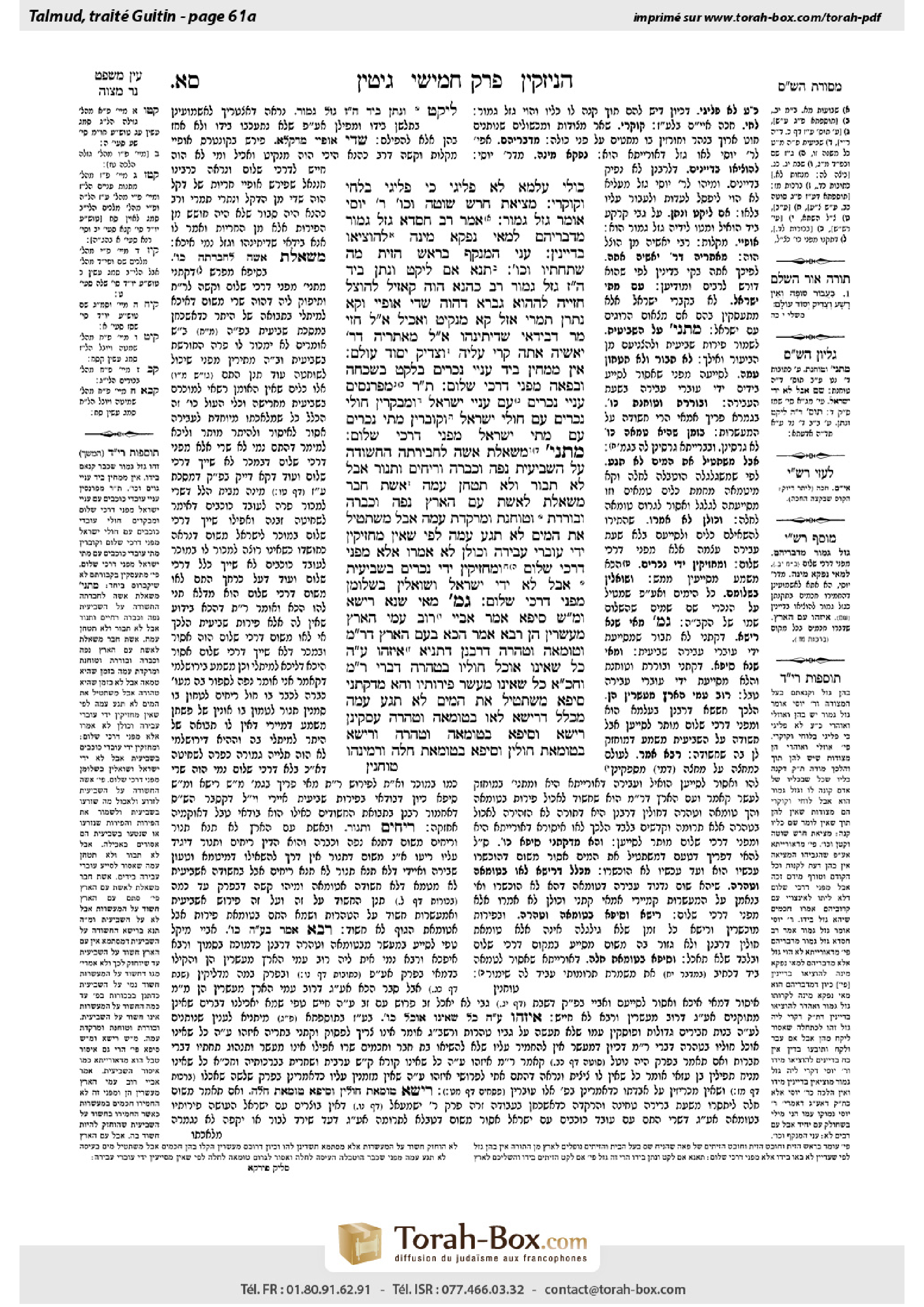
Gittin 61a: Talmud study for Daf Yomi
Study the Talmud for Daf Yomi with scanned pages, Hebrew text, English translations from Sefaria and AI-generated French translations.
Passage selection and English or AI-generated French translation are available where the scan has annotations. Daf Study is independent of Torah-Box and Sefaria.
Browse Gittin · גיטין · All tractatesGittin 61a text and translations
This page of Gittin includes the Aramaic text, an English translation and an AI-generated French translation, alongside the scan above.
גיטין ס״א א · Aramaic and Hebrew text
כּוּלֵּי עָלְמָא לָא פְּלִיגִי, כִּי פְּלִיגִי – בְּלֶחִי וְקוּקְרֵי.
מְצִיאַת חֵרֵשׁ, שׁוֹטֶה וְכוּ׳ רַבִּי יוֹסֵי אוֹמֵר: גָּזֵל גָּמוּר: אָמַר רַב חִסְדָּא: גָּזֵל גָּמוּר מִדִּבְרֵיהֶם. לְמַאי נָפְקָא מִינַּהּ? לְהוֹצִיאוֹ בְּדַיָּינִין.
עָנִי הַמְנַקֵּף בְּרֹאשׁ הַזַּיִת, מַה שֶּׁתַּחְתָּיו וְכוּ׳: תָּנָא: אִם לִיקֵּט וְנָתַן בַּיָּד – הֲרֵי זֶה גָּזֵל גָּמוּר.
רַב כָּהֲנָא הֲוָה קָאָזֵיל לְהוּצָל, חַזְיֵיהּ לְהָהוּא גַּבְרָא דַּהֲוָה שָׁדֵי אוּפְיֵי וְקָא נָתְרָן תַּמְרֵי, אֲזַל קָא מְנַקֵּיט וְאָכֵיל. אֲמַר לֵיהּ: חֲזִי מָר דְּבִידַאי שְׁדֵיתִינְהוּ. אֲמַר לֵיהּ: מֵאַתְרֵיהּ דְּרַבִּי יֹאשִׁיָּה אַתָּה. קָרֵי עֲלֵיהּ: ״וְצַדִּיק יְסוֹד עוֹלָם״.
אֵין מְמַחִין בְּיַד עֲנִיֵּי גוֹיִם בְּלֶקֶט בְּשִׁכְחָה וּבְפֵאָה, מִפְּנֵי דַּרְכֵי שָׁלוֹם: תָּנוּ רַבָּנַן: מְפַרְנְסִים עֲנִיֵּי גוֹיִם עִם עֲנִיֵּי יִשְׂרָאֵל, וּמְבַקְּרִין חוֹלֵי גוֹיִם עִם חוֹלֵי יִשְׂרָאֵל, וְקוֹבְרִין מֵתֵי גוֹיִם עִם מֵתֵי יִשְׂרָאֵל, מִפְּנֵי דַּרְכֵי שָׁלוֹם.
מַתְנִי׳ מַשְׁאֶלֶת אִשָּׁה לַחֲבֶירְתָּהּ הַחֲשׁוּדָה עַל הַשְּׁבִיעִית – נָפָה, וּכְבָרָה, וְרֵיחַיִם, וְתַנּוּר. אֲבָל לֹא תָּבוֹר וְלֹא תִּטְחַן עִמָּהּ.
אֵשֶׁת חָבֵר מַשְׁאֶלֶת לְאֵשֶׁת עַם הָאָרֶץ – נָפָה וּכְבָרָה; וּבוֹרֶרֶת, וְטוֹחֶנֶת, וּמְרַקֶּדֶת עִמָּהּ; אֲבָל מִשֶּׁתָּטִיל אֶת הַמַּיִם – לֹא תִּגַּע עִמָּהּ, לְפִי שֶׁאֵין מַחְזִיקִין יְדֵי עוֹבְרֵי עֲבֵירָה. וְכוּלָּן לֹא אָמְרוּ, אֶלָּא מִפְּנֵי דַּרְכֵי שָׁלוֹם.
וּמַחְזִיקִין יְדֵי גוֹיִם בַּשְּׁבִיעִית – אֲבָל לֹא יְדֵי יִשְׂרָאֵל; וְשׁוֹאֲלִין בִּשְׁלוֹמָן, מִפְּנֵי דַּרְכֵי שָׁלוֹם.
גְּמָ׳ מַאי שְׁנָא רֵישָׁא, וּמַאי שְׁנָא סֵיפָא? אָמַר אַבָּיֵי: רוֹב עַמֵּי הָאָרֶץ מְעַשְּׂרִין הֵן.
רָבָא אָמַר: הָכָא בְּעַם הָאָרֶץ דְּרַבִּי מֵאִיר, וְטוּמְאָה וְטׇהֳרָה דְּרַבָּנַן – דְּתַנְיָא: אֵיזֶהוּ עַם הָאָרֶץ? כֹּל שֶׁאֵינוֹ אוֹכֵל חוּלָּיו בְּטָהֳרָה, דִּבְרֵי רַבִּי מֵאִיר. וַחֲכָמִים אוֹמְרִים: כֹּל שֶׁאֵינוֹ מְעַשֵּׂר פֵּירוֹתָיו.
וְהָא מִדְּקָתָנֵי סֵיפָא: מִשֶּׁתָּטִיל אֶת הַמַּיִם לֹא תִּגַּע עִמָּהּ; מִכְּלָל דְּרֵישָׁא, לָאו בְּטוּמְאָה וְטׇהֳרָה עָסְקִינַן!
רֵישָׁא וְסֵיפָא בְּטוּמְאָה וְטׇהֳרָה; וְרֵישָׁא – בְּטוּמְאַת חוּלִּין, וְסֵיפָא – בְּטוּמְאַת חַלָּה.
וּרְמִינְהוּ:
Gittin 61a · English translation
everyone agrees that since they are receptacles that hold the fish or animal entering them, by right the trapped animals belong to the owner of the trap. When they disagree, it is with regard to a fishhook or other traps [kokrei] that merely catch the fish or animal but are not receptacles that hold it. In such cases, there is reason to say that the owner of the trap does not take possession of the trapped animal, and therefore another person who takes it is guilty only of robbery on account of the ways of peace.
§ The mishna teaches: Taking a lost item found by a deaf-mute, an imbecile, or a minor is considered robbery on account of the ways of peace. Rabbi Yosei says: It is full-fledged robbery. Rav Ḥisda says: Rabbi Yosei means that it is full-fledged robbery by rabbinic law but not by Torah law. The Gemara asks: What difference is there between full-fledged robbery by rabbinic law and robbery on account of the ways of peace? The Gemara answers: If it is full-fledged robbery by rabbinic law, the victim of robbery can recover the property from the robber by appealing to judges, i.e., the court can expropriate it from him by force.
§ The mishna teaches that if a poor person gleans olives at the top of an olive tree and olives fall to the ground under the tree, then taking those olives that are beneath it is considered robbery on account of the ways of peace. According to Rabbi Yosei, it is full-fledged robbery. A Sage taught: If the poor person gathered the olives and placed them in his hand before they fell to the ground, this is full-fledged robbery, because the poor person had already acquired legal ownership of the olives when they were in his hand.
The Gemara relates that Rav Kahana was once walking to the city of Huzal when he saw a certain man who was throwing sticks at a palm tree and dates were falling to the ground. Rav Kahana went, gathered up some of the dates, and ate them. That man said to Rav Kahana: See, Master, that I threw them down with my hand, i.e., the dates were already in my hand, and therefore they are legally mine. Rav Kahana said to him: You are from the place of Rabbi Yoshiya, who was a great Sage in the city of Huzal. For that reason, you are knowledgeable in halakha. Rav Kahana read the verse about Rabbi Yoshiya: “And a righteous man is the foundation of the world” (Proverbs 10:25). Even after his death, Rabbi Yoshiya left a foundation for the world, as his city continued to be a center of Torah study.
§ The mishna teaches: One does not protest against poor gentiles who come to take gleanings, forgotten sheaves, and the produce in the corner of the field, which is given to the poor [pe’a], although they are meant exclusively for the Jewish poor, on account of the ways of peace. Similarly, the Sages taught in a baraita (Tosefta 5:4): One sustains poor gentiles along with poor Jews, and one visits sick gentiles along with sick Jews, and one buries dead gentiles along with dead Jews. All this is done on account of the ways of peace, to foster peaceful relations between Jews and gentiles.
MISHNA: A woman may lend utensils to her friend who is suspect with regard to eating produce that grew in the Sabbatical Year after the time that such produce must be removed from the house and may no longer be eaten. The utensils that she may lend her include: A winnow, a sieve, a mill, and an oven. Lending her such utensils is not considered aiding in the commission of a transgression. But she may not select the grain from the chaff or grind wheat with her, i.e., she may not actively assist her in the performance of a sin.
The wife of a ḥaver, one who is devoted to the meticulous observance of mitzvot, especially the halakhot of ritual purity, teruma, and tithes, may lend the wife of an am ha’aretz, one who is not scrupulous in these areas, a winnow and a sieve, and she may even select, grind, and sift with her. But once the wife of the am ha’aretz pours water into the flour, thereby rendering it susceptible to ritual impurity, the wife of the ḥaver may not touch anything with her, because one may not assist those who commit transgressions. And all of the allowances mentioned in the mishna were stated only on account of the ways of peace.
And one may assist gentiles who work the land during the Sabbatical Year, but one may not assist Jews who do this. Similarly, one may extend greetings to gentiles on account of the ways of peace.
GEMARA: The Gemara asks with regard to the halakhot taught in the mishna: What is different in the first clause of the mishna that teaches that a woman may not select and grind grain with a woman who is suspected of eating produce of the Sabbatical Year after it is forbidden, and what is different in the latter clause that teaches that it is permitted for the wife of a ḥaver to assist the wife of an am ha’aretz in her selecting and grinding? Abaye said: Most amei ha’aretz tithe their produce, and therefore there is no reason to render it prohibited to assist the wife of an am ha’aretz in her work, as she is probably preparing a permitted food. Although there may be concern that the food was not tithed due to the minority of amei ha’aretz who do not separate tithes, this concern is ignored on account of the ways of peace.
Rava said: Here the mishna speaks about the am ha’aretz as defined by Rabbi Meir and the issue of ritual impurity and purity by rabbinic law. It does not speak about the matter of separating teruma and tithes. As it is taught in a baraita (Tosefta, Avoda Zara 3:10): Who is an am ha’aretz? Anyone who does not eat his non-sacred produce in a state of ritual purity; this is the statement of Rabbi Meir. And the Rabbis say: An am ha’aretz is anyone who does not tithe his produce. Since the mishna is referring to the type of am ha’aretz about whom there is an assumption that he tithes his produce but does not eat his non-sacred produce in a state of ritual purity, and in light of the fact that eating non-sacred produce in a state of ritual purity is stipulated by rabbinic law, on account of the ways of peace, the Sages did not prohibit the wife of a ḥaver from assisting the wife of an am ha’aretz.
The Gemara raises an objection: But from the fact that the latter clause of the mishna teaches: Once the wife of the am ha’aretz pours water into the flour, the wife of the ḥaver may not touch anything with her because the water has rendered the dough susceptible to ritual impurity, it may be inferred that in the first clause in the mishna we are not dealing with concern about the halakhot of impurity and purity. Rather, the concern pertains to tithes.
The Gemara answers: Both in the first clause and in the latter clause the concern relates to impurity and purity. The difference is that in the first clause, even if the grain was already rendered susceptible to impurity, the concern is only about impurity of non-sacred produce. Rendering non-sacred produce impure is not prohibited by Torah law; it is a matter about which ḥaverim were meticulous. But in the latter clause, the concern is the impurity of ḥalla, the portion that must be separated from the dough and given to a priest. It is at the time that water is added to the flour that the obligation to separate ḥalla from the dough takes effect. Due to the ḥalla that will be separated from the dough, it is prohibited by Torah law for one to render the dough impure.
And the Gemara raises a contradiction from another baraita (Tosefta, Demai 4:29):
Gittin 61a · Traduction française (IA)
Tous s'accordent sur le fait que puisque ces récipients contiennent les poissons ou les animaux qui y pénètrent, par droit les animaux capturés appartiennent à l'owner de la trappe. Lorsqu'ils divergent, c'est concernant une ligne de pêche ou d'autres pièges [kokrei] qui capturent simplement le poisson ou l'animal mais ne les contiennent pas. Dans ces cas, il y a lieu de dire que l'owner de la trappe ne prend pas possession de l'animal capturé, et par conséquent, une autre personne qui le prend est coupable seulement de vol en raison des voies de la paix.
§ La mitsva enseigne : Prendre un objet perdu trouvé par un muet, un imbécile ou un mineur est considéré comme un vol en raison des voies de la paix. Rabbi Yosei dit : C'est un vol complet. Rav Ḥisda dit : Rabbi Yosei veut dire que c'est un vol complet selon la loi rabbinique mais pas selon la loi de la Torah. La Guemara demande : Quelle différence y a-t-il entre un vol complet selon la loi rabbinique et un vol en raison des voies de la paix ? La Guemara répond : Si c'est un vol complet selon la loi rabbinique, la victime du vol peut récupérer la propriété auprès du voleur en demandant aux juges, c'est-à-dire que le tribunal peut exproprier la propriété par la force.
§ La mitsva enseigne que si un pauvre ramasse des olives en haut d'un arbre à olives et des olives tombent au sol sous l'arbre, alors prendre ces olives qui sont sous l'arbre est considéré comme un vol en raison des voies de la paix. Selon Rabbi Yosei, c'est un vol complet. Un Sage a enseigné : Si le pauvre a ramassé les olives et les a placées dans sa main avant qu'elles ne tombent au sol, cela est un vol complet, car le pauvre avait déjà acquis la propriété légale des olives lorsqu'elles étaient dans sa main.
La Guemara rapporte que Rav Kahana était un jour en chemin vers la ville de Huzal lorsqu'il a vu un certain homme qui lançait des bâtons contre un palmier et des dattes tombaient au sol. Rav Kahana est allé, a ramassé quelques dattes et les a mangées. Cet homme a dit à Rav Kahana : Voyez, Maître, que je les ai lancées avec ma main, c'est-à-dire que les dattes étaient déjà dans ma main, et par conséquent, elles sont légales à moi. Rav Kahana a dit à lui : Vous êtes de la ville de Rabbi Yoshiya, qui était un Sage grand dans la ville de Huzal. Pour cette raison, vous êtes savant en halakha. Rav Kahana a lu la verset sur Rabbi Yoshiya : « Et un homme juste est la fondation du monde » (Proverbes 10:25). Même après sa mort, Rabbi Yoshiya a laissé une fondation pour le monde, car sa ville a continué à être un centre d'étude de la Torah.
§ La mitsna enseigne : On ne proteste pas contre les gentils pauvres qui viennent prendre les épis de blé, les épis oubliés et les produits du coin du champ, qui sont donnés aux pauvres [pe’a], bien qu'ils soient exclusivement destinés aux pauvres juifs, en raison des voies de la paix. De même, les Sages ont enseigné dans une baraïta (Tosefta 5:4) : On sustente les gentils pauvres avec les Juifs pauvres, et on visite les gentils malades avec les Juifs malades, et on enterré les gentils morts avec les Juifs morts. Tout cela est fait en raison des voies de la paix, afin de favoriser les relations pacifiques entre les Juifs et les gentils.
MITSVA : Une femme peut prêter des ustensiles à sa amie qui est suspecte en ce qui concerne la consommation de produits qui ont grandi dans l'année sabbatique après le moment où tels produits doivent être retirés de la maison et ne peuvent plus être mangés. Les ustensiles qu'elle peut prêter à sa amie incluent : un éplucheur, un tamis, un moulin et un four. Prêter ces ustensiles n'est pas considéré comme aider à commettre un péché. Mais elle ne peut pas sélectionner le grain du blé ou moudre le blé avec elle, c'est-à-dire elle ne peut pas activement l'aider à commettre un péché.
La femme d'un ḥaver, celui qui est dévoué à l'observation minutieuse des mitsvot, surtout les halakhot de pureté rituelle, terouma et des dîmes, peut prêter la femme d'un am ha’aretz, celui qui n'est pas rigoureux dans ces domaines, un éplucheur et un tamis, et elle peut même sélectionner, moudre et tamiser avec elle. Mais une fois que la femme de l'am ha’aretz verse de l'eau dans la farine, ce qui rend la farine susceptible de souillure rituelle, la femme du ḥaver ne peut pas toucher quoi que ce soit avec elle, car on ne doit pas aider ceux qui commettent des transgressions. Et toutes les autorisations mentionnées dans la mitsna ont été énoncées uniquement en raison des voies de la paix.
Et on peut aider les gentils qui travaillent la terre pendant l'année sabbatique, mais on ne peut pas aider les Juifs qui le font. De même, on peut saluer les gentils en raison des voies de la paix.
GUEMARA : La Guemara demande concernant les halakhot enseignées dans la mitsna : Quelle est la différence dans la première clause de la mitsna qui enseigne que la femme ne peut pas sélectionner et moudre le grain avec une femme suspecte de consommer des produits de l'année sabbatique après qu'ils sont interdits, et quelle est la différence dans la dernière clause qui enseigne que c'est permis pour la femme d'un ḥaver d'aider la femme d'un am ha’aretz dans son sélection et mouture ? Abaye a dit : La plupart des amei ha’aretz titrent leurs produits, et par conséquent, il n'y a pas de raison de rendre interdit d'aider la femme d'un am ha’aretz dans son travail, car elle est probablement en train de préparer un aliment permis. Bien que l'on puisse avoir une crainte que l'aliment n'ait pas été titré en raison de la minorité des amei ha’aretz qui ne séparent pas les dîmes, cette crainte est ignorée en raison des voies de la paix.
Rava a dit : Ici, la mitsna parle de l'am ha’aretz comme défini par Rabbi Meir et de la question de la pureté rituelle et de l'impureté selon la loi rabbinique. Elle ne parle pas de la question de la séparation de la terouma et des dîmes. Comme il est enseigné dans une baraïta (Tosefta, Avoda Zara 3:10) : Qui est un am ha’aretz ? Tout celui qui ne mange pas ses produits non sacrés dans un état de pureté rituelle ; c'est la déclaration de Rabbi Meir. Et les Rabbins disent : Un am ha’aretz est tout celui qui ne titre pas ses produits. Puisque la mitsna parle du type d'am ha’aretz pour lequel il y a une présomption qu'il titre ses produits mais ne mange pas ses produits non sacrés dans un état de pureté rituelle, et en lumière du fait que manger des produits non sacrés dans un état de pureté rituelle est stipulé par la loi rabbinique, en raison des voies de la paix, les Sages n'ont pas interdit à la femme d'un ḥaver d'aider la femme d'un am ha’aretz.
La Guemara soulève une objection : Mais à partir du fait que la clause ultérieure de la mitsna enseigne : Une fois que la femme de l'am ha'aretz verse de l'eau dans la farine, la femme du ḥaver ne peut plus toucher quoi que ce soit, car l'eau a rendu la pâte susceptible de souillure rituelle, on peut en déduire que dans la première clause de la mitsna, nous ne traitons pas de la crainte concernant les halakhot de la souillure et de la pureté. Plutôt, la crainte concerne les dîmes.
La Guemara répond : À la fois dans la première clause et dans la clause ultérieure, la crainte concerne la souillure et la pureté. La différence est que dans la première clause, même si le grain était déjà rendu susceptible de souillure, la crainte est uniquement concernant la souillure des produits non sacrés. Rendre des produits non sacrés souillés n'est pas interdit par la loi divine ; il s'agit d'une question sur laquelle les ḥaverim étaient minutieux. Mais dans la clause ultérieure, la crainte est la souillure de la ḥalla, la portion qui doit être séparée de la pâte et donnée à un prêtre. C'est au moment où l'eau est ajoutée à la farine que l'obligation de séparer la ḥalla de la pâte prend effet. En raison de la ḥalla qui sera séparée de la pâte, il est interdit par la loi divine de rendre la pâte souillante.
Et la Guemara soulève une contradiction à partir d'une autre baraïta (Tosefta, Demai 4:29) :
Traduction française générée par IA à partir de l’édition anglaise de Sefaria. Vérifie toujours un passage avec le texte source.
Text from Sefaria: William Davidson Edition - Vocalized Aramaic (CC BY NC); William Davidson Edition - English (CC BY NC).