Gittin 61b: Talmud study for Daf Yomi
Study the Talmud for Daf Yomi with scanned pages, Hebrew text, English translations from Sefaria and AI-generated French translations.
Passage selection and English or AI-generated French translation are available where the scan has annotations. Daf Study is independent of Torah-Box and Sefaria.
Browse Gittin · גיטין · All tractatesGittin 61b text and translations
This page of Gittin includes the Aramaic text, an English translation and an AI-generated French translation, alongside the scan above.
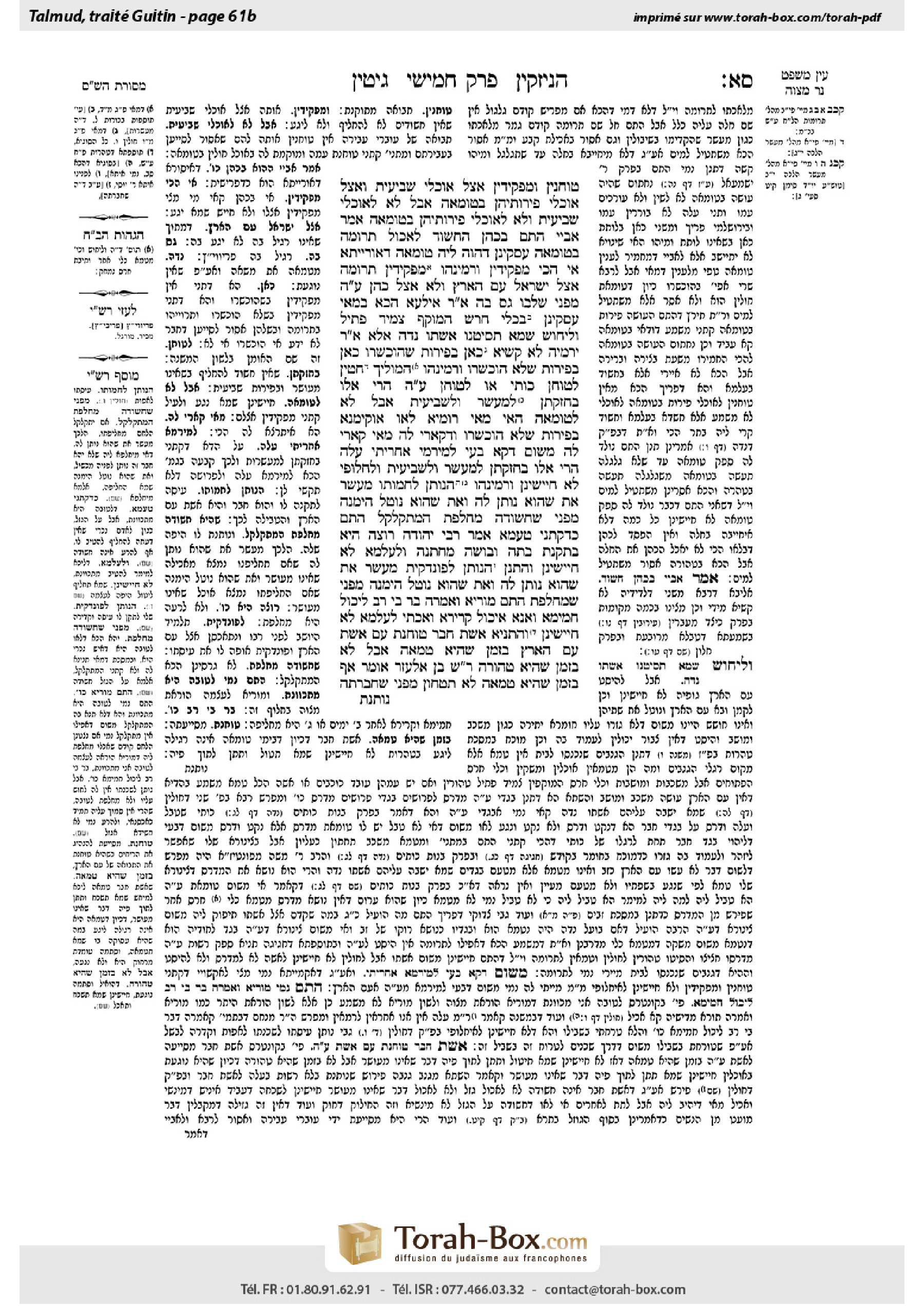
גיטין ס״א ב · Aramaic and Hebrew text
טוֹחֲנִין וּמַפְקִידִין אֵצֶל אוֹכְלֵי שְׁבִיעִית, וְאֵצֶל אוֹכְלֵי פֵירוֹתֵיהֶן בְּטוּמְאָה; אֲבָל לֹא לְאוֹכְלֵי שְׁבִיעִית, וְלֹא לְאוֹכְלֵי פֵירוֹתֵיהֶן בְּטוּמְאָה!
אָמַר אַבָּיֵי: הָתָם, בְּכֹהֵן הֶחָשׁוּד לֶאֱכוֹל תְּרוּמָה בְּטוּמְאָה עָסְקִינַן – דַּהֲוָה לֵיהּ טוּמְאָה דְּאוֹרָיְיתָא.
אִי הָכִי, מַפְקִידִין?! וּרְמִינְהוּ: מַפְקִידִין תְּרוּמָה אֵצֶל יִשְׂרָאֵל עַם הָאָרֶץ, וְלֹא אֵצֶל כֹּהֵן עַם הָאָרֶץ, מִפְּנֵי שֶׁלִּבּוֹ גַּס בָּהּ!
אָמַר רַבִּי אִילְעָא: הָכָא בְּמַאי עָסְקִינַן – בִּכְלִי חֶרֶשׂ הַמּוּקָּף צָמִיד פָּתִיל.
וְלֵיחוּשׁ שֶׁמָּא תְּסִיטֶנּוּ אִשְׁתּוֹ נִדָּה!
אֶלָּא אָמַר רַבִּי יִרְמְיָה: לָא קַשְׁיָא; כָּאן בְּפֵירוֹת שֶׁהוּכְשְׁרוּ, כָּאן בְּפֵירוֹת שֶׁלֹּא הוּכְשְׁרוּ.
וּרְמִינְהוּ: הַמּוֹלִיךְ חִטִּין לְטָחוֹן כּוּתִי אוֹ לְטָחוֹן עַם הָאָרֶץ – הֲרֵי אֵלּוּ בְּחֶזְקָתָן לְמַעֲשֵׂר וְלִשְׁבִיעִית, אֲבָל לֹא לְטוּמְאָה!
הַאי מַאי רוּמְיָא? לָאו אוֹקֵימְנָא בְּפֵירוֹת שֶׁלֹּא הוּכְשְׁרוּ?
וּדְקָאָרֵי לַהּ – מַאי קָאָרֵי לַהּ? מִשּׁוּם דְּקָא בָּעֵי לְמִירְמֵי אַחֲרִיתִי עֲלַהּ – הֲרֵי אֵלּוּ בְּחֶזְקָתָן לְמַעֲשֵׂר וְלִשְׁבִיעִית, וּלְחַלּוֹפֵי לָא חָיְישִׁינַן.
וּרְמִינְהוּ: הַנּוֹתֵן לַחֲמוֹתוֹ, מְעַשֵּׂר אֵת שֶׁהוּא נוֹתֵן לָהּ וְאֵת שֶׁהוּא נוֹטֵל הֵימֶנָּה, מִפְּנֵי שֶׁחֲשׁוּדָה מַחְלֶפֶת הַמִּתְקַלְקֵל!
הָתָם כִּדְקָתָנֵי טַעְמָא, אָמַר רַבִּי יְהוּדָה: רוֹצֶה הִיא בְּתַקָּנַת בִּתָּהּ, וּבוֹשָׁה מֵחֲתָנָהּ.
וּלְעָלְמָא – לָא חָיְישִׁינַן?! וְהָתְנַן: הַנּוֹתֵן לַפּוּנְדָּקִית, מְעַשֵּׂר אֶת שֶׁהוּא נוֹתֵן לָהּ וְאֶת שֶׁהוּא נוֹטֵל הֵימֶנָּה, מִפְּנֵי שֶׁמַּחְלֶפֶת! הָתָם מוֹרְיָא וְאָמְרָה: בַּר בֵּי רַב לֵיכוֹל חַמִּימָא, וַאֲנָא אֵיכוֹל קָרִירָא?!
וְאַכַּתִּי, לְעָלְמָא לָא חָיְישִׁינַן?! וְהָתַנְיָא: אֵשֶׁת חָבֵר טוֹחֶנֶת עִם אֵשֶׁת עַם הָאָרֶץ – בִּזְמַן שֶׁהִיא טְמֵאָה אֲבָל לֹא בִּזְמַן שֶׁהִיא טְהוֹרָה. רַבִּי שִׁמְעוֹן בֶּן אֶלְעָזָר אוֹמֵר: אַף בִּזְמַן שֶׁהִיא טְמֵאָה לֹא תִּטְחוֹן, מִפְּנֵי שֶׁחֲבֶרְתָּהּ
Gittin 61b · English translation
One may grind one’s tithed produce and deposit it with those who eat Sabbatical-Year produce and those who eat their own produce in a state of impurity, because there is no concern that they will exchange this produce with Sabbatical-Year produce or with impure produce, or that they will touch the produce. But one may not grind for those who eat Sabbatical-Year produce or for those who eat their own produce in a state of impurity, so as not to assist them in committing a transgression. This is difficult according to Rava’s explanation of the mishna, that the wife of a ḥaver may grind non-sacred produce with the wife of an am ha’aretz, who eats his own produce in a state of ritual impurity.
Abaye said: There, in that baraita, we are dealing with a priest who is suspected with regard to partaking of teruma in a state of ritual impurity, which involves a prohibition of impurity by Torah law.
The Gemara asks: If so, if the baraita is referring to a priest, how then may one deposit tithed produce with him? The Gemara raises a contradiction from that which was taught in a baraita (Tosefta, Demai 4:28): One may deposit teruma with an Israelite who is an am ha’aretz. Although he is not meticulous about the halakhot of purity, there is no concern that he will defile the teruma. But one may not deposit teruma with a priest who is an am ha’aretz because he is accustomed to having teruma, and therefore he might not treat it properly and will touch and defile it.
Rabbi Ile’a says: With what are we dealing here, in the previously mentioned baraita, which teaches that one may deposit his tithed produce with one who eats his own produce in a state of ritual purity? This is referring to a case where one deposited the produce in an earthenware vessel with a tightly bound cover. In such a case, there is no concern that the priest who is suspected of partaking of teruma in a state of ritual impurity will touch the produce and render it impure.
The Gemara asks: And let there nevertheless be a concern lest the priest’s menstruating wife move the vessel and impart ritual impurity to the produce inside it. A menstruating woman imparts impurity to the produce inside the vessel through moving it, even if the contents are tightly sealed in the vessel, and she does not come into direct contact with the contents.
Rather, Rabbi Yirmeya says that this is not difficult. Here, where it is prohibited to deposit produce with a priest who is suspected with regard to partaking of teruma in a state of ritual impurity, we are dealing with produce that came into contact with a liquid and became susceptible to contracting ritual impurity. Consequently, there is concern that the priest may impart impurity to it. There, where it is permitted to deposit produce with such a priest, we are dealing with produce that has not yet become susceptible to contracting ritual impurity, in which case there is no concern that the priest will impart impurity to it.
And the Gemara raises a contradiction from what is taught in a mishna (Demai 3:4): With regard to one who takes tithed wheat to a Samaritan grinder or to a grinder who is an am ha’aretz, the wheat retains its presumptive status with regard to tithes and Sabbatical-Year produce, as there is no concern that the grinder switched the grain. But the wheat does not retain its presumptive status with regard to impurity, as there is concern that perhaps the grinder touched it and rendered it impure.
The Gemara asks: What contradiction is there here? Did we not establish that the baraita that permits depositing produce is dealing with produce that has not yet become susceptible to contracting ritual impurity, and so it does not become impure when touched by an impure person? Here, the mishna in tractate Demai is dealing with produce that already became susceptible to contracting ritual impurity, and therefore there is concern that the produce will be rendered impure.
The Gemara asks: And he who asked the question, why did he ask it? Wasn’t this answer already stated earlier? The Gemara answers: The one who asked the question cited this mishna only because he wished to raise a contradiction to it from another mishna, as according to this mishna the wheat that was brought to the suspect grinder retains its presumptive status with regard to tithes and Sabbatical-Year produce, and we are not concerned that perhaps the grinder exchanged the grain he had received with grain of his own that was forbidden in some way.
And the Gemara raises a contradiction to this from what was taught in a mishna (Demai 3:6): With regard to one who gives food to his mother-in-law, who is the wife of an am ha’aretz, so that she may prepare it for him, he must tithe everything that he gives her and everything that he takes from her. This is because she is suspected of exchanging any food received from him that was spoiled with her own food that was not spoiled. Perhaps, then, she did not return the food that he had given her but rather food that was not yet tithed. In this mishna, there is concern that an am ha’aretz may exchange produce that he received with produce of his own.
The Gemara answers that there the concern is for the reason that was explicitly taught in that mishna: Rabbi Yehuda said: His mother-in-law wants what is good for her daughter, that she not eat anything that is spoiled, and she is ashamed before her son-in-law to tell him that he had given her something that was spoiled. For this reason, she does not tell him that she exchanged the food.
The Gemara asks: And is this to say that in the case of ordinary people we are not concerned that food will be exchanged in a similar situation? But didn’t we learn in a mishna (Demai 3:5): If one gives food to an innkeeper [pundakit] so that she can prepare it for him, he must tithe everything that he gives her and everything that he takes from her, because she exchanges the food received from him with food of her own? This indicates that the concern is not limited to the case of a mother-in-law. The Gemara answers: There, the innkeeper rules for herself that it is permitted for her to do this and says: Why should this student of Torah eat hot food while I will eat cold food? In other words, the innkeeper may justify her behavior to herself and exchange his food for hers.
The Gemara asks: And still, in the case of ordinary people, are we not concerned about food being switched? But isn’t it taught in a baraita (Tosefta, Teharot 8:4): The wife of a ḥaver may grind with the wife of an am ha’aretz when she, the wife of the ḥaver, is impure, e.g., when she is menstruating and therefore careful not to touch food. And there is no concern that she will come to eat untithed produce. But she may not do this when she is pure. Rabbi Shimon ben Elazar says: She may not grind even when she is impure, because the other woman, the wife of the am ha’aretz,
Gittin 61b · Traduction française (IA)
On peut moudre ses produits titrés et les déposer chez ceux qui mangent les produits de l'année sabbatique et chez ceux qui mangent leurs propres produits dans un état d'impureté, car il n'y a pas de crainte qu'ils échangent ces produits avec des produits de l'année sabbatique ou avec des produits impurs, ou qu'ils touchent les produits. Mais on ne peut pas moudre pour ceux qui mangent les produits de l'année sabbatique ou pour ceux qui mangent leurs propres produits dans un état d'impureté, afin de ne pas les aider à commettre un péché. Cela est difficile selon l'explication de Rava sur la mitsna, que la femme d'un ḥaver peut moudre des produits non sacrés avec la femme d'un am ha'aretz, qui mange ses propres produits dans un état d'impureté.
Abaye dit : Là, dans ce baraïta, nous parlons d'un prêtre soupçonné d'avoir mangé la terouma dans un état d'impureté, ce qui implique une interdiction d'impureté selon la loi divine.
Le Guemara demande : Si c'est ainsi, comment peut-on déposer des produits titrés chez lui ? Le Guemara soulève une contradiction à partir de ce qui a été enseigné dans un baraïta (Tosefta, Demai 4:28) : On peut déposer la terouma chez un Israélite qui est un am ha'aretz. Bien qu'il ne soit pas soigneux des halakhot de pureté, il n'y a pas de crainte qu'il rende la terouma impure. Mais on ne peut pas déposer la terouma chez un prêtre qui est un am ha'aretz, car il est habitué à avoir la terouma et pourrait ne pas la traiter correctement, et toucherait et la rendrait impure.
Rabbi Ile’a dit : De quoi sommes-nous en train de parler ici, dans le baraïta mentionné précédemment, qui enseigne que l'on peut déposer ses produits titrés chez celui qui mange ses propres produits dans un état de pureté ? Cela fait référence à un cas où l'on a déposé les produits dans un récipient en terre avec un couvercle étroitement fermé. Dans ce cas, il n'y a pas de crainte que le prêtre soupçonné d'avoir mangé la terouma dans un état d'impureté touche les produits et les rende impurs.
Le Guemara demande : Et pourtant, il pourrait y avoir une crainte que la femme menstruelle du prêtre déplace le récipient et transmette l'impureté aux produits à l'intérieur. Une femme menstruelle transmet l'impureté aux produits à l'intérieur du récipient en les déplaçant, même si les produits sont étroitement scellés dans le récipient, et elle ne vient pas en contact direct avec les produits.
Plutôt, Rabbi Yirmeya dit que cela n'est pas difficile. Ici, où il est interdit de déposer des produits chez un prêtre soupçonné d'avoir mangé la terouma dans un état d'impureté, nous parlons de produits qui ont été en contact avec un liquide et sont devenus susceptibles de contracter l'impureté. Par conséquent, il y a une crainte que le prêtre les rende impurs. Là, où il est permis de déposer des produits chez un tel prêtre, nous parlons de produits qui n'ont pas encore devenus susceptibles de contracter l'impureté, dans ce cas, il n'y a pas de crainte que le prêtre les rende impurs.
Et la Guemara soulève une contradiction à partir de ce qui est enseigné dans une mitsva (Demai 3:4) : Concernant celui qui apporte du blé titré à un meunier samaritain ou à un meunier qui est un am ha'aretz, le blé conserve son statut présomptif concernant les titres et les produits de l'année sabbatique, car il n'y a pas de crainte qu'il ait échangé le grain. Mais le blé ne conserve pas son statut présomptif concernant l'impureté, car il y a une crainte qu'il ait touché le blé et l'ait rendu impur.
La Guemara demande : Quelle contradiction y a-t-il ici ? N'avons-nous pas établi que la baraïta qui permet de déposer des produits traite de des produits qui n'ont pas encore devenu susceptibles de contracter l'impureté, et donc ne deviennent pas impurs en étant touchés par une personne impure ? Ici, la mitsva dans le traité Demai traite de des produits qui ont déjà devenu susceptibles de contracter l'impureté, et par conséquent, il y a une crainte que les produits soient rendus impurs.
La Guemara demande : Et celui qui a posé la question, pourquoi l'a-t-il posée ? N'était-ce pas cette réponse déjà évoquée plus tôt ? La Guemara répond : Celui qui a posé la question cite cette mitsva uniquement parce qu'il voulait élever une contradiction à partir d'une autre mitsva, car selon cette mitsva, le blé apporté à un meunier suspect conserve son statut présomptif concernant les titres et les produits de l'année sabbatique, et nous ne craignons pas qu'il ait échangé le grain qu'il avait reçu avec du grain de sa propre propriété qui était interdit d'une certaine manière.
Et la Guemara soulève une contradiction à partir de ce qui a été enseigné dans une mitsva (Demai 3:6) : Concernant celui qui donne de la nourriture à sa belle-mère, qui est l'épouse d'un am ha'aretz, afin qu'elle le prépare, il faut titrer tout ce qu'il lui donne et tout ce qu'il prend de chez elle. Cela est dû au fait qu'elle est soupçonnée d'échanger toute nourriture reçue de lui qui est pourrie avec sa propre nourriture qui n'est pas pourrie. Peut-être, alors, elle n'a pas rendu la nourriture qu'il lui avait donnée, mais plutôt de la nourriture qui n'était pas encore titrée. Dans cette mitsva, il y a une crainte qu'un am ha'aretz échange des produits qu'il a reçus avec ses propres produits.
La Guemara répond que là, la crainte est pour la raison explicitement enseignée dans cette mitsva : Rabbi Yehuda dit : Sa belle-mère veut ce qui est bon pour sa fille, qu'elle ne mange pas de chose pourrie, et elle est honteuse devant son gendre pour lui dire qu'il lui avait donné quelque chose de pourri. Pour cette raison, elle ne lui dit pas qu'elle a échangé la nourriture.
La Guemara pose la question : Et cela signifie-t-il que dans le cas des gens ordinaires, nous ne nous inquiétons pas que les aliments soient échangés dans une situation similaire ? Mais n’avons-nous pas appris dans une mitsna (Demai 3:5) : Si l’on donne de la nourriture à un aubergiste [pundakit] afin qu’elle le prépare, il doit sanctifier tout ce qu’il lui donne et tout ce qu’il prend de chez elle, car elle échange la nourriture qu’elle reçoit de lui contre sa propre nourriture ? Cela montre que l’inquiétude n’est pas limitée au cas d’une belle-mère. La Guemara répond : Là, l’aubergiste se fixe elle-même la permission de faire cela et dit : Pourquoi ce disciple de la Torah devrait-il manger de la nourriture chaude alors que moi, je mangerai de la nourriture froide ? Autrement dit, l’aubergiste peut justifier son comportement à ses propres yeux et échanger la nourriture de l’homme contre la sienne.
La Guemara pose la question : Et pourtant, dans le cas des gens ordinaires, ne sommes-nous pas inquiets que les aliments soient échangés ? Mais n’est-il pas enseigné dans une baraïta (Tosefta, Téharot 8:4) : La femme d’un ḥaver peut moudre avec la femme d’un am ha’aretz quand elle, la femme du ḥaver, est impure, c’est-à-dire quand elle est en période de menstruation et donc prudente de ne pas toucher les aliments. Et là, il n’y a pas d’inquiétude qu’elle vienne à manger des produits non sanctifiés. Mais elle ne peut pas faire cela quand elle est pure. Rabbi Šimon ben Elazar dit : Elle ne peut pas moudre même quand elle est impure, car l’autre femme, la femme de l’am ha’aretz,
Traduction française générée par IA à partir de l’édition anglaise de Sefaria. Vérifie toujours un passage avec le texte source.
Text from Sefaria: William Davidson Edition - Vocalized Aramaic (CC BY NC); William Davidson Edition - English (CC BY NC).