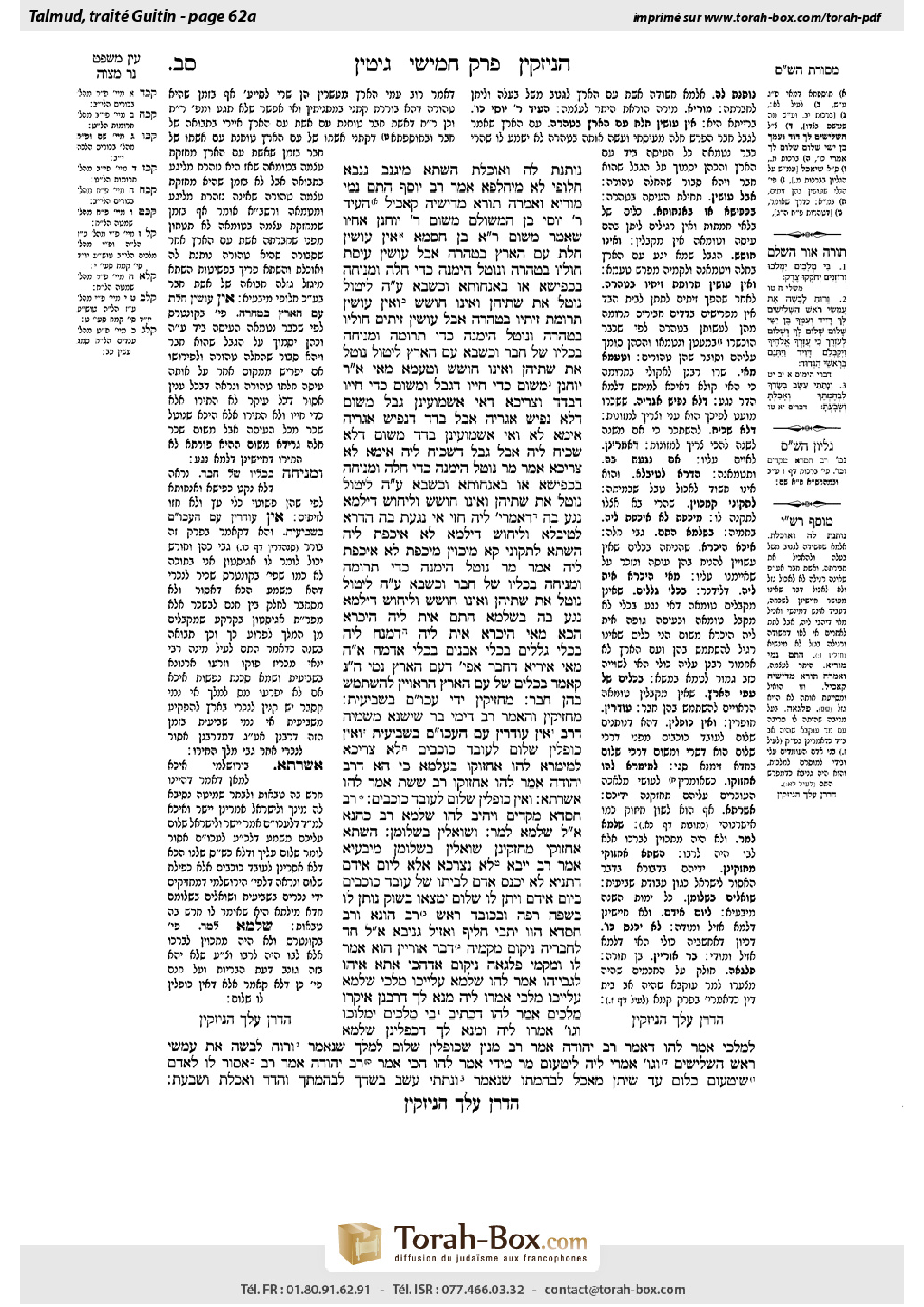
Gittin 62a: Talmud study for Daf Yomi
Study the Talmud for Daf Yomi with scanned pages, Hebrew text, English translations from Sefaria and AI-generated French translations.
Passage selection and English or AI-generated French translation are available where the scan has annotations. Daf Study is independent of Torah-Box and Sefaria.
Browse Gittin · גיטין · All tractatesGittin 62a text and translations
This page of Gittin includes the Aramaic text, an English translation and an AI-generated French translation, alongside the scan above.
גיטין ס״ב א · Aramaic and Hebrew text
נוֹתֶנֶת לָהּ וְאוֹכֶלֶת. הַשְׁתָּא מִיגְנָב גָּנְבָא, חַלּוֹפֵי לָא מְיחַלְּפָא?!
אָמַר רַב יוֹסֵף: הָתָם נָמֵי, מוֹרְיָא וְאָמְרָה: תּוֹרָא מִדִּישֵׁיהּ קָאָכֵיל.
הֵעִיד רַבִּי יוֹסֵי בֶּן הַמְשׁוּלָּם מִשּׁוּם רַבִּי יוֹחָנָן אָחִיו, שֶׁאָמַר מִשּׁוּם רַבִּי אֶלְעָזָר בֶּן חַסָּמָא: אֵין עוֹשִׂין חַלַּת עַם הָאָרֶץ בְּטׇהֳרָה, אֲבָל עוֹשִׂין עִיסַּת חוּלָּיו בְּטָהֳרָה; וְנוֹטֵל הֵימֶנָּה כְּדֵי חַלָּה, וּמַנִּיחָהּ בִּכְפִישָׁא אוֹ בְּאַנְחוּתָא; וּכְשֶׁבָּא עַם הָאָרֶץ לִיטּוֹל, נוֹטֵל אֶת שְׁתֵּיהֶן וְאֵינוֹ חוֹשֵׁשׁ.
וְאֵין עוֹשִׂין תְּרוּמַת זֵיתָיו בְּטׇהֳרָה, אֲבָל עוֹשִׂין זֵיתֵי חוּלָּיו בְּטָהֳרָה; וְנוֹטֵל הֵימֶנָּה כְּדֵי תְּרוּמָה, וּמַנִּיחָהּ בְּכִלְיוֹ שֶׁל חָבֵר; וּכְשֶׁבָּא עַם הָאָרֶץ לִיטּוֹל – נוֹטֵל אֶת שְׁתֵּיהֶן, וְאֵינוֹ חוֹשֵׁשׁ.
וְטַעְמָא מַאי? אָמַר רַבִּי יוֹחָנָן: מִשּׁוּם כְּדֵי חַיָּיו דְּגַבָּל, וּמִשּׁוּם כְּדֵי חַיָּיו דְּבַדָּד.
וּצְרִיכָא; דְּאִי אַשְׁמוֹעִינַן גַּבָּל – מִשּׁוּם דְּלָא נְפִישׁ אַגְרֵיהּ, אֲבָל בַּדָּד – דִּנְפִישׁ אַגְרֵיהּ, אֵימָא לָא. וְאִי אַשְׁמוֹעִינַן בַּדָּד – מִשּׁוּם דְּלָא שְׁכִיחַ לֵיהּ, אֲבָל גַּבָּל – דִּשְׁכִיחַ לֵיהּ, אֵימָא לָא; צְרִיכָא.
אָמַר מָר: נוֹטֵל הֵימֶנָּה כְּדֵי חַלָּה, וּמַנִּיחָהּ בִּכְפִישָׁא אוֹ בְּאַנְחוּתָא; וּכְשֶׁבָּא עַם הָאָרֶץ לִיטּוֹל, נוֹטֵל אֶת שְׁתֵּיהֶן וְאֵינוֹ חוֹשֵׁשׁ. וְלֵיחוּשׁ דִּילְמָא נָגַע בָּהּ! דְּאָמְרִינַן לֵיהּ: חֲזִי, אִי נָגְעַתְּ בַּהּ הָדְרָא לְטִיבְלָא.
וְלֵיחוּשׁ דִּילְמָא לָא אִיכְפַּת לֵיהּ! הַשְׁתָּא לְתַקּוֹנֵי קָא מִיכַּוֵּין, מִיכְפָּת לָא אִיכְפַּת לֵיהּ?!
אָמַר מָר: נוֹטֵל הֵימֶנָּה כְּדֵי תְרוּמָה, וּמַנִּיחָהּ בְּכִלְיוֹ שֶׁל חָבֵר; וּכְשֶׁבָּא עַם הָאָרֶץ לִיטּוֹל, נוֹטֵל אֶת שְׁתֵּיהֶן וְאֵינוֹ חוֹשֵׁשׁ. וְלֵיחוּשׁ דִּילְמָא נָגַע בַּהּ! בִּשְׁלָמָא הָתָם, אִית לֵיהּ הֶיכֵּרָא; הָכָא, מַאי הֶיכֵּרָא אִית לֵיהּ? דְּמַנַּח לֵיהּ בִּכְלֵי גְלָלִים, בִּכְלֵי אֲבָנִים, בִּכְלֵי אֲדָמָה.
אִי הָכִי, מַאי אִירְיָא דְּחָבֵר? אֲפִילּוּ דְּעַם הָאָרֶץ נָמֵי! הָכִי נָמֵי קָאָמַר: בְּכֵלִים שֶׁל עַם הָאָרֶץ, הָרְאוּיִין לְהִשְׁתַּמֵּשׁ בָּהֶן חָבֵר.
מַחְזִיקִין יְדֵי גּוֹיִם בַּשְּׁבִיעִית: מַחְזִיקִין?! וְהָאָמַר רַב דִּימִי בַּר שִׁישְׁנָא מִשְּׁמֵיהּ דְּרַב: אֵין עוֹדְרִין עִם הַגּוֹי בַּשְּׁבִיעִית, וְאֵין כּוֹפְלִין ״שָׁלוֹם״ לְגוֹי! לָא צְרִיכָא, לְמֵימְרָא לְהוּ ״אַחְזוּקוּ״ בְּעָלְמָא – כִּי הָא דְּרַב יְהוּדָה אֲמַר לְהוּ ״אַחְזוּקוּ״; רַב שֵׁשֶׁת אָמַר לְהוּ ״אַשַּׁרְתָּא״.
וְאֵין כּוֹפְלִין ״שָׁלוֹם״ לְגוֹי: רַב חִסְדָּא מַקְדֵּים וְיָהֵיב לְהוּ שְׁלָמָא. רַב כָּהֲנָא אֲמַר לְהוּ ״שְׁלָמָא לְמָר״.
וְשׁוֹאֲלִין בִּשְׁלוֹמָן. הַשְׁתָּא אַחְזוֹקֵי מַחְזְקִינַן, שׁוֹאֲלִין בִּשְׁלוֹמָן מִיבַּעְיָא?! אָמַר רַב יֵיבָא: לֹא נִצְרְכָה אֶלָּא לְיוֹם אֵידָם – דְּתַנְיָא: לֹא יִכָּנֵס אָדָם לְבֵיתוֹ שֶׁל גּוֹי בְּיוֹם אֵידוֹ, וְיִתֵּן לוֹ ״שָׁלוֹם״. מְצָאוֹ בַּשּׁוּק – נוֹתֵן לוֹ בְּשָׂפָה רָפָה וּבְכוֹבֶד רֹאשׁ.
רַב הוּנָא וְרַב חִסְדָּא הֲווֹ יָתְבִי. חָלֵיף וְאָזֵיל גְּנִיבָא, אֲמַר לֵיהּ חַד לְחַבְרֵיהּ: נֵיקוּם מִקַּמֵּיהּ, דְּבַר אוֹרְיָין הוּא. אָמַר לוֹ: וּמִקַּמֵּי פָּלְגָאָה נֵיקוּם?! אַדְּהָכִי אֲתָא אִיהוּ לְגַבַּיְיהוּ, אֲמַר לְהוּ: שְׁלָמָא עֲלַיְיכוּ מַלְכֵי, שְׁלָמָא עֲלַיְיכוּ מַלְכֵי! אֲמַרוּ לֵיהּ: מְנָא לָךְ דְּרַבָּנַן אִיקְּרוּ מְלָכִים? אֲמַר לְהוּ: דִּכְתִיב: ״בִּי מְלָכִים יִמְלוֹכוּ וְגוֹ׳״.
אֲמַרוּ לֵיהּ: וּמְנָא לָךְ דְּכָפְלִינַן ״שְׁלָמָא״ לְמַלְכֵי? אֲמַר לְהוּ, דְּאָמַר רַב יְהוּדָה אָמַר רַב: מִנַּיִן שֶׁכּוֹפְלִין ״שָׁלוֹם״ לְמֶלֶךְ? שֶׁנֶּאֱמַר: ״וְרוּחַ לָבְשָׁה אֶת עֲמָשַׂי רֹאשׁ הַשָּׁלִישִׁים וְגוֹ׳״.
אָמְרִי לֵיהּ: לִיטְעוֹם מָר מִידֵּי. אֲמַר לְהוּ: הָכִי אָמַר רַב יְהוּדָה אָמַר רַב: אָסוּר לוֹ לְאָדָם שֶׁיִּטְעוֹם כְּלוּם עַד שֶׁיִּתֵּן מַאֲכָל לִבְהֶמְתּוֹ, שֶׁנֶּאֱמַר: ״וְנָתַתִּי עֵשֶׂב בְּשָׂדְךָ לִבְהֶמְתֶּךָ״, וַהֲדַר: ״וְאָכַלְתָּ וְשָׂבָעְתָּ״.
הֲדַרַן עֲלָךְ הַנִּיזָּקִין
Gittin 62a · English translation
may give her food and she may eat it, and there is concern that she will feed others her produce that was not tithed. Now, if there is concern that the wife of the am ha’aretz might steal from her husband and give the other woman food without his permission, should there not be concern that she might exchange her own food with that of the other woman? Can she be relied upon not to make the exchange? She certainly cannot be trusted, and there is concern about this possibility. Consequently, it is not only in the cases of a man’s mother-in-law and an innkeeper that there is concern that food may be exchanged.
Rav Yosef said: There too, the wife of the am ha’aretz rules for herself that she is permitted to do this, and she says: The ox may eat from its threshing. She thinks that while she is engaged in preparing food, it is permitted for her to take from the food and it is not considered stealing. Consequently, it cannot be learned from here that every am ha’aretz is suspected of exchanging his own food with that of another.
§ The Gemara cites a baraita (Tosefta, Demai 3:1) dealing with produce deposited with an am ha’aretz: Rabbi Yosei ben HaMeshullam testified in the name of Rabbi Yoḥanan, his brother, who said in the name of Rabbi Elazar ben Ḥasma: A dough kneader who is a ḥaver may not prepare a loaf to serve as ḥalla for an am ha’aretz while keeping the ḥalla dough in a state of ritual purity. But he may prepare all of his ordinary dough while keeping the dough in a state of purity, and then take the amount required for ḥalla from it, and place it in a basket [kefisha] or vessel [anḥuta], which do not contract ritual impurity. And when the am ha’aretz comes to take what was prepared for him, he can take both the dough and the ḥalla, and the one who prepared the dough does not need to be concerned that the am ha’aretz will impart impurity to the ḥalla.
And similarly, an olive presser who is a ḥaver may not prepare oil from the olives of an am ha’aretz that are teruma while keeping the oil in a state of ritual impurity. But he may prepare all of his ordinary olives while keeping the oil in a state of purity, and then take the amounted required for teruma from all of the oil, and place it in ritually pure vessels belonging to the ḥaver. And when the am ha’aretz comes to take what was prepared for him, he takes both the ordinary oil and the teruma, and the olive presser does not need to be concerned that the am ha’aretz will impart impurity to the teruma.
The Gemara asks: And what is the reason that such leniency was granted? Rabbi Yoḥanan said: For the sake of the kneader’s livelihood and for the sake of the olive presser’s livelihood.
The Gemara comments: And it is necessary for the baraita to state this halakha in both cases, as had the baraita taught it to us only in the case of a kneader, one might have said the following: The Sages were lenient with the kneader because his payment is not great, and therefore he is poor and in need of help, but with regard to an olive presser, whose payment is great, say that the Sages were not lenient with him. And had the baraita taught us the halakha only in the case of an olive presser, one might have said: The Sages were lenient with the olive presser because this type of work is not common. It is performed only during the olive harvest, and therefore there is great concern about his livelihood. But with regard to a kneader, whose work is common and performed year-round, say that the Sages were not lenient with him. Consequently, it is necessary to state the halakha in both cases.
The Gemara proceeds to clarify several points in the aforementioned baraita, in which the Master said: He may take the amount required for ḥalla from it, and place it in a basket or vessel, which do not contract ritual impurity. And when the am ha’aretz comes to take what was prepared for him, he can take both the dough and the ḥalla, and the one who prepared the dough does not need to be concerned that the am ha’aretz will impart impurity to the ḥalla. The Gemara questions this ruling: But let there be a concern lest the am ha’aretz touch the ḥalla and thereby impart impurity to it. The Gemara explains: This is not a concern, because we say to him: See that you do not touch the ḥalla, because if you touch it the dough will once again be considered like untithed produce.
The Gemara questions this explanation: But let there be a concern lest he does not care that the dough will once again be considered untithed. The Gemara explains: Now that it is evident that his intention was to do things in the right manner, and for this reason he employed a kneader who works in a state of ritual purity, can one say that he does not care whether or not his dough is properly prepared?
The Master said with regard to oil, further in that baraita: He may take the amounted required for teruma from all of the oil, and place it in ritually pure vessels belonging to the ḥaver. And when the am ha’aretz comes to take what was prepared for him, he takes both the ordinary oil and the teruma, and the olive presser does not need to be concerned that the am ha’aretz will impart impurity to the teruma. The Gemara questions this ruling: But let there be a concern lest the am ha’aretz touch the teruma oil and impart impurity to it. Granted, there, in the case of ḥalla, there is a conspicuous marker, as one places the ḥalla in a special vessel that is not usually used for dough. But here, what conspicuous marker is there? The Gemara answers: He places the teruma oil in dung vessels, in stone vessels, or in clay vessels, which do not contract ritual impurity.
The Gemara raises a difficulty: If so, why mention specifically the vessels of a ḥaver? The same would hold true even for the vessels of an am ha’aretz, as they do not contract ritual impurity either. The Gemara answers: That is also what the tanna is saying, i.e., the olive presser takes the amount required for teruma and places it in vessels belonging to the am ha’aretz that cannot contract ritual impurity and are therefore fit to be used by a ḥaver.
§ The mishna teaches that one may assist gentiles who work the land during the Sabbatical Year. The Gemara asks: May one really assist them? But didn’t Rav Dimi bar Shishna say in the name of Rav: One may not hoe with a gentile during the Sabbatical Year, and one may not double the greeting extended to a gentile, saying: Shalom, shalom? The Gemara answers: No, one may not actually help a gentile in his work, but it is necessary to state that one may merely say to them: Be strong, as in that incident where Rav Yehuda said to gentiles in such a situation: Be strong, and Rav Sheshet said to them: Well done. Statements of this kind are certainly permitted.
It was stated above in the name of Rav that one may not double the greeting of shalom extended to a gentile. The Gemara relates that Rav Ḥisda would greet gentiles first so that he would not have to respond to the greeting extended to him with a twofold shalom. Rav Kahana, by contrast, would wait for their greeting, and then say to them: Peace to my master, thereby freeing himself from having to say shalom twice.
The mishna teaches that one may extend greetings to gentiles on account of the ways of peace. The Gemara asks: Now that it is taught that one may assist them, is it necessary to say that one may extend greetings to them? Rav Yeiva said: This halakha is necessary only on their holidays, as it is taught in a baraita: A person may not enter the home of a gentile on his holiday and extend greetings to him, as it appears that he is blessing him in honor of his holiday. If he encounters him in the market, he may greet him in an undertone and in a solemn manner, so that he does not appear to be rejoicing with him.
§ With regard to the matter of doubling one’s greeting, the Gemara relates that Rav Huna and Rav Ḥisda were once sitting when the Sage Geneiva passed by alongside them. One of them said to the other: We should stand before him, in his honor, for he is a son of Torah. The other one said to him: But should we stand before an argumentative person? In the meantime, Geneiva approached them and said to them: Peace be upon you, kings, peace be upon you, kings. They said to him: From where do you know that the Sages are called kings? He said to them: As it is written with regard to the Torah in the book of Proverbs: “Through me kings rule” (Proverbs 8:15).
Rav Huna and Rav Ḥisda said to him further: And from where do you know that we must double the greeting of shalom extended to kings? He said to them: As Rav Yehuda says that Rav says: From where is it derived that one must double the greeting of shalom extended to a king? As it is stated: “And the spirit clothed Amasai, who was chief of the captains, and he said: We are yours, David, and on your side, you son of Yishai; peace, peace be to you” (I Chronicles 12:19), indicating that a king is greeted with a doubled shalom.
Rav Huna and Rav Ḥisda said to Geneiva: Does the Master wish to taste something? Geneiva said to them: So says Rav Yehuda that Rav says: It is prohibited for a person to taste anything until he gives food to his animal, as it is stated in the verse: “And I will give grass in the field for your animals” (Deuteronomy 11:15), and only afterward is it written in that verse: “And you shall eat and be satisfied.” I have yet to feed my animal, so I may not eat.
Gittin 62a · Traduction française (IA)
Il peut lui donner de la nourriture et elle peut la manger, et il y a une crainte qu'elle nourrisse d'autres personnes avec ses produits non titrés. Maintenant, si l'on craint que la femme de l'am ha'aretz puisse voler à son mari et donner de la nourriture à l'autre femme sans son autorisation, ne devrait-on pas avoir la même crainte qu'elle échange sa propre nourriture avec celle de l'autre femme ? Peut-elle être considérée comme fiable pour ne pas faire cet échange ? Elle ne peut certainement pas être considérée comme fiable, et il y a une crainte à ce sujet. Par conséquent, ce n'est pas seulement dans les cas d'une femme de la belle-mère d'un homme ou d'un hôte qu'il y a une crainte que la nourriture puisse être échangée.
Rav Yosef a dit : Il en va de même, la femme de l'am ha'aretz règne sur elle-même en disant qu'elle est autorisée à le faire, et elle dit : L'âne peut manger de son battage. Elle pense que pendant qu'elle prépare la nourriture, il est permis qu'elle prenne de la nourriture et qu'il ne soit pas considéré comme un vol. Par conséquent, on ne peut pas en déduire que tout am ha'aretz est soupçonné d'échanger sa propre nourriture avec celle d'une autre.
§ La Guemara cite une baraïta (Tosefta, Demai 3:1) concernant des produits déposés chez un am ha'aretz : Rabbi Yosei ben HaMeshullam témoignait au nom de Rabbi Yoḥanan, son frère, qui disait au nom de Rabbi Elazar ben Ḥasma : Un pétrisseur qui est un ḥaver ne peut pas préparer un pain pour servir de ḥalla à un am ha'aretz tout en maintenant la pâte de ḥalla dans un état de pureté rituelle. Mais il peut préparer toute sa pâte ordinaire tout en la maintenant dans un état de pureté, puis prendre la quantité nécessaire pour la ḥalla à partir de celle-ci et la placer dans un panier [kefisha] ou un récipient [anḥuta], qui ne contractent pas de souillure rituelle. Et lorsque l'am ha'aretz vient prendre ce qui a été préparé pour lui, il peut prendre à la fois la pâte et la ḥalla, et celui qui a préparé la pâte n'a pas besoin de craindre que l'am ha'aretz souille la ḥalla.
Et de même, un presse-olive qui est un ḥaver ne peut pas préparer de l'huile à partir des olives d'un am ha'aretz qui sont terouma tout en maintenant l'huile dans un état de souillure rituelle. Mais il peut préparer toutes ses olives ordinaires tout en les maintenant dans un état de pureté, puis prendre la quantité nécessaire pour la terouma à partir de toute l'huile et la placer dans des récipients rituellement purs appartenant au ḥaver. Et lorsque l'am ha'aretz vient prendre ce qui a été préparé pour lui, il prend à la fois l'huile ordinaire et la terouma, et le presse-olive n'a pas besoin de craindre que l'am ha'aretz souille la terouma.
La Guemara demande : Et quelle est la raison pour laquelle une telle leniencé a été accordée ? Rabbi Yoḥanan a dit : Pour le compte du pétrisseur et pour le compte du presse-olive.
La Guemara commente : Il est nécessaire que la baraïta énonce cette halakha dans les deux cas, car si la baraïta nous avait enseigné cette halakha uniquement dans le cas du pétrisseur, on aurait pu dire : Les Sages ont été lenients avec le pétrisseur car sa rémunération n'est pas grande, et donc il est pauvre et a besoin d'aide, mais concernant le presse-olive, dont la rémunération est grande, disons que les Sages n'ont pas été lenients avec lui. Et si la baraïta nous avait enseigné cette halakha uniquement dans le cas du presse-olive, on aurait pu dire : Les Sages ont été lenients avec le presse-olive car ce type de travail n'est pas commun. Il est effectué uniquement pendant la récolte des olives, et donc il y a une grande crainte concernant son subsistance. Mais concernant le pétrisseur, dont le travail est commun et effectué toute l'année, disons que les Sages n'ont pas été lenients avec lui. Par conséquent, il est nécessaire d'énoncer cette halakha dans les deux cas.
La Guemara poursuit pour clarifier plusieurs points dans la baraïta mentionnée précédemment, dans laquelle le Maître a dit : Il peut prendre la quantité nécessaire pour la ḥalla à partir de celle-ci et la placer dans un panier ou un récipient, qui ne contractent pas de souillure rituelle. Et lorsque l'am ha'aretz vient prendre ce qui a été préparé pour lui, il peut prendre à la fois la pâte et la ḥalla, et celui qui a préparé la pâte n'a pas besoin de craindre que l'am ha'aretz souille la ḥalla. La Guemara questionne cette décision : Mais il y a une crainte que l'am ha'aretz touche la ḥalla et y imprime ainsi une souillure. La Guemara explique : Ce n'est pas une crainte, car nous disons à lui : Regarde que tu ne touches pas la ḥalla, car si tu la touches, la pâte sera à nouveau considérée comme des produits non titrés.
La Guemara questionne cette explication : Mais il y a une crainte qu'il ne s'occupe pas du fait que la pâte sera à nouveau considérée comme non titrée. La Guemara explique : Maintenant que c'est évident que son intention était de faire les choses correctement, et pour cette raison il a employé un pétrisseur qui travaille dans un état de pureté rituelle, peut-on dire qu'il ne s'occupe pas de savoir si sa pâte est correctement préparée ?
Le Maître a dit concernant l'huile, plus loin dans cette baraïta : Il peut prendre la quantité nécessaire pour la terouma à partir de toute l'huile et la placer dans des récipients rituellement purs appartenant au ḥaver. Et lorsque l'am ha'aretz vient prendre ce qui a été préparé pour lui, il prend à la fois l'huile ordinaire et la terouma, et le presse-olive n'a pas besoin de craindre que l'am ha'aretz souille la terouma. La Guemara questionne cette décision : Mais il y a une crainte que l'am ha'aretz touche l'huile de terouma et y imprime ainsi une souillure. En effet, là, dans le cas de la ḥalla, il y a un marqueur évident, car on place la ḥalla dans un récipient spécial qui n'est pas habituellement utilisé pour la pâte. Mais ici, quel marqueur évident y a-t-il ? La Guemara répond : Il place l'huile de terouma dans des récipients de crottin, de pierre ou de terre, qui ne contractent pas de souillure rituelle.
La Guemara soulève une difficulté : Si c'est ainsi, pourquoi mentionner spécifiquement les récipients du ḥaver ? La même chose serait vraie même pour les récipients de l'am ha'aretz, car ils ne contractent pas non plus de souillure rituelle. La Guemara répond : C'est aussi ce que dit le tanna, c'est-à-dire que le presse-olive prend la quantité nécessaire pour la terouma et la place dans des récipients appartenant à l'am ha'aretz qui ne contractent pas de souillure rituelle et sont donc adaptés à être utilisés par un ḥaver.
§ La Michna enseigne que l'on peut aider les non-Juifs qui travaillent la terre pendant l'année sabbatique. La Guemara demande : Peut-on vraiment les aider ? Mais n'a-t-il pas dit Rav Dimi bar Shishna, en nom de Rav : On ne doit pas labourer avec un non-Juif pendant l'année sabbatique, et on ne doit pas répéter le salut adressé à un non-Juif, disant : Paix, paix ? La Guemara répond : Non, on ne peut pas vraiment aider un non-Juif dans son travail, mais il est nécessaire de dire qu'on peut simplement leur dire : Soyez forts, comme dans l'incident où Rav Yéhuda a dit aux non-Juifs dans une telle situation : Soyez forts, et Rav Shéshet a dit à eux : Bien fait. Des déclarations de ce genre sont certainement permises.
Il a été dit ci-dessus en nom de Rav que l'on ne doit pas répéter le salut de paix adressé à un gentil. La Guemara rapporte que Rav Ḥisda saluait d'abord les gentils afin de ne pas avoir à répondre au salut adressé à lui avec un double paix. Rav Kahana, en revanche, attendait leur salut et disait alors à eux : Paix à mon maître, ce qui lui permettait de se dispenser de dire paix deux fois.
La Michna enseigne que l'on peut saluer les gentils en raison des voies de paix. La Guemara demande : Maintenant que cela est enseigné que l'on peut les aider, est-il nécessaire de dire que l'on peut les saluer ? Rav Yéiva a dit : Cette halakha est nécessaire uniquement à leurs fêtes, comme il est enseigné dans une baraïta : Une personne ne doit pas entrer chez un gentil lors de ses fêtes et lui adresser un salut, car cela semble le bénir en l'honneur de ses fêtes. Si l'on croise un gentil dans le marché, on peut le saluer à voix basse et de manière solennelle, afin qu'il ne semble pas se réjouir avec lui.
§ En ce qui concerne la question du double salut, la Guemara rapporte que Rav Huna et Rav Ḥisda étaient assis lorsqu'un Sage nommé Geneiva passait à côté d'eux. L'un d'eux dit à l'autre : Nous devrions nous lever devant lui, en son honneur, car il est fils de Torah. L'autre dit à lui : Mais devons-nous nous lever devant une personne argumentative ? Pendant ce temps, Geneiva s'approcha d'eux et leur dit : Paix soit avec vous, rois, paix soit avec vous, rois. Ils dirent à lui : D'où savez-vous que les Sages sont appelés rois ? Il leur dit : Comme il est écrit concernant la Torah dans le livre des Proverbes : « Par moi les rois règnent » (Proverbes 8:15).
Rav Huna et Rav Ḥisda dirent à Geneiva : Et d'où savez-vous que nous devons doubler le salut de paix adressé aux rois ? Il leur dit : Comme Rav Yéhuda dit que Rav dit : D'où est-il tiré que l'on doit doubler le salut de paix adressé à un roi ? Comme il est écrit : « Et l'esprit enveloppa Amasai, chef des chefs, et il dit : Nous sommes à vous, David, et du côté de vous, vous fils de Yishai ; paix, paix soit avec vous » (I Chroniques 12:19), indiquant qu'un roi est salué avec un double paix.
Rav Huna et Rav Ḥisda dirent à Geneiva : Le Maître veut-il goûter quelque chose ? Geneiva dit à eux : C'est ce que dit Rav Yéhuda que Rav dit : Il est interdit à une personne de goûter quelque chose avant d'avoir nourri son animal, comme il est écrit dans la Torah : « Et je donnerai de l'herbe dans le champ pour vos bêtes » (Deutéronome 11:15), et ensuite seulement est-il écrit dans cette même Torah : « Et vous mangerez et vous serez rassasiés. » Je n'ai pas encore nourri mon animal, donc je ne peux pas manger.
Traduction française générée par IA à partir de l’édition anglaise de Sefaria. Vérifie toujours un passage avec le texte source.
Text from Sefaria: William Davidson Edition - Vocalized Aramaic (CC BY NC); William Davidson Edition - English (CC BY NC).