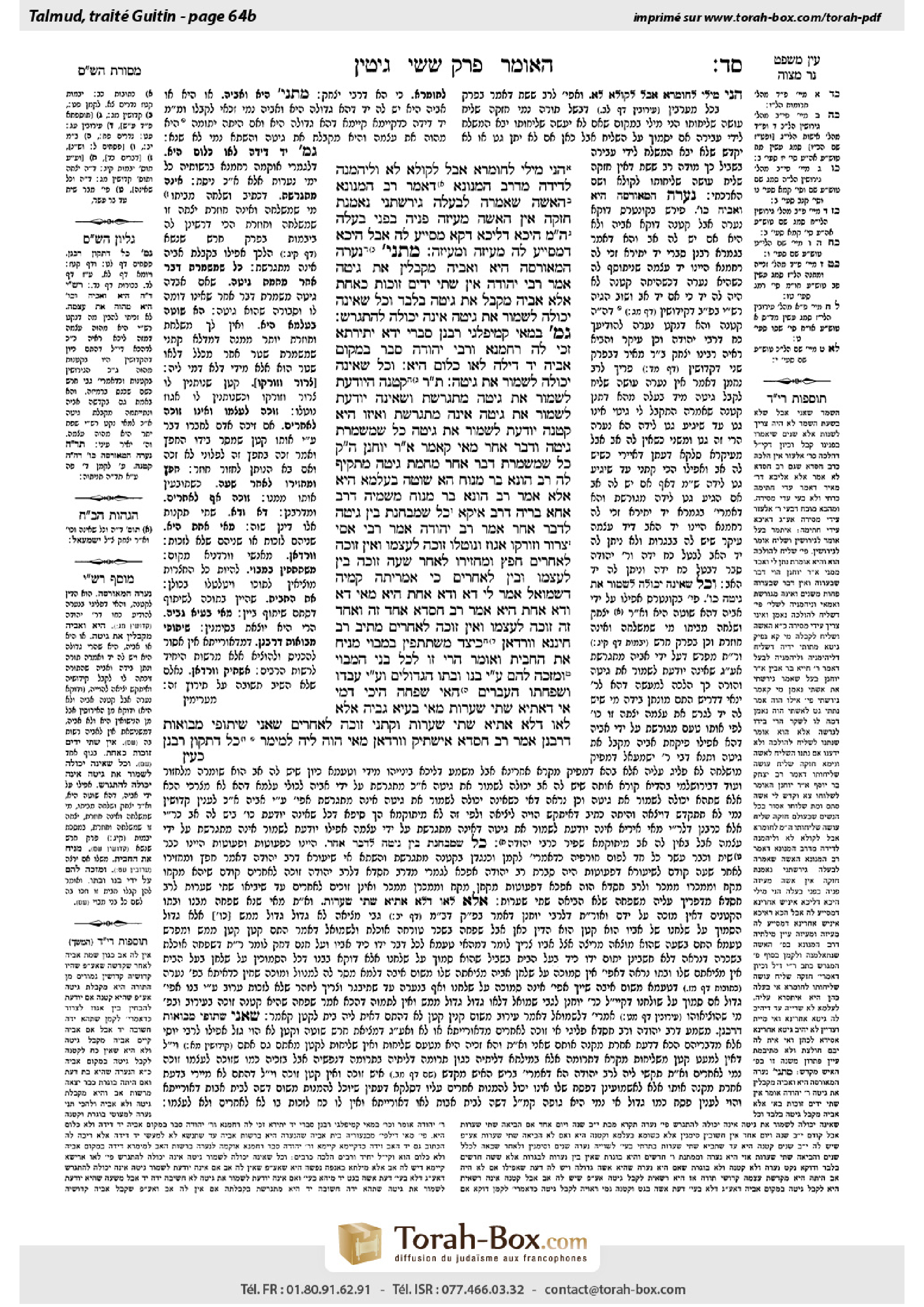
Gittin 64b: Talmud study for Daf Yomi
Study the Talmud for Daf Yomi with scanned pages, Hebrew text, English translations from Sefaria and AI-generated French translations.
Passage selection and English or AI-generated French translation are available where the scan has annotations. Daf Study is independent of Torah-Box and Sefaria.
Browse Gittin · גיטין · All tractatesGittin 64b text and translations
This page of Gittin includes the Aramaic text, an English translation and an AI-generated French translation, alongside the scan above.
גיטין ס״ד ב · Aramaic and Hebrew text
הָנֵי מִילֵּי לְחוּמְרָא, אֲבָל לְקוּלָּא לָא.
וְלִיהֵמְנַהּ לְדִידַהּ, מִדְּרַב הַמְנוּנָא – דְּאָמַר רַב הַמְנוּנָא, הָאִשָּׁה שֶׁאָמְרָה לְבַעְלָהּ: ״גֵּירַשְׁתַּנִי״ – נֶאֱמֶנֶת, חֲזָקָה אֵין הָאִשָּׁה מְעִיזָּה פָּנֶיהָ בִּפְנֵי בַּעְלָהּ!
הָנֵי מִילֵּי הֵיכָא דְּלֵיכָּא דְּקָא מְסַיַּיע לַהּ, אֲבָל הֵיכָא דִּמְסַיַּיע לַהּ – מְעִיזָּה וּמְעִיזָּה.
מַתְנִי׳ נַעֲרָה הַמְאוֹרָסָה, הִיא וְאָבִיהָ מְקַבְּלִין אֶת גִּיטָּהּ. אָמַר רַבִּי יְהוּדָה: אֵין שְׁתֵּי יָדַיִם זוֹכוֹת כְּאַחַת, אֶלָּא אָבִיהָ מְקַבֵּל אֶת גִּיטָּהּ בִּלְבַד. וְכֹל שֶׁאֵינָהּ יְכוֹלָה לִשְׁמוֹר אֶת גִּיטָּהּ, אֵינָהּ יְכוֹלָה לְהִתְגָּרֵשׁ.
גְּמָ׳ בְּמַאי קָמִיפַּלְגִי? רַבָּנַן סָבְרִי: יְדָא יַתִּירְתָּא זַכִּי לַהּ רַחֲמָנָא, וְרַבִּי יְהוּדָה סָבַר: בִּמְקוֹם אָבִיהָ – יָד דִּילַהּ לָאו כְּלוּם הִיא.
וְכֹל שֶׁאֵינָהּ יְכוֹלָה לִשְׁמוֹר אֶת גִּיטָּהּ. תָּנוּ רַבָּנַן: קְטַנָּה הַיּוֹדַעַת לִשְׁמוֹר אֶת גִּיטָּהּ – מִתְגָּרֶשֶׁת, וְשֶׁאֵינָהּ יוֹדַעַת לִשְׁמוֹר אֶת גִּיטָּהּ – אֵינָהּ מִתְגָּרֶשֶׁת. וְאֵיזוֹ הִיא קְטַנָּה יוֹדַעַת לִשְׁמוֹר אֶת גִּיטָּהּ? כֹּל שֶׁמְּשַׁמֶּרֶת גִּיטָּהּ וְדָבָר אַחֵר.
מַאי קָאָמַר? אָמַר רַבִּי יוֹחָנָן, הָכִי קָאָמַר: כֹּל שֶׁמְּשַׁמֶּרֶת דָּבָר אַחֵר מֵחֲמַת גִּיטָּהּ.
מַתְקֵיף לַהּ רַב הוּנָא בַּר מָנוֹחַ: הָא שׁוֹטָה בְּעָלְמָא הִיא! אֶלָּא אָמַר רַב הוּנָא בַּר מָנוֹחַ מִשְּׁמֵיהּ דְּרַב אַחָא בְּרֵיהּ דְּרַב אִיקָא: כֹּל שֶׁמַּבְחֶנֶת בֵּין גִּיטָּהּ לְדָבָר אַחֵר.
אָמַר רַב יְהוּדָה אָמַר רַבִּי אַסִּי: צְרוֹר וְזוֹרְקוֹ, אֱגוֹז וְנוֹטְלוֹ – זוֹכֶה לְעַצְמוֹ, וְאֵין זוֹכֶה לַאֲחֵרִים. חֵפֶץ – וּמַחְזִירוֹ לְאַחַר שָׁעָה, זוֹכֶה בֵּין לְעַצְמוֹ וּבֵין לַאֲחֵרִים.
כִּי אַמְרִיתַהּ קַמֵּיהּ דִּשְׁמוּאֵל, אָמַר לִי: דָּא וְדָא אַחַת הִיא. מַאי ״דָּא וְדָא אַחַת הִיא״? אָמַר רַב חִסְדָּא: אֶחָד זֶה וְאֶחָד זֶה – זוֹכֶה לְעַצְמוֹ, וְאֵין זוֹכֶה לַאֲחֵרִים.
מֵתִיב רַב חִינָּנָא וַורְדָּאן: כֵּיצַד מִשְׁתַּתְּפִין בְּמָבוֹי? מַנִּיחַ אֶת הֶחָבִית, וְאוֹמֵר: ״הֲרֵי זוֹ לְכׇל בְּנֵי הַמָּבוֹי״, וּמְזַכֶּה לָהֶם עַל יְדֵי בְּנוֹ וּבִתּוֹ הַגְּדוֹלִים, וְעַל יְדֵי עַבְדּוֹ וְשִׁפְחָתוֹ הָעִבְרִים.
הַאי שִׁפְחָה – הֵיכִי דָמֵי? אִי דְּאַתְיָא שְׁתֵּי שְׂעָרוֹת, מַאי בָּעֲיָא גַּבֵּיהּ? אֶלָּא לָאו דְּלָא אַתְיָא שְׁתֵּי שְׂעָרוֹת, וְקָתָנֵי זוֹכָה לַאֲחֵרִים?
שָׁאנֵי שִׁיתּוּפֵי מְבוֹאוֹת – דְּרַבָּנַן.
אָמַר רַב חִסְדָּא: אִישְׁתִּיק וַורְדָּאן. מַאי הֲוָה לֵיהּ לְמֵימַר? כֹּל דְּתַקּוּן רַבָּנַן –
Gittin 64b · English translation
The Gemara answers: This matter, the presumption that an agent performs his agency, applies only when its application leads to stringency, as there is a concern that the agent performed his agency. However, when its application leads to leniency, no, the presumption does not apply.
The Gemara asks: But let one deem the wife herself credible, based on the statement of Rav Hamnuna, as Rav Hamnuna says: A woman who said to her husband: You divorced me, is deemed credible, as there is a presumption that a woman would not be insolent in the presence of her husband and lie.
The Gemara answers: This matter applies only in a case where there is no factor that supports her claim, as the presumption is that she would not be so insolent as to tell a lie that has no basis. However, in a case where there is a factor that supports her claim, as in this case both the husband and the third party claim that the husband sent a bill of divorce, she would indeed be insolent. Therefore, her claim that she was divorced is accepted only if she can produce the bill of divorce.
MISHNA: With regard to a betrothed young woman, she and her father are each eligible to receive her bill of divorce, and the divorce takes effect at the moment that either of them receives the bill of divorce. Rabbi Yehuda said: Two hands do not have the right to acquire an item on behalf of one person as one. Rather, her father alone receives her bill of divorce on her behalf. And there is another principle: Any female who is unable to safeguard her bill of divorce is unable to be divorced.
GEMARA: The Gemara asks: With regard to what do the Rabbis, who stated the unattributed first opinion in the mishna, and Rabbi Yehuda disagree? The Rabbis hold: The Merciful One grants the betrothed young woman an additional hand, beyond the hand of her father, who can receive the bill of divorce on her behalf. And Rabbi Yehuda holds: In a place, i.e., situation, where her father is alive, her hand is nothing and she is ineligible to receive her bill of divorce.
The mishna teaches: And any woman who is unable to safeguard her bill of divorce is unable to be divorced. The Sages taught: A minor girl who knows how to safeguard her bill of divorce can be divorced, and one who does not know how to safeguard her bill of divorce cannot be divorced. And which is the minor girl who knows how to safeguard her bill of divorce? It is any minor girl who safeguards her bill of divorce and something else.
The Gemara asks: What is the tanna saying in the statement: Who safeguards her bill of divorce and something else? Rabbi Yoḥanan says that this is what he is saying: Any minor who safeguards something else due to her bill of divorce, i.e., she lost her bill of divorce itself but she guards something else that she mistook for her bill of divorce.
Rav Huna bar Manoaḥ objects to this: That minor girl is merely an imbecile, as she keeps something else in lieu of her bill of divorce. Rather, Rav Huna bar Manoaḥ says in the name of Rav Aḥa, son of Rav Ika: The reference is to any girl who distinguishes between her bill of divorce and something else, and safeguards her bill of divorce and does not safeguard less significant items.
Apropos minors, Rav Yehuda says that Rabbi Asi says: If one gives a child a pebble and he throws it away and one gives him a nut and he takes it, he is capable of distinguishing between items of value and worthless items, and he acquires property for himself but does not acquire property on behalf of others. If the child develops to the extent that he is given an item and he returns it to its owners later, because he understands the concept of ownership, he acquires property both for himself and on behalf of others.
Rav Yehuda continued. When I stated Rabbi Asi’s ruling before Shmuel he said to me: This and that are one. The Gemara asks: What is the meaning of: This and that are one? Rav Ḥisda says: With regard to both this child and that child, each acquires property for himself but does not acquire property on behalf of others, and there is no distinction in this regard between the developmental stages of a minor.
Rav Ḥinnana of Vardania raises an objection based on what was taught in a mishna (Eiruvin 79b): How does one merge the courtyards that open into the alleyway on behalf of all the residents of the alleyway? He places a barrel filled with his wine and says: This is for all the residents of the alleyway. And he may confer possession of the wine to the other residents of the alleyway by means of his adult son or daughter, or by means of his Hebrew slave or maidservant.
The Gemara asks: What are the circumstances of this maidservant? If she developed two pubic hairs, indicating that she reached majority, what is she doing with the owner of the barrel? A Hebrew maidservant is emancipated when she reaches puberty. Rather, is the reference here not to a case where she did not yet develop two pubic hairs, and she is a minor, and it is taught that she can acquire on behalf of others? Apparently, a minor can acquire property on behalf of other people.
The Gemara rejects this proof: The merging of alleyways is different, as it is an ordinance by rabbinic law. The Sages ruled leniently with regard to this rabbinic ordinance and allowed a minor to acquire property on behalf of others.
Rav Ḥisda said: Rav Ḥinnana of Vardonia was silent and had no response. The Gemara asks: What could he have said in response? The Gemara answers that he could have responded: All ordinances that the Sages instituted,
Gittin 64b · Traduction française (IA)
La Guemara répond : Cette question, l'assomption que l'agent exécute son acte, s'applique uniquement lorsqu'elle entraîne une stricte application, car il y a une crainte que l'agent ait effectivement exécuté son acte. Cependant, lorsqu'elle entraîne une application plus clémente, l'assomption ne s'applique pas.
La Guemara pose la question : Mais on peut considérer la femme elle-même comme crédible, en vertu de la déclaration de Rav Hamnuna, car Rav Hamnuna dit : Une femme qui dit à son mari : Tu m'as divorcée, est considérée comme crédible, car il y a une présomption que la femme ne serait pas insolente en présence de son mari et mentirait.
La Guemara répond : Cette question s'applique uniquement dans un cas où il n'y a aucun facteur qui soutient sa déclaration, car l'assomption est que celle-ci ne serait pas si insolente pour mentir sans fondement. Cependant, dans un cas où il y a un facteur qui soutient sa déclaration, comme dans ce cas où à la fois le mari et le tiers affirment que le mari a envoyé un acte de divorce, elle serait effectivement insolente. Par conséquent, sa déclaration selon laquelle elle a été divorcée est acceptée uniquement si elle peut produire l'acte de divorce.
MICHNA : En ce qui concerne une jeune fille fiancée, elle et son père sont chacun éligibles à recevoir son acte de divorce, et le divorce prend effet au moment où l'un d'eux reçoit l'acte de divorce. Rabbi Yehuda a dit : Deux mains n'ont pas le droit d'acquérir un objet au nom d'une seule personne. Plutôt, son père seul reçoit son acte de divorce au nom d'elle. Et il y a un autre principe : Toute femme qui n'est pas en mesure de garder son acte de divorce n'est pas en mesure d'être divorcée.
GUEMARA : La Guemara pose la question : Sur quel point les Rabbins, qui ont énoncé l'opinion non attribuée en tête de la mishna, et Rabbi Yehuda s'opposent-ils ? Les Rabbins maintiennent : L'Éternel Miséricordieux accorde à la jeune fille fiancée une main supplémentaire, au-delà de la main de son père, qui peut recevoir l'acte de divorce au nom d'elle. Et Rabbi Yehuda maintient : Dans un lieu, c'est-à-dire une situation, où son père est vivant, sa main est rien et elle n'est pas éligible à recevoir son acte de divorce.
La mishna enseigne : Et toute femme qui n'est pas en mesure de garder son acte de divorce n'est pas en mesure d'être divorcée. Les Sages ont enseigné : Une jeune fille mineure qui sait garder son acte de divorce peut être divorcée, et celle qui ne sait pas le garder ne peut pas être divorcée. Et quelle est la jeune fille mineure qui sait garder son acte de divorce ? C'est toute jeune fille mineure qui garde son acte de divorce et quelque chose d'autre.
La Guemara pose la question : Quel est le tanna qui dit dans l'affirmation : Qui garde son acte de divorce et quelque chose d'autre ? Rabbi Yoḥanan dit que c'est ce qu'il dit : Toute mineure qui garde quelque chose d'autre à cause de son acte de divorce, c'est-à-dire qu'elle a perdu son acte de divorce lui-même mais elle garde quelque chose d'autre qu'elle a confondu avec son acte de divorce.
Rav Huna bar Manoaḥ s'oppose à cela : Cette jeune fille est simplement une imbécile, car elle garde quelque chose d'autre à la place de son acte de divorce. Plutôt, Rav Huna bar Manoaḥ dit en nom de Rav Aḥa, fils de Rav Ika : La référence est à toute fille qui distingue entre son acte de divorce et quelque chose d'autre, et qui garde son acte de divorce et ne garde pas les objets moins importants.
A propos des mineurs, Rav Yehuda dit que Rabbi Asi dit : Si l'on donne à un enfant une pierre et qu'il la jette, et qu'on lui donne un noix et qu'il la prend, il est capable de distinguer entre les objets de valeur et les objets inutiles, et il acquiert des biens pour lui-même mais ne peut pas acquérir des biens au nom des autres. Si l'enfant développe à tel point qu'on lui donne un objet et il le rend plus tard à son propriétaire, car il comprend le concept de propriété, il acquiert des biens pour lui-même et au nom des autres.
Rav Yehuda continua. Lorsque j'ai énoncé la décision de Rabbi Asi devant Shmuel, il m'a dit : Cela et cela sont un seul. La Guemara pose la question : Quelle est la signification de : Cela et cela sont un seul ? Rav Ḥisda dit : En ce qui concerne à la fois cet enfant et cet autre enfant, chacun acquiert des biens pour lui-même mais ne peut pas acquérir des biens au nom des autres, et il n'y a pas de distinction en ce qui concerne les étapes de développement d'un mineur.
Rav Ḥinnana de Vardania émet un objection basée sur ce qui a été enseigné dans une mishna (Eiruvin 79b) : Comment un courtyards qui s'ouvrent sur un passage commun peuvent-ils être fusionnés au bénéfice de tous les habitants du passage ? Il place un tonneau rempli de son vin et dit : Cela est pour tous les habitants du passage. Et il peut conférer la possession du vin aux autres habitants du passage par le biais de son fils ou de sa fille adulte, ou par le biais de son serviteur hébreu ou de sa servante.
La Guemara pose la question : Quelles sont les circonstances de cette servante ? Si elle a développé deux poils pubiens, indiquant qu'elle a atteint la majorité, qu'est-ce qu'elle fait avec le propriétaire du tonneau ? Une servante hébreuse est emancipée lorsqu'elle atteint la puberté. Plutôt, n'est-ce pas une référence à un cas où elle n'a pas encore développé deux poils pubiens, et elle est une mineure, et il est enseigné qu'elle peut acquérir au nom des autres ? Apparemment, une mineure peut acquérir des biens au nom d'autres personnes.
La Guemara rejette cette preuve : La fusion des passages est différente, car il s'agit d'une ordonnance de la loi rabbinique. Les Sages ont adopté une position clémente concernant cette ordonnance rabbinique et ont permis à un mineur d'acquérir des biens au nom des autres.
Rav Ḥisda dit : Rav Ḥinnana de Vardonia a gardé le silence et n'avait pas de réponse. La Guemara pose la question : Qu'aurait-il pu répondre ? La Guemara répond que l'il aurait pu répondre : Toutes les ordonnances que les Sages ont instituées,
Traduction française générée par IA à partir de l’édition anglaise de Sefaria. Vérifie toujours un passage avec le texte source.
Text from Sefaria: William Davidson Edition - Vocalized Aramaic (CC BY NC); William Davidson Edition - English (CC BY NC).