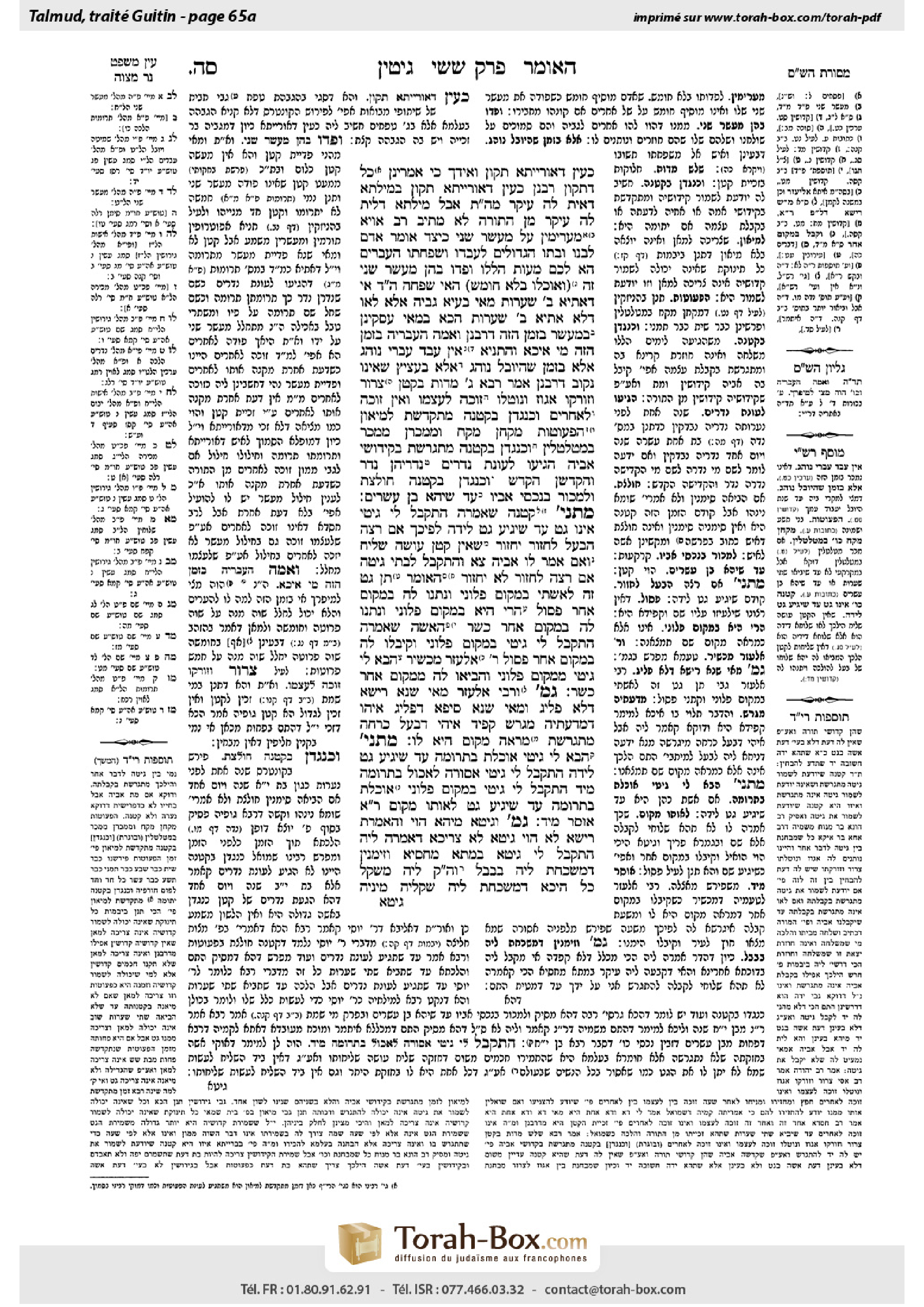
Gittin 65a: Talmud study for Daf Yomi
Study the Talmud for Daf Yomi with scanned pages, Hebrew text, English translations from Sefaria and AI-generated French translations.
Passage selection and English or AI-generated French translation are available where the scan has annotations. Daf Study is independent of Torah-Box and Sefaria.
Browse Gittin · גיטין · All tractatesGittin 65a text and translations
This page of Gittin includes the Aramaic text, an English translation and an AI-generated French translation, alongside the scan above.
גיטין ס״ה א · Aramaic and Hebrew text
כְּעֵין דְּאוֹרָיְיתָא תַּקּוּן.
וְאִידַּךְ – כִּי אָמְרִינַן: כָּל דְּתַקּוּן רַבָּנַן כְּעֵין דְּאוֹרָיְיתָא תַּקּוּן – בְּמִילְּתָא דְּאִית לַהּ עִיקָּר מִן הַתּוֹרָה, אֲבָל מִילְּתָא דְּלֵית לַהּ עִיקָּר מִן הַתּוֹרָה – לָא.
מֵתִיב רַב אַוְיָא: מַעֲרִימִין עַל מַעֲשֵׂר שֵׁנִי. כֵּיצַד? אוֹמֵר אָדָם לִבְנוֹ וּבִתּוֹ הַגְּדוֹלִים; לְעַבְדּוֹ וְשִׁפְחָתוֹ הָעִבְרִים: ״הֵא לָכֶם מָעוֹת הַלָּלוּ, וּפְדוּ בָּהֶן מַעֲשֵׂר שֵׁנִי זֶה״, וְאוֹכְלוֹ בְּלֹא חוֹמֶשׁ.
הַאי שִׁפְחָה הֵיכִי דָמֵי? אִי דְּאַתְיָא שְׁתֵּי שְׂעָרוֹת, מַאי בָּעֲיָא גַּבֵּיהּ? אֶלָּא לָאו דְּלָא אַתְיָא שְׁתֵּי שְׂעָרוֹת? הָכָא בְּמַאי עָסְקִינַן, בְּמַעֲשֵׂר בִּזְמַן הַזֶּה – דְּרַבָּנַן.
וְאָמָה הָעִבְרִיָּה בִּזְמַן הַזֶּה מִי אִיכָּא?! וְהָתַנְיָא: אֵין עֶבֶד עִבְרִי נוֹהֵג אֶלָּא בִּזְמַן שֶׁהַיּוֹבֵל נוֹהֵג! אֶלָּא בְּעָצִיץ שֶׁאֵינוֹ נָקוּב – דְּרַבָּנַן.
אָמַר רָבָא, שָׁלֹשׁ מִדּוֹת בְּקָטָן: צְרוֹר וְזוֹרְקוֹ, אֱגוֹז וְנוֹטְלוֹ – זוֹכֶה לְעַצְמוֹ, וְאֵין זוֹכֶה לַאֲחֵרִים; וּכְנֶגְדָּן בִּקְטַנָּה – מִתְקַדֶּשֶׁת לְמֵיאוּן.
הַפָּעוֹטוֹת – מִקָּחָן מִקָּח וּמִמְכָּרָן מִמְכָּר בְּמִטַּלְטְלִין; וּכְנֶגְדָּן בִּקְטַנָּה – מִתְגָּרֶשֶׁת בְּקִידּוּשֵׁי אָבִיהָ.
הִגִּיעוּ לְעוֹנַת נְדָרִים – נִדְרֵיהֶן נֶדֶר וְהֶקְדֵּשָׁן הֶקְדֵּשׁ; וּכְנֶגְדָּן בִּקְטַנָּה – חוֹלֶצֶת. וְלִמְכּוֹר בְּנִכְסֵי אָבִיו – עַד שֶׁיְּהֵא בֶּן עֶשְׂרִים.
מַתְנִי׳ קְטַנָּה שֶׁאָמְרָה: ״הִתְקַבֵּל לִי גִּיטִּי״ – אֵינוֹ גֵּט עַד שֶׁיַּגִּיעַ גֵּט לְיָדָהּ; לְפִיכָךְ, אִם רָצָה הַבַּעַל לַחֲזוֹר – יַחְזוֹר. שֶׁאֵין קָטָן עוֹשֶׂה שָׁלִיחַ.
וְאִם אָמַר לוֹ אָבִיהָ: ״צֵא וְהִתְקַבֵּל לְבִתִּי גִּיטָּהּ״, אִם רָצָה לַחֲזוֹר – לֹא יַחְזוֹר.
הָאוֹמֵר: ״תֵּן גֵּט זֶה לְאִשְׁתִּי בְּמָקוֹם פְּלוֹנִי״, וּנְתָנוֹ לָהּ בְּמָקוֹם אַחֵר – פָּסוּל. ״הֲרֵי הִיא בְּמָקוֹם פְּלוֹנִי״, וּנְתָנוֹ לָהּ בְּמָקוֹם אַחֵר – כָּשֵׁר.
הָאִשָּׁה שֶׁאָמְרָה: ״הִתְקַבֵּל לִי גִּיטִּי בְּמָקוֹם פְּלוֹנִי״, וְקִיבְּלוֹ לָהּ בְּמָקוֹם אַחֵר – פָּסוּל; רַבִּי אֶלְעָזָר מַכְשִׁיר. ״הָבֵא לִי גִּיטִּי מִמָּקוֹם פְּלוֹנִי״, וֶהֱבִיאוֹ לָהּ מִמָּקוֹם אַחֵר – כָּשֵׁר.
גְּמָ׳ וְרַבִּי אֶלְעָזָר – מַאי שְׁנָא רֵישָׁא דְּלָא פְּלִיג, וּמַאי שְׁנָא סֵיפָא דִּפְלִיג?
אִיהוּ, דְּמִדַּעְתֵּיהּ מְגָרֵשׁ – קָפֵיד, אִיהִי, דִּבְעַל כֻּרְחַהּ מִתְגָּרֶשֶׁת – מַרְאָה מָקוֹם הִיא לוֹ.
מַתְנִי׳ ״הָבֵא לִי גִּיטִּי״ – אוֹכֶלֶת בִּתְרוּמָה עַד שֶׁיַּגִּיעַ גֵּט לְיָדָהּ. ״הִתְקַבֵּל לִי גִּיטִּי״, אֲסוּרָה לֶאֱכוֹל בִּתְרוּמָה מִיָּד. ״הִתְקַבֵּל לִי גִּיטִּי בְּמָקוֹם פְּלוֹנִי״ – אוֹכֶלֶת בִּתְרוּמָה עַד שֶׁיַּגִּיעַ גֵּט לְאוֹתוֹ מָקוֹם, רַבִּי אֶלְעָזָר אוֹסֵר מִיָּד.
גְּמָ׳ וְגִיטָּא מִיהָא הָוֵי? וְהָאָמְרַתְּ רֵישָׁא, לָא הָוֵי גִּיטָּא!
לָא צְרִיכָא, דְּאָמְרָה לֵיהּ: ״הִתְקַבֵּל לִי גִּיטָּא בְּמָתָא מַחְסֵיָא, וְזִימְנִין דְּמַשְׁכַּחַתְּ לֵיהּ בְּבָבֶל״; וְהָכִי קָאָמְרָה לֵיהּ: מִשְׁקָל – כֹּל הֵיכָא דְּמַשְׁכַּחַתְּ לֵיהּ, שִׁקְלֵיהּ מִינֵּיהּ;
Gittin 65a · English translation
they instituted parallel to Torah law, and they did not innovate novel halakhic models.
And the other Sage, Rav Ḥinnana of Vardonia, why was he silent? He holds that when we say: All ordinances that the Sages instituted, they instituted parallel to Torah law, it is with regard to a matter that is rooted in the Torah, and upon which the Sages instituted an ordinance. However, with regard to a matter that is not rooted in the Torah, e.g., the halakhot of joining courtyards and merging alleyways, no, they did not institute the ordinances parallel to Torah law.
Rav Avya raises another objection to Shmuel’s opinion, according to Rav Ḥisda’s explanations, that a minor cannot acquire property on behalf of others, based on a mishna in tractate Ma’aser Sheni (4:4): One may employ artifice to exempt himself from the obligation to add one-fifth to the sum when redeeming second tithe, which the owner of the tithe is required to add. How so? A person says to his adult son or daughter, or to his Hebrew slave or his maidservant: Here you are, take money and redeem second tithe with it. After they redeem the second tithe, they give it to their father or master and he eats it without adding one-fifth.
The Gemara asks: What are the circumstances of this maidservant? If she developed two pubic hairs, indicating that she reached majority, what is she doing with the owner of the produce? A Hebrew maidservant is emancipated when she reaches puberty. Rather, is the reference here not to a case where she did not yet develop two pubic hairs? Apparently, a minor can also acquire property on behalf of others. The Gemara rejects this proof: With what are we dealing here? It is with tithes today, which is in effect by rabbinic law, and the Sages ruled leniently in matters of rabbinic law.
The Gemara asks: And is there a Hebrew maidservant today? But isn’t it taught in a baraita: The provision of a Hebrew slave is in practice only during a period when the Jubilee Year is in practice. Therefore, there have been no Hebrew slaves or maidservants since observance of the Jubilee Year ceased, before the destruction of the First Temple. Rather, it must be that the mishna is referring to a case where the produce grew in an unperforated pot, which one is obligated to tithe by rabbinic law.
Apropos the capacity of minors to acquire property, Rava says that there are three stages in the development of a minor: With regard to a minor who is given a pebble and he throws it away but when given a nut he takes it, he acquires property for himself but does not acquire property on behalf of others. And with regard to a minor girl with the corresponding stage of intellectual development, after the death of her father she can be betrothed by her mother and her brother by rabbinic law, and can opt out of that betrothal through refusal.
At the next stage of development are young children aged approximately six through eight, whose purchase is a purchase and whose sale is a sale, with regard to movable property. And with regard to a minor girl with the corresponding stage of development, she is divorced by receipt of her bill of divorce, even if it is from betrothal by her father, which is by Torah law.
The third stage of development is when they have reached the age of vows, when their vows are valid vows and their consecration is valid consecration. And with regard to a minor girl with the corresponding stage of development, she performs ḥalitza to free herself from her levirate bond. And with regard to selling his father’s landed property, a minor cannot sell it until he will reach the age of twenty.
MISHNA: In the case of a minor girl who said to an agent: Receive my bill of divorce for me, it is not a valid bill of divorce until the bill of divorce reaches her possession. Therefore, if the husband seeks to retract his decision before his wife receives the bill of divorce, he can retract it, as a minor does not designate an agent. Consequently, the agent is not an agent for receipt, and the divorce does not take effect when the husband hands the document to the agent. The agent is an agent for delivery, and the divorce takes effect when the bill of divorce enters the wife’s possession.
And if her father said to the agent: Go out and receive my daughter’s bill of divorce on her behalf, then if the husband seeks to retract his decision, he cannot retract it. As a father can receive the bill of divorce on behalf of his minor daughter, he can designate an agent for receipt, and the divorce takes effect when the husband hands the document to the agent.
With regard to one who says to an agent: Give this bill of divorce to my wife in such and such a place, if the agent deviated and gave it to her in another place the divorce is invalid. However, if he said to the agent: Give this bill of divorce to my wife, she is in such and such a place, without explicitly instructing the agent to give her the document there, and he gave it to her in another place the divorce is valid.
With regard to the woman who when designating her agent for receipt said to her agent: Receive my bill of divorce for me in such and such a place, and he received it for her in another place, the divorce is invalid; and Rabbi Elazar deems it valid. If she said to him: Bring me my bill of divorce from such and such a place, and he brought it for her from another place, it is valid. Because he is an agent for delivery, the woman is not particular where he receives the bill of divorce, as the divorce takes effect only when the bill of divorce reaches her possession.
GEMARA: The Gemara asks: And according to Rabbi Elazar, what is different in the first clause, where the agent deviated from the husband’s instructions and delivered the bill of divorce in a different place, where he does not disagree with the unattributed opinion of the first tanna that the divorce is invalid, and what is different in the latter clause, where the agent deviated from the wife’s instructions and received the bill of divorce in a different place, where he disagrees with the unattributed opinion of the first tanna and deems the divorce valid?
The Gemara answers: He, the husband, who divorces his wife of his own volition, insists that the divorce be effected in a certain place. However, she, the wife, who is divorced even against her will, is in no position to insist with regard to the manner in which the divorce will be effected, and is merely indicating a place for him to give her the bill of divorce.
MISHNA: An Israelite woman married to a priest partakes of teruma. If she says to an agent: Bring me my bill of divorce, designating him as an agent for delivery, she continues to partake of teruma until the bill of divorce reaches her possession. However, if she says: Receive my bill of divorce for me, thereby designating him as an agent for receipt, it is immediately prohibited for her to partake of teruma. Since the divorce takes effect when the husband hands the bill of divorce to the agent, the concern is that the agent encountered the husband nearby. If the woman said to the agent: Receive my bill of divorce for me in such and such a place, then even if he received it elsewhere, she continues to partake of teruma until the bill of divorce reaches that place. Rabbi Elazar prohibits her from partaking of teruma immediately.
GEMARA: In this mishna, the first tanna apparently states that if the agent for receipt received the bill of divorce in a place other than the place designated by the woman for receipt, the bill of divorce is valid when the agent brings it to the designated place. The Gemara asks: And in any event, is it a valid bill of divorce? But didn’t you say in the first clause, i.e., in the previous mishna, that if the agent received the bill of divorce in another place, it is not a valid bill of divorce?
The Gemara asks: No, this halakha is necessary with regard to a case where she said to him: Receive the bill of divorce for me in the city of Mata Meḥasya, and sometimes you can find him in the city of Babylon. And this is what she is saying: When taking the bill of divorce, anywhere that you find him, take it from him,
Gittin 65a · Traduction française (IA)
ils ont institué parallèlement à la loi de la Torah, et ils n'ont pas innové de nouveaux modèles halakhiques.
Et l'autre Sage, Rav Ḥinnana de Vardonia, pourquoi était-il muet ? Il considère que lorsque nous disons : Toutes les ordonnances que les Sages ont instituées, ils les ont instituées parallèlement à la loi de la Torah, cela concerne une matière ancrée dans la Torah, et sur laquelle les Sages ont institué une ordonnance. Cependant, concernant une matière non ancrée dans la Torah, par exemple les halakhot de la jonction de courtyards et de la fusion d'allées, non, ils n'ont pas institué d'ordonnances parallèlement à la loi de la Torah.
Rav Avya émet une autre objection contre l'opinion de Shmuel, selon les explications de Rav Ḥisda, selon laquelle un mineur ne peut pas acquérir des biens au nom des autres, fondée sur une mitsva du traité Ma'aser Sheni (4:4) : On peut employer un artifice pour s'exonorer de l'obligation d'ajouter un cinquième au montant lors du rachat de la deuxième part, que l'propriétaire de la part est tenu d'ajouter. Comment cela se passe-t-il ? Une personne dit à son fils ou à sa fille majeure, ou à son serviteur hébreu ou à sa servante : Ici, prends de l'argent et rachète la deuxième part avec. Après qu'ils aient racheté la deuxième part, ils la donnent à leur père ou à leur maître et il la mange sans ajouter un cinquième.
Le Guemara demande : Quelles sont les circonstances de cette servante ? Si elle a développé deux poils pubiens, indiquant qu'elle a atteint la majorité, qu'est-ce qu'elle fait avec l'propriétaire des produits ? Une servante hébreuse est emancipée lorsqu'elle atteint la puberté. Plutôt, ne s'agit-il pas d'un cas où elle n'a pas encore développé deux poils pubiens ? Apparemment, un mineur peut également acquérir des biens au nom des autres. Le Guemara rejette cette preuve : Avec quoi sommes-nous en train de parler ici ? C'est avec les dîmes aujourd'hui, qui sont en vigure selon la loi rabbinique, et les Sages ont adopté une position clémente en matière de lois rabbiniques.
Le Guemara demande : Et y a-t-il une servante hébreuse aujourd'hui ? Mais n'est-il pas enseigné dans une baraïta : La provision d'un serviteur hébreu est en pratique uniquement durant une période où l'année du Jubilé est en vigueur. Ainsi, il n'y a eu aucun serviteur ou servante hébreuse depuis que l'observation de l'année du Jubilé a cessé, avant la destruction du Premier Temple. Plutôt, il doit s'agir d'un cas où les produits ont grandi dans un pot non percé, dont l'obligation de dîmer est en vigueur selon la loi rabbinique.
En ce qui concerne la capacité des mineurs à acquérir des biens, Rava dit qu'il y a trois étapes dans le développement d'un mineur : Concernant un mineur qui reçoit une pierre et la jette, mais qui reçoit un noix et la prend, il acquiert des biens pour lui-même mais ne peut pas acquérir des biens au nom des autres. Et concernant une jeune fille mineure avec la même étape de développement intellectuel, après la mort de son père, elle peut être fiancée par sa mère et son frère selon la loi rabbinique, et peut se retirer de cette fiancée par refus.
À la prochaine étape de développement viennent les jeunes enfants âgés d'environ six à huit ans, dont l'achat est un achat et la vente est une vente, concernant les biens mobiliers. Et concernant une jeune fille mineure avec la même étape de développement, elle est divorcée par la réception de son acte de divorce, même si c'est d'un fiancement par son père, qui est selon la loi de la Torah.
La troisième étape de développement est lorsqu'ils ont atteint l'âge des vœux, lorsqu'ils sont des vœux valides et leur consécration est une consécration valide. Et concernant une jeune fille mineure avec la même étape de développement, elle effectue la ḥalitza pour se libérer de son lien levirique. Et concernant la vente de la propriété terrienne de son père, un mineur ne peut pas la vendre jusqu'à ce qu'il atteigne l'âge de vingt ans.
MICHNA : Dans le cas d'une jeune fille mineure qui dit à un agent : Reçois mon acte de divorce pour moi, ce n'est pas un acte de divorce valide jusqu'à ce que l'acte de divorce entre en possession d'elle. Ainsi, si le mari cherche à rétracter sa décision avant que la femme ne reçoive l'acte de divorce, il peut le rétracter, car un mineur ne désigne pas d'agent. Par conséquent, l'agent n'est pas un agent pour la réception, et le divorce ne prend effet lorsque le document est remis à l'agent. L'agent est un agent pour la livraison, et le divorce prend effet lorsque l'acte de divorce entre en possession de la femme.
Et si son père dit à l'agent : Va et reçois mon acte de divorce pour ma fille, alors si le mari cherche à rétracter sa décision, il ne peut pas le faire. Comme un père peut recevoir l'acte de divorce au nom de sa fille mineure, il peut désigner un agent pour la réception, et le divorce prend effet lorsque le mari remet le document à l'agent.
Concernant celui qui dit à un agent : Donne cet acte de divorce à ma femme dans telle et telle place, si l'agent s'écarte et le donne à elle dans une autre place, le divorce est invalide. Cependant, si il dit à l'agent : Donne cet acte de divorce à ma femme, elle est dans telle et telle place, sans préciser explicitement à l'agent de lui donner le document là, et il le donne à elle dans une autre place, le divorce est valide.
Concernant la femme qui, lorsqu'elle désignait son agent pour la réception, dit à son agent : Reçois mon acte de divorce pour moi dans telle et telle place, et il le reçoit pour elle dans une autre place, le divorce est invalide ; et Rabbi Elazar considère qu'il est valide. Si elle dit à lui : Apporte-moi mon acte de divorce depuis telle et telle place, et il l'apporte pour elle depuis une autre place, il est valide. Car il est un agent pour la livraison, la femme n'est pas exigeante quant à l'endroit où il reçoit l'acte de divorce, car le divorce prend effet uniquement lorsque l'acte de divorce arrive en sa possession.
GUEMARA : La Guemara pose la question : Selon le maître Eléazar, qu’est-ce qui diffère dans la première clause, où l’agent s’est écarté des instructions du mari et a remis le document de divorce dans un lieu différent, où il ne conteste pas l’opinion non attribuée du premier tanna selon laquelle le divorce est nul, et qu’est-ce qui diffère dans la seconde clause, où l’agent s’est écarté des instructions de la femme et a reçu le document de divorce dans un lieu différent, où il conteste l’opinion non attribuée du premier tanna et considère le divorce comme valide ?
La Guemara répond : Le mari, qui divorce de sa propre initiative, insiste pour que le divorce ait lieu dans un lieu déterminé. Cependant, la femme, qui est divorcée même contre sa volonté, n’est pas en position de s’insister quant à la manière dont le divorce sera effectué, et elle n’indique qu’un lieu où le mari peut lui remettre le document de divorce.
MICHNA : Une femme israélite mariée à un prêtre partage la terouma. Si elle dit à un agent : Apporte-moi mon document de divorce, en le désignant comme agent de livraison, elle continue de partager la terouma jusqu’à ce que le document de divorce arrive en son possession. Cependant, si elle dit : Reçois mon document de divorce pour moi, en le désignant comme agent de réception, il est immédiatement interdit à elle de partager la terouma. Puisque le divorce prend effet lorsque le mari remet le document de divorce à l’agent, la préoccupation est que l’agent ait rencontré le mari près de chez lui. Si la femme dit à l’agent : Reçois mon document de divorce pour moi dans telle et telle place, alors même s’il le reçoit ailleurs, elle continue de partager la terouma jusqu’à ce que le document de divorce arrive dans cette place. Le maître Eléazar interdit à elle de partager la terouma immédiatement.
GUEMARA : Dans cette mishna, le premier tanna semble affirmer que si l’agent de réception reçoit le document de divorce dans un lieu différent de celui désigné par la femme pour la réception, le document de divorce est valide lorsque l’agent le rapporte au lieu désigné. La Guemara pose la question : Et dans tous les cas, est-ce un document de divorce valide ? Mais n’avez-vous pas dit dans la première clause, c’est-à-dire dans la mishna précédente, que si l’agent reçoit le document de divorce dans un autre lieu, ce n’est pas un document de divorce valide ?
La Guemara pose la question : Non, cette halakha est nécessaire dans le cas où elle dit à lui : Reçois le document de divorce pour moi dans la ville de Mata Meḥasya, et parfois tu peux le trouver dans la ville de Babylone. Et c’est ce qu’elle dit : Lors de la réception du document de divorce, partout que tu le trouves, prends-le de lui,
Traduction française générée par IA à partir de l’édition anglaise de Sefaria. Vérifie toujours un passage avec le texte source.
Text from Sefaria: William Davidson Edition - Vocalized Aramaic (CC BY NC); William Davidson Edition - English (CC BY NC).