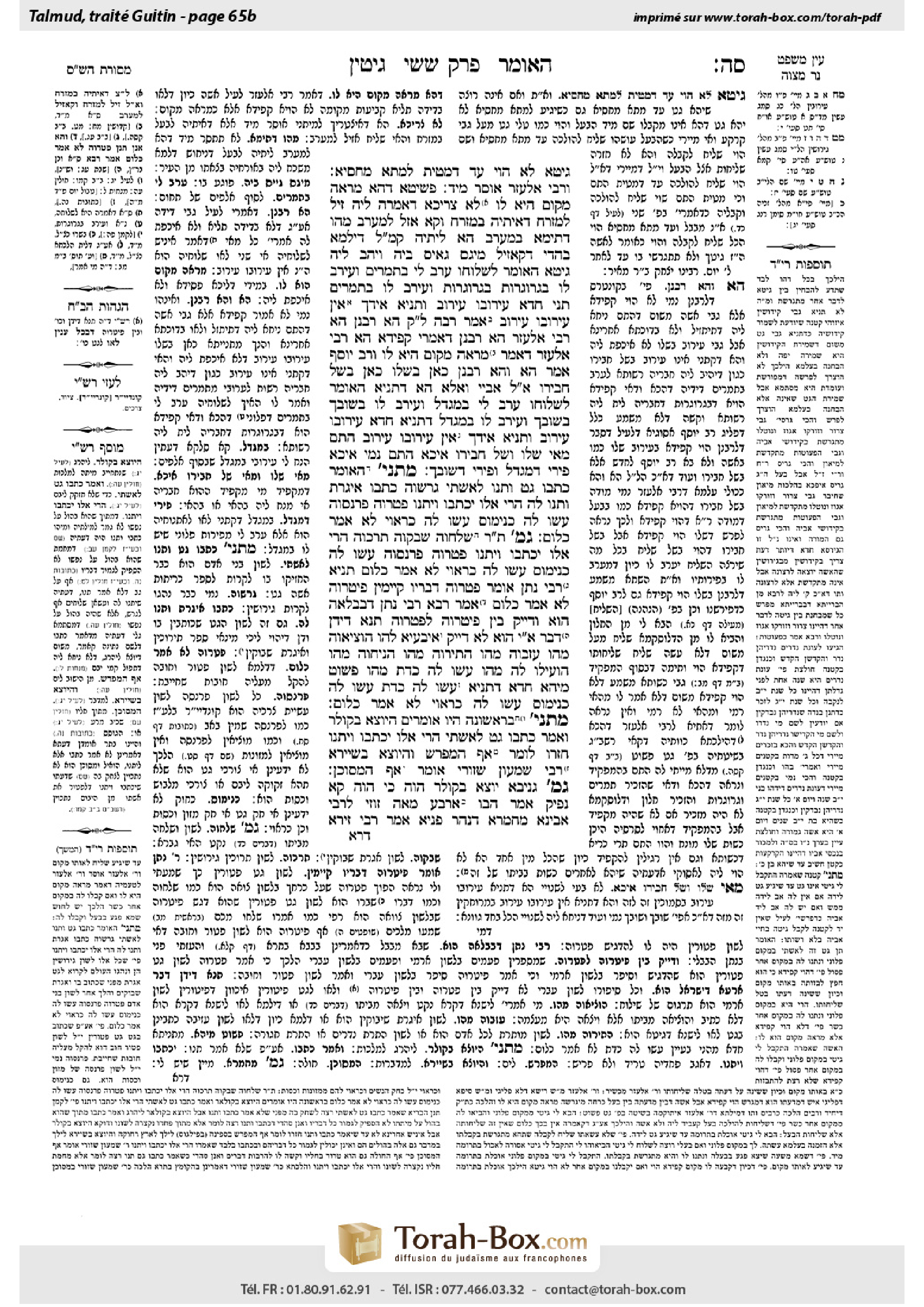
Gittin 65b: Talmud study for Daf Yomi
Study the Talmud for Daf Yomi with scanned pages, Hebrew text, English translations from Sefaria and AI-generated French translations.
Passage selection and English or AI-generated French translation are available where the scan has annotations. Daf Study is independent of Torah-Box and Sefaria.
Browse Gittin · גיטין · All tractatesGittin 65b text and translations
This page of Gittin includes the Aramaic text, an English translation and an AI-generated French translation, alongside the scan above.
גיטין ס״ה ב · Aramaic and Hebrew text
גִּיטָּא לָא הָוֵי – עַד דְּמָטֵית לְמָתָא מַחְסֵיָא.
וְרַבִּי אֶלְעָזָר אוֹסֵר מִיָּד. פְּשִׁיטָא, דְּהָא מַרְאָה מָקוֹם הִיא לוֹ!
לָא צְרִיכָא, דַּאֲמַרָה לֵיהּ: ״זִיל לְמִזְרָח, דְּאִיתֵיהּ בְּמִזְרָח״; וְקָא אָזֵל לְמַעֲרָב. מַהוּ דְּתֵימָא, בְּמַעֲרָב – הָא לֵיתֵיהּ; קָא מַשְׁמַע לַן, דִּילְמָא בַּהֲדֵי דְּקָאָזֵיל מֵיגָס גָּאֵיס בֵּיהּ, וִיהַב לֵיהּ גִּיטָּא.
הָאוֹמֵר לִשְׁלוּחוֹ ״עָרֵב לִי בִּתְמָרִים״, וְעֵירַב לוֹ בִּגְרוֹגְרוֹת; ״בִּגְרוֹגְרוֹת״, וְעֵירַב לוֹ בִּתְמָרִים; תָּנֵי חֲדָא: עֵירוּבוֹ עֵירוּב, וְתַנְיָא אִידַּךְ: אֵין עֵירוּבוֹ עֵירוּב!
אָמַר רַבָּה: לָא קַשְׁיָא; הָא רַבָּנַן, הָא רַבִּי אֶלְעָזָר. הָא רַבָּנַן – דְּאָמְרִי: קְפִידָא; הָא רַבִּי אֶלְעָזָר, דְּאָמַר: מַרְאָה מָקוֹם הִיא לוֹ.
וְרַב יוֹסֵף אָמַר: הָא וְהָא רַבָּנַן; כָּאן בְּשֶׁלּוֹ, כָּאן בְּשֶׁל חֲבֵירוֹ.
אֲמַר לֵיהּ אַבָּיֵי: וְאֶלָּא הָא דְּתַנְיָא, הָאוֹמֵר לִשְׁלוּחוֹ: ״עָרֵב לִי בְּמִגְדָּל״ – וְעֵירַב לוֹ בְּשׁוֹבָךְ, ״בְּשׁוֹבָךְ״ – וְעֵירַב לוֹ בְּמִגְדָּל; דְּתַנְיָא חֲדָא: עֵירוּבוֹ עֵירוּב, וְתַנְיָא אִידַּךְ: אֵין עֵירוּבוֹ עֵירוּב; הָתָם – מַאי שֶׁלּוֹ וְשֶׁל חֲבֵירוֹ אִיכָּא?
הָתָם נָמֵי, אִיכָּא פֵּירֵי דְמִגְדָּל וּפֵירֵי דְשׁוֹבָךְ.
מַתְנִי׳ הָאוֹמֵר: ״כִּתְבוּ גֵּט וּתְנוּ לְאִשְׁתִּי״; ״גָּרְשׁוּהָ״; ״כִּתְבוּ אִיגֶּרֶת וּתְנוּ לַהּ״ – הֲרֵי אֵלּוּ יִכְתְּבוּ וְיִתְּנוּ.
״פַּטְּרוּהָ״; ״פַּרְנְסוּהָ״; ״עֲשׂוּ לָהּ כְּנִימוּס״; ״עֲשׂוּ לָהּ כָּרָאוּי״ – לֹא אָמַר כְּלוּם.
גְּמָ׳ תָּנוּ רַבָּנַן: ״שַׁלְּחוּהָ״; ״שִׁבְקוּהָ״; ״תָּרְכוּהָ״ – הֲרֵי אֵלּוּ יִכְתְּבוּ וְיִתְּנוּ. ״פַּטְּרוּהָ״; ״פַּרְנְסוּהָ״; ״עֲשׂוּ לָהּ כְּנִימוֹס״; ״עֲשׂוּ לָהּ כָּרָאוּי״ – לֹא אָמַר כְּלוּם.
תַּנְיָא, רַבִּי נָתָן אוֹמֵר: ״פַּטְּרוּהָ״ – דְּבָרָיו קַיָּימִין, ״פִּיטְרוּהָ״ – לֹא אָמַר כְּלוּם. אָמַר רָבָא: רַבִּי נָתָן – דְּבַבְלָאָה הוּא, וְדָיֵיק בֵּין ״פִּיטְרוּהָ״ לְ״פַטְּרוּהָ״, תַּנָּא דִּידַן – דְּבַר אֶרֶץ יִשְׂרָאֵל הוּא, לָא דָּיֵיק.
אִיבַּעְיָא לְהוּ: ״הוֹצִיאוּהָ״, מַהוּ? ״עִזְבוּהָ״, מַהוּ? ״הַתִּירוּהָ״, מַהוּ? ״הַנִּיחוּהָ״, מַהוּ? ״הוֹעִילוּ לָהּ״, מַהוּ? ״עֲשׂוּ לָהּ כַּדָּת״, מַהוּ?
פְּשׁוֹט מִיהָא חֲדָא, דְּתַנְיָא: ״עֲשׂוּ לָהּ כַּדָּת״; ״עֲשׂוּ לָהּ כְּנִימוֹס״; ״עֲשׂוּ לָהּ כָּרָאוּי״ – לֹא אָמַר כְּלוּם.
מַתְנִי׳ בָּרִאשׁוֹנָה הָיוּ אוֹמְרִים: הַיּוֹצֵא בְּקוֹלָר, וְאָמַר: ״כִּתְבוּ גֵּט לְאִשְׁתִּי״ – הֲרֵי אֵלּוּ יִכְתְּבוּ וְיִתְּנוּ. חָזְרוּ לוֹמַר: אַף הַמְפָרֵשׁ, וְהַיּוֹצֵא בִּשְׁיָירָא. רַבִּי שִׁמְעוֹן שֵׁזוּרִי אוֹמֵר: אַף הַמְסוּכָּן.
גְּמָ׳ גְּנִיבָא יוֹצֵא בְּקוֹלָר הֲוָה, כִּי הֲוָה קָא נָפֵיק, אָמַר: הַבוּ אַרְבַּע מְאָה זוּזֵי לְרַבִּי אֲבִינָא, מֵחַמְרָא דִּנְהַר פַּנְיָא. אָמַר רַבִּי זֵירָא:
Gittin 65b · English translation
However, it is not a valid bill of divorce until you reach Mata Meḥasya.
The mishna teaches that if the woman said to the agent: Receive my bill of divorce for me in such and such a place, Rabbi Elazar prohibits her from partaking of teruma immediately. The Gemara asks: That is obvious, as she is merely indicating a place for him to receive the bill of divorce and not stipulating that the divorce is contingent upon receipt of the document in that place.
The Gemara answers: No, Rabbi Elazar’s ruling is necessary in a case where she said to him: Go to the east, as my husband is in the east, and the agent went to the west. Lest you say that since the husband is certainly not in the west and the agent will not find him there, the bill of divorce will certainly not take effect until later, Rabbi Elazar teaches us that perhaps while he was going west, the agent happened to encounter the husband, and the husband gave the bill of divorce to the agent.
The Gemara cites a related halakha. With regard to one who says to his agent: Establish an eiruv of Shabbat boundaries on my behalf with dates, and he established an eiruv on his behalf with dried figs, or if said to his agent: Establish an eiruv on my behalf with dried figs, and he established an eiruv on his behalf with dates, it is taught in one baraita: His eiruv is a valid eiruv. And it is taught in another baraita: His eiruv is not a valid eiruv.
Rabba said: This is not difficult. This baraita, in which it is taught that it is not a valid eiruv, is in accordance with the opinion of the Rabbis, and that baraita, in which it is taught that it is a valid eiruv, is in accordance with the opinion of Rabbi Elazar. He explains: This baraita is in accordance with the opinion of the Rabbis, who say: When one gives instructions to his agent, there is insistence on his part that the agent implement those instructions without deviation. Failure to do so revokes his designation as his agent. And that baraita is in accordance with the opinion of Rabbi Elazar, who says: She is merely indicating a place for him to receive the bill of divorce and not stipulating that the divorce is contingent on receipt of the document in that place. In the baraita as well, he was not particular as to what food should be used to establish the eiruv.
And Rav Yosef said: Both this baraita and that baraita are the opinion of the Rabbis, who say: When one gives instructions to his agent, there is insistence on his part that the agent implement those instructions without deviation. However, not all deviations are equal. Here, where the baraita rules that it is a valid eiruv, the reference is to a case where the one who designated the agent instructed him to establish the joining of the courtyard with his dates or dried figs and the agent deviated and established the eiruv with the other type of fruit, but it belonged to the one issuing the instructions. There, where the baraita rules that it is not a valid eiruv, the reference is to a case where the one who designated the agent instructed him to establish the joining of the courtyard with the dates or dried figs of another, and the agent deviated and established the eiruv with the other type of fruit belonging to that other person. The eiruv is not valid because that other person authorized use of only a specific type of fruit.
Abaye said to Rav Yosef: However, that which is taught in a baraita: With regard to one who says to his agent: Establish a joining of Shabbat boundaries on my behalf in a tower, and he established the eiruv in a dovecote, or he said to the agent: Establish a joining of Shabbat boundaries on my behalf in a dovecote, and he established the eiruv in a tower, it is taught in one baraita: His joining of Shabbat boundaries is a valid eiruv. And it is taught in another baraita: His joining of Shabbat boundaries is not a valid eiruv. There, what distinction between his fruit and fruit of another is there?
The Gemara answers: There too, there is a distinction between fruit of the tower and fruit of the dovecote. In these baraitot the instruction did not relate to the location of the placement of the eiruv; rather, the instruction was related to the location of the fruit to be used in establishing the eiruv. In one baraita, the produce in both locations belongs to the one who designated the agent; in the other baraita, the produce in both locations belongs to another.
MISHNA: With regard to a husband who says to two people: Write a bill of divorce and give it to my wife, or: Divorce her, or: Write a letter and give it to her, they should write the document and give it to her. In each of those cases his intent is clear. He is instructing them to effect her divorce.
However, one who said: Release her, or: Sustain her, or: Treat her according to the law [nimus], or: Treat her appropriately, said nothing, as none of these expressions clearly expresses his desire to divorce his wife.
GEMARA: The Sages taught that if the husband said: Send her, or: Separate her, or: Banish her, then all of these expressions convey his will to divorce her, and consequently, they should write the bill of divorce and give it to her. However, one who said: Release her [patruha], or: Sustain her, or: Treat her according to the law, or: Treat her appropriately, said nothing.
It is taught in a baraita that Rabbi Natan says: If one said patruha, his statement stands, and they give her a bill of divorce. However, if one said pitruha, he said nothing. Rava said: Rabbi Natan, who is a Babylonian, distinguished between pitruha and patruha. Pitruha means exempt her, which is unrelated to divorce; patruha means release her, which is very much related to divorce. However, the tanna of our mishna, who is a resident of Eretz Yisrael, did not distinguish between these two expressions.
A dilemma was raised before the Sages: If the husband said: Remove her, what is the halakha? If he said: Abandon her, what is the halakha? If he said: Unbind her, what is the halakha? If he said: Let her be, what is the halakha? If he said: Be useful for her, what is the halakha? If he said: Treat her according to the custom, what is the halakha?
The Gemara answers: Resolve at least one of these expressions, as it is taught in a baraita: One who said: Treat her according to the custom, or: Treat her according to the law, or: Treat her appropriately, said nothing and it is not a valid bill of divorce. Apparently, the expression: Treat her according to the custom, is not an unequivocal instruction to effect divorce.
MISHNA: At first the Sages would say: In the case of one who is taken out in a neck chain [kolar] to be executed and who said: Write a bill of divorce for my wife, these people should write the document and give it to his wife even though there was no explicit instruction to give it to her. They then said: Even with regard to one who sets sail and one who departs in a caravan to a far-off place and says: Write a bill of divorce to my wife, his intention is to write the bill of divorce and give it to his wife. Rabbi Shimon Shezuri says: Even if one who is dangerously ill gives that instruction, they write the bill of divorce and give it to his wife.
GEMARA: The Gemara relates: Geneiva was one who went out in a neck chain to be executed. When he was going out, he said to the people there as his dying bequest: Give four hundred dinars to Rabbi Avina from wine that I have in the city of Nehar Panya. Rabbi Zeira said:
Gittin 65b · Traduction française (IA)
Cependant, ce n'est pas un acte de divorce valide jusqu'à ce que vous atteigniez Mata Meḥasya.
La Michna enseigne que si la femme dit à l'agent : Reçois mon acte de divorce pour moi à tel endroit, le Rabbi Elazar interdit à la femme de consommer la terouma immédiatement. La Guemara demande : Cela est évident, car elle indique simplement un lieu où il doit recevoir l'acte de divorce, sans stipuler que le divorce dépend de la réception du document à cet endroit.
La Guemara répond : Non, la décision du Rabbi Elazar est nécessaire dans le cas où elle dit à lui : Va vers l'Est, car mon mari est à l'Est, et l'agent est allé vers l'Ouest. De peur que l'on dise que puisque le mari n'est certainement pas à l'Ouest et que l'agent ne le trouvera pas là, l'acte de divorce ne prendra effet qu'ultérieurement, le Rabbi Elazar nous enseigne que peut-être pendant qu'il allait vers l'Ouest, l'agent a rencontré le mari et le mari a donné l'acte de divorce à l'agent.
La Guemara cite une halakha connexe. Concernant celui qui dit à son agent : Établis un eiruv des limites du Shabbat à mon compte avec des dattes, et il a établi un eiruv à son compte avec des figues sèches, ou s'il dit à son agent : Établis un eiruv à mon compte avec des figues sèches, et il a établi un eiruv à son compte avec des dattes, il est enseigné dans une baraïta : Son eiruv est un eiruv valide. Et il est enseigné dans une autre baraïta : Son eiruv n'est pas un eiruv valide.
Rabba dit : Cela n'est pas difficile. Cette baraïta, dans laquelle il est enseigné qu'il n'est pas un eiruv valide, est selon l'opinion des Rabbins, et cette baraïta, dans laquelle il est enseigné qu'il est un eiruv valide, est selon l'opinion du Rabbi Elazar. Il explique : Cette baraïta est selon l'opinion des Rabbins, qui disent : Lorsqu'on donne des instructions à son agent, il y a une insistance de sa part pour que l'agent mette en œuvre ces instructions sans déviation. L'échec à y parvenir annule son désignation d'agent. Et cette baraïta est selon l'opinion du Rabbi Elazar, qui dit : Elle indique simplement un lieu où il doit recevoir l'acte de divorce et ne stipule pas que le divorce dépend de la réception du document à cet endroit. Dans la baraïta également, il n'était pas particulier quant au type de fruit à utiliser pour établir l'eiruv.
Et Rav Yosef dit : Ces deux baraitot sont selon l'opinion des Rabbins, qui disent : Lorsqu'on donne des instructions à son agent, il y a une insistance de sa part pour que l'agent mette en œuvre ces instructions sans déviation. Cependant, tous les écarts ne sont pas égaux. Ici, où la baraïta règle qu'il s'agit d'un eiruv valide, la référence est à un cas où celui qui a désigné l'agent a ordonné à l'agent d'établir la jonction du courtil avec ses dattes ou ses figues sèches et l'agent a dévié et établi l'eiruv avec le type de fruit opposé, mais qui appartenait à celui qui donnait les instructions. Là, où la baraïta règle qu'il ne s'agit pas d'un eiruv valide, la référence est à un cas où celui qui a désigné l'agent a ordonné à l'agent d'établir la jonction du courtil avec les dattes ou les figues sèches d'un autre, et l'agent a dévié et établi l'eiruv avec le type de fruit opposé appartenant à cette autre personne. L'eiruv n'est pas valide car cette autre personne a autorisé l'utilisation d'un type spécifique de fruit uniquement.
Abaye dit à Rav Yosef : Cependant, ce qui est enseigné dans une baraïta : Concernant celui qui dit à son agent : Établis une jonction des limites du Shabbat à mon compte dans une tour, et il a établi l'eiruv dans un poulaire, ou s'il dit à l'agent : Établis une jonction des limites du Shabbat à mon compte dans un poulaire, et il a établi l'eiruv dans une tour, il est enseigné dans une baraïta : Sa jonction des limites du Shabbat est un eiruv valide. Et il est enseigné dans une autre baraïta : Sa jonction des limites du Shabbat n'est pas un eiruv valide. Là, quelle distinction entre ses fruits et les fruits d'autrui y a-t-il ?
La Guemara répond : Il y a également une distinction entre les fruits de la tour et les fruits du poulaire. Dans ces baraitot, l'instruction ne concernait pas la localisation de l'installation de l'eiruv ; plutôt, l'instruction concernait la localisation des fruits à utiliser pour établir l'eiruv. Dans une baraïta, les produits des deux lieux appartiennent à celui qui a désigné l'agent ; dans l'autre baraïta, les produits des deux lieux appartiennent à un autre.
MICHNA : Concernant un mari qui dit à deux personnes : Écris un acte de divorce et donne-le à ma femme, ou : Divorce-la, ou : Écris une lettre et donne-la-lui, ils doivent écrire le document et le lui donner. Dans chaque cas, son intention est claire. Il leur ordonne d'effectuer son divorce.
Cependant, celui qui dit : Libère-la, ou : Sustente-la, ou : Traite-la selon la loi [nimus], ou : Traite-la convenablement, dit rien, car aucune de ces expressions ne clairement exprime son désir de divorcer de sa femme.
GUEMARA : Les Sages ont enseigné que si le mari dit : Envoie-la, ou : Sépare-la, ou : Expulse-la, alors toutes ces expressions expriment son désir de divorcer d'elle, et par conséquent, ils doivent écrire l'acte de divorce et le lui donner. Cependant, celui qui dit : Libère-la [patruha], ou : Sustente-la, ou : Traite-la selon la loi, ou : Traite-la convenablement, dit rien.
Il est enseigné dans une baraïta que Rabbi Natan dit : Si l'on dit patruha, son déclaration est valide, et on donne à la femme un acte de divorce. Cependant, si l'on dit pitruha, il dit rien. Rava dit : Rabbi Natan, qui est un Babylonien, distingue entre pitruha et patruha. Pitruha signifie exempter, ce qui est sans lien avec le divorce ; patruha signifie libérer, ce qui est très lié au divorce. Cependant, le tanna de notre mishna, qui est un résident de la Terre d'Israël, n'a pas distingué entre ces deux expressions.
Un dilemme a été soulevé devant les Sages : Si le mari disait : Délivre-la, quelle est la halakha ? Si il disait : Abandonne-la, quelle est la halakha ? Si il disait : Détache-la, quelle est la halakha ? Si il disait : Laisse-la, quelle est la halakha ? Si il disait : Fais-la bénéficier, quelle est la halakha ? Si il disait : Traite-la selon la coutume, quelle est la halakha ?
La Guemara répond : Résolvez au moins l'une de ces expressions, car cela est enseigné dans une baraïta : Celui qui disait : Traite-la selon la coutume, ou : Traite-la selon la loi, ou : Traite-la convenablement, a dit rien et ce n'est pas un divorce valide. Apparemment, l'expression : Traite-la selon la coutume, n'est pas une instruction claire pour divorcer.
MICHNA : D'abord les Sages disaient : Dans le cas d'une personne qui est sortie en chaîne au cou pour être exécuté et qui disait : Écris un divorce pour ma femme, ces gens devraient écrire le document et le donner à sa femme même s'il n'y avait pas d'instruction explicite de le lui donner. Ils dirent ensuite : Même en ce qui concerne une personne qui part en bateau ou qui s'éloigne en caravane vers un lieu éloigné et qui dit : Écris un divorce à ma femme, son intention est d'écrire le divorce et de le donner à sa femme. Rabbi Shimon Shezuri dit : Même si une personne gravement malade donne cet ordre, ils écrivent le divorce et le donnent à sa femme.
GUEMARA : La Guemara relate : Geneiva était celui qui est sorti en chaîne au cou pour être exécuté. Lorsqu'il sortait, il disait aux gens comme dernier legs : Donnez quatre cents dinars à Rabbi Avina à partir du vin que j'ai dans la ville de Nehar Panya. Rabbi Zeira dit :
Traduction française générée par IA à partir de l’édition anglaise de Sefaria. Vérifie toujours un passage avec le texte source.
Text from Sefaria: William Davidson Edition - Vocalized Aramaic (CC BY NC); William Davidson Edition - English (CC BY NC).