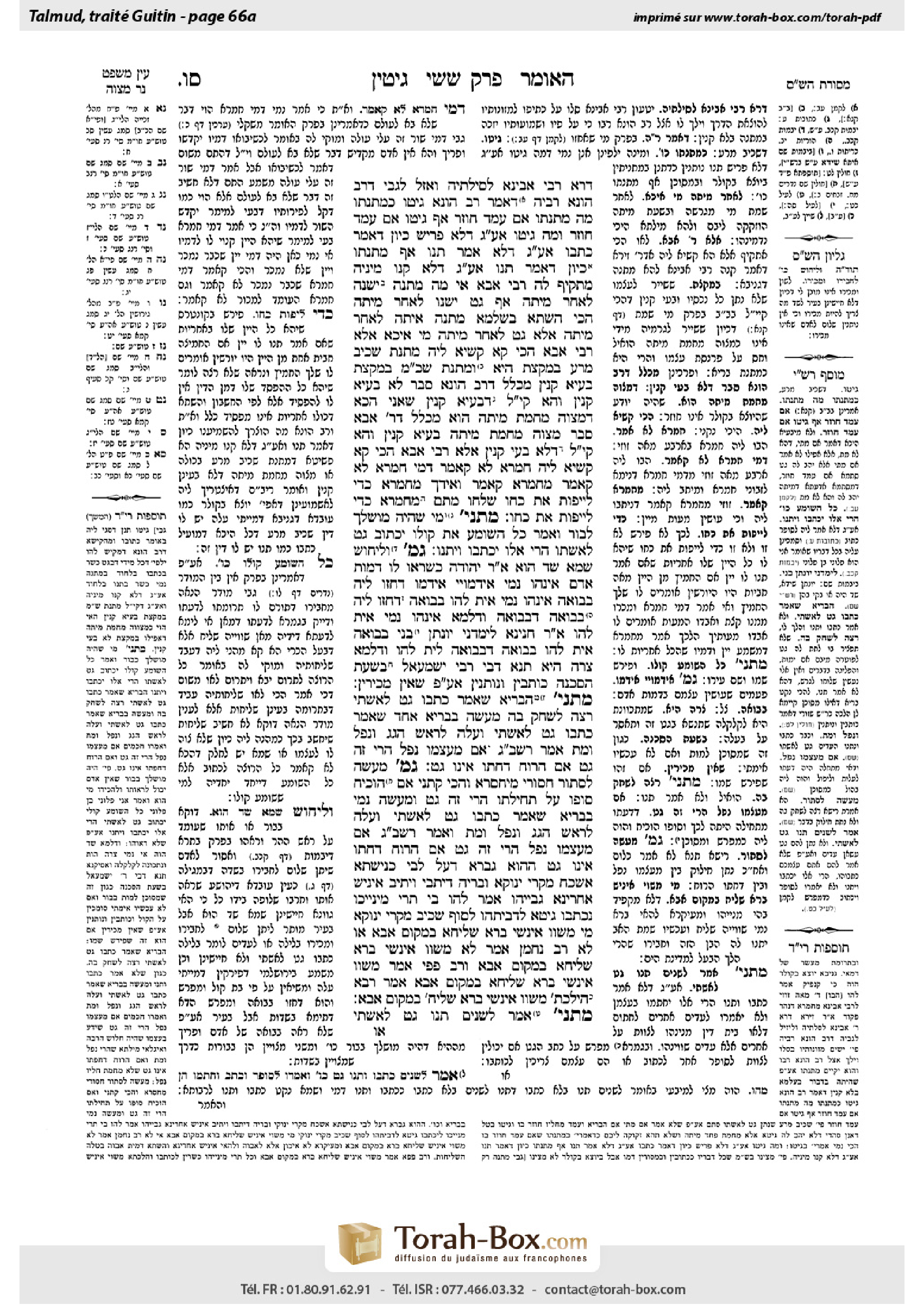
Gittin 66a: Talmud study for Daf Yomi
Study the Talmud for Daf Yomi with scanned pages, Hebrew text, English translations from Sefaria and AI-generated French translations.
Passage selection and English or AI-generated French translation are available where the scan has annotations. Daf Study is independent of Torah-Box and Sefaria.
Browse Gittin · גיטין · All tractatesGittin 66a text and translations
This page of Gittin includes the Aramaic text, an English translation and an AI-generated French translation, alongside the scan above.
גיטין ס״ו א · Aramaic and Hebrew text
דְּרָא רַבִּי אֲבִינָא לְסִילְּתֵיהּ, וַאֲזַל לְגַבֵּי דְּרַב הוּנָא רַבֵּיהּ – דְּאָמַר רַב הוּנָא: גִּיטּוֹ כְּמַתְּנָתוֹ, מַה מַתְּנָתוֹ, אִם עָמַד – חוֹזֵר, אַף גִּיטּוֹ, אִם עָמַד – חוֹזֵר.
וּמָה גִּיטּוֹ, אַף עַל גַּב דְּלָא פָּרֵישׁ, כֵּיוָן דְּאָמַר ״כִּתְבוּ״ – אַף עַל גַּב דְּלָא אָמַר ״תְּנוּ״; אַף מַתְּנָתוֹ, כֵּיוָן דְּאָמַר ״תְּנוּ״ – אַף עַל גַּב דְּלָא קְנוֹ מִינֵּיהּ.
מַתְקֵיף לַהּ רַבִּי אַבָּא: אִי – מָה מַתָּנָה יֶשְׁנָהּ לְאַחַר מִיתָה, אַף גֵּט יֶשְׁנוֹ לְאַחַר מִיתָה?! הָכִי הַשְׁתָּא?! בִּשְׁלָמָא מַתָּנָה – אִיתַהּ לְאַחַר מִיתָה, אֶלָּא גֵּט – לְאַחַר מִיתָה מִי אִיכָּא?!
אֶלָּא רַבִּי אַבָּא, הָכִי קָא קַשְׁיָא לֵיהּ: מַתְּנַת שְׁכִיב מְרַע בְּמִקְצָת הִיא, וּמַתְּנַת שְׁכִיב מְרַע בְּמִקְצָת בָּעֲיָא קִנְיָן! מִכְּלָל דְּרַב הוּנָא סָבַר לָא בָּעֲיָא קִנְיָן?! וְהָא קַיְימָא לַן דְּבָעֲיָא קִנְיָן! שָׁאנֵי הָכָא דְּמְצַוֶּה מֵחֲמַת מִיתָה הוּא.
מִכְּלָל דְּרַבִּי אַבָּא סָבַר: מְצַוֶּה מֵחֲמַת מִיתָה בָּעֲיָא קִנְיָן?! וְהָא קַיְימָא לַן דְּלָא בָּעֵי קִנְיָן!
אֶלָּא רַבִּי אַבָּא, הָכִי קָא קַשְׁיָא לֵיהּ: ״חַמְרָא״ – לָא קָאָמַר, ״דְּמֵי חַמְרָא״ – לָא קָאָמַר, ״מֵחַמְרָא״ קָאָמַר! וְאִידַּךְ, ״מֵחַמְרָא״ – כְּדֵי לְיַיפּוֹת אֶת כֹּחוֹ. שְׁלַחוּ מִתָּם: ״מֵחַמְרָא״ – כְּדֵי לְיַיפּוֹת אֶת כֹּחוֹ.
מַתְנִי׳ מִי שֶׁהָיָה מוּשְׁלָךְ לְבוֹר, וְאָמַר: כׇּל הַשּׁוֹמֵעַ אֶת קוֹלוֹ יִכְתּוֹב גֵּט לְאִשְׁתּוֹ, הֲרֵי אֵלּוּ יִכְתְּבוּ וְיִתְּנוּ.
גְּמָ׳ וְלֵיחוּשׁ שֶׁמָּא שֵׁד הוּא! אָמַר רַב יְהוּדָה: כְּשֶׁרָאוּ לוֹ דְּמוּת אָדָם.
אִינְהוּ נָמֵי אִידְּמוֹיֵי אִידְּמוֹ! דַּחֲזוֹ לֵיהּ בָּבוּאָה. אִינְהוּ נָמֵי אִית לְהוּ בָּבוּאָה! דַּחֲזוֹ לֵיהּ בָּבוּאָה דְבָבוּאָה. וְדִלְמָא אִינְהוּ נָמֵי אִית לְהוּ? אָמַר רַבִּי חֲנִינָא: לִימְּדַנִי יוֹנָתָן בְּנִי: בָּבוּאָה אִית לְהוּ, בָּבוּאָה דְבָבוּאָה לֵית לְהוּ.
וְדִלְמָא צָרָה הִיא! תָּנָא דְּבֵי רַבִּי יִשְׁמָעֵאל: בִּשְׁעַת הַסַּכָּנָה, כּוֹתְבִין וְנוֹתְנִין אַף עַל פִּי שֶׁאֵין מַכִּירִין.
מַתְנִי׳ הַבָּרִיא שֶׁאָמַר: ״כִּתְבוּ גֵּט לְאִשְׁתִּי״ – רָצָה לְשַׂחֶק בָּהּ.
מַעֲשֶׂה בְּבָרִיא אֶחָד שֶׁאָמַר: ״כִּתְבוּ גֵּט לְאִשְׁתִּי״, וְעָלָה לְרֹאשׁ הַגָּג וְנָפַל וָמֵת; אָמַר רַבָּן שִׁמְעוֹן בֶּן גַּמְלִיאֵל: אִם מֵעַצְמוֹ נָפַל, הֲרֵי זֶה גֵּט, אִם הָרוּחַ דָּחַתּוּ – אֵינוֹ גֵּט.
גְּמָ׳ מַעֲשֶׂה לִסְתּוֹר?!
חַסּוֹרֵי מִיחַסְּרָא, וְהָכִי קָתָנֵי: אִם הוֹכִיחַ סוֹפוֹ עַל תְּחִילָּתוֹ – הֲרֵי זֶה גֵּט; וּמַעֲשֶׂה נָמֵי בְּבָרִיא שֶׁאָמַר: ״כִּתְבוּ גֵּט לְאִשְׁתִּי״, וְעָלָה לְרֹאשׁ הַגָּג וְנָפַל וָמֵת, וְאָמַר רַבָּן שִׁמְעוֹן בֶּן גַּמְלִיאֵל: אִם מֵעַצְמוֹ נָפַל – הֲרֵי זֶה גֵּט, אִם הָרוּחַ דָּחַתּוּ – אֵינוֹ גֵּט.
הָהוּא גַּבְרָא דְּעָל לְבֵי כְנִישְׁתָּא, אַשְׁכַּח מַקְרֵי יָנוֹקָא וּבְרֵיהּ דְּיָתְבִי, וְיָתֵיב אִינִישׁ אַחֲרִינָא גַּבַּיְיהוּ, אֲמַר לְהוּ: בֵּי תְרֵי מִינַּיְיכוּ נִכְתְּבוּ גִּיטָּא לִדְבֵיתְהוּ. לְסוֹף שְׁכֵיב מַקְרֵי יָנוֹקָא, מִי מְשַׁוּוּ אִינָשֵׁי בְּרָא שְׁלִיחָא בִּמְקוֹם אַבָּא, אוֹ לָא?
רַב נַחְמָן אָמַר: לָא מְשַׁוּוּ אִינָשֵׁי בְּרָא שְׁלִיחָא בִּמְקוֹם אַבָּא; וְרַב פַּפֵּי אָמַר: מְשַׁוּוּ אִינָשֵׁי בְּרָא שְׁלִיחָא בִּמְקוֹם אַבָּא. אָמַר רָבָא, הִילְכְתָא: מְשַׁוּוּ אִינָשֵׁי בְּרָא שְׁלִיחָא בִּמְקוֹם אַבָּא.
מַתְנִי׳ אָמַר לִשְׁנַיִם: ״תְּנוּ גֵּט לְאִשְׁתִּי״,
Gittin 66a · English translation
Let Rabbi Avina lift his basket and go to Rav Huna his teacher, as in order to acquire the item he must rely on the opinion of his teacher, as Rav Huna said: The legal status of one’s bill of divorce is like that of his gift. Just as with regard to a gift given by one on his deathbed, if he recovered from his illness and arose from his deathbed, he revokes his gift, so too, with regard to his bill of divorce given by one on his deathbed, if he recovered from his illness and arose from his deathbed, he revokes the bill of divorce.
And just as with regard to the bill of divorce of one on his deathbed, even though he did not specify, once he said: Write the bill of divorce, even though he did not say: Give it to my wife, they write and give it to his wife, as it was taught in the mishna. So too, with regard to a gift given by one on his deathbed, once he said: Give the gift, even though the recipients did not acquire the item from him by means of an act of acquisition, the one on his deathbed has given the gift. Based on the parallel drawn by Rav Huna between a bill of divorce and a gift, Rabbi Avina can go and collect the gift given him by Geneiva.
Rabbi Abba objects to that conclusion. If that parallel is valid, extend it and say: Just as a gift is valid after death, so too, a bill of divorce is valid after death. The Gemara rejects this: How can these cases be compared? Granted, a gift is valid after death; however, is a bill of divorce valid after death? A bill of divorce severs the bond between husband and wife. After the husband dies, the bill of divorce is pointless. Therefore, the parallel certainly does not extend to after death.
Rather, this is what is difficult according to Rabbi Abba: Geneiva’s instruction is the gift of a person on his deathbed of a portion of his estate, and the gift of a person on his deathbed of a portion of his estate requires an act of acquisition. The Gemara asks: Is that to say, by inference, that Rav Huna, according to whose opinion Rabbi Avina acquired the gift, holds that the gift of a person on his deathbed of a portion of his estate does not require an act of acquisition? But don’t we maintain that the gift of a person on his deathbed of a portion of his estate requires an act of acquisition? The Gemara answers: It is different here, as this is not a standard case of the gift of a person on his deathbed. This is a case where one issues an instruction to give the gift due to his imminent death. In that case, the principle: It is a mitzva to fulfill the statement of the deceased, applies even if it is a gift of a portion of his estate.
The Gemara asks: Is that to say by inference that Rabbi Abba holds that one who issues an instruction to give the gift due to his imminent death requires an act of acquisition? But don’t we maintain that one who issues an instruction to give the gift due to his imminent death does not require an act of acquisition? What, then, is difficult for Rabbi Abba?
Rather, this is what is difficult according to Rabbi Abba: Geneiva did not say to give four hundred dinars of wine to Rabbi Avina, and he did not say: The monetary value of four hundred dinars of wine. He said: Four hundred dinars from wine. The question is: What did Geneiva seek to convey with that ambiguous expression? And the other amora, Rabbi Zeira, who does not find this difficult, holds that when Geneiva said: Four hundred dinars from wine, it was in order to enhance Rabbi Avina’s ability to collect the gift. Geneiva sought to give him a gift of value; in order to guarantee that Rabbi Avina would have access to his property and that the heirs would not be able to prevent him from receiving the gift with various claims, he specifically designated from which property Rabbi Avina could collect the gift. The Gemara notes: They sent a message from there, i.e., Eretz Yisrael, that the term: From wine, is in order to enhance Rabbi Avina’s ability to collect the gift.
MISHNA: With regard to one who was thrown into a pit and thought that he would die there, and he said that anyone who hears his voice should write a bill of divorce for his wife, and he specified his name, her name, and all relevant details, those who hear him should write this bill of divorce and give it to his wife, even though they do not see the man and do not know him.
GEMARA: The Gemara asks: But let us be concerned that perhaps the source of the voice in the pit is a demon, as no one saw the person in the pit. Rav Yehuda says: It is referring to a case where they saw that the being in the pit has human form.
The Gemara objects: Demons too can appear in human form, and therefore the fact that the being looked human is not a proof that it is not a demon. The Gemara explains: It is a case where they saw that he has a shadow [bavua]. The Gemara objects: Demons also have a shadow. The Gemara explains: It is a case where they saw that he has the shadow of a shadow. The Gemara objects: And perhaps demons too have the shadow of a shadow? Rabbi Ḥanina says: Yonatan my son taught me that demons have a shadow but they do not have the shadow of a shadow.
The Gemara asks: But perhaps the source of the voice in the pit is a rival wife of the woman who is to be divorced. She seeks to cause her rival to receive a bill of divorce under false pretenses, leading her to believe that she is divorced. Based on that mistaken belief, she will remarry without a divorce and will then be forbidden to both her first and second husband. The Gemara answers: A Sage from the school of Rabbi Yishmael taught: During a time of danger, when there is the likelihood that the wife would assume deserted wife status, one writes and gives a bill of divorce even though the people instructed to do so are not familiar with the man who gave the instructions. Here too, when a voice is heard from a pit, one writes and gives the bill of divorce, as there is no possibility of properly clarifying the issue.
MISHNA: A healthy man who said: Write a bill of divorce for my wife, but did not say to give it to her, presumably sought to mock her. Since he told them to write the bill of divorce and not to give it, it is not a valid bill of divorce.
The mishna relates: There was an incident involving a healthy man who said: Write a bill of divorce for my wife, and then ascended to the roof and fell, and died. Rabban Shimon ben Gamliel said: If he fell at his own initiative, taking his own life, it is a valid bill of divorce, as it is clear that he anticipated his death and instructed those listening to write the bill of divorce with the intent of giving it to her. However, if the wind forced him to fall, it is not a valid bill of divorce, as there was no clear intent to give her the bill of divorce.
GEMARA: The Gemara asks: Was an incident cited to contradict the halakha stated in the mishna? The halakha is that in a case where a healthy man said: Write a bill of divorce for my wife, the bill of divorce is not valid. From the incident it is clear that under certain circumstances when a healthy man said: Write a bill of divorce for my wife, the bill of divorce is valid.
The Gemara answers: The mishna is incomplete and this is what it is teaching: In the case of a healthy man who said: Write a bill of divorce for my wife, but he did not say to give it to her, presumably sought to mock her. However, if his ultimate actions prove the nature of his initial intent, that he seeks to give the bill of divorce because he is about to die, it is a valid bill of divorce. And there was an incident involving a healthy man who said: Write a bill of divorce for my wife, and he then ascended to the roof and fell and died. Rabban Shimon ben Gamliel said: If he fell at his own initiative, it is a valid bill of divorce. However, if the wind forced him to fall, it is not a valid bill of divorce.
The Gemara relates: There was a certain man who entered the synagogue and found a schoolteacher and his son who were sitting there, and another person also sat with them. The man said to them: Two of you should write a bill of divorce for my wife. Ultimately, the schoolteacher died. The Sages considered the following question: Do people designate a son as an agent in the presence of his father, even though the two of them could not serve together as witnesses because they are relatives, or not? As the man’s intent was to designate two people who could serve as witnesses, the schoolteacher and the other person, the question is whether the son of the schoolteacher and the other person are agents and eligible to write and give the bill of divorce.
Rav Naḥman said: People do not designate a son as an agent in the presence of his father. And Rav Pappi said: People designate a son as an agent in the presence of his father. Rava said that the halakha is: People designate a son as an agent in the presence of his father.
MISHNA: If a man said to two people: Give a bill of divorce to my wife,
Gittin 66a · Traduction française (IA)
Que le Rabbi Avina soulève son panier et aille chez son maître, le Rav Huna, car afin d'acquérir l'objet, il doit se baser sur l'opinion de son maître, comme le Rav Huna a dit : Le statut légal d'un divorce est comme celui d'un don. Aussi bien qu'avec un don fait par une personne sur son lit de mort, si celui-ci se rétablit de sa maladie et se lève de son lit de mort, il révoque son don, de même, avec un divorce donné par une personne sur son lit de mort, si celui-ci se rétablit de sa maladie et se lève de son lit de mort, il révoque le divorce.
Et aussi bien qu'avec le divorce d'une personne sur son lit de mort, même s'il n'a pas spécifié, une fois qu'il a dit : Écris le divorce, même s'il n'a pas dit : Donne-le à ma femme, on écrit et on le donne à sa femme, comme il a été enseigné dans la mitsna. De même, avec un don fait par une personne sur son lit de mort, une fois qu'il a dit : Donne le don, même si les bénéficiaires n'ont pas acquis l'objet à partir de lui par un acte d'acquisition, la personne sur son lit de mort a donné le don. Basé sur le parallèle établi par le Rav Huna entre un divorce et un don, le Rabbi Avina peut aller et récupérer le don qu'il a reçu de Geneiva.
Le Rabbi Abba s'oppose à cette conclusion. Si ce parallèle est valide, étendez-le et dites : Aussi bien qu'un don est valide après la mort, de même, un divorce est valide après la mort. La Guemara rejette cela : Comment peuvent ces cas être comparés ? Bien sûr, un don est valide après la mort ; cependant, un divorce est-il valide après la mort ? Un divorce coupe le lien entre époux. Après la mort du mari, le divorce est inutile. Par conséquent, ce parallèle ne s'étend certainement pas à la mort.
Plutôt, c'est ce qui est difficile selon le Rabbi Abba : L'instruction de Geneiva est le don d'une personne sur son lit de mort d'une portion de son patrimoine, et le don d'une personne sur son lit de mort d'une portion de son patrimoine exige un acte d'acquisition. La Guemara demande : Est-ce que cela signifie par inférence que le Rav Huna, selon dont l'opinion le Rabbi Avina a acquis le don, considère que le don d'une personne sur son lit de mort d'une portion de son patrimoine n'exige pas un acte d'acquisition ? Mais ne maintenons-nous pas que le don d'une personne sur son lit de mort d'une portion de son patrimoine exige un acte d'acquisition ? La Guemara répond : C'est différent ici, car ce n'est pas un cas standard de don d'une personne sur son lit de mort. C'est un cas où l'on donne une instruction pour donner le don en raison de sa mort imminente. Dans ce cas, le principe : Il est un mitsva de remplir la parole du défunt, s'applique même si c'est un don d'une portion de son patrimoine.
La Guemara demande : Est-ce que cela signifie par inférence que le Rabbi Abba considère que celui qui donne une instruction pour donner le don en raison de sa mort imminente exige un acte d'acquisition ? Mais ne maintenons-nous pas que celui qui donne une instruction pour donner le don en raison de sa mort imminente n'exige pas un acte d'acquisition ? Qu'est-ce donc qui est difficile pour le Rabbi Abba ?
Plutôt, c'est ce qui est difficile selon le Rabbi Abba : Geneiva n'a pas dit de donner quatre cents dinars de vin au Rabbi Avina, et il n'a pas dit : La valeur monétaire de quatre cents dinars de vin. Il a dit : Quatre cents dinars de vin. La question est : Qu'est-ce que Geneiva cherchait à exprimer avec cette expression ambiguë ? Et l'autre amora, le Rabbi Zeira, qui ne trouve pas cela difficile, considère que lorsque Geneiva a dit : Quatre cents dinars de vin, c'était pour renforcer la capacité du Rabbi Avina à récupérer le don. Geneiva cherchait à lui donner un don de valeur ; afin de garantir que le Rabbi Avina puisse accéder à ses biens et que les héritiers ne puissent pas l'empêcher de recevoir le don avec diverses revendications, il a spécifiquement désigné à partir de quel bien le Rabbi Avina pouvait récupérer le don. La Guemara note : Ils ont envoyé un message d'Israël, c'est-à-dire d'Éretz Yisrael, que le terme : De vin, est pour renforcer la capacité du Rabbi Avina à récupérer le don.
MICHNA : Concernant une personne jetée dans un puits et croyant qu'elle allait mourir, et qui a dit que quiconque entend sa voix devrait écrire un divorce pour sa femme, et qui a spécifié son nom, le nom de sa femme et tous les détails pertinents, ceux qui l'entendent devraient écrire ce divorce et le donner à sa femme, même s'ils ne le voient pas et ne le connaissent pas.
GUEMARA : La Guemara demande : Mais pouvons-nous avoir peur que la source de la voix dans le puits soit un démon, comme personne n'a vu la personne dans le puits. Rav Yehuda dit : Il s'agit d'un cas où ils ont vu que la créature dans le puits a une forme humaine.
La Guemara s'oppose : Les démons aussi peuvent apparaître sous forme humaine, et par conséquent, le fait que la créature ait l'air humain n'est pas une preuve qu'il ne s'agit pas d'un démon. La Guemara explique : Il s'agit d'un cas où ils ont vu qu'il a une ombre [bavua]. La Guemara s'oppose : Les démons aussi ont une ombre. La Guemara explique : Il s'agit d'un cas où ils ont vu qu'il a l'ombre d'une ombre. La Guemara s'oppose : Et peut-être les démons aussi ont-ils l'ombre d'une ombre ? Le Rabbi Ḥanina dit : Yonatan mon fils m'a appris que les démons ont une ombre mais ils n'ont pas l'ombre d'une ombre.
La Guemara demande : Mais peut-être la source de la voix dans le puits est une rivale de la femme à divorcer. Elle cherche à faire croire à sa rivale qu'elle reçoit un divorce sous des prétextes faux, la faisant croire qu'elle est divorcée. Basée sur cette croyance erronée, elle se remarie sans divorce et sera ensuite interdite à son premier et à son deuxième mari. La Guemara répond : Un Sage de la maison de Rabbi Yishmael a enseigné : Lors d'une situation de danger, où il y a la probabilité que la femme devienne une épouse abandonnée, on écrit et on donne un divorce même si les personnes chargées de le faire ne connaissent pas l'homme qui a donné les instructions. Ici aussi, lorsqu'une voix est entendue d'un puits, on écrit et on donne le divorce, car il n'y a pas de possibilité de clarifier correctement la question.
MICHNA : Un homme sain d'esprit qui dit : Écrivez un acte de divorce pour ma femme, mais ne dit pas de le lui donner, voulait probablement la taquiner. Puisque il a dit d'écrire l'acte de divorce et non de le lui donner, ce n'est pas un acte de divorce valide.
La mishna relate : Il y avait un cas d'un homme sain d'esprit qui dit : Écrivez un acte de divorce pour ma femme, et puis monta sur le toit et tomba, et mourut. Rabban Shimon ben Gamliel dit : Si il est tombé de son propre chef, en prenant sa propre vie, c'est un acte de divorce valide, car il est clair qu'il anticipait sa mort et a ordonné à ceux qui l'écoutaient d'écrire l'acte de divorce avec l'intention de le lui donner. Cependant, si le vent l'a forcé à tomber, ce n'est pas un acte de divorce valide, car il n'y avait pas d'intention claire de lui donner l'acte de divorce.
GUEMARA : La Guemara demande : Un cas a-t-il été cité pour contredire la halakha énoncée dans la mishna ? La halakha est que dans le cas où un homme sain d'esprit dit : Écrivez un acte de divorce pour ma femme, l'acte de divorce n'est pas valide. À partir du cas, il est clair que sous certaines circonstances, lorsque un homme sain d'esprit dit : Écrivez un acte de divorce pour ma femme, l'acte de divorce est valide.
La Guemara répond : La Michna est incomplète et c'est ce qu'elle enseigne : Dans le cas d'un homme sain d'esprit qui dit : Écrivez un acte de divorce pour ma femme, mais qui ne dit pas de le lui donner, il a probablement voulu la taquiner. Cependant, si ses actions ultérieures prouvent la nature de son intention initiale, c'est-à-dire qu'il cherche à lui donner l'acte de divorce parce qu'il va mourir, c'est un acte de divorce valide. Et il y avait un cas d'un homme sain d'esprit qui dit : Écrivez un acte de divorce pour ma femme, et puis monta sur le toit et tomba et mourut. Rabban Shimon ben Gamliel dit : Si il est tombé de son propre chef, c'est un acte de divorce valide. Cependant, si le vent l'a forcé à tomber, ce n'est pas un acte de divorce valide.
La Guemara relate : Il y avait un certain homme qui entra dans la synagogue et trouva un maître de maison et son fils qui y étaient assis, et une autre personne aussi s'était assise avec eux. L'homme dit à eux : Deux d'entre vous devraient écrire un acte de divorce pour ma femme. Finalement, le maître de maison est mort. Les Sages ont considéré la question suivante : Les gens désignent-ils un fils comme agent en présence de son père, même si les deux ne peuvent pas témoigner ensemble en raison de leur parenté, ou non ? Comme l'intention de l'homme était de désigner deux personnes qui pourraient témoigner, le maître de maison et l'autre personne, la question est de savoir si le fils du maître de maison et l'autre personne sont des agents et éligibles à écrire et à donner l'acte de divorce.
Rav Naḥman dit : Les gens ne désignent pas un fils comme agent en présence de son père. Et Rav Pappi dit : Les gens désignent un fils comme agent en présence de son père. Rava dit que la halakha est : Les gens désignent un fils comme agent en présence de son père.
MICHNA : Si un homme dit à deux personnes : Donnez un acte de divorce à ma femme,
Traduction française générée par IA à partir de l’édition anglaise de Sefaria. Vérifie toujours un passage avec le texte source.
Text from Sefaria: William Davidson Edition - Vocalized Aramaic (CC BY NC); William Davidson Edition - English (CC BY NC).