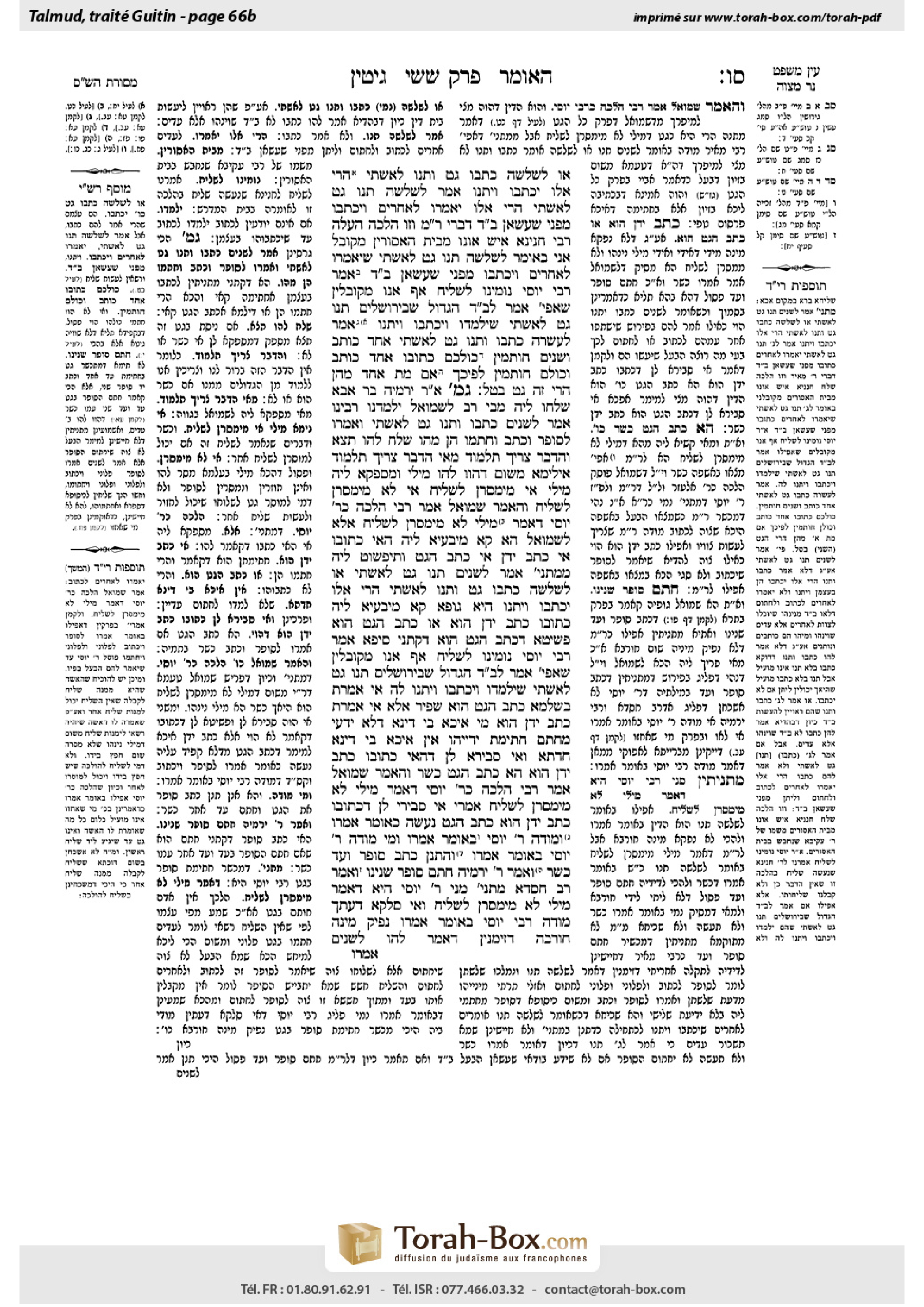
Gittin 66b: Talmud study for Daf Yomi
Study the Talmud for Daf Yomi with scanned pages, Hebrew text, English translations from Sefaria and AI-generated French translations.
Passage selection and English or AI-generated French translation are available where the scan has annotations. Daf Study is independent of Torah-Box and Sefaria.
Browse Gittin · גיטין · All tractatesGittin 66b text and translations
This page of Gittin includes the Aramaic text, an English translation and an AI-generated French translation, alongside the scan above.
גיטין ס״ו ב · Aramaic and Hebrew text
אוֹ לִשְׁלֹשָׁה: ״כִּתְבוּ גֵּט, וּתְנוּ לְאִשְׁתִּי״, הֲרֵי אֵלּוּ יִכְתְּבוּ וְיִתְּנוּ. אָמַר לִשְׁלֹשָׁה: ״תְּנוּ גֵּט לְאִשְׁתִּי״, הֲרֵי אֵלּוּ יֹאמְרוּ לַאֲחֵרִים וְיִכְתְּבוּ, מִפְּנֵי שֶׁעֲשָׂאָן בֵּית דִּין; דִּבְרֵי רַבִּי מֵאִיר.
וְזוֹ הֲלָכָה הֶעֱלָה רַבִּי חֲנִינָא אִישׁ אוֹנוֹ מִבֵּית הָאֲסוּרִין: מְקוּבָּל אֲנִי בְּאוֹמֵר לִשְׁלֹשָׁה: ״תְּנוּ גֵּט לְאִשְׁתִּי״ – שֶׁיֹּאמְרוּ לַאֲחֵרִים וְיִכְתְּבוּ, מִפְּנֵי שֶׁעֲשָׂאָן בֵּית דִּין,
אָמַר רַבִּי יוֹסֵי, נוּמֵינוּ לַשָּׁלִיחַ: אַף אָנוּ מְקוּבָּלִין, שֶׁאֲפִילּוּ אָמַר לְבֵית דִּין הַגָּדוֹל שֶׁבִּירוּשָׁלַיִם: ״תְּנוּ גֵּט לְאִשְׁתִּי״ – שֶׁיִּלְמְדוּ וְיִכְתְּבוּ וְיִתְּנוּ.
אָמַר לַעֲשָׂרָה: ״כִּתְבוּ וּתְנוּ גֵּט לְאִשְׁתִּי״ – אֶחָד כּוֹתֵב, וּשְׁנַיִם חוֹתְמִין. ״כּוּלְּכֶם כְּתוֹבוּ״ – אֶחָד כּוֹתֵב, וְכוּלָּם חוֹתְמִין; לְפִיכָךְ אִם מֵת אֶחָד מֵהֶן – הֲרֵי זֶה גֵּט בָּטֵל.
גְּמָ׳ אָמַר רַבִּי יִרְמְיָה בַּר אַבָּא: שְׁלַחוּ לֵיהּ מִבֵּי רַב לִשְׁמוּאֵל: יְלַמְּדֵנוּ רַבֵּינוּ; אָמַר לִשְׁנַיִם: ״כִּתְבוּ וּתְנוּ גֵּט לְאִשְׁתִּי״, וְאָמְרוּ לְסוֹפֵר וְכָתַב, וְחָתְמוּ הֵן, מַהוּ? שְׁלַח לְהוּ: תֵּצֵא, וְהַדָּבָר צָרִיךְ תַּלְמוּד.
מַאי ״הַדָּבָר צָרִיךְ תַּלְמוּד״? אִילֵּימָא מִשּׁוּם דְּהָווּ לְהוּ מִילֵּי; וּמְסַפְּקָא לֵיהּ מִילֵּי – אִי מִימַּסְרָן לְשָׁלִיחַ, אִי לָא מִימַּסְרָן לְשָׁלִיחַ;
וְהָאָמַר שְׁמוּאֵל אָמַר רַבִּי: הֲלָכָה כְּרַבִּי יוֹסֵי, דְּאָמַר מִילֵּי לָא מִימַּסְרָן לְשָׁלִיחַ!
אֶלָּא לִשְׁמוּאֵל – הָא קָא מִיבַּעְיָא לֵיהּ: הַאי ״כְּתוֹבוּ״ – אִי כְּתַב יָדָן, אִי כְּתַב הַגֵּט?
וְתִיפְשׁוֹט לֵיהּ מִמַּתְנִיתִין: אָמַר לִשְׁנַיִם: ״תְּנוּ גֵּט לְאִשְׁתִּי״, אוֹ לִשְׁלֹשָׁה: ״כִּתְבוּ גֵּט וּתְנוּ לְאִשְׁתִּי״ – הֲרֵי אֵלּוּ יִכְתְּבוּ וְיִתְּנוּ.
הִיא גּוּפָא קָא מִיבַּעְיָא לֵיהּ, ״כְּתוֹבוּ״ – כְּתַב יָדָן הוּא, אוֹ כְּתַב הַגֵּט הוּא? פְּשִׁיטָא דִּכְתַב הַגֵּט הוּא, דְּקָתָנֵי סֵיפָא: אָמַר רַבִּי יוֹסֵי, נוּמֵינוּ לַשָּׁלִיחַ: אַף אָנוּ מְקוּבָּלִין, שֶׁאֲפִילּוּ אָמַר לְבֵית דִּין הַגָּדוֹל שֶׁבִּירוּשָׁלַיִם: ״תְּנוּ גֵּט לְאִשְׁתִּי״ – שֶׁיִּלְמְדוּ וְיִכְתְּבוּ וְיִתְּנוּ לָהּ.
אִי אָמְרַתְּ בִּשְׁלָמָא כְּתַב הַגֵּט הוּא, שַׁפִּיר; אֶלָּא אִי אָמְרַתְּ כְּתַב יָדָן הוּא, מִי אִיכָּא בֵּי דִינָא דְּלָא יָדְעִי מִחְתָּם חֲתִימַת יְדַיְיהוּ?! אִין, אִיכָּא בֵּי דִינָא חַדְתָּא.
וְאִי סְבִירָא לַן דְּהַאי ״כְּתוֹבוּ״ – כְּתַב יָדָן הוּא; הָא כְּתַב הַגֵּט – כָּשֵׁר?! וְהָאָמַר שְׁמוּאֵל, אָמַר רַבִּי: הֲלָכָה כְּרַבִּי יוֹסֵי, דְּאָמַר מִילֵּי לָא מִימַּסְרָן לְשָׁלִיחַ!
אָמְרִי: אִי סְבִירִי לַן דִּ״כְתוֹבוּ״ – כְּתַב יָדָן הוּא; כְּתַב הַגֵּט – נַעֲשָׂה כְּאוֹמֵר: ״אִמְרוּ״, וּמוֹדֶה רַבִּי יוֹסֵי בְּאוֹמֵר ״אִמְרוּ״. וּמִי מוֹדֶה רַבִּי יוֹסֵי בְּאוֹמֵר: ״אִמְרוּ״?! וְהָתְנַן: ״כָּתַב סוֹפֵר וְעֵד – כָּשֵׁר״, וְאָמַר רַבִּי יִרְמְיָה: ״חָתַם סוֹפֵר״ שָׁנִינוּ;
וְאָמַר רַב חִסְדָּא: מַתְנִיתִין מַנִּי – רַבִּי יוֹסֵי הִיא, דְּאָמַר: מִילֵּי לָא מִימַּסְרָן לְשָׁלִיחַ.
וְאִי סָלְקָא דַעְתָּךְ מוֹדֶה רַבִּי יוֹסֵי בְּאוֹמֵר ״אִמְרוּ״, נָפֵיק מִינַּהּ חוּרְבָּה – דְּזִימְנִין דְּאָמַר לְהוּ לִשְׁנַיִם:
Gittin 66b · English translation
or if a man said to three people: Write a bill of divorce and give it to my wife, these people should write the document themselves and give it to her. If he said to three people: Give a bill of divorce to my wife, these people should tell others, and those others will write the document, because he designated the three people as a court. This is the statement of Rabbi Meir.
And it is that halakha that Rabbi Ḥanina of Ono brought up from prison in the name of Rabbi Akiva, who was incarcerated there: I received a tradition from my teachers that in a case where a man says to three people: Give a bill of divorce to my wife, that these people should tell others and those others will write the document, because he designated the three people as a court.
Rabbi Yosei said: We said [nomeinu] to the agent, Rabbi Ḥanina of Ono: We too received a tradition. However, it is a different one, that even if a man said to the High Court [Sanhedrin] in Jerusalem: Give a bill of divorce to my wife, that the members of the court should learn to write, and should write the document themselves, and give it to his wife.
If a man said to ten people: Write and give a bill of divorce to my wife, one of the ten writes the bill of divorce and two sign it. If he said: All of you write the document, one of them writes the bill of divorce and all of them sign it. Therefore, if one of them died, then this is a bill of divorce that is null and void, as he directed all of them to participate in the process.
GEMARA: Rabbi Yirmeya bar Abba says: After Rav’s death, they sent a question from the study hall of Rav to Shmuel: Let our teacher teach us: In a case where a man said to two people: Write and give a bill of divorce to my wife, and they told the scribe and he wrote the bill of divorce and they signed it, what is the halakha? He sent this response to them: If the woman remarried on the basis of this bill of divorce, she should leave her second husband, and the matter requires study. It is necessary to clarify the halakha, as there is fundamental uncertainty with regard to this matter.
The Gemara asks: What is the meaning of: The matter requires study? What aspect of this question requires study? If we say that the uncertainty arises due to the fact that these are verbal directives, as the husband merely gave them instructions and did not hand them anything tangible, and Shmuel is uncertain whether verbal directives, instructions given to one agent, are transferred to another agent or whether verbal directives are not transferred to another agent; this leads to the question of whether the agents designated by the husband to write the bill of divorce can designate the scribe to write it. That cannot be the question.
The Gemara explains why not: But didn’t Shmuel say that Rabbi Yehuda HaNasi says: The halakha is in accordance with the opinion of Rabbi Yosei, who said: Verbal directives cannot be delegated to an agent, i.e., an agent cannot be deputized to give instructions on behalf of another. Shmuel was not uncertain concerning this issue.
Rather, this is the dilemma that Shmuel is raising: When the man told the two people: Write the bill of divorce, the question is whether he was referring to their signatures, in which case they could designate the scribe to write the document, or whether he was referring to writing the text of the bill of divorce, in which case it would be incumbent upon them alone to write and sign the document.
The Gemara asks: But let Shmuel resolve the dilemma from the mishna: If a man said to two people: Give a bill of divorce to my wife, or if a man said to three people: Write a bill of divorce and give it to my wife, these people should write the document themselves and give it to her. Apparently, they must write the bill of divorce themselves.
The Gemara answers: The proper interpretation of the mishna itself is the dilemma that Shmuel is raising: When the man told the two people: Write the bill of divorce, was he referring to their signatures, or was he referring to writing the text of the bill of divorce? The Gemara explains: It is obvious that it is referring to the writing of the bill of divorce, as it is taught in the latter clause of the mishna: Rabbi Yosei said: We said to the agent, Rabbi Ḥanina of Ono: We too received a tradition; that even if a man said to the High Court in Jerusalem: Give a bill of divorce to my wife, that the members of the court should learn to write, and should write the document themselves, and give it to his wife.
Granted, if you say it means the writing of the bill of divorce, that they must write the actual bill of divorce, this works out well, as a certain degree of expertise is necessary in order to write a bill of divorce correctly. However, if you say that it means their signatures, is there a court whose members do not know how to sign their signatures? The Gemara responds: Yes, there is a new court, whose members have not yet learned to sign a unique signature that will be recognizable to the public.
The Gemara asks: But if we hold that this instruction: Write the bill of divorce, is a reference to their signatures, is the writing of the bill of divorce by a scribe valid? But didn’t Shmuel say that Rabbi Yehuda HaNasi says: The halakha is in accordance with the opinion of Rabbi Yosei, who says: Verbal directives cannot be delegated to an agent.
The Sages say in response that if we hold that the phrase: Write the bill of divorce, is a reference to their signatures, the writing of the bill of divorce becomes as one who says to those agents: Tell another to write it. And Rabbi Yosei concedes in the case of one who says: Tell another to write it, that the agent can designate another to write the document. The Gemara asks: And does Rabbi Yosei concede in the case of one who says: Tell another to write it? But didn’t we learn in a mishna (87b): If a bill of divorce has the writing of a scribe, and the scribe identifies his handwriting, and one witness verifies his signature, it is valid as though two witnesses testified to ratify their signatures. And Rabbi Yirmeya said: We learned in the mishna that this is the halakha with regard to the scribe’s signature and not the scribe’s writing.
And Rav Ḥisda said: Whose opinion is expressed in the mishna? It is that of Rabbi Yosei, who said: Verbal directives cannot be delegated to an agent, and there is no concern that the scribe signed the document without the husband instructing him to do so.
And if it enters your mind to say that Rabbi Yosei concedes in the case of one who says: Tell another to write it, a pitfall will result from it. As sometimes, it happens that one said to two people:
Gittin 66b · Traduction française (IA)
ou s'il dit à trois personnes : Écris un acte de divorce et donne-le à ma femme, ces personnes doivent écrire le document eux-mêmes et le lui donner. S'il dit à trois personnes : Donne un acte de divorce à ma femme, ces personnes doivent dire à d'autres, et ceux-ci écriront le document, car il a désigné les trois personnes comme un tribunal. C'est la déclaration du Rabbi Meir.
Et c'est cette halakha que le Rabbi Ḥanina d'Ono a rapportée de prison en nom du Rabbi Akiva, qui était emprisonné là : J'ai reçu une tradition de mes maîtres que dans un cas où un homme dit à trois personnes : Donne un acte de divorce à ma femme, ces personnes doivent dire à d'autres et ceux-ci écriront le document, car il a désigné les trois personnes comme un tribunal.
Le Rabbi Yosei dit : Nous avons dit [nomeinu] à l'agent, le Rabbi Ḥanina d'Ono : Nous aussi, nous avons reçu une tradition. Cependant, c'est une autre, celle-ci : même si un homme dit au Sanhédrin de Jérusalem : Donne un acte de divorce à ma femme, les membres du tribunal doivent apprendre à écrire, et doivent écrire le document eux-mêmes et le lui donner.
Si un homme dit à dix personnes : Écris et donne un acte de divorce à ma femme, l'un des dix écrit l'acte de divorce et deux le signent. S'il dit : Tous vous écrivez le document, l'un d'eux écrit l'acte de divorce et tous le signent. Ainsi, si l'un d'eux meurt, alors c'est un acte de divorce nul et non avent, car il a ordonné qu'ils participent tous au processus.
GUEMARA : Rabbi Yirmeya bar Abba dit : Après la mort du Rav, ils ont envoyé une question de la maison de étude du Rav à Shmuel : Faisons-nous apprendre par notre maître : dans un cas où un homme dit à deux personnes : Écris et donne un acte de divorce à ma femme, et ils ont dit au scribe et il a écrit l'acte de divorce et ils l'ont signé, quelle est la halakha ? Il a envoyé cette réponse à eux : Si la femme s'est remariée sur la base de cet acte de divorce, elle doit quitter son deuxième mari, et la question nécessite une étude. Il est nécessaire de clarifier la halakha, car il y a une incertitude fondamentale concernant cette question.
La Guemara demande : Quelle est la signification de : la question nécessite une étude ? Quel aspect de cette question nécessite une étude ? Si nous disons que l'incertitude provient du fait que ces sont des ordres verbaux, car l'homme a simplement donné des instructions et n'a pas donné quelque chose de tangible, et Shmuel est incertain quant au fait que les ordres verbaux, les instructions données à un agent, soient transmis à un autre agent ou non, ou si les ordres verbaux ne sont pas transmis à un autre agent ; cela mène à la question de savoir si les agents désignés par l'homme pour écrire l'acte de divorce peuvent désigner le scribe pour l'écrire. Cela ne peut pas être la question.
La Guemara explique pourquoi pas : Mais n’a-t-il pas dit Shmuel que Rabbi Yehuda HaNasi dit : la halakha suit l’opinion de Rabbi Yosei, qui dit : les ordres verbaux ne peuvent pas être délégués à un agent, c’est-à-dire qu’un agent ne peut pas être désigné pour donner des instructions au nom d’un autre. Shmuel n’était pas incertain à cet égard.
Plutôt, c’est cette difficulté que Shmuel soulève : lorsque l’homme a dit aux deux personnes : écris l’acte de divorce, la question est de savoir s’il faisait référence à leurs signatures, dans ce cas ils pourraient désigner le scribe pour écrire le document, ou s’il faisait référence à l’écriture du texte de l’acte de divorce, dans ce cas il serait incumbent à eux seuls d’écrire et de signer le document.
La Guemara demande : Mais laissez Shmuel résoudre cette difficulté à partir de la mitsva : si un homme dit à deux personnes : donne un acte de divorce à ma femme, ou si un homme dit à trois personnes : écris un acte de divorce et donne-le à ma femme, ces personnes doivent écrire le document eux-mêmes et le lui donner. Apparemment, ils doivent écrire l’acte de divorce eux-mêmes.
La Guemara répond : L'interprétation correcte de la mitsna elle-même est la difficulté que Shmuel soulève : lorsque l'homme a dit aux deux personnes : écris l'acte de divorce, faisait-il référence à leurs signatures, ou à l'écriture du texte de l'acte de divorce ? La Guemara explique : Il est évident qu'il fait référence à l'écriture de l'acte de divorce, car cela est enseigné dans la seconde partie de la mitsna : Rabbi Yosei dit : Nous avons dit à l'agent, Rabbi Ḥanina d'Ono : Nous aussi, nous avons reçu une tradition ; que même si un homme dit au Sanhédrin de Jérusalem : Donne un acte de divorce à ma femme, les membres du tribunal doivent apprendre à écrire, et doivent écrire le document eux-mêmes et le lui donner.
Admettons, si vous dites qu'il fait référence à l'écriture de l'acte de divorce, que ce soit l'acte de divorce lui-même, cela s'aligne bien, car un certain degré d'expertise est nécessaire pour écrire un acte de divorce correctement. Cependant, si vous dites qu'il fait référence à leurs signatures, y a-t-il un tribunal dont les membres ne savent pas comment signer leur signature ? La Guemara répond : Oui, il existe un nouveau tribunal, dont les membres n'ont pas encore appris à signer une signature unique reconnue du public.
La Guemara demande : Mais si nous tenons compte que cette instruction : écris l'acte de divorce, fait référence à leurs signatures, est-ce que l'écriture de l'acte de divorce par un scribe est valide ? Mais n'a-t-il pas dit Shmuel que Rabbi Yehuda HaNasi dit : la halakha suit l'opinion de Rabbi Yosei, qui dit : les ordres verbaux ne peuvent pas être délégués à un agent.
Les Sages répondent que si l'on considère que la phrase : Écris le document de divorce, fait référence à leurs signatures, l'écriture du document de divorce devient comme si l'on disait aux agents : Faites-le écrire par un autre. Et Rabbi Yosei admet dans le cas où l'on dit : Faites-le écrire par un autre, que l'agent peut désigner un autre pour écrire le document. La Guemara demande : Et Rabbi Yosei admet-il dans le cas où l'on dit : Faites-le écrire par un autre ? Mais n'avons-nous pas appris dans une mitsva (87b) : Si un document de divorce a été écrit par un scribe et que ce dernier identifie sa propre écriture, et qu'un témoin vérifie sa signature, cela est valide comme si deux témoins avaient témoigné pour valider leurs signatures. Et Rabbi Yirmeya a dit : Nous avons appris dans la mitsva que c'est la halakha concernant la signature du scribe et non son écriture.
Et Rav Ḥisda a dit : De quel opinion exprime-t-on la mitsva ? Celle de Rabbi Yosei, qui a dit : Les directives verbales ne peuvent pas être déléguées à un agent, et il n'y a pas de crainte que le scribe ait signé le document sans que le mari ne l'ait instruit de le faire.
Et si vous pensez que Rabbi Yosei admet dans le cas où l'on dit : Faites-le écrire par un autre, cela entraînera un piège. Car parfois, il arrive qu'une personne dise à deux personnes :
Traduction française générée par IA à partir de l’édition anglaise de Sefaria. Vérifie toujours un passage avec le texte source.
Text from Sefaria: William Davidson Edition - Vocalized Aramaic (CC BY NC); William Davidson Edition - English (CC BY NC).