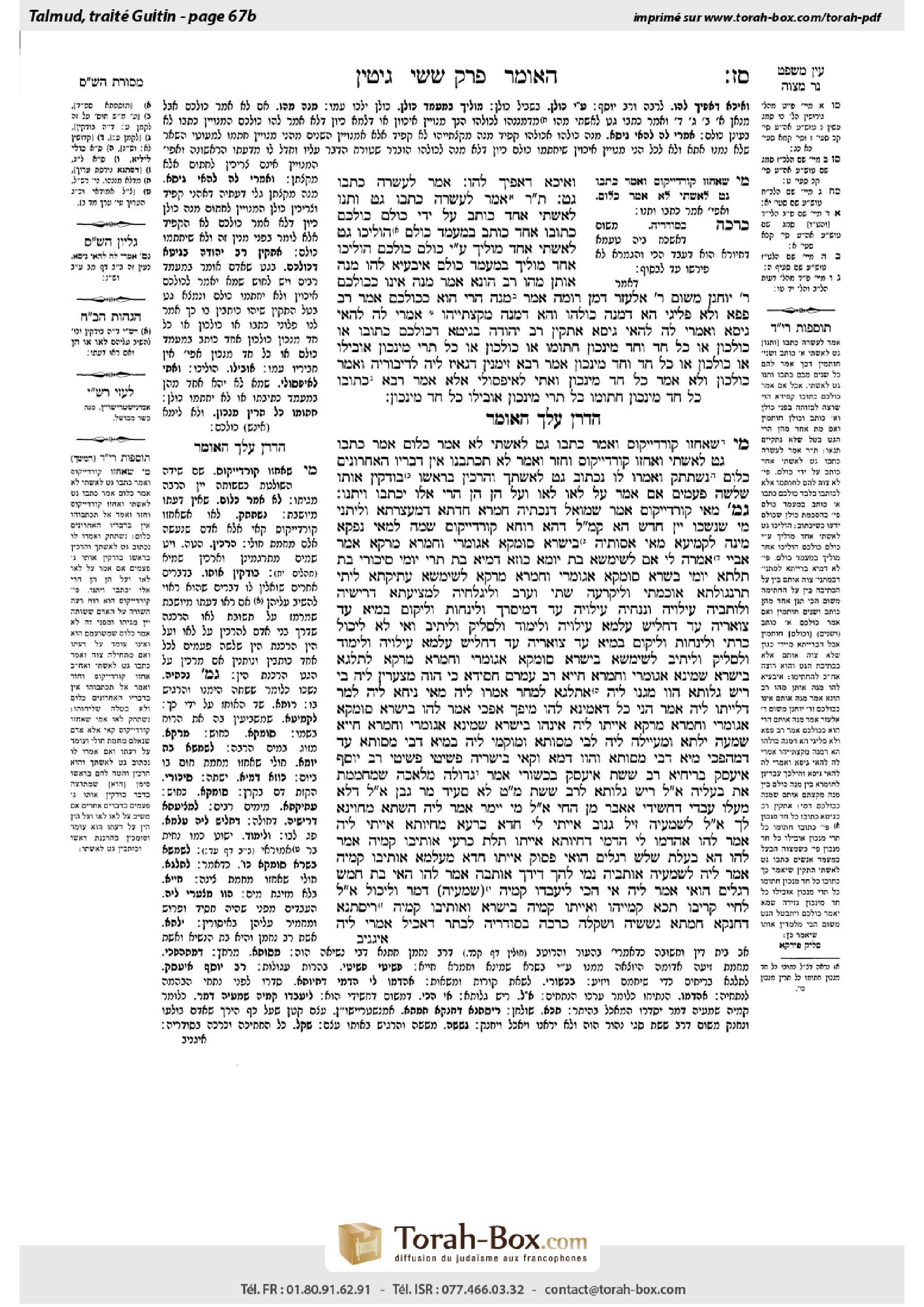
Gittin 67b: Talmud study for Daf Yomi
Study the Talmud for Daf Yomi with scanned pages, Hebrew text, English translations from Sefaria and AI-generated French translations.
Passage selection and English or AI-generated French translation are available where the scan has annotations. Daf Study is independent of Torah-Box and Sefaria.
Browse Gittin · גיטין · All tractatesGittin 67b text and translations
This page of Gittin includes the Aramaic text, an English translation and an AI-generated French translation, alongside the scan above.
גיטין ס״ז ב · Aramaic and Hebrew text
וְאִיכָּא דְּאָפֵיךְ לְהוּ.
אָמַר לַעֲשָׂרָה: ״כִּתְבוּ גֵּט״. תָּנוּ רַבָּנַן, אָמַר לַעֲשָׂרָה: ״כִּתְבוּ גֵּט, וּתְנוּ לְאִשְׁתִּי״ – אֶחָד כּוֹתֵב עַל יְדֵי כּוּלָּם. ״כּוּלְּכֶם כְּתוֹבוּ״ – אֶחָד כּוֹתֵב בְּמַעֲמַד כּוּלָּם. ״הוֹלִיכוּ גֵּט לְאִשְׁתִּי״ – אֶחָד מוֹלִיךְ עַל יְדֵי כּוּלָּם. ״כּוּלְּכֶם הוֹלִיכוּ״ – אֶחָד מוֹלִיךְ בְּמַעֲמַד כּוּלָּם.
אִיבַּעְיָא לְהוּ: מָנָה אוֹתָן, מַהוּ? רַב הוּנָא אָמַר: מָנָה אֵינוֹ כְּ״כוּלְּכֶם״, רַבִּי יוֹחָנָן מִשּׁוּם רַבִּי אֶלְעָזָר דְּמִן רוֹמָה אָמַר: מָנָה הֲרֵי הוּא כְּ״כוּלְּכֶם״.
אָמַר רַב פָּפָּא: וְלָא פְּלִיגִי; הָא דְּמָנָה כּוּלְּהוּ, וְהָא דְּמָנָה מִקְצָתַיְיהוּ – אָמְרִי לַהּ לְהַאי גִּיסָא, וְאָמְרִי לַהּ לְהַאי גִּיסָא.
אַתְקֵין רַב יְהוּדָה בְּגִיטָּא דְּ״כוּלְּכֶם״: כְּתוֹבוּ – אוֹ כּוּלְּכוֹן אוֹ כֹּל חַד וְחַד מִינְּכוֹן; חֲתוֹמוּ – אוֹ כּוּלְּכוֹן אוֹ כֹּל תְּרֵי מִינְּכוֹן; אוֹבִילוּ – אוֹ כּוּלְּכוֹן אוֹ כֹּל חַד וְחַד מִינְּכוֹן.
אָמַר רָבָא: זִימְנִין דְּגָאֵיז לֵיהּ לְדִיבּוּרֵיהּ, וְאָמַר ״כּוּלְּכוֹן״ וְלָא אָמַר ״כֹּל חַד מִינְּכוֹן״, וְאָתֵי לְאִיפְּסוֹלֵי!
אֶלָּא אָמַר רָבָא: ״כְּתוֹבוּ – כֹּל חַד מִינְּכוֹן, חֲתוֹמוּ – כֹּל תְּרֵי מִינְּכוֹן, אוֹבִילוּ – כֹּל חַד מִינְּכוֹן״.
הֲדַרַן עֲלָךְ הָאוֹמֵר
מִי שֶׁאֲחָזוֹ קוּרְדְּיָיקוֹס, וְאָמַר: ״כִּתְבוּ גֵּט לְאִשְׁתִּי״ – לֹא אָמַר כְּלוּם. אָמַר: ״כִּתְבוּ גֵּט לְאִשְׁתִּי״, וַאֲחָזוֹ קוּרְדְּיָיקוֹס, וְחָזַר וְאָמַר: ״לֹא תִּכְתְּבֶנּוּ״ – אֵין דְּבָרָיו הָאַחֲרוֹנִים כְּלוּם.
נִשְׁתַּתֵּק, וְאָמְרוּ לוֹ: ״נִכְתּוֹב גֵּט לְאִשְׁתְּךָ״, וְהִרְכִּין בְּרֹאשׁוֹ – בּוֹדְקִין אוֹתוֹ שְׁלֹשָׁה פְּעָמִים, אִם אָמַר עַל לָאו – ״לָאו״, וְעַל הֵן – ״הֵן״, הֲרֵי אֵלּוּ יִכְתְּבוּ וְיִתְּנוּ.
גְּמָ׳ מַאי קוּרְדְּיָיקוֹס? אָמַר שְׁמוּאֵל: דְּנַכְתֵיהּ חַמְרָא חַדְתָּא דְּמַעְצַרְתָּא. וְלִיתְנֵי: מִי שֶׁנְּשָׁכוֹ יַיִן חָדָשׁ! הָא קָא מַשְׁמַע לַן, דְּהָא רוּחָא – ״קוּרְדְּיָיקוֹס״ שְׁמַהּ.
לְמַאי נָפְקָא מִינַּהּ? לִקְמִיעָא. מַאי אָסוּתֵיהּ? בִּישְׂרָא סוּמָּקָא אַגּוּמְרֵי, וְחַמְרָא מַרְקָא.
אָמַר אַבָּיֵי, אֲמַרָה לִי אֵם: לְשִׁימְשָׁא בַּת יוֹמָא – כּוּזָא דְמַיָּא. בַּת תְּרֵי יוֹמֵי – סִיכּוּרֵי. בַּת תְּלָתָא יוֹמֵי – בִּשְׂרָא סוּמָּקָא אַגּוּמְרֵי, וְחַמְרָא מַרְקָא. לְשִׁימְשָׁא עַתִּיקְתָּא – לַיְתֵי תַּרְנְגוֹלְתָּא אוּכַּמְתִּי, וְלִיקְרְעַהּ שְׁתִי וָעֵרֶב, וְלִיגַלְּחֵיהּ לִמְצִיעֲתָא דְרֵישֵׁיהּ – וְלוֹתְבֵיהּ עִילָּוֵיהּ, וְנַנְּחֵיהּ עִילָּוֵיהּ עַד (דְּמִיסְּרַךְ);
וְלִינְחוֹת וְלֵיקוּם בְּמַיָּא עַד צַוְּארֵיהּ – עַד דְּחָלֵישׁ עָלְמָא עִילָּוֵיהּ, וְלֵימוֹד, וְלִסְלַיק וְלִיתֵיב. וְאִי לָא – לֵיכוֹל כַּרָּתֵי, וְלִינְחוֹת וְלֵיקוּם בְּמַיָּא עַד צַוְּארֵיהּ – עַד דְּחָלֵישׁ עָלְמָא עִילָּוֵיהּ, וְלֵימוֹד, וְלִסְלַיק וְלִיתֵיב.
לְשִׁימְשָׁא – בִּישְׂרָא סוּמָּקָא אַגּוּמְרֵי, וְחַמְרָא מַרְקָא. לְתַלְגָא – בִּישְׂרָא שַׁמִּינָא אַגּוּמְרֵי, וְחַמְרָא חַיָּיא.
רַב עַמְרָם חֲסִידָא, כִּי הֲוָה מְצַעֲרִין לֵיהּ בֵּי רֵישׁ גָּלוּתָא, הֲווֹ מַגְנוּ לֵיהּ אַתַּלְגָא. לִמְחַר אֲמַרוּ לֵיהּ: מַאי נִיחָא לֵיהּ לְמָר דְּלַיְיתוֹ לֵיהּ? אָמַר: הָנֵי, כֹּל דְּאָמֵינָא לְהוּ – מֵיפָךְ אָפְכִי. אֲמַר לְהוּ: בִּישְׂרָא סוּמָּקָא אַגּוּמְרֵי, וְחַמְרָא מַרְקָא. אַיְיתוֹ לֵיהּ אִינְהוּ: בִּישְׂרָא שַׁמִּינָא אַגּוּמְרֵי, וְחַמְרָא חַיָּיא.
שָׁמְעָה יַלְתָּא, וּמְעַיְּילָה לֵיהּ לְבֵי מַסּוּתָא, וּמוֹקְמִי לֵיהּ בְּמַיָּא דְּבֵי מַסּוּתָא – עַד דִּמְהַפְכִי מַיָּא דְּבֵי מַסּוּתָא וְהָווּ דְּמָא, וְקָאֵי בִּישְׂרֵיהּ פְּשִׁיטֵי פְּשִׁיטֵי.
רַב יוֹסֵף אִיעֲסֵק בְּרִיחְיָא. רַב שֵׁשֶׁת אִיעֲסֵק בִּכְשׁוּרֵי, אֲמַר: גְּדוֹלָה מְלָאכָה שֶׁמְּחַמֶּמֶת אֶת בְּעָלֶיהָ.
אֲמַר לֵיהּ רֵישׁ גָּלוּתָא לְרַב שֵׁשֶׁת: מַאי טַעְמָא לָא סָעֵיד מָר גַּבָּן? אֲמַר לֵיהּ: דְּלָא מְעַלּוּ עַבְדֵי, דַּחֲשִׁידִי אַאֵבֶר מִן הַחַי. אֲמַר לֵיהּ: מִי יֵימַר? אֲמַר לֵיהּ: הַשְׁתָּא מַחְוֵינָא לָךְ. אֲמַר לֵיהּ לְשַׁמָּעֵיהּ: זִיל גְּנוֹב, אַיְיתִי לִי חֲדָא כַּרְעָא מֵחֵיוְתָא.
אַיְיתִי לֵיהּ. אֲמַר לְהוּ: אַהְדְּמוּ לִי הַדְמֵי דְּחֵיוְתָא. אַיְיתוֹ תְּלָת כַּרְעֵי, אוֹתִיבוּ קַמֵּיהּ. אֲמַר לְהוּ: הָא בַּעֲלַת שָׁלֹשׁ רַגְלַיִם הֲוַאי? פְּסוּק אַיְיתוֹ חֲדָא מֵעָלְמָא, אוֹתִיבוּ קַמֵּיהּ. אֲמַר לֵיהּ לְשַׁמָּעֵיהּ: אוֹתְבַיהּ נָמֵי לְהָךְ דִּידָךְ. אוֹתְבַהּ. אֲמַר לְהוּ: הַאי בַּת חָמֵשׁ רַגְלַיִם הֲוַאי?!
אֲמַר לֵיהּ: אִי הָכִי, לִיעְבְּדוּ קַמֵּיהּ (שַׁמָּעֵיהּ) דְּמָר, וְלֵיכוֹל. אֲמַר לֵיהּ: לְחַיֵּי. קָרִיבוּ תַּכָּא קַמַּיְיהוּ, וְאַיְיתוֹ קַמֵּיהּ בִּישְׂרָא, וְאוֹתִיבוּ קַמֵּיהּ רִיסְתָּנָא דְּחָנְקָא חַמְתָּא. גַּשְּׁשֵׁיהּ וְשַׁקְלַהּ, כַּרְכַהּ בְּסוּדָרֵיהּ.
לְבָתַר דְּאָכֵיל, אָמְרִי לֵיהּ:
Gittin 67b · English translation
And there are those who reverse the attribution of the opinions of Rabba and Rav Yosef with regard to this matter.
The mishna teaches that if a man said to ten people: Write and give a bill of divorce to my wife, one of the ten writes the bill of divorce and two sign it. The Sages taught: If one said to ten people: Write a bill of divorce and give it to my wife, one writes on behalf of them all. If he said: All of you write the document, one writes it in the presence of them all. If he said: Deliver a bill of divorce to my wife, one person brings it on behalf of them all. If he said: All of you deliver a bill of divorce, then one brings it in the presence of them all.
A dilemma was raised before the Sages: If he said: Write a bill of divorce, and he enumerated them by name, what is the halakha? Can one of them write the bill of divorce on behalf of them all? Or perhaps it is comparable to a situation where one says: All of you write, when it must be written in the presence of them all. Rav Huna says: If one enumerated them by name, it is not comparable to saying: All of you write. Rabbi Yoḥanan says in the name of Rabbi Elazar of Rome: If one enumerated them by name, it is comparable to saying: All of you write.
Rav Pappa said: And they do not disagree. This is referring to a case where he enumerated them all, and that is referring to a case where he enumerated some of them. Some say that the distinction between the cases should be explained in this manner, and some say it in that manner. Some explain that the distinction is that if he enumerated them all, he insists that they all participate, but if he enumerated some of them, he does not insist that they do so. He enumerated the names that he did only to indicate that he wants the people performing the task to be chosen from those people. Others explain that if he enumerated only some of them, he thereby expressed his intent that they alone participate, but if he enumerated them all but did not say: All of you write, that is not the case.
The Gemara recounts: Rav Yehuda instituted in the case of a bill of divorce with regard to which the husband gave instructions in the presence of many people and the concern is that it will be interpreted that he said: All of you write, and if they do not all sign there will be uncertainty whether or not the woman is divorced, that he should say: Write it, either all of you or each and every one of you; sign it, either all of you or every two of you; deliver it, either all of you or each and every one of you. In that way, there is no concern that the bill of divorce will be invalid if one of them fails to participate.
Rava said: This ordinance still leaves room for a pitfall. Since Rav Yehuda instituted a formula that is that long and complex, sometimes the husband may truncate his statement and say: All of you, but he will not say: Every one of you. And the bill of divorce will be invalidated as a result.
Rather, Rava said that he must say: Each of you may write it, every two of you may sign it, each one of you may deliver it. However, he should not say: All of you, so that the bill of divorce will not be invalidated if one fails to do so.
MISHNA: In the case of one who was afflicted with temporary insanity [kordeyakos] and said: Write a bill of divorce for my wife, he said nothing, because he was not lucid at the time. If he said: Write a bill of divorce for my wife, when he was lucid, and was then afflicted with temporary insanity and he retracted his previous statement and said: Do not write it, his latter statement is considered to be nothing, i.e., it is not halakhically valid.
The mishna continues: In a case where the husband became mute, and two people said to him: Shall we write a bill of divorce for your wife, and he nodded his head indicating his agreement, they examine him with various questions three times. If he responded to questions that have a negative answer: No, and responded to questions that have a positive answer: Yes, indicating his competence, they shall write the bill of divorce and give it to his wife based on the nod of his head.
GEMARA: The Gemara asks: What is the nature of the temporary insanity mentioned in the mishna? Shmuel said: The reference is to one who was afflicted by drinking new wine that came directly from the winepress. The Gemara asks: And let the tanna of the mishna then teach explicitly: With regard to one who was afflicted by drinking new wine. The Gemara answers: This teaches us that the name of the demon that causes this insanity is Kordeyakos.
The Gemara asks: What difference is there? The Gemara answers: The difference is with regard to writing an amulet to prevent harm caused by the demon. The amulet must include the name of the demon. The Gemara asks: What is the remedy for that illness? The Gemara responds: The afflicted person should eat red meat roasted over coals and drink wine diluted [marka] with a large amount of water.
Abaye said: My mother told me that the remedy for a day-old fever, i.e., one contracted that day, is drinking a jug [kuza] of water. The remedy for a fever two days old is bloodletting [sikurei]. The remedy for a fever three days old is eating red meat roasted over coals and drinking diluted wine. For an old fever that lasts for an extended period of time, the remedy is to bring a black hen, tear it lengthwise and widthwise, shave the middle of the sufferer’s head, and place the hen upon it, and leave the hen upon him until it adheres to his head due to the blood.
And let him descend into the water and let him stand in the water up to his neck until the world appears faint for him, i.e., he feels faint. And let him submerge himself in the water, and emerge from the water and sit and rest. And if he is not able to undergo this process, let him eat leeks, and descend into the water, and stand in the water up to his neck until the world appears faint for him. And let him submerge himself in the water, and emerge from the water and sit and rest.
The remedy for a fever is eating red meat that was roasted over coals and drinking diluted wine. A remedy for the chills is eating fatty meat that was roasted over coals and drinking undiluted wine.
It was related: When the members of the Exilarch’s house would afflict Rav Amram the pious they would make him lie down to sleep all night on the snow. The next day they would say to him: What is preferable for the Master, i.e., Rav Amram, for us to bring him to eat? Rav Amram said to himself: Anything I say to them, they will do the opposite. He said to them: Bring me red meat roasted over coals and diluted wine. They brought him fatty meat roasted over coals and undiluted wine instead, which is what Rav Amram had intended, because this is the remedy for one who suffers from the chills.
Yalta, Rav Naḥman’s wife, heard what the members of the Exilarch’s house did, and that Rav Amram was suffering from the chills. And she brought him to the bathhouse, and placed him in the water of the bathhouse until the water of the bathhouse turned red like blood. And his flesh became covered with spots that looked like coins [peshitei].
It is related: When Rav Yosef suffered from the cold he would work by grinding with millstones in order to keep warm. When Rav Sheshet suffered from the cold he would work by lifting beams. He said: Great is labor, as it warms its master.
§ The Gemara relates another incident of the house of the Exilarch: The Exilarch said to Rav Sheshet: What is the reason that the Master, i.e., Rav Sheshet, does not eat with us? He said to him: Because the slaves do not act according to a high standard, as they are suspected of transgressing the prohibition against eating a limb severed from a living animal. The Exilarch said to him: Who says that this is so? Rav Sheshet said to him: I will now show you. Rav Sheshet said to his servant: Go steal one leg from the animal that the servants of the Exilarch’s house slaughtered for a meal and bring it to me.
Rav Sheshet’s servant brought one leg to him and afterward Rav Sheshet said to the servants of the Exilarch’s household: Set out the portions of the animal for me. They brought him only three legs and placed them before him, because the fourth leg had been stolen. Rav Sheshet said to them: Did this animal have only three legs? When the servants heard this they cut one leg from another living animal and they brought it and placed it before Rav Sheshet. Rav Sheshet said to his servant: Bring out this leg of yours, i.e., that you stole, as well. He placed that leg on the table and Rav Sheshet said to them: Did this animal have five legs?
The Exilarch realized that he could not rely on his servants. He said to Rav Sheshet: If so, they should prepare the meat in the presence of my Master’s servant and then you can eat without concern. Rav Sheshet said to him: Very well. They brought a table before them, and they brought the meat before him. And the servants placed a small bone in the meat before him so that it would cause Rav Sheshet to choke. Since Rav Sheshet was blind, they thought that he would be unable to notice the bone. He felt it, took the entire piece of meat and wrapped it in his scarf [sudarei] out of concern that he would be hurt by the small bones that he could not see.
After he ate, the servants realized what he had done and they wanted to show the Exilarch that Rav Sheshet did not eat the meat that was given to him. Therefore, the servants said to the Exilarch:
Gittin 67b · Traduction française (IA)
Et il y a ceux qui inversent l'attribution des opinions de Rabba et de Rav Yosef concernant cette question.
La mitsva enseigne que si un homme dit à dix personnes : Écrivez et donnez un acte de divorce à ma femme, l'une des dix écrit l'acte de divorce et deux le signent. Les Sages enseignent : Si l'on dit à dix personnes : Écrivez un acte de divorce et donnez-le à ma femme, l'un d'entre eux écrit à la place de tous. Si l'on dit : Tous écrivez le document, l'un d'entre eux l'écrit en présence de tous. Si l'on dit : Portez un acte de divorce à ma femme, l'une des personnes apporte l'acte à la place de tous. Si l'on dit : Tous portez un acte de divorce, alors l'un d'entre eux l'apporte en présence de tous.
Un dilemme a été soulevé devant les Sages : Si l'on dit : Écrivez un acte de divorce, et l'on énumère les noms, quelle est la halakha ? Peut-on que l'un d'entre eux écrive l'acte de divorce à la place de tous ? Ou peut-être est-ce comparable à un cas où l'on dit : Tous écrivez, alors qu'il faut écrire en présence de tous. Rav Huna dit : Si l'on énumère les noms, ce n'est pas comparable à dire : Tous écrivez. Rabbi Yoḥanan, en nom de Rabbi Elazar de Rome, dit : Si l'on énumère les noms, c'est comparable à dire : Tous écrivez.
Rav Pappa dit : Et ils ne sont pas en désaccord. Cela fait référence à un cas où l'on énumère tous les noms, et cela fait référence à un cas où l'on énumère certains d'entre eux. Certains disent que la distinction entre les cas doit être expliquée ainsi, et d'autres disent en ce sens. Certains expliquent que la distinction est que s'il énumère tous les noms, il insiste sur la participation de tous, mais s'il énumère certains d'entre eux, il ne l'insiste pas. Il énumère les noms qu'il a seulement pour indiquer qu'il veut que les personnes effectuant la tâche soient choisies parmi ces personnes. D'autres expliquent que s'il énumère seulement certains d'entre eux, il exprime ainsi son intention que seuls ceux-ci participent, mais s'il énumère tous les noms sans dire : Tous écrivez, ce n'est pas le cas.
La Guemara rapporte : Rav Yehuda a institué dans le cas d'un acte de divorce concernant lequel le mari a donné des instructions en présence de beaucoup de personnes et la crainte est qu'il soit interprété comme ayant dit : Tous écrivez, et si ils ne signent pas tous, il y aura une incertitude quant à savoir si la femme est divorcée, qu'il dise : Écrivez-le, que ce soit tous ou chacun d'entre vous ; signez-le, que ce soit tous ou deux à deux ; portez-le, que ce soit tous ou chacun d'entre vous. Ainsi, il n'y a pas de crainte que l'acte de divorce soit invalide si l'un d'eux ne participe pas.
Rava dit : Cette ordonnance laisse encore place à un piège. Puisque Rav Yehuda a institué une formule si longue et complexe, parfois le mari peut abréger son discours et dire : Tous, mais il ne dira pas : Chacun d'entre vous. Et l'acte de divorce sera ainsi invalidé.
Plutôt, Rava dit qu'il doit dire : Chacun d'entre vous peut l'écrire, deux à deux peuvent le signer, chacun d'entre vous peut le porter. Cependant, il ne doit pas dire : Tous, afin que l'acte de divorce ne soit pas invalidé si l'un d'eux ne participe pas.
MICHNA : Dans le cas d'une personne atteinte d'une folie temporaire [kordeyakos] qui dit : Écrivez un acte de divorce pour ma femme, il a dit rien, car il n'était pas lucide à ce moment. Si l'on dit : Écrivez un acte de divorce pour ma femme, lorsqu'il était lucide, et ensuite il est atteint de folie temporaire et il rétracte son précédent discours en disant : Ne l'écrivez pas, son dernier discours est considéré comme nul, c'est-à-dire qu'il n'est pas halakhiquement valide.
La mitsva continue : Dans le cas où le mari est devenu muet, et deux personnes lui disent : Écrivons un acte de divorce pour votre femme, et il hoche la tête pour indiquer son accord, ils l'examinent avec diverses questions trois fois. Si il répond aux questions qui ont une réponse négative : Non, et répond aux questions qui ont une réponse positive : Oui, indiquant sa compétence, ils doivent écrire l'acte de divorce et le donner à sa femme en se basant sur le hochement de tête.
GUEMARA : La Guemara demande : Quelle est la nature de la folie temporaire mentionnée dans la mitsna ? Shmuel dit : Il s'agit d'une personne atteinte par la boisson du vin nouveau venu directement de la presse. La Guemara demande : Et pourquoi ne pas enseigner explicitement : Concernant une personne atteinte par la boisson du vin nouveau ? La Guemara répond : Cela nous apprend que le nom du démon qui cause cette folie est Kordeyakos.
La Guemara demande : Quelle est la différence ? La Guemara répond : La différence est concernant l'écriture d'un amulet pour prévenir les dommages causés par le démon. L'amulet doit inclure le nom du démon. La Guemara demande : Quel est le remède pour cette maladie ? La Guemara répond : La personne atteinte devrait manger de la viande rouge rôtie sur des braises et boire du vin dilué [marka] avec une grande quantité d'eau.
Abaye dit : Ma mère m'a dit que le remède pour une fièvre d'un jour, c'est-à-dire une fièvre contractée ce jour-là, est de boire un jarre [kuza] d'eau. Le remède pour une fièvre de deux jours est la saignée [sikurei]. Le remède pour une fièvre de trois jours est de manger de la viande rouge rôtie sur des braises et de boire du vin dilué. Pour une fièvre ancienne qui dure un long temps, le remède est d'amener une poule noire, de la déchirer longitudinalement et transversalement, de raser le milieu de la tête du malade, et de placer la poule dessus, et de la laisser sur lui jusqu'à ce qu'elle s'adhere à sa tête en raison du sang.
Et qu'il descende dans l'eau et qu'il se tienne dans l'eau jusqu'au cou jusqu'à ce que le monde lui apparaisse flou, c'est-à-dire qu'il ressente un vertige. Et qu'il se plonge dans l'eau, et qu'il en émerge et qu'il se repose. Et s'il n'est pas capable de subir ce processus, qu'il mange des oignons, et qu'il descende dans l'eau, et qu'il se tienne dans l'eau jusqu'au cou jusqu'à ce que le monde lui apparaisse flou. Et qu'il se plonge dans l'eau, et qu'il en émerge et qu'il se repose.
Le remède contre la fièvre est de manger de la viande rouge cuite sur des braises et de boire du vin dilué. Le remède contre les frissons est de manger de la viande grasse cuite sur des braises et de boire du vin non dilué.
On rapporte que lorsque les membres de la maison de l'Exilarch voulaient tourmenter Rav Amram le pieux, ils le forçaient à dormir toute la nuit sur la neige. Le lendemain, ils lui demandaient : Quel est ce que le Maître, c'est-à-dire Rav Amram, préfère que nous lui apportions à manger ? Rav Amram se disait : Tout ce que je dis à eux, ils feront l'inverse. Il leur dit : Apportez-moi de la viande rouge cuite sur des braises et du vin dilué. Ils apportèrent plutôt de la viande grasse cuite sur des braises et du vin non dilué, ce qui était ce que Rav Amram avait en tête, car c'est le remède pour celui qui souffre de frissons.
Yalta, la femme de Rav Naḥman, entendit ce que faisaient les membres de la maison de l'Exilarch, et qu'Rav Amram souffrait de frissons. Elle le conduisit à la bain et le plongea dans l'eau du bain jusqu'à ce que l'eau du bain devienne rouge comme du sang. Et sa peau s'couvrit de taches qui ressemblaient à des pièces [peshitei].
On rapporte que lorsque Rav Yosef souffrait du froid, il travaillait en meutillant des meules afin de se réchauffer. Lorsque Rav Sheshet souffrait du froid, il travaillait en levant des poutres. Il dit : Grand est le travail, car il réchauffe son maître.
§ La Guemara rapporte un autre incident de la maison de l'Exilarch : L'Exilarch dit à Rav Sheshet : Quelle est la raison pour laquelle le Maître, c'est-à-dire Rav Sheshet, ne mange pas avec nous ? Il lui dit : Parce que les serviteurs ne se comportent pas selon un haut standard, car ils sont soupçonnés de transgresser l'interdiction de manger une partie séparée d'un animal vivant. L'Exilarch dit à lui : Qui dit cela ? Rav Sheshet lui dit : Je vais maintenant te le montrer. Rav Sheshet dit à son serviteur : Va voler une jambe de l'animal que les serviteurs de la maison de l'Exilarch ont tué pour un repas et apporte-la-moi.
Le serviteur de Rav Sheshet apporta une jambe à lui, et ensuite Rav Sheshet dit aux serviteurs de la maison de l'Exilarch : Apportez-moi les parts de l'animal. Ils apportèrent seulement trois jambes et les placèrent devant lui, car la quatrième jambe avait été volée. Rav Sheshet dit à eux : Cet animal n'avait que trois jambes ? Lorsque les serviteurs entendirent cela, ils coupèrent une jambe d'un autre animal vivant et l'apportèrent et la placèrent devant Rav Sheshet. Rav Sheshet dit à son serviteur : Apporte-moi cette jambe que tu as volée, c'est-à-dire. Il plaça cette jambe sur la table et Rav Sheshet dit à eux : Cet animal n'avait cinq jambes ?
L'Exilarch réalisa qu'il ne pouvait pas compter sur ses serviteurs. Il dit à Rav Sheshet : Si c'est ainsi, ils devraient préparer la viande en présence de mon serviteur et alors tu pourras manger sans crainte. Rav Sheshet dit à lui : Très bien. Ils apportèrent une table devant eux et apportèrent la viande devant lui. Et les serviteurs placèrent un petit os dans la viande devant lui afin qu'il s'étouffe. Puisque Rav Sheshet était aveugle, ils pensaient qu'il ne remarquerait pas l'os. Il le sentit, prit la pièce entière de viande et l'enveloppa dans son foulard [sudarei] par crainte qu'il ne soit blessé par les petits os qu'il ne pouvait pas voir.
Après avoir mangé, les serviteurs réalisèrent ce qu'il avait fait et ils voulaient montrer à l'Exilarch que Rav Sheshet n'avait pas mangé la viande qui lui avait été donnée. Ainsi, les serviteurs dirent à l'Exilarch :
Traduction française générée par IA à partir de l’édition anglaise de Sefaria. Vérifie toujours un passage avec le texte source.
Text from Sefaria: William Davidson Edition - Vocalized Aramaic (CC BY NC); William Davidson Edition - English (CC BY NC).