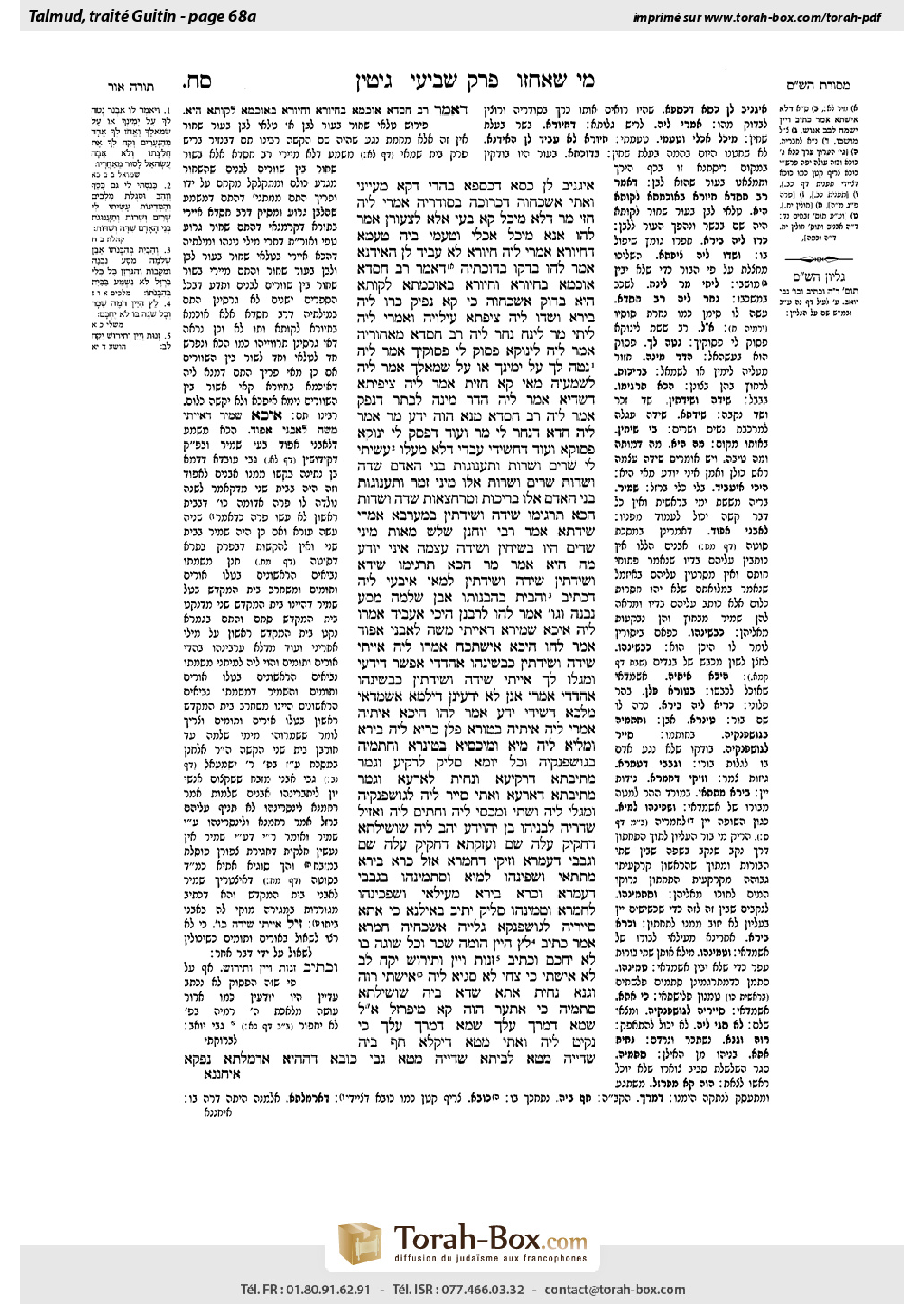
Gittin 68a: Talmud study for Daf Yomi
Study the Talmud for Daf Yomi with scanned pages, Hebrew text, English translations from Sefaria and AI-generated French translations.
Passage selection and English or AI-generated French translation are available where the scan has annotations. Daf Study is independent of Torah-Box and Sefaria.
Browse Gittin · גיטין · All tractatesGittin 68a text and translations
This page of Gittin includes the Aramaic text, an English translation and an AI-generated French translation, alongside the scan above.
גיטין ס״ח א · Aramaic and Hebrew text
אִיגְּנִיב לַן כָּסָא דְכַסְפָּא! בַּהֲדֵי דְּקָא מְעַיְּינִי וְאָתוּ, אַשְׁכְּחוּהָ דִּכְרִוכָה בְּסוּדָרֵיהּ.
אָמְרִי לֵיהּ: חֲזִי מָר, דְּלָא מֵיכַל קָא בָּעֵי – אֶלָּא לְצַעוֹרַן! אֲמַר לְהוּ: אֲנָא מֵיכָל אֲכַלִי, וּטְעַמִי בֵּיהּ טַעְמָא דְחִיוָּרָא. אָמְרִי לֵיהּ: חִיוָּרָא לָא עֲבִיד לַן הָאִידָּנָא. אֲמַר לְהוּ: בְּדַקוּ בְּדוּכְתֵּיהּ; דְּאָמַר רַב חִסְדָּא: אוּכָּמָא בְּחִיוָּרָא, וְחִיוָּרָא בְּאוּכַּמְתָּא – לָקוּתָא הִיא. בְּדוּק אַשְׁכְּחוּהּ.
כִּי קָא נָפֵיק, כְּרוֹ לֵיהּ בֵּירָא וּשְׁדוֹ לֵיהּ צִיפְּתָא עִילָּוֵיהּ, וְאָמְרִי לֵיהּ: לֵיתֵי מָר לֵינַח. נְחַר לֵיהּ רַב חִסְדָּא מֵאֲחוֹרֵיהּ. אֲמַר לֵיהּ לְיָנוֹקָא: פְּסוֹק לִי פְּסוּקָיךְ, אֲמַר לֵיהּ: ״נְטֵה לְךָ עַל יְמִינְךָ אוֹ עַל שְׂמֹאלֶךָ״. אֲמַר לֵיה לְשַׁמָּעֵיהּ: מַאי קָא חָזֵית? אֲמַר לֵיהּ: צִיפְּיתָא דְּשַׁדְיָא. אֲמַר לֵיהּ: הֲדַר מִינַּהּ.
לְבָתַר דִּנְפַק, אֲמַר לֵיהּ רַב חִסְדָּא: מְנָא הֲוָה יָדַע מָר? אֲמַר לֵיהּ: חֲדָא – דִּנְחַר לִי מָר. וְעוֹד – דִּפְסַק לִי יָנוֹקָא פְּסוּקָא. וְעוֹד – דַּחֲשִׁידִי עַבְדֵי דְּלָא מְעַלּוּ.
״עָשִׂיתִי לִי שָׁרִים וְשָׁרוֹת וְתַעֲנוּגוֹת בְּנֵי הָאָדָם, שִׁדָּה וְשִׁדּוֹת״; ״שָׁרִים וְשָׁרוֹת״ – אֵלּוּ מִינֵי זֶמֶר, ״וְתַעֲנוּגוֹת בְּנֵי הָאָדָם״ – אֵלּוּ בְּרֵיכוֹת וּמֶרְחֲצָאוֹת, ״שִׁדָּה וְשִׁדּוֹת״ – הָכָא תַּרְגִּימוּ: שֵׁידָה וְשֵׁידְתִין. בְּמַעְרְבָא אָמְרִי: שִׁידְּתָא.
אָמַר רַבִּי יוֹחָנָן: שְׁלֹשׁ מֵאוֹת מִינֵי שֵׁדִים הָיוּ בְּשִׁיחִין, וְשֵׁידָה עַצְמָהּ אֵינִי יוֹדֵעַ מָה הִיא.
אָמַר מָר, הָכָא תַּרְגִּימוּ: שֵׁידָא וְשֵׁידְתִין. שֵׁידָה וְשֵׁידְתִין – לְמַאי אִיבְּעִי לֵיהּ? דִּכְתִיב: ״וְהַבַּיִת בְּהִבָּנוֹתוֹ אֶבֶן שְׁלֵמָה מַסָּע נִבְנָה וְגוֹ׳״ – אָמַר לְהוּ לְרַבָּנַן: הֵיכִי אֶעֱבֵיד? אֲמַרוּ לֵיהּ: אִיכָּא שָׁמִירָא דְּאַיְיתִי מֹשֶׁה לְאַבְנֵי אֵפוֹד.
אֲמַר לְהוּ: הֵיכָא אִישְׁתְּכַח? אֲמַרוּ לֵיהּ: אַיְיתִי שֵׁידָה וְשֵׁידְתִין כַּבְשִׁינְהוּ אַהֲדָדֵי, אֶפְשָׁר דְּיָדְעִי וּמְגַלּוּ לָךְ. אַיְיתִי שֵׁידָה וְשֵׁידְתִין כַּבְשִׁינְהוּ אַהֲדָדֵי, אָמְרִי: אֲנַן לָא יָדְעִינַן, דִּילְמָא אַשְׁמְדַאי – מַלְכָּא דְשֵׁידֵי, יָדַע.
אֲמַר לְהוּ: הֵיכָא אִיתֵיהּ? אָמְרִי לֵיהּ: אִיתֵיהּ בְּטוּרָא פְּלָן. כַּרְיָא לֵיהּ בֵּירָא, וּמַלְיָא לֵיהּ מַיָּא, וּמִיכַּסְּיָא בְּטִינָּרָא, וַחֲתִימָה בְּגוּשְׁפַּנְקֵיהּ; וְכֹל יוֹמָא סָלֵיק לִרְקִיעָא וְגָמַר מְתִיבְתָּא דִרְקִיעָא, וְנָחֵית לְאַרְעָא וְגָמַר מְתִיבְתָּא דְאַרְעָא; וְאָתֵי סָיֵיר לֵיהּ לְגוּשְׁפַּנְקֵיהּ וּמְגַלֵּי לֵיהּ וְשָׁתֵי, וּמְכַסֵּי לֵיהּ וְחָתֵים לֵיהּ וְאָזֵיל.
שַׁדְּרֵיהּ לִבְנָיָהוּ בֶּן יְהוֹיָדָע, יְהַב לֵיהּ שׁוּשִׁילְתָּא דַּחֲקִיק עֲלַהּ שֵׁם, וְעִזְקְתָא דַּחֲקִיק עֲלַהּ שֵׁם, וּגְבָבֵי דְעַמְרָא, וְזִיקֵי דְחַמְרָא. אֲזַל, כְּרָא בֵּירָא מִתַּתַּאי, וּשְׁפִינְהוּ לְמַיָּא, וְסַתְמִינְהוּ בִּגְבָבֵי דְעַמְרָא; וּכְרָא בֵּירָא מֵעִילַּאי, (וְשַׁפְכִינְהוּ) [וְשַׁפְכֵיהּ] לְחַמְרָא; וְטַמִּינְהוּ. סְלֵיק יְתֵיב בְּאִילָנָא
כִּי אֲתָא סַיְירֵיהּ לְגוּשְׁפַּנְקָא, גַּלְּיֵיהּ, אַשְׁכְּחֵיהּ חַמְרָא. אֲמַר: כְּתִיב: ״לֵץ הַיַּיִן הוֹמֶה שֵׁכָר, וְכׇל שׁוֹגֶה בּוֹ לֹא יֶחְכָּם״, וּכְתִיב: ״זְנוּת וְיַיִן וְתִירוֹשׁ יִקַּח לֵב״. לָא אִישְׁתִּי. כִּי צָחֵי, לָא סַגִּיא לֵיהּ; אִישְׁתִּי, רְוָא וּגְנָא.
נְחֵית, אֲתָא, שְׁדָא בֵּיהּ שׁוּשִׁילְתָּא, סְתָמֵיהּ. כִּי אִתְּעַר, הֲוָה קָא מִיפַּרְזַל; אֲמַר לֵיהּ: שְׁמָא דְמָרָךְ עֲלָךְ! שְׁמָא דְּמָרָךְ עֲלָךְ!
כִּי נָקֵיט לֵיהּ וְאָתֵי, מְטָא דִּיקְלָא – חַף בֵּיהּ, שַׁדְיֵיהּ; מְטָא לְבֵיתָא – שַׁדְיֵיהּ; מְטָא גַּבֵּי כּוּבָּא דְּהָהִיא אַרְמַלְתָּא, נְפַקָא
Gittin 68a · English translation
A silver cup was stolen from us, and they searched everyone for it. When they were checking they found the piece of meat wrapped in his scarf.
The Exilarch’s servants said to the Exilarch: See Master, i.e., the Exilarch, Rav Sheshet does not desire to eat, rather he wishes only to afflict us. Even after everything that was done for him he did not eat from the Exilarch’s meal. Rav Sheshet said to them: I ate and I tasted the taste of white leprous spots in the meat and therefore I did not eat it. They said to the Exilarch: We did not prepare an animal with white spots today. Rav Sheshet said to them: Check the skin in the place of the portion that I was given. He issued this instruction in accordance with the statement of Rav Ḥisda, as Rav Ḥisda said: Black spots within white skin and white spots within black skin are an affliction and a sign of disease. They checked and found that the animal was afflicted in this manner, and the Exilarch’s servants became even angrier with him.
When Rav Sheshet was exiting the house of the Exilarch the servants dug a pit and placed a reed mat [tzifta] on top of it so that the pit would not be noticed. And they said to Rav Sheshet: The Master, i.e., Rav Sheshet, should come and rest for a short time, and they intended for him to fall and be hurt. Rav Ḥisda, who was also present, snorted [neḥar] to him from behind in order to signal to him. Rav Sheshet said to a child who was there: Recite your verse for me that you studied today. The child said to him: “Turn to your right or to your left” (II Samuel 2:21). Rav Sheshet, who was blind, said to his servant: What do you see? His servant said to him: I see a mat that has been placed on the ground. Rav Sheshet said to him: Turn away from it and we will go around it.
After Rav Sheshet left the Exilarch’s house, Rav Ḥisda said to him: From where did the Master, i.e., Rav Sheshet, know that the servants had dug a pit in that place? Rav Sheshet said to him: There were several matters that raised my suspicions. One, that the Master, i.e., Rav Ḥisda, snorted to me to signal that I should beware. And additionally, when the child recited the verse for me it alluded to this matter. And additionally, servants are suspect of not acting according to a high standard, and I suspected that they would attempt to cause me harm.
§ After mentioning the spirit named kordeyakos on the previous daf the Gemara relates other matters connected to spirits and demons. It is written: “I got myself sharim and sharot, and human pleasures, shidda and shiddot” (Ecclesiastes 2:8). The Gemara explains: “Sharim and sharot”: These are types of musical instruments. “And human pleasures”: These are pools and bathhouses. “Shidda and shiddot”: Here, in Babylonia, they interpreted these words in the following manner: Male demons [shidda] and female demons [shiddetin]. In the West, Eretz Yisrael, they said that these words are referring to carriages [shiddeta].
Rabbi Yoḥanan says: There were three hundred types of demons in a place named Shiḥin, but I do not know what the form or nature of a demon itself is.
The Master said: Here they interpreted it: Male demons and female demons. The Gemara asks: Why was it necessary for Solomon, the author of Ecclesiastes, to have male demons and female demons? The Gemara answers: As it is written with regard to the building of the Temple: “For the house, when it was being built, was built of stone made ready at the quarry; and there was neither hammer nor axe nor any tool of iron heard in the house, while it was being built” (I Kings 6:7). Solomon said to the sages: How shall I make it so that the stone will be precisely cut without using iron? They said to him: There is a creature called a shamir that can cut the stones, which Moses brought and used to cut the stones of the ephod.
Solomon said to them: Where is it found? They said to him: Bring a male demon and a female demon and torment them together. It is possible that they know where, and due to the suffering they will reveal the place to you. Solomon brought a male demon and a female demon and tormented them together, and they said: We do not know where to find the shamir. Perhaps Ashmedai, king of the demons, knows.
Solomon said to them: Where is Ashmedai? They said to him: He is on such-and-such a mountain. He has dug a pit for himself there, and filled it with water, and covered it with a rock, and sealed it with his seal. And every day he ascends to Heaven and studies in the heavenly study hall and he descends to the earth and studies in the earthly study hall. And he comes and checks his seal to ensure that nobody has entered his pit, and then he uncovers it and drinks from the water in the pit. And then he covers it and seals it again and goes.
Solomon sent for Benayahu, son of Jehoiada, a member of the royal entourage, and gave him a chain onto which a sacred name of God was carved, and a ring onto which a sacred name of God was carved, and fleeces of wool and wineskins of wine. What did Benayahu do? He went and dug a pit lower down the mountain, below the pit dug by Ashmedai, drained the water, and plugged it with the fleeces of wool so that Ashmedai’s pit was emptied. And he dug a pit higher up the mountain, above Ashmedai’s pit. And he poured the wine into it so that the wine filled Ashmedai’s pit, and he plugged the lower and upper pits that he dug. He climbed up and sat in a tree.
When Ashmedai came he checked his seal, opened the pit, and found it to be filled with wine. He said that it is written: “Wine is a mocker, strong drink is riotous; and whosoever wallows in it is not wise” (Proverbs 20:1), and it is written: “Harlotry, wine, and new wine take away the heart” (Hosea 4:11). He concluded: I will not drink this wine. Eventually, when he became thirsty, he was unable to resist the wine and he drank, became intoxicated, and fell asleep.
Benayahu descended from the tree, came, and threw the chain around Ashmedai, and enclosed him within it. When Ashmedai awoke he struggled to remove the chain. Benayahu said to him: The name of your Master is upon you, the name of your Master is upon you, do not tear the chain. God’s name is written on this chain, and it is forbidden to destroy it.
When Benayahu took Ashmedai and came to Jerusalem he reached a palm tree and Ashmedai rubbed against it and knocked it down. He reached a house and knocked it down. He reached a small shack [kuva] belonging to a certain widow. This widow emerged,
Gittin 68a · Traduction française (IA)
Un bol d'argent a été volé, et ils ont examiné tout le monde à ce sujet. Lorsqu'ils faisaient leur vérification, ils ont trouvé un morceau de viande enveloppé dans son écharpe.
Les serviteurs de l'Exilarch dirent à l'Exilarch : Voyez, Maître, c'est-à-dire l'Exilarch, Rav Sheshet n'a pas envie de manger, mais il souhaite plutôt nous affliger. Même après tout ce qui a été fait pour lui, il n'a pas mangé de son repas. Rav Sheshet dit à eux : J'ai mangé et j'ai goûté le goût des taches blanches de peste dans la viande, et c'est pourquoi je n'ai pas mangé. Ils dirent à l'Exilarch : Nous n'avons pas préparé un animal avec des taches blanches aujourd'hui. Rav Sheshet dit à eux : Vérifiez la peau à l'endroit de la portion que j'ai reçue. Il a donné cet ordre conformément à la déclaration de Rav Ḥisda, car Rav Ḥisda a dit : Les taches noires dans une peau blanche et les taches blanches dans une peau noire sont une maladie et un signe de maladie. Ils ont vérifié et ont trouvé que l'animal était malade ainsi, et les serviteurs de l'Exilarch se sont même encore plus en colère contre lui.
Lorsque Rav Sheshet quittait la maison de l'Exilarch, les serviteurs creusèrent un trou et placèrent un tapis [tzifta] sur le dessus pour que le trou ne soit pas remarqué. Et ils dirent à Rav Sheshet : Le Maître, c'est-à-dire Rav Sheshet, devrait venir se reposer un moment, et ils comptaient le faire tomber et se blesser. Rav Ḥisda, qui était également présent, souffla [neḥar] à Rav Sheshet derrière lui pour le signaler. Rav Sheshet dit à un enfant qui était là : Récite-moi ton verset que tu as étudié aujourd'hui. L'enfant dit à lui : « Tourne à droite ou à gauche » (II Samuel 2:21). Rav Sheshet, qui était aveugle, dit à son serviteur : Qu'est-ce que tu vois ? Son serviteur dit à lui : Je vois un tapis posé sur le sol. Rav Sheshet dit à lui : Recule de ce tapis et nous irons autour.
Après que Rav Sheshet eut quitté la maison de l'Exilarch, Rav Ḥisda lui dit : D'où le Maître, c'est-à-dire Rav Sheshet, a-t-il su que les serviteurs avaient creusé un trou là-bas ? Rav Sheshet lui répondit : Il y avait plusieurs choses qui avaient suscité mes soupçons. Une, que le Maître, c'est-à-dire Rav Ḥisda, m'avait soufflé pour me signaler qu'il fallait que je sois vigilant. Et en outre, lorsque l'enfant avait récité le verset pour moi, cela faisait allusion à cette affaire. Et en outre, les serviteurs sont suspects de ne pas agir selon un haut standard, et j'avais soupçonné qu'ils allaient tenter de m'attirer dans un piège.
§ Après avoir mentionné l'esprit nommé kordeyakos sur le précédent daf, le Guemara relate d'autres affaires liées aux esprits et aux démons. Il est écrit : « J'ai obtenu des sharim et des sharot, et les plaisirs humains, shidda et shiddot » (Ecclésiaste 2:8). Le Guemara explique : « Sharim et sharot » : Ce sont des types d'instruments de musique. « Et les plaisirs humains » : Ce sont des bassins et des bains. « Shidda et shiddot » : Ici, en Babylone, ils ont interprété ces mots ainsi : les démons masculins [shidda] et les démons féminins [shiddetin]. Dans l'Ouest, en Terre d'Israël, ils ont dit que ces mots faisaient référence aux carrosses [shiddeta].
Rabbi Yoḥanan dit : Il y avait trois cents types de démons dans un lieu nommé Shiḥin, mais je ne sais pas ce que la forme ou la nature d'un démon est.
Le Maître dit : Ici, ils l'ont interprété ainsi : les démons masculins et les démons féminins. La Guemara pose la question : Pourquoi fallait-il que Salomon, l'auteur des Psaumes, ait des démons masculins et féminins ? La Guemara répond : Comme il est écrit concernant la construction du Temple : « Car la maison, lorsqu'elle était construite, était construite de pierres prêtes à la carrière ; et il n'y avait ni marteau ni hache ni aucun outil d'acier entendu dans la maison, pendant qu'elle était construite » (I Rois 6:7). Salomon dit aux sages : Comment puis-je faire en sorte que la pierre soit parfaitement taillée sans utiliser l'acier ? Ils dirent à lui : Il existe un créature appelée shamir qui peut tailler les pierres, que Moïse a apporté et a utilisé pour tailler les pierres de l'ephod.
Salomon dit à eux : Où est-il trouvé ? Ils dirent à lui : Apporte un démon masculin et une démon féminin et tourmente-les ensemble. Il est possible qu'ils sachent où, et en raison de la souffrance, ils révéleront la place à vous. Salomon apporta un démon masculin et une démon féminin et les tourmenta ensemble, et ils dirent : Nous ne savons pas où trouver le shamir. Peut-être Ashmedai, roi des démons, le sait.
Salomon dit à eux : Où est Ashmedai ? Ils dirent à lui : Il est sur une montagne telle et telle. Il a creusé un trou là-bas, l'a rempli d'eau, l'a recouvert d'une pierre et l'a scellé avec son sceau. Et chaque jour, il monte au Ciel et étudie dans la salle de récitation céleste, puis il descend sur la terre et étudie dans la salle de récitation terrestre. Et il vient et vérifie son sceau pour s'assurer que personne n'a entré dans son trou, puis il le dégèle et boit de l'eau dans le trou. Puis il le recouvre et le scelle à nouveau et part.
Salomon envoya Benayahu, fils de Jéhoida, un membre de la cour royale, et lui donna une chaîne sur laquelle un nom sacré de Dieu était gravé, et un anneau sur lequel un nom sacré de Dieu était gravé, et des touffes de laine et des peaux de vin. Qu'alla-t-il faire ? Il alla et creusa un trou plus bas sur la montagne, en dessous du trou creusé par Ashmedai, draina l'eau, et boucha les trous avec les touffes de laine afin que le trou d'Ashmedai fût vidé. Et il creusa un trou plus haut sur la montagne, au-dessus du trou d'Ashmedai. Et il versa le vin dedans afin que le vin remplisse le trou d'Ashmedai, et il boucha les trous inférieurs et supérieurs qu'il avait creusés. Il monta et s'assit dans un arbre.
Lorsque Ashmedai vint, il vérifia son sceau, ouvrit le trou, et trouva qu'il était rempli de vin. Il dit que cela est écrit : « Le vin est un moqueur, la boisson forte est une fête ; et celui qui s'abandonne à elle n'est pas sage » (Proverbes 20:1), et cela est écrit : « La prostitution, le vin et le vin nouveau éloignent le cœur » (Osée 4:11). Il conclut : Je ne boirai pas ce vin. Finalement, lorsqu'il fut assoiffé, il ne put résister au vin et il but, s'ivonna et s'endormit.
Benayahu descendit de l'arbre, vint et jeta la chaîne autour d'Asmodé, et l'enferma dedans. Lorsqu'Asmodé s'éveilla, il lutta pour ôter la chaîne. Benayahu lui dit : Le nom de ton Maître est sur toi, le nom de ton Maître est sur toi, ne déchire pas la chaîne. Le nom de Dieu est écrit sur cette chaîne, et il est interdit de la détruire.
Lorsque Benayahu emmena Asmodé et vint à Jérusalem, il arriva à un palmier et Asmodé s'agita contre lui et le renversa. Il arriva à une maison et la renversa. Il arriva à une petite cabane [kuva] appartenant à une certaine veuve. Cette veuve sortit,
Traduction française générée par IA à partir de l’édition anglaise de Sefaria. Vérifie toujours un passage avec le texte source.
Text from Sefaria: William Davidson Edition - Vocalized Aramaic (CC BY NC); William Davidson Edition - English (CC BY NC).