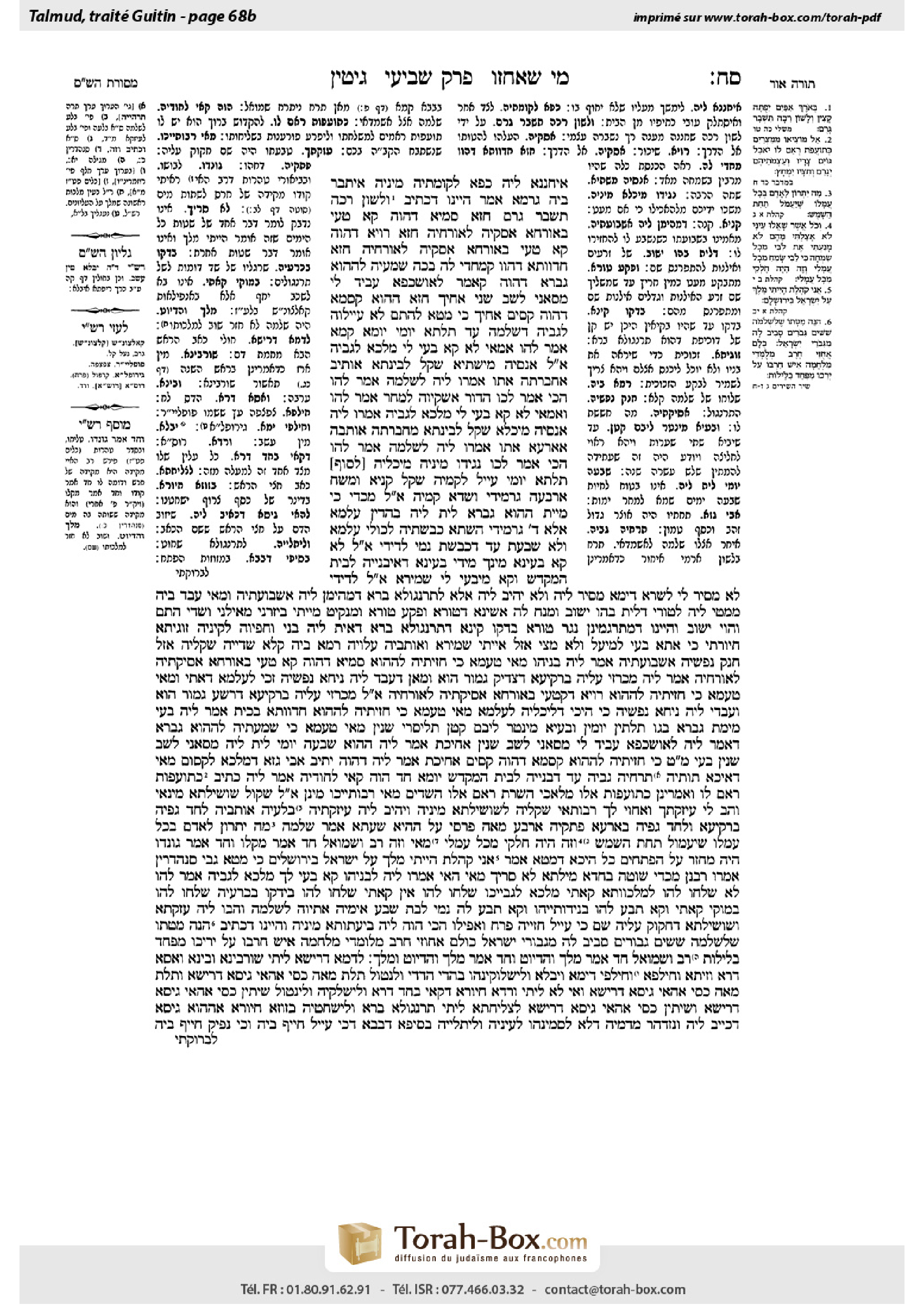
Gittin 68b: Talmud study for Daf Yomi
Study the Talmud for Daf Yomi with scanned pages, Hebrew text, English translations from Sefaria and AI-generated French translations.
Passage selection and English or AI-generated French translation are available where the scan has annotations. Daf Study is independent of Torah-Box and Sefaria.
Browse Gittin · גיטין · All tractatesGittin 68b text and translations
This page of Gittin includes the Aramaic text, an English translation and an AI-generated French translation, alongside the scan above.
גיטין ס״ח ב · Aramaic and Hebrew text
אִיחַנַּנָא לֵיהּ. כְּפָא לְקוֹמְתֵיהּ מִינֵּיהּ, אִיתְּבַר בֵּיהּ גַּרְמָא. אֲמַר, הַיְינוּ דִּכְתִיב: ״וְלָשׁוֹן רַכָּה תִּשְׁבׇּר גָּרֶם״.
חֲזָא סַמְיָא דַּהֲוָה קָא טָעֵי בְּאוֹרְחָא, אַסְּקֵיהּ לְאוֹרְחֵיהּ. חֲזָא רַוְיָא דַּהֲוָה קָא טָעֵי בְּאוֹרְחָא, אַסְּקֵיהּ לְאוֹרְחֵיהּ. חֲזָא חֶדְוְותָא דַּהֲווֹ קָמְחַדִּי לַהּ, בְּכָה. שַׁמְעֵיהּ לְהָהוּא גַּבְרָא דַּהֲוָה קָאָמַר לְאוּשְׁכָּפָא: עָבֵיד לִי מְסָאנֵי לְשַׁב שְׁנֵי, אַחֵיךְ. חֲזָא הָהוּא קַסָּמָא דַּהֲוָה קָסֵים, אַחֵיךְ.
כִּי מְטָא לְהָתָם, לָא עַיְּילוּהּ לְגַבֵּיהּ דִּשְׁלֹמֹה עַד תְּלָתָא יוֹמֵי. יוֹמָא קַמָּא אֲמַר לְהוּ: אַמַּאי לָא קָא בָעֵי לִי מַלְכָּא לְגַבֵּיהּ? אֲמַרוּ לֵיהּ: אַנְסֵיהּ מִישְׁתְּיָא. שְׁקַל לְבֵינְתָּא אוֹתֵיב אַחֲבִרְתַּהּ. אֲתוֹ אֲמַרוּ לֵיהּ לִשְׁלֹמֹה. אָמַר לְהוּ, הָכִי אָמַר לְכוּ: הֲדוּר אַשְׁקְיוּהּ.
לִמְחַר אֲמַר לְהוּ: וְאַמַּאי לָא קָא בָּעֵי לִי מַלְכָּא לְגַבֵּיהּ? אֲמַרוּ לֵיהּ: אַנְסֵיהּ מֵיכְלָא. שְׁקַל לְבֵינְתָּא מֵחֲבִרְתַּהּ, אוֹתְבַהּ אַאַרְעָא. אֲתוֹ אֲמַרוּ לֵיהּ לִשְׁלֹמֹה. אֲמַר לְהוּ, הָכִי אָמַר לְכוּ: נְגִידוּ מִינֵּיהּ מֵיכְלֵיהּ.
לְסוֹף תְּלָתָא יוֹמֵי עֲיַיל לְקַמֵּיהּ. שְׁקַל קַנְיָא, וּמְשַׁח אַרְבְּעָה גַּרְמִידֵי, וּשְׁדָא קַמֵּיהּ. אֲמַר לֵיהּ: מִכְּדִי כִּי מָיֵית הָהוּא גַּבְרָא, לֵית לֵיהּ בְּהָדֵין עָלְמָא אֶלָּא אַרְבָּעָה גַּרְמִידֵי; הַשְׁתָּא כְּבַשְׁתֵּיהּ לְכוּלֵּי עָלְמָא, וְלָא שְׂבַעְתְּ עַד דִּכְבַשְׁתְּ נָמֵי לְדִידִי?!
אֲמַר לֵיהּ: לָא קָא בָעֵינָא מִינָּךְ מִידֵּי; בָּעֵינָא דְּאֶיבְנְיֵיהּ לְבֵית הַמִּקְדָּשׁ, וְקָא מִיבְּעֵי לִי שָׁמִירָא. אֲמַר לֵיהּ: לְדִידִי לָא מְסִיר לִי, לְשָׂרָא דְיַמָּא מָסֵיר לֵיהּ; וְלָא יָהֵיב לֵיהּ אֶלָּא לְתַרְנְגוֹלָא בָּרָא, דִּמְהֵימַן לֵיהּ אַשְּׁבוּעֲתֵיהּ.
וּמַאי עָבֵד בֵּיהּ? מַמְטֵי לֵיהּ לְטוּרֵי דְּלֵית בְּהוּ יִשּׁוּב, וּמַנַּח לֵהּ אַשִּׁינָּא דְטוּרָא, וּפָקַע טוּרָא; וּמְנַקֵּיט מַיְיתִי בִּיזְרָנֵי מֵאִילָנֵי, וְשָׁדֵי הָתָם, וְהָוֵי יִשּׁוּב. וְהַיְינוּ דִּמְתַרְגְּמִינַן: ״נַגָּר טוּרָא״.
בְּדַקוּ קִינָּא דְּתַרְנְגוֹלָא בָּרָא דְּאִית לֵיהּ בְּנֵי, וְחַפְּיוּהּ לְקִינֵּיהּ זוּגִּיתָא חִיוָּרְתִּי. כִּי אֲתָא, בָּעֵי לְמֵיעַל וְלָא מָצֵי. אֲזַל אַיְיתִי שָׁמִירָא, וְאוֹתְבֵיהּ עִלָּוֵיהּ. רְמָא בֵּיהּ קָלָא, שַׁדְיֵיהּ, שַׁקְלֵיהּ. אֲזַל חֲנַק נַפְשֵׁיהּ אַשְּׁבוּעֲתֵיהּ.
אֲמַר לֵיהּ בְּנָיָהוּ: מַאי טַעְמָא כִּי חֲזִיתֵיהּ לְהָהוּא סַמְיָא דַּהֲוָה קָא טָעֵי בְּאוֹרְחָא, אַסֵּיקְתֵּיהּ לְאוֹרְחֵיהּ? אֲמַר לֵיהּ: מַכְרְזִי עֲלֵיהּ בִּרְקִיעָא דְּצַדִּיק גָּמוּר הוּא, וּמַאן דַּעֲבַד לֵיהּ נִיחָא נַפְשֵׁיהּ, זָכֵי לְעָלְמָא דְּאָתֵי.
וּמַאי טַעְמָא כִּי חֲזֵיתֵיהּ לְהָהוּא רַוְיָא דְּקָטָעֵי בְּאוֹרְחָא, אַסֵּיקְתֵּיהּ לְאוֹרְחֵיהּ? אֲמַר לֵיהּ: מַכְרְזִי עֲלֵיהּ בִּרְקִיעָא דְּרָשָׁע גָּמוּר הוּא, וְעָבְדִי לֵיהּ נִיחָא נַפְשֵׁיהּ כִּי הֵיכִי דְּלֵיכְלֵיהּ לְעָלְמָא.
מַאי טַעְמָא כִּי חֲזֵיתֵיהּ לְהָהוּא חֶדְוְותָא, בְּכֵית? אֲמַר לֵיהּ: בָּעֵי מֵימָת גַּבְרָא בְּגוֹ תְּלָתִין יוֹמִין, וּבָעֲיָא מִינְטָר לְיָבָם קָטָן תְּלֵיסְרֵי שְׁנִין.
מַאי טַעְמָא כִּי שְׁמַעְתֵּיהּ לְהָהוּא גַּבְרָא דַּאֲמַר לֵיהּ לְאוּשְׁכָּפָא: ״עֲבֵיד לִי מְסָאנֵי לְשַׁב שְׁנִין״, אַחֵיכְתְּ? אֲמַר לֵיהּ: הָהוּא, שִׁבְעָה יוֹמֵי לֵית לֵיהּ, מְסָאנֵי לְשַׁב שְׁנִין בָּעֵי?!
מַאי טַעְמָא כִּי חֲזֵיתֵיהּ לְהָהוּא קַסָּמָא דַּהֲוָה קָסֵים, אַחֵיכְתְּ? אֲמַר לֵיהּ: דַּהֲוָה יְתֵיב אַבֵּי גַזָּא דְּמַלְכָּא, לִקְסוֹם מַאי דְּאִיכָּא תּוּתֵיהּ!
תַּרְחֵיהּ גַּבֵּיהּ עַד דְּבַנְיֵיהּ לְבֵית הַמִּקְדָּשׁ. יוֹמָא חַד הֲוָה קָאֵי לְחוֹדֵיהּ, אֲמַר לֵיהּ: כְּתִיב: ״כְּתוֹעֲפוֹת רְאֵם לוֹ״; וְאָמְרִינַן: ״כְּתוֹעֲפוֹת״ – אֵלּוּ מַלְאֲכֵי הַשָּׁרֵת, ״רְאֵם״ – אֵלּוּ הַשֵּׁדִים. מַאי רְבוּתַיְיכוּ מִינַּן?
אֲמַר לֵיהּ: שְׁקוֹל שׁוּשִׁילְתָּא מִינַּאי, וְהַב לִי עִיזְקְתָךְ, וְאַחְוִי לָךְ רְבוּתַאי. שַׁקְלֵיהּ לְשׁוּשִׁילְתָּא מִינֵּיהּ, וְיָהֵיב לֵיהּ עִיזְקְתֵיהּ. בַּלְעֵיהּ, אוֹתְבֵיהּ לְחַד גַּפֵּיהּ בִּרְקִיעָא, וּלְחַד גַּפֵּיהּ בְּאַרְעָא, פַּתְקֵיהּ אַרְבַּע מְאָה פַּרְסֵי. עַל הַהִיא שַׁעְתָּא אֲמַר שְׁלֹמֹה: ״מַה יִּתְרוֹן לָאָדָם בְּכׇל עֲמָלוֹ שֶׁיַּעֲמֹל תַּחַת הַשָּׁמֶשׁ״.
״וְזֶה הָיָה חֶלְקִי מִכׇּל עֲמָלִי״ – מַאי ״וְזֶה״? רַב וּשְׁמוּאֵל; חַד אָמַר: מַקְלוֹ; וְחַד אָמַר: גּוּנְדּוֹ. הָיָה מְחַזֵּר עַל הַפְּתָחִים, כֹּל הֵיכָא דִּמְטָא, אָמַר: ״אֲנִי קֹהֶלֶת הָיִיתִי מֶלֶךְ עַל יִשְׂרָאֵל בִּירוּשָׁלִָים״. כִּי מְטָא גַּבֵּי סַנְהֶדְרִין, אֲמַרוּ רַבָּנַן: מִכְּדִי שׁוֹטֶה – בַּחֲדָא מִילְּתָא לָא סְרִיךְ, מַאי הַאי?
אֲמַרוּ לֵיהּ לִבְנָיָהוּ: קָא בָעֵי לָךְ מַלְכָּא לְגַבֵּיהּ? אֲמַר לְהוּ: לָא. שְׁלַחוּ לְהוּ לְמַלְכְּווֹתָא: קָאָתֵי מַלְכָּא לְגַבַּיְיכוּ? שְׁלַחוּ לְהוּ: אִין, קָאָתֵי. שְׁלַחוּ לְהוּ: בִּידְקוּ בְּכַרְעֵיהּ. שְׁלַחוּ לְהוּ: בְּמוּקֵי קָאָתֵי;
וְקָא תָבַע לְהוּ בְּנִידּוּתַיְיהוּ; וְקָא תָבַע לַהּ נָמֵי לְבַת שֶׁבַע אִימֵּיהּ. אַתְיוּהּ לִשְׁלֹמֹה, וְהַבוּ לֵיהּ עִזְקְתָא, וְשׁוּשִׁילְתָּא דַּחֲקִוק עָלֶיהָ שֵׁם. כִּי עָיֵיל, חַזְיֵיהּ, פְּרַח.
וַאֲפִילּוּ הָכִי, הֲוָה לֵיהּ בִּיעֲתוּתָא מִינֵּיהּ. וְהַיְינוּ דִּכְתִיב: ״הִנֵּה מִטָּתוֹ שֶׁלִּשְׁלֹמֹה שִׁשִּׁים גִּבּוֹרִים סָבִיב לָהּ מִגִּבּוֹרֵי יִשְׂרָאֵל, כּוּלָּם אֲחוּזֵי חֶרֶב מְלוּמְּדֵי מִלְחָמָה, אִישׁ חַרְבּוֹ עַל יְרֵיכוֹ מִפַּחַד בַּלֵּילוֹת״.
רַב וּשְׁמוּאֵל, חַד אָמַר: מֶלֶךְ וְהֶדְיוֹט, וְחַד אָמַר: מֶלֶךְ וְהֶדְיוֹט וּמֶלֶךְ.
לִדְמָא דְּרֵישָׁא – לַיְתֵי שׁוּרְבִּינָא, וּבִינָא, וְאָסָא דָּרָא, וְזֵיתָא, וְחִילְפָא, וְחִילְפֵי דְיַמָּא, וְיַבְלָא; וְלִישְׁלוֹקִינְהוּ בַּהֲדֵי הֲדָדֵי; וְלִנְטוֹל תְּלָת מְאָה כָּסֵי אַהַאי גִּיסָא דְרֵישָׁא, וּתְלָת מְאָה כָּסֵי אַהַאי גִּיסָא דְרֵישָׁא.
וְאִי לָא – לַיְתֵי וַרְדָּא חִיוָּרָא דְּקָאֵי בְּחַד דָּרָא, וְלִישְׁלְקֵיהּ, וְלִינְטוֹל שִׁיתִּין כָּסֵי אַהַאי גִּיסָא דְרֵישָׁא, וְשִׁיתִּין כָּסֵי אַהַאי גִּיסָא דְרֵישָׁא.
לִצְלִיחְתָּא – לַיְתֵי תַּרְנְגוֹלָא בָּרָא; וְלִישְׁחֲטֵיהּ בְּזוּזָא חִיוָּרָא – אַהָהוּא גִּיסָא דְּכָיֵיב לֵיהּ, וְנִזְדְּהַר מִדְּמֵיהּ דְּלָא לְסַמִּינְהוּ לְעֵינֵיהּ; וְלִיתְלְיֵיהּ בְּסֵיפָא דְבָבָא – דְּכִי עָיֵיל חָיֵיף בֵּיהּ, וְכִי נָפֵיק חָיֵיף בֵּיהּ.
Gittin 68b · English translation
and she begged him not to knock down the house. He bent his body away from her, to the other side, and broke one of his bones. He said: This is as it is written: “Soft speech can break a bone” (Proverbs 25:15).
Ashmedai saw a blind man who was lost on the road and he brought him to the correct road. He saw a drunk who was lost on the road and he brought him to the correct road. He saw the joy of a wedding celebration in which they were celebrating, and he cried. He heard a certain man say to a shoemaker [ushkafa]: Make me shoes that will last for seven years, and he laughed. He saw a certain sorcerer performing magic, and he laughed.
When Ashmedai arrived there, in Jerusalem, they did not bring him before Solomon until three days had passed. On the first day he said to them: Why doesn’t the king want me to come to him? They said to him: He drank too much and was overcome by drink. Ashmedai took a brick and placed it on top of another brick. The servants came and told Solomon what he had done. Solomon interpreted the action and said to them: This is what he said to you through this allusion: Return and give the king more to drink.
The following day Ashmedai said to them: And why doesn’t the king want me to come to him? They said to him: He ate too much and was overcome by food. Ashmedai took the brick off the other brick and placed it on the ground. The servants came and told Solomon what Ashmedai had done. He interpreted Ashmedai’s actions and said to them: This is what he said to you through this allusion: Take his food away from him.
At the end of three days Ashmedai came before Solomon. Ashmedai took a reed and measured four cubits [garmidei], and threw it before him. He said to Solomon: See, when that man, Solomon, dies, he will have nothing in this world except the four cubits of his grave. Now you have conquered the entire world and yet you are not satisfied until you also conquer me?
Solomon said to him: I need nothing from you. I want to build the Temple and I need the shamir for this. Ashmedai said to him: The shamir was not given to me, but it was given to the angelic minister of the sea. And he gives it only to the wild rooster, also known as the dukhifat or the hoopoe, whom he trusts by the force of his oath to return it.
And what does the wild rooster do with it? He brings it to mountains that are not fit for habitation, and he places the shamir on the craggy rock and the mountain splits. And he takes and brings seeds of trees, throws them there, and it becomes fit for habitation. And this is why we interpret the word dukhifat as a cutter of mountains [naggar tura], i.e., the Aramaic translation of the word dukhifat in the Bible is naggar tura, cutter of mountains.
They investigated and found the nest of a wild rooster in which there were chicks, and he covered its nest with translucent glass. When the rooster came it wanted to enter the nest but was unable to do so. It went and brought the shamir and placed it on top to crack the glass. Solomon’s servant threw a clump of dirt at the rooster and the rooster knocked over the shamir. The man took it and the wild rooster went and strangled itself over the fact that it had not kept its oath, by not returning the shamir.
Later, Benayahu said to Ashmedai: What is the reason that when you saw that blind man who was lost on the road you brought him to the correct road? Ashmedai said to him: They proclaim about him in heaven that he is a completely righteous man, and anyone who does good for his soul shall merit to enter the World-to-Come.
Then Benayahu asked: And what is the reason that when you saw the drunk man who was lost on the road you brought him to the correct road? Ashmedai said to him: They proclaim about him in heaven that he is a completely wicked man. And I did good for his soul so that he will consume his reward in this world and not have any reward in the World-to-Come.
Benayahu continued and asked him: What is the reason that when you saw that joy of the wedding you cried? Ashmedai said to him: I knew that this man will die within thirty days. And his wife is required to wait for the yavam, the husband’s brother, who is a minor, to reach the age of thirteen years, the age of majority, so that he can release her through ḥalitza, the ritual through which the yavam frees the yevama of her levirate bonds.
In addition, he asked: What is the reason that when you heard that man say to a shoemaker: Make me shoes that will last for seven years, you laughed? Ashmedai said to him: That man does not have seven days to live; does he need shoes that will last for seven years?
Benayahu then asked: What is the reason that when you saw that sorcerer performing magic you laughed? Ashmedai said to him: Because he was sitting on the king’s treasury [bei gaza]. Let him use his magic to know what there is buried underneath him.
Solomon kept Ashmedai with him until he completed building the Temple. One day he stood with Ashmedai alone. He said to Ashmedai: It is written: “For him like the lofty horns of the wild ox” (Numbers 24:8), and the Sages say in explanation of the verse: “Like the lofty horns”; these are the ministering angels. “The wild ox”; these are the demons. In what way are you greater than us? Why does the verse praise your abilities and powers over those of human beings?
Ashmedai said to him: Take the chain engraved with God’s name off me and give me your ring with God’s name engraved on it, and I will show you my strength. Solomon took the chain off him and he gave him his ring. Ashmedai swallowed the ring and grew until he placed one wing in the heaven and one wing on the earth. He threw Solomon a distance of four hundred parasangs. With regard to that moment Solomon said: “What profit is there for a person through all of his toil under the sun?” (Ecclesiastes 1:3). With Solomon deposed from the throne, Ashmedai took his place.
With regard to the verse: “And this was my portion from all of my toil” (Ecclesiastes 2:10), the Gemara asks: What is the meaning of the expression: “And this”? This expression is always an allusion to an item that is actually in his hand or can be shown. Rav and Shmuel disagree with regard to the meaning of this phrase. One said: This is referring to Solomon’s staff that remained in his hand. And one said: This is referring to his cloak. Solomon circulated from door to door collecting charity, and wherever he arrived he would say: “I, Ecclesiastes, was king over Israel in Jerusalem” (Ecclesiastes 1:12). When he finally arrived at the Sanhedrin in Jerusalem the sages said: Now, an imbecile does not fixate on one matter all of the time, so what is this matter? Is this man perhaps telling the truth that he is Solomon?
The sages said to Benayahu: Does the king require you to be with him? Benayahu said to them: No. They sent to the queens and asked: Does the king come to be with you? The queens sent a response to them: Yes, he comes. They sent a request to the queens: Check his feet to see if they are human feet. The queens sent a response to the sages: He always comes in socks [bemokei], and it is not possible to see his feet.
The queens continued discussing the king’s behavior: And he demands of them, i.e., the queens, to engage in sexual intercourse when they are menstruating. And he also demands that Bathsheba his mother engage in sexual intercourse with him. Once the Sanhedrin heard this they understood that this was an imposter and not actually Solomon. They brought Solomon, gave him a ring and the chain on which the name of God was carved. When Solomon entered, Ashmedai saw him and fled.
The Gemara adds: And even so, although Ashmedai fled, Solomon was fearful of him, and this is as it is written: “Behold the bed of Solomon surrounded by sixty strong men from the warriors of Israel. All of them holding swords and trained in war, each man with his sword on his thigh from fear in the nights” (Song of Songs 3:7–8).
Rav and Shmuel disagreed with regard to this story of Solomon. One said: He was a king and afterward he became a commoner, and never returned to his position as king. And one said: He was a king, and became a commoner, and a king, as ultimately he returned to his throne and defeated Ashmedai.
§ The Gemara returns to the discussion concerning the different remedies with which the chapter began: As a remedy for a headache caused by excessive blood in the head, let him bring cypress [shurvina], willow, fresh myrtle [asa dara], olive, poplar, sea willow, and cynodon grass and boil them together. And he should pour three hundred cups of this liquid on one side of his head and three hundred cups on this, the other side of his head.
And if it is not effective or he is unable to obtain all of these ingredients then let him bring a white rose [varda] that stands in one row, meaning that it was growing alone, and he should boil it. And he should pour sixty cups on this side of his head and sixty cups on this side of his head.
As a remedy for a migraine, let him bring a wild rooster and slaughter it using a silver dinar, so that the blood flows over the side of his head that hurts him. And he should be careful of its blood so as not to blind his eye. And he should hang it on the doorpost of his house, so that when he enters he rubs against it and when he exits he rubs against it.
Gittin 68b · Traduction française (IA)
et elle suppliait de ne pas abattre la maison. Il s'éloigna de son corps vers le côté opposé et cassa l'une de ses os. Il dit : C'est comme il est écrit : « La parole douce peut briser un os » (Proverbes 25:15).
Ashmedai vit un homme aveugle perdu sur la route et il le conduisit sur la bonne route. Il vit un ivrogne perdu sur la route et il le conduisit sur la bonne route. Il vit la joie d'une fête de mariage où ils célébraient, et il pleura. Il entendit un certain homme dire à un cordonnier [ushkafa] : Fais-moi des chaussures qui dureront sept ans, et il rit. Il vit un certain sorcier faire de la magie, et il rit.
Quand Ashmedai arriva là, à Jérusalem, on ne lui présenta pas devant Salomon avant que trois jours ne soient passés. Le premier jour, il dit à ceux-ci : Pourquoi le roi ne veut-il pas que je vienne le voir ? Ils lui dirent : Il a trop bu et est tombé sous l'effet de l'alcool. Ashmedai prit un briquet et le posa sur un autre briquet. Les serviteurs vinrent et dirent à Salomon ce qu'il avait fait. Salomon interpréta l'action et dit à ceux-ci : C'est ce qu'il vous a dit par cette allusion : Retournez et donnez au roi plus à boire.
Le lendemain, Ashmedai dit à ceux-ci : Et pourquoi le roi ne veut-il pas que je vienne le voir ? Ils lui dirent : Il a trop mangé et est tombé sous l'effet de la nourriture. Ashmedai prit le briquet du briquet et le posa sur le sol. Les serviteurs vinrent et dirent à Salomon ce qu'Ashmedai avait fait. Il interpréta les actions d'Ashmedai et dit à ceux-ci : C'est ce qu'il vous a dit par cette allusion : Enlevez la nourriture de lui.
Au terme de trois jours, Ashmedai vint devant Salomon. Ashmedai prit une canne et mesura quatre coudées [garmidei], et le jeta devant lui. Il dit à Salomon : Voyez, quand ce homme, Salomon, mourra, il n'aura rien dans ce monde à l'exception des quatre coudées de son tombeau. Maintenant vous avez conquis tout le monde et pourtant vous n'êtes pas satisfait jusqu'à ce que vous conquériez aussi moi ?
Salomon dit à lui : Je n'ai besoin de rien de toi. Je veux construire le Temple et j'ai besoin du shamir pour cela. Ashmedai dit à lui : Le shamir n'a pas été donné à moi, mais il a été donné au ministre angélique de la mer. Et il le donne seulement au coq sauvage, aussi connu sous le nom de dukhifat ou de la moineau, à qui il fait confiance par la force de son serment de le rendre.
Et que fait le coq sauvage avec cela ? Il apporte cela vers les montagnes qui ne sont pas adaptées à l'habitation, et il place le shamir sur la roche escarpée, et la montagne se brise. Il prend des graines d'arbres, les jette là, et cela devient adapté à l'habitation. C'est pourquoi nous interprétons le mot dukhifat comme un coupeur de montagnes [naggar tura], c'est-à-dire que la traduction araméenne du mot dukhifat dans la Bible est naggar tura, coupeur de montagnes.
Ils investiguèrent et trouvèrent le nid d'un coq sauvage où il y avait des poussins, et il couvrit son nid avec un verre translucide. Quand le coq vint, il voulait entrer dans le nid mais ne pouvait pas le faire. Il alla chercher le shamir et le posa sur le dessus pour briser le verre. Le serviteur de Salomon jeta un tas de terre au coq et le coq renversa le shamir. L'homme le prit, et le coq alla se tuer à cause du fait qu'il n'avait pas tenu son serment, par n'avoir pas rendu le shamir.
Plus tard, Benayahu dit à Ashmedai : Quelle est la raison que, quand tu as vu cet homme aveugle perdu sur la route, tu l'as conduit sur la bonne route ? Ashmedai répondit à lui : Ils proclament à son sujet au ciel qu'il est un homme entièrement juste, et celui qui fait du bien à son âme mérite d'entrer dans le Monde à Venir.
Puis Benayahu demanda : Et quelle est la raison que quand tu as vu l'ivrogne perdu sur la route, tu l'as conduit sur la bonne route ? Ashmedai dit à lui : Ils proclament à son sujet au ciel qu'il est un homme entièrement mauvais. Et j'ai fait du bien à son âme afin qu'il consume sa récompense dans ce monde et n'ait plus de récompense dans le Monde à Venir.
Benayahu continua et demanda : Quelle est la raison que quand tu as vu la joie du mariage, tu as pleuré ? Ashmedai dit à lui : Je savais que cet homme mourra dans trente jours. Et sa femme est tenue d'attendre le yavam, le frère du mari, qui est mineur, jusqu'à l'âge de treize ans, l'âge de la majorité, afin qu'il puisse la libérer par ḥalitza, la cérémonie par laquelle le yavam libère la yevama de ses liens levirats.
En outre, il demanda : Quelle est la raison que quand tu as entendu cet homme dire à un cordonnier : Fais-moi des chaussures qui dureront sept ans, tu as ri ? Ashmedai dit à lui : Cet homme n'a pas sept jours à vivre ; a-t-il besoin de chaussures qui dureront sept ans ?
Benayahu demanda alors : Quelle est la raison pour laquelle, lorsqu'on a vu ce sorcier pratiquer la magie, on a ri ? Ashmedai répondit à lui : Parce qu'il était assis sur le trésor du roi [bei gaza]. Faisons-lui utiliser sa magie pour découvrir ce qui est enterré sous lui.
Salomon garda Ashmedai auprès de lui jusqu'à ce qu'il ait achevé la construction du Temple. Un jour, il resta seul avec Ashmedai. Il lui dit : Il est écrit : « Pour lui comme les cornes élevées du bœuf sauvage » (Nombres 24:8), et les Sages expliquent cette parole en disant : « Comme les cornes élevées » ; ces sont les anges ministériel. « Le bœuf sauvage » ; ces sont les démons. Dans quelle mesure es-tu supérieur à nous ? Pourquoi ce passage loue-t-il tes capacités et puissances par rapport à celles des humains ?
Ashmedai dit à lui : Prends la chaîne gravée avec le nom de Dieu que je porte et donne-moi ton anneau gravé avec le nom de Dieu, et je te montrerai ma force. Salomon retira la chaîne de lui et lui donna son anneau. Ashmedai engloutit l'anneau et s'élargit jusqu'à ce qu'il place une aile au ciel et une aile sur la terre. Il lança Salomon à une distance de quatre cents parasangs. À ce moment-là, Salomon dit : « Quel profit y a-t-il pour un homme par toute son activité sous le soleil ? » (Ecclésiaste 1:3). Avec Salomon déposé du trône, Ashmedai prit sa place.
Concernant la parole : « Et ceci fut ma part de toute mon activité » (Ecclésiaste 2:10), le Guemara demande : Quelle est la signification de l'expression : « Et ceci » ? Cette expression désigne toujours un objet qui est effectivement dans sa main ou peut être montré. Rav et Shmuel s'opposent quant à la signification de cette phrase. L'un dit : Cela fait référence à la canne de Salomon qui restait dans sa main. Et l'autre dit : Cela fait référence à sa robe. Salomon se promenait d'une porte à l'autre pour collecter des charités, et partout où il arrivait, il disait : « Je, Ecclésiaste, étais roi d'Israël à Jérusalem » (Ecclésiaste 1:12). Lorsqu'il arriva enfin devant le Sanhédrin à Jérusalem, les sages dirent : Maintenant, un imbécile ne fixe pas un seul sujet toute sa vie, donc quel est ce sujet ? Ce homme est-il peut-être en train de dire la vérité qu'il est Salomon ?
Les sages dirent à Benayaou : Le roi a-t-il besoin que tu sois avec lui ? Benayaou dit à eux : Non. Ils envoyèrent aux reines et demandèrent : Le roi vient-il être avec toi ? Les reines envoyèrent une réponse à eux : Oui, il vient. Ils envoyèrent une demande aux reines : Examine ses pieds pour voir s'ils sont des pieds humains. Les reines envoyèrent une réponse aux sages : Il vient toujours en chaussettes [bemokei], et il n'est pas possible de voir ses pieds.
Les reines continuèrent à discuter du comportement du roi : Il exige d'elles, c'est-à-dire des reines, de faire l'amour lorsqu'elles sont en période de ménstruation. Il exige également que Bathsheba, sa mère, fasse l'amour avec lui. Une fois que le Sanhédrin eut entendu cela, ils comprirent que c'était un imposteur et non Salomon lui-même. Ils amenèrent Salomon, lui donnèrent un anneau et la chaîne sur laquelle était gravé le nom de Dieu. Lorsque Salomon entra, Ashmedai le vit et s'enfuit.
Le Guemara ajoute : Et même ainsi, bien que Ashmedai s'enfuie, Salomon avait peur de lui, et c'est ainsi qu'il est écrit : « Regarde le lit de Salomon entouré de soixante hommes forts des guerriers d'Israël. Tous tenant des épées et entraînés à la guerre, chacun avec son épée à la cuisse, de crainte des nuits » (Cantique des Cantiques 3 : 7–8).
Rav et Shmuel s'opposaient concernant cette histoire de Salomon. L'un disait : Il était un roi et ensuite devint un simple citoyen, et ne revint jamais à son poste de roi. L'autre disait : Il était un roi, puis devint un simple citoyen, et un roi à nouveau, car finalement il revint à son trône et battit Ashmedai.
§ Le Guemara reprend la discussion concernant les différents remèdes avec lesquels le chapitre a commencé : En tant que remède pour une migraine causée par un excès de sang dans la tête, qu'il apporte un cypress [shurvina], un saule, un myrte frais [asa dara], un olivier, un tremble, un saule maritime, et de l'herbe cynodon et qu'il les fasse bouillir ensemble. Et il devrait verser trois cents coupes de ce liquide sur un côté de sa tête et trois cent coupes sur l'autre côté de sa tête.
Et si cela n'est pas efficace ou s'il ne peut pas obtenir tous ces ingrédients, qu'il apporte une rose blanche [varda] qui pousse en une rangée, c'est-à-dire qu'elle pousse seule, et qu'il la fasse bouillir. Et il devrait verser soixante coupes sur ce côté de sa tête et soixante coupes sur l'autre côté de sa tête.
En tant que remède pour une migraine, qu'il apporte un coq sauvage et le tue avec un dinar d'argent, de sorte que le sang coule sur le côté de sa tête qui lui fait mal. Et il devrait être prudent avec son sang pour ne pas le rendre aveugle. Et il devrait accrocher le coq à la porte de sa maison, de sorte que lorsqu'il entre, il frotte contre lui et lorsqu'il sort, il frotte contre lui.
Traduction française générée par IA à partir de l’édition anglaise de Sefaria. Vérifie toujours un passage avec le texte source.
Text from Sefaria: William Davidson Edition - Vocalized Aramaic (CC BY NC); William Davidson Edition - English (CC BY NC).