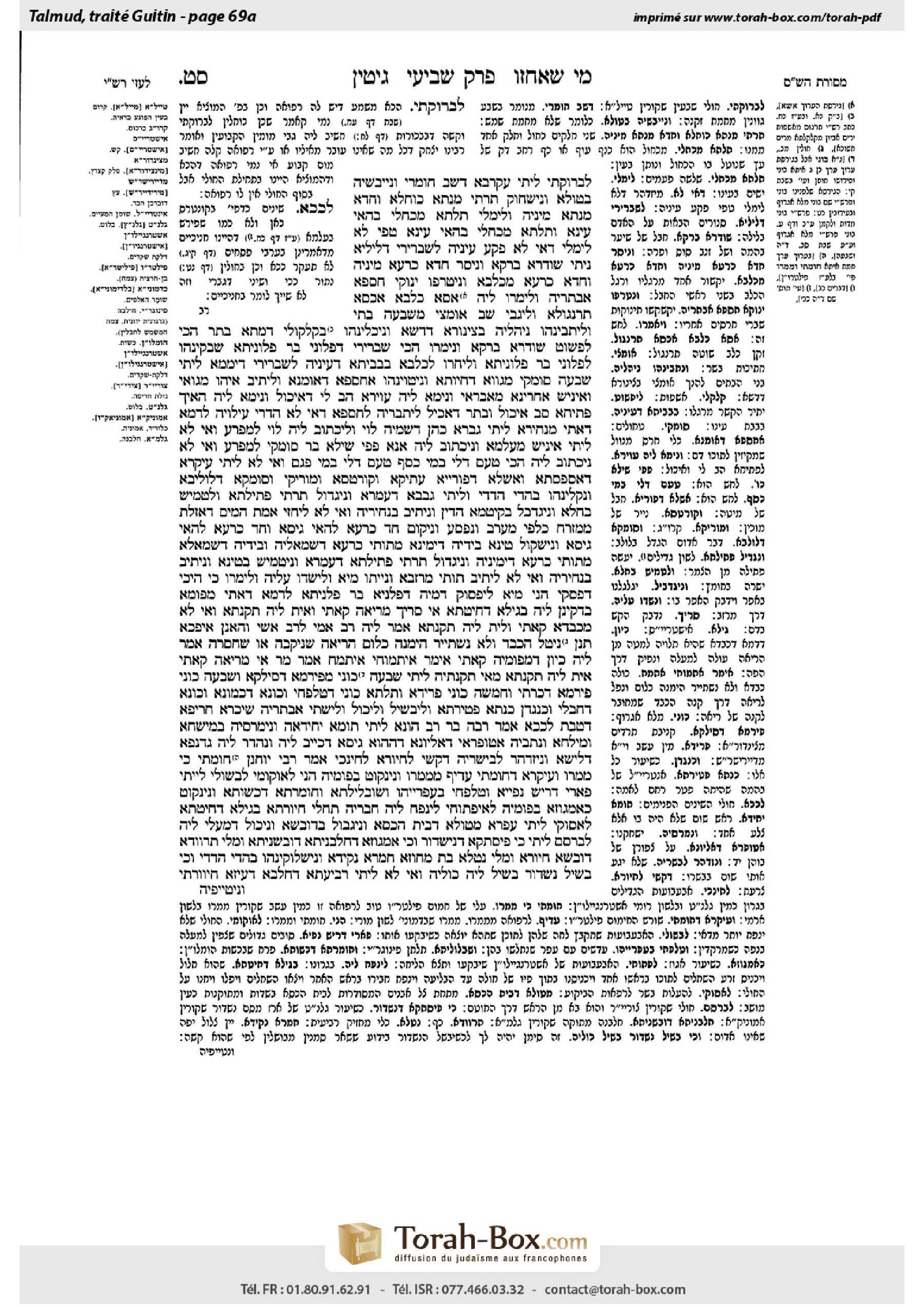
Gittin 69a: Talmud study for Daf Yomi
Study the Talmud for Daf Yomi with scanned pages, Hebrew text, English translations from Sefaria and AI-generated French translations.
Passage selection and English or AI-generated French translation are available where the scan has annotations. Daf Study is independent of Torah-Box and Sefaria.
Browse Gittin · גיטין · All tractatesGittin 69a text and translations
This page of Gittin includes the Aramaic text, an English translation and an AI-generated French translation, alongside the scan above.
גיטין ס״ט א · Aramaic and Hebrew text
לִבְרוּקְתִּי – לַיְתֵי עַקְרַבָּא דְּשַׁב חוּמְרֵי, וּנְיַיבְּשֵׁיהּ בְּטוּלָּא; וְנִישְׁחוֹק תַּרְתֵּי מְנָתָא כּוּחְלָא, וַחֲדָא מְנָתָא מִינֵּיהּ; וְלִימְלֵי תַּלְתָּא מַכְחָלֵי בְּהַאי עֵינָא וּתְלָתָא מַכְחָלֵי בְּהַאי עֵינָא; טְפֵי לָא לִימַלֵּי, דְּאִי לָא – פָּקַע עֵינֵיהּ.
לְשַׁבְרִירֵי דְלֵילְיָא – נֵיתֵי שׁוּדְרָא בָּרְקָא, וְנֵיסַר חֲדָא כַּרְעָא מִינֵּיהּ וַחֲדָא כַּרְעָא מִכַּלְבָּא; וְנִיטְרְפוּ יָנוֹקֵי חַסְפָּא אַבָּתְרֵיהּ, וְלֵימְרוּ לֵיהּ: ״אַסָּא כַּלְבָּא אַכְסָא תַּרְנְגוֹלָא״; וְלִיגְבֵּי שַׁב אוּמְצֵי מִשִּׁבְעָה בָּתֵּי, וְלִיתְּבִינְהוּ נִיהֲלֵיהּ בְּצִינּוֹרָא דְּדַשָּׁא, וְנֵיכְלִינְהוּ בְּקִלְקְולֵי דְּמָתָא. בָּתַר הָכִי, לִפְשׁוֹט שׁוּדְרָא בָּרְקָא, וְנֵימְרוּ הָכִי: ״שַׁבְרִירֵי דִּפְלוֹנִי בַּר פְּלוֹנִיתָא (שַׁבְקִינְהוּ) [לִישְׁבְּקוּהּ] לִפְלוֹנִי בַּר פְּלוֹנִיתָא, וְלִיחֲרוּ לְכַלְבָּא בְּבָבִיתָא דְּעֵינֵיה״ּ.
לְשַׁבְרִירֵי דִימָמָא – לַיְתֵי שִׁבְעָה סוּמָּקֵי מִגַּוּוֹא דְחֵיוְתָא, וְנִיטְוִינְהוּ אַחַסְפָּא דְאוּמָּנָא; וְלִיתֵיב אִיהוּ מִגַּוַּאי וְאִינִישׁ אַחֲרִינָא מֵאַבָּרַאי, וְנֵימָא לֵיהּ עַוִּירָא: ״הַב לִי דְּאֵיכוֹל״, וְנֵימָא לֵיהּ הַאיְךְ פְּתִיחָא: ״סַב אֵיכוֹל״; וּבָתַר דְּאָכֵיל לִיתְבְּרֵיהּ לְחַסְפָּא, דְּאִי לָא – הָדְרִי עִילָּוֵיהּ.
לִדְמָא דְּאָתֵי מִנְּחִירָא – לֵיתֵי גַּבְרָא כֹּהֵן דִּשְׁמֵיהּ לֵוִי, וְלִיכְתּוֹב לֵיהּ לֵוִי לְמַפְרֵעַ. וְאִי לָא – לַיְתֵי אִינִישׁ מֵעָלְמָא, וְנִיכְתּוֹב לֵיהּ: ״אֲנָא פַּפֵּי שֵׁילָא בַּר סוּמָּקֵי״ – לְמַפְרֵעַ.
וְאִי לָא – נִיכְתּוֹב לֵיהּ הָכִי: טַעַם דְּלִי בְּמֵי כֶסֶף, טַעַם דְּלִי בְּמֵי פְגָם. וְאִי לָא – לַיְתֵי עִיקָּרָא דְאַסְפַּסְתָּא, וְאַשְׁלָא דְפוּרְיָיא עַתִּיקָא, וְקוּרְטְסָא, וּמוֹרִיקֵי, וְסוּמָּקָא דְלוּלִיבָּא; וְנִקְלִינְהוּ בַּהֲדֵי הֲדָדֵי; וְלַיְתֵי גְּבָבָא דְעַמְרָא וְנִיגְדּוֹל תַּרְתֵּי פְּתִילָתָא, וְלִטְמִישׁ בְּחַלָּא, וְנִיגַדְבֵּל בְּקִיטְמָא הָדֵין, וְנִיתֵּיב בִּנְחִירֵיהּ.
וְאִי לָא – לִיחְזֵי אַמַּת הַמַּיִם דְּאָזְלָא מִמִּזְרָח כְּלַפֵּי מַעֲרָב; וְנִפְסַע וְנֵיקוּם חַד כַּרְעָא לְהַאי גִּיסָא וְחַד כַּרְעָא לְהַאי גִּיסָא; וְנִישְׁקוֹל טִינָא בִּידֵיהּ דְּיַמִּינָא מִתּוּתֵי כַּרְעָא דִשְׂמָאלֵיהּ, וּבִידֵיהּ דִּשְׂמָאלָא מִתּוּתֵי כַּרְעָא דְיַמִּינֵיהּ; וְנִיגְדּוֹל תַּרְתֵּי פְּתִילָתָא דְעַמְרָא וְנִיטְמִישׁ בְּטִינָא, וְנִיתֵּיב בִּנְחִירֵיהּ.
וְאִי לָא – לֵיתֵיב תּוּתֵי מַרְזָבָא, וְנַיְיתוֹ מַיָּא וְלִישְׁדּוֹ עֲלֵיהּ, וְלֵימְרוּ: ״כִּי הֵיכִי דְּפָסְקִי הָנֵי מַיָּא, לִיפְסוֹק דְּמֵיהּ דִּפְלָנְיָא בַּר פְּלָנִיתָא״.
לִדְמָא דְּאָתֵי מִפּוּמָּא – בָּדְקִינַן לֵיהּ בְּגִילָא דְחִיטְּתָא, אִי סָרֵיךְ – מֵרֵיאָה קָאָתֵי וְאִית לֵיהּ תַּקַּנְתָּא, וְאִי לָא – מִכַּבְדָּא קָאָתֵי וְלֵית לֵיהּ תַּקַּנְתָּא.
אֲמַר לֵיהּ רַב אַמֵּי לְרַב אָשֵׁי, וְהָאֲנַן אִיפְּכָא תְּנַן: נִיטָּל הַכָּבֵד וְלֹא נִשְׁתַּיֵּיר הֵימֶנָּה כְּלוּם, הָרֵיאָה שֶׁנִּיקְּבָה אוֹ שֶׁחָסְרָה! אֲמַר לֵיהּ: כֵּיוָן דְּמִפּוּמֵּיהּ קָאָתֵי, אֵימַר אִיתְּמוֹחֵי אִיתְּמַח.
אָמַר מָר: אִי מֵרֵיאָה קָאָתֵי, אִית לֵיהּ תַּקַּנְתָּא. מַאי תַּקַּנְתֵּיהּ? לַיְתֵי שִׁבְעָה כּוּנֵי מִפִּירְמָא דְסִילְקָא, וְשִׁבְעָה כּוּנֵי פִּירְמָא דְכַרָּתֵי, וְחַמְשָׁה כּוּנֵי פְּרִידָא, וּתְלָתָא כּוּנֵי דִּטְלָפְחֵי, וְכוּנָא דְּכַמּוֹנָא, וְכוּנָא (דְּחַבְלֵי) [דְּתַבְלֵי]; וּכְנֶגְדָּן – כַּנְתָּא פְּטִירְתָּא; וְלִיבַשֵּׁיל וְלֵיכוֹל, וְלִישְׁתֵּי אַבָּתְרֵיהּ שִׁיכְרָא חֲרִיפָא דְּטֵבֵת.
לְכַכָּא – אָמַר רַבָּה בַּר רַב הוּנָא: לַיְתֵי תּוּמָא יְחִידָאָה וְנִימְרְסֵיהּ בְּמִישְׁחָא וּמִילְחָא, וְנִתְּבֵיהּ אַטֻּופְרָא דְאִלְיוֹנָא דְּהָהוּא גִּיסָא דְּכָיֵיב לֵיהּ, וְנַהְדַּר לֵיהּ גְּדָנְפָא דְלֵישָׁא. וְנִיזְדְּהַר לְבִישְׂרֵיהּ, דְּקָשֵׁי לְחִיוָּרָא.
לְחִינְכֵי – אָמַר רַבִּי יוֹחָנָן: חוּמְתִי – כִּי מַמְרוּ, וְעִיקָּרָא דְחוּמְתִי – עֲדִיף מִמַּמְרוּ, וְנִינְקוֹט בְּפוּמֵּיהּ. הָנֵי לְאוֹקוֹמֵי; לְבַשּׁוֹלֵי – לַיְיתֵי פָּארֵי דְּרֵישׁ נָפְיָיא, וּטְלָפְחֵי בְּעַפְרַיְיהוּ, וְשׁוּבְלִילְתָּא, וְחוּמַרְתָּא דִכְשׁוּתָא, וְנִינְקוֹט כְּאַמְגּוּזָא בְּפוּמֵּיהּ.
לְאִיפְּתוֹחֵי – לִינְפַּח לֵיהּ חַבְרֵיהּ תַּחְלֵי חִיוָּרְתָּא בְּגִילָא דְחִיטְּתָא. לְאַסּוֹקֵי – לַיְתֵי עַפְרָא מִטּוּלָּא דְּבֵית הַכִּסֵּא, וְנִיגְבּוֹל בְּדוּבְשָׁא וְנֵיכוֹל, דִּמְעַלֵּי לֵיהּ.
לְבַרְסָם – לַיְתֵי כִּי פִיסְתְּקָא דְּנִישָׁדוּר, וְכִי אַמְגּוּזָא דְחֶלְבְּנִיתָא דּוּבְשָׁנִיתָא, וּמְלֵי תַּרְווֹדָא דּוּבְשָׁא חִיוָּרָא, וּמְלֵי נַטְלָא בַּת מָחוֹזָא חַמְרָא נְקִידָא; וְנִישְׁלוֹקִינְהוּ בַּהֲדֵי הֲדָדֵי; וְכִי בְּשִׁיל נִשָׁדוּר – בְּשִׁיל לֵיהּ כּוּלֵּיהּ. וְאִי לָא – לַיְתֵי רְבִיעֵתָא דַּחֲלָבָא דְּעִיזָּא חִיוַּורְתִּי
Gittin 69a · English translation
§ As a remedy for eye disease [beroketi], let him bring the body of a seven-colored scorpion, dry it in the shade, and grind together two portions of stibium and one portion of the dried scorpion. And let him place three eyebrushes full in this eye, and three eyebrushes full in that eye. But he should not place more, as if he does not heed this advice and he does place more, his eye will burst.
As a remedy for night blindness, he should bring a rope of animal hair [shudra barka], and he should tie one of his legs and one leg of a dog together with the rope. And let children throw pottery shards behind him, and let them say to him: The dog is old and the rooster is foolish. And let him take seven pieces of raw meat from seven houses and let him leave them for him in the socket of the door. And let him then eat them in the junkyard of the city. Afterward, he should untie the rope of hair and say as follows: The blindness of so-and-so, son of so-and-so; leave so-and-so, son of so-and-so; and then they say: Let them blow into the dog’s eye.
As a remedy for day blindness, hemeralopia, which is the inability to see clearly in bright light, let him bring seven animal spleens, and let the patient roast them on the pottery shard of a bloodletter. And let the patient sit on the inside of the house and let another person sit on the outside, and let the patient say to himself: Blind man, give me something to eat, and let the other one say to the patient: Seeing man, take and eat. And after the patient eats, let him break the shard, as if not, the blindness will follow him.
As a remedy for a nosebleed, let the patient bring a man named Levi who is a priest, and that man should write for the patient the name Levi, backward. And if the patient is not able do this let him bring an ordinary man, and let that man write for the patient the following expression: I am Pappi Sheila bar Summakei. And that man should also write this backward.
And if he is not able to do this let that man write for the patient like this: Taste from a bucket in silver water, taste from a bucket in tainted water. And if the patient is not able to do this let him bring the root of fodder [aspasta], rope [ashla] from an old bed, and paper [kurtesa], and saffron, and the red portion of a palm branch, and let him burn them with each other. And let the patient bring a fleece of wool and spin it into two strings, and let him soak [litmish] them in vinegar, roll them in this ash of the burned materials, and place them in his nostrils.
And if the patient is not able to do this let him look at a stream of water flowing from the east toward the west, and let him spread his legs and stand with one foot on this side and one foot on that side. And let him take clay in his right hand from under his left foot, and let him take clay with his left hand from under his right foot. And let him spin two strings of wool, soak them in the clay, and place them in his nostrils.
And if the patient is not able to do this let him sit under the gutter and let them bring water and pour it on him. And let them say: Just as the water has ceased, let the blood of so-and-so, son of so-and-so, cease.
As a remedy for blood that comes from the mouth we check the patient with a straw of wheat. If the blood sticks to the straw then it comes from his lungs and it has a remedy. But if the blood does not stick to the straw, it means that the blood comes from the liver and it has no remedy.
Rav Ami said to Rav Ashi: But didn’t we learn the opposite in a mishna (Ḥullin 42a): If the liver was completely removed and none of it remains, then it is considered to be an animal with a condition that will cause it to die within twelve months [tereifa]. But in the case of a lung that is punctured or missing, the animal is considered to be a tereifa, even if it has not been completely removed. This indicates that damage to the lung is more serious than damage to the liver. Rav Ashi said to him: Since the blood comes out from this person’s mouth, one must say that the liver has dissolved and he will not survive.
The Master said: If the blood comes from the lungs then it has a remedy. The Gemara asks: What is its remedy? The Gemara answers: Let him bring seven fistfuls of sliced beets, and seven fistfuls of sliced leek, and five fistfuls of perida grass, and three fistfuls of lentils, and a fistful of cumin, and a fistful of ropes, and a corresponding amount of the intestines of a firstborn animal. And let him cook all of it together and let him eat everything and afterward let him drink good, strong beer.
With regard to the remedy for pain in one’s teeth [lekhakha], Rabba bar Rav Huna said: Let him bring an individual garlic that grew as a single clove and grind it with oil and salt. And let him place it on the thumbnail of the side that hurts him, and let him surround it with a rim [gedanpa] of dough. And he should take care that it does not touch his flesh because it is harmful and can cause boils.
With regard to the remedy for gums, Rabbi Yoḥanan said: The Spanish chamomile [ḥomti] plant is like the mamru plant, and the root of the Spanish chamomile is preferable to mamru, and let him take it in his mouth. This is meant to stabilize the illness so that it does not intensify. To boil them, meaning to cause the wounds to open so that the pus can be removed from them, let him bring the coarsest bran found at the upper portion of the sifter, and lentils in their dirt, and fenugreek [shuvlilta], and the flower of the hop plant. And let him take an amount about the size of a nut in his mouth.
In order to open the blisters to remove the pus, let his friend blow white cress into his mouth with a straw of wheat. And if he wishes to heal the blisters let him bring dirt found in the shade of the bathroom and knead it with honey and eat it, as this is effective for curing the blisters.
For a bronchial infection [levarsam], let him bring a nut-sized amount of ammonia [nishdor] water and a nut-sized amount of sweet galbanum, and a large spoonful of white honey, a vessel from Meḥoza, i.e., one that holds a quarter-log of liquid, full of clear [nekida] wine, and let him boil them together. And once the ammonia is cooked everything will have cooked. And if he is not able to do this let him bring a quarter-log of milk from a white goat,
Gittin 69a · Traduction française (IA)
§ Comme remède pour une maladie oculaire [beroketi], qu'il apporte le corps d'un scorpion à sept couleurs, le séche à l'ombre, et mélange deux portions de stibium et une portion du scorpion séché. Et qu'il place trois balais d'yeux pleins dans cet œil, et trois balais d'yeux pleins dans l'autre œil. Mais il ne doit pas en mettre plus, car si l'on ne suit pas ce conseil et qu'on en met plus, l'œil éclatera.
Comme remède pour la cécité nocturne, il doit apporter un cordage de poils d'animaux [shudra barka], et il doit attacher un de ses pieds et un pied d'un chien avec ce cordage. Et les enfants doivent lancer des fragments de poterie derrière lui, et dire à lui : Le chien est vieux et le coq est bête. Et il doit prendre sept morceaux de viande crue de sept maisons et les laisser pour lui dans le trou de la porte. Et ensuite, il doit les manger dans la décharge de la ville. Après cela, il doit délier le cordage de poils et dire comme suit : La cécité de tel et tel, fils de tel et tel ; laisse tel et tel, fils de tel et tel ; et alors ils disent : Faites souffler dans l'œil du chien.
Comme remède pour la cécité diurne, l'hémeralopie, qui est l'incapacité de voir clairement en lumière vive, il doit apporter sept foies d'animaux, et le malade doit les faire rôtir sur un fragment de poterie d'un saigneur. Et le malade doit s'asseoir à l'intérieur de la maison et un autre personne doit s'asseoir à l'extérieur, et le malade doit dire à lui-même : Aveugle, donne-moi quelque chose à manger, et l'autre doit dire au malade : Voyant, prends et mange. Et après que le malade ait mangé, il doit briser le fragment, car si ce n'est pas fait, la cécité le suivra.
Comme remède pour un saignement de nez, le malade doit apporter un homme nommé Lévi qui est un prêtre, et cet homme doit écrire pour le malade le nom Lévi, à l'envers. Et si le malade n'est pas capable de le faire, il doit apporter un homme ordinaire, et cet homme doit écrire pour le malade l'expression suivante : Je suis Pappi Sheila bar Summakei. Et cet homme doit aussi écrire cela à l'envers.
Et si le malade n'est pas capable de le faire, cet homme doit écrire pour le malade comme suit : Goûte à une outre d'eau en argent, goûte à une outre d'eau souillée. Et si le malade n'est pas capable de le faire, il doit apporter la racine d'une herbe [aspasta], une corde [ashla] d'un lit ancien, et du papier [kurtesa], et du safran, et la partie rouge d'un branché de palmier, et il doit les brûler ensemble. Et le malade doit apporter un morceau de laine de mouton et le tisser en deux fils, et il doit les tremper [litmish] dans du vinaigre, les rouler dans cette cendre des matériaux brûlés, et les placer dans ses narines.
Et si le malade n'est pas capable de le faire, il doit regarder un courant d'eau qui coule de l'est vers l'ouest, et il doit étendre ses jambes et se tenir avec un pied de ce côté et un pied de l'autre côté. Et il doit prendre de la boue de sa main droite sous son pied gauche, et prendre de la boue avec sa main gauche sous son pied droit. Et il doit tisser deux fils de laine, les tremper dans la boue, et les placer dans ses narines.
Et si le malade n'est pas capable de le faire, qu'il s'assoie sous le gouttier et qu'on lui apporte de l'eau et qu'on le verse dessus. Et qu'on dise : Comme l'eau a cessé, que le sang de tel et tel, fils de tel et tel, cesse.
Comme remède pour le sang qui vient de la bouche, on examine le malade avec un tige de blé. Si le sang s'attache à la tige, cela vient de ses poumons et il a un remède. Mais si le sang ne s'attache pas à la tige, cela signifie que le sang vient du foie et il n'a pas de remède.
Rav Ami a dit à Rav Ashi : Mais n'avons-nous pas appris l'opposé dans une mitsva (Ḥullin 42a) : Si le foie a été entièrement retiré et ne reste rien, alors on le considère comme un animal en mauvais état qui mourra dans les douze mois [tereifa]. Mais dans le cas d'un poumon percé ou manquant, l'animal est considéré comme tereifa, même s'il n'a pas été entièrement retiré. Cela indique que la détérioration du poumon est plus grave que celle du foie. Rav Ashi a dit à lui : Puisque le sang vient de cette personne, on doit dire que le foie a dissous et il ne survivra pas.
Le Maître a dit : Si le sang vient des poumons, il a un remède. La Guemara demande : Quel est son remède ? La Guemara répond : Qu'il apporte sept poignées de betteraves tranchées, et sept poignées d'oignons tranchés, et cinq poignées d'herbe perida, et trois poignées de lentilles, et une poignée de cumin, et une poignée de cordes, et une quantité correspondante des intestins d'un animal premier-né. Et qu'il les fasse cuire ensemble et qu'il mange tout et ensuite qu'il boive une bonne bière forte.
Concernant le remède pour la douleur dans les dents [lekhakha], Rabba bar Rav Huna a dit : Qu'il apporte un ail qui a grandi comme une seule gousse et le mélange avec de l'huile et du sel. Et qu'il le place sur le pouce du côté qui le fait souffrir, et qu'il l'entoure d'un bord [gedanpa] de pâte. Et il doit prendre soin qu'il ne touche pas sa chair, car c'est nuisible et peut causer des cloques.
Concernant le remède pour les gencives, Rabbi Yoḥanan a dit : La plante chamomille espagnole [ḥomti] est comme la plante mamru, et la racine de la chamomille espagnole est préférable à mamru, et qu'il le prenne dans sa bouche. Cela a pour but de stabiliser la maladie afin qu'elle ne s'intensifie pas. Pour faire bouillir, c'est-à-dire pour faire s'ouvrir les plaies afin que le pus puisse être retiré, qu'il apporte la paille la plus grossière trouvée à la partie supérieure du tamis, et des lentilles dans leur terre, et du fenouil [shuvlilta], et la fleur de la plante de houblon. Et qu'il prenne une quantité de la taille d'une noix dans sa bouche.
Pour ouvrir les cloques afin de retirer le pus, qu'un de ses amis souffle de la cresson blanchâtre dans sa bouche avec une tige de blé. Et si il veut guérir les cloques, qu'il apporte de la terre trouvée à l'ombre de la salle de bain et qu'il la mélange avec du miel et qu'il l'eat, car cela est efficace pour guérir les cloques.
Pour une infection des voies respiratoires [levarsam], qu'il apporte une quantité égale à un noyau d'ammoniaque [nishdor] d'eau et une quantité égale à un noyau de galbanum sucré, ainsi qu'une cuillère à soupe grande de miel blanc, un récipient de Meḥoza, c'est-à-dire un récipient qui contient un quart de log de liquide, plein de vin clair [nekida], et qu'il les fasse bouillir ensemble. Et une fois que l'ammoniaque est cuit, tout sera cuit. Et si cela lui est impossible, qu'il apporte un quart de log de lait d'une chèvre blanche,
Traduction française générée par IA à partir de l’édition anglaise de Sefaria. Vérifie toujours un passage avec le texte source.
Text from Sefaria: William Davidson Edition - Vocalized Aramaic (CC BY NC); William Davidson Edition - English (CC BY NC).