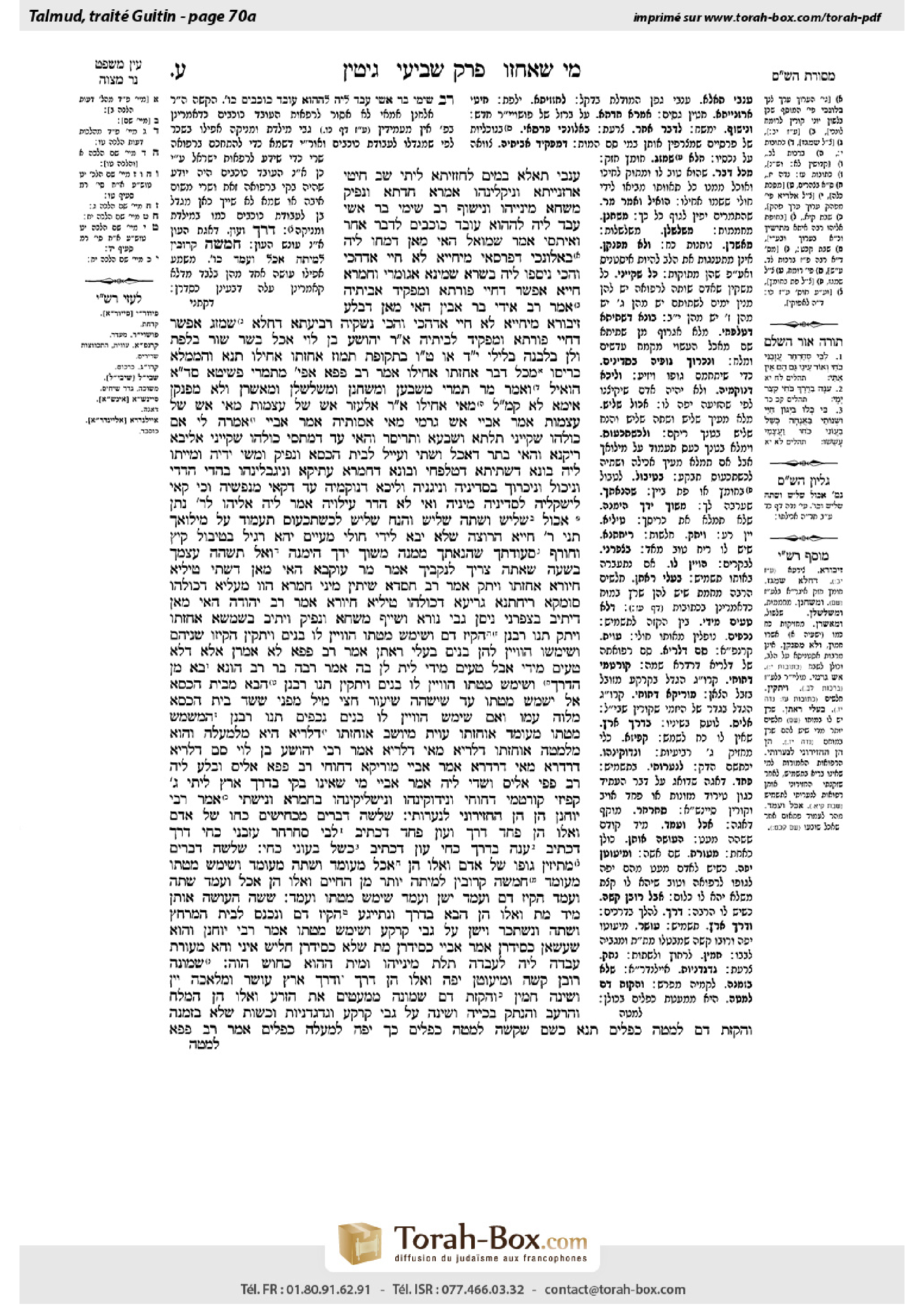
Gittin 70a: Talmud study for Daf Yomi
Study the Talmud for Daf Yomi with scanned pages, Hebrew text, English translations from Sefaria and AI-generated French translations.
Passage selection and English or AI-generated French translation are available where the scan has annotations. Daf Study is independent of Torah-Box and Sefaria.
Browse Gittin · גיטין · All tractatesGittin 70a text and translations
This page of Gittin includes the Aramaic text, an English translation and an AI-generated French translation, alongside the scan above.
גיטין ע׳ א · Aramaic and Hebrew text
עִנְבֵי תַאֲלָא בְּמַיִם.
לַחֲזָזִיתָא – לַיְתֵי שַׁב חִיטֵּי אַרְזַנְיָיתָא, וְנִיקְלִינְהוּ אַמָּרָא חַדְתָּא, וְנָפֵיק מִשְׁחָא מִינַּיְיהוּ, וְנֵישׁוּף. רַב שִׁימִי בַּר אָשֵׁי עֲבַד לֵיהּ לְהָהוּא גּוֹי לְדָבָר אַחֵר, וְאִיתַּסִּי.
אָמַר שְׁמוּאֵל: הַאי מַאן דִּמְחוֹ לֵיהּ בַּאֲלוֹנְכֵּי דְפָרְסָאֵי, מִיחְיָיא לָא חָיֵי; אַדְּהָכִי וְהָכִי, נִיסְפּוֹ לֵיהּ בִּשְׂרָא שַׁמִּינָא אַגּוּמְרֵי, וְחַמְרָא חַיָּיא, אֶפְשָׁר דְּחָיֵי פּוּרְתָּא וּמְפַקֵּיד אַבֵּיתֵיהּ.
אָמַר רַב אִידִי בַּר אָבִין: הַאי מַאן דִּבְלַע זִיבּוּרָא – מִיחְיָיא לָא חָיֵי, אַדְּהָכִי וְהָכִי נַשְׁקְיֵהּ רְבִיעֵתָא דְּחַלָּא שַׁמְגָּז, אֶפְשָׁר דְּחָיֵי פּוּרְתָּא וּמְפַקֵּיד לְבֵיתֵיהּ.
אָמַר רַבִּי יְהוֹשֻׁעַ בֶּן לֵוִי: אָכַל בְּשַׂר שׁוֹר בְּלֶפֶת, וְלָן בַּלְּבָנָה בְּלֵילֵי אַרְבָּעָה עָשָׂר אוֹ חֲמִשָּׁה עָשָׂר בִּתְקוּפַת תַּמּוּז – אֹחַזְתּוֹ אֲחִילוּ.
תָּנָא: וְהַמְמַלֵּא כְּרֵיסוֹ מִכׇּל דָּבָר, אֹחַזְתּוֹ אֲחִילוּ. אָמַר רַב פָּפָּא: אֲפִילּוּ מִתַּמְרֵי. פְּשִׁיטָא! סָלְקָא דַּעְתָּךְ אָמֵינָא, הוֹאִיל וְאָמַר מָר: תַּמְרֵי – מַשְׂבְּעָן, וּמְשַׁחֲנָן, וּמְשַׁלְשְׁלָן, וּמְאַשְּׁרָן וְלָא מְפַנְּקָן; אֵימָא לָא, קָא מַשְׁמַע לַן.
מַאי אֲחִילוּ? אָמַר רַבִּי אֶלְעָזָר: אֵשׁ שֶׁל עֲצָמוֹת. מַאי ״אֵשׁ שֶׁל עֲצָמוֹת״? אָמַר אַבָּיֵי: אֵשׁ גַּרְמֵי.
מַאי אָסוּתֵיהּ? אָמַר אַבָּיֵי, אֲמַרָה לִי אֵם: כּוּלְּהוּ שַׁקְיָינֵי – תְּלָתָא, וְשִׁבְעָא, וּתְרֵיסַר; וְהַאי – עַד דְּמִתַּסֵּי.
כּוּלְּהוּ שַׁקְיָינֵי – אַלִּיבָּא רֵיקָנָא, וְהַאי – בָּתַר דְּאָכֵל, וְשָׁתֵי, וְעָיֵיל לְבֵית הַכִּסֵּא, וְנָפֵיק וּמָשֵׁי יְדֵיהּ. וּמַיְיתוּ לֵיהּ בּוּנָא דִּשְׁתִיתָא דִּטְלָפְחֵי, וּבוּנָא דְּחַמְרָא עַתִּיקָא, וְנִיגְבְּלִינְהוּ בַּהֲדֵי הֲדָדֵי וְנֵיכוֹל; וְנִיכְרוֹךְ בִּסְדִינֵיהּ, וְנַיגְנְיֵהּ, וְלֵיכָּא דְּנוֹקְמֵיהּ עַד דְּקָאֵי מִנַּפְשֵׁיהּ; וְכִי קָאֵי, לִישְׁקְלֵיהּ לִסְדִינֵיהּ מִינֵּיהּ, וְאִי לָא, הָדַר עִילָּוֵיהּ.
אֲמַר לֵיהּ אֵלִיָּהוּ לְרַבִּי נָתָן: אֱכוֹל שְׁלִישׁ וּשְׁתֵה שְׁלִישׁ וְהַנַּח שְׁלִישׁ – לִכְשֶׁתִּכְעוֹס, תַּעֲמוֹד עַל מִילּוּאֶךָ.
תָּנֵי רַבִּי חִיָּיא: הָרוֹצֶה שֶׁלֹּא יָבֹא לִידֵי חוֹלִי מֵעַיִים, יְהֵא רָגִיל בְּטִיבּוּל – קַיִץ וָחוֹרֶף; סְעוּדָתְךָ שֶׁהֲנָאָתְךָ מִמֶּנָּה – מְשׁוֹךְ יָדְךָ הֵימֶנָּה; וְאַל תְּשַׁהֶה עַצְמְךָ בְּשָׁעָה שֶׁאַתָּה צָרִיךְ לִנְקָבֶיךָ.
אָמַר מָר עוּקְבָא: הַאי מַאן דְּשָׁתֵי טִילְיָא חִיוָּרָא – אֹחַזְתּוֹ וִיתֵּק. אָמַר רַב חִסְדָּא: שִׁיתִּין מִינֵי חַמְרָא הֲווֹ, מְעַלְּיָא דְּכוּלְּהוּ – סוּמָּקָא רֵיחָתָנָא, גְּרִיעָא דְּכוּלְּהוּ – טִילְיָא חִיוָּרָא.
אָמַר רַב יְהוּדָה: הַאי מַאן דְּיָתֵיב בְּצַפְרָנֵי נִיסָן גַּבֵּי נוּרָא, וְשָׁיֵיף מִשְׁחָא, וְנָפֵיק וְיָתֵיב בְּשִׁמְשָׁא – אֹחַזְתּוֹ וִיתַּק.
תָּנוּ רַבָּנַן: הִקִּיז דָּם וְשִׁימֵּשׁ מִטָּתוֹ – הוֹוִיין לוֹ בָּנִים וִיתְּקִין. הִקִּיזוּ שְׁנֵיהֶם וְשִׁימְּשׁוּ – הוֹוִיין לָהֶן בָּנִים בַּעֲלֵי רָאתָן. אָמַר רַב פָּפָּא: לָא אֲמַרַן אֶלָּא דְּלָא טָעֵים מִידֵּי, אֲבָל טָעֵים מִידֵּי – לֵית לַן בַּהּ.
אָמַר רַבָּה בַּר רַב הוּנָא: בָּא מִן הַדֶּרֶךְ וְשִׁימֵּשׁ מִטָּתוֹ – הוֹוִיין לוֹ בָּנִים וִיתְּקִין. תָּנוּ רַבָּנַן: הַבָּא מִבֵּית הַכִּסֵּא, אַל יְשַׁמֵּשׁ מִטָּתוֹ עַד שֶׁיִּשְׁהֶה שִׁיעוּר חֲצִי מִיל, מִפְּנֵי שֶׁשֵּׁד בֵּית הַכִּסֵּא מְלַוֶּה עִמּוֹ; וְאִם שִׁימֵּשׁ – הוֹוִיין לוֹ בָּנִים נִכְפִּים.
תָּנוּ רַבָּנַן: הַמְשַׁמֵּשׁ מִטָּתוֹ מְעוּמָּד – אוֹחַזְתּוֹ עֲוִית; מְיוּשָּׁב – אוֹחַזְתּוֹ דָּלָרְיָא; הִיא מִלְּמַעְלָה וְהוּא מִלְּמַטָּה – אוֹחַזְתּוֹ דָּלָרְיָא.
מַאי דָּלָרְיָא? אָמַר רַבִּי יְהוֹשֻׁעַ בֶּן לֵוִי: סַם דָּלָרְיָא – דַּרְדָּרָא. מַאי דַּרְדָּרָא? אָמַר אַבָּיֵי: מוֹרִיקָא דְחוֹחֵי. רַב פָּפָּא אָלֵיס וּבָלַע לֵיהּ. רַב פַּפֵּי אָלֵיס וְשָׁדֵי לֵיהּ.
אָמַר אַבָּיֵי: מִי שֶׁאֵינוֹ בָּקִי בְּדֶרֶךְ אֶרֶץ, לֵיתֵי שְׁלֹשָׁה קְפִיזֵי קוּרְטְמֵי דְחוֹחֵי, וְנֵידוּקִינְהוּ, וְנִישְׁלְקִינְהוּ בְּחַמְרָא וְנִישְׁתֵּי. אֲמַר רַבִּי יוֹחָנָן: הֵן הֵן הֶחְזִירוּנִי לְנַעֲרוּתִי.
שְׁלֹשָׁה דְּבָרִים מַכְחִישִׁים כֹּחוֹ שֶׁל אָדָם, וְאֵלּוּ הֵן: פַּחַד, דֶּרֶךְ וְעָוֹן. פַּחַד – דִּכְתִיב: ״לִבִּי סְחַרְחַר עֲזָבַנִי כֹחִי״. דֶּרֶךְ – דִּכְתִיב: ״עִנָּה בַדֶּרֶךְ כֹּחִי״. עָוֹן – דִּכְתִיב: ״כָּשַׁל בַּעֲוֹנִי כֹחִי״.
שְׁלֹשָׁה דְּבָרִים מַתִּיזִין גּוּפוֹ שֶׁל אָדָם, וְאֵלּוּ הֵן: אָכַל מְעוּמָּד, וְשָׁתָה מְעוּמָּד, וְשִׁימֵּשׁ מִטָּתוֹ מְעוּמָּד.
חֲמִשָּׁה קְרוֹבִין לְמִיתָה יוֹתֵר מִן הַחַיִּים, וְאֵלּוּ הֵן: אָכַל וְעָמַד, שָׁתָה וְעָמַד, הִקִּיז דָּם וְעָמַד, יָשֵׁן וְעָמַד, שִׁימֵּשׁ מִטָּתוֹ וְעָמַד.
שִׁשָּׁה, הָעוֹשֶׂה אוֹתָן – מִיָּד מֵת, וְאֵלּוּ הֵן: הַבָּא בַּדֶּרֶךְ וְנִתְיַיגַּע, הִקִּיז דָּם, וְנִכְנַס לְבֵית הַמֶּרְחָץ, וְשָׁתָה וְנִשְׁתַּכֵּר, וְיָשַׁן עַל גַּבֵּי קַרְקַע, וְשִׁימֵּשׁ מִטָּתוֹ. אָמַר רַבִּי יוֹחָנָן: וְהוּא שֶׁעֲשָׂאָן כְּסִידְרָן.
אָמַר אַבָּיֵי: כְּסִידְרָן – מֵת, שֶׁלֹּא כְּסִידְרָן – חָלֵישׁ. אִינִי?! וְהָא מְעוּרַת עֲבַדָה לֵיהּ לְעַבְדַּהּ תְּלָת מִינַּיְיהוּ, וּמִית! הָהוּא כָּחוּשׁ הֲוָה.
שְׁמוֹנָה – רוּבָּן קָשֶׁה וּמִיעוּטָן יָפֶה, וְאֵלּוּ הֵן: דֶּרֶךְ, וְדֶרֶךְ אֶרֶץ, עוֹשֶׁר, וּמְלָאכָה, יַיִן, וְשֵׁינָה, חַמִּין, וְהַקָּזַת דָּם.
שְׁמוֹנָה מְמַעֲטִים אֶת הַזֶּרַע, וְאֵלּוּ הֵן: הַמֶּלַח, וְהָרָעָב, וְהַנֶּתֶק, בְּכִיָּיה, וְשֵׁינָה עַל גַּבֵּי קַרְקַע, וְגֻדְגְּדָנִיּוֹת, וּכְשׁוּת שֶׁלֹּא בִּזְמַנָּהּ, וְהַקָּזַת דָּם לְמַטָּה – כִּפְלַיִם.
תָּנָא: כְּשֵׁם שֶׁקָּשָׁה לְמַטָּה כִּפְלַיִם, כָּךְ יָפָה לְמַעְלָה – כִּפְלַיִם. אָמַר רַב פָּפָּא:
Gittin 70a · English translation
grapes grown by trellising the vine on a palm tree soaked in water.
As a remedy for lichen planus [ḥazazita] on one’s skin, let him bring seven large wheat kernels [arzanayata] and let him roast them over a fire on the blade of a new hoe. And let him extract oil from the wheat and rub it into his skin. It is told: Rav Shimi bar Ashi used this remedy for a certain gentile who had something else, i.e., leprosy, and he was healed.
Shmuel said: One who is struck with Persian spears [alunkei] will not live long afterward, as he will certainly die from this wound. In the meantime, they should force-feed him fatty meat that was roasted over coals, and undiluted wine. If they do this, it is possible that he will live for a little bit longer and have time to instruct his household with regard to what they should do after his death.
Similarly, Rav Idi bar Avin said: One who swallowed a hornet will not live. In the meantime they should give him a quarter-log of sharp [shamzag] vinegar to drink. If they do this, it is possible that he will live for a little bit longer and have time to instruct his household with regard to what they should do after his death.
§ Rabbi Yehoshua ben Levi says: If one ate ox meat with a turnip, and slept by the light of the moon on the night of the fourteenth or the fifteenth of the month in the season of Tammuz, i.e., summer, he will be afflicted with aḥilu, a severe fever.
A Sage taught: And one who fills his stomach with anything, meaning that he eats too much, will be afflicted with aḥilu. Rav Pappa said: Even if he fills his stomach with dates. The Gemara asks: Isn’t this obvious, as Rabbi Yehoshua ben Levi explicitly mentioned if one fills his stomach with anything. The Gemara answers: It might enter your mind to say that since the Master said the following in praise of dates: Dates satisfy the body, warm it up, act as a laxative, strengthen the body, and do not spoil it, one might say that as dates are beneficial, he would not be harmed by eating too many. Nevertheless, it teaches us that they can also cause harm when eaten in excess.
The Gemara asks: What is the affliction aḥilu mentioned here? Rabbi Elazar says: A fire of the bones. The Gemara asks: What is a fire of the bones? Abaye said: This is what is called esh garmei in Aramaic.
What is its remedy? Abaye said: My mother told me that any drink consumed for medicinal purposes should be taken for either three or seven or twelve days, depending on what is necessary for that specific ailment. And if this is taken to treat aḥilu then he must drink it until he is healed.
Any drink consumed for medicinal purposes should be consumed with an empty heart, i.e., without eating first. And for this disease of aḥilu he consumes the medicine after he eats and drinks and enters the bathroom, and exits and washes his hands, and they bring him a fistful of shetita, a type of food made from lentils, and a fistful of aged wine. And let him mix them together and let him eat this mixture. And let him wrap himself with his sheet and sleep. And let there be no one who will awaken him until he awakens on his own. And when he awakens let him remove the sheet from himself. And if he does not do this then the illness will return to him.
§ Elijah the prophet said to Rabbi Natan: Eat a third of your fill, and drink a third of your fill, and leave a third of your fill, so that when you become angry you will become full. If you do this, there will be room, as it were, for the anger. If you become angry when your stomach is full you will be harmed.
Rabbi Ḥiyya teaches: One who does not want to come to a situation whereby he contracts intestinal disease should become accustomed to dipping his food in wine or vinegar, both in the summer and in the winter. He also teaches: You should remove your hand, i.e., stop eating, from a meal that you enjoy so that you do not overeat. And do not delay yourself at the time when it is necessary to relieve yourself.
Mar Ukva said: This one who drinks inferior white wine [tilya] will be afflicted with weakness [vitak]. Rav Ḥisda said: There are sixty types of wine. The best of them all is red, fragrant wine. The worst of them all is inferior white wine.
Rav Yehuda said: This one who sits near the fire during the mornings in the month of Nisan and rubs himself with oil and then goes out and sits in the sun will be afflicted with weakness.
The Sages taught: One who let blood and afterward engaged in sexual intercourse has weak children conceived from those acts of intercourse. If both of them, husband and wife, let blood and engaged in sexual intercourse they will have children afflicted with a disease known as ra’atan. Rav Pappa said: We said this only if he did not taste anything after letting blood. But if he tasted something then we have no problem with it.
Rabba bar Rav Huna says: One who came back from traveling on the road and engaged in sexual intercourse immediately has weak children conceived from those acts of intercourse. The Sages taught: With regard to one who comes in from the bathroom, he should not engage in sexual intercourse until he waits the measure of time it takes to walk half a mil because the demon of the bathroom accompanies him. And if he engaged in sexual intercourse without waiting this measure of time, he has children who are epileptic.
The Sages taught: One who engages in sexual intercourse while standing will be afflicted by spasms. One who engages in sexual intercourse while sitting will be afflicted with dalarya. If she, the woman, is above and he, the husband, is below during sexual intercourse, then he will be afflicted with dalarya.
The Gemara asks: What is dalarya? Rabbi Yehoshua ben Levi said: The remedy for dalarya is dardara. The Gemara asks: What is dardara? Abaye said: Saffron of thorns. Rav Pappa would chew [aleis] and swallow this remedy. Rav Pappi would chew and spit it out.
Abaye says: As a remedy for one who is not an expert, i.e., does not have strength, in the way of the world, i.e., in sexual intercourse, let him bring three vessels [kefizei], each containing three-quarters of a log of safflower thorns. And let him grind them, and boil them in wine, and drink the mixture. Rabbi Yoḥanan says: These are the remedies that return me to my youth with regard to sexual intercourse.
§ Three things diminish a person’s strength, and they are: Fear, traveling on the road, and sin. The Gemara explains: Fear, as it is written: “My heart flutters, my strength fails me” (Psalms 38:11). Traveling on the road, as it is written: “He has weakened my strength on the road” (Psalms 102:24). Sin, as it is written: “My strength fails because of my sin” (Psalms 31:11).
Three things break a person’s body, and they are: If he ate while standing, if he drank while standing, and if he engaged in sexual intercourse while standing.
There are five actions that bring one closer to death than to life, and they are: If he ate and stood up immediately, if he drank and stood up immediately, if he let blood and stood up immediately, if he slept and stood up immediately, and if he engaged in sexual intercourse and stood up immediately.
With regard to one who performs the following acts, if he performs the six of them consecutively he dies immediately, and they are: If one came back from a journey on the road and was exhausted, let blood, and entered the bathhouse, and drank and became intoxicated, and slept on the ground, and engaged in sexual intercourse, then he will die. Rabbi Yoḥanan says: But he will die for certain only in the case where he performs them in this order.
Abaye said: If he performs these actions in this order he will die. But if he performs them out of order he will become weak. The Gemara asks: Is that so? But didn’t a woman named Me’oret make her slave perform three of these actions and he died as a result? The Gemara answers: That slave was weak, which is why he died. But an ordinary individual would die only upon performing all of these acts in the previously mentioned order.
Eight actions are difficult for the body and the soul to handle in large amounts and are beneficial in small amounts, and they are: Traveling on the road, engaging in the way of the world, i.e., engaging in sexual intercourse, having wealth, work, drinking wine, sleep, hot water, and bloodletting.
Eight actions or illnesses decrease the semen, and they are: Salt, hunger, a skin disease called netek, crying, sleeping on the ground, the melilot plant, and dodder eaten not in its time, i.e., before it is ripe. And bloodletting performed below, on the lower portion of the body, causes twice as much harm as the other actions mentioned.
The Sage taught: Just as bloodletting below causes twice as much harm, so too, bloodletting above, on the upper portion of the body, is twice as effective. Rav Pappa said:
Gittin 70a · Traduction française (IA)
des raisins cultivés en les trellisant sur un palmier trempé dans l'eau.
Comme remède contre le lichen plan (ḥazazita) sur la peau, qu'on lui apporte sept gros grains de blé (arzanayata) et qu'on les frotte sur un feu sur la lame d'une faux neuve. Et qu'on extraye l'huile du blé et qu'on la frotte sur sa peau. On raconte : Rav Shimi bar Ashi a utilisé ce remède pour un certain non-Juif qui avait une autre maladie, à savoir la lepra, et il s'est guéri.
Shmuel a dit : Celui qui est frappé par des lances perses (alunkei) ne vivra pas longtemps après, car il mourra certainement de cette blessure. Pendant ce temps, on doit lui administrer de la viande grasse cuite sur des braises et du vin non dilué. Si on fait cela, il est possible qu'il survive un peu plus longtemps et qu'il ait le temps d'instruire sa famille sur ce qu'ils doivent faire après sa mort.
De même, Rav Idi bar Avin a dit : Celui qui a avalé un guêpier ne vivra pas. Pendant ce temps, on doit lui donner à boire un quart de log de vinaigre piquant (shamzag). Si on fait cela, il est possible qu'il survive un peu plus longtemps et qu'il ait le temps d'instruire sa famille sur ce qu'ils doivent faire après sa mort.
§ Rabbi Yehoshua ben Levi dit : Si l'on mange de la viande de bœuf avec un chou et qu'on dort à la lumière de la lune la nuit du quatorzième ou du quinzième du mois, pendant la saison de Tammuz, c'est-à-dire l'été, il sera atteint d'une ḥilu, une fièvre grave.
Un Sage a enseigné : Et celui qui remplit son estomac avec n'importe quoi, c'est-à-dire qui mange trop, sera atteint d'une ḥilu. Rav Pappa a dit : Même s'il remplit son estomac avec des dattes. La Guemara demande : Ce n'est pas évident, puisque Rabbi Yehoshua ben Levi a explicitement mentionné le cas où l'on remplit son estomac avec n'importe quoi. La Guemara répond : On pourrait penser que, puisque le Maître a dit en l'honneur des dattes : Les dattes rassasient le corps, le réchauffent, agissent comme un laxatif, renforcent le corps et ne le gâtent pas, on pourrait dire que, comme les dattes sont bénéfiques, on ne sera pas atteint en mangeant trop. Cependant, cela nous apprend que, lorsqu'elles sont mangées en excès, elles peuvent aussi causer des dommages.
La Guemara demande : Quelle est l'affliction d'achilu mentionnée ici ? Rabbi Elazar dit : Un feu des os. La Guemara demande : Qu'est-ce qu'un feu des os ? Abaye a dit : C'est ce qu'on appelle esh garmei en araméen.
Quel est le remède ? Abaye a dit : Ma mère m'a dit que tout breuvage consommé à des fins médicales doit être pris pendant trois, sept ou douze jours, selon ce qui est nécessaire pour cette maladie spécifique. Et si on le prend pour traiter l'achilu, il doit boire jusqu'à ce qu'il se guérisse.
Tout breuvage consommé à des fins médicales doit être consommé avec un cœur vide, c'est-à-dire sans avoir mangé auparavant. Et pour cette maladie d'achilu, il consomme le médicament après avoir mangé et bu et être allé aux toilettes, puis il sort, se lave les mains, et on lui apporte une poignée de shetita, un type de nourriture faite de lentilles, et une poignée de vin âgé. Et qu'on les mélange et qu'il mange ce mélange. Et qu'il se couvre avec sa couverture et dorme. Et qu'il n'y ait personne pour le réveiller jusqu'à ce qu'il s'éveille tout seul. Et quand il s'éveille, qu'on lui retire la couverture. Et si on ne fait pas cela, la maladie reviendra.
§ Elie le prophète a dit à Rabbi Natan : Mange un tiers de ce que tu as à manger, bois un tiers de ce que tu as à boire, et laisse un tiers de ce que tu as à manger, afin que quand tu te fâches, tu sois plein. Si tu fais cela, il y aura de la place, comme si, pour la colère. Si tu te fâches quand ton estomac est plein, tu seras blessé.
Rabbi Ḥiyya enseigne : Celui qui ne veut pas se mettre dans une situation où il contracte une maladie intestinale devrait s'habituer à tremper sa nourriture dans du vin ou du vinaigre, à la fois en été et en hiver. Il enseigne aussi : Tu devrais retirer ta main, c'est-à-dire arrêter de manger, d'un repas que tu apprécies, afin de ne pas manger trop. Et ne retarde pas le moment où il est nécessaire de se soulager.
Mar Ukva a dit : Celui qui boit un vin blanc inférieur (tilya) sera atteint de faiblesse (vitak). Rav Ḥisda a dit : Il y a soixante types de vin. Le meilleur d'entre eux est un vin rouge, parfumé. Le pire d'entre eux est un vin blanc inférieur.
Rav Yehuda a dit : Celui qui s'assoit près du feu pendant les matins du mois de Nisan, se frotte avec de l'huile et sort ensuite pour s'exposer au soleil sera atteint de faiblesse.
Les Sages ont enseigné : Celui qui a saigné et a ensuite eu des relations sexuelles a des enfants faibles conçus à partir de ces actes. Si à la fois le mari et la femme saignent et ont des relations sexuelles, ils auront des enfants atteints d'une maladie connue sous le nom de ra’atan. Rav Pappa a dit : Nous avons dit cela seulement si l'homme n'avait pas goûté quelque chose après avoir saigné. Mais si l'homme a goûté quelque chose, nous n'avons pas de problème.
Rabba bar Rav Huna dit : Celui qui est revenu d'un voyage sur la route et a immédiatement eu des relations sexuelles a des enfants faibles conçus à partir de ces actes. Les Sages ont enseigné : Concernant celui qui sort de la salle de toilette, il ne devrait pas avoir des relations sexuelles avant d'avoir attendu le temps nécessaire pour marcher demi-mil, car le démon de la salle de toilette l'accompagne. Et si l'homme a eu des relations sexuelles sans attendre ce temps, il a des enfants épileptiques.
Les Sages ont enseigné : Celui qui a des relations sexuelles debout sera atteint de convulsions. Celui qui a des relations sexuelles assis sera atteint de dalarya. Si la femme est au-dessus et l'homme est en dessous pendant les relations sexuelles, alors l'homme sera atteint de dalarya.
La Guemara pose la question : Qu'est-ce que la dalarya ? Rabbi Yéhoshua ben Lévi dit : Le remède contre la dalarya est le dardara. La Guemara pose la question : Qu'est-ce que le dardara ? Abaye dit : Le safran des épineux. Rav Pappa mâchait [aleis] et avalait ce remède. Rav Pappi mâchait et recrachait ce remède.
Abaye dit : En tant que remède pour celui qui n'est pas un expert, c'est-à-dire qui n'a pas la force, dans la voie du monde, c'est-à-dire dans les relations sexuelles, qu'il apporte trois récipients [kefizei], chacun contenant trois quarts de log de cactus épineux. Et qu'il les mélange, et les fait bouillir dans du vin, et boive la mixture. Rabbi Yoḥanan dit : Ces sont les remèdes qui me ramènent à ma jeunesse en ce qui concerne les relations sexuelles.
§ Trois choses affaiblissent la force d'une personne, et ce sont : La peur, le voyage sur la route, et le péché. La Guemara explique : La peur, comme il est écrit : « Mon cœur tremble, ma force me fait défaut » (Psaumes 38:11). Le voyage sur la route, comme il est écrit : « Il a affaibli ma force sur la route » (Psaumes 102:24). Le péché, comme il est écrit : « Ma force me fait défaut à cause de mon péché » (Psaumes 31:11).
Trois choses brisent le corps d'une personne, et ce sont : s'il mange debout, s'il boit debout, et s'il a des relations sexuelles debout.
Il y a cinq actions qui rapprochent une personne de la mort plutôt que de la vie, et ce sont : s'il mange et se lève immédiatement, s'il boit et se lève immédiatement, s'il fait saigner et se lève immédiatement, s'il dort et se lève immédiatement, et s'il a des relations sexuelles et se lève immédiatement.
En ce qui concerne celui qui effectue les actions suivantes, s'il les effectue les six consécutivement, il meurt immédiatement, et ce sont : s'il revient d'un voyage sur la route et est épuisé, fait saigner, entre dans la bain, boit et devient ivre, dort sur le sol, et a des relations sexuelles, alors il mourra. Rabbi Yoḥanan dit : Mais il mourra certainement uniquement dans le cas où il les effectue dans cet ordre.
Abaye dit : S'il effectue ces actions dans cet ordre, il mourra. Mais s'il les effectue dans un ordre différent, il s'affaiblira. La Guemara pose la question : Est-ce ainsi ? Mais n'a-t-il pas été rapporté qu'une femme nommée Me'oret faisait exécuter à son serviteur trois de ces actions et il mourut en conséquence ? La Guemara répond : Ce serviteur était faible, ce qui est pourquoi il mourut. Mais un individu ordinaire mourrait uniquement en effectuant toutes ces actions dans l'ordre mentionné auparavant.
Huit actions sont difficiles pour le corps et l'âme à exécuter en grande quantité et bénéfiques en petite quantité, et ce sont : Le voyage sur la route, l'engagement dans la voie du monde, c'est-à-dire les relations sexuelles, la richesse, le travail, la boisson de vin, le sommeil, l'eau chaude, et le saignement.
Huit actions ou maladies diminuent le sperme, et ce sont : Le sel, la faim, une maladie cutanée appelée netek, les larmes, dormir sur le sol, la plante melilot, et le dodder mangé avant son temps, c'est-à-dire avant qu'il ne soit mûr. Et le saignement effectué en bas, sur la partie inférieure du corps, cause deux fois plus de dommages que les autres actions mentionnées.
Le Sage enseignait : Comme le saignement en bas cause deux fois plus de dommages, ainsi le saignement en haut, sur la partie supérieure du corps, est deux fois plus efficace. Rav Pappa dit :
Traduction française générée par IA à partir de l’édition anglaise de Sefaria. Vérifie toujours un passage avec le texte source.
Text from Sefaria: William Davidson Edition - Vocalized Aramaic (CC BY NC); William Davidson Edition - English (CC BY NC).