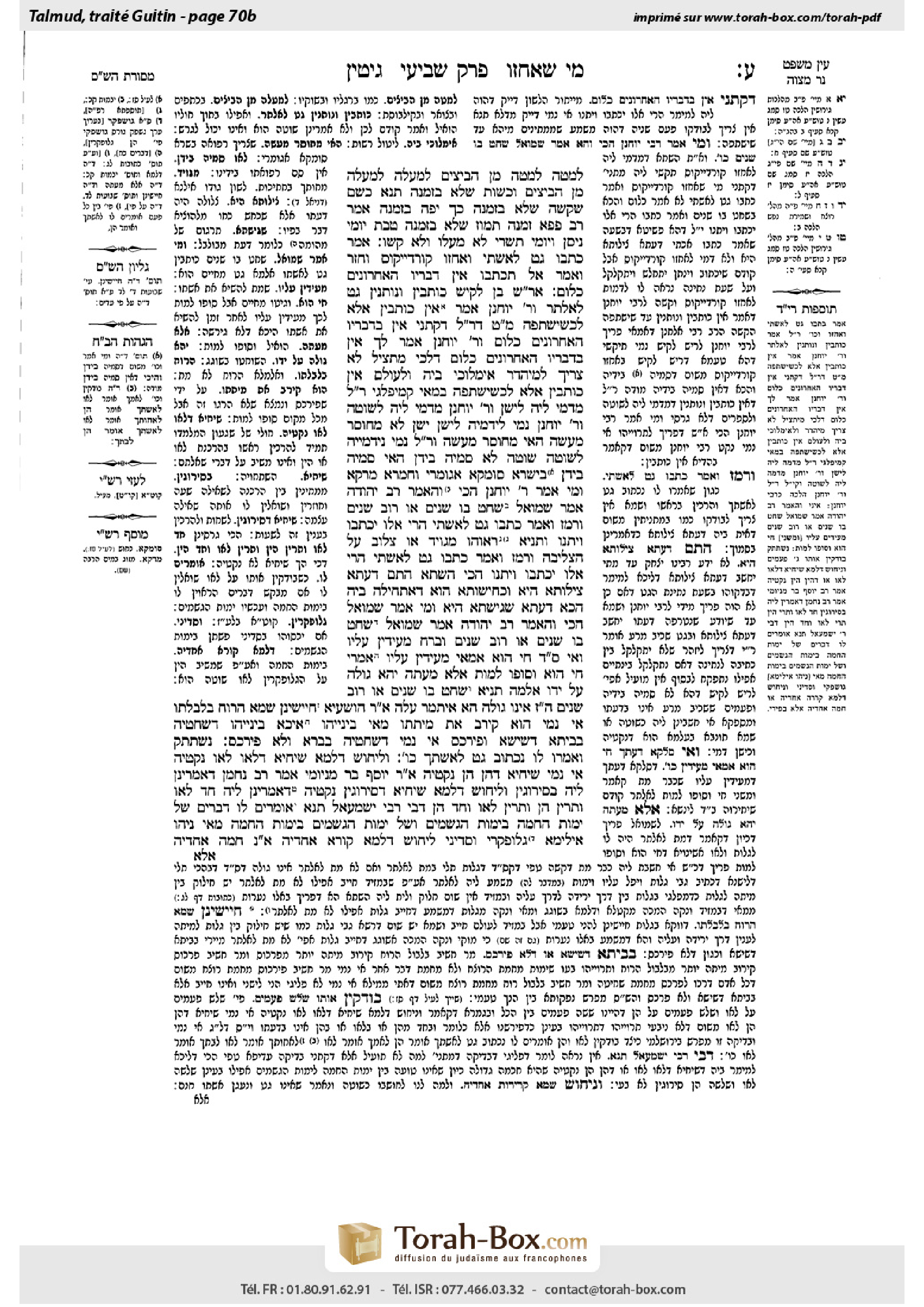
Gittin 70b: Talmud study for Daf Yomi
Study the Talmud for Daf Yomi with scanned pages, Hebrew text, English translations from Sefaria and AI-generated French translations.
Passage selection and English or AI-generated French translation are available where the scan has annotations. Daf Study is independent of Torah-Box and Sefaria.
Browse Gittin · גיטין · All tractatesGittin 70b text and translations
This page of Gittin includes the Aramaic text, an English translation and an AI-generated French translation, alongside the scan above.
גיטין ע׳ ב · Aramaic and Hebrew text
לְמַטָּה – לְמַטָּה מִן הַבֵּיצִים, לְמַעְלָה – לְמַעְלָה מִן הַבֵּיצִים.
וּכְשׁוּת שֶׁלֹּא בִּזְמַנָּהּ. תָּנָא: כְּשֵׁם שֶׁקָּשָׁה שֶׁלֹּא בִּזְמַנָּהּ, כָּךְ יָפָה בִּזְמַנָּהּ. אָמַר רַב פָּפָּא: זְמַנָּהּ – תַּמּוּז, שֶׁלֹּא בִּזְמַנָּהּ – טֵבֵת, יוֹמֵי נִיסָן וְיוֹמֵי תִּשְׁרֵי – לָא מְעַלּוּ וְלָא קָשׁוּ.
אָמַר: ״כִּתְבוּ גֵּט לְאִשְׁתִּי״, וַאֲחָזוֹ קוּרְדְּיָיקוֹס, וְחָזַר וְאָמַר: ״אַל תִּכְתְּבוּ״ – אֵין דְּבָרָיו הָאַחֲרוֹנִים כְּלוּם. אָמַר רַבִּי שִׁמְעוֹן בֶּן לָקִישׁ: כּוֹתְבִין וְנוֹתְנִין גֵּט לְאַלְתַּר. וְרַבִּי יוֹחָנָן אָמַר: אֵין כּוֹתְבִין אֶלָּא לִכְשֶׁיִּשְׁתַּפֶּה.
מַאי טַעְמָא דְּרֵישׁ לָקִישׁ? דְּקָתָנֵי: אֵין בִּדְבָרָיו הָאַחֲרוֹנִים כְּלוּם. וְרַבִּי יוֹחָנָן אָמַר לָךְ: אֵין בִּדְבָרָיו הָאַחֲרוֹנִים כְּלוּם – דִּלְכִי מִתְּצִיל לָא צְרִיךְ לְמִיהְדַּר אִימְּלוֹכֵי בֵּיהּ; וּלְעוֹלָם אֵין כּוֹתְבִין אֶלָּא לִכְשֶׁיִּשְׁתַּפֶּה.
בְּמַאי קָמִיפַּלְגִי? רֵישׁ לָקִישׁ מְדַמֵּי לֵיהּ לְיָשֵׁן, וְרַבִּי יוֹחָנָן מְדַמֵּי לֵיהּ לְשׁוֹטֶה.
וְרַבִּי יוֹחָנָן נָמֵי לִידַמְּיֵהּ לְיָשֵׁן! יָשֵׁן – לָא מְחוּסָּר מַעֲשֶׂה, הַאי – מְחוּסָּר מַעֲשֶׂה.
וְרֵישׁ לָקִישׁ נָמֵי נִידַמְּיֵיהּ לְשׁוֹטֶה! שׁוֹטֶה לָא סַמֵּיהּ בִּידַן, הַאי, סַמֵּיהּ בִּידַן – בִּישְׂרָא סוּמָּקָא אַגּוּמְרֵי, וְחַמְרָא מַרְקָא.
וּמִי אָמַר רַבִּי יוֹחָנָן הָכִי?! וְהָאָמַר רַב יְהוּדָה אָמַר שְׁמוּאֵל: שָׁחַט בּוֹ שְׁנַיִם, אוֹ רוֹב שְׁנַיִם, וְרָמַז וְאָמַר: ״כִּתְבוּ גֵּט לְאִשְׁתִּי״ – הֲרֵי אֵלּוּ יִכְתְּבוּ וְיִתְּנוּ;
וְתַנְיָא: רָאוּהוּ מְגוּיָּד אוֹ צָלוּב עַל הַצְּלִיבָה, וְרָמַז וְאָמַר: ״כִּתְבוּ גֵּט לְאִשְׁתִּי״ – הֲרֵי אֵלּוּ יִכְתְּבוּ וְיִתְּנוּ!
הָכִי הַשְׁתָּא?! הָתָם דַּעְתָּא צִילּוּתָא הִיא, וּכְחִישׁוּתָא הוּא דְּאַתְחִילָה בֵּיהּ; הָכָא דַּעְתָּא שְׁגִישְׁתָּא הִיא.
וּמִי אָמַר שְׁמוּאֵל הָכִי?! וְהָאָמַר רַב יְהוּדָה אָמַר שְׁמוּאֵל: שָׁחַט בּוֹ שְׁנַיִם אוֹ רוֹב שְׁנַיִם, וּבָרַח – מְעִידִין עָלָיו. וְאִי סָלְקָא דַעְתָּךְ חַי הוּא, אַמַּאי מְעִידִין עָלָיו?
אָמְרִי: חַי הוּא – וְסוֹפוֹ לָמוּת.
אֶלָּא מֵעַתָּה, יְהֵא גּוֹלֶה עַל יָדוֹ! אַלְּמָה תַּנְיָא: שָׁחַט בּוֹ שְׁנַיִם אוֹ רוֹב שְׁנַיִם – הֲרֵי זֶה אֵינוֹ גּוֹלֶה?
הָא אִיתְּמַר עֲלַהּ, אָמַר רַבִּי הוֹשַׁעְיָא: חָיְישִׁינַן שֶׁמָּא הָרוּחַ בִּלְבְּלַתּוּ. אִי נָמֵי, הוּא קֵירַב אֶת מִיתָתוֹ.
מַאי בֵּינַיְיהוּ? אִיכָּא בֵּינַיְיהוּ דְּשַׁחְטֵיהּ בְּבֵיתָא דְשֵׁישָׁא, וּפַירְכֵּס. אִי נָמֵי, דְּשַׁחְטֵיהּ בְּבָרָא, וְלָא פַּירְכֵּס.
נִשְׁתַּתֵּק, וְאָמְרוּ לוֹ: ״נִכְתּוֹב גֵּט לְאִשְׁתְּךָ״ כּוּ׳. וְלֵיחוּשׁ דִּלְמָא שִׁיחְיָא דְּ״לָאו לָאו״ נַקְטֵיהּ, אִי נָמֵי שִׁיחְיָא דְּ״הֵן הֵן״ נַקְטֵיהּ!
אָמַר רַב יוֹסֵף בַּר מִנְיוֹמֵי אָמַר רַב נַחְמָן: דְּאָמְרִינַן לֵיהּ בְּסֵירוּגִין.
וְלֵיחוּשׁ דִּלְמָא שִׁיחְיָא דְּסֵירוּגִין נַקְטֵיהּ! דְּאָמְרִינַן לֵיהּ חַד ״לָאו״ וּתְרֵין ״הֵן״, וּתְרֵין ״לָאו״ וְחַד ״הֵן״.
דְּבֵי רַבִּי יִשְׁמָעֵאל תָּנָא: אוֹמְרִים לוֹ דְּבָרִים שֶׁל יְמוֹת הַחַמָּה בִּימוֹת הַגְּשָׁמִים, וְשֶׁל יְמוֹת הַגְּשָׁמִים בִּימוֹת הַחַמָּה.
מַאי נִיהוּ? אִילֵּימָא גְּלוּפְקְרֵי וּסְדִינֵי – לֵיחוּשׁ דִּלְמָא קוֹרָא אַחְדֵּיהּ, אִי נָמֵי חַמָּה אַחְדֵּיהּ!
Gittin 70b · English translation
When the Gemara mentioned letting blood from below it meant below the testicles, and when it mentioned letting blood from above it meant above the testicles.
It was taught: And dodder eaten not in its time, before it is ripe, causes harm. The Gemara explains: A Sage taught: Just as eating dodder not in its time is harmful to the body, so too, eating it in its time, when it is ripe, is good for the body. Rav Pappa said: Its time is Tammuz, in the summer, and not in its time is Tevet, in the winter. And during the days of Nisan, spring, and the days of Tishrei, autumn, they neither help nor harm.
§ The Gemara returns to its discussion of the halakhot mentioned in the mishna. The mishna teaches: If he said: Write a bill of divorce for my wife, when he was lucid, and was then afflicted with temporary insanity and he retracted his previous statement and said: Do not write it, his latter statement is considered to be nothing, i.e., it is not halakhically valid. The Gemara comments on this that Rabbi Shimon ben Lakish says: In that case the court writes and gives the bill of divorce immediately, because even though he is insane, the court does not wait for him to return to his senses. And Rabbi Yoḥanan says: They write this bill of divorce based on his instructions only once he is healed and returns to a sound state of mind.
The Gemara elaborates: What is the reason for the opinion of Reish Lakish? As it teaches in the mishna: His final statement is considered to be nothing, which indicates that his initial statement stands and the court should act in accordance with his instructions. By contrast, Rabbi Yoḥanan could have said to you as follows: When the mishna said that his final statement is considered to be nothing it means that when his mind becomes lucid it is not necessary for the court to return and confirm his instructions; rather, they rely on his statement. But the court actually writes the bill of divorce only once he is healed.
The Gemara asks: With regard to what principle do Reish Lakish and Rabbi Yoḥanan disagree? Reish Lakish compares one afflicted with temporary insanity to one who is sleeping. If one said to write a bill of divorce and went to sleep then the court may write it without waiting for him to awaken. And Rabbi Yoḥanan compares him to an imbecile: When he is afflicted with temporary insanity he is not of sound mind and is therefore unfit to give a bill of divorce.
The Gemara asks: And Rabbi Yoḥanan also could compare him to one who is sleeping, so why does he not do so? The Gemara answers: One who is sleeping is not lacking an action, meaning that no action is needed in order to awaken him, and he can awaken on his own. This one, who is afflicted with temporary insanity, is lacking an action by not taking the remedy mentioned earlier.
The Gemara asks: And Reish Lakish could also compare him to an imbecile, so why does he not do so? The Gemara answers: There is a difference, as there is no remedy in our possession that can cure an imbecile. And since there is no remedy, a bill of divorce may not be written on his behalf. By contrast, for this one, who is afflicted with temporary insanity, there is a remedy in our possession. As the Gemara explained (67b): The remedy for this disease is for the afflicted person to eat lean red meat roasted over coals and drink wine that has been diluted with a large amount of water.
The Gemara asks: But did Rabbi Yoḥanan actually say this, that the court must wait for him to regain his mental capabilities? But didn’t Rav Yehuda say that Shmuel says: If one was attacked by another who slit his throat and severed the two pipes, his trachea and esophagus, or the majority of the two pipes, and the dying man signaled and thereby stated through his gestures: Write a bill of divorce for my wife, then those present should write and give a bill of divorce to his wife?
And it was similarly taught in a baraita: If they saw a man whose limbs had been severed or crucified on a cross, and he signaled and thereby stated: Write a bill of divorce for my wife, then those present should write and give the document to his wife. This teaches that it is permitted to write a bill of divorce even on behalf of one who cannot be cured and will certainly die. If so, why does Rabbi Yoḥanan claim that a bill of divorce may be written for someone afflicted with temporary insanity only once he has been cured?
The Gemara rejects this: How can these cases be compared? There, after his throat was slit or he was crucified, his mind is lucid, but he has begun to feel weakness and will die very soon. Consequently, he cannot speak, but his intellectual capabilities are assumed to be intact. But here, in the case of one afflicted with temporary insanity, his mind is confused, and he is not lucid enough to act with intent.
The Gemara asks: But did Shmuel actually say this, that someone whose throat has been slit is treated as though he is alive, and he can give a bill of divorce? But didn’t Rav Yehuda say that Shmuel says: If someone slit the two pipes in his throat or the majority of the two pipes and the victim fled without the witnesses seeing what ultimately happened to him, then they may testify with regard to him that he is dead? And if it enters your mind to say that one whose throat has been slit is alive and able to instruct others to write a bill of divorce for his wife, then why can witnesses testify with regard to him that he is dead?
The Gemara says in response to this that he is currently alive and on account of this he can give a bill of divorce to his wife, but ultimately he will certainly die within a short period of time. Consequently, it is possible to testify with certainty that he died later on.
The Gemara asks: If that is so, that he is assumed to have ultimately died, then the one who slit his throat should be exiled on his account if he did so unintentionally. Exile is the punishment for unintentionally killing another. If so, why is it taught in a baraita: If he unintentionally slit the two pipes in his throat or the majority of the two, for example if one dropped a knife and accidentally cut another’s trachea and esophagus, then this one is not exiled?
The Gemara answers: Wasn’t it stated with regard to that baraita that Rabbi Hoshaya says: We are concerned that perhaps the wind made him senseless, and it was not only the one who dropped the knife who caused this man’s death, but also the wind or some other factor. One who only partially causes the death of another is not exiled. Or also perhaps he, the one who had his throat slit, brought his death closer through his convulsions and his death throes.
What is the difference between the first and second explanations with regard to why the killer is not exiled? The difference between them is if he slit his throat in a marble house and the victim convulsed. In such a case the death cannot be attributed to the wind, so according to the first explanation the killer would be exiled. Rather, his death can be attributed to his convulsions, so according to the latter explanation the killer would not be exiled. Alternatively, he slit his throat outside and the victim did not convulse. In such a case the death can be attributed to the wind, so according to the first explanation the killer would not be exiled. Since it cannot be attributed to his convulsions, according to the latter explanation the killer would be exiled.
§ The mishna teaches: In a case where the husband became mute, and the members of the court said to him: Shall we will write a bill of divorce for your wife? And he nodded his head as a signal, and then the court checked his intent three times with different questions; if he said no, shaking his head to questions to which he should have answered no, and yes to questions to which he should have answered yes, this demonstrates that he understands the questions and his intent is clear. The Gemara asks: But let there be a concern that perhaps the involuntary movement of: No, no, took hold of him, and he continuously nods his head as if he were signaling no, even though he does not intend it? Alternatively, perhaps the involuntary movement of: Yes, yes, took hold of him?
Rav Yosef bar Minyumi says that Rav Naḥman says: The meaning of the mishna is that we, the court, say alternating questions to him, switching between asking him questions to which he must answer yes and questions to which he must answer no.
The Gemara asks: But let there be a concern that perhaps alternating involuntary movements took hold of him, such that he switches between nodding his head yes and nodding his head no. The Gemara answers: The meaning of the mishna is that we, the court, say to him questions to which he must answer no once and yes twice, and twice no and one time yes. If he nevertheless answers each question correctly there is no concern that his movements were involuntary.
The school of Rabbi Yishmael taught: The court says to him questions concerning matters of the summer in the rainy season, and concerning matters of the rainy season in the summer, in order to check if he is answering coherently.
The Gemara asks: What are these matters that the court asks him? If we say that the court asks him if he wants a warm coat in the summer or a thin sheet in the rainy season, and he answers that he does, this cannot serve as proof of his intellectual capabilities, as the following is possible: Let there be a concern that perhaps he has the chills even though it is the summer and needs a warm coat. Alternatively, that the heat afflicted him during the rainy season and he requires a thin sheet, in which case his response does not demonstrate a lack of comprehension.
Gittin 70b · Traduction française (IA)
Quand la Guemara a mentionné l'écoulement du sang en dessous, cela signifiait en dessous des testicules, et quand elle a mentionné l'écoulement du sang au-dessus, cela signifiait au-dessus des testicules.
Il a été enseigné : Et le dodder, non mangé à sa saison, avant qu'il ne soit mûr, cause un préjudice. La Guemara explique : Un Sage a enseigné : Tout comme manger du dodder non à sa saison est nuisible pour le corps, ainsi aussi, manger du dodder à sa saison, quand il est mûr, est bénéfique pour le corps. Rav Pappa a dit : Sa saison est le mois de Tammuz, en été, et non à sa saison est le mois de Tevet, en hiver. Et durant les jours de Nisan, printemps, et les jours de Tishrei, automne, ils n'ont ni un effet bénéfique ni un effet nuisible.
§ La Guemara reprend sa discussion des halakhot mentionnés dans la michna. La michna enseigne : S'il a dit : Écris un document de divorce pour ma femme, quand il était lucide, et ensuite il a été atteint d'une folie temporaire et il a rétracté son précédent déclaration et a dit : N'écris pas, son dernier déclaration est considéré comme nul, c'est-à-dire qu'il n'est pas halakhiquement valide. La Guemara commente cela en disant que Rabbi Shimon ben Lakish dit : Dans ce cas, le tribunal écrit et donne immédiatement le document de divorce, car même s'il est fou, le tribunal ne attend pas qu'il retrouve ses esprits. Et Rabbi Yoḥanan dit : Ils écrivent ce document de divorce uniquement sur ses instructions une fois qu'il est guéri et qu'il est revenu à un état sain d'esprit.
La Guemara développe : Quel est le fondement de l'opinion de Reish Lakish ? Comme il enseigne dans la michna : Son dernier discours est considéré comme nul, ce qui indique que son premier discours est valide et que le tribunal devrait agir selon ses instructions. À l'inverse, Rabbi Yoḥanan aurait pu te dire ainsi : Quand la michna a dit que son dernier discours est considéré comme nul, cela signifie que quand son esprit redevient clair, il n'est pas nécessaire pour le tribunal de revenir et de confirmer ses instructions ; plutôt, ils s'appuient sur sa déclaration. Mais le tribunal écrit effectivement le document de divorce uniquement une fois qu'il est guéri.
La Guemara pose la question : Sur quel principe Reish Lakish et Rabbi Yoḥanan s'opposent-ils ? Reish Lakish compare celui qui est atteint d'une folie temporaire à celui qui dort. Si l'on a dit à écrire un document de divorce et qu'il est allé dormir, alors le tribunal peut écrire sans attendre qu'il se réveille. Et Rabbi Yoḥanan compare à un imbécile : Quand il est atteint d'une folie temporaire, il n'est pas d'esprit sain et est donc inapte à donner un document de divorce.
La Guemara pose la question : Et Rabbi Yoḥanan aurait aussi pu le comparer à celui qui dort, pourquoi ne le fait-il pas ? La Guemara répond : Celui qui dort n'a pas manqué d'action, c'est-à-dire qu'il n'y a pas d'action nécessaire pour le réveiller, et il peut se réveiller tout seul. Ce dernier, qui est atteint d'une folie temporaire, manque d'action en ne prenant pas le remède mentionné plus tôt.
La Guemara pose la question : Et Reish Lakish aurait aussi pu le comparer à un imbécile, pourquoi ne le fait-il pas ? La Guemara répond : Il y a une différence, car il n'y a pas de remède à notre disposition pour guérir un imbécile. Et comme il n'y a pas de remède, un document de divorce ne peut pas être écrit à son nom. À l'inverse, pour celui qui est atteint d'une folie temporaire, il y a un remède à notre disposition. Comme la Guemara l'a expliqué (67b) : Le remède pour cette maladie est que la personne atteinte mange de la viande rouge maigre rôtie sur des braises et boit du vin dilué avec une grande quantité d'eau.
La Guemara pose la question : Mais Rabbi Yoḥanan a-t-il vraiment dit cela, que le tribunal doit attendre qu'il retrouve ses capacités mentales ? Mais n'a-t-il pas dit Rav Yehuda que Shmuel dit : Si l'on a été attaqué par un autre qui a tranché sa gorge et a sectionné les deux canaux, la trachée et l'œsophage, ou la majorité des deux canaux, et que le mourant a fait un geste et a ainsi déclaré : Écris un document de divorce pour ma femme, alors ceux présents devraient écrire et donner le document à sa femme ?
Et cela a été enseigné de la même manière dans une baraïta : Si on a vu un homme dont les membres avaient été sectionnés ou crucifiés sur une croix, et qu'il a fait un geste et a ainsi déclaré : Écris un document de divorce pour ma femme, alors ceux présents devraient écrire et donner le document à sa femme. Cela enseigne que c'est permis d'écrire un document de divorce même en faveur de celui qui ne peut être guéri et qui mourra certainement. Si c'est ainsi, pourquoi Rabbi Yoḥanan affirme-t-il que le document de divorce peut être écrit pour celui atteint d'une folie temporaire uniquement une fois qu'il a été guéri ?
La Guemara rejette cela : Comment ces cas peuvent-ils être comparés ? Là-bas, après que sa gorge ait été tranchée ou qu'il ait été crucifié, son esprit est clair, mais il commence à ressentir de la faiblesse et mourra très bientôt. Par conséquent, il ne peut pas parler, mais ses capacités intellectuelles sont supposées être intactes. Ici, dans le cas de celui atteint d'une folie temporaire, son esprit est confus et il n'est pas clair suffisamment pour agir avec l'intention.
La Guemara pose la question : Mais Shmuel a-t-il vraiment dit cela, que celui dont la gorge a été tranchée est traité comme s'il était vivant et peut donner un document de divorce ? Mais n'a-t-il pas dit Rav Yehuda que Shmuel dit : Si quelqu'un a tranché les deux canaux de sa gorge ou la majorité des deux canaux et que la victime a fui sans que les témoins ne voient ce qui s'est réellement passé, alors ils peuvent témoigner à son sujet qu'il est mort ? Et si cela entre en votre tête de dire que celui dont la gorge a été tranchée est vivant et capable d'instruire d'autres à écrire un document de divorce pour sa femme, alors pourquoi les témoins peuvent-ils témoigner à son sujet qu'il est mort ?
La Guemara répond à cela en disant qu'il est actuellement vivant et à cause de cela il peut donner un document de divorce à sa femme, mais finalement il mourra certainement dans un court laps de temps. Par conséquent, il est possible de témoigner avec certitude qu'il est mort plus tard.
La Guemara pose la question : Si c’est ainsi, qu’on suppose qu’il est finalement mort, alors celui qui a tranché sa gorge devrait être exilé à cause de lui s’il l’a fait de manière involontaire. L’exil est la sanction pour avoir involontairement tué un autre. Si c’est ainsi, pourquoi est-il enseigné dans une baraïta : Si l’on tranchait involontairement les deux canaux de sa gorge ou la majorité des deux, par exemple si l’on laissait tomber un couteau et qu’on coupait accidentellement la trachée et l’œsophage d’un autre, alors celui-ci ne serait pas exilé ?
La Guemara répond : N’était-ce pas dit concernant cette baraïta que Rabbi Hoshaya dit : Nous craignons que le vent ait fait perdre connaissance à cette personne, et ce n’est pas seulement celui qui a laissé tomber le couteau qui a causé la mort de cette personne, mais aussi le vent ou un autre facteur. Celui qui cause partiellement la mort d’un autre n’est pas exilé. Ou peut-être que celui qui a eu sa gorge tranchée a rapproché sa mort par ses convulsions et ses souffrances.
Quelle est la différence entre la première et la deuxième explication concernant pourquoi le meurtrier n’est pas exilé ? La différence entre elles est si l’on tranchait la gorge dans une maison de marbre et que la victime convulse. Dans ce cas, la mort ne peut être attribuée au vent, donc selon la première explication le meurtrier serait exilé. Cependant, la mort peut être attribuée à ses convulsions, donc selon l’autre explication le meurtrier ne serait pas exilé. Alternativement, l’on tranchait la gorge en dehors et la victime ne convulsait pas. Dans ce cas, la mort peut être attribuée au vent, donc selon la première explication le meurtrier ne serait pas exilé. Comme elle ne peut être attribuée à ses convulsions, selon l’autre explication le meurtrier serait exilé.
§ La mitsna enseigne : Dans un cas où le mari est devenu muet, et les membres du tribunal lui dirent : Voulons-nous écrire un acte de divorce pour votre femme ? Et il fit signe avec sa tête, et ensuite le tribunal vérifia son intention trois fois avec des questions différentes ; si, en secouant la tête aux questions auxquelles il devait répondre non, il répondit non, et en inclinant la tête aux questions auxquelles il devait répondre oui, il répondit oui, cela montre qu’il comprend les questions et son intention est claire. La Guemara pose la question : Mais qu’il y ait une crainte que peut-être le mouvement involontaire de : Non, non, ait pris le contrôle de lui, et qu’il continue à faire signe avec sa tête comme s’il disait non, même s’il n’a pas l’intention de le faire ? Alternativement, peut-être que le mouvement involontaire de : Oui, oui, ait pris le contrôle de lui ?
Rav Yosef bar Minyumi dit que Rav Naḥman dit : Le sens de la mitsna est que nous, le tribunal, posons des questions alternatives à lui, en alternant entre des questions auxquelles il doit répondre oui et des questions auxquelles il doit répondre non.
La Guemara pose la question : Mais qu’il y ait une crainte que peut-être des mouvements involontaires alternatifs aient pris le contrôle de lui, de sorte qu’il change entre un signe de tête pour oui et un signe de tête pour non. La Guemara répond : Le sens de la mitsna est que nous, le tribunal, posons à lui des questions auxquelles il doit répondre non une fois et oui deux fois, et deux fois non et une fois oui. Si, malgré cela, il répond correctement à chaque question, il n’y a pas de crainte que ses mouvements aient été involontaires.
La maison de Rabbi Yishmael enseigna : Le tribunal pose à lui des questions concernant les affaires de l’été en saison de pluie, et concernant les affaires de la saison de pluie en été, afin de vérifier s’il répond de manière cohérente.
La Guemara pose la question : Quels sont ces affaires que le tribunal lui pose ? Si nous disons que le tribunal lui demande s’il veut un manteau chaud en été ou un linge fin en saison de pluie, et il répond oui, cela ne peut pas servir de preuve de ses capacités intellectuelles, car ceci est possible : qu’il y ait une crainte qu’il ait froid même s’il fait l’été et qu’il ait besoin d’un manteau chaud. Alternativement, que la chaleur l’ait affecté pendant la saison de pluie et qu’il ait besoin d’un linge fin, dans ce cas sa réponse ne démontre pas un manque de compréhension.
Traduction française générée par IA à partir de l’édition anglaise de Sefaria. Vérifie toujours un passage avec le texte source.
Text from Sefaria: William Davidson Edition - Vocalized Aramaic (CC BY NC); William Davidson Edition - English (CC BY NC).