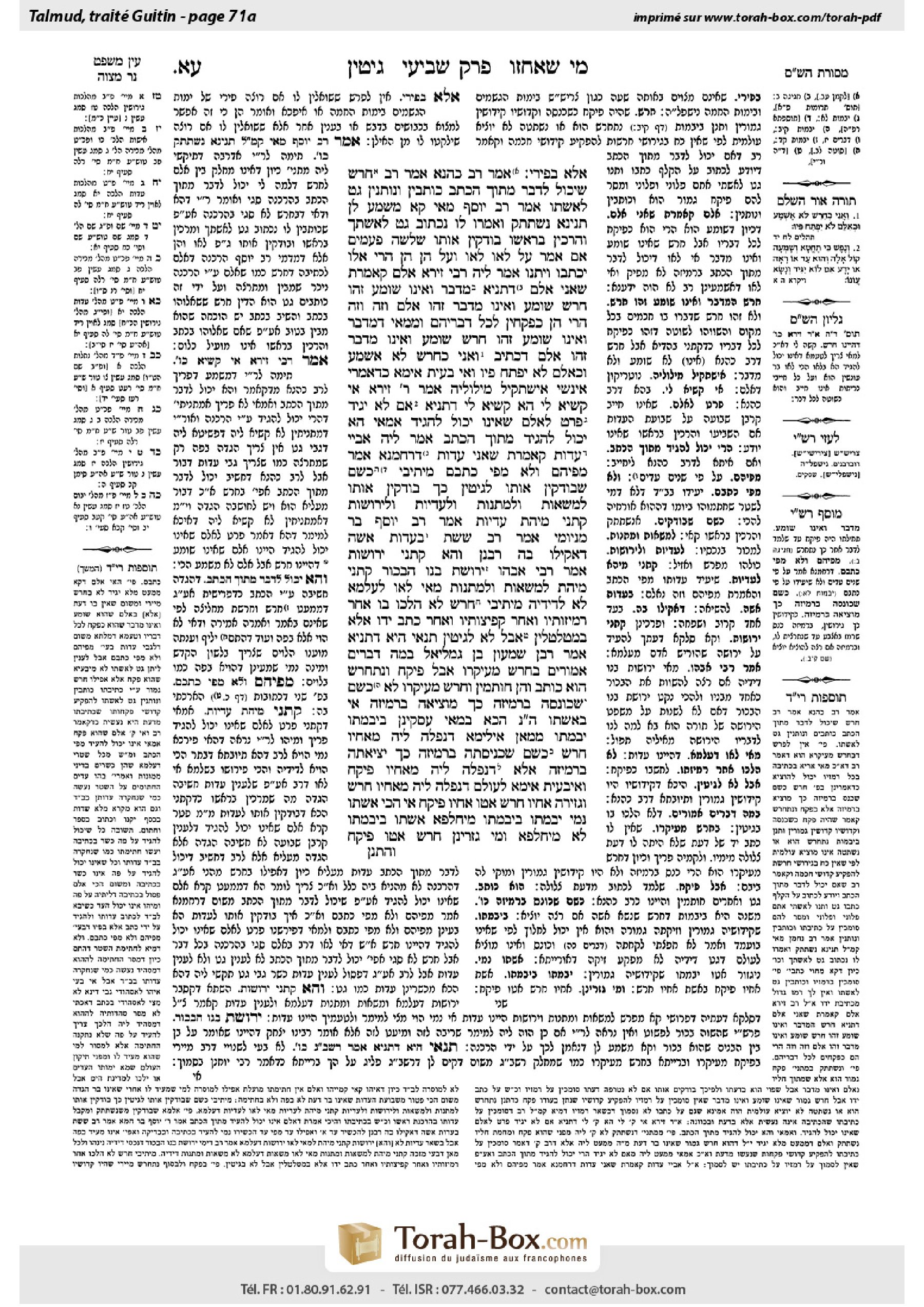
Gittin 71a: Talmud study for Daf Yomi
Study the Talmud for Daf Yomi with scanned pages, Hebrew text, English translations from Sefaria and AI-generated French translations.
Passage selection and English or AI-generated French translation are available where the scan has annotations. Daf Study is independent of Torah-Box and Sefaria.
Browse Gittin · גיטין · All tractatesGittin 71a text and translations
This page of Gittin includes the Aramaic text, an English translation and an AI-generated French translation, alongside the scan above.
גיטין ע״א א · Aramaic and Hebrew text
אֶלָּא בְּפֵירֵי.
אָמַר רַב כָּהֲנָא אָמַר רַב: חֵרֵשׁ שֶׁיָּכוֹל לְדַבֵּר מִתּוֹךְ הַכְּתָב, כּוֹתְבִין וְנוֹתְנִין גֵּט לְאִשְׁתּוֹ. אָמַר רַב יוֹסֵף: מַאי קָא מַשְׁמַע לַן? תְּנֵינָא: נִשְׁתַּתֵּק, וְאָמְרוּ לוֹ: ״נִכְתּוֹב גֵּט לְאִשְׁתְּךָ?״ וְהִרְכִּין בְּרֹאשׁוֹ, בּוֹדְקִין אוֹתוֹ שְׁלֹשָׁה פְּעָמִים, אִם אָמַר עַל לָאו – ״לָאו״, וְעַל הֵן – ״הֵן״, הֲרֵי אֵלּוּ יִכְתְּבוּ וְיִתְּנוּ.
אֲמַר לֵיהּ רַבִּי זֵירָא: אִלֵּם קָאָמְרַתְּ? שָׁאנֵי אִלֵּם – דְּתַנְיָא: מְדַבֵּר וְאֵינוֹ שׁוֹמֵעַ – זֶהוּ חֵרֵשׁ, שׁוֹמֵעַ וְאֵינוֹ מְדַבֵּר – זֶהוּ אִלֵּם, וְזֶה וָזֶה הֲרֵי הֵן כְּפִקְחִין לְכׇל דִּבְרֵיהֶם.
וּמִמַּאי דִּמְדַבֵּר וְאֵינוֹ שׁוֹמֵעַ זֶהוּ חֵרֵשׁ, שׁוֹמֵעַ וְאֵינוֹ מְדַבֵּר זֶהוּ אִלֵּם? דִּכְתִיב: ״וַאֲנִי כְחֵרֵשׁ לֹא אֶשְׁמָע וּכְאִלֵּם לֹא יִפְתַּח פִּיו״. וְאִי בָּעֵית אֵימָא, כִּדְאָמְרִי אִינָשֵׁי: אִישְׁתְּקִיל מִילּוּלֵיהּ.
אָמַר רַבִּי זֵירָא: אִי קַשְׁיָא לִי – הָא קַשְׁיָא לִי, דְּתַנְיָא: ״אִם לֹא יַגִּיד״ – פְּרָט לְאִלֵּם, שֶׁאֵינוֹ יָכוֹל לְהַגִּיד. אַמַּאי? הָא יָכוֹל לְהַגִּיד מִתּוֹךְ הַכְּתָב!
אֲמַר לֵיהּ אַבָּיֵי: עֵדוּת קָאָמְרַתְּ? שָׁאנֵי עֵדוּת, דְּרַחֲמָנָא אָמַר: ״מִפִּיהֶם״ – וְלֹא מִפִּי כְתָבָם.
מֵיתִיבִי: כְּשֵׁם שֶׁבּוֹדְקִין אוֹתוֹ לְגִיטִּין, כָּךְ בּוֹדְקִין אוֹתוֹ לְמַשָּׂאוֹת, וּלְמַתָּנוֹת, וּלְעֵדִיּוֹת, וְלִירוּשּׁוֹת. קָתָנֵי מִיהַת – ״עֵדִיּוֹת״!
אָמַר רַב יוֹסֵף בַּר מִנְיוֹמֵי אָמַר רַב שֵׁשֶׁת: בְּעֵדוּת אִשָּׁה, דַּאֲקִילּוּ בַּהּ רַבָּנַן.
וְהָא קָתָנֵי: ״יְרוּשּׁוֹת״! אָמַר רַבִּי אֲבָהוּ: יְרוּשַּׁת בְּנוֹ הַבְּכוֹר.
קָתָנֵי מִיהַת – ״לְמַשָּׂאוֹת וּלְמַתָּנוֹת״, מַאי, לָאו לְעָלְמָא? לָא, לְדִידֵיהּ.
מֵיתִיבִי: חֵרֵשׁ, לֹא הָלְכוּ בּוֹ אַחַר רְמִיזוֹתָיו וְאַחַר קְפִיצוֹתָיו וְאַחַר כְּתַב יָדוֹ, אֶלָּא בְּמִטַּלְטְלִין; אֲבָל לֹא לְגִיטִּין.
תַּנָּאֵי הִיא – דְּתַנְיָא, אָמַר רַבָּן שִׁמְעוֹן בֶּן גַּמְלִיאֵל: בַּמֶּה דְּבָרִים אֲמוּרִים – בְּחֵרֵשׁ מֵעִיקָּרוֹ, אֲבָל פִּיקֵּחַ וְנִתְחָרֵשׁ – הוּא כּוֹתֵב וְהֵן חוֹתְמִין.
וְחֵרֵשׁ מֵעִיקָּרוֹ – לֹא?! כְּשֵׁם שֶׁכּוֹנְסָהּ בִּרְמִיזָה, כָּךְ מוֹצִיאָהּ בִּרְמִיזָה!
אִי בְּאִשְׁתּוֹ, הָכִי נָמֵי; הָכָא בְּמַאי עָסְקִינַן – בִּיבִמְתּוֹ.
יְבִמְתּוֹ מִמַּאן? אִילֵימָא דִּנְפַלָה לֵיהּ מֵאָחִיו חֵרֵשׁ – כְּשֵׁם שֶׁכְּנִיסָתָהּ בִּרְמִיזָה, כָּךְ יְצִיאָתָהּ בִּרְמִיזָה! אֶלָּא דִּנְפַלָה לֵיהּ מֵאָחִיו פִּיקֵּחַ.
וְאִיבָּעֵית אֵימָא: לְעוֹלָם דִּנְפַלָה לֵיהּ מֵאָחִיו חֵרֵשׁ, וּגְזֵירָה אָחִיו חֵרֵשׁ אַטּוּ אָחִיו פִּיקֵּחַ.
אִי הָכִי, אִשְׁתּוֹ נָמֵי! יְבִמְתּוֹ בִּיבִמְתּוֹ מִיחַלְּפָא, אִשְׁתּוֹ בִּיבִמְתּוֹ לָא מִיחַלְּפָא.
וּמִי גָּזְרִינַן חֵרֵשׁ אַטּוּ פִּיקֵּחַ?!
Gittin 71a · English translation
Rather, it means that the court asks him questions with regard to produce that is not found during that season.
Rav Kahana says that Rav says: With regard to a deaf-mute who can express himself through writing, the judges of the court may write and give a bill of divorce to his wife based on his written instructions. Rav Yosef said: What is he teaching us? We already learned in the mishna: In a case where the husband became mute, and the members of the court said to him: Shall we write a bill of divorce for your wife, and he nodded his head indicating his agreement, they examine him with various questions three times. If he responded to questions that have a negative answer: No, and responded to questions that have a positive answer: Yes, indicating his competence, they shall write the bill of divorce and give it to his wife based on the nod of his head.
Rabbi Zeira said to him: A mute, you say? Is your challenge based on the mishna which discusses one who is mute? A mute is different because it is clear that his mind is intact. As it is taught in a baraita (Tosefta, Terumot 1:2): With regard to one who speaks but cannot hear, this individual is categorized as a deaf person. With regard to one who hears but cannot speak, this individual is categorized as a mute person, and both this one and that one are considered to be like halakhically competent people with regard to all their matters. Rav Kahana stated his ruling with regard to one who can neither hear nor speak. This goes beyond the halakha of the mishna, as Rav Kahana says that the written statement of a deaf-mute is an indication of his mental competence.
The Gemara asks: And from where do we learn that one who speaks but cannot hear, this individual is categorized as a deaf person, and that with regard to one who hears but cannot speak, this individual is categorized as a mute person? As it is written: “And I am like a deaf man, I do not hear, and like the mute man who will not open his mouth” (Psalms 38:14). And if you wish, say as people say: The word for a mute [ilem] is a contraction of the expression his speech has been taken [ishtakil millulei].
Rabbi Zeira said: If Rav Kahana’s statement is difficult for me, this is difficult for me, as it is taught in a baraita with regard to the punishment of one who was called to testify and failed to do so: “If he does not utter his testimony then he shall bear his iniquity” (Leviticus 5:1). The Sages derive from this that the verse serves to exclude a mute who is unable to utter his testimony, and he is exempt from bringing the offering of one who refuses to testify. And it is possible to raise the following question: Why is he exempt from bringing the offering; but he is able to utter his testimony through writing? Apparently, written testimony is not valid testimony.
Abaye said to him: You say testimony? Testimony is different, as the Merciful One states: “From their mouths” (Deuteronomy 17:6), which emphasizes that testimony must come from the witnesses’ mouths and not from their writing.
The Gemara raises an objection to this based on that which is taught in a baraita (Tosefta 7:1): Just as the judges of the court investigate him, one who lost his ability to speak, with regard to bills of divorce, so too, the judges investigate him with regard to business transactions, testimonies, and inheritances. In any event it teaches: Testimonies, which proves that even one unable to speak can give testimony.
Rav Yosef bar Minyumi said that Rav Sheshet said: This is not referring to testimony in general. Rather, it is referring to testimony with regard to a woman whose husband died, as the Sages were lenient with her and allowed testimony that would normally not be accepted, in order to permit her to remarry.
The Gemara challenges: But isn’t it also taught: Inheritances. This seems to be referring to monetary matters, where proper testimony is required. Rabbi Abbahu said: The baraita is referring to the inheritance of his own firstborn son, meaning that he is not testifying about other people’s property but testifying which one of his sons is the firstborn. Since this testimony is merely considered to be a division of the property that belongs to him, the testimony of one who is unable to speak is valid.
The Gemara continues to challenge: In any event it teaches in the baraita: With regard to business transactions, what, does it not mean that a mute may testify with regard to business transactions for everyone else? The Gemara answers: No, he may testify for himself only. The baraita is saying that when a mute conducts business the court must first check if he is mentally capable.
The Gemara raises an objection from a baraita: With regard to a deaf-mute, the judges of the court follow his signals, and follow the movement of his lips, and follow his handwriting only for matters of buying and selling movable property but not for bills of divorce. This appears to contradict Rav Kahana’s statement that it is permitted for a deaf-mute husband to give written instructions to divorce his wife.
The Gemara answers: It is a dispute between tanna’im, as it is taught in a baraita (Tosefta, Terumot 1:1) that Rabban Shimon ben Gamliel said: In what case is this statement that the court may not rely on the written testimony of a deaf-mute with regard to a bill of divorce said? Only in the case of a deaf-mute who was deaf from the outset, i.e., from birth. But if he had been halakhically competent, i.e., he could previously hear, but became a deaf-mute later, then he may write instructions to give his wife a bill of divorce and they, the witnesses, should sign, in accordance with the opinion of Rav Kahana.
The Gemara asks: And one who is a deaf-mute from the outset cannot give written instructions with regard to a bill of divorce? Isn’t it true that just as he marries her with intimation, i.e., without speaking, so too, he divorces her with intimation.
The Gemara answers: If the baraita is referring to his wife, indeed this would be the case and he could divorce her through intimations, because such a marriage is not a fully valid marriage by Torah law. But with what are we dealing here? With his yevama, his sister-in-law whose husband, his brother, died childless to whom he performed levirate marriage, and whom he subsequently wishes to divorce. This marriage is a fully valid marriage.
The Gemara asks: His yevama from whom? If we say that she fell to him from his brother who was also a deaf-mute, then just as her marriage to the brother was through intimation, so too, her divorce from the yavam can be through intimation. Rather, it must be that she fell to him from his halakhically competent brother. Consequently, the bond of the levirate marriage is by Torah law, whereas the deaf-mute man’s intimations that he desires to divorce her are valid only by rabbinic law.
And if you wish, say instead: Actually, explain that she fell to him from his deaf-mute brother, and the Sages instituted a rabbinic decree with regard to a woman bound in a levirate marriage from his deaf-mute brother due to the death of his halakhically competent brother.
The Gemara challenges: If so, and the Sages made such a decree with regard to a case where a deaf-mute brother died due to the case where a brother who is halakhically competent died, then with regard to his own wife as well, they should have made a decree that a deaf-mute husband cannot divorce her with a bill of divorce if he married her as a deaf-mute. The Gemara answers: His yevama who was married to his halakhically competent brother might be confused with his yevama who was married to his deaf-mute brother. But people would not confuse his own wife with his yevama. Therefore, there was no need to institute such a decree.
The Gemara asks: And do we, the Sages, decree with regard to his deaf-mute brother due to confusion between him and his halakhically competent brother?
Gittin 71a · Traduction française (IA)
En réalité, cela signifie que le tribunal pose des questions concernant des produits qui ne sont pas disponibles durant cette saison.
Rav Kahana dit que Rav dit : En ce qui concerne un sourd-muet qui peut s'exprimer par écrit, les juges du tribunal peuvent écrire et donner un acte de divorce à sa femme selon ses instructions écrites. Rav Yosef dit : Qu'est-ce qu'il nous apprend ? Nous avons déjà appris dans la mitsna : Dans un cas où le mari est devenu sourd-muet, et les membres du tribunal lui demandent : Voulons-nous écrire un acte de divorce pour votre femme, et il hoche la tête pour indiquer son accord, ils l'interrogent avec diverses questions trois fois. Si il répond aux questions qui ont une réponse négative : Non, et répond aux questions qui ont une réponse positive : Oui, en indiquant sa compétence, ils doivent écrire l'acte de divorce et le donner à sa femme selon le signe de sa tête.
Rabbi Zeira dit à lui : Un sourd-muet, vous dites ? Votre défi est-il basé sur la mitsna qui discute d'une personne sourde ? Un sourd-muet est différent car il est clair que son esprit est intact. Comme il est enseigné dans une baraïta (Tosefta, Terouma 1:2) : En ce qui concerne une personne qui parle mais ne peut pas entendre, cette personne est catégorisée comme sourde. En ce qui concerne une personne qui entend mais ne peut pas parler, cette personne est catégorisée comme sourd-muet, et les deux sont considérés comme des personnes halakhiquement compétentes concernant toutes leurs affaires. Rav Kahana a formulé son jugement concernant une personne qui ne peut ni entendre ni parler. Cela dépasse la halakha de la mitsna, car Rav Kahana dit que l'écriture d'un sourd-muet est une indication de sa compétence mentale.
Le Guemara demande : Et d'où apprenons-nous que celui qui parle mais ne peut pas entendre est considéré comme un sourd, et que celui qui entend mais ne peut pas parler est considéré comme un muet ? Comme il est écrit : « Et je suis comme un sourd, je n'entends pas, et comme un muet qui ne ouvre pas la bouche » (Psaumes 38:14). Et si vous le souhaitez, dites comme les gens disent : Le mot pour un muet [ilem] est une contraction de l'expression « sa parole a été enlevée » [ishtakil millulei].
Rabbi Zeira dit : Si l'affirmation de Rav Kahana est difficile pour moi, cela est difficile pour moi, car il est enseigné dans une baraïta concernant la punition d'une personne appelée à témoigner et qui n'a pas fait cela : « Si il ne prononce pas son témoignage, il portera la responsabilité de son iniquité » (Lévitique 5:1). Les Sages en déduisent que cette verset sert à exclure un muet qui ne peut pas prononcer son témoignage, et il est exempt de présenter l'offrande de celui qui refuse de témoigner. Et il est possible de poser la question suivante : Pourquoi est-il exempt de présenter l'offrande ; mais il est capable de prononcer son témoignage par écrit ? Apparemment, le témoignage écrit n'est pas considéré comme un témoignage valide.
Abaye dit à lui : Vous dites témoignage ? Le témoignage est différent, car l'Éternel dit : « De leurs bouches » (Deutéronome 17:6), ce qui souligne que le témoignage doit venir de la bouche des témoins et non de leur écriture.
Le Guemara soulève une objection à cela en se basant sur ce qui est enseigné dans une baraïta (Tosefta 7:1) : Tout comme les juges du tribunal interrogent celui qui a perdu la capacité de parler concernant les actes de divorce, de même, les juges interrogent celui-ci concernant les transactions commerciales, les témoignages et les successions. En tout cas, cela enseigne : Les témoignages, ce qui prouve que même celui qui ne peut pas parler peut donner un témoignage.
Rav Yosef bar Minyumi dit que Rav Sheshet dit : Ce n'est pas concernant le témoignage en général. C'est plutôt concernant le témoignage concernant une femme dont le mari est décédé, car les Sages étaient indulgents envers elle et permettaient un témoignage qui ne serait normalement pas accepté, afin de lui permettre de se remarier.
Le Guemara conteste : Mais n'est-il pas aussi enseigné : Les successions. Cela semble faire référence aux affaires monétaires, où un témoignage approprié est requis. Rabbi Abbahu dit : La baraïta fait référence à l'héritage de son propre premier fils, c'est-à-dire qu'il ne témoigne pas sur la propriété d'autrui mais sur celui de ses fils qui est le premier. Puisque ce témoignage est simplement considéré comme une division de la propriété qui lui appartient, le témoignage d'une personne qui ne peut pas parler est valide.
Le Guemara continue à poser des questions : En tout cas, il est mentionné dans la baraïta : Concernant les transactions commerciales, que signifie cela ? N'est-ce pas que le sourd-muet peut témoigner concernant les transactions commerciales pour tout le monde ? Le Guemara répond : Non, il peut témoigner uniquement pour lui-même. La baraïta indique que lorsque le sourd-muet engage des transactions commerciales, le tribunal doit d'abord vérifier s'il est mentalement apte.
Le Guemara soulève une objection tirée d'une baraïta : Concernant un sourd-muet, les juges du tribunal suivent ses signaux, suivent le mouvement de ses lèvres et ne suivent son écriture que pour les affaires de vente et d'achat de biens mobiliers, mais pas pour les actes de divorce. Cela semble contredire l'affirmation de Rav Kahana que c'est permis à un mari sourd-muet de donner des instructions écrites pour divorcer sa femme.
Le Guemara répond : C'est un débat entre les tannaïm, comme il est enseigné dans une baraïta (Tosefta, Terouma 1:1) que Rabban Shimon ben Gamliel dit : Dans quel cas cette affirmation que le tribunal ne peut pas se fier au témoignage écrit d'un sourd-muet concernant un acte de divorce est-elle dite ? Seulement dans le cas d'un sourd-muet qui est devenu sourd dès la naissance. Mais s'il a été halakhiquement compétent, c'est-à-dire s'il pouvait entendre auparavant mais est devenu sourd-muet plus tard, alors il peut écrire des instructions pour donner un acte de divorce à sa femme et les témoins devraient signer, conformément à l'opinion de Rav Kahana.
Le Guemara demande : Et un sourd-muet depuis le début ne peut-il pas donner des instructions écrites concernant un acte de divorce ? N'est-ce pas vrai que tout comme il épouse sa femme par indication, c'est-à-dire sans parler, de même il divorce sa femme par indication.
La Guemara répond : Si la baraïta fait référence à sa femme, en effet, cela serait le cas et il pourrait la divorcer par des intimations, car ce mariage n'est pas un mariage entièrement valide selon la loi torah. Mais avec qui sommes-nous ici ? Avec sa yevama, sa belle-sœur dont le mari, son frère, est mort sans enfants, à qui il a accompli un mariage levirat, et qu'il souhaite ensuite divorcer. Ce mariage est un mariage entièrement valide selon la loi torah.
La Guemara demande : Sa yevama de qui ? Si nous disons qu'elle est tombée à lui à partir de son frère qui était également sourd-muet, alors tout comme son mariage avec le frère était par des intimations, ainsi son divorce du yavam pourrait être par des intimations. Plutôt, il faut que ce soit qu'elle est tombée à lui à partir de son frère halakhiquement compétent. Ainsi, le lien du mariage levirat est selon la loi torah, tandis que les intimations du sourd-muet qui désire divorcer d'elle sont valides uniquement selon la loi rabbinique.
Et si vous le souhaitez, dites plutôt : En réalité, expliquez qu'elle est tombée à lui à partir de son frère sourd-muet, et les Sages ont institué un décret rabbinique concernant une femme liée par un mariage levirat à partir de son frère sourd-muet en raison de la mort de son frère halakhiquement compétent.
La Guemara conteste : Si tel est le cas, et que les Sages ont institué un tel décret concernant un cas où un frère sourd-muet est mort en raison du cas où un frère halakhiquement compétent est mort, alors concernant sa propre femme également, ils auraient dû instituer un décret selon lequel un mari sourd-muet ne peut divorcer d'elle par un acte de divorce s'il l'a épousée comme sourd-muet. La Guemara répond : Sa yevama mariée à son frère halakhiquement compétent pourrait être confondue avec sa yevama mariée à son frère sourd-muet. Mais les gens ne confondraient pas sa propre femme avec sa yevama. Ainsi, il n'était pas nécessaire d'instituer un tel décret.
La Guemara demande : Et nous, les Sages, instituons-nous un décret concernant son frère sourd-muet en raison de la confusion entre lui et son frère halakhiquement compétent ?
Traduction française générée par IA à partir de l’édition anglaise de Sefaria. Vérifie toujours un passage avec le texte source.
Text from Sefaria: William Davidson Edition - Vocalized Aramaic (CC BY NC); William Davidson Edition - English (CC BY NC).