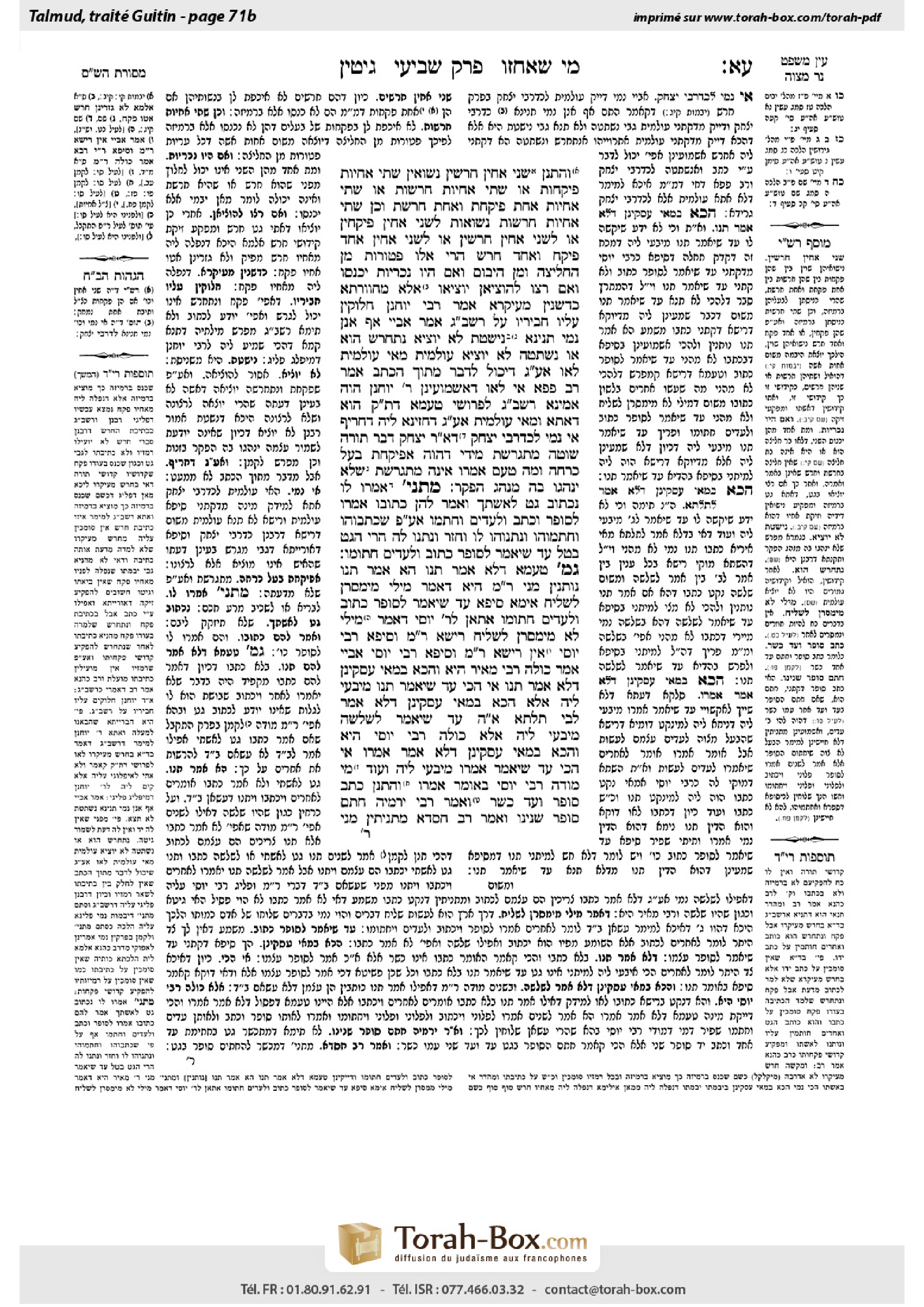
Gittin 71b: Talmud study for Daf Yomi
Study the Talmud for Daf Yomi with scanned pages, Hebrew text, English translations from Sefaria and AI-generated French translations.
Passage selection and English or AI-generated French translation are available where the scan has annotations. Daf Study is independent of Torah-Box and Sefaria.
Browse Gittin · גיטין · All tractatesGittin 71b text and translations
This page of Gittin includes the Aramaic text, an English translation and an AI-generated French translation, alongside the scan above.
גיטין ע״א ב · Aramaic and Hebrew text
וְהָתְנַן: שְׁנֵי אַחִין חֵרְשִׁין – נְשׂוּאִין שְׁתֵּי אֲחָיוֹת פִּיקְּחוֹת, אוֹ שְׁתֵּי אֲחָיוֹת חֵרְשׁוֹת, אוֹ שְׁתֵּי אֲחָיוֹת אַחַת פִּיקַּחַת וְאַחַת חֵרֶשֶׁת; וְכֵן שְׁתֵּי אֲחָיוֹת חֵרְשׁוֹת – נְשׂוּאוֹת לִשְׁנֵי אַחִין פִּיקְּחִין, אוֹ לִשְׁנֵי אַחִין חֵרְשִׁין, אוֹ לִשְׁנֵי אַחִין אֶחָד פִּיקֵּחַ וְאֶחָד חֵרֵשׁ – הֲרֵי אֵלּוּ פְּטוּרוֹת מִן הַחֲלִיצָה וּמִן הַיִּבּוּם.
וְאִם הָיוּ נׇכְרִיּוֹת, יִכָּנְסוּ; וְאִם רָצוּ לְהוֹצִיאָן – יוֹצִיאוּ.
אֶלָּא מְחַוַּורְתָּא כִּדְשַׁנִּין מֵעִיקָּרָא.
אָמַר רַבִּי יוֹחָנָן: חֲלוּקִין עָלָיו חֲבֵירָיו עַל רַבָּן שִׁמְעוֹן בֶּן גַּמְלִיאֵל.
אָמַר אַבָּיֵי, אַף אֲנַן נָמֵי תְּנֵינָא: נִישַּׁטֵּת, לֹא יוֹצִיא. נִתְחָרֵשׁ הוּא אוֹ נִשְׁתַּטָּה – לֹא יוֹצִיא עוֹלָמִית. מַאי ״עוֹלָמִית״? לָאו – אַף עַל גַּב דְּיָכוֹל לְדַבֵּר מִתּוֹךְ הַכְּתָב?
אָמַר רַב פָּפָּא: אִי לָאו דְּאַשְׁמְעִינַן רַבִּי יוֹחָנָן, הֲוָה אָמֵינָא רַבָּן שִׁמְעוֹן בֶּן גַּמְלִיאֵל לְפָרוֹשֵׁי טַעְמָא דְּתַנָּא קַמָּא הוּא דַּאֲתָא; וּמַאי ״עוֹלָמִית״? אַף עַל גַּב דַּחֲזֵינָא לֵיהּ דְּחָרִיף.
אִי נָמֵי, לְכִדְרַבִּי יִצְחָק – דְּאָמַר רַבִּי יִצְחָק: דְּבַר תּוֹרָה, שׁוֹטָה מִתְגָּרֶשֶׁת – מִידֵּי דְּהָוֵה אַפִּיקַּחַת בְּעַל כׇּרְחָהּ.
וּמָה טַעַם אָמְרוּ אֵינָהּ מִתְגָּרֶשֶׁת – שֶׁלֹּא יִנְהֲגוּ בָּהּ מִנְהַג הֶפְקֵר.
מַתְנִי׳ אָמְרוּ לוֹ: ״נִכְתּוֹב גֵּט לְאִשְׁתֶּךָ?״ וְאָמַר לָהֶן: ״כְּתוֹבוּ״; אָמְרוּ לַסּוֹפֵר וְכָתַב, וְלָעֵדִים וְחָתְמוּ; אַף עַל פִּי שֶׁכְּתָבוּהוּ וַחֲתָמוּהוּ וּנְתָנוּהוּ לוֹ, וְחָזַר וּנְתָנוֹ לָהּ – הֲרֵי הַגֵּט בָּטֵל, עַד שֶׁיֹּאמַר לַסּוֹפֵר ״כְּתוֹב״ וְלָעֵדִים ״חֲתוֹמוּ״.
גְּמָ׳ טַעְמָא דְּלֹא אָמַר ״תְּנוּ״, הָא אָמַר ״תְּנוּ״ – נוֹתְנִין, מַנִּי? רַבִּי מֵאִיר הִיא, דְּאָמַר: מִילֵּי מִימַּסְרָן לְשָׁלִיחַ.
אֵימָא סֵיפָא: ״עַד שֶׁיֹּאמַר לַסּוֹפֵר כְּתוֹב וְלָעֵדִים חֲתוֹמוּ״ – אֲתָאן לְרַבִּי יוֹסֵי, דְּאָמַר: מִילֵּי לָא מִימַּסְרָן לְשָׁלִיחַ.
רֵישָׁא רַבִּי מֵאִיר וְסֵיפָא רַבִּי יוֹסֵי?! אִין, רֵישָׁא רַבִּי מֵאִיר וְסֵיפָא רַבִּי יוֹסֵי.
אַבָּיֵי אָמַר: כּוּלָּהּ רַבִּי מֵאִיר הִיא, וְהָכָא בְּמַאי עָסְקִינַן – דְּלָא אֲמַר ״תְּנוּ״. אִי הָכִי, ״עַד שֶׁיֹּאמַר תְּנוּ״ מִיבְּעֵי לֵיהּ!
אֶלָּא הָכָא בְּמַאי עָסְקִינַן – דְּלָא אֲמַר לְבֵי תְלָתָא. אִי הָכִי, ״עַד שֶׁיֹּאמַר לִשְׁלֹשָׁה״ מִיבְּעֵי לֵיהּ!
אֶלָּא כּוּלַּהּ רַבִּי יוֹסֵי הִיא, וְהָכָא בְּמַאי עָסְקִינַן – דְּלָא אֲמַר ״אִמְרוּ״.
אִי הָכִי, ״עַד שֶׁיֹּאמַר אִמְרוּ״ מִיבְּעֵי לֵיהּ!
וְעוֹד, מִי מוֹדֶה רַבִּי יוֹסֵי בְּאוֹמֵר: ״אִמְרוּ״?! וְהָתְנַן: ״כָּתַב סוֹפֵר וְעֵד – כָּשֵׁר״; וְאָמַר רַבִּי יִרְמְיָה: ״חָתַם סוֹפֵר״ שָׁנִינוּ. וְאָמַר רַב חִסְדָּא: מַתְנִיתִין מַנִּי –
Gittin 71b · English translation
But didn’t we learn in a mishna (Yevamot 112b): In a case where there were two deaf-mute brothers, whose marriage is valid by rabbinic law, married to two halakhically competent sisters, or to two deaf-mute sisters, or to two sisters, one of whom was halakhically competent and one of whom was a deaf-mute; and similarly, if there were two deaf-mute sisters, whose marriage is valid by rabbinic law, married to two halakhically competent brothers, or to two deaf-mute brothers, or to two brothers, one of whom was halakhically competent and one of whom was a deaf-mute; and in each case one brother dies without children, then all these women are exempt from ḥalitza and from levirate marriage. Each sister is exempt, as she is the sister of the wife of the yavam.
And if they were unrelated women the men may marry them in levirate marriage, and if they wanted to divorce them later via a bill of divorce they may divorce them. Since this is stated as a general halakha it indicates that the deaf-mute brother can also give a bill of divorce to his yevama who was previously married to his deaf-mute brother, and the Sages did not institute a decree in order not to create confusion with the similar case of a deceased halakhically competent brother.
Rather, it is clear as we initially answered, that it is referring to a yevama, previously married to a halakhically competent brother, who fell before a yavam who was a deaf-mute from birth. The alternative answer given on the previous amud is rejected.
Rabbi Yoḥanan says: The colleagues of Rabban Shimon ben Gamliel disagree with him, and hold that written instructions from a deaf-mute have no halakhic validity.
Abaye said that we, too, learn in the mishna (Yevamot 112b) that non-verbal instructions are insufficient to initiate a divorce even for one who was born with the ability to hear and subsequently became a deaf-mute: If a woman became an imbecile after her wedding the Sages instituted that the husband must not divorce her. If the husband became a deaf-mute or an imbecile he can never divorce her, as he does not have the legal competence to grant a bill of divorce. Abaye explains: What is the reason that the mishna emphasizes that he can never divorce her? Isn’t this teaching that even though he can communicate through writing, he is unable to divorce her?
Rav Pappa said: If not for the fact that Rabbi Yoḥanan teaches us that there is a dispute between Rabban Shimon ben Gamliel and the Rabbis, then I would say that Rabban Shimon ben Gamliel comes only to explain the reason of the first tanna, not to disagree with him. If that were so, all agree that one who was born with the ability to hear and subsequently became a deaf-mute can issue written instructions to write and give a bill of divorce for his wife. And according to this explanation, what is the meaning of the word never? It is not referring to issuing written instructions. It means that even though I see that he is sharp by means of examining his gestures, these indications are not sufficient to warrant the giving of a bill of divorce. Despite this, if he were to issue written instructions to divorce his wife, they would be followed.
Alternatively, the mishna emphasized that the only situation where the husband can never divorce his wife is where her husband became a deaf-mute or an imbecile, but not if the husband remained healthy and the wife became a deaf-mute or imbecile, in accordance with the opinion of Rabbi Yitzḥak, as Rabbi Yitzḥak says: By Torah law a woman who is an imbecile may be divorced even though she is unable to give her consent, just as it is permitted to divorce a halakhically competent woman against her will.
And what is the reason that the Rabbis said she may not be divorced? So that she will not be treated as ownerless property. If she has no husband to protect her, and she is unable to protect herself, she may be treated as ownerless property by anyone who wishes to engage in sexual intercourse with her. By contrast, if the husband is a deaf-mute or an imbecile then he cannot divorce her by Torah law. This is why the mishna stresses only that the husband may never divorce his wife in the case where he becomes halakhically incompetent, but not when it is the wife who becomes a deaf-mute or an imbecile, in order to demonstrate the difference between the two cases in terms of Torah law.
MISHNA: If people said to the husband: Shall we write a bill of divorce for your wife? And he said to them: Write the document, and those people told the scribe to write it, and he wrote it and instructed the witnesses to sign it, and they signed it; even if they wrote it, and signed it, and gave it to him, and he then gave it to his wife, the bill of divorce is void unless he himself says to the scribe: Write the document, and he himself says to the witnesses: Sign the document.
GEMARA: The Gemara infers from the mishna: The reason that the bill of divorce is void is because he told the people only to write the document, but he did not say: Give a bill of divorce to my wife. But if he said to them: Give a bill of divorce to my wife, and they told the scribe to write the document and the witnesses to sign it, those people give the document to his wife and it is valid. In accordance with whose opinion is this statement? It is in accordance with the opinion of Rabbi Meir, who says: Verbal directives can be delegated to an agent. Everyone agrees that an agent can be appointed to perform an action on behalf of another, but Rabbi Meir holds that an agent can be appointed to give instructions to others on behalf of another.
The Gemara comments: Say the latter clause of the mishna: The bill of divorce is void unless he himself says to the scribe: Write the document, and he himself says to the witnesses: Sign the document. In the latter clause of the mishna, we arrive at the opinion of Rabbi Yosei, who said: Verbal directives cannot be delegated to an agent.
The Gemara asks: Is that to say that the first clause of the mishna is in accordance with the opinion of Rabbi Meir and the latter clause is in accordance with the opinion of Rabbi Yosei? The Gemara answers: Yes, the first clause is in accordance with the opinion of Rabbi Meir and the latter clause is in accordance with the opinion of Rabbi Yosei. Although unusual, it is possible for a single mishna to represent two contrary opinions.
Abaye said: Actually, the mishna in its entirety is in accordance with the opinion of Rabbi Meir. And with what are we dealing here? With a situation whereby the husband did not say: Give the bill of divorce to my wife, but said only to write it. In that case he must instruct the scribe and the witnesses directly. If he issued instructions to give the bill of divorce, it would also have been effective. The Gemara asks: If so, the mishna should have said: The bill of divorce is void unless he says: Give the bill of divorce to my wife.
Rather, with what are we dealing here? With a situation whereby the husband did not say his instructions to three people, who constitute a court with the authority to appoint others to write a bill of divorce. Rather, he instructed two people, who do not constitute a court, and therefore do not have the authority to appoint others to write a bill of divorce, even if the husband told them to give the bill of divorce to his wife. Witnesses may only write and give the document themselves. The Gemara challenges: If so, the mishna should have said: Unless he says his instructions to three people.
Rather, the mishna in its entirety is in accordance with the opinion of Rabbi Yosei, and with what are we dealing here? With a situation whereby the husband did not explicitly say to his agents: Say my instructions to the scribe to write the document.
The Gemara challenges: If so, the expression: Until he says to the scribe, is imprecise. Rather, the mishna should have said: Until the husband instructs the agents to tell.
And does Rabbi Yosei concede in the case of one who says: Tell another to write it? But didn’t we learn in a mishna (87b): If a bill of divorce has the writing of a scribe, and the scribe identifies his handwriting, and one witness verifies his signature, it is valid as though two witnesses testified to ratify their signatures. And Rabbi Yirmeya said: We learned in the mishna that this is the halakha with regard to the scribe’s signature and not the scribe’s writing. And Rav Ḥisda said: Whose opinion is expressed in the mishna?
Gittin 71b · Traduction française (IA)
Mais n'avons-nous pas appris dans une mitsva (Yevamot 112b) : Dans un cas où il y avait deux frères muets, dont le mariage est valide selon la loi rabbinique, mariés à deux sœurs compétentes halakhiquement, ou à deux sœurs muettes, ou à deux sœurs, l'une compétente halakhiquement et l'autre muette ; et de même, si deux sœurs muettes, dont le mariage est valide selon la loi rabbinique, étaient mariées à deux frères compétents halakhiquement, ou à deux frères muets, ou à deux frères, l'un compétent halakhiquement et l'autre muet ; et dans chaque cas, un frère meurt sans enfants, alors toutes ces femmes sont exemptes de ḥalitza et du mariage levirique. Chaque sœur est exemptée, car elle est la sœur de l'épouse du yavam.
Et si ce sont des femmes non apparentées, les hommes peuvent les épouser en mariage levirique, et si ils souhaitent divorcer ultérieurement par un acte de divorce, ils peuvent divorcer. Puisque cela est dit comme une halakha générale, cela indique que le frère muet peut également donner un acte de divorce à sa yevama qui avait été précédemment mariée à son frère muet, et les Sages n'ont pas institué un décret afin d'éviter la confusion avec le cas similaire d'un frère décédé compétent halakhiquement.
Plutôt, il est clair, comme nous l'avons répondu initialement, qu'il s'agit d'une yevama, précédemment mariée à un frère compétent halakhiquement, qui est tombée devant un yavam qui était muet depuis la naissance. La réponse alternative donnée sur l'amud précédent est rejetée.
Rabbi Yoḥanan dit : Les collègues de Rabban Shimon ben Gamliel s'opposent à lui, et pensent que les instructions écrites d'un muet n'ont pas de validité halakhique.
Abaye dit que nous aussi, nous apprenons dans la mitsna (Yevamot 112b) que les instructions non verbales sont insuffisantes pour initier un divorce même pour celui qui était né avec la capacité d'entendre et est ensuite devenu muet : Si une femme est devenue une imbécile après son mariage, les Sages ont institué que le mari ne doit pas divorcer d'elle. Si le mari est devenu muet ou imbécile, il ne peut jamais divorcer d'elle, car il n'a pas la compétence juridique pour donner un acte de divorce. Abaye explique : Quel est le motif pour lequel la mitsna insiste sur le fait qu'il ne peut jamais divorcer d'elle ? N'est-ce pas enseigner que même s'il peut communiquer par écrit, il ne peut pas divorcer d'elle ?
Rav Pappa dit : Si ce n'était pas pour le fait que Rabbi Yoḥanan nous enseigne qu'il y a un désaccord entre Rabban Shimon ben Gamliel et les Sages, je dirais que Rabban Shimon ben Gamliel vient seulement expliquer la raison du premier tanna, pas pour s'opposer à lui. Si c'était ainsi, tous s'accordent sur le fait qu'un homme né avec la capacité d'entendre et devenu ensuite muet peut émettre des instructions écrites pour donner un acte de divorce à sa femme. Et selon cette explication, quelle est la signification du mot « jamais » ? Ce n'est pas en référence à l'émission d'instructions écrites. Cela signifie que même si je vois qu'il est intelligent par l'examen de ses gestes, ces indications ne sont pas suffisantes pour justifier l'émission d'un acte de divorce. Malgré cela, si il émettait des instructions écrites pour divorcer de sa femme, elles seraient suivies.
Une autre interprétation : la Michna insiste sur le fait que le seul cas où le mari ne peut jamais divorcer de sa femme est celui où son mari est devenu muet ou imbécile, mais pas si le mari reste sain et la femme devient muette ou imbécile, conformément à l'opinion de Rabbi Yitzḥak, car Rabbi Yitzḥak dit : Selon la loi de la Torah, une femme qui est une imbécile peut être divorcée même si elle ne peut pas donner son consentement, tout comme il est permis de divorcer une femme halakhiquement compétente contre sa volonté.
Et quel est le motif pour lequel les Sages ont dit qu'elle ne peut pas être divorcée ? Afin qu'elle ne soit pas traitée comme une propriété sans propriétaire. Si elle n'a pas de mari pour la protéger et qu'elle ne peut pas se protéger elle-même, elle peut être traitée comme une propriété sans propriétaire par quiconque souhaite avoir des relations sexuelles avec elle. En revanche, si le mari est muet ou imbécile, il ne peut pas divorcer d'elle selon la loi de la Torah. C'est pourquoi la Michna insiste uniquement sur le fait que le mari ne peut jamais divorcer de sa femme dans le cas où il devient halakhiquement incompetent, mais pas lorsque c'est la femme qui devient muette ou imbécile, afin de démontrer la différence entre les deux cas en termes de loi de la Torah.
MICHNA : Si des gens dirent au mari : Devons-nous écrire un acte de divorce pour votre femme ? Et il dit à eux : Écrivez le document, et ces gens dirent au scribe d'écrire, et il l'écrivit et ordonna aux témoins de le signer, et ils le signèrent ; même s'ils l'ont écrit, signé et donné à lui, et il l'a donné à sa femme, l'acte de divorce est nul à moins qu'il lui dise lui-même au scribe : Écrivez le document, et lui-même dise aux témoins : Signez le document.
GUEMARA : La Guemara déduit de la mitsna : La raison pour laquelle l'acte de divorce est nul est parce qu'il a dit aux gens seulement d'écrire le document, mais il n'a pas dit : Donnez un acte de divorce à ma femme. Mais si il dit à eux : Donnez un acte de divorce à ma femme, et ils disent au scribe d'écrire le document et aux témoins de le signer, ces gens donnent le document à sa femme et il est valide. Selon l'opinion de qui est cette déclaration ? C'est selon l'opinion de Rabbi Meir, qui dit : Les directives verbales peuvent être déléguées à un agent. Tout le monde convient qu'un agent peut être désigné pour accomplir une action au nom d'un autre, mais Rabbi Meir considère que l'agent peut être désigné pour donner des instructions à d'autres au nom d'un autre.
La Guemara commente : Dites la dernière partie de la mitsna : L'acte de divorce est nul à moins qu'il lui dise lui-même au scribe : Écrivez le document, et lui-même dise aux témoins : Signez le document. Dans la dernière partie de la mitsna, nous arrivons à l'opinion de Rabbi Yosei, qui dit : Les directives verbales ne peuvent pas être déléguées à un agent.
La Guemara pose la question : Cela signifie-t-il que la première clause de la michna est selon l'opinion de Rabbi Meir et la seconde selon celle de Rabbi Yosei ? La Guemara répond : Oui, la première clause est selon l'opinion de Rabbi Meir et la seconde selon celle de Rabbi Yosei. Bien que cela soit inhabituel, il est possible qu'une seule michna représente deux opinions contraires.
Abaye dit : En réalité, la michna dans son ensemble est selon l'opinion de Rabbi Meir. Et de quoi s'agit-il ici ? D'une situation où le mari n'a pas dit : Donne le document de divorce à ma femme, mais a dit seulement de l'écrire. Dans ce cas, il faut qu'il instruise directement l'écrivain et les témoins. Si il avait donné des instructions pour donner le document de divorce, cela aurait également été efficace. La Guemara pose la question : Si c'est ainsi, la michna aurait dû dire : Le document de divorce est nul à moins qu'il dise : Donne le document de divorce à ma femme.
En réalité, de quoi s'agit-il ici ? D'une situation où le mari n'a pas dit ses instructions à trois personnes, qui constituent un tribunal ayant le pouvoir d'engager d'autres à écrire un document de divorce. Plutôt, il a instruit deux personnes, qui ne constituent pas un tribunal, et par conséquent n'ont pas le pouvoir d'engager d'autres à écrire un document de divorce, même si le mari leur avait dit de donner le document de divorce à sa femme. Les témoins peuvent seulement écrire et donner eux-mêmes le document. La Guemara conteste : Si c'est ainsi, la michna aurait dû dire : À moins qu'il dise ses instructions à trois personnes.
En réalité, la Michna dans son ensemble suit l'opinion de Rabbi Yosei, et de quoi s'agit-il ici ? D'une situation où le mari n'a pas dit explicitement à ses agents : Dis à l'écrivain d'écrire le document.
La Guemara conteste : Si c'est ainsi, l'expression : Jusqu'à ce qu'il dise à l'écrivain, est imprecise. Plutôt, la Michna aurait dû dire : Jusqu'à ce que le mari instruise les agents de dire.
Et Rabbi Yosei reconnaît-il le cas d'une personne qui dit : Dis à un autre d'écrire cela ? Mais n'avons-nous pas appris dans une Michna (87b) : Si un document de divorce a la signature d'un écrivain, et l'écrivain identifie sa signature, et un témoin vérifie sa signature, il est valide comme si deux témoins avaient témoigné pour valider leurs signatures. Et Rabbi Yirmeya a dit : Nous avons appris dans la Michna que c'est la halakha concernant la signature de l'écrivain et non l'écriture de l'écrivain. Et Rav Ḥisda a dit : De quel opinion s'agit-il dans la Michna ?
Traduction française générée par IA à partir de l’édition anglaise de Sefaria. Vérifie toujours un passage avec le texte source.
Text from Sefaria: William Davidson Edition - Vocalized Aramaic (CC BY NC); William Davidson Edition - English (CC BY NC).