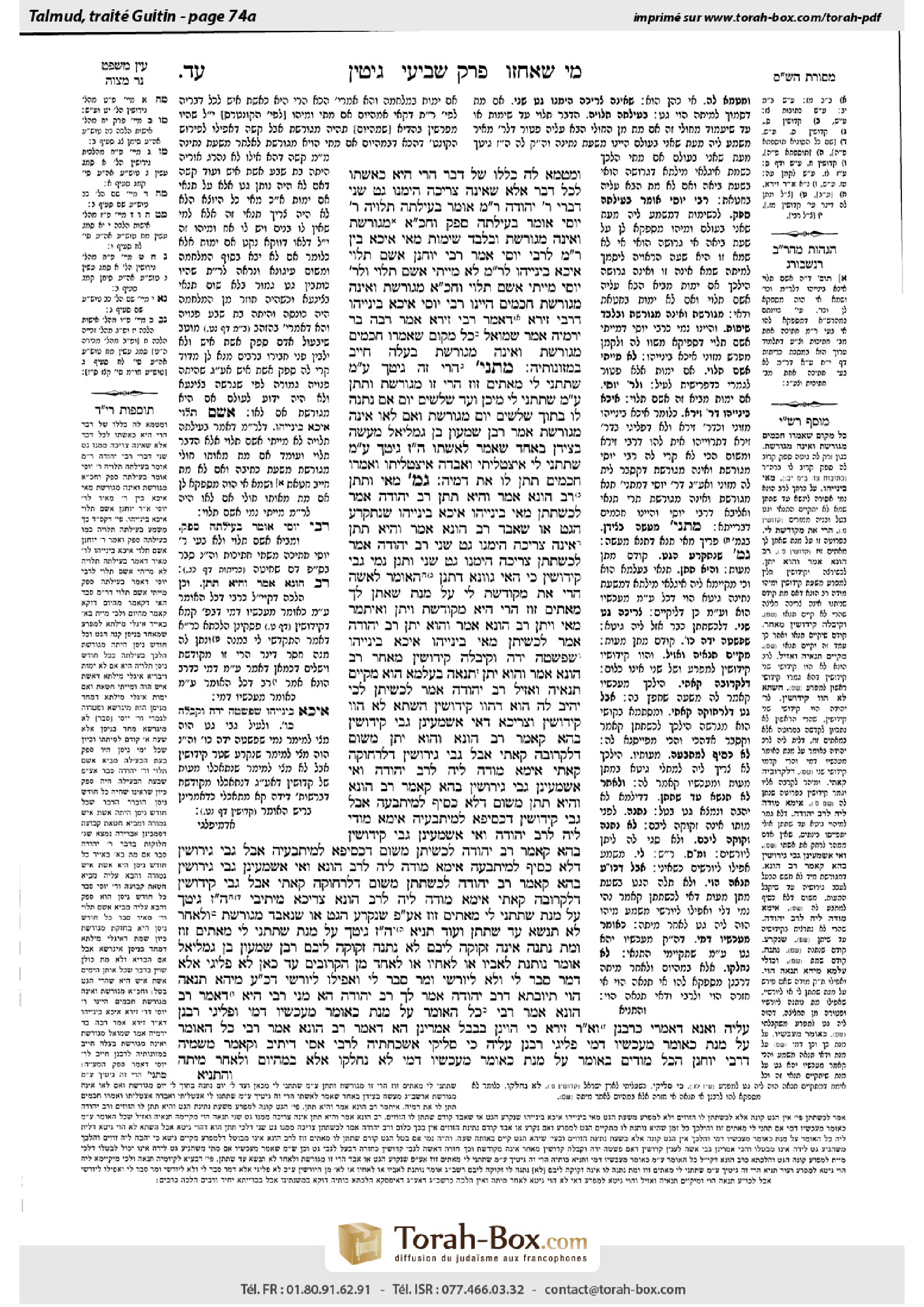
Gittin 74a: Talmud study for Daf Yomi
Study the Talmud for Daf Yomi with scanned pages, Hebrew text, English translations from Sefaria and AI-generated French translations.
Passage selection and English or AI-generated French translation are available where the scan has annotations. Daf Study is independent of Torah-Box and Sefaria.
Browse Gittin · גיטין · All tractatesGittin 74a text and translations
This page of Gittin includes the Aramaic text, an English translation and an AI-generated French translation, alongside the scan above.
גיטין ע״ד א · Aramaic and Hebrew text
וּמִטַּמֵּא לָהּ. כְּלָלוֹ שֶׁל דָּבָר: הֲרֵי הִיא כְּאִשְׁתּוֹ לְכׇל דָּבָר – אֶלָּא שֶׁאֵינָהּ צְרִיכָה הֵימֶנּוּ גֵּט שֵׁנִי, דִּבְרֵי רַבִּי יְהוּדָה.
רַבִּי מֵאִיר אוֹמֵר: בְּעִילָתָהּ תְּלוּיָה. רַבִּי יוֹסֵי אוֹמֵר: בְּעִילָתָהּ סָפֵק. וַחֲכָמִים אוֹמְרִים: מְגוֹרֶשֶׁת וְאֵינָהּ מְגוֹרֶשֶׁת, וּבִלְבַד שֶׁיָּמוּת.
מַאי אִיכָּא בֵּין רַבִּי מֵאִיר לְרַבִּי יוֹסֵי?
אָמַר רַבִּי יוֹחָנָן: אָשָׁם תָּלוּי אִיכָּא בֵּינַיְיהוּ; לְרַבִּי מֵאִיר – לָא מַיְיתֵי אָשָׁם תָּלוּי, וּלְרַבִּי יוֹסֵי – מַיְיתֵי אָשָׁם תָּלוּי.
וַחֲכָמִים אוֹמְרִים: מְגוֹרֶשֶׁת וְאֵינָהּ מְגוֹרֶשֶׁת. חֲכָמִים הַיְינוּ רַבִּי יוֹסֵי! אִיכָּא בֵּינַיְיהוּ דְּרַבִּי זֵירָא – דְּאָמַר רַבִּי זֵירָא אָמַר רַבָּה בַּר יִרְמְיָה אָמַר שְׁמוּאֵל: כׇּל מָקוֹם שֶׁאָמְרוּ חֲכָמִים ״מְגוֹרֶשֶׁת וְאֵינָהּ מְגוֹרֶשֶׁת״ – בַּעְלָהּ חַיָּיב בִּמְזוֹנוֹתֶיהָ.
מַתְנִי׳ ״הֲרֵי זֶה גִּיטִּךְ, עַל מְנָת שֶׁתִּתְּנִי לִי מָאתַיִם זוּז״ – הֲרֵי זוֹ מְגוֹרֶשֶׁת, וְתִתֵּן.
״עַל מְנָת שֶׁתִּתְּנִי לִי מִיכָּן וְעַד שְׁלֹשִׁים יוֹם״ – אִם נָתְנָה לוֹ בְּתוֹךְ שְׁלֹשִׁים יוֹם, מְגוֹרֶשֶׁת; וְאִם לָאו, אֵינָהּ מְגוֹרֶשֶׁת.
אָמַר רַבָּן שִׁמְעוֹן בֶּן גַּמְלִיאֵל: מַעֲשֶׂה בְּצַיְדָּן, בְּאֶחָד שֶׁאָמַר לְאִשְׁתּוֹ: ״הֲרֵי זֶה גִּיטִּךְ, עַל מְנָת שֶׁתִּתְּנִי לִי אִיצְטְלִיתִי״, וְאָבְדָה אִיצְטְלִיתוֹ, וְאָמְרוּ חֲכָמִים: תִּתֵּן לוֹ אֶת דָּמֶיהָ.
גְּמָ׳ מַאי ״וְתִתֵּן״? רַב הוּנָא אָמַר: וְהִיא תִּתֵּן. רַב יְהוּדָה אָמַר: לִכְשֶׁתִּתֵּן.
מַאי בֵּינַיְיהוּ? אִיכָּא בֵּינַיְיהוּ שֶׁנִּתְקָרַע הַגֵּט אוֹ שֶׁאָבַד; רַב הוּנָא אָמַר ״וְהִיא תִּתֵּן״ – אֵינָהּ צְרִיכָה הֵימֶנּוּ גֵּט שֵׁנִי; רַב יְהוּדָה אָמַר ״לִכְשֶׁתִּתֵּן״ – צְרִיכָה הֵימֶנּוּ גֵּט שֵׁנִי.
וּתְנַן נָמֵי גַּבֵּי קִידּוּשִׁין כִּי הַאי גַוְונָא – דִּתְנַן: הָאוֹמֵר לְאִשָּׁה: ״הֲרֵי אַתְּ מְקוּדֶּשֶׁת לִי, עַל מְנָת שֶׁאֶתֵּן לִיךְ מָאתַיִם זוּז״ – הֲרֵי הִיא מְקוּדֶּשֶׁת, וְיִתֵּן. וְאִיתְּמַר: מַאי ״וְיִתֵּן״? רַב הוּנָא אָמַר: וְהוּא יִתֵּן. רַב יְהוּדָה אָמַר: לִכְשֶׁיִּתֵּן.
מַאי בֵּינַיְיהוּ: אִיכָּא בֵּינַיְיהוּ – שֶׁפָּשְׁטָה יָדָהּ וְקִיבְּלָה קִידּוּשִׁין מֵאַחֵר. רַב הוּנָא אָמַר ״וְהוּא יִתֵּן״ – תְּנָאָה בְּעָלְמָא הוּא, מְקַיֵּים תְּנָאֵיהּ וְאָזֵיל. רַב יְהוּדָה אָמַר ״לִכְשֶׁיִּתֵּן״ – לְכִי יָהֵיב לַהּ הוּא דְּהָווּ קִידּוּשִׁין, הַשְׁתָּא לָא הָווּ קִידּוּשִׁין.
וּצְרִיכָא; דְּאִי אַשְׁמְעִינַן גַּבֵּי קִידּוּשִׁין, בְּהָא קָאָמַר רַב הוּנָא ״וְהוּא יִתֵּן״ – מִשּׁוּם דִּלְקָרוֹבַהּ קָאָתֵי; אֲבָל גַּבֵּי גֵירוּשִׁין – דִּלְרַחוֹקַהּ קָאָתֵי, אֵימָא מוֹדֵי לֵיהּ לְרַב יְהוּדָה;
וְאִי אַשְׁמְעִינַן גַּבֵּי גֵירוּשִׁין; בְּהָא קָאָמַר רַב הוּנָא ״וְהִיא תִּתֵּן״ – מִשּׁוּם דְּלָא כְּסִיף לְמִיתְבְּעַהּ; אֲבָל גַּבֵּי קִידּוּשִׁין, דִּכְסִיפָא לְמִיתְבְּעֵיהּ, אֵימָא מוֹדֵי לֵיהּ לְרַב יְהוּדָה.
וְאִי אַשְׁמְעִינַן גַּבֵּי קִידּוּשִׁין; בְּהָא קָאָמַר רַב יְהוּדָה ״לִכְשֶׁיִּתֵּן״ – מִשּׁוּם דִּכְסִיפָא לְמִיתְבְּעֵיהּ; אֲבָל גַּבֵּי גֵירוּשִׁין – דְּלָא כְּסִיף לְמִיתְבְּעַהּ, אֵימָא מוֹדֵי לֵיהּ לְרַב הוּנָא;
וְאִי אַשְׁמְעִינַן גַּבֵּי גֵירוּשִׁין; בְּהָא קָאָמַר רַב יְהוּדָה ״לִכְשֶׁתִּתֵּן״ – מִשּׁוּם דִּלְרַחוֹקַהּ קָאָתֵי; אֲבָל גַּבֵּי קִידּוּשִׁין – דִּלְקָרוֹבַהּ קָאָתֵי, אֵימָא מוֹדֵה לֵיהּ לְרַב הוּנָא; צְרִיכָא.
מֵיתִיבִי: ״הֲרֵי זֶה גִּיטִּךְ, עַל מְנָת שֶׁתִּתְּנִי לִי מָאתַיִם זוּז״, אַף עַל פִּי שֶׁנִּקְרַע הַגֵּט אוֹ שֶׁנֶּאֱבַד – מְגוֹרֶשֶׁת; וּלְאַחֵר לֹא תִּנָּשֵׂא עַד שֶׁתִּתֵּן.
וְעוֹד תַּנְיָא: ״הֲרֵי זֶה גִּיטִּךְ, עַל מְנָת שֶׁתִּתְּנִי לִי מָאתַיִם זוּז״, וָמֵת, נָתְנָה – אֵינָהּ זְקוּקָה לְיָבָם; לֹא נָתְנָה – זְקוּקָה לְיָבָם. רַבָּן שִׁמְעוֹן בֶּן גַּמְלִיאֵל אוֹמֵר: נוֹתֶנֶת לְאָבִיו אוֹ לְאָחִיו אוֹ לְאֶחָד מִן הַקְּרוֹבִים.
עַד כָּאן לָא פְּלִיגִי – אֶלָּא דְּמָר סָבַר: ״לִי״ – וְלָא לְיוֹרְשַׁי, וּמָר סָבַר: ״לִי״ – וַאֲפִילּוּ לְיוֹרְשַׁי; וְכוּלֵּי עָלְמָא מִיהָא תְּנָאָה הָוֵי – תְּיוּבְתָּא דְרַב יְהוּדָה!
אָמַר לָךְ רַב יְהוּדָה: הָא מַנִּי, רַבִּי הִיא – דְּאָמַר רַב הוּנָא אָמַר רַבִּי: כׇּל הָאוֹמֵר ״עַל מְנָת״ כְּאוֹמֵר ״מֵעַכְשָׁיו״ דָּמֵי. וּפְלִיגִי רַבָּנַן עֲלֵיהּ, וַאֲנָא דַּאֲמַרִי כְּרַבָּנַן.
וְאָמַר רַבִּי זֵירָא: כִּי הֲוֵינַן בְּבָבֶל אָמְרִינַן, הָא דְּאָמַר רַב הוּנָא אָמַר רַבִּי: כׇּל הָאוֹמֵר ״עַל מְנָת״ כְּאוֹמֵר ״מֵעַכְשָׁיו״ דָּמֵי – פְּלִיגִי רַבָּנַן עֲלֵיהּ. כִּי סְלִיקִי, אַשְׁכַּחְתֵּיהּ לְרַבִּי אַסִּי דְּיָתֵיב וְקָאָמַר מִשְּׁמֵיהּ דְּרַבִּי יוֹחָנָן: הַכֹּל מוֹדִים בְּאוֹמֵר ״עַל מְנָת״ – כְּאוֹמֵר ״מֵעַכְשָׁיו״ דָּמֵי. לֹא נֶחְלְקוּ אֶלָּא בְּ״מֵהַיּוֹם וּלְאַחַר מִיתָה״.
Gittin 74a · English translation
and he becomes ritually impure for her if he is a priest. The principle of the matter is as follows: At that time she is like his wife in every sense, but she does not require a second bill of divorce from him when he dies. This is the statement of Rabbi Yehuda.
Rabbi Meir says: If she engages in sexual intercourse with another man, the legal status of her sexual intercourse depends on whether or not her husband dies from this illness. If he dies, she is considered to have been divorced from the time the bill of divorce was given, and her sexual intercourse is not deemed adulterous. Rabbi Yosei says: Her sexual intercourse has an uncertain status. And the Rabbis say: There is uncertainty whether she is divorced or whether she is not divorced, and this is an uncertainty provided that he dies from this illness. If he does not, they are certainly not divorced.
The Gemara clarifies: What difference is there between the opinion of Rabbi Meir, who says that the status of her sexual intercourse depends on whether or not her husband dies from his illness, and the opinion of Rabbi Yosei, who says that the status of her sexual intercourse is uncertain?
Rabbi Yoḥanan said: The practical difference between them is with regard to the bringing of a provisional guilt-offering, which is brought by one who is uncertain as to whether he committed a sin that requires a sin-offering. According to the opinion of Rabbi Meir, the paramour does not bring a provisional guilt-offering (see Leviticus 5:17–19), because, although there was uncertainty at the time of the act of sexual intercourse, the matter will eventually be clarified once the husband either dies or recovers from his illness. If the husband survives her paramour must bring a sin-offering, and if the husband dies the other man is exempt from bringing any offering. And according to the opinion of Rabbi Yosei her status is uncertain, and even if the husband dies from this illness Rabbi Yosei is uncertain when the bill of divorce took effect. Therefore, her paramour must bring a provisional guilt-offering.
The baraita taught: And the Rabbis say: There is uncertainty whether she is divorced or whether she is not divorced. The Gemara comments: Apparently, the opinion of the Rabbis is the same as the opinion of Rabbi Yosei. Why are they recorded as having a dispute? The Gemara answers: There is a practical difference between them with regard to the halakhic ruling transmitted by Rabbi Zeira. As Rabbi Zeira says that Rabba bar Yirmeya says that Shmuel says: Wherever the Sages said: There is uncertainty whether she is divorced or whether she is not divorced, her husband is obligated to provide her with sustenance. This formulation is stated only by the Rabbis, and Rabbi Zeira’s halakha would apply only according to them, not according to Rabbi Yosei.
MISHNA: If a husband says to his wife: This is your bill of divorce on the condition that you will give me two hundred dinars, then she is divorced and must give two hundred dinars in order to fulfill the condition of the bill of divorce.
If a husband says to his wife: This is your bill of divorce on the condition that you will give me money from now until the conclusion of thirty days, if she gives the money to him within thirty days she is divorced. And if not she is not divorced.
Rabban Shimon ben Gamliel said: There was an incident in the city of Tzaidan involving one who said to his wife: This is your bill of divorce on the condition that you will give me my coat [itztaliti], and she lost his coat, so that she could not give it to him. And the Rabbis said that she must give him the value of the coat, and by doing so she fulfills the condition and is divorced.
GEMARA: The mishna teaches: She is divorced and must give the money. The Gemara asks: What is the meaning of: And must give? Rav Huna says: She is divorced immediately, once the bill of divorce has been given over to her, and she must give him the money subsequently in order to fulfill the condition. The bill of divorce takes effect retroactively, from the time when it was given, after she gives the money. Rav Yehuda says: She is divorced only when she gives him this sum.
The Gemara asks: What is the difference between the opinion of Rav Huna and the opinion of Rav Yehuda? The Gemara answers: There is a difference between them if the bill of divorce was torn or lost after she received it but before she gave the money. According to the opinion of Rav Huna, who says: And she must give but the bill of divorce takes effect retroactively, if it was torn or lost then she does not require a second bill of divorce from him. By contrast, Rav Yehuda says that the divorce takes effect only when she gives him the sum. Therefore, if the document is torn or lost she requires a second bill of divorce from him, as in his opinion it is not yet a valid bill of divorce until she has given him the money.
The Gemara comments: And it was also taught in the mishna with regard to betrothal that Rav Huna and Rav Yehuda also disagreed about a case like this, as we learned in a mishna (Kiddushin 60a): If one says to a woman: You are hereby betrothed to me on the condition that I will give you two hundred dinars, then she is betrothed, and he must give the sum. And it was stated that Rav Huna and Rav Yehuda disagreed with regard to what is the meaning of: And he must give. Rav Huna says: And he must give, meaning that she is betrothed immediately, provided that the husband gives what he promised. Rav Yehuda says: She is betrothed only when he gives.
The Gemara asks: What is the difference between them? The Gemara answers: There is a difference between them in a case where she extended her hand and received betrothal from another man before the first man gave her the money that he promised. Rav Huna says: And he must give, meaning that it is merely a condition that he accepted upon himself. He fulfills his condition and moves on, and the woman is betrothed to him immediately. Therefore, her betrothal to the second man has no validity. Rav Yehuda says: When he gives, which means that when he gives her the money it will be a valid betrothal. But now it is not a valid betrothal and therefore the betrothal from the second man takes effect.
The Gemara comments: And it is necessary to mention this dispute in both the case of divorce and the case of betrothal. As if it would have taught us their opinions only with regard to betrothal, then one may think that it is specifically with regard to this case that Rav Huna says: And he should give, because he comes to draw her close in marriage. Consequently, he does this willingly, and therefore there is an assumption that his intention was for the betrothal to take effect immediately. But with regard to divorce, where he comes to distance her, there is an assumption that he does so unwillingly, so that he makes the divorce dependent on a condition in order to delay the matter. Therefore, say that Rav Huna concedes to Rav Yehuda that the divorce does not take effect until the condition has been fulfilled.
And if it would have taught us their opinions only with regard to divorce, then one may think that it is specifically with regard to this case that Rav Huna says: And she must give, because he is not embarrassed to demand the money from her afterward to fulfill the condition of the bill of divorce, and his intent was to divorce her immediately. But with regard to betrothal, where she is embarrassed to demand the money that he promised would come from him, she may not agree to be betrothed to him until she actually receives the money. Therefore, you might say that Rav Huna concedes to Rav Yehuda that the betrothal is valid only once he gives her the money.
And furthermore, if it would have taught us their opinions only with regard to betrothal, then one may think that it is specifically with regard to this case that Rav Yehuda says that the betrothal is valid only when he gives her the money, because she is embarrassed to demand it from him if he does not give it to her. Therefore, her intention is that she will be betrothed only once the condition is fulfilled. But with regard to divorce, where the husband is not embarrassed to demand the money from her, you might say that Rav Yehuda concedes to Rav Huna that the bill of divorce takes effect immediately.
And furthermore, if it would have taught us only with regard to the case of divorce, then one may think that it is specifically with regard to this case that Rav Yehuda says that the divorce is valid only when she gives him the money, because the husband comes to distance her. But with regard to betrothal, where he comes to draw her close, you might say that Rav Yehuda concedes to Rav Huna. Therefore, it is necessary to state this dispute in both cases.
The Gemara raises an objection based on what was taught in a baraita (Tosefta 7:5): If one says to a woman: This is your bill of divorce on the condition that you will give me two hundred dinars, then even though the bill of divorce was torn or lost she is divorced. And she may not marry another man until she gives her first husband the money.
And it is taught further in that same baraita: If one says to his wife: This is your bill of divorce on the condition that you will give two hundred dinars to me, and the husband died childless, if she had already given him the money, then she is not bound with a levirate bond to the yavam because she was already divorced from her husband through the bill of divorce that he gave her. But if she had not given him the money, then she is bound with a levirate bond to the yavam because the bill of divorce did not take effect and she is a widow. Rabban Shimon ben Gamliel says: She should give the money to her late husband’s father, or to his brother, or to one of the relatives who inherit from him, and by doing so she fulfills the condition and is released from the levirate bond.
The Gemara notes: The first tanna and Rabban Shimon ben Gamliel disagree only with regard to the meaning of the condition. One Sage, the first tanna, holds that when the husband said: On the condition that she will give to me, he meant: To me specifically and not to my heirs. Consequently, she cannot fulfill the condition by giving the money to his heirs. And one Sage, Rabban Shimon ben Gamliel, holds that when the husband said that she will give the money to me, he meant and even to my heirs. But in any event, everyone agrees that this is a valid condition, yet its fulfillment does not change the date that the bill of divorce takes effect. This is a conclusive refutation of the opinion of Rav Yehuda, who said that the bill of divorce takes effect only when she gives.
The Gemara answers: Rav Yehuda could have said to you: In accordance with whose opinion is this baraita? It is the opinion of Rabbi Yehuda HaNasi. As Rav Huna says that Rabbi Yehuda HaNasi says: Anyone who states a condition employing the language: On the condition, is like one who states: The agreement will take effect retroactively from now, even though the condition is fulfilled only later on. And the Rabbis disagree with him. And I say my ruling in accordance with the opinion of the Rabbis.
And Rabbi Zeira says: When we were in Babylonia we would say with regard to this following statement that Rav Huna says that Rabbi Yehuda HaNasi says: Anyone who states a condition employing the language: On the condition, is like one who states: The agreement will take effect retroactively from now, even though the condition is fulfilled only later on; we would say that the Rabbis disagree with him. When I ascended to Eretz Yisrael I found Rabbi Asi, who was sitting and saying in the name of Rabbi Yoḥanan: Everyone concedes that with regard to anyone who states a condition employing the language: On the condition, he is like one who states: The agreement will take effect retroactively from now; and the Rabbis disagreed with Rabbi Yehuda HaNasi only in a case where the bill of divorce included the condition: From today and after my death.
Gittin 74a · Traduction française (IA)
et il devient impur pour elle s'il est prêtre. Le principe de la question est le suivant : à ce moment-là, elle est comme sa femme en tous sens, mais elle ne nécessite pas un second divorce de sa part lorsqu'il meurt. C'est la déclaration du Rabbi Yéhuda.
Le Rabbi Méir dit : Si elle a des relations sexuelles avec un autre homme, le statut légal de ses relations sexuelles dépend du fait que son mari meurt de cette maladie ou non. Si il meurt, elle est considérée comme divorcée depuis le moment où le divorce a été donné, et ses relations sexuelles ne sont pas considérées comme adultères. Le Rabbi Yosei dit : ses relations sexuelles ont un statut incertain. Et les Sages disent : il y a incertitude quant à ce qu'elle est divorcée ou non, et cela est une incertitude conditionnellement à ce qu'il meurt de cette maladie. Si il ne meurt pas, ils sont certainement pas divorcés.
La Guemara clarifie : Quelle différence y a-t-il entre l'opinion du Rabbi Méir, qui dit que le statut de ses relations sexuelles dépend du fait que son mari meurt de cette maladie ou non, et l'opinion du Rabbi Yosei, qui dit que le statut de ses relations sexuelles est incertain ?
Le Rabbi Yoḥanan dit : La différence pratique entre eux concerne l'offrande de culpabilité provisoire, qui est offerte par celui qui est incertain quant à s'il a commis un péché nécessitant une offrande expiatoire. Selon l'opinion du Rabbi Méir, le paramoureux ne doit pas offrir une offrande de culpabilité provisoire (cf. Lévitique 5:17–19), car, bien qu'il y ait eu une incertitude au moment des relations sexuelles, la question sera finalement clarifiée une fois que le mari meurt ou se rétablit de sa maladie. Si le mari survit, le paramoureux doit offrir une offrande expiatoire, et si le mari meurt, l'autre homme est exempt d'offrir toute offrande. Selon l'opinion du Rabbi Yosei, son statut est incertain, et même si le mari meurt de cette maladie, le Rabbi Yosei est incertain quant au moment où le divorce a pris effet. Par conséquent, le paramoureux doit offrir une offrande de culpabilité provisoire.
La baraïta enseigne : Et les Sages disent : il y a incertitude quant à ce qu'elle est divorcée ou non. La Guemara commente : Apparemment, l'opinion des Sages est la même que celle du Rabbi Yosei. Pourquoi sont-ils enregistrés comme ayant un débat ? La Guemara répond : il y a une différence pratique entre eux concernant la décision halachique transmise par le Rabbi Zéira. Comme le Rabbi Zéira dit que Rabba bar Yirméya dit que Shmuel dit : partout où les Sages ont dit : il y a incertitude quant à ce qu'elle est divorcée ou non, son mari est tenu de lui fournir un soutien. Cette formulation est uniquement énoncée par les Sages, et la halakha du Rabbi Zéira s'appliquerait uniquement selon eux, pas selon le Rabbi Yosei.
MICHNA : Si un mari dit à sa femme : C'est ton divorce sous la condition que tu me donnes deux cents dinars, alors elle est divorcée et doit donner deux cents dinars afin de remplir la condition du divorce.
Si un mari dit à sa femme : C'est ton divorce sous la condition que tu me donnes de l'argent dès maintenant jusqu'à la fin des trente jours, si elle lui donne l'argent dans les trente jours, elle est divorcée. Et si elle ne le lui donne pas, elle n'est pas divorcée.
Rabban Shimon ben Gamliel dit : Il y avait un incident dans la ville de Tsaidan concernant celui qui dit à sa femme : C'est ton divorce sous la condition que tu me donnes mon manteau [itztaliti], et elle a perdu son manteau, de sorte qu'elle ne pouvait pas le lui donner. Et les Sages dirent qu'elle doit lui donner la valeur du manteau, et en le faisant, elle remplit la condition et est divorcée.
GUEMARA : La mishna enseigne : Elle est divorcée et doit donner l'argent. La Guemara demande : Quel est le sens de : et doit donner ? Rav Huna dit : Elle est divorcée immédiatement, une fois que le divorce a été remis à elle, et elle doit lui donner l'argent ultérieurement afin de remplir la condition. Le divorce prend effet rétroactivement, depuis le moment où il a été donné, après qu'elle ait donné l'argent. Rav Yéhuda dit : Elle est divorcée seulement quand elle lui donne cette somme.
La Guemara demande : Quelle est la différence entre l'opinion de Rav Huna et celle de Rav Yéhuda ? La Guemara répond : Il y a une différence entre eux si le document de divorce a été déchiré ou perdu après qu'elle l'ait reçu mais avant qu'elle ne lui donne l'argent. Selon l'opinion de Rav Huna, qui dit : et elle doit donner, mais le divorce prend effet rétroactivement, si le document a été déchiré ou perdu, elle n'a pas besoin d'un second document de divorce de sa part. En revanche, Rav Yéhuda dit que le divorce prend effet seulement quand elle lui donne cette somme. Par conséquent, si le document est déchiré ou perdu, elle a besoin d'un second document de divorce de sa part, car selon son opinion, ce n'est pas encore un divorce valide jusqu'à ce qu'elle lui ait donné l'argent.
La Guemara commente : Et cela a également été enseigné dans la mishna concernant le mariage de betrothal que Rav Huna et Rav Yéhuda ont également disputé dans un cas similaire, comme nous l'avons appris dans une mishna (Kiddushin 60a) : Si l'un dit à une femme : Tu es ici betroché à moi sous la condition que je te donne deux cents dinars, alors elle est betroché, et il doit donner la somme. Et il a été dit que Rav Huna et Rav Yéhuda disputaient concernant le sens de : et il doit donner. Rav Huna dit : et il doit donner, signifiant qu'elle est betroché immédiatement, à condition que le mari donne ce qu'il a promis. Rav Yéhuda dit : elle est betroché seulement quand il donne.
La Guemara pose la question : Quelle est la différence entre eux ? La Guemara répond : Il y a une différence entre eux dans le cas où elle a tendu la main et reçu le mariage d'un autre homme avant que le premier homme ne lui donne l'argent qu'il avait promis. Rav Huna dit : Et il doit donner, c'est-à-dire qu'il s'agit simplement d'une condition qu'il s'est imposé. Il remplit sa condition et passe à autre chose, et la femme est immédiatement mariée à lui. Ainsi, son mariage avec le second homme n'est pas valide. Rav Yéhuda dit : Quand il donne, c'est-à-dire que quand il lui donne l'argent, cela constitue un mariage valide. Mais maintenant, ce n'est pas un mariage valide et donc le mariage du second homme prend effet.
La Guemara commente : Il est nécessaire de mentionner ce débat à la fois dans le cas du divorce et dans le cas de l'engagement. Comme si on avait seulement appris leurs opinions concernant l'engagement, on pourrait penser que c'est spécifiquement dans ce cas que Rav Huna dit : Et il doit donner, parce qu'il veut rapprocher la femme de lui dans le mariage. Il le fait volontiers, et donc on suppose que son intention était que l'engagement prenne effet immédiatement. Mais concernant le divorce, où il veut s'éloigner d'elle, on suppose qu'il le fait de manière involontaire, donc il rend le divorce conditionnel afin de retarder la chose. Ainsi, on dit que Rav Huna reconnaît la position de Rav Yéhuda selon laquelle le divorce ne prend effet que lorsque la condition est remplie.
Et si on avait seulement appris leurs opinions concernant le divorce, on pourrait penser que c'est spécifiquement dans ce cas que Rav Huna dit : Et elle doit donner, parce qu'il n'est pas honteux de demander l'argent à elle après pour remplir la condition du contrat de divorce, et son intention était de la divorcer immédiatement. Mais concernant l'engagement, où elle est honteuse de demander l'argent qu'il avait promis de lui donner, elle ne peut pas accepter d'être engagée à lui avant qu'elle ne reçoive l'argent. Ainsi, on pourrait dire que Rav Huna reconnaît la position de Rav Yéhuda selon laquelle l'engagement n'est valide que lorsqu'il lui donne l'argent.
Et de plus, si on avait seulement appris leurs opinions concernant l'engagement, on pourrait penser que c'est spécifiquement dans ce cas que Rav Yéhuda dit que l'engagement est valide seulement lorsqu'il lui donne l'argent, parce qu'elle est honteuse de le demander s'il ne lui donne pas l'argent. Ainsi, son intention est qu'elle sera engagée seulement une fois que la condition est remplie. Mais concernant le divorce, où le mari n'est pas honteux de demander l'argent à elle, on pourrait dire que Rav Yéhuda reconnaît la position de Rav Huna selon laquelle le contrat de divorce prend effet immédiatement.
Et de plus, si on avait seulement appris leurs opinions concernant le cas du divorce, on pourrait penser que c'est spécifiquement dans ce cas que Rav Yéhuda dit que le divorce est valide seulement lorsqu'elle lui donne l'argent, parce que le mari veut s'éloigner d'elle. Mais concernant l'engagement, où il veut rapprocher la femme, on pourrait dire que Rav Yéhuda reconnaît la position de Rav Huna. Ainsi, il est nécessaire d'énoncer ce débat dans les deux cas.
La Guemara soulève une objection fondée sur ce qui a été enseigné dans une baraïta (Tosefta 7:5) : Si l'on dit à une femme : C'est ton contrat de divorce à la condition que tu me donnes deux cents dinars, alors même si le contrat de divorce a été déchiré ou perdu, elle est divorcée. Et elle ne peut pas se marier à un autre homme avant qu'elle ne donne à son premier mari l'argent.
Et il est enseigné davantage dans la même baraïta : Si l'on dit à sa femme : C'est ton contrat de divorce à la condition que tu me donnes deux cents dinars, et si le mari est mort sans enfants, et si elle a déjà donné l'argent, alors elle n'est pas liée par un lien levirique au yavam, car elle a déjà été divorcée par le contrat de divorce qu'il lui avait donné. Mais si elle n'a pas encore donné l'argent, alors elle est liée par un lien levirique au yavam, car le contrat de divorce n'a pas pris effet et elle est veuve. Rabban Shimon ben Gamliel dit : Elle doit donner l'argent à son père ou à son frère ou à l'un des parents qui héritent de lui, et en le faisant elle remplira la condition et sera libérée du lien levirique.
La Guemara note : Le premier tanna et Rabban Shimon ben Gamliel ne s'entendent que sur la signification de la condition. Un Sage, le premier tanna, considère que lorsque le mari dit : À la condition qu'elle me donne, il entend : à moi spécifiquement et non à mes héritiers. Ainsi, elle ne peut pas remplir la condition en donnant l'argent à ses héritiers. Un autre Sage, Rabban Shimon ben Gamliel, considère que lorsque le mari dit qu'elle doit lui donner l'argent, il entend même à ses héritiers. Mais en tout cas, tout le monde convient que c'est une condition valide, mais la réalisation de cette condition ne change pas la date à laquelle le contrat de divorce prend effet. Cela constitue une réfutation définitive de l'opinion de Rav Yéhuda, qui disait que le contrat de divorce ne prend effet que lorsqu'elle donne l'argent.
La Guemara répond : Rav Yéhuda aurait pu dire à vous : Selon l'opinion de qui est-ce que cette baraïta ? Celle de Rabbi Yéhuda HaNasi. Comme Rav Huna dit que Rabbi Yéhuda HaNasi a dit : Quiconque formule une condition en utilisant la formule : À la condition, est comme si l'on disait : L'accord prend effet rétroactivement à partir de maintenant, même si la condition est remplie plus tard. Et les Rabbins s'opposent à lui. Et je donne mon avis selon l'opinion des Rabbins.
Et Rabbi Zéira dit : Lorsque nous étions en Babylone, nous disions concernant cette déclaration suivante que Rav Huna dit que Rabbi Yéhuda HaNasi dit : Quiconque formule une condition en utilisant la formule : « sous condition que », est comme si on disait : « l'accord prend effet rétroactivement à partir de maintenant », même si la condition est remplie plus tard ; nous disions que les Sages s'opposent à lui. Lorsque j'ai monté en Terre d'Israël, j'ai trouvé Rabbi Asi, qui était assis et qui disait au nom de Rabbi Yochanan : Tout le monde reconnaît que concernant quiconque formule une condition en utilisant la formule : « sous condition que », il est comme si on disait : « l'accord prend effet rétroactivement à partir de maintenant » ; et les Sages s'opposaient à Rabbi Yéhuda HaNasi uniquement dans le cas où l'acte de divorce comportait la condition : « à partir d'aujourd'hui et après ma mort. »
Traduction française générée par IA à partir de l’édition anglaise de Sefaria. Vérifie toujours un passage avec le texte source.
Text from Sefaria: William Davidson Edition - Vocalized Aramaic (CC BY NC); William Davidson Edition - English (CC BY NC).