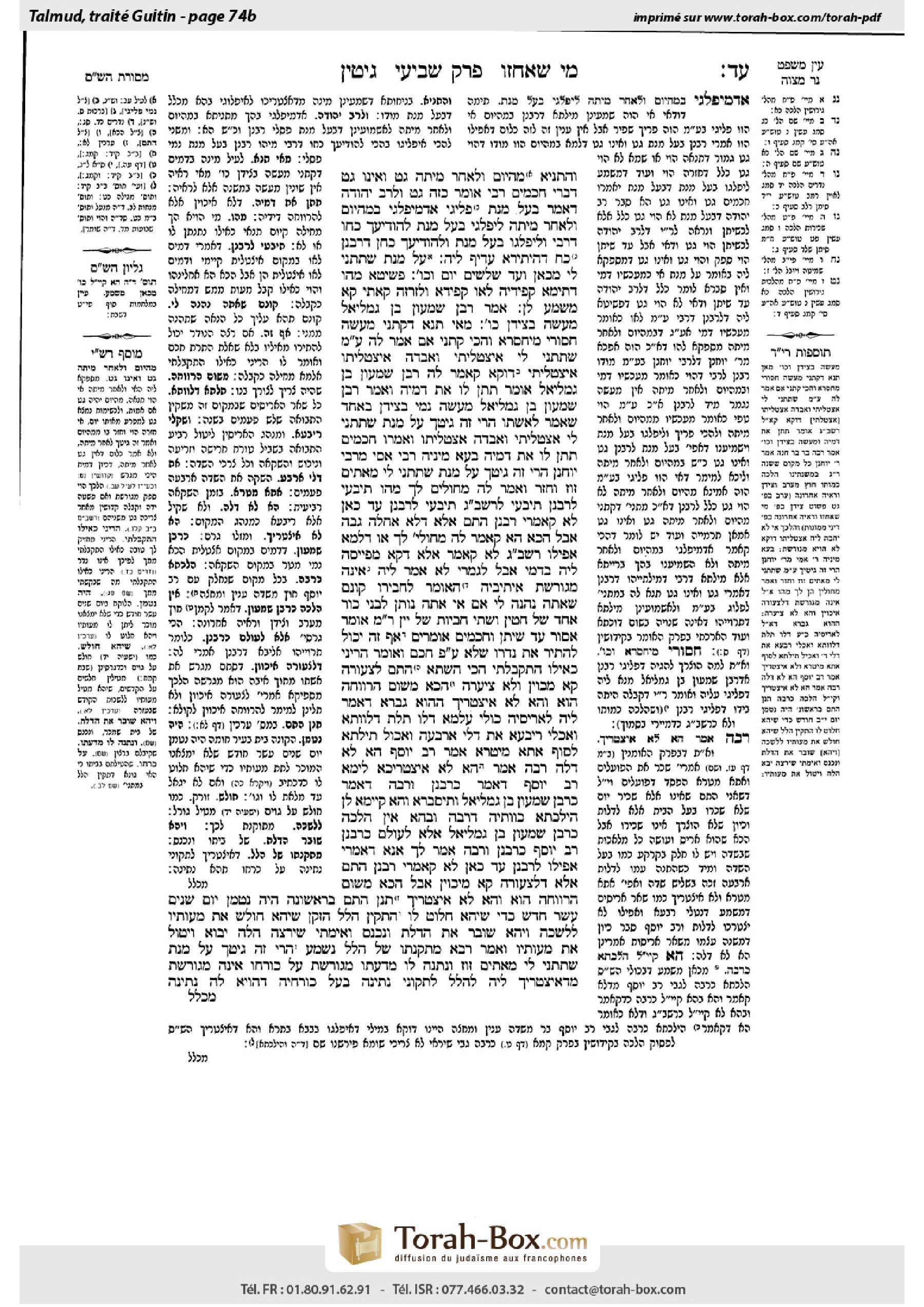
Gittin 74b: Talmud study for Daf Yomi
Study the Talmud for Daf Yomi with scanned pages, Hebrew text, English translations from Sefaria and AI-generated French translations.
Passage selection and English or AI-generated French translation are available where the scan has annotations. Daf Study is independent of Torah-Box and Sefaria.
Browse Gittin · גיטין · All tractatesGittin 74b text and translations
This page of Gittin includes the Aramaic text, an English translation and an AI-generated French translation, alongside the scan above.
גיטין ע״ד ב · Aramaic and Hebrew text
וְהָתַנְיָא: ״מֵהַיּוֹם וּלְאַחַר מִיתָה״ – גֵּט וְאֵינוֹ גֵּט, דִּבְרֵי חֲכָמִים; רַבִּי אוֹמֵר: כָּזֶה – גֵּט.
וּלְרַב יְהוּדָה – דְּאָמַר: בְּ״עַל מְנָת״ פְּלִיגִי, אַדְּמִיפַּלְגִי בְּ״מֵהַיּוֹם וּלְאַחַר מִיתָה״, (לִיפַּלְגִי) [לִיפַּלְגוּ] בְּ״עַל מְנָת״! לְהוֹדִיעֲךָ כֹּחוֹ דְּרַבִּי.
וְלִיפַּלְגוּ בְּ״עַל מְנָת״ – וּלְהוֹדִיעֲךָ כֹּחָן דְּרַבָּנַן! כֹּחַ דְּהֶיתֵּירָא עֲדִיף לֵיהּ.
״עַל מְנָת שֶׁתִּתְּנִי לִי מִכָּאן וְעַד שְׁלֹשִׁים יוֹם״ וְכוּ׳. פְּשִׁיטָא! מַהוּ דְּתֵימָא קְפִידֵיהּ לָאו קְפִידָא – וּלְזָרֹזַהּ קָאָתֵי; קָא מַשְׁמַע לַן.
אָמַר רַבָּן שִׁמְעוֹן בֶּן גַּמְלִיאֵל: מַעֲשֶׂה בְּצַיְדָּן כּוּ׳. מַאי תַּנָּא דְּקָתָנֵי מַעֲשֶׂה?
חַסּוֹרֵי מִיחַסְּרָא, וְהָכִי קָתָנֵי: אִם אָמַר לָהּ: ״עַל מְנָת שֶׁתִּתְּנִי לִי אִיצְטְלִיתִי״, וְאָבְדָה אִיצְטְלִיתוֹ – אִיצְטְלִיתִי דַּוְקָא קָאָמַר לַהּ. רַבָּן שִׁמְעוֹן בֶּן גַּמְלִיאֵל אוֹמֵר: תִּתֵּן לוֹ אֶת דָּמֶיהָ. וְאָמַר רַבָּן שִׁמְעוֹן בֶּן גַּמְלִיאֵל: מַעֲשֶׂה נָמֵי בְּצַיְדָּן, בְּאֶחָד שֶׁאָמַר לְאִשְׁתּוֹ: ״הֲרֵי זֶה גִּיטִּךְ עַל מְנָת שֶׁתִּתְּנִי לִי אִצְטְלִיתִי״, וְאָבְדָה אִצְטְלִיתוֹ, וְאָמְרוּ חֲכָמִים: תִּתֵּן לוֹ אֶת דָּמֶיהָ.
בְּעָא מִינֵּיהּ רַבִּי אַסִּי מֵרַבִּי יוֹחָנָן: ״הֲרֵי זֶה גִּיטִּךְ עַל מְנָת שֶׁתִּתְּנִי לִי מָאתַיִם זוּז״, וְחָזַר וְאָמַר לָהּ ״מְחוּלִים לָךְ״, מַהוּ?
תִּיבְּעֵי לְרַבָּנַן; תִּיבְּעֵי לְרַבָּן שִׁמְעוֹן בֶּן גַּמְלִיאֵל.
תִּיבְּעֵי לְרַבָּנַן – עַד כָּאן לָא קָאָמְרִי רַבָּנַן הָתָם, אֶלָּא דְּלָא אַחֲלַהּ גַּבָּהּ; אֲבָל הָכָא, הָא קָאָמַר לַהּ: ״מְחוּלִים לָךְ״; אוֹ דִלְמָא, אֲפִילּוּ רַבָּן שִׁמְעוֹן בֶּן גַּמְלִיאֵל לָא קָאָמַר, אֶלָּא דְּקָא מְפַיְּיסָה לֵיהּ בִּדְמֵי; אֲבָל לִגְמָרֵי – לָא. אֲמַר לֵיהּ: אֵינָהּ מְגוֹרֶשֶׁת.
אֵיתִיבֵיהּ: הָאוֹמֵר לַחֲבֵירוֹ: ״קֻוֽנָּם שֶׁאַתָּה נֶהֱנֶה לִי, אִם אִי אַתָּה נוֹתֵן לִבְנִי כּוֹר אֶחָד שֶׁל חִטִּין וּשְׁתֵּי חָבִיּוֹת שֶׁל יַיִן״, רַבִּי מֵאִיר אוֹמֵר: אָסוּר עַד שֶׁיִּתֵּן; וַחֲכָמִים אוֹמְרִים: אַף זֶה – יָכוֹל לְהַתִּיר אֶת נִדְרוֹ שֶׁלֹּא עַל פִּי חָכָם, וְאוֹמֵר: ״הֲרֵינִי כְּאִילּוּ הִתְקַבַּלְתִּי״!
הָכִי הַשְׁתָּא?! הָתָם לְצַעוֹרַהּ קָא מְכַוֵּין – וְלָא צַיעֲרַהּ. הָכָא מִשּׁוּם הַרְוָוחָה הוּא, וְהָא לָא אִיצְטְרִיךְ.
הָהוּא גַּבְרָא דַּאֲמַר לֵיהּ לַאֲרִיסֵיהּ: כּוּלֵּי עָלְמָא דְּלוּ תְּלָת דָּלָווֹתָא, וְאָכְלִי רִיבְעָא; אַתְּ דְּלִי אַרְבְּעָה, וֶאֱכוֹל תִּילְתָּא. לְסוֹף אֲתָא מִיטְרָא.
אָמַר רַב יוֹסֵף: הָא לָא דְּלָה. רַבָּה אָמַר: הָא לָא אִיצְטְרִיכָא.
לֵימָא רַב יוֹסֵף דְּאָמַר כְּרַבָּנַן, וְרַבָּה דְּאָמַר כְּרַבָּן שִׁמְעוֹן בֶּן גַּמְלִיאֵל?
וְתִיסְבְּרָא?! וְהָא קַיְימָא לַן הִילְכְתָא כְּווֹתֵיהּ דְּרַבָּה; וּבְהָא – אֵין הֲלָכָה כְּרַבָּן שִׁמְעוֹן בֶּן גַּמְלִיאֵל!
אֶלָּא לְעוֹלָם כְּרַבָּנַן. רַב יוֹסֵף – כְּרַבָּנַן; וְרַבָּה אָמַר לָךְ: אֲנָא דַּאֲמַרִי אֲפִילּוּ לְרַבָּנַן, עַד כָּאן לָא קָאָמְרִי רַבָּנַן הָתָם – אֶלָּא דִּלְצַעוֹרַהּ קָא מִיכַּוֵּין; אֲבָל הָכָא, מִשּׁוּם הַרְוָוחָה הוּא, וְהָא לָא אִיצְטְרִיךְ.
תְּנַן הָתָם: בָּרִאשׁוֹנָה הָיָה נִטְמָן יוֹם שְׁנֵים עָשָׂר חֹדֶשׁ, כְּדֵי שֶׁיְּהֵא חָלוּט לוֹ. הִתְקִין הִלֵּל הַזָּקֵן שֶׁיְּהֵא חוֹלֵשׁ אֶת מְעוֹתָיו לַלִּשְׁכָּה, וִיהֵא שׁוֹבֵר אֶת הַדֶּלֶת וְנִכְנָס. וְאֵימָתַי שֶׁיִּרְצֶה הַלָּה, יָבוֹא וְיִטּוֹל אֶת מְעוֹתָיו.
וְאָמַר רָבָא: מִתַּקָּנָתוֹ שֶׁל הִלֵּל נִשְׁמַע – ״הֲרֵי זֶה גִּיטִּיךְ עַל מְנָת שֶׁתִּתְּנִי לִי מָאתַיִם זוּז״, וְנָתְנָה לוֹ מִדַּעְתּוֹ, מְגוֹרֶשֶׁת; עַל כּוֹרְחוֹ, אֵינָהּ מְגוֹרֶשֶׁת –
מִדְּאִיצְטְרִיךְ לֵיהּ לְהִלֵּל לְתַקּוֹנֵי נְתִינָה בְּעַל כּוּרְחֵיהּ – דְּהָוְיָא לַהּ נְתִינָה,
Gittin 74b · English translation
And it is taught in a baraita: If a husband says to his wife: This is your bill of divorce from today and after my death, then this is both a valid bill of divorce and not a valid bill of divorce. This is the statement of the Rabbis. Rabbi Yehuda HaNasi disagrees and says: A case like this is a valid bill of divorce without any uncertainty. This teaches that Rabbi Yehuda HaNasi and the Rabbis disagree only in this case, but everyone agrees that when he employed the language: On the condition, it is as though he stipulated: From now.
The Gemara asks: And according to Rav Yehuda, who said that Rabbi Yehuda HaNasi and the Rabbis disagree about one who employs the language: On the condition, rather than disagreeing with regard to the case where the husband said: From today and after my death, let them disagree with regard to the case where the husband said: On the condition. The Gemara answers that the baraita uses this case to inform you about the far-reaching nature of the opinion of Rabbi Yehuda HaNasi, who is certain that the bill of divorce is valid.
The Gemara challenges: And let them disagree about: On the condition, to convey to you the far-reaching nature of the opinion of the Rabbis, who do not hold that the phrase: On the condition, is considered to be like the phrase: From now, as this ruling is a more general matter. The Gemara answers: It is preferable to emphasize the power of leniency, and therefore it is preferable to teach the degree to which Rabbi Yehuda HaNasi is lenient.
§ The mishna teaches: If a husband said to his wife: This is your bill of divorce on the condition that you will give me money from now until the conclusion of thirty days, if she gives the money to him within thirty days she is divorced, and if not she is not divorced. The Gemara asks: Isn’t that obvious, since everything depends on whether or not the condition was fulfilled? The Gemara answers: No, the halakha that the divorce does not take effect unless she gives the money by that time needs to be said, lest you say that the concern of the husband that his wife will give him the money within a specific time frame is not a real concern, and he comes only to galvanize her. Although he wishes to receive this money as soon as possible, in truth he does not care if he receives it later. Therefore, it teaches us that his statement is a valid condition, and if she does not fulfill it then it is not a valid bill of divorce.
§ The mishna teaches that Rabban Shimon ben Gamliel said: There was an incident in the city of Tzaidan involving one who said to his wife: This is your bill of divorce on the condition that you will give me my coat, and she lost his coat. And the Rabbis said that she should give him the value of that coat, and by doing so she fulfills the condition and is divorced. The Gemara asks: What did Rabban Shimon ben Gamliel teach before, such that he now teaches and cites an incident which is similar to it? This incident does not seem to be referring to what was stated immediately before in the mishna.
The Gemara answers: The mishna is incomplete and this is what it is teaching: If the husband said to his wife: This is your bill of divorce on the condition that you will give me my coat, and she lost his coat, then since he specifically stated to her: Give me my coat, she cannot give him its value instead. And since she has lost the coat, the bill of divorce is not valid; this is the opinion of the Rabbis. Rabban Shimon ben Gamliel says: In such a case she can give him its value. And Rabban Shimon ben Gamliel said in support of his statement: There was an incident also in the city of Tzaidan involving one who said to his wife: This is your bill of divorce on the condition that you will give me my coat, and she lost his coat. And the Rabbis said that she should give him its value.
Rabbi Asi raised a dilemma before Rabbi Yoḥanan: If a man says to his wife: This is your bill of divorce on the condition that you will give me two hundred dinars, and afterward he returned and said to her: It is waived for you, then what is the halakha?
He explained his question in detail: Let the dilemma be raised according to the opinion of the Rabbis, and let the dilemma be raised according to the opinion of Rabban Shimon ben Gamliel.
Let the dilemma be raised according to the opinion of the Rabbis: One can say that only there do the Rabbis state their opinion that she is not divorced if the condition is not fulfilled and she gives him his coat, because he did not waive his claim to it; but here he says to her: It is waived for you, so they are divorced. Or perhaps one can say that even Rabban Shimon ben Gamliel states that she can be divorced even if he does not receive the coat only there, as she appeases him by giving him money, i.e., the condition is considered to be fulfilled due to the fact that he received the value of the coat; but in a case where he waives the condition entirely, no, because he does not receive anything from her. Rabbi Yoḥanan said to him in response: She is not divorced, because the condition has not been fulfilled.
He raised an objection to his opinion from a mishna (Nedarim 63b): In the case of one who says to another: Benefiting from me is konam for you, meaning it is prohibited for you to derive benefit from me, if you do not give my son one kor of wheat and two barrels of wine as a wedding gift, Rabbi Meir says: It is prohibited for this other person to benefit from the person who took the vow until he gives his son the gift. And the Rabbis say: Even this individual who took the vow can dissolve his vow without the consent of a halakhic authority, and he does this by saying: I hereby consider it as though I have received the gift from you. Based on this mishna, it would seem that if the husband forgives his wife the money that she owes him, it should be considered as if he received it, and the bill of divorce should be valid.
The Gemara rejects this: How can these cases be compared? There, in the case of a bill of divorce, he intends to vex her, and until she pays him he did not vex her. If he forgives this condition, his initial intention has not been fulfilled. Here, in the case of the vow, the reason the father took the vow is for the sake of profit; he wants his son to receive a valuable gift, but subsequently the one who took the vow decides that it was not necessary. Therefore, he can waive his claim.
The Gemara relates an incident of a certain man who said to his sharecropper: Everyone waters the field three times during the season, and they consume, i.e., receive as payment, one quarter of the crops from the field. Will you water four times and consume as your payment one-third of the produce? Ultimately, rain came when the sharecropper would have needed to water a fourth time, and so he did not need to water the field a fourth time. The question was presented to the Sages: Is the sharecropper still entitled to receive one-third of the produce since he was prepared to water the field four times, although ultimately it was not necessary to do so?
Rav Yosef said: But he did not water the field a fourth time, so the condition was not fulfilled. Consequently, he deserves the same as the other sharecroppers, and receives only one quarter of the produce. Rabba said: But it was not necessary to water the field the fourth time because the rain fell to the benefit of the sharecropper, and therefore he should receive one-third of the produce.
The Gemara asks: Shall we say that Rav Yosef said his ruling in accordance with the opinion of the Rabbis, who require that the condition of the bill of divorce be fulfilled, and that Rabba said his ruling in accordance with the opinion of Rabban Shimon ben Gamliel, that it is not the fulfillment of the specifics of the condition that matter but the fulfillment of the intent of the condition?
The Gemara asks: And how can you understand it in this way? But don’t we maintain that in all of their disputes the halakha is in accordance with the opinion of Rabba when he disagrees with Rav Yosef? And with regard to this halakha we maintain that the halakha is not in accordance with the opinion of Rabban Shimon ben Gamliel. If so, this presents a contradiction between one halakha and another.
Rather, according to both opinions, this dispute is actually in accordance with the opinion of the Rabbis. Rav Yosef clearly rules in accordance with the Rabbis. And Rabba could have said to you: I was saying my statement even according to the opinion of the Rabbis, as the Rabbis are saying there that she is not divorced if she does not return the coat itself only when the husband intends to vex her, and if she does not need to give the coat itself she will not be vexed, as it is not difficult for her to give him its value. But here, in the case of watering the field, the reason the owner is making the condition is only for the sake of increasing his profit, and it was not necessary to actually water the field.
§ With regard to the redemption of houses in walled cities, we learned elsewhere in a mishna (Arakhin 31b) that if a house was sold and not redeemed by its owners within twelve months it remains permanently in the possession of the purchaser. The Gemara describes this: At first the purchaser would hide for all of the final day of the twelfth month so that the house would be confirmed as his (see Leviticus 25:29–30). Because the purchaser was in hiding, the seller would be unable to redeem the house from him. Hillel the Elder instituted an ordinance whereby the seller may deposit [ḥolesh] his redemption money in the Temple treasury chamber, and then he may break the door of his house and enter and take possession. And when that purchaser wishes, he should come and take his money from the Temple treasury.
And Rava says: From the ordinance of Hillel we learn that if one says to his wife: This is your bill of divorce on the condition that you will give me two hundred dinars, and she gave him the money with his consent, then she is divorced. If she gave it to him against his will then she is not divorced.
How does Rava prove this? From the fact that it was necessary for Hillel to institute a unique ordinance in the case of houses in walled cities whereby giving against the will of the receiver is considered giving.
Gittin 74b · Traduction française (IA)
Et il est enseigné dans une baraïta : Si un mari dit à sa femme : C'est ton acte de divorce d'aujourd'hui et après ma mort, alors c'est à la fois un acte de divorce valide et un acte de divorce non valide. C'est la déclaration des Rabbins. Rabbi Yehuda HaNasi désaccorde et dit : Un cas comme celui-ci est un acte de divorce valide sans aucune incertitude. Cela enseigne que Rabbi Yehuda HaNasi et les Rabbins ne s'entendent que dans ce cas, mais tous s'accordent sur le fait que lorsqu'il utilise la formule : Sur la condition, cela équivaut à stipuler : À partir de maintenant.
La Guemara pose la question : Et selon Rav Yehuda, qui dit que Rabbi Yehuda HaNasi et les Rabbins s'entendent sur celui qui utilise la formule : Sur la condition, plutôt que s'entendre sur le cas où le mari dit : D'aujourd'hui et après ma mort, plutôt s'entendre sur le cas où le mari dit : Sur la condition. La Guemara répond que la baraïta utilise ce cas pour vous informer de la portée de l'opinion de Rabbi Yehuda HaNasi, qui est certain que l'acte de divorce est valide.
La Guemara conteste : Et s'ils s'entendent sur : Sur la condition, pour vous faire comprendre la portée de l'opinion des Rabbins, qui ne considèrent pas que la formule : Sur la condition, équivaut à la formule : À partir de maintenant, comme cette décision est une question plus générale. La Guemara répond : Il est préférable de souligner la puissance de la leniency, et donc il est préférable d'enseigner le degré de leniency que Rabbi Yehuda HaNasi met en pratique.
§ La mitsna enseigne : Si un mari dit à sa femme : C'est ton acte de divorce sur la condition que tu me donnes de l'argent dès maintenant jusqu'à la fin des trente jours, si elle lui donne l'argent dans les trente jours, elle est divorcée, et si non, elle ne l'est pas. La Guemara pose la question : Ce n'est pas évident, puisque tout dépend de la réalisation ou non de la condition ? La Guemara répond : Non, la halakha selon laquelle le divorce ne prend effet que si elle lui donne l'argent à cette époque doit être dite, afin que vous ne disiez pas que l'inquiétude du mari que sa femme lui donne l'argent dans un délai spécifique n'est pas réelle, et qu'il vient seulement la stimuler. Bien qu'il veuille recevoir cet argent aussi tôt que possible, en réalité il n'a pas d'importance s'il le reçoit plus tard. Ainsi, cela nous enseigne que son déclaration est une condition valide, et si elle ne la réalise pas, alors l'acte de divorce n'est pas valide.
§ La mitsna enseigne que Rabban Shimon ben Gamliel a dit : Il y avait un incident dans la ville de Tzaidan concernant celui qui a dit à sa femme : C'est ton acte de divorce sur la condition que tu me donnes mon manteau, et elle a perdu son manteau. Et les Rabbins ont dit qu'elle devrait lui donner la valeur de ce manteau, et en le faisant, elle remplissait la condition et était divorcée. La Guemara pose la question : Qu'avait enseigné Rabban Shimon ben Gamliel avant, de sorte qu'il enseigne maintenant et cite un incident semblable ? Cet incident ne semble pas se référer à ce qui a été dit immédiatement avant dans la mitsna.
La Guemara répond : La Michna est incomplète et c'est ce qu'elle enseigne : Si le mari a dit à sa femme : C'est ton acte de divorce sur la condition que tu me donnes mon manteau, et elle a perdu son manteau, alors puisque il a spécifiquement dit à elle : Donne-moi mon manteau, elle ne peut pas lui donner la valeur au lieu de cela. Et puisque elle a perdu le manteau, l'acte de divorce n'est pas valide ; c'est l'opinion des Rabbins. Rabban Shimon ben Gamliel dit : Dans un tel cas, elle peut lui donner la valeur. Et Rabban Shimon ben Gamliel a soutenu son déclaration en disant : Il y avait aussi un incident dans la ville de Tzaidan concernant celui qui a dit à sa femme : C'est ton acte de divorce sur la condition que tu me donnes mon manteau, et elle a perdu son manteau. Et les Rabbins ont dit qu'elle devrait lui donner la valeur de ce manteau.
Rabbi Asi a soulevé un dilemme devant Rabbi Yoḥanan : Si un homme dit à sa femme : C'est ton acte de divorce sur la condition que tu me donnes deux cents dinars, et ensuite il revient et dit à elle : C'est annulé pour toi, alors quelle est la halakha ?
Il a expliqué sa question en détail : Que le dilemme soit soulevé selon l'opinion des Rabbins, et que le dilemme soit soulevé selon l'opinion de Rabban Shimon ben Gamliel.
Que le dilemme soit soulevé selon l'opinion des Rabbins : On peut dire que seulement là les Rabbins affirment leur opinion que la femme n'est pas divorcée si la condition n'est pas remplie et qu'elle lui donne son manteau, parce qu'il n'a pas annulé son droit à cela ; mais ici il dit à elle : C'est annulé pour toi, donc elles sont divorcées. Ou peut-être on peut dire que même Rabban Shimon ben Gamliel affirme que la femme peut être divorcée même s'il ne reçoit pas le manteau seulement là, car elle le calme en lui donnant de l'argent, c'est-à-dire que la condition est considérée comme remplie en raison du fait qu'il a reçu la valeur du manteau ; mais dans un cas où il annule la condition entièrement, non, parce qu'il ne reçoit rien d'elle. Rabbi Yoḥanan a répondu à lui en disant : Elle n'est pas divorcée, parce que la condition n'a pas été remplie.
Il a soulevé un contre-exemple à son opinion à partir d'une mitsna (Nedarim 63b) : Dans le cas d'une personne qui dit à une autre : Benefiter de moi est konam pour toi, c'est-à-dire il est interdit pour toi de tirer profit de moi, si tu ne donnes à mon fils un kor de blé et deux barils de vin en cadeau de mariage, Rabbi Meir dit : Il est interdit à cette autre personne de tirer profit de la personne qui a pris le serment jusqu'à ce qu'il donne à son fils le cadeau. Et les Rabbins disent : Même cette personne qui a pris le serment peut annuler son serment sans le consentement d'une autorité halakhique, et il le fait en disant : Je considère cela comme si j'avais reçu le cadeau de toi. Selon cette mitsna, il semble que si le mari annule la dette que la femme lui doit, cela devrait être considéré comme s'il l'avait reçu, et l'acte de divorce devrait être valide.
La Guemara rejette cette comparaison : comment peut-on comparer ces cas ? Là, dans le cas d'un acte de divorce, il a l'intention de tourmenter sa femme, et jusqu'à ce qu'elle lui paie, il ne l'avait pas tourmentée. Si il révoque cette condition, son intention initiale n'a pas été accomplie. Ici, dans le cas du vœu, la raison pour laquelle le père a pris le vœu est pour son profit ; il veut que son fils reçoive un cadeau précieux, mais ensuite celui qui a pris le vœu décide que cela n'était pas nécessaire. Ainsi, il peut renoncer à son droit.
La Guemara rapporte un incident concernant un certain homme qui a dit à son fermier : tout le monde arrose le champ trois fois durant la saison, et ils reçoivent, c'est-à-dire sont payés, un quart des récoltes du champ. Veux-tu arroser quatre fois et recevoir comme paiement un tiers des produits ? Finalement, la pluie est venue lorsque le fermier aurait eu besoin d'arroser une quatrième fois, et ainsi il n'avait pas besoin d'arroser le champ une quatrième fois. La question a été soumise aux Sages : le fermier est-il encore dû un tiers des produits puisqu'il était prêt à arroser le champ quatre fois, bien qu'ultimement cela n'ait pas été nécessaire ?
Rav Yosef a dit : mais il n'a pas arrosé le champ une quatrième fois, donc la condition n'a pas été remplie. Ainsi, il mérite la même chose que les autres fermiers, et reçoit seulement un quart des produits. Rabba a dit : mais il n'était pas nécessaire d'arroser le champ une quatrième fois car la pluie est tombée au bénéfice du fermier, et donc il devrait recevoir un tiers des produits.
La Guemara pose la question : devons-nous dire que Rav Yosef a rendu son verdict selon l'opinion des Sages, qui exigent que la condition de l'acte de divorce soit accomplie, et que Rabba a rendu son verdict selon l'opinion de Rabban Shimon ben Gamliel, qui considère que ce n'est pas la réalisation des détails de la condition qui compte, mais la réalisation de l'intention de la condition ?
La Guemara pose la question : et comment pouvez-vous comprendre cela ainsi ? Ne maintenons-nous pas que dans toutes leurs disputes, la halakha suit l'opinion de Rabba lorsqu'il s'oppose à Rav Yosef ? Et concernant cette halakha, nous maintenons que la halakha ne suit pas l'opinion de Rabban Shimon ben Gamliel. Si c'est le cas, cela présente une contradiction entre une halakha et une autre.
Plutôt, selon les deux opinions, ce débat suit effectivement l'opinion des Sages. Rav Yosef rend clairement son verdict selon l'opinion des Sages. Et Rabba aurait pu dire à vous : je disais mon opinion même selon l'opinion des Sages, car les Sages disent là que si elle ne rend pas le manteau lui-même, elle n'est pas divorcée seulement quand le mari a l'intention de la tourmenter, et si elle n'a pas besoin de lui rendre le manteau lui-même, elle ne sera pas tourmentée, car ce n'est pas difficile pour elle de lui donner sa valeur. Ici, dans le cas d'arroser le champ, la raison pour laquelle le propriétaire fait la condition est seulement pour le compte de son profit, et il n'était pas nécessaire d'arroser effectivement le champ.
§ Concernant le rachat des maisons dans les villes murées, nous avons appris ailleurs dans une mitsna (Arakhin 31b) que si une maison avait été vendue et n'avait pas été rachetée par ses propriétaires dans les douze mois, elle restait définitivement en possession de l'acheteur. La Guemara décrit cela : d'abord, l'acheteur se cachait pendant toute la dernière journée du douzième mois afin que la maison soit confirmée comme sienne (voir Lévitique 25:29–30). Parce que l'acheteur était en cachette, le vendeur ne pouvait pas racheter la maison. Hillel le Vieil a institué une ordonnance selon laquelle le vendeur pouvait déposer [ḥolesh] son argent de rachat dans la chambre du trésor du Temple, puis il pouvait briser la porte de sa maison et entrer et prendre possession. Et quand cet acheteur le souhaitait, il devait venir et récupérer son argent du trésor du Temple.
Et Rava dit : d'après l'ordonnance d'Hillel, nous apprenons que si l'on dit à sa femme : ceci est ton acte de divorce à la condition que tu me donnes deux cents dinars, et elle lui donne l'argent avec son accord, alors elle est divorcée. Si elle lui donne l'argent contre son gré, alors elle n'est pas divorcée.
Comment Rava prouve-t-il cela ? D'après le fait que cela était nécessaire pour Hillel d'instituer une ordonnance unique dans le cas des maisons dans les villes murées, où donner contre la volonté du receveur est considéré comme donner.
Traduction française générée par IA à partir de l’édition anglaise de Sefaria. Vérifie toujours un passage avec le texte source.
Text from Sefaria: William Davidson Edition - Vocalized Aramaic (CC BY NC); William Davidson Edition - English (CC BY NC).