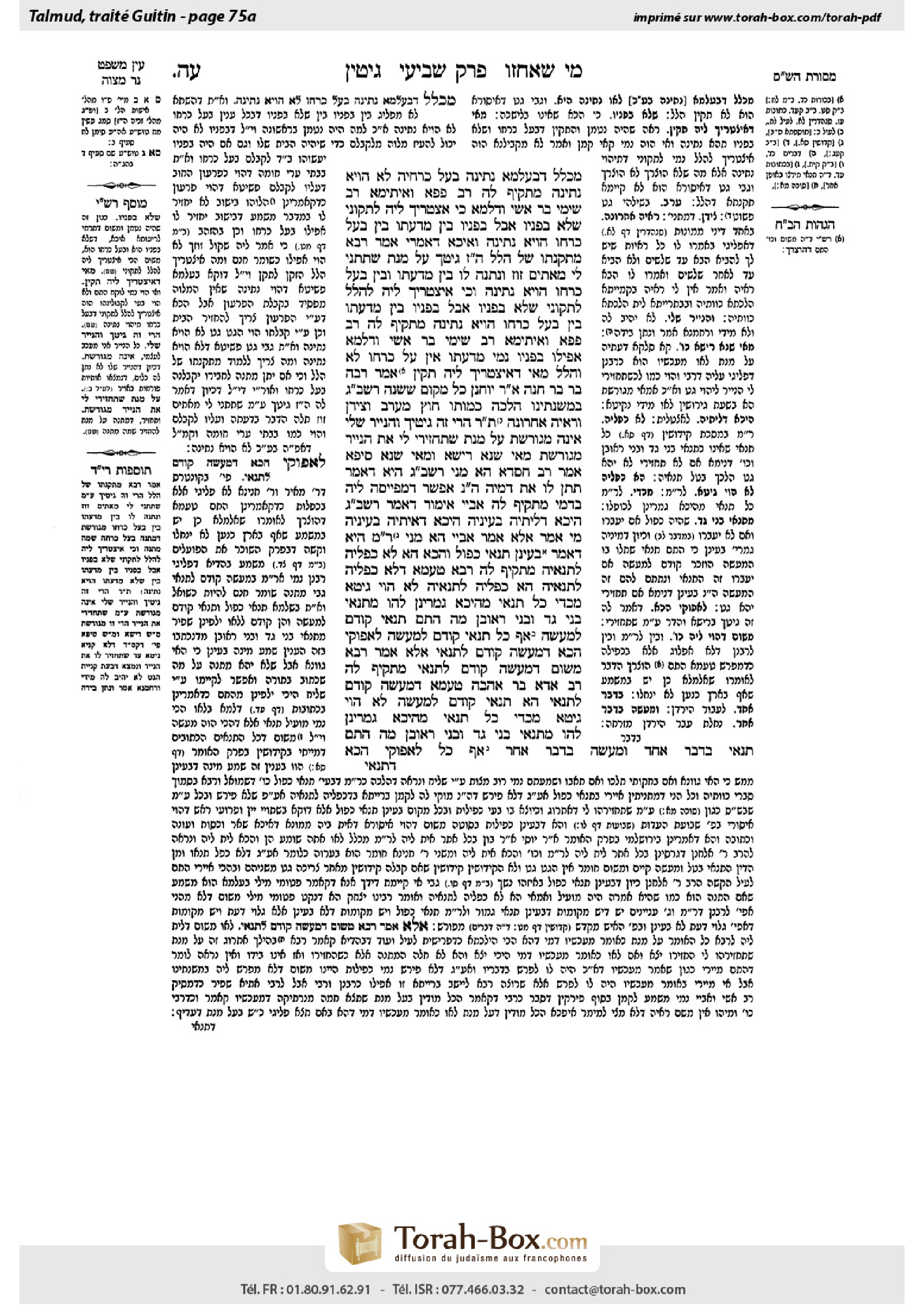
Gittin 75a: Talmud study for Daf Yomi
Study the Talmud for Daf Yomi with scanned pages, Hebrew text, English translations from Sefaria and AI-generated French translations.
Passage selection and English or AI-generated French translation are available where the scan has annotations. Daf Study is independent of Torah-Box and Sefaria.
Browse Gittin · גיטין · All tractatesGittin 75a text and translations
This page of Gittin includes the Aramaic text, an English translation and an AI-generated French translation, alongside the scan above.
גיטין ע״ה א · Aramaic and Hebrew text
מִכְּלָל דִּבְעָלְמָא, נְתִינָה בְּעַל כֻּרְחֵיהּ לָא הָוְיָא נְתִינָה.
מַתְקֵיף לַהּ רַב פָּפָּא, וְאִיתֵּימָא רַב שִׁימִי בַּר אָשֵׁי: וְדִלְמָא כִּי אִצְטְרִיךְ לֵיהּ לְתַקּוֹנֵי – שֶׁלֹּא בְּפָנָיו, אֲבָל בְּפָנָיו – בֵּין מִדַּעְתּוֹ בֵּין בְּעַל כׇּרְחוֹ הָוְיָא נְתִינָה!
וְאִיכָּא דְּאָמְרִי, אָמַר רָבָא: מִתַּקָּנָתוֹ שֶׁל הִלֵּל – ״הֲרֵי זֶה גִּיטֵּךְ עַל מְנָת שֶׁתִּתְּנִי לִי מָאתַיִם זוּז״, וּנְתָנָהּ לוֹ – בֵּין מִדַּעְתּוֹ וּבֵין בְּעַל כׇּרְחוֹ הָוְיָא נְתִינָה; וְכִי אִיצְטְרִיךְ לֵיהּ לְהִלֵּל לְתַקּוֹנֵי – שֶׁלֹּא בְּפָנָיו, אֲבָל בְּפָנָיו – בֵּין מִדַּעְתּוֹ בֵּין בְּעַל כׇּרְחוֹ הָוְיָא נְתִינָה.
מַתְקֵיף לַהּ רַב פָּפָּא, וְאִיתֵּימָא רַב שִׁימִי בַּר אָשֵׁי: וְדִלְמָא אֲפִילּוּ בְּפָנָיו נָמֵי – מִדַּעְתּוֹ אִין, עַל כׇּרְחוֹ לָא; וְהִלֵּל – מַאי דְּאִיצְטְרִיךְ לֵיהּ תַּקֵּין.
אָמַר רַבָּה בַּר בַּר חָנָה אָמַר רַבִּי יוֹחָנָן: כׇּל מָקוֹם שֶׁשָּׁנָה רַבָּן שִׁמְעוֹן בֶּן גַּמְלִיאֵל בְּמִשְׁנָתֵינוּ – הֲלָכָה כְּמוֹתוֹ; חוּץ מֵעָרֵב, וְצַיְדָן,
וּרְאָיָה אַחֲרוֹנָה.
תָּנוּ רַבָּנַן: ״הֲרֵי זֶה גִּיטִּיךְ, וְהַנְּיָיר שֶׁלִּי״ – אֵינָהּ מְגוֹרֶשֶׁת. ״עַל מְנָת שֶׁתַּחְזִירִי לִי אֶת הַנְּיָיר״ – מְגוֹרֶשֶׁת.
מַאי שְׁנָא רֵישָׁא וּמַאי שְׁנָא סֵיפָא? אָמַר רַב חִסְדָּא: הָא מַנִּי – רַבָּן שִׁמְעוֹן בֶּן גַּמְלִיאֵל הִיא, דְּאָמַר: תִּתֵּן לוֹ אֶת דָּמֶיהָ; הָכָא נָמֵי – אֶפְשָׁר דִּמְפַיְּיסָה לֵיהּ בִּדְמֵי.
מַתְקֵיף לַהּ אַבָּיֵי: אֵימוֹר דְּאָמַר רַבָּן שִׁמְעוֹן בֶּן גַּמְלִיאֵל – הֵיכָא דְּלֵיתֵיהּ בְּעֵינֵיהּ, הֵיכָא דְּאִיתֵיהּ בְּעֵינֵיהּ מִי אָמַר?!
אֶלָּא אָמַר אַבָּיֵי: הָא מַנִּי – רַבִּי מֵאִיר הִיא, דְּאָמַר: בָּעֵינַן תְּנַאי כָּפוּל; וְהָכָא – הָא לָא כַּפְלֵיהּ לִתְנָאֵיהּ.
מַתְקֵיף לַהּ רָבָא: טַעְמָא דְּלָא כַּפְלֵיהּ לִתְנָאֵיהּ, הָא כַּפְלֵיהּ לִתְנָאֵיהּ – לָא הָוֵי גִּיטָּא; מִכְּדֵי כֹּל תְּנָאֵי מֵהֵיכָא גָּמְרִינַן לְהוּ? מִתְּנַאי בְּנֵי גָּד וּבְנֵי רְאוּבֵן;
מָה הָתָם – תְּנַאי קוֹדֵם לְמַעֲשֶׂה, אַף כֹּל תְּנַאי קוֹדֵם לְמַעֲשֶׂה; לְאַפּוֹקֵי הָכָא – דְּמַעֲשֶׂה קוֹדֵם לִתְנַאי!
אֶלָּא אָמַר רָבָא: מִשּׁוּם דְּמַעֲשֶׂה קוֹדֵם לִתְנַאי.
מַתְקֵיף לַהּ רַב אַדָּא בַּר אַהֲבָה: טַעְמָא דְּמַעֲשֶׂה קוֹדֵם לִתְנַאי, הָא תְּנַאי קוֹדֵם לְמַעֲשֶׂה – לָא הָוֵי גִּיטָּא; מִכְּדֵי כֹּל תְּנָאֵי מֵהֵיכָא גָּמְרִינַן לְהוּ – מִתְּנַאי בְּנֵי גָּד וּבְנֵי רְאוּבֵן, מָה הָתָם – תְּנַאי בְּדָבָר אֶחָד וּמַעֲשֶׂה בְּדָבָר אַחֵר, אַף כֹּל; לְאַפּוֹקֵי הָכָא –
Gittin 75a · English translation
This proves by inference that generally, giving against the recipient’s will is not considered valid giving, as if it were, then Hillel would not have needed to institute this ordinance.
Rav Pappa objects to this, and some say it was Rav Shimi bar Ashi who raises this objection: And perhaps when it was necessary for Hillel to institute an ordinance allowing the seller to repay the money against the will of the purchaser it was specifically in a case where he gives the money not in the presence of the purchaser. But when he repays him in his presence, whether the recipient was willing or whether it was against his will, it is considered valid giving. Accordingly, one cannot apply Hillel’s ordinance to the case of conditional bills of divorce.
And there are those who say a different version of this discussion. Rava says: From the ordinance of Hillel it can be inferred that if one says to his wife: This is your bill of divorce on the condition that you will give me two hundred dinars, and she gave it to him, whether it was with his consent or whether it was against his will, it is valid giving. And the case where it was necessary for Hillel to institute his ordinance was when the giving of the money was not in his presence. But if the repayment was in his presence, whether it was with his consent or whether it was against his will, it is considered valid giving.
Rav Pappa objects to this, and some say it was Rav Shimi bar Ashi who raises this objection: And perhaps even in a case where she gives him the money in his presence, if she gives it with his consent, yes, it is valid. If she gives it against his will, no, it is not considered to be valid giving. And Hillel specifically instituted what was necessary, because in the case of a house in a walled city the purchaser would hide, and therefore that ordinance was necessary there.
§ Rabba bar bar Ḥana says that Rabbi Yoḥanan says: In every place where Rabban Shimon ben Gamliel taught a halakha in our body of Mishna, the halakha is in accordance with his opinion, even though it is cited as an individual opinion, except for three cases. With regard to the halakha of a guarantor (Bava Batra 173b), if the creditor stipulated that he can collect his debt from either the debtor or the guarantor, according to the Rabbis he can collect from the guarantor’s property even if the debtor has available property. Rabban Shimon ben Gamliel holds that the creditor can collect the debt only from the debtor. And likewise the halakha is not like Rabban Shimon ben Gamliel with regard to the case mentioned here concerning the incident that occurred in Tzaidan.
And similarly, the halakha is not in accordance with the opinion of Rabban Shimon ben Gamliel concerning the dispute with regard to evidence in the final disagreement (Sanhedrin 31a), where the Rabbis hold that if one claims that he has no evidence or witnesses, but subsequently brings evidence to court, the judges do not accept it. According to the opinion of Rabban Shimon ben Gamliel they can accept it.
§ The Sages taught in a baraita: If the husband said to his wife: Behold this is your bill of divorce, but the paper on which it is written is still mine, then she is not divorced, as he must give her the actual bill of divorce in order for the divorce to take effect. Since the paper still belongs to him, it is as if he had given her only the writing. But if he said to her: Behold this is your bill of divorce on the condition that you return the paper to me, then she is divorced. The bill of divorce belongs entirely to her, and the returning of the paper is only a stipulation that must be fulfilled later.
The Gemara asks: What is different in the first clause of the baraita and what is different in the latter clause? In neither case does she have ownership of the bill of divorce. Rav Ḥisda said: In accordance with whose opinion is this baraita? It is in accordance with the opinion of Rabban Shimon ben Gamliel, who says with regard to his coat that she can give him its value and does not need to give the item itself in order to fulfill the condition. Here also, since it is possible for her to appease him with money and she may give him the value of the paper, therefore it is considered as though she received the paper.
Abaye objects to this answer: Say that Rabban Shimon ben Gamliel says that it is acceptable to give the value instead of the item itself when the item is not extant, because it is lost. But in a case where it is extant, such as the paper in this case, did Rabban Shimon ben Gamliel actually say that giving the value of the item is sufficient?
Rather, Abaye said: In accordance with whose opinion is this baraita? It is in accordance with the opinion of Rabbi Meir, who says: We require any stipulated condition to be structured as a compound condition describing both outcomes, meaning that the condition must mention what will happen both if the condition is fulfilled and if it is not fulfilled. And here he did not compound his condition. The husband said only: This is your bill of divorce on the condition that you return the paper to me. He did not specify that it will not be a valid bill of divorce if she does not return it.
Rava objects to this explanation: According to Abaye the reason the bill of divorce is valid is that the husband did not compound his condition, but if the husband did compound his condition then it would not be a valid bill of divorce. Now, from where do we learn the halakhot of all conditions? They are derived from the condition of the children of Gad and the children of Reuben. Moses stipulated with them that if they fight the battles with the Jewish people in Eretz Yisrael, they will inherit the land of Gilead in the Transjordan, as they requested; but if they do not fight the battles with the Jewish people in Eretz Yisrael, they will not inherit that land (see Numbers, chapter 32).
Just as there, in the conditions that Moses made, the language of the condition precedes the consequent action, for he first stated the condition and afterward he described the result if they fulfill the condition: “And you shall give them the land of Gilead as an inheritance” (Numbers 32:29), so too, any condition is valid only when it is stated before the resultant action. And this serves to exclude the case mentioned here, where the resultant action of the giving of the bill of divorce precedes the condition. Consequently, according to Rabbi Meir this bill of divorce would not be valid, even if the husband had compounded the condition.
Rather, Rava said: The condition does not apply and the woman is divorced because the action of giving the bill of divorce precedes the condition.
Rav Adda bar Ahava objects to this explanation: The reason that the bill of divorce is valid is that the action precedes the condition, and the condition does not take effect. But if the condition were to precede the action then it would not be a valid bill of divorce. Now, from where do we learn all the halakhot of conditions? They are derived from the condition of the children of Gad and the children of Reuben. Just as there it is a condition with regard to one matter, i.e., that they should fight along with the rest of the Jewish people, and a resultant action with regard to another matter, i.e., that they would receive the land of Gilead, so too, every other condition must follow this pattern. This serves to exclude the case mentioned here,
Gittin 75a · Traduction française (IA)
Cela prouve par déduction que généralement, donner contre la volonté du destinataire n'est pas considéré comme un don valide, car si c'était le cas, Hillel n'aurait pas eu besoin d'instaurer cette ordonnance.
Rav Pappa s'oppose à cela, et certains disent que c'est Rav Shimi bar Ashi qui a soulevé cet objection : Et peut-être que lorsque Hillel a eu besoin d'instaurer une ordonnance permettant au vendeur de rembourser l'argent contre la volonté de l'acheteur, c'était spécifiquement dans un cas où il donnait l'argent sans la présence de l'acheteur. Mais lorsque le remboursement a lieu en sa présence, qu'il soit volontaire ou non, cela est considéré comme un don valide. Ainsi, on ne peut pas appliquer l'ordonnance d'Hillel au cas des lettres de divorce conditionnelles.
Et certains disent une version différente de cette discussion. Rava dit : On peut déduire de l'ordonnance d'Hillel que si l'on dit à sa femme : C'est votre lettre de divorce à la condition que vous me donniez deux cents drachmes, et qu'elle le donne, qu'elle le fasse avec son consentement ou non, cela est considéré comme un don valide. Et le cas où il a été nécessaire d'instaurer cette ordonnance d'Hillel était lorsque la remise de l'argent n'était pas en sa présence. Mais si le remboursement a lieu en sa présence, qu'il soit volontaire ou non, cela est considéré comme un don valide.
Rav Pappa s'oppose à cela, et certains disent que c'est Rav Shimi bar Ashi qui a soulevé cette objection : Et peut-être même dans le cas où elle lui donne l'argent en sa présence, si elle le fait avec son consentement, oui, cela est valide. Si elle le fait contre sa volonté, non, cela n'est pas considéré comme un don valide. Et Hillel a spécifiquement institué ce qui était nécessaire, car dans le cas d'une maison d'une ville murée, l'acheteur se cachait, et donc cette ordonnance était nécessaire là.
§ Rabba bar bar Ḥana dit que Rabbi Yoḥanan dit : Dans tout lieu où Rabban Shimon ben Gamliel a enseigné une halakha dans notre Michna, la halakha suit son opinion, même si elle est citée comme une opinion individuelle, à l'exception de trois cas. Concernant la halakha du garant (Bava Batra 173b), si le créancier stipule qu'il peut récupérer sa dette soit auprès du débiteur soit auprès du garant, selon les Rabbins, il peut récupérer la dette auprès des biens du garant même si le débiteur a des biens disponibles. Rabban Shimon ben Gamliel affirme que le créancier peut récupérer la dette uniquement auprès du débiteur. De même, la halakha ne suit pas Rabban Shimon ben Gamliel concernant le cas mentionné ici concernant l'incident survenu à Tzaidan.
Et de même, la halakha ne suit pas l'opinion de Rabban Shimon ben Gamliel concernant le débat concernant les preuves dans le dernier désaccord (Sanhedrin 31a), où les Rabbins affirment que si l'on affirme n'avoir aucun témoignage ou preuve, mais qu'ensuite on apporte des preuves devant le tribunal, les juges ne les acceptent pas. Selon l'opinion de Rabban Shimon ben Gamliel, ils pourraient les accepter.
§ Les Sages ont enseigné dans une baraïta : Si le mari dit à sa femme : Voici votre lettre de divorce, mais le papier sur lequel elle est écrite est encore à moi, alors elle n'est pas divorcée, car il faut qu'il lui donne la lettre de divorce elle-même pour que le divorce prenne effet. Puisque le papier lui appartient encore, c'est comme s'il lui avait donné seulement l'écriture. Mais s'il dit à elle : Voici votre lettre de divorce à la condition que vous me rendiez le papier, alors elle est divorcée. La lettre de divorce appartient entièrement à elle, et le rendement du papier est seulement une stipulation à remplir ultérieurement.
La Guemara pose la question : Qu'est-ce qui diffère dans la première partie de la baraïta et dans la seconde partie ? Dans aucun cas la femme ne possède la lettre de divorce. Rav Ḥisda a dit : Selon quel avis est cette baraïta ? Selon l'avis de Rabban Shimon ben Gamliel, qui dit concernant sa veste qu'elle peut lui donner sa valeur et n'a pas besoin de lui donner l'objet lui-même pour remplir la condition. Ici aussi, puisqu'elle peut apaiser lui avec de l'argent et qu'elle peut lui donner la valeur du papier, cela est considéré comme si elle avait reçu le papier.
Abaye s'oppose à cette réponse : Dis que Rabban Shimon ben Gamliel dit que donner la valeur à la place de l'objet est acceptable lorsque l'objet n'existe pas, car il est perdu. Mais dans le cas où l'objet existe, comme c'est le cas ici, Rabban Shimon ben Gamliel a-t-il vraiment dit que donner la valeur de l'objet suffisait ?
Plutôt, Abaye a dit : Selon quel avis est cette baraïta ? Selon l'avis de Rabbi Meir, qui dit : Nous exigeons que toute condition stipulée soit structurée comme une condition composée décrivant les deux résultats, c'est-à-dire que la condition doit mentionner ce qui arrivera à la fois si la condition est remplie et si elle ne l'est pas. Et ici, il n'a pas composé sa condition. Le mari a dit seulement : C'est votre lettre de divorce à la condition que vous me rendiez le papier. Il n'a pas spécifié que ce ne serait pas une lettre de divorce valide si elle ne le rendait pas.
Rava s'oppose à cette explication : Selon Abaye, la raison pour laquelle la lettre de divorce est valide est que le mari n'a pas composé sa condition, mais si le mari avait composé sa condition, alors la lettre de divorce ne serait pas valide. Maintenant, d'où apprenons-nous les halakhot de toutes les conditions ? Elles sont déduites de la condition des enfants de Gad et des enfants de Rouben. Moïse a stipulé avec eux que s'ils combattaient les batailles avec le peuple juif en Terre d'Israël, ils hériteraient la terre de Gilead en Transjordanie, comme ils le demandaient ; mais s'ils ne combattaient pas les batailles avec le peuple juif en Terre d'Israël, ils ne hériteraient pas cette terre (voir Nombres, chapitre 32).
Comme là, dans les conditions que Moïse a établies, la formulation de la condition précède l'action conséquente, car il a d'abord énoncé la condition et ensuite décrit le résultat si elle est accomplie : « Et vous donnerez à eux la terre de Gilead en héritage » (Nombres 32:29), de même, toute condition est valide uniquement lorsqu'elle est énoncée avant l'action conséquente. Et cela sert à exclure le cas mentionné ici, où l'action conséquente de la remise du parchemin de divorce précède la condition. Ainsi, selon Rabbi Meïr, ce parchemin de divorce ne serait pas valide, même si le mari avait formulé la condition.
Au contraire, Rava a dit : La condition ne s'applique pas et la femme est divorcée car l'action de la remise du parchemin de divorce précède la condition.
Rav Adda bar Ahava s'oppose à cette explication : La raison pour laquelle le parchemin de divorce est valide est que l'action précède la condition, et la condition ne prend effet. Mais si la condition avait précédé l'action, ce n'aurait pas été un parchemin de divorce valide. Maintenant, d'où tirons-nous toutes les halakhot des conditions ? Elles sont tirées de la condition des fils de Gad et des fils de Rouben. Comme là, il s'agit d'une condition concernant une seule chose, à savoir qu'ils devaient combattre avec le reste du peuple juif, et d'une action conséquente concernant une autre chose, à savoir qu'ils recevraient la terre de Gilead, de même, toute autre condition doit suivre ce modèle. Cela sert à exclure le cas mentionné ici,
Traduction française générée par IA à partir de l’édition anglaise de Sefaria. Vérifie toujours un passage avec le texte source.
Text from Sefaria: William Davidson Edition - Vocalized Aramaic (CC BY NC); William Davidson Edition - English (CC BY NC).